Apocalypse
What happened on (and after) Oct. 7, 2023.
There is no need to remember what happened on Oct. 7, 2023,
except as a turning point. If you are an "eye for an eye" sort of
person, you should realize that number of Israelis killed came
nowhere near balancing the books of the past 80 years, and that
within a day or two, Israel had already taken its revenge, and
then some. Had Israel just thrown its tantrum and killed
indiscriminately for a week or month, we would have quickly
forgotten it, figuring it just another example of the
disproportionate collective punishment they have meted out
regularly for decades on end.
But Netanyahu didn't stop, nor did Biden make any serious effort
to rein Israel in — as previous American presidents had done
so regularly Israeli politicians never had to learn to discipline
themselves. The result had all the signs of genocide, although
what Israel was doing was consistent with what they've been doing
for decades, so only the speed and intensity has changed. Arguably
the speed and intensity have slowed down since the phony ceasefire
of last November, but the policies remain consistent with the
oft-stated intentions of many Israeli politicians: of transferring
all Palestinians out of the country, dead or alive. Sometimes
genocide is less a statistic than simply a frame of mind.
◆ ◆ ◆
I wrote
Arafat and Abbas on Violence back on June 25, which was largely
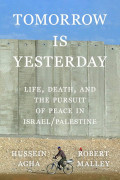
based on quotes from Hussein Agha and Rob Malley's book, Tomorrow
Is Yesterday (2025, Farrar Straus and Giroux). At the time, I
mentioned that I wanted to write a second piece, based on another
quote, where they write about "the events of October 7, 2023."
Three years after those "events" is as good a time as any. What
follows is a long quote, starting on p. 155, with some notes.
The events of October 7, 2023, had three distinctive features. They
could have been prevented. They were not out of the ordinary. And they
did not go as planned.
The following quotes explain the first point, and subsequent pages
expand on the other points. They're solid, and sobering, as far as
they go. But they focus on what is familiar and expected, and not
what was distinct about these particular events.
Had it not been for Israel's massive lapse in security preparedness,
the massacre almost certainly would have been averted. Israel's
failure reflected complacency born of hubris, the disdain with which
occupiers view the occupied. It was the product of nearly two decades
of successfully containing Hamas through economic pressure, physical
isolation, and, in response to Palestinian violence, minimal
concessions coupled with punishing blows. Israel had been more
concerned with what it considered more serious opponents: Hezbollah
and Iran, both of which it meticulously tracked and carefully
infiltrated, as the two would discover when Israel turned its fire on
them.
Israel's lapses were also political. Israelis and Palestinians with
direct access to Netanyahu and Yahya Sinwar, elected leader of Hamas
in Gaza in 2017, met in private meetings as early as that year and
did so until shortly before October 7. Earnest or feigning
earnestness, the two sides traded concrete suggestions to ensure
longer-term stability, allow Gazans to breathe more easily, and help
Israelis to feel more secure. In the months before October 7, Hamas's
latest proposal was for a truce: quiet in return for steps that would
enable a functioning Palestinian government in Gaza, freedom of
movement through Egypt, a port to ship goods out, a license to import
a greater number of essential ones. In the end, Hamas's seriousness
was never put to the test, as Israel pondered, wavered, balked. If
Sinwar's indirect involvement in the talks was clear, the question of
who was behind the Israeli participants was in doubt. The answer
endlessly shifted from the prime minister's office to the IDF and to
the Shin Bet, which led Hamas to conclude that the Israelis were just
stringing them along. However close Israeli governments came to
signing off, they recoiled at the thought that any such deal would
empower a party still intent on the Jewish state's liquidation. At
times Israelis sought to accommodate Hamas. At others they sought to
subdue it. They could never make up their minds.
Israel ultimately shunned the possibility of a broader
understanding with Hamas because it concluded a redirection from the
path it had taken was unnecessary and possibly dangerous; the existing
reality appeared less hazardous than the alternative. Accustomed to
the way things were, Israelis assumed Hamas was as well. They saw no
reason why Hamas might change its behavior, and were caught
flat-footed when it did. That Israeli policymakers missed the
evolution in Hamas's thinking is puzzling. Few societies have been
more thoroughly penetrated and surveiled than Gaza. Israel had eyes
and ears fixated on the Strip and on the handful of leaders whose
decisions shaped its fate. It pored through reams of intelligence
reports. Even as evidence of Hamas's preparations accumulated,
however, Israelis were taken by surprise, unable to reconcile the
reality of a movement that wished to govern with that of a movement
that was willing to throw it all away. Many things can be blamed for
their astonishing blunder. Lack of information is not one of them. It
was as if they craved knowledge that, once in their possession, they
refused to believe.
Israel had all the data and did not know what to make of it. The
conclusion many of them drew from the October 7 assault — that
it revealed Hamas's true, unchanging, fanatical, messianic identity
— has it backwards and exposes this confusion. When Hamas held
fire for the sake of governance, its religious roots were in
evidence. When, persuaded that successful governance was out of reach,
it took the fight to Israel, its Palestinian identity took over. The
transition from trying to govern to blowing everything up seems
brutal, as if the two were consistent with Hamas's dual religious and
political orientations and with the fundamental project they
served. Israel could not affect Hamas's ultimate, sacred goals: to
oversee its own society and eliminate the Jewish state. It could,
through its actions, influence how Hamas behaved in the interim, which
side of its everyday activities it chose to emphasize, and how quickly
it moved from one to the other.
The lack of recriminations for the security lapses of October 7
stands in marked contrast to the joint Egyptian-Syrian attack in
1973, which cost the job of Moshe Dayan, until then the hero of the
1967 war. The big difference this time is that the 1973 war led to
a brokered ceasefire in less than a month. This time, Netanyahu has
managed to extend the war beyond three years, postponing any day of
reckoning. While this has emerged
as an issue in the upcoming election, its effect is muted compared
to what it would have been in the moment.
Picking up on p. 162:
October 7 stands out not because it was novel but because of what it
accomplished, which was almost certainly beyond Hamas's expectations,
plans, or ambitions. Its outcome was unparalleled in part because
Hamas proved far more organized and meticulous than any of its
forebears, but chiefly because Israel had fallen asleep. It was
unprecedented due not to its nature but to its scale, which vastly
surpassed that of any other similar operation. . . .
From 1948 onward, Israel has been no stranger to acts of
destruction, displacement, and dispossession, attempts to erase traces
of Palestinian presence where that presence had come to be viewed or
designated as a threat to Israel's existence. Sites of Israeli
massacres, forever etched in Palestinian consciousness: Deir Yassin,
[Abu Shusha, Tantura, Lydda, Al Dawayima (all in 1948), Qibya (1953),
Kafr Qasim (1956), . . . ].
Hamas's onslaught and Israel's war of destruction were not one-offs
or historical exceptions. They were historical re-enactments. They
made quick work of years of a peace process that had become a sore
farce. They reached deep into each side's collective memories and then
let loose their most abiding emotions. Hamas did not invent anything;
it reclaimed a Palestinian past. Israel's reaction was not unusual
either, rather a concentrated, magnified version of a long Zionist
tradition of how to deal with the land's Arab inhabitants. . . .
Residents of southern Israel paid for all the pain and humiliation
Palestinians had suffered at Israeli hands. The people of Gaza paid
not only for Hamas's actions but for Nazi crimes as well. History
does not move forward. It slips sideways. And, in the darkest of
ways, repeats itself.
Still, this understates the scale of the October 7 outbreak.
Sure, there have been isolated instances of Palestinians entering
Israel and killing or capturing hostages, especially before 1967,
but never on this scale. Moreover, Israel's reaction was scaled
up even more. Since the closing of Gaza in 2005, Israel has
reacted hysterically (and disproportionately) to every toy rocket
attack. When Netanyahu did the same this time, he was following
business-as-usual standards. What was different this time wasn't
the savage, disproportionate response, but that it never stopped.
I think you have to blame Biden for that. It never occurred to him
to temper Netanyahu's worst instincts — as most American
presidents, from Eisenhower to Obama, had regularly done to pull
Israel back from the brink.
Moving on to p. 169:
The Hamas leaders who planned October 7 nurtured more ambitious
expectations. Unable to govern and increasingly at the mercy of
domestic detractors, they wanted to show Israel the cost of the
status quo and the price of besieging Gaza; remind the world of the
Palestinian cause at a time of drifting attention; hinder Arab-Israeli
normalization; score political points against Fatah, the PA, and
Abbas; and grab the mantle of leadership of the Palestinian
movement. They may well have had even grander hopes, such as to unleash
a broader confrontation, igniting the West Bank and sparking a
regional war with others joining the fray, ensuring Hamas would not
bear the brunt of Israel's retaliation alone. But such broader
aspirations were hardly unique to October 7 and do not warrant the
reassessment of Sinwar from somewhat pragmatic to wholly messianic,
or viewing his actions as having moved from the political to the
eschatological. Neither Hamas nor Sinwar launched the operation
because they believed it would immediately liberate Palestine or
destroy Israel, any more than earlier generations of Palestinian
militants had engage din acts of violence harboring that expectation. . . .
October 7 defied many of those precedents by succeeding beyond its
planners' anticipation. They could not have imagined so thin an
Israeli resistance, so easy a foray into enemy territory, so many
Israeli victims and hostages. The upshot was unparalleled worldwide
attention to the question of Palestine and unparalleled anti-Israeli
mobilization. Soon enough, it triggered tension in the US-Israeli
relationship, demonstrations on university campuses, and calls for
legal accountability from the International Criminal Court. . . .
The precise date was no coincidence either — the fiftieth
anniversary of the start of the Yom Kippur War, a
joint-Egyptian/Syrian military attack that stunned and shocked a
slumbering Israel. But much of what happened on October 7 was
unforeseen and unscripted. . . . The tide would shift, and then shift
again. Hamas's central hope, and only certainty, was that Israel cared
for its hostages and would not leave them behind. Sinwar counted on a
spectacular prisoner exchange that would make up for whatever calamity
befell Gaza and make his gamble worthwhile, but the gamble fell
short. Netanyahu resisted domestic and international pressure and
stood firm, leaving many Israeli hostages to their tragic fate. Little
by little, Israel recovered, exhibited superior strength and
formidable military might, exacted revenge on all who stood in its way
and a vast number who did not — a demonstration of overwhelming
and devastating power. If Israel paid a price, many others would pay
too, far more painfully. Gaza suffered most, bombed to a heap of dust,
death, and destruction. When Israel turned its sights on Lebanon and
Iran, it settled other scores. October 7 exposed Israel's weakness;
with its response, Israel set out on a path to reassert its strength.
And also to demonstrate its scorn and contempt for the world, its
belief that power is the only thing that matters, regardless of how
repulsively it is wielded, with so little concern for the lives of
others. They may well continue to get away with it, at least as long
as cynics like Netanyahu can pull the strings of fools like Trump,
but how long can that last until the insults and injuries start to
add up? The problem is not just that Israel will come to be seen as
a pariah state. It is also that Israel will eventually divide into
two camps: those with no sense of their own monstrosity, and those
ashamed to have been led into such dehumanizing war.
I've been writing a piece which expresses considerable doubt
about the ability of international law to cope with outlaw states
like Israel (and, even more so, the US), but I have to admit that
it is heartening that the ICJ judge who chaired the UN commission
that concluded Israel was guilty of genocide in Gaza, Navi Pillay,
has won the
Nobel Peace Prize. It should also open some eyes that Trump's
immediate response has been to
impose sanctions on ICC.
|