Blog Entries [30 - 39]Saturday, March 14, 2026
Music Week
March archive
(in progress).
Music: Current count 45655 [45603] rated (+52), 39 [11] unrated (+28).
This is indeed the first Music Week of March. I've been slow all
year, and I'm not very optimistic about ever catching up, but I do
keep plugging away at it. Last
Music Week
actually appeared around March 2, but was backdated to February 28,
which was a fairly honest cutoff date. I had been held back trying
to wrap up an overgrown and unruly
Loose Tabs,
which barely made it just before Trump's decapitation strike against
Iran, and then got sidelined by a minor illness. The squeeze kept
me from sending anything to my Substack newsletter,
Notes on Everyday Life, although I had a draft piece on comfort
cooking in the works, and several more ideas.
Those all got shelved by the Iran war. I was shocked and appalled
the moment I heard the news, although the shock wore off as soon as
I replaced the initial hypothetical (why would any rational leader
do something as obviously stupid and counterproductive?) with the
names of the actual leaders: Trump and Netanyahu. It's not that they
are incapable of reason, although each is trapped in his own matrix
of myths (some self-generated, especially for the exceptionally vain
and gullible Trump), but their judgment is perverted by enchantment
with power and a genuine lack of care for their victims, let alone
any longer-term consequences.
I felt the need to write something, if only to clarify my own
thoughts. I remembered what I had written on
March 18, 2003, the day after Bush started his full-scale war on
Iraq. I started out:
Yesterday, March 17, 2003, is another date that will live in
infamy. On this date, U.S. President George W. Bush rejected the
efforts and council of the United Nations, and the expressed concerns
of overwhelming numbers of people throughout the U.S. and all around
the world, and committed the U.S. to attack, invade, and occupy Iraq,
to prosecute or kill Iraq's government leaders, and to install a new
government favorable to U.S. interests.
At the time, the effort to sell Americans on the war didn't seem
remarkable: it had started with the neocon
Project for the New American Century in 1997, and went into hard
sell, no-lie-left-unturned mode in September 2002. In the end, it's
fair to say that the snow job failed, with Bush arbitrarily starting
the war and palming it off as fait accompli (PR, much like his later
"mission accomplished" moment). But as I started thinking about the
"day of infamy" quote, it occurred to me that the word belonged more
to the ones attacked. A more accurate word for the attackers would be
"ignominy": the dictionary starts with "deep personal humiliation,
public shame, or total disgrace," then adds "dishonorable actions
or loss of reputation." While both wars started in fits of arrogance,
Trump's is unique in his disregard for any sense of democracy. I'm
not much impressed by Democrats who would like to support this war
but who balk on procedural grounds, but they do have a point: this
is not just a war against Iran, but one against whatever's left of
democracy in America. It seeks not just to engage in war, but to
deprive the people of any say in when or why the US goes to war.
And while Democrats have often contributed to exalting presidential
power — e.g., Obama's bombing of Libya and Syria — this
time it feels different, because Trump's ambitions are domestic as
much as foreign.
The rest of the Iraq war posts are interesting enough I'm tempted
to dust them off as a "Big Lookback." On
March 25, 2003,
one week after the war started in earnest, I wrote:
The war grinds on. The fantasy that expected the Iraqis to roll out
the red carpet for their American liberators has been dashed. Nobody
expects that Iraq will be able to repulse the U.S. invasion, but the
level and form of resistance pretty much guarantees that eventually
the U.S. will leave Iraq without having accomplished anything more
notable than the perverse satisfaction of serving up Saddam's head on
some platter.
As I said earlier, the level of resistance will be telling. If you
want a rule of thumb for neocolonialist wars of occupation, it's that
once you can't tell your friends from your enemies in the native
population, you're fucked. At its simplest level, that's because the
occupiers get nervous and make mistakes. The mistakes, in turn,
compound, pushing more and more people from the friendly side to the
hostile side. That in turn reinforces the nervousness, the mistakes,
the alienation. In turn, the resistance gets bolder; as this happens,
the occupation digs in, becoming more brutal, vicious, capricious. The
high-minded rhetoric is exposed as pure hypocrisy, and the occupation
becomes more nakedly about nothing more than power. Such wars become
vastly unpopular, and eventually the occupier has to cut their losses
and go home. This is pretty much what happened in Vietnam, and we're
going to be hearing a lot more about the similarity as this war bogs
down. . . .
So, let's face it, the U.S. war against Iraq is a colossal failure.
The only question remaining is how long it will take the U.S. to give
up and get out, and how much destruction the U.S. will leave in its
wake. So remember this: This war did not have to happen.
I also wrote this on
April 11, 2003:
There was a period back in the Afghanistan war when the Northern
Alliance started reeling off a quick series of victories — not
so much that they were defeating the Taliban in confrontations as that
the Taliban was high-tailing it out of the cities, allowing Herat,
Kabul, and Kandahar to fall in quick succession. The hawks then made
haste to trumpet their victory and to dump on anyone who had doubted
the US in this war. Back then, I referred to those few weeks as "the
feel good days of the war." Well, we had something like that in Iraq,
too, except that use of the plural now seems unwarranted. So mark it
on your calendar, Wednesday, April 9, 2003, was the feel good day of
the Iraq war.
I mentioned the looting, the killing of shi'ite collaborators, and
mob reprisals against Ba'ath leaders. I could have mentioned Rumsfeld's
blasé "stuff happens" quote. I ended with "So happy last Wednesday.
That's very likely to be the last one for a long time now." It was.
Anyhow, it took longer than I expected (what else doesn't these
days?), but I finally sent out my
Days of Infamy piece on March 13. Reaction so far has been
underwhelming: three likes, no comments. A notice
on Facebook got one like, no comments. (I've rather arbitrarily
limited my Facebook "friends" list to people I know personally, but
that's still over 100. By the way, I just enabled "Professional Mode,"
which I think will allow non-Friends to follow me. I don't really
know a lot about this, but settings are pretty open, and we'll see
how that goes.) Probably a lot of "TL;DR." It could have been longer,
even beyond the earlier draft of a final section I cut (but it's still
in the
archive file, along with two
more attached footnotes. I'll have more to say as I collect links
for Loose Tabs (if you're interested, the
draft file has a couple
dozen already, as well as a few extras). I'll try to wrap that
up fairly quickly (perhaps before next Music Week, which is likely
to skip next week).
I'm also thinking about following up the Iran piece with a second,
hopefully more succinct one. I'm thining the format there should be
questions and answers. Here's my first stab at a list:
- Why did Netanyahu want a war with Iran?
- Why did Trump go along with the war?
- Why didn't Iran surrender once the Supreme Leader has killed?
- How long can Iran continue to fight back?
- Is there any chance of regime change (anywhere)?
- Will world opinion of the US and Israel change? And will it
matter?
- If the US and Israel aren't stopped, will they go on and attack
more countries?
- Will the war end democracy?
- Is there any chance for a revival of international law?
Most of these questions are addressed in my piece, but not in a
very well organized way. I could be more explicit about the political
prospects for Trump and Netanyahu, but I thought I'd slip that in
under "regime change" (since those are the regimes that really need
to change). I could also break out the question of terrorism and
other economic impacts. Important stuff, but I think secondarily
(even through they're already receiving a lot of attention). Or I
could just stop with the first four, and let the rest of the chips
fall where they may. Maybe ask readers for questions. I do have a
little-used
question form.
Oscars tomorrow night. My wife has been plotting to see all the
nominated movies (except some rejected out of hand). We watch a
couple hours of TV every night every night, which sometimes she
wants to use for a movie. I have only rarely enjoyed movies for
quite some time now. My most obvious complaint is the need to fit
a whole story into allotted time, either compressing it or stretching
it out, with a story arc that grows ever more clichéd, essentialist,
and/or dreary. Still, given that I have a moment here, and I like to
be reasonably well informed, I thought I'd run down the nominee films.
No reviews, or even grades (which I've been known to do, but long ago).
No real criticism (but some griping). Just notes. The best film
nominees, as far as I know:
- Bugonia: We watched it tonight. I don't have much to say
about it.
- F1: We watched 10 minutes last night. Full of shit, over
the hill driver hitches a fast ride, probably to glory. I followed
F1 closely in my teens, and I can tell you a lot about everyone
from Tazio Nuvolari up to whoever preceded Niki Lauda (whose name
I had to check spelling on). I'd watch it. I don't regret having
watched Ford vs. Ferrari, which was history I knew, even if
the focus had changed. Wasn't great, but watchable.
- Frankenstein: L liked, but I didn't see.
- Hamnet: L had no interest.
- Marty Supreme: I don't even remember hearing about it.
Something about table tennis.
- One Battle After Another: L turned it off after a minute,
but was talked into giving it another try. We watched it. I thought
the politics were absurdly cartoonish. Only at the end did I see that
it was based on Thomas Pynchon's Vineland. I've long been a
huge fan of V., but only made it half-way through Gravity's
Rainbow, and haven't tried his later books. Still, I wonder
whether knowing it was based on Pynchon might have let me accept
the premise and run with it.
- The Secret Agent: Brazilian film set in the 1970s. We watched
it. I thought it was awful slow and I struggled to follow it — I
didn't get that the tape-monitoring scenes were distant future (now-ish)
until the end, which helped make sense. So I remember it better than I
experienced it.
- Sentimental Value: Norwegian film. We saw it. I thought it
was fine, but mostly after the fact.
- Sinners: We saw it. I hated the vampire shit, but otherwise
it could have been good.
- Train Dreams: Didn't see. I don't think L did either.
Other films with prominent nominees:
- Blue Moon: Richard Linklater film about Lorenz Hart.
We saw it. Dialogue reads better than it sounds, but I rarely
mind that.
- If I Had Legs I'd Kick You: Didn't see, or hear of it.
- It Was Just an Accident: Set in Iran. We saw it. I found
it tedious and uncomfortable. Settled better after it ended, not
that I actually liked the ending.
- Song Sung Blue: We saw it. About a Neil Diamond tribute
duo, which was bound to be hokey, but we enjoyed it.
- Weapons: I don't recall hearing about it, but as a
"supernatural mystery horror film" I wouldn't. [PS: Turns out that
L watched this. Liked it, but didn't think I would.]
I skipped over several films in the song, makeup, sound, and
visual effects categories.
In international features, we didn't see: Sirat; The
Voice of Hind Rajab. We didn't see any of the documentary
features. I didn't see any of the animated features, although L
may have.
Almost two weeks of records below. Robert Christgau's
Consumer Guide got me to reevaluate Buck 65 and Gogol Bordello.
Phil Overeem's
February list was also useful. I've done some minor updating to
the
EOY Aggregate. I doubt
I'll be doing much more of that, but hard to say for sure. I did
save off my
frozen 2025 file as of
March 1, which is a month earlier than last year, but typical of
previous years. Seemed like a good enough breaking point, as my
appetite for more
2025 releases has sunk down to
my level of interest in
2026 releases. I will continue
adding late 2025 releases to that file, marked in color, as well
as to the year-end lists for
jazz and
non-jazz.
Aside from the
Streamnotes bookkeeping, I've
finally caught up with my unpacking, hence this week's oversized
list. I'll work on knocking that down.
New records reviewed this week:
Melissa Aldana: Filin (2025 [2026], Blue Note):
Tenor saxophonist from Chile, debut 2010, third album on Blue Note,
a quartet with Gonzalo Rubalcaba (piano), Peter Washington (bass),
and Kush Abadey (drums), mostly playing Cuban ballads arranged by
Rubalcaba. Cécile McLorin Salvant sings two of them.
B+(**) [sp]
Kal Banx: Rhoda (2026, Top Dawg Entertainment):
Rapper Kalon Berry, Discogs credits him with a couple of singles,
also seems to have some production experience, first solo album
a sprawling 25 tracks, 81 minutes. First half consistently solid;
second slipped in and out.
B+(**) [sp]
Julianna Barwick & Mary Lattimore: Tragic Magic
(2026, In Finé): The former is known for wrapping choral vocals in
electronic loops, with four solo (and now three collaborative) albums
since 2011. The latter, with solo albums back to 2013, adds harp.
B+(*) [sp]
By Storm: My Ghosts Go Ghost (2026, Dead Air/By(e)
Storm): Two-thirds of Arizona hip-hop trio Injury Reserve (rapper
Nathaniel Ritchie and producer Parker Corey), carrying on after
rapper Steppa J. Groggs died in 2020. Working through some pain,
somewhat short of voice.
B+(*) [sp]
Ron Carter & Ricky Dillard: Sweet, Sweet Spirit
(2026, Blue Note): Bassist, best known as part of the Miles Davis
Quartet (1963-68), nearing 90 he probably holds the record for most
recording sessions ever (per Wikipedia: 2,221). Dillard is a gospel
choirmaster, starting with his New Generation Chorale in 1990, and
out in force here. Standards arranged around bass lines composed by
Carter, it's fun to focus on the bass, although the rest is overkill.
B+(*) [sp]
Charli XCX: Wuthering Heights (2026, Atlantic):
An unlikely follow up to the huge Brat, a slim (34:34)
batch of 12 songs tied to a new movie version of Emily Bronte's
1847 novel. Strings for soundtrack ambiance, and the ambiance is
thick, but some songs are striking.
B+(***) [sp]
Steve Cohn/Billy Stein: Up From the Soil (2021-24
[2025], Hathor Music): Cohn plays piano, shakuhachi, trombone,
drums, and Fender Rhodes in four duets with the guitarist.
B+(**) [cd]
The Cucumbers: As You Heard Me: Songs From "Hello George"
(2026, Life Force):
New Jersey group, formed by Deena Shoskes (vocals) and Jon Fried
(guitar), released a good EP in 1983 and a great LP in 1987, with
various stops and restarts ever since. This is a collection of 16
very fetching songs, based on the novella Hello George by
Fried (who has several more short story collections).
[PS: I have the novella, but haven't read it yet. Too much war in
the way.]
A- [cd]
Daggerboard: The Skipper and Mike Clark (2022 [2026],
Wide Hive): Group led by Erik Jekabson (trumpet) and Gregory Howe
(percussion), has a handful of albums since 2021. Skipper (bassist
Henry Franklin) was a guest last time, joined here by keyboardist
Mike Clark, Dave McNab (guitar), Dave Ellis (tenor/soprano sax), Mads
Tolling (violin), and Babatunde (congas).
B+(**) [cd]
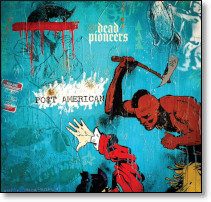
Dead Pioneers: Po$t American (2025, Hassle):
Indigenous punk rock band from Denver, second album, spoken word,
so no compromising he messages by searching for rhymes. The music
is as pointed as the critique of settler colonialism, with lines
like "the audacity (no the caucasity)," "there will always be
another settler to take your place," and an Indian name I can't
transcribe which means "white person who talks too much, presumes
too much, and has no boundaries, which is a mouthful."
A- [sp]
DJ Eprom: We Are the Biobots (2026, JuNouMi):
Polish electronica producer Michal Baj ("who has ties to Silesia")
has synthesized the perfect Kraftwerk album, built from turntable
scratch samples and electronically processed vocals. Thankfully,
the robot world is one we can still laugh at.
A- [sp]
Art Edmaiston & Chad Fowler: Memphis Mandala
(2024 [2026], Mahakala Music): Tenor/soprano saxophonist from
Tennessee, based in Memphis since 1990, has quite a few side
credits since 1997, mostly with blues groups like JJ Grey &
Mofro. Gets a shot at a free jazz album, with label head Fowler
playing strich and flute, backed by bass (Damon Smith) and two
drummer/percussionists (Ra Kalam Bob Moses and Clifford "Pee Wee"
Jackson). Seems a little subdued.
B+(*) [sp]
John Ellis & Double Wide: Fireball (2019 [2026],
Sunnyside): Saxophonist from North Carolina, albums since 1997, band
connected to New Orleans with Jason Marsalis (drums), Alan Ferber
(trombone), Matt Perrine (sousaphone), and Gary Versace (keyboards;
one track also with Rogerio Boccato on percussion). Recording date
inferred from doc. The low brass is delightful.
B+(**) [sp]
Fakemink: The Boy Who Cried Terrified (2026,
EtnaVeraVela, EP): British rapper, has a previous album (21:17)
as 9090gate, this one runs 7 songs, 14:39.
B+(*) [sp]
The Femcels: I Have to Get Hotter (2026, Getting
Hotter): British group, first album, sketchy punk-pop, often slips
off the beat and sometimes out of tune, which is both appeal and
some kind of limit. 16 songs, 32:31.
B+(**) [sp]
Bill Frisell: In My Dreams (2025 [2026], Blue
Note): Jazz guitarist, major figure since 1980, one frequent
theme is his use of folk materials (including "Hard Times" and
"Home on the Range" here). Group with strings — Jenny
Scheinman (violin), Eyvind Kang (viola), Hank Roberts (cello),
Thomas Morgan (double bass) — and drums (Rudy Royston).
B+(**) [sp]
Peter Furlan: The Peter Furlan Project Live at Maureen's
Jazz Cellar (2025 [2026], Beany Bops): Tenor/soprano
saxophonist, composer and arranger, Discogs credits him for this
and two other albums (1981-83). Fairly large group (nine pieces),
allowing for some interesting solo textures.
B+(*) [cd]
Heavenly: Highway to Heavenly (2026, Skep Wax):
British twee pop band, released four albums and an EP 1991-96,
Amelia Fletcher the singer, first album since reuniting in 2023.
B+(*) [sp]
Imarhan: Essam (2026, City Slang): Tuareg desert
rock band from the Algerian side of the Sahara. Reports are that
earlier albums distinguished themselves by rocking harder than
their similar-sounding contemporaries, but this one starts out
leisurely, and hardly suffers from doing so.
B+(***) [sp]
Jon Irabagon: Focus Out (2022 [2026], Irrabagast):
Saxophonist, alto here, a star in Moppa Elliott's Mostly Other
People Do the Killing, has a substantial discography on his own.
Quartet with Matt Mitchell (keyboards), Chris Lightcap (bass),
and Dan Weiss (drums), plus guest spots, including two Kokayi
raps, and spots for trumpet, guitar, and tenor sax (two at once).
B+(***) [cd] [03-13]
Jon Irabagon and Dan Oestreicher: Saturday's Child
(2023 [2026], Irrabagast): Instruments not listed, but Oestreicher
is a New Orleans-based baritone saxophonist who likely goes even
lower here, giving this a delightfully jaunty oom-pah feel. Just
the two of them, as far as I can tell.
B+(***) [cd]
Lazy Californians: Back to San Francisco (2026,
Angel Island): Group led by Cameron Washington, plays trumpet
and vocals, based in San Francisco, patterned on New Orleans
brass bands but supplements trad jazz with rap and funk organ
and more.
B+(***) [cd]
Shawn Lovato: Biotic (2024 [2026], Endectomorph
Music): Bassist, has a couple previous albums, this one a trio
with Ingrid Laubrock (tenor sax) and Henry Mermer (drums), a
fine example of the form.
B+(***) [cd]
Mandy, Indiana: Urgh (2026, Sacred Bones):
French singer-songwriter Valentine Caulfield, mostly in French,
organized the band in Manchester, although they also have a
toehold in Berlin. Second album, with Scott Fair (guitar,
production), Simon Catling (synthesizer), and Alex Macdougall
(drums) sharing writing credits. Mostly going off sound here,
which is dense but hard to parse.
B+(**) [sp]
The Messthetics and James Brandon Lewis: Deface the
Currency (2026, Impulse!): Guitar-bass-drums trio had a
couple albums (2018-19) before they joined up with the powerhouse
tenor saxophonist. I filed the early albums under rock as the
bassist (Joe Lally) and drummer (Brendan Canty) came from Fugazi,
although guitarist Anthony Pirog had a fringe-jazz resume (two
albums with Henry Kaiser, one a conduction of Terry Riley, a
couple more I've heard but don't particularly recall). Time to
move them into the jazz file, but I'm not all that pleased.
The saxophonist makes a strong effort, but it's hard to sort
him out.
B [sp]
Pat Metheny: Side-Eye III+ (2026, Ubiquity Music):
Jazz guitarist, long career, exceptionally popular, second
Side-Eye recording (after 2021's Side-Eye NYC (V1.IV)),
but a different group — the trio with Chris Fishman (keyboards)
and Joe Dyson (drums) gets cover billing, plus guests including a
vocal ensemble.
B+(*) [sp]
Van Morrison: Somebody Tried to Sell Me a Bridge
(2026, Townsend Music/Orangefield): He turned 80 last year, has
developed a reputation as a sociopolitical crank, and he's writing
fewer songs (4 of 20 here, not sure how many are new), but keeps
active, here with his 48th studio album, mostly blues covers that
get a fresh dose of swing. He's in good voice, and plays a little
saxophone, some harmonica, a bit of guitar, while entertaining
guests like Elvin Bishop, Taj Mahal, and Buddy Guy. Sounds good,
but wears a bit thin before ending strong.
B+(*) [sp]
Quinsin Nachoff: Patterns From Nature (2023 [2026],
Whirlwind): Canadian saxophonist, based in New York, albums since
2006, some earlier side credits (especially with Michael Bates).
Two long, complex pieces (one dubbed a concerto), played by a large
ensemble with extra strings, a bit much for my taste.
B+(***) [cd]
Negative Press Project: Friction Quartet (2025 [2026],
Envelopmental Music): Bay Area chamber jazz octet led by Ruthie
Dineen (piano) and Andrew Lion (bass), debuted in 2017 with an
album called Eternal Life: Jeff Buckley Songs and Sounds,
this their fifth album (although Discogs only lists their first),
supplemented here by the Friction Quartet ("a cutting-edge string
ensemble").
B+(*) [cd]
Angelika Niescier: Chicago Tapes (2025 [2026],
Intakt): Alto saxophonist, born in Poland, debut album 2000,
with a fairly well known pick up band in Chicago, names on
the cover: Jason Adasiewicz (vibes), Nicole Mitchell (flute),
Mike Reed (drums), Dave Rempis (alto/tenor sax), and Luke
Stewart (bass).
B+(***) [sp]
PVA: No More Like This (2026, It's All for Fun):
British electropop, or perhaps trip-hop, group; second album, has
a striking sound.
B+(***) [sp]
Ratboys: Singin' to an Empty Chair (2026, New West):
Chicago indie rock band, Julia Steiner the singer, guitarist David
Sagan the other principal, sixth studio album since 2015.
B+(**) [sp]
Ron Rieder: Compositions in Blue and Other Hues
(2024 [2026], Meson): Composer, based in Boston, has a couple of
recent Latin jazz albums, this a collection of more conventionally
postbop pieces, played by a quintet I scarcely recognize —
Yaure Muñiz (trumpet) is on some Cuban albums I've heard, and Mark
Lockwood (bass) was in the Fringe.
B+(**) [cd]
Brandon Seabrook: Hellbent Daydream (2026,
Pyroclastic): Guitarist, also plays banjo, albums since 2014,
many credits, has leaned toward metal noise, does some kind of
chamber jazz experiment here, with bass (Henry Fraser), violin
(Erica Dicker), and keyboards (Elias Stemeseder). Has some
interest, but not much appeal.
B+(*) [cd]
Shabaka: Of the Earth (2026, Shabaka): Last
name Hutchings, British saxophonist, has been a major figure in
groups like Sons of Kemet and The Comet Is Coming, his own
Ancestors, has a couple solo albums, at one point swore off
sax in favor of flute, but seems to have recovered. Solo,
with rhythm tracks and some rap. Still a lot of flute.
B+(*) [sp]
Sleaford Mods: The Demise of Planet X (2026, Rough
Trade): British post-punk duo, started in 2007 with raw rap vocals,
has evolved into something slightly more sung, like Psychedelic Furs.
Lyrics matter, but so far I'm mostly taking theirs on faith.
B+(**) [sp]
Squirrel Nut Zippers: Squirrel Nut Zippers Starring in
"Fat City" (The Ballad of Lil' Tony) (2026, Music Maker):
Swing revival band from North Carolina, first appeared in 1995,
five albums up through 2000, after which Jimbo Mathis recorded
as a solo, and others scattered. A couple revivals later, he
returns with a suite of songs based on his grandfather, Tony
Malvezzi, "a bootlegger and juke joint operator" who moved on
to promoting big bands in New Orleans.
B+(**) [sp]
Karen Stachel, Norbert Stachel & LehCats: Live @ the
Breakroom With Giovanni Hidalgo (2024 [2025], Purple Room
Productions, 2CD): Wife and husband, she sings and plays flutes,
he plays soprano and tenor sax (and more flutes), the band includes
Matt Clark on keyboards, Dan Feiszli on bass, and Dan Gonzalez on
drums, with guest percussion for more than a little Latin tinge.
B+(*) [cd] [03-20]
Teen Jesus & the Jean Teasers: Glory (2025,
Mom + Pop Music): Australian riot grrrl-inspired quartet, second
album after a couple EPs, 10 snappy songs in 29:16, songcraft up,
energy down.
B+(**) [sp]
They Might Be Giants: Eyeball (2026, Idlewild, EP):
John Flansburgh and John Linnell, their 1986 debut was my favorite
album of the year, although I've never again been so taken by their
musical and lyrical wit. Four songs, 8:31, one a remix.
B- [sp]
Zu: Ferrum Sidereum (2026, House of Mythology):
Italian group, founded 1999, came to my attention in jazz but always
had a fondness for noise and lately have gravitated toward metal.
Principally Luca T Mai (sax) and Massimo Pupillo (bass), both also
on keyboards, plus new drummer Paolo Mongardi. I have this tagged
as "avant-metal," but it's instrumental, and as tricky as ever.
B+(**) [sp]
Recent reissues, compilations, and vault discoveries:
Kelan Phil Cohran & Legacy: African Skies
(1993 [2025], Listening Position): Trumpet player (1927-2017),
in Sun Ra Arkestra 1959-61, recorded several albums, leading
Hypnotic Brass Ensemble. Plays various instruments here (congas,
flute, guitar, harp, trumpet, violin uke, and his own invention
of an electrified kalimba, the frankiphone). Starts uncertain,
with some vocals, but finds its groove, highlighted by a blues.
A- [bc]
Marty Ehrlich/Julius Hemphill: Circle the Heart
(1982 [2026], Relative Pitch): Hemphill (1938-95) founded the
Black Artists Group in St. Louis, which Ehrlich joined before
moving to New York. Duets, both playing soprano and alto sax,
and flute, with Ehrlich also on bass clarinet.
B+(**) [sp]
Grupo Um: Nineteen Seventy Seven (1977 [2026], Far
Out): Brazilian jazz group, with Roberto Sion (soprano sax/clarinet),
Lelo Nazario (keyboards), Zeca Assumpção (electric bass), and Zé
Eduardo Nazario (drums), released three albums 1979-82, this find
dating from a bit earlier.
B+(**) [sp]
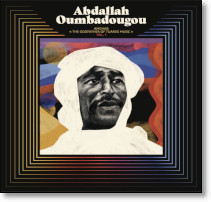
Abdallah Oumbadougou: Amghar: The Godfather of Tuareg
Music Vol. 1 ([2024], Petaluma): Tuareg guitarist-singer from
Niger (1962-2020), a pioneer in the Saharan rock style practiced
by many later bands from Niger and Mali. No info on when this
well-selected classic material was recorded, but Sahel Sounds
released another good album from 1995, Anou Malane.
A- [sp]
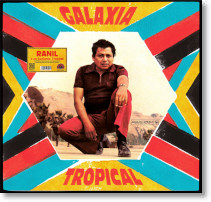
Ranil Y Su Conjunto Tropical: Galaxia Tropical
([2026], Analog Africa): Cumbia group, from Iquitos deep in the
Pervian Amazon, led by singer Ranil (Raúl Llena Vásquez, 1935-2020).
Dates are hard to come by, but he/they released a dozen albums
starting in the 1970s (Discogs only has dates on three 1974-77
singles, plus some later compilations). This German label came
up with a previous compilation in 2020 (plus a digital-only
supplement called Stay Safe and Sound Rail Selection!!).
A- [sp]
Old music:
Dead Pioneers: Dead Pioneers (2023, self-released):
Indigenous punk-rap group from Denver, Gregg Deal the vocalist,
with two guitars, bass, and drums, racing through 12 songs in
22:01. Starts with: "America's a pyramid scheme, and you ain't
at the top." Continues: "The foundation of this country is rooted
in slavery and genocide, born in the bosom of colonialism," then
after noting capitalism adds "this structure is a rigged game."
He goes on to admit to being a "Bad Indian" and a "Doom Indian"
("doom sustains me; it's no longer a description so much as a
solid indigenous character; doom is angry and real and could
care less about how it makes you feel."
A- [sp]
Madonna: Madame X: Music From the Theater Xperience
(2020 [2021], Warner): As the pace of her studio albums has slowed,
she's gotten into the habit of punctuating them with live megatour
albums — the tours being the main point of the albums. Thus
we have The Confessions Tour (2007), Sticky & Sweet
Tour (2010), MDNA World Tour (2013), Rebel Heart Tour
(2017), and now this, following her excellent Madame X album
(2019). This one was recorded in Lisbon, where Madonna moved in 2019,
and incorporates a fado segment, among the new songs that mix in
with the always welcome hits. In between, her banter is more sharply
political than ever. Good.
B+(***) [sp]
Madonna: MDNA World Tour (2012 [2013], Interscope):
Her fourth live album, following MDNA, her twelfth studio
album (2012), one of her better ones. The new album contributes 9
songs ("Turn Up the Radio" is one of the best), in a 114-minute,
24-song program. Sound is a bit thin, but the music is terrific,
as ever.
B+(***) [sp]
Madonna: Rebel Heart Tour (2016 [2017], Eagle):
Another megatour, behind her thirteenth studio album, Rebel
Heart (2016), a concert from Sydney, originally released as
a 138:16 video, later reduced by a 22-track, 99:01 album. Eight
songs from a good but not great album, plus many more.
B+(**) [sp]
Masaka Kids Africana: Greatful (2021, Masaka
Kids Africana): Group of Ugandan teens (more or less), under
the name of a nonprofit that helps "orphaned, vulnerable and
abandoned children," in this specific case to become YouTube
dancing and musical stars. Second album after a 2019 debut,
one more since plus several EPs, including some Xmas music.
Several sources misread the album title as "Grateful," which
they may well be, but they're also pretty great.
A- [sp]
Range Rats: Range Rats (1986 [2010], Mississippi):
Ragged-but-right country-rock band led by Fred and Toody Cole,
"some sad lilting ballads & some punk as hell," seems to be
their only album under this name but the Coles have other credits,
including the Rats (1980-83, before their country turn) and Dead
Moon (1988-2004; I have two of their albums at A-).
A- [sp]
Michael Hurley/The Range Rats: Dead Moon Night
(1986-2017 [2024], Mississippi, EP): "Limited one time edition,"
consists of the folksinger covering a Dead Moon song from Portland's
first Dead Moon Day (in honor of the band, after Freddy Cole's death),
followed by a previously unreleased Range Rats song. Curios at best.
B [bc]
Grade (or other) changes:
Buck 65: Do Not Bend (2026, Vertices):
Rapper/beatmaker Richard Terfly, from Nova Scotia, seems to be in
Toronto these days, called his 1988-96 juvenilia compilation
Weirdo Magnet, has released many albums since, with a
2014-22 break, but he's been superb ever since. Short one (14
tracks, 26:43), snappy, as exceptional as ever. Noted: "I don't
like this universe, let's move on to another one."
[Label unspecified, but Christgau used Buck 65's Substack title.
Lyrics
here.]
[was: B+(***)] A- [bc]
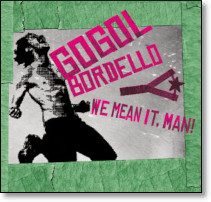
Gogol Bordello: We Mean It, Man! (2026, Casa Gogol):
New York-based punk band, principally Eugene Hütz, the one constant
since 1999, draws heavily on his Ukrainian background. Strong album.
[was: B+(***)] A- [sp]
Unpacking: Found in the mail last week (actually last
several, as I had fallen way behind):
- David Adewumi: The Flame Beneath the Silence (Giant Step Arts) [03-27]
- Tyrone Allen II: Upward (Dreams and Fears) [03-16]
- Anthony Branker & Other Ways of Knowing: Manifestations of a Diasporic Groove & Spirit (Origin) [03-20]
- Asher Brinson: Midnight Hurricane (AsherBrin) [04-03]
- Owen Chen: Eternal Wind: The Ghibli Collection (OA2) [04-03]
- Steve Cohn/Billy Stein: Up From the Soil (Hathor Music) [2025-10-03]
- Matt Dwonsyk: Live at the Sidedoor (self-released) [03-06]
- Simon Hanes: Gargantua (Pyroclastic) [03-27]
- Alexander Hawkins/Taylor Ho Bynum: A Near Permanent State of Wonder (RogueArt) [2025-09-12]
- Steven Husted and Friends: Two Nights - "Live!" (self-released) [02-16]
- The Interplay Jazz Orchestra: Bite Your Tongue (self-released) [02-26]
- Jon Irabagon: Focus Out (Irrabagast) [03-13]
- Jon Irabagon and Dan Oestreicher: Saturday's Child (Irrabagast) [03-13]
- Javon Jackson: Jackson Plays Dylan (Solid Jackson/Palmetto) [03-27]
- Jamile/Vinicius Gomes: Boundless Species (La Reserve) [04-03]
- DeYeon Kim: Wellspring (TAO Forms) [05-01]
- Erica von Kleist: Picc Pocket (self-released) [04-23]
- Anna Kolchina: Reach for Tomorrow (OA2) [02-27]
- Steve Kovalcheck: Buckshot Blues (OA2) [04-03]
- Brian Landrus: Just When You Think You Know (BlueLand/Palmetto) [03-20]
- Scott Lee: Greetings From Florida: Postcards From Paradise (Sunnyside) [04-16]
- Tom Lippincott: Ode to the Possible (self-released) [03-02]
- Lisanne Lyons: May I Come In (OA2) [02-27]
- Quinsin Nachoff: Patterns From Nature (Whirlwind) [02-27]
- Luke Norris: Moment From the Past (self-released) [03-20]
- Adam O'Farrill: Elephant (Out of Your Head) [03-20]
- Meg Okura: Isaiah (Adhyâropa) [02-20]
- Beto Paciello: The Stoic Suite (Moons Arts) [04-17]
- Chenxi Pan: This Very Moment (Origin) [03-20]
- Benjie Porecki: Faster Than We Know (Funklove Productions) [03-02]
- Reverso: Between Two Silences (Alternate Side) [03-27]
- Harvie S: Bright Dawn (Origin) [03-20]
- Marta Sanchez: For the Space You Left (Out of Your Head) [04-17]
- Dave Schumacher & Cubeye: Agua Con Gas (Cubeye Music) [04-17]
- Yuyo Sotashe & Chris Pattishall: Invocation (self-released) [03-20]
- Chad Taylor/Aymeric Avice/Luke Stewart: Deep in the Earth High in the Sky (RogueArt) [02-09] *
- Harriet Tubman & Georgia Muldrow: Electrical Field of Love (Pi) [03-27]
- Jack Wood: For Every Man There's a Woman (Jazz Hang) [03-24]
Ask a question, or send a comment.
Saturday, February 28, 2026
Music Week
February archive
(finished).
Music: Current count 45603 [45565] rated (+38), 11 [27] unrated (-16).
I'm writing this introduction on March 2, but it seems fair to
backdate this one. Not that I'm not happy to be done with February,
but the shortfall of days messed up my schedule (or would have, if
I had followed a normal schedule in February). Besides, the cutoff
is honest. All of these reviews were logged by Feb. 28, and I haven't
written any more since. Saturday was disrupted by having someone
come over to trim the giant elm tree in the backyard. Then I picked
up some kind of stomach bug, and I spent most of Sunday in bed. I'm
feeling somewhat better today, but remain in a bad mood, and I don't
expect that to alleviate any time soon.
I published a rather massive
Loose Tabs on Friday, where I obviously didn't pay enough attention
to the likelihood that Trump would be so befuddled as to launch a war
against Iran. I did a minor update last night, where I noted that
Franklin Roosevelt's designation of Japan's attack on Pearl Harbor
as "a day in infamy" applies equally well to Trump's attack on Iran
and to Bush's 2003 attack on Iraq. I also wrote:
That Trump and Netanyahu have blindly thrust us into a new state of
the world is undeniable. The things we should be absolutely clear on
are: the "crisis" that precipitated this action was totally
fabricated, the result of Israel hyping Iran as some kind of supreme
existential enemy, for no reason beyond their desire to provide cover
for their ongoing displacement of the Palestinian people; that the US
has gone along with demonizing Iran because the CIA installation of
the Shah in 1953 and the subsequent support of the Shah's terror
campaign against his people is something Americans have never
acknowledged and made any sort of amends for; and that several
generations of American politicians, including Biden and Trump, have
allowed themselves to be manipulated and dictated to by Israelis,
Netanyahu in particular. There was never any need to go to war with
Iran, and even a week ago an agreement could have been negotiated, at
least had the US shown any decent respect for the Iranian regime and
people.
I wasn't able to follow the news as the attack unfolded, and thus
far I've barely skimmed a couple of reports. As far as I've been able
to glean, Trump wants to continue bombing for several more weeks. As
such, he's wasting the opportunity caused by killing Khamenei: a pause
would allow cooler heads to regroup, while keeping up the attack will
only increase Iran's resolve to fight back — as they are doing,
but thus far to limited effect. I wouldn't dismiss the possibility
that Iran could make their attackers feel real (if not commensurate)
pain, but what worries me more at the moment is the extraordinary
exhilaration and hubris Trump and Netanyahu are feeling in flexing
their power to destroy and wreak havoc, especially given how unpopular
their warmaking is. I doubt either of them will meet the justice they
deserve. I just fear that they're on a path that will only get worse
until someone finally stops them (as if anyone could or would).
In old age, I often reflect back on maxims I learned when I was
a child. One of the most enduring is: power corrupts, and absolute
power corrupts absolutely. Sure, Trump was pretty corrupt long before
he had the absolute power to kill thousands or millions of people.
I don't know how people couldn't have seen through Trump, but for
all of my lifetime, we've been brought up to adore and trust American
power, despite constant reminders that we cannot and should not.
I finally cracked into the 2026 promo queue last week (or two),
so that's much of what you'll find below. I have more that I haven't
unpacked yet. Main thing that's slowed me down is that my office
space has descended into a horrible mess. I'll try to straighten
that out next week. Meanwhile, my main source for new non-jazz
picks this week is
RiotRiot. I also looked up some Neil Sedaka after his death —
I've been playing The Brill Building Box, where
Stairway
to Heaven is a favorite (here's a
live take,
in a medley) — and I also sampled a couple
of this year's Rock & Roll Hall of Fame nominees that I had
nothing rated by (still missing for me are Inxs and Iron Maiden).
I'm not invited to vote, and almost certainly never will be, but
Chuck Eddy is, so I followed his link as a checklist, then I
compiled a table of the 17 nominees' graded albums: only 4 had A/A-
graded albums (Joy Division/New Order, Pink, Shakira, Wu-Tang Clan),
so I would have been very hard-pressed to meet their minimum of 7
votes: I wouldn't begrudge Vandross, and admit that lots of (almost
exclusively British?) people like Oasis to a HOF degree, and I'm
somewhat into the post-New Edition solo/trio albums. But it feels
to me like in their rush to induct everyone they've started scraping
the bottom of the barrel — although I'm pretty sure that if I
did a bit of research I could find many much better individuals and/or
bands they've overlooked (e.g., Pere Ubu, Pet Shop Boys, Kid Creole
& the Coconuts, Pavement).
New records reviewed this week:
Michael Aadal: Aggressive Hymns, Energetic Ballads
(2025 [2026], Losen): Norwegian guitarist, tenth album since 2009,
cover lists last name only, quartet with André Kassen (tenor/baritone
sax), Audun Ramo (acoustic/electric bass), Gunnar Sæter (drums),
all original pieces, most pretty strong.
B+(***) [cd]
Joshua Achiron: Climbing (2026, Calligram):
Young guitarist, from Chicago, first album, playing original
pieces (plus one Ellington), backed by veteran who elevate
his game: Geof Bradfield (tenor sax), Clark Sommers (bass),
and Dana Hall (drums).
B+(**) [cd]
Naseem Alatrash: Bright Colors on a Dark Canvas
(2025 [2026], Levantine Music): Cellist, Arabic heritage, teaches
in Boston, is a member of Turtle Island Quartet, has credits with
Danilo Perez and Simon Shaheen. Seven original compositions, 32:03,
backed by piano, bass, string quartet, and drums. Zips right along.
B+(***) [cd] [02-27]
Eddie Allen's Push: Rhythm People (2023 [2026],
Origin): Trumpet player, originally from Milwaukee, based in New
York, credits back to 1987 (Lester Bowie, Mongo Santamaria),
albums from 1993, one called Push from 2014. Sextet here,
plus "special guest" Steve Turre (trombone).
B+(**) [cd]
Courtney Marie Andrews: Valentine (2026, Loose
Future): Country singer-songwriter, ninth album since 2008.
B+(*) [sp]
Kris Davis and the Lutoslawski Quartet: The Solastalgia
Suite (2024 [2026], Pyroclastic): Pianist, originally
from Canada, put together a series of impressive albums in the
2000s, then moved to the forefront when she set up a label that
is much more than just herself. Now she's making moves, this one
with a scratchy Polish string quartet that doesn't allow you the
option of not listening. A bit too "classical" for my taste, but
those not similarly prejudiced are likely to be impressed.
B+(***) [cd]
Hilary Duff: Luck . . . or Something (2026,
Atlantic): Pop singer-songwriter, sixth album since 2002 (when
she was 15), only second album since 2007 (when she was 20),
started as a Disney "teen idol," has a fairly long (if not all
that distinguished) list of acting credits, and has written a
trilogy of "young adult" novels.
B+(**) [sp]
Gaudi: Jazz Gone Dub (2025, Dubmission): Italian
producer Daniele Cenacchi, plays keyboards, has been dabbling in
jazz, electronica, and especially dub since the late 1980s, moving
to London in 1995.
B+(**) [sp]
Gogol Bordello: We Mean It, Man! (2026, Gogol):
New York-based punk band, principally Eugene Hütz, the one constant
since 1999, draws heavily on his Ukrainian background. Strong album.
B+(***) [sp]
Andy Haas: In Praise of Insomnia (2025 [2026],
Resonant Music): Saxophonist, career goes back to the 1980s,
including the notable group Radio I-Ching. Solo exercises,
credit "saxophone, circular breath, nano pulsar"). This format
is inevitably limited, but revelatory if you pay close attention.
Helps that it is varied but short: 12 tracks, 29:24.
B+(**) [cd]
Hemlocke Springs: The Apple Tree Under the Sea
(2026, AWAL): Pop singer-songwriter Isimeme Udu, has degrees in
biology and medical informatics, released a well-regarded EP in
2023, first album (10 songs, 33:22).
B+(***) [sp]
Joyce Manor: I Used to Go to This Bar (2026, Epitaph,
EP): Punk band from California, Barry Johnson the singer-songwriter,
Chase Knobbe on guitar, Matt Ebert on bass, various drummers since
2011, seventh album, but at 7 songs, 19:03 I'm inclined to treat it
as an EP.
B+(*) [sp]
Gil Livni: All In (2024-25 [2026], OA2): Guitarist
from Israel, seems to be his second album, a quartet with Amit Friedman
(sax), Yonatan Riklis (organ), and Yonatan Rosen (drums), so soul jazz?
Three covers (including a Lennon-McCartney), seven originals, pretty
lively.
B+(**) [cd]
Chris Madsen/Dana Hall/Clark Sommers: Threefold
(2025 [2026], Calligram): Tenor/soprano saxophonist, name listed
last but type suggests crediting him first. If so (he produced
and wrote 4/8 songs, the others by bassist Sommers), this may be
his first, although he has side credits back to 2000. This is
very solid.
B+(***) [cd] [03-06]
Luke Marantz/Simon Jermyn: Echoes (2025 [2026],
Chill Tone): Presented as duets (although a drummer is also
credited), Marantz plays piano/keyboards, Jermyn electric guitar
and bass. Marantz has a fair number of side credits since 2011.
Jermyn, from Ireland but based in New York, had a debut album
in 2010 (solo electric bass).
B+(**) [cd]
Bruno Mars: The Romantic (2026, Atlantic): Pop
genius Peter Gene Hernandez, broke through with Doo-Wops and
Hooligans in 2010, and since then has shown occasional flashes
of brilliance without putting together another compelling album.
But this is only his fourth, with a 10-year gap since 2016's
lame 24K Magic. This isn't lame, but the overproduction
is pretty severe.
B+(*) [sp]
Megan Moroney: Cloud 9 (2026, Columbia Nashville):
Country singer-songwriter from Georgia, third album.
B+(***) [sp]
Lord Jah-Monte Ogbon: As of Now (2026, Lex):
Rapper Jamonte Lyde, from Charlotte but he's been around,
Discogs lists 15 albums since 2019 but this is his big step
forward.
A- [sp]
Kate Olson: So It Goes (2025 [2026], OA2):
Soprano saxophonist, from Seattle, has a previous (2009) album
of "improvised duets" I wouldn't hold against calling this a
debut, and side work with Wayne Horvitz, who appears as a guest
here (3 tracks). Mostly quartet with Conner Eisenmenger (trombone),
Tim Carey (electric bass/guitar), and Evan Woodle (drums), with
extra double bass (Geoff Harper) on three tracks.
B+(***) [cd]
The Paranoid Style: Known Associates (2026, Bar/None):
Singer-songwriter Elizabeth Nelson, with husband Timothy Bracy, fifth
album, pens historico-politico-philosophical tracts set to conventional,
guitar-heavy but far from sludgy rock and roll. As someone who is slow
to grasp lyrics, I tend to be less than impressed at first, then start
to notice phrases and appreciate the clarity of the music. Main thing
I've noted so far is that these songs are all hooked to their titles,
which are somewhat more oblique than usual ("Tearing the Ticket," "A
Barrier to Entry," "Shark Eyes," "Elegant Bachelors," the title song).
A- [sp]
Pony: Clearly Cursed (2026, Take This to Heart):
Toronto indie-pop group, Sam Bielanski the singer-songwriter,
third album, with Matty Morand now the exclusive guitarist. Ten
songs, 30:45.
B+(**) [sp]
Brad Schrader: Late Nights With Brad Schrader
(2025, self-released): Standards singer, been plying his trade
for 25 years, nothing under Discogs, this seems to be his first.
Seven standards (23:50, including the all-but-obligatory Jobim),
backed nicely by piano (music director Jerry Vezza), bass, drums,
and sax.
B [cd]
Noé Sécula/Jorge Rossy: A Sphere Between Other Obsessions
(2023 [2026], Fresh Sound New Talent): French pianist, second album,
mostly duo with vibraphone (7/10 cuts), mostly playing Monk tunes.
B+(*) [bc]
Dave Stryker: Blue Fire: The Van Gelder Session
(2025 [2026], Strikezone): Guitarist, from Nebraska, called his
first album First Strike (1988), co-led a long-running
group with saxophonist Steve Slagle, has lately been in the habit
of releasing something new every January. This year's offering
is a back-to-roots session with organ (Jon Gold) and drums
(McClenty Hunter).
B+(**) [cd]
Mattias Svensson: Embrace (2022 [2026], Origin):
Swedish bassist, studied in New York but returned to Sweden, has
a couple previous albums under his own name, plus several dozen
side-credits (especially with Jan Lundgren and Viktoria Tolstoy).
Wrote all the pieces here, performed with Bill Mays (piano) and
Morten Lund (drums). Nice outing.
B+(**) [cd]
Craig Taborn: Dream Archives (2024 [2026], ECM):
Pianist, first came to my attention in James Carter's 1990s quartet,
has a wide-ranging solo career with several dozen albums and many
more side-credits, ultimately leading to a MacArthur grant in 2024.
Trio with Tomeka Reid (cello) and Ches Smith (drums). Talented
group, but doesn't really take off (unlike, say, 2025's Trio
of Bloom).
B+(*) [sp]
Vance Thompson: Lost and Found (2024 [2026],
Moondo): Trumpet player, founder/director of the Knoxville Jazz
Orchestra, lost his ability to play due to focal dystonia, but
has returned to music here, playing the vibraphone in a quintet
with piano, guitar, bass, and drums.
B+(*) [cd]
Recent reissues, compilations, and vault discoveries:
John Vanore & Abstract Truth: Easter Island Suite
(1989-2024 [2026], Acoustical Concepts): Trumpet player, several
albums since 1991, started composing this suite in the 1980s and
recorded the first movement in 1989, returning to the studio for
the middle sections in 2012, then the final movement in 2024. The
groups evolved, but all are deep in brass.
B+(*) [cd]
Old music:
Phil Collins: Face Value (1981, Virgin): First
solo album by the former Genesis drummer, started a string of
eight gold/platinum albums (up to 2010), none I've heard so far,
which is unusual for someone being given serious consideration
for the Rock & Roll Hall of Fame (but not the only 2026
nominee I have nothing in the database for: also INXS, Iron
Maiden, and New Edition). Seems like an agreeable pop album,
but the only whole song that caught my attention was the Beatles
cover ("Tomorrow Never Knows"), and the only other bits I was
impressed by were drum breaks.
B [sp]
The Damned: Damned Damned Damned (1977, Stiff):
English punk rock group, first album, Dave Vanian the singer,
backed by guitar (Brian James), bass (Captain Sensible), and
drums (Rat Scabies), produced by Nick Lowe. I recall the group
getting a lot of hype at the time, but little respect. Sounds
pretty good at first, a little short of material toward the
final rave up.
B+(**) [yt]
New Edition: New Edition (1984, MCA): Another
RRHOF nominee I totally missed, released 7 studio albums 1983-2004,
selling over 20 million copies. Boy group, conceived as successor
to the Jackson 5, updated with some rap to coin the term "new jack
swing," the five members on this second album went on to solo acts
for Bobby Brown and Ralph Tresvant as well as the trio known as
Bell Biv Devoe. (Later member was/is Johnny Gill.)
B+(**) [sp]
The OKeh Rhythm & Blues Story: 1949-1957
(1949-57 [1993], Epic/Legacy, 3CD): Label founded 1918 by Otto
Karl Erich Heinemann (1876-1965), recorded early "race" records
including Louis Armstrong's Hot Fives and Sevens. The label was
sold to Columbia in 1926, sold off in 1934 and bought back by
CBS in 1938, which periodically shut it down and revived it. This
was their prime R&B period, with plenty of hot jump blues,
but nothing I recognize from standard compilations (like Rhino's
fabulous The R&B Box), and a shortage of star power
(the "big" names here are Big Maybelle, Chuck Willis, Hadda
Brooks, and Screamin' Jay Hawkins).
B+(***) [sp]
Rosé: Rosie (2024, The Black Label/Atlantic):
Born in New Zealand, raised in Australia, moved to South Korea
(where her parents had emigrated from) and joined the bestselling
girl group Blackpink, released a solo "single album" in 2021
(6:15, expanded on CD to 12:30), then this studio album, which
belatedly came to my attention thanks to the Bruno Mars feature
"APT." That single sound pretty good, but it's hardly helped by
an overload of ballads, even if they're not bad.
B+(*) [sp]
Neil Sedaka: Sings His Greatest Hits (1958-62
[1963], RCA): Brill Building songwriter, an original member of
the Tokens (which had a 1961 hit with "The Lion Sleeps Tonight"),
recorded a half-dozen top-ten singles 1959-62, which loom large
here. Seems like he should have a memorable period compilation.
This comes close.
B+(***) [yt]
Neil Sedaka: Neil Sedaka and the Tokens (1956-57
[1963], Guest Star): Short compilation (10 songs, 21:54), unclear
exactly when recorded (Google says that Sedaka left to go solo in
1958), but 6 songs are credited to Sedaka alone, 2 with the Tokens,
and 2 (twisters) to Joe Martin and His Orchestra.
B [sp]
Neil Sedaka: Sedaka's Back (1972-73 [1974], Rocket):
Elton John's label compiled this from three UK-only LPs, including
songs that were hits for others, and one that became his first since
1962, and set him up for years to come.
B+(*) [sp]
Unpacking: I have stuff but haven't logged it yet.
Ask a question, or send a comment.
Friday, February 27, 2026
Loose Tabs
Shortly after I posted this on Friday night, Trump (and Israel)
launched a wave of attacks against Iran, aimed at decapitating
the Islamic regime (at least it appears successful in killing
long-ruling Ayatollah Ali Khamineh). Franklin Roosevelt called
Japan's surprise attacks on Pearl Harbor a "day of infamy." I
used that same phrase to describe GW Bush's opening salvo of
"shock and awe" on Baghdad in 2003. While I don't know the
dimensions of Trump's attack — it was clearly larger
than several similar attacks Trump had already made, but one
could argue that the "war" actually started somewhere back
— one would not be amiss to reckon this another "day of
infamy." Whether this fizzles out in some sort of face-saving
agreement, or escalates into WWIII, remains to be seen. That
Trump and Netanyahu have blindly thrust us into a new state
of the world is undeniable. The things we should be absolutely
clear on are: the "crisis" that precipitated this action was
totally fabricated, the result of Israel hyping Iran as some
kind of supreme existential enemy, for no reason beyond their
desire to provide cover for their ongoing displacement of the
Palestinian people; that the US has gone along with demonizing
Iran because the CIA installation of the Shah in 1953 and the
subsequent support of the Shah's terror campaign against his
people is something Americans have never acknowledged and made
any sort of amends for; and that several generations of American
politicians, including Biden and Trump, have allowed themselves
to be manipulated and dictated to by Israelis, Netanyahu in
particular. There was never any need to go to war with Iran,
and even a week ago an agreement could have been negotiated,
at least had the US shown any decent respect for the Iranian
regime and people.
After rushing this out, I realized that I had left an earlier
date in place, so I should at least fix that. This came out on
the 27th, not the 24th. I also meant to add the Table of Contents,
so that's here now. Beyond that, the only thing I've added was a
note to the latest
Jeffrey St Clair "Roaming Charges,"
which includes some useful anticipation of the attack. I haven't
had time or stomach to survey the more recent news —
literally, as I've come down with something that makes work
impossible as well as undesirable. I also missed squeezing in
a final February Music Week (although I still could post-date
one), or putting up anything on my
Substack in February.
This is an occasional collection of newsworthy links and comments,
much less systematic than what I attempted in my late
Speaking of Which posts. The new name comes from my extensive
use of browser tabs. When I get around to cleaning up, I often find
tabs opened to old articles I might want to comment on and/or refer
back to. So
these posts are mostly
housecleaning, but may also serve as a very limited but persistent
record of what 20+ years ago I started calling "the end of the American
empire" and nowadays feels more like "the end of civilization." I
collect these bits in a
draft file, and flush them
out when periodically (12 times from April-December 2025).
My previous one appeared 34 days ago, on
January 24.
I have a little-used option of selecting
bits of text highlighted with a background
color, for emphasis a bit more subtle than bold or
ALL CAPS. (I saw this on Medium. I started with their greenish
color [#bbdbba] and lightened it a bit [#dbfbda].) I'll try to
use it sparingly.
Table of Contents:
Topical Stories
Sometimes stuff happens, and it dominates the news/opinion cycle
for a few days or possibly several weeks. We might as well lead with
it, because it's where attention is most concentrated. But eventually
these stories will fold into the broader, more persistent themes of
the following section.
Last time:
Thanksgiving;
Epsteinmania;
Zohran Mamdani;
ICE Stories;
Venezuela;
Iran;
Jerome Powell. We're probably not done with all of these
(certainly not ICE, although I've moved them into a new regular section
I'm calling
Trump Goes to War (Domestic Edition)).
Epsteinmania: After numerous delays, the Department of Justice
finally released a
"large
cache" of documents and media related to its investigation of
Jeffrey Epstein: this one an overwhelming dump of 3 million pages
and 180,000 images.
Philip Weiss [12-19]:
The New York Times ignores an essential part of the Jeffrey Epstein
story — Israel. Cameron Peters [02-02]:
3 million new Epstein files, briefly explained. Nia Prater [02-03]:
DoJ makes appalling mistakes in release of new Epstein files. Michael Arria [02-03]:
Newly released Epstein files reveal further ties to Israel: "Further
connections between the late, convicted sex criminal and the state of
Israel." Branko Marcetic [02-06]:
Ehud Barak had a very close friendship with Jeffrey Epstein. Jeet Heer [02-06]:
From Epstein to Bezos, the ruling class is rotten to the core:
"Let this week be yet another reminder that plutocrats are a threat
to democracy, not its saviors." But doesn't "threat" imply future
peril. Plutocrats already exist, and their existence demonstrates that
democracy isn't working for nearly everyone it's supposed to. Part of
the problem is that people keep making excuses for billionaires as if
their wealth is independent of the world it's been derived from. For
example:
Matthew Yglesias [2025-12-29]:
Let's all practice billionaire positivity: While he's right that
"it's not a zero-sum world," and for that matter his implication that
you can't change anything important by just singling out a few "bad
apple" billionaires, his habit of sucking up to the rich leaves him
no critical ground to stand on, however profitable it may be for him
personally (perhaps even beyond his main gig of writing for Bloomberg).
Caitlin Dewey [02-04]:
Epstein gave America a common enemy: "His case has become a
vehicle for a strain of anti-elite populism that's growing across
the political spectrum." David Futrelle [02-11]:
What Peter Thiel saw in Jeffrey Epstein: "In the extensive
correspondence between the Silicon Valley venture capitalist
and the late pedophile, both men expressed a deep aversion to
democracy." Zachary Clifton [02-12]:
The Yale professor who e-mailed Epstein about a "small goodlooking
blonde" student is no longer teaching: "After outcry from students
over e-mails showing David Gelernter's relationship with Jeffrey
Epstein, the computer science professor is under review by the
university." Before jumping to the conclusion that Gelernter is
a victim of "cancel culture," you might want to consider reports
that he was the lowest-regarded professor of all at Yale.
Gelernter is one of the more interesting cases to have gotten
caught up in the Epstein tarbaby. It's not clear to me whether his
work in computer science is notable or not, but it gave him academic
standing and business contacts (like Epstein and Peter Thiel) that
allowed him to spin off dubious socio-political theories, and paved
his way toward becoming a Trump prop. He's written a couple books
that seem to raise big questions, like
Americanism: The Fourth Great Western Religion (his notion
there is not just that Americanism has taken on the air of religious
dogma, but that it is a form of "secular zionism"), and the more
jaundiced
America-Lite: How Imperial Academia Dismantled Our Culture (and
Ushered in the Obamacrats), which Russell Jacoby
reviewed as
Dreaming of a world with no intellectuals.
Isaac Chotiner [2018-10-23]:
"The idea that he's racist is absurd": Interview with David
Gelernter on why a rich guy with a Jewish son-in-law can't be a
racist. Trump's just an exaggerated version of an average American.
He has a slippery excuse for any charge you might lob at Trump, but
he doesn't shy away from generalizing about the left, who hate Trump
because they hate average Americans, and indeed the whole idea of
America. Dave Zirin [02-13]:
The NFL owners and Olympic organizers in Epstein's inbox: "The
sports media is ignoring the story, but wealthy sports figures are
all over the Epstein files." Melinda Cooper [02-14]:
Epstein family values: "The billionaire patriarchs of the American
far-right want to rule an economy of masters and servants." Elie Honig [02-20]:
The new Epstein list: celebrities named; predators redacted.
"The lesson, as always, is that Bondi and this Justice Department
are simply not to be trusted." Ana Marie Cox [02-22]:
The paranoid style of Jeffrey Epstein has come for us all:
"The pedophile plutocrat has some peculiar predilections —
especially for academics and thinkers who showed a potential to
further his grand experiments in inhumanity."
There's a pattern to Epstein's consumption of ideas and to the kinds
of people he found compatible. It wasn't a wish to brush shoulders
with the famous and well-regarded — generic
star-fucking. Epstein didn't collect people for status; he identified
and aligned himself with the intellectual machinery now justifying our
current dystopia, including the academic rationalizations and
motivated reasoning that hover behind the most terrible excesses of
the Trump administration: glorified phrenology, violent misogyny,
genetic determinism, and elite impunity.
It is not a coincidence that Epstein was also interested in crypto,
in AI, in right-wing populism, in trad Cath extremists, and anti-trans
ideology, in addition to creepy experiments in pain tolerance,
psychopathology, and advantageous genetics. Epstein gravitated toward
fields and figures that rank humans, explain away cruelty, or
biologize inequality. He did not forge connections with these people:
He saw they were already in alignment.
H Scott Prosterman [02-24]:
Former Israeli PM, in Epstein files, dreamed of Israeli eugenics and
pretty converts. Dan Mangan [02-24]:
DOJ withheld documents about claim that Trump sexually abused minor.
[Weird how this story vanishes under creeping Javascript. Probably
a better source elsewhere?] Jelinda Montes [02-24]:
DOJ withheld Trump-related documents in Epstein files. Maureen Tkacik [02-26]:
Newspapers did not kill themselves: "New docs say Jeffrey Epstein
collaborated with the Russian mob to loot the New York Daily News,
then tried to help Mort Zuckerman discard it when reporting became
inconvenient." Elie Honig [02-27]:
The British are putting Trump's DoJ to shame on Epstein accountability:
"While the UK makes arrests, the US Justice Department offers weak
explanations for inaction." Noam Chomsky: The famous linguist and anti-war intellectual,
a consistent critic of American and Israeli foreign policy, got caught
up in Epstein's web, and so got singled out for concern.
Melania: The movie Jeff Bezos spent $75 million on to
flatter the Trumps. This is, of course, a lightning rod for critical
ridicule — which, sure, is a big part of why I'm reporting on
it at all. Given the subject and circumstances, I'm not surprised
that at
Rotten Tomatoes the average of scores given by recognized critics
is 8% (50 reviews). It's likely that most film critics are anti-Trump
to start with, but even if there is a bit of selection bias, that's a
pretty low score, suggesting that the film isn't very good, at least
by common critical standards. (The sample size is pretty decent: it
may be slightly inflated by critics out to slam Trump, but not much.
Moreover, one shoudn't assume that anti-Trump means anti-Melania,
as a lot of people like to think that Melania is secretly anti-Trump
too.) What's much more suspect is that the viewer ratings appear to
be ecstatic at 99% (1000+ verified ratings), for a largest-ever
discrepancy between the ratings of 91 points. I don't know how to
prove this, but intuitively the self-selection bias here must be
huge. Who, after all, would buy a ticket to this particular movie?
No one I know, except perhaps to write a nasty review, and those
people would show up in the critics column. But I find it hard to
understand how anyone would pay money to see Melania. It's
not unusual for right-wingers to mass-purchase books to plant them
on the New York Times bestseller list. Same thing could be happening
here. Indeed 1000 tickets for party operatives promising to follow
up on Rotten Tomatoes would be a drop in the Bezos bucket.
Margaret Hartmann:
[01-31]:
Movie review: Does Melania dream of AI-generated sheep? "The
First Lady's weirdly soulless MAGA lullaby is going to put a lot
of Amazon Prime viewers to sleep." [02-02]:
The Melania movie, explained: box office, reviews, & what
she made. "Why did the notoriously private First Lady film a Brett
Ratner-directed documentary? It might have something to do with the $28
million paycheck." When asked why Amazon is paying $40 million, when
the second highest bidder topped out at $14 million, a "person close
to Bezos" said: "He is doing a deal, offering money to buy the Trump
Family's affection and flattering the president. If you think about
it in terms of costs versus benefit, it is pretty low. It's a smart
investment."
Nick Hilton [01-30]:
First Lady is a preening, scowling void of pure nothingness in this
ghastly bit of propaganda. Maureen Dowd [01-31]:
Slovenian sphinx flick nixed! "It turns out there is no riddle,
no enigma, no mystery, no dark anguish, Melania is not Rapunzel in
the tower, pining to be saved from the ogre imprisoning her. She is
comfortable in the frosty vertical solitude of the tower, swaddled
in luxury." Monica Hesse [01-31]:
Melania promises to take us behind the scenes. There's nothing
to see: Anyone searching for hidden layers will be disappointed:
"we were dealing with a situation that was not an onion but a potato.
Yes, there's a thin protective skin. But after you breach that, no
matter how many times you go after it with a peeler, you're dealing
with pretty much the same pulp." Sophia Tesfaye [01-31]:
Why MAGA won't rally for Melania documentary. Matt Labash [02-01]:
Is Melania the worst film ever made? "It's no small wonder
it's taking such a drubbing. Melania is a personality-study
of a person who doesn't actually have one." Tom Brueggemann [02-01]:
Five box office results this weekend more important than expensive
vanity doc Melania. Coleman Spilde [02-01]:
The "Melania" movie is empty, foul and worse than we imagined. Chas Danner [02-02]:
What critics are saying about the Melania documentary:
"Here are the highlights of their lowlights." This pointed me to
several other pieces cited here, but has much more (and is being
"continuously updated"). Some more sample quotes:
Lauren Collins [The New Yorker]: "For his comeback, [Brett
Ratner] has summoned all the artistic ambition of a local Realtor
who just got a drone." Also revealing:
We are told, for instance, that Melania's father, Viktor Knavs, is an
avid videographer, but the film is devoid of baby pictures, family
mementos, or any of the other low-hanging archival materials that
typically serve to humanize a distant subject. She is a woman without
a past, effacing biography just as her husband erases national
history. (As I noted in 2016, their four-hundred-and-fifty-person
wedding included all of three guests from Melania's homeland: her
mother, her father, and her sister.) Melania says that everything
she does is for "the children," but no actual children appear in
Melania. Nor do pets, friends, hobbies, or music, except in
a sad little scene in which she struggles to sing along to "Billie
Jean," supposedly her favorite song. You almost wince when her
towering adult son, Barron, brushes her off without so much as a
peck on the cheek.
Rick Perlstein "recommends watching the film (if, like him, you
are endlessly fascinated with how the pageantry of the American
presidency is staged)."
Alexandra Petri [The Atlantic]: "The movie reveals how well
insulated she is from anything resembling human life, like a cheetah
in the house of a Russian oligarch."
Heather Schwedel [Slate]: "I'm not sure anyone else could have
made a movie that taught me so remarkably little about its main
subject."
Sonny Bunch [The Bulwark]: "The target audience seemed to enjoy
it fine; the 12:40 p.m. showing at the AMC NorthPark in Dallas was
80 percent full and laughed in all the right places. It preaches to
the faithful with great reverence and they were thrilled to bask in
the golden glow of Trump Tower. But it's fascinating to see so pure
and naked an instrument of graft and propaganda deployed to great
effect on an audience happy to lap it up."
Michael Clark [The Epoch Times]: "In a few days, it's possible I
could be the only U.S.-based critic on RottenTomatoes.com with a
positive review of Melania. As of Saturday morning, the 31st,
the film's critical consensus sits at 6 percent. Under normal
circumstances, this would suggest that I was out of touch and don't
know how to do my job. However, the audience rating is 98 percent,
making Melania the biggest ratings-gap title in Rotten
Tomatoes history." David Yearsley [02-06]:
Melania's music: A view from Berlin, thinking of Bach . . . and
Leni Riefenstahl. Eboni Boykin-Patterson [02-06]:
Rotten Tomatoes desperately claims 'impossible' rating for 'Melania'
is real. Katie Rosseinsky [02-07]:
Rotten Tomatoes addresses 'fake' user score claims for Melania movie
after documentary sets new record. Catherine Bouris [02-09]:
Melania box office plummets in second weekend. Daniel Parris [2025-08-20]:
Is Rotten Tomatoes still reliable? A statistical analysis. This
predates Melania, but offers some context, and some hints as
to the underlying business models.
The Washington Post:
Super Bowl LX: For the first time in several decades, I watched
(and mostly enjoyed) the game, was perplexed by the half-time show, and
suffered through enough commercials to fill a new screed like
Guy Debord's
Society of the Spectacle, but no time for that now.
Marissa Martinez [02-06]:
Bad Bunny is taking over the US. Does he want Puerto Rico to leave
it? Sean Illing [02-07]:
Enjoy the Super Bowl while you can. Football won't last forever:
"The sport feels unstoppable — yet also doomed." Interview with
Chuck Klosterman. Izzie Ramirez [02-08]:
Bad Bunny's knockout halftime show, explained by a Puerto Rican:
"All of the cultural Easter eggs you might have missed." Ophell Garcia-Lawler [02-09]:
How Bad Bunny shut down his haters at Super Bowl. Cruz Bonlarron Martínez [02-09]:
Bad Bunny's Super Bowl show was political art at its best. Alfred Soto [02-09]:
The boricua quotidian: Bad Bunny.
When MAGA has to coax a barely functional Kid Rock into alternative
Superbowl programming, then you know Bunny is lucky to have such
feeble adversaries. The show itself? Wobbly at first. Bunny looked
like he'd realized several hundred million spectators were learning
about him. Then, as he played subject and object for a staged
recreation of life in a blighted U.S. territory, his confidence
swelled; the recent tracks that nodded towards the boricua
quotidian gained resonance. Pedro Pascal and Gaga came across as eager
fellow travelers. Past and future Billboard chart toppers Ricky
Martin and Cardi B served as reminders of the scope of Puerto Rican
popular music. "I appreciate Bad Bunny for bringing the Telemundo
Saturday afternoon variety show ethos (dancers, inapt sets,
let's-try-this attitude) to global TV," I wrote on Bluesky. The
dancers, for many watchers the show's kitschiest part, come straight
from the twilight zone that is Spanish language television on a
weekend at 4 p.m. Hell yeah. The last two minutes played as much as an
elegy to an endangered hemispheric comity as an Epcot parade.
Josh Fiallo [02-09]:
Kid Rock's lip-synced halftime show brings MAGA pundit to tears. Constance Grady [02-10]:
Woke isn't dead. Bad Bunny's halftime show proved it. "Maybe the
right didn't capture the culture as much as they thought." Addy Bink [02-08]:
Trump calls out this 'sissy' NFL rule a lot. Why? I hadn't watched
football for decades, but had little trouble following the game. I didn't
notice anything on the initial kickoff, except that the the ball was
spotted on the 35-yard-line after the end-zone touchback. I looked up
this one after Trump complained about the "sissy" rule. Seems OK to me,
but some assholes are primed to complain about anything. Kickoff returns
always seemed like a randomizing function to me: a possible (but unlikely)
lucky break as opposed to the usual methodical grind. In addition to
reducing injuries, it also seems likely that the rule reduces flags
away from the play, and good riddance to them. Aaron Ross Coleman [02-13]:
The only solution capitalism has is to sell us more useless junk:
"Ad makers will never say the quiet part loud, but they increasingly
know that we're unhappy and looking for solutions." I've long regarded
advertising as one of the fundamental sins of modern life, and I've
worked hard to arrange my life so I hardly ever have to face it. So
I was far from prepared to watch the Super Bowl, in real time, with
full state-of-the-art ads. I was overwhelmed, so I've been hoping to
find some clear analysis. This barely glances the surface, but does
suggest an explanation for the how hard I found it to figure out who's
selling what: if the selling is always implicit, perhaps the best you
can do is to just lodge an indelible image. Over the course of the
show, I probably recognized 50+ actors in cameo bits, paid just to
register their faces in some context. Beyond that, there were dozens
(maybe hundreds) of pop culture references, many of which I couldn't
pin down. It would take a whole new volume of Cultural Literacy
to decipher all the references advertisers assume we know (or perhaps
just hope we recognize).
The DHS shutdown: Funding for the Department of Homeland
Security, which includes ICE, ended on February 14, causing a
"shutdown" of the Department (which doesn't seem to include ICE).
As of Feb. 24, the shutdown remain in effect. Seems like this
should have been a bigger story, but I've seen very little
mention of it (at least that I care to include here). It doesn't
even seem to have its own Wikipedia article, although some basic
info is available under
2026 United States federal government shutdowns.
The Supreme Court rules on tariffs: Or some of them, some of
the time, using some definition of "ruling." The days of the Court
doing us favors by clarifying the rule of law seems to be long past.
Cameron Peters [02-20]:
Trump's tariff defeat, briefly explained. Elie Honig [02-20]:
Trump's tariff fantasy just exploded. Ian Millhiser [02-20]:
Why a Republican Supreme Court struck down Trump's tariffs:
"Trump loses, and the Democratic justices didn't need to concede
anything." In particular, the Democratic justices didn't endorse
the "major questions" doctrine that Roberts tried invoking, pace
Honig above. Eric Levitz [02-20]:
The Supreme Court's tariff decision could save you $1,000: "The
Court just did Trump a huge favor. Will he take it?" The assumption
is that everyone but Trump understands that tariffs are bad, so the
Court ruling is saving Trump from self-harm. But it's possible that
Trump's focus was always more about enhancing presidential power than
anything economic. That's certainly why he's fighting the ruling.
Moreover, the whole refund angle is a mess, not least because you
can't roll back every consequence of the tariff decision. Greg Sargent [02-20]:
Trump's epic loss on tariffs is even worse for him than you think:
"The Supreme Court's stunning invalidation of most of the president's
tariffs is another sign that Trumpist populist nationalism is in
crisis." That's not my take at all. It reduces a bit of the drag
that tariffs are taking on the economy, while creating a messy
problem of restitution that isn't likely to be handled at all
well. (Personally, while I agree that Trump abused the law in
implementing his tariffs, I'd write the losses off, except for
purposes of blaming Trump.) But more importantly, it gives Trump
an excuse for his failed policies, and turns the Supreme Court
back into part of the deep state swamp conspiracy that is dead
set on stopping Trump from saving the nation. That's a political
argument he can, and will, run with. My main hope here is that
by stressing the nefariously political nature of the Court, it
bites him back. Joshua Keating [02-20]:
The Supreme Court just blew up Trump's foreign policy: "How will
Trump get countries to do what he wants without tariffs?" Trump has
regularly threatened countries to tariffs, demanding "policy concessions
on a host of issues that often had little to do with trade." Tariffs
were his "big stick," and pretty much the only tool he had, since
"soft power" and good will were beneath him. Karthik Sankaran [02-20]:
Why SCOTUS won't deter Trump's desire to weaponize trade:
"Today's Supreme Court decision only closes one avenue for the
president to unilaterally impose tariffs." Harold Meyerson [02-23]:
Trump's tariffs weren't really about trade policy: "They were
about his nostalgia, his ego, his bigotry, and his greed." Sure,
but more than all that, he discovered in them a source of instant
presidential power, which he could use for its own sake, as well
as to shake down bribes. David Sirota [02-23]:
On tariffs, Neil Gorsuch is hardly apolitical. Matt Ford [02-24]:
Clarence Thomas has lost the plot: "The associate justice's dissent
in the tariffs case deserves some extra attention, because it is
hopelessly uncoupled from law, history, and the Constitution." Elie Mystal [02-24]:
The giant mess behind the Supreme Court's tariffs ruling: "The
6-3 decision was a rare victory, but it was crafted out of conflicts
that leave almost nothing certain — including future tariff
rulings."
Threatening/Attacking Iran: As has been standard policy
since 1991 — for how and why this happened see Trita Parsi's
book, Treacherous Alliance: The Secret Dealings of Israel, Iran,
and the United States (2007) — Israel is once again pushing
the US into war with Iran. Reminds me of the Iraq War-era quip about
how "real men go to Tehran."
Joshua Keating [02-19]:
It really looks like we're about to bomb Iran again. Kelley Beaucar Vlahos [02-19]:
Military tankers for Iran attack deploying near Iraq War levels:
"'Strikes could occur any time now,' say experts who explain what
id-air refuelers mean for sustained operations." Nick Turse [02-19]:
Trump menaces Iran with massive armada capable of prolonged war:
"The amount of military forces gathering near Iran dwarfs even the
monthslong build-up before the US coup in Venezuela." Trita Parsi [02-20]:
No, even a 'small attack' on Iran will lead to war: "The deal
Trump wants is a no-go for Tehran, which is resigned to retaliating
if bombed again, limited or otherwise." Ryan Grim/Jeremy Scahill/Murtaza Hussain
[02-20]:
Trump privately dreams of Iran regime change glory as Democrats
cynically weigh political benefits of war: "Trump says he
wants to be the president who takes down the Islamic Republic.
Democratic leaders see him walking into a political trap of his
own making ahead of the midterms." [02-23]:
Iranian officials to Drop Site: Tehran is showing "unbelievable
level of flexibility" in talks to prevent US war: "Iran
understand it is dealing with an erratic US president, but its
negotiators still believe they can thread the needle with Trump."
Two probably unsurmountable problems with a possible deal: Trump
cannot be trusted to honor even his own deal; and Israel still
has effective veto over any deal (even if they give in for the
moment, they know they can kill it later). Eldar Mamedov [02-21]:
Why Arab states are terrified of US war with Iran: "They see the
military build-up and now that bombing and regime change can have
consequences, especially geopolitical ones." Especially because they
are much more vulnerable to Iranian reprisals than Israel or the US
is. Chris Hedges [02-21]:
The suicidal folly of a war with Iran: While I agree that
attacking Iran would be complete and uttery folly, I don't quite
buy the word "suicidal." It's folly because the only way to achieve
the stated goals is to get Iran to agree to something satisfactory,
which probably means the US has to give up some points that don't
really hurt and may even be for the better. And there's no real
scenario where bombing Iran gets one closer to such an agreement.
Indeed, the more you attack Iran, the more insistent you are on
dictating a change of government and power, the more resistant
you are to treating Iran with any degree of respect, the harder
negotiation becomes. Given all the effort the US and Israel have
already put into backing Iran into a corner from which they can
only lash out in spite, it's remarkable how level-headed their
leaders have remained. And that's why another attack doesn't seem
likely to be provoke Iran into a response which inflicts serious
harm on its attackers. It's not really clear how much harm Iran
could inflict, but it's not something that should be dismissed
out of hand. US bases and ships in the region are vulnerable,
as is a lot of US-friendly oil infrastructure (and the latter
is pretty conspicuously vulnerable, as is any shipping going
through the Straits of Hormuz). And while Iran has consistently
denied any desire to develop let alone use nuclear weapons, it's
pretty widely agreed that they could if they wanted to. That
mere fact should act as a powerful deterrent, but the US seems
determined to push Iran into a corner where they have no other
option. A sufficiently large attack could tip that balance.
Also, while Iran's leaders clearly want to avoid provoking the
US into a massive attack — that's probably why their
responses to previous attacks have been muted and advertised
— at some point the leaders may decide that their own
survival matters more than their people, and risk the latter
to save their own skins. (Iraq, Syria, and Libya offer recent
examples of regimes that turned on their own people rather
than giving up power.) So while the assumption so far has been
that Iran's leadership is too responsible to respond to attacks
irrationally, is that really something the US wants to depend
on in the future? And if it is a dependable assumption, why
all the fearmongering about a useless Iranian nuke? James A Russell [02-22]:
All aboard America's strategic blunder train. Next stop: Iran:
"Our stumbling into war with Tehran would be the latest in a
self-inflicted 30-year road to nowhere." Dave DeCamp:
Sajjad Safaei [02-23]:
What if today's Iran is resigned to a long, hellish war with the
US? "Tehran learned from the June attack and its comparative
advantage now is to drag Washington into a protracted regional
conflict." Sina Azodi [02-24]:
History tells us coercion through airpower alone won't work:
"Donald Trump won't commit troops because he knows it would hurt
him politically. But that's what it would take if he wants Iran
to capitulate." Iraq and Afghanistan are examples where air power
alone failed, and ground troops were needed to seize the capitals.
Whether ground troops worked is arguable: temporarily perhaps, but
the US struggled to remain in control, and ultimately lost. The
Nazi Blitz of England in 1940-45 and the US bombing of North
Vietnam are also examples of air power failing to win. Still,
Iran is roughly three times the size and population of Iraq.
And while the regime has been weakened by sanctions, there is
no reason to believe that the legacy of supporting the Shah,
imposing sanctions, and sporadic attacks and subversion has
made many Iranians long for a US-imposed, Israeli-directed
puppet regime. Maybe Lindsey Graham still thinks that "real
men go to Tehran," but I doubt that Trump could line up anyone
in the actual Army leadership to sign up for a ground invasion.
Even in Venezuela, they made no effort to occupy anything: that
was just a snatch and grab operation, leaving the old system in
place and hoping they can extort some slightly better deals.
I could see Trump thinking he'd like to do something like that,
but it's going to be much harder, for lots of reasons. The thing
is, he could have cut a deal with Iran (and for that matter with
Venezuela) if he only showed them some respect and allowed them
to settle differences with dignity. He didn't do that, because
he wants to show the world he's really a leg-breaking mobster,
someone who can reduce his enemies to ash and dictate terms.
The world doesn't work like that. (Although Netanyahu also
thinks it does, and with America backstopping his every move
and funding his perpetual war machine, he's been able to get
away with it so far.) Blaise Malley [02-25]:
Who are the Dems giving tacit green light to Iran attack and why?
Schumer and Jeffries, for instance. Ori Goldberg [02-26]:
Israel's lonely push for war with Iran: "Internationally isolated,
restrained in Gaza, and unraveling at home, Israel sees another
escalation as the only way to maintain its aggressive regional
agenda." Iran doesn't want war with the US. Neither do the great
majority of Americans. The only one who wants this war is Israel:
they need an enemy to justify their permanent war machine (which
provides cover for their continued usurpation of the West Bank),
they fear that their right-wing political order will collapse
without continued war, and they believe that trapping the US in
conflict with Iran will keep American support coming.
Shortly after I posted this, Trump and Netanyahu unleashed a
major bombing attack on Iran. I added a bit up top on this, and
added a Jeffrey St Clair link below. I wasn't planning on searching
for more, but a few early pieces came up anyway (I needed to update
this on 03-03 because I missed a link, and wound up adding a couple
more pieces; obviously, there is much more I am missing):
Richard Silverstein [02-28]:
Iran: Trump's war of annihilation: One key point here, not widely
reported elsewhere, is that Ayatollah Khamenei "reportedly prepares
leadership plan if killed." Al Jazeera [03-02]:
Rubio suggests US strikes on Iran were influenced by Israeli plans:
This makes it pretty clear that Israel is directing US foreign policy:
US Secretary of State Marco Rubio has suggested that a planned Israeli
attack on Iran determined the timing of Washington's assault on the
government in Tehran.
The top diplomat told reporters on Monday that Washington was aware
Israel was going to attack Iran, and that Tehran would retaliate
against US interests in the region, so US forces struck
pre-emptively.
"We knew that there was going to be an Israeli action," Rubio said
after a briefing with congressional leaders.
"We knew that that would precipitate an attack against American
forces, and we knew that if we didn't pre-emptively go after them
before they launched those attacks, we would suffer higher
casualties."
Michael Hudson [03-02]:
The US/Israeli attack was to prevent peace, not advance it. Jonathan Larsen [03-02]:
US troops were told Iran War is for "Armageddon," return of Jesus:
"Advocacy group reports commanders giving similar messages at more than
30 installations in every branch of the military." This story is also
reported by:
Trita Parsi [03-01]:
Some observations and comments on Trump and Israel's war on Iran:
I scraped this off Facebook, so might best just quote it here:
Tehran is not looking for a ceasefire and has rejected outreach
from Trump. The reason is that they believe they committed a mistake
by agreeing to the ceasefire in June - it only enabled the US and
Israel to restock and remobilize to launch war again. If they agree to
a ceasefire now, they will only be attacked again in a few
months. For a ceasefire to be acceptable, it appears difficult for
Tehran to agree to it until the cost to the US has become much higher
than it currently is. Otherwise, the US will restart the war at a
later point, the calculation reads. Accordingly, Iran has shifted its strategy. It is striking
Israel, but very differently from the June war. There is a constant
level of attack throughout the day rather than a salvo of 50 missiles
at once. Damage will be less, but that isn't a problem because Tehran
has concluded that Israel's pain tolerance is very high - as long as
the US stays in the war. So the focus shifts to the US. From the outset, and perhaps surprisingly, Iran has been
targeting US bases in the region, including against friendly
states. Tehran calculates that the war can only end durably if the
cost for the US rises dramatically, including American
casualties. After the assassination of Ayatollah Khamenei, Iran says
it has no red lines left and will go all out in seeking the
destruction of these bases and high American casualties. Iran understands that many in the American security
establishment had been convinced that Iran's past restraint reflected
weakness and an inability or unwillingness to face the US in a direct
war. Tehran is now doing everything it can to demonstrate the opposite
- despite the massive cost it itself will pay. Ironically, the
assassination of Khamenei facilitated this shift. One aspect of this is that Iran has now also struck bases in
Cyprus, which have been used for attacks against Iran. Iran is well
aware that this is an attack on a EU state. But that seems to be the
point. Tehran appears intent on not only expanding the war into
Persian Gulf states but also into Europe. Note the attack on the
French base in the UAE. For the war to be able to end, Europe too has
to pay a cost, the reasoning appears to be. There appears to be only limited concern about the internal
situation. The announcement of Khamenei's death opened a window for
people to pour onto the streets and seek to overthrow the
regime. Though expressions of joy were widespread, no real
mobilization was seen. That window is now closing, as the theocratic
system closes ranks and establishes new formal leadership. Vijay Prashad [03-03]:
A war that cannot be won: Israel and the United States bomb Iran:
Of course, I agree with this conclusion, but that's largely because
I subscribe to the broader assertion, that no war can ever be won.
The best you can do is to lose a bit less than the other guys, but
that does little to redeem your losses. I think this is true even
when you downgrade your ambitions: instead of regime destruction
and regeneration, which happened in Germany and Japan after WWII,
or the occupation and propping up of quisling governments that the
US attempted in Afghanistan and Iraq, Trump seems to have adopted
Israel's Gaza model which is that of periodically "mowing the
grass," hitting Iran repeatedly in a forever war that ultimately
points toward genocide.
Trump's State of the Union speech: The Constitutionally-mandated
annual speech is scheduled for Tuesday, Feb. 24. That's approximately
when I hoped to post this, so the section starts with speculation,
including much Trump is unlikely to say anything honest about, and
will be added to if need be.
Michael Tomasky [02-23]:
The real state of the union: millions of Americans are just disgusted:
"Yes, we're angry about what Donald Trump is doing to our country. But
even more than that, we're heartsick over the countless ways in which
he is destroying this nation." Jeet Heer [02-24]:
The state of the union will be even worse than Trump's polling numbers:
"What's a flopping demagogue to do?" John Nichols [02-24]:
Summer Lee knows the real state of the union: "The progressive
representative from Pennsylvania will speak truth to Trump's power
tonight." I gather the Democrats' "official" state of the union
response will be from centrist Abigail Spanberger, but this one
should be more interesting. Alex Galbraith:
[02-24]:
"These people are crazy": Trump uses State of the Union to attack
Democrats, SCOTUS. "I'm not sure this word is the dagger to the
heart Trump thinks it is. It's rather like "weird," in that it
not only attacks one party, it also shows the attacker to be an
elitist, thin-skinned and super judgmental, a prig. I think that
Walz calling Trump (and his supporters) "weird" backfired, for
many reasons, including that it made Trump look like a possible
alternative to a system that was being choked by the dictums of
what respectable politicians can say. I doubt Democrats will try
to play this by embracing the charge, but one can at least look
askance at who's making the charge. [02-24]:
"Is the president working for you?": Spanberger hammers Trump on
affordability. While Trump mocks them, Democrats have finally
found a word which consolidates inflation, debt, wages, and costs
into a single concept that better fits one's lived experience.
The following is a useful primer:
Dylan Gyauch-Lewis [02-11]:
What is affordability? "It's more than just prices." It's also
more complicated, but perhaps not complicated enough. It's hard to
factor in increasing precarity, partly because it strikes so hard in
individual but rather random cases. Also the sense of powerlessness
more and more people are feeling (because those in power are always
pressing their advantages: that alone is enough for a "vibecession").
Quality also factors into affordability: while tech is generally
improving, the transition is rarely smooth, creating losers as well
as unintended consequences; on the other hand, business is always
looking to cut corners, and shirking on quality is one way to do
that. Zack Beauchamp [02-24]:
The most important line from Trump's State of the Union.
It came during a discussion of the SAVE Act, a Republican bill
designed to combat the fictitious scourge of noncitizen voting.
Democrats, Trump claimed, only opposed the bill because "they
want to cheat." And then he took it much further.
"Their policy is so bad that the only way they can get elected is
to cheat," Trump said on Tuesday night. "We're going to stop it. We
have to stop it."
Think about that for a second. This is the president of the United
States, speaking to the country in a ritualized national address,
claiming that the opposition party is not only wrong on policy but
fundamentally illegitimate, so much so that if they win an election
it must be because they cheated.
Taken literally, that is the president announcing that the stated
policy of his administration is preventing the opposition from winning
any future election.
Of course, the odd thing here is that most of the actual instances
we can think of where a party tries to rig elections for their own
advantage occur on the right-wing side: today's Republicans, or for
white Democrats during the Jim Crow era. The purpose of the SAVE Act
is to make it harder for poor people to vote. What Trump really wants
is a system where Democrats can never win an election, no matter how
unpopular Republican policies are. That's because, well:
But Trump doesn't see Democrats as opponents. He sees them as
enemies. . . . And indeed, this was how Trump talked about
Democrats in the State of the Union.
"These people are crazy. I'm telling you, they're crazy. Boy,
we're lucky we have a country with people like this," he said.
"Democrats are destroying our country, but we've stopped it,
just in the nick of time."
Beauchamp relates this to Nazi legal theorist Carl Schmitt,
but the Nazis studied America's Jim Crow laws for precedents.
It's tiring to have to keep talking about democratic principles,
but that's the line Republicans insist on drawing. The problem
for Democrats is not that they lack moral high ground, but that
a great many Americans simply dismiss the notion of moral high
ground (except inasmuch as they claim it themselves, ideally as
a grant from God), but also the principle allows for either side
to win, and leaves it to the people to decide which. In defending
that principle, which the other side flat-out rejects, Democrats
tend to undermine what should be their real mission, which is to
show that it is the Republicans who are the enemies not just of
the political system but of the people the system is supposed to
represent. Ed Kilgore [02-25]:
Trump's State of the Union was a bloated awards show. Much discussion
before the speech about Trump's record low approval numbers, and how he
desperately needs to turn a corner. No one seems to think that he did
with this particular speech. Kilgore thinks it at least "thrilled his
base," even if it convinced or much impressed anyone else. I'm left with
two thoughts: that for someone who claims to love America, he sure hates
an awful lot of actual Americans; yet he seems to sincerely believe in
not just the righteousness but the inevitable success of his program.
As Kilgore put it: "It appears he will go into difficult midterm
elections standing pat on his record, his message, and his unshakable
belief in his own greatness." I'm not really sure how Trump could rig
the 2026 (and 2028) elections, but as long as he thinks he's winning,
he's unlikely to try (at least beyond his habitual complaining about
mail-in ballots, voter id, etc.). Meagan Day [02-25]:
Pay close attention to Trump's affordability rhetoric: "Donald
Trump's State of the Union was mostly lies and grievances. But his
aggressive play for economic populism — borrowing progressive
ideas and branding them as his own — should be a warning for
Democrats to get serious about affordability." Paul Heideman [02-25]:
Donald Trump is staying the course: "Donald Trump's inane
self-aggrandizement made listening to his State of the Union
speech an exercise in endurance. It was also a reminder of how
lucky the nation is that Trump's pathologies prevent him from
more ably seizing his historical moment." Christian Paz [02-26]:
How Democrats reorganized their State of the Union resistance:
"The Democrats tried something new to rebut Trump's address."
Aside from the "official" response by Abigail Spanbarger, there
were others, plus two counter-programming events, one dubbed the
"People's State of the Union," the other the "State of the Swamp." Alec Hernandez/Dasha Burns [02-26]:
The SOTU moment that Republicans hope saves the midterms:
"Americans have soured on the White House immigration enforcement
tactics, but the president's speech has the GOP strategizing on how
to regain momentum on a favorite issue." Their initial is this
30-second ad, which shows Trump saying: "If you agree with this
statement, then stand up and show your support. The first duty of
the American government is to protect American citizens, not illegal
aliens." It then shows Republicans applauding en masse, and pans to
various Democrats who look bored out of their minds. Given Trump's
lackadaisical delivery, buried deep within a speech that rambled on
for nearly two hours, who wouldn't be bored? Even had they been
hanging on every word, Trump's challenge scarcely makes any sense
— if you asked me, I'd say that the first job is to ensure
equal justice for all, which no one would say ICE is doing. (Then
I'd add a few more things, like regulating the economy, protecting
the environment, and making war unthinkable. Granted, do those
things and American citizens would be safer — most likely
"illegal aliens" would neither be illegal nor aliens.) Trump then
points to the Democrats, and says "These people are crazy." Really
sick
burn. Harold Meyerson [02-26]:
The SOTU clips that should prove disastrous for Trump and the GOP:
"Democrats should stream and broadcast the president's odes to our
economy over and over again." Jimmy Kimmel's
60-second
edit gives you a taste, but jumps around too much. Corey Robin [02-26]:
On the Democratic Party style: Just focusing on style/rhetoric:
I don't think I've ever encountered, outside academia, people with
such a bottomless appetite for mountainous piles of meaningless,
unnecessary, empty words and phrases, each genetically engineered, in
whole or in part, to make any sentient being stop paying
attention. Reading this speech, that is the only conclusion I can come
to: that the sole purpose of this speech is to make people stop paying
attention.
Sasha Abramsky [02-27]:
For 108 minutes, Trump gives a tedious Mussolini impersonation.
I've never listened to Mussolini, but I'm skeptical that he was ever
so offhandedly wry and lackadaisical.
Major Threads
Israel: Enter "stage two" of
Trump's Gaza War Peace Plan,
which we can now safely say that Trump is implementing in the worst
way possible, through his so-called
Board of Peace. It is worth recalling my [10-21] piece on
Making Peace in Gaza and Beyond, which lays out a different
approach (one which cuts Israel considerable slack, arguably much
more than they deserve, but which could be tolerated if the Trump
and other key Americans decided the war had to end). As I noted
last time, the minimal requirements for any serious peace plan are:
- Israel has to leave Gaza, and cannot be allowed any role in its
reconstruction.
- The people who still live in Gaza must have political control of
their own destiny.
- The UN is the only organization that be widely trusted to guide
Gaza toward self-government, with security for all concerned.
Trump's Board of Peace not only bypasses the UN — forget
that it's theoretically sanction by
UN Security Council Resolution 2803, because Trump already has
— it suggests a new alignment under Trump's personal control,
excluding any nation not willing to bow and scrape up tribute money.
This is reminiscent of Bush's "Coalition of the Willing," but where
Bush's ad hoc club was mere propaganda, this is styled as a plot to
control the world. Not even Ian Flemming has managed to concoct a
villain as megalomaniacal as Trump.
Omar H Rahman [01-13]:
Israel's Somaliland gambit reflects a doctrine of endless escalation:
"By projecting power into the Horn of Africa, Israel aims to increase
pressure on rivals, undermine regional stability, and narrow the space
for diplomacy."
Somaliland is
region in northern Somalia, along the coast of the Gulf of Aden, that
has broken away from the beleaguered Somali Republic (which Trump
has bombed over 100 times). Israel is the only country to recognize
Somaliland's independence. One speculation is that Somaliland could
be used as dumping grounds for exiling Palestinians from Gaza. Sam Kimball [01-27]:
Zionist expansion: a first-hand account of Israel's illegal occupation
of southwestern Syria. Muhammad Shehada [01-29]:
How Netanyahu is sabotaging phase two of the Gaza ceasefire: "By
undermining a new Palestinian technocratic body, Israel is trying to
make Gaza appear ungovernable — and prove the need for its
sustained military rule." Many details loom large, especially the
return of the spectacularly corrupt Mohammad Dahlan masquerading as
a neutral "technocratic" functionary. Basel Adra [01-30]:
Inside a coordinated, multi-village settler-soldier pogrom in Masafer
Yatta: "As settlers set homes ablaze and looted livestock across
three villages for over five hours, Israeli soldiers blocked ambulances,
arrested victims, and even took part in beatings. This is how it
unfolded." Jamal Kanj [02-02]:
Weaponizing America's economy in service of Israel: Not only does
the US subsidize Israel's wars, especially against "their own people"[*],
but the US uses its financial power to punish dissent around the world.
Thus, the US has "sanctioned international courts, punished UN officials,
pressured humanitarian organizations and national leaders who dared to
insist that Israeli crimes be judged by the same standards applied to
all nations." In this context, US sanctions against states like Iran,
Venezuela, Russia, and North Korea are not just acts of war "by other
means," but are threats to other countries of what could happen to them
should they stray too far from US dictates in support of Israel.
[*] One of the most effective propaganda lines used against Saddam
Hussein was that he had "gassed his own people": Kurds resident in
Iraq, suspected of sympathies with Iran during the ongoing war, and
later in open rebellion against Iraq's regime, but still counted as
"his own people." Israel bears at least as much responsibility for
its Palestinian residents, some nominally citizens but most denied
legal rights and standing. Israel is the only nation in the world
where we accept that the political elite can divide the people who
live there into a favored group of "citizens" and others that can
be discriminated against. Deema Hattab [02-03]:
A catalog of Gaza's loss: "Recording what has been erased —
and making sense of what remains." Part of a series on "A Day for Gaza."
Ramzy Baroud [02-06]:
On the menu: how the Middle Powers sacrificed Gaza to save
themselves. Neve Gordon [02-09]:
Demographic engineering connects record murder rates in its Palestinian
towns and the weaponisation of antisemitism. Qassam Muaddi [02-11]:
Israel just started legalizing its annexation of the West Bank. Here's
what that means. Abdaljawad Omar [02-13]:
How Israel is eroding life for Palestinians in the West Bank:
"Israeli violence in the West Bank isn't as dramatic as in Gaza, but
it is methodical, durable, and sometimes harder to understand. Here's
how Israel is using settler terror, financial policies, and legal
tactics to suffocate Palestinian life." One problem with focusing
on the clear cut genocide charge in Gaza is that as far as Smotrich
and Ben Gvir (and quite possibly Netanyahu) are concerned, Gaza is
just a side show: the real battlefront is the West Bank. Gaza is a
test of how much violence Israel can get away with (which has turned
out to be quite a lot). Israel clings onto Gaza because no one that
matters has told them the obvious, which is that they have to give
it up and leave. If the US did make such a demand, I suspect that
Israel would have no choice other than to accept the loss. Israel
has, after all, already turned the strip into a wasteland. But
Israel is unlikely ever to consider withdrawing from the West Bank.
Their project there is to make so burdensome for Palestinians that
they eventually give up, leaving Israel with the "land without a
people" they've always longed for. Mira Al Hussein [02-19]:
In widening Saudi-UAE rift, Israel is at the heart of a narrative
war: "Saudi accusations that Abu Dhabi acts as Israel's proxy
have ignited a media firestorm. But similar anti-Israel sentiments
circulate within the UAE itself." Tom Perkins [02-23]:
How data on the crackdown on Gaza protests reflects the increasing
repression of activist movements in the US: "Data shows Gaza
protesters faced harsher punishments than Black Lives Matter
protesters did just a few years ago. Experts tell Mondoweiss
this is the result of pro-Israel bias and a backlash against
protest movements that has been building for years." Farid Hafez [02-24]:
Why Israel is joining hands with Europe's far right: "Tel Aviv
is courting the same movements that once peddled lies about a global
Jewish conspiracy — only now their target has shifted to Islam."
Brett Wilkins [02-24]:
Huckabee accused of inciting murder after Israeli settlers kill
Palestinian-American teen: "The US ambassador to Israel is
engaging in empowering and allowing for actions that lead to
the targeted lynching and killing of US citizens." Nicholas Liu [02-25]:
How the Gaza war changed America: Interview with Bruce Robbins,
who "argues Gaza has shifted the debate over how and when the label
is used." The label he focuses on is "atrocity," which is the subject
of his recent book,
Atrocity: A Literary History. Michael Arria [02-26]:
International outcry over Huckabee claim that Israel can control
from Egypt to Iraq: "The Trump administration is in damage
control mode after Mike Huckabee claimed Israeli has the biblically
mandated right to stretch from the Nile River in Egypt to the
Euphrates River in Iraq." Fallout from a Tucker Carlson interview
of Trump's Ambassador to Israel — a Baptist minister and an
especially devout and belligerent Christian Zionist.
Trump's Board of Peace: The coalition of the willing to
pay has had their first meeting, and the coalition of the vulture
capitalists are licking their chops. Everyone understands that
Israel's destruction of Gaza has been so total that the world
community will have to chip in billions of dollars to restore
even the bare necessities for modern life today. The purpose of
the Board is to raise this money, and to make sure that as little
as possible goes to the Palestinians, who remain (as Israel has
long insisted) unwanted and unnecessary people. The obvious way
to do this is to imagine Gaza as a blank slate for profitable
real estate scams, where most of the money will ultimately be
siphoned off by the insiders who control the purse strings.
Chief among these is "chairman for life" Donald Trump, but the
real brains behind this appears to be son-in-law Jared Kushner,
whose Saudi-financed investment fund turned out to be the single
biggest grift of Trump's first term.
Dave DeCamp [02-19]:
US plans to build a 5,000-person military base in Gaza for
international force. Nick Cleveland-Stout [02-20]:
Board of Peace will be a bonanza for wealthy board members:
"Trump son-in-law Jared Kushner downplayed the potential for
profiteering but that's not exactly the case." This is worth
quoting at some length, although this only hints at the extent
of the coruption.
Companies are already jockeying for contracts. This week, The Guardian
reported that the Board of Peace issued a contract to build a
5,000-person military base for an international force tasked with
protecting civilians and training "vetted Palestinian police forces."
It's not clear who the contractor is.
In December, a leaked document revealed that U.S. officials were
searching for a "Master Contractor" that would "earn a fair return"
for trucking. A U.S. disaster response firm, Gothams LLC, submitted a
plan to the White House that would guarantee the company 300% profits
for work in Gaza. The company would move goods into Gaza in exchange
for a fee, as well as a seven-year monopoly over trucking and
logistics for the Board of Peace.
Administration officials and businesspeople affiliated with the
Board have also promoted a new "Gaza supply system" which, according
to a January slide deck, offers sovereign investors between 46% and
175% returns in the first year of investment.
"Everybody and their brother is trying to get a piece of this," one
long-time contractor told The Guardian. "People are treating this like
another Iraq or Afghanistan. And they're trying to get, you know, rich
off of it."
Israel's representative on the Board of Peace, billionaire Yakir
Gabay, said that Gaza's coastline should be "developed as a new
Mediterranean Riviera with 200 hotels and potential islands." Gabay
made his money largely through real estate, though he claims he will
refrain from building hotels in Gaza himself.
Another member of the Executive Board, Marc Rowan, runs one of the
world's largest private equity firms, Apollo Global Management. Rowan
touted the money to be made during yesterday's meeting. "The coastline
alone? 50 billion in value on a conservative basis," he said. "The
housing stock — more than $30 billion . . . The infrastructure —
more than $30 billion." Altogether, Rowan said, Gaza contains some
$115 billion in real estate value, but "it just needs to be unlocked
and financed."
The dominance of private equity and real estate moguls on the
Board, combined with a lack of transparency surrounding policies and
timetables for Gaza's reconstruction, raise concerns about abuse. Hugh
Lovatt, a Senior Policy Fellow at the European Council on Foreign
Relations, said that the role of businesspeople such as Rowan and
Kushner is "completely at odds with what the Palestinians in Gaza
need."
I'd edit that last line to change "need" for "want." This notion
that other people (Americans, Israelis, Saudis), qualified exclusively
by their wealth and hubris, are entitled to decide what Gazans need
is profoundly not only disrespectful, it is a recipe for class war
(even assuming the ethnic and religious "deradialization" proceeds
according to plan, which I wouldn't bet on). Let's say, for the sake
of argument, that some of this gets built, and some Palestinians are
hired to work in these foreign-owned palaces and factories. Workers
could strike for better wages and working conditions, but the Board
is also running its own private police (think of the 19th century
US Pinkertons), and many of the Board members (especially the Saudis
and Israelis) are quite comfortable with the idea of importing foreign
scab labor, which will further imiserate the Palestinians and kindle
new conflicts (on top of the old). This probably ends in Israel
leveling Gaza once more, hoping to drive the Palestinians out.
And while this might seem like a setback for the war profiteers,
they're taking their cut up front, and can always resurrect their
graft with a new Board promising another new Peace. I may still
be of the opinion that the
Trump Plan is better than the naked genocide that preceded it,
and perhaps is the best one can hope for given the unchallenged power
of Netanyahu and Trump, but it it still far short of the
very modest proposals I made back in October. Ishaan Tharoor [02-21]:
Donald Trump's pantomime United Nations: "The Board of Peace might
be destined to fail, but it still threatens to undermine an international
system in which the US was once the linchpin." First paragraph begins:
"It didn't take long for the flattery to begin." Michael Arria [02-25]:
Meet the companies and billionaires looking to make a massive profit
off Trump's plans in Gaza: "U.S. companies are aiming to make
huge profits from the Gaza reconstruction plan, with several
billionaires on Trump's Board of Peace openly discussing the
opportunity to make billions." Matt Wolfson [02-25]:
The Gaza Plan's 'sick kind of detachment' and its dangers for
America. Ben Armbruster [02-26]:
The White House wants Iran to attack Americans: "Trump officials
are searching for ways to get into a war with Tehran."> Jehad Abusalim [02-26]:
Gaza does not need new overlords: "The U.S. plan for Gaza
is the final stage of Israel's genocide. Bombs and bulldozers
obliterated Gaza's landscape, and now skyscrapers and data
centers aim to dismantle its social fabric and capacity to
resist."
Around the World: Formerly "Russia/Ukraine," and that's
still going on, but Trump seems to think the US is enjoying a
unipolar moment like some Americans fantasized about after the
Soviet Union dissolved, and that's having repercussions around
the world. For Trump's own activities, see the next section.
This one will look at the world is reacting, or sometimes just
minding its own business.
David Broder [12-18]:
The new Europeans, Trump-style: "Donald Trump is sowing division
in the European Union, even as he calls on it to spend more on
defense." He's probably confusing several different trends, in
part because Trump's own foreign policy is so incoherent. I expect
his threat to Greenland will spur the re-armament crowd, but not
to buy more American arms. (If they're going to buy arms, they
shouldn't they build up their own arms industries?) Moreover, the
far right, which he has clear sympathies with, is more likely to
turn against the US than nearly anyone in the despised center. Dan M Ford [2025-12-31]:
6 stories that defined Trump's approach to Africa in 2025:
"Minerals, peace deals, and a complete dissolution of relations
with at least one country."
- Diplomatic scuffle with South Africa: This doesn't
mention Israel, but does mention "genocide," which Trump claimed
"was being perpetrated by the country's black population against
white farmers."
- Massad Boulos' role as Senior Africa Advisor: Boulos
is the father-in-law of Trump daughter Tiffany.
- Peace agreement between Democratic Republic of the Congo
(DRC) and Rwanda: all the better to tap into the region's
"vast mineral wealth."
- Effort to end the war in Sudan: ineffectively so far,
but Trump has some leverage with outside forces (UAE, Egypt,
Saudi Arabia) and, well, there's oil at stake.
- Economic engagement with Africa: Where he "secured
a record $2.5 billion in business deals."
- The US bombs Nigeria: Merry Christmas!
Robert Skidelsky [01-30]:
Much ado about a Chinese 'mega-embassy' in London: "British
newspapers and politicians have taken to fighting an imaginary
war with Beijing." Joshua Keating [02-03]:
Is a new US-Russia arms race about to begin? "We're about to lose
our last nuclear arms control treaty with Russia. What does that mean?"
New START, the last of several arms control treaties the US and Soviet
Union negotiated, expires on Feb. 5. The treaty limited the US and Russia
to 1,550 deployed warheads. As both already have many more warheads in
storage, the arms race could be rapid, if either side count think of a
rationale for deploying more. I can't think of one, but the US nuke
industry has been pushing a multi-trillion-dollar "modernization" for
some time.
Evan Robins [02-13]:
Keir Starmer's failure is nearly complete: "The wildly unpopular
UK prime minister is likely doomed in the wake of an Epstein-related
scandal entirely of his own making. He deserves every bit of hell he's
in." The Epstein connection was through Peter Mandelson ("a longtime
Labour power broker and Starmer's handpicked former ambassador to the
United States"). Starmer's takeover of the party from Jeremy Corbyn
seemed doomed from the start: he purged Corbyn and jettisoned the last
vestiges of democratic socialism, leaving the party with no principles
other than corrupt compromise with financial power and US militarism.
Not only couldn't he make it work, he had no defense when it failed.
Johnny Ryan [02-17]:
Europeans are dangerously reliant on US tech. Now is a good time to
build our own: Actually, now is the time to go open source, and
not let any country or company tell you what you can or cannot
do, let alone how much tribute you have to pay to keep the lights on.
Laura Wittebroek [02-20]:
Profit over people: How the world fuels Sudan's war. Since
2019, Sudan has been torn apart by a civil war between two militia
factions, each supported by an array of outside opportunists
(especially the UAE, but everyone in the international arms trade
seems to be involved), although this follows decades of conflict
between whoever controlled Khartoum and the outer provinces. Tanya Goudsouzian/Ibrahim Al-Marashi [02-20]:
How Pakistan is busting the Great Power monopoly on air power:
"The industry here is showing how emerging states are gaining
leverage through the democratization . . . of weapons." Long
dependent on the US for F-16 aircraft, Pakistan is now building
its own fighter-bombers, dubbed the JF-17, co-developed with
China, and available for export. Anatol Lieven [02-23]:
Ukraine marks biggest evolution in military tactics since WWII:
"The transformation in weapons and conventional warfare has resulted
in the bloodiest stalemate in generations." This, by the way, led me
to a couple of earlier articles, also on futility:
Martin Di Caro [02-23]:
What does Putin really want? "Four Russia-Ukraine experts tell
us if aything has changed as the war enters its fifth year without
resolve." Nikolai Petro, Sergey Radchenko, Sumantra Maitra, Nikolas
Gvosdev. I have little confidence that any of them know. This is
part of an
anniversary series, along with the already cited Lieven piece, and:
Peter Rutland [02-24]:
Ukraine's dilemma: "The nation has fought bravely but will it have
the support to keep going, externally and internally, for a fifth
year?" The problem is under Biden you had a president who refused
to negotiate. Under Trump you have a president who cannot negotiate.
Zelensky and Putin are just following their assigned roles, especially
given that neither leader can afford to look like a loser, both can
sustain what they're doing indefinitely (although Ukraine is in much
more precarious shape, with limited resources and dependent on outside
help), and outsiders aren't ready to sweeten the pot (end sanctions,
offer reconstruction funds, take some steps toward disarmament). I've
long believed this would be easy to solve, but the US and Europe have
to value peace and cooperation more than division and war. Russia
needs to meet them part way, too, but until the West is willing to
settle this dispute, it matters little what Putin does. Jason Ditz [02-26]:
US demands Iraq end Maliki nomination by Friday: Iraq is another
country where Trump feels he should be able to dictate its leader.
Trump Goes to War (International Edition): Formerly "Trump's
War & Peace," but not much of the latter anymore. On opening this
file, this includes actual or threatened wars in Venezuela, Iran, and
Greenland.
Heather Digby Parton [01-08]:
War has become fashionable again for the GOP: "The right's detour
into pacifism under Trump was never going to stick." Pavel Devyatkin [01-13]:
Tech billionaires behind Greenland bid want to build 'freedom cities':
"As Europeans try to redirect Trump, his Silicon Valley supporters have
ideas of their own, involving low-regulated communities and access to
rare earths." Sara Herschander [01-30]:
America's culture wars are killing people overseas: "When 'pro-life'
foreign aid hurts women and children the most." Martin Di Caro [02-02]:
Geo-kleptocracy and the rise of 'global mafia politics': "Expert
Alex de Waal explains how the capture of Maduro, leaving his corrupt
regime in place, is a 'crystalline example' of regime change in the
new era." Rachel Janfaza [02-03]:
The quiet reason why Trump is losing Gen Z: "They wanted fewer
wars. He didn't deliver." Pull quote from a 22-year-old woman in
Ohio: "The 'no new wars' thing is now the biggest joke of my life."
But why is this just a "quiet reason"? Probably because Democrats
don't talk about it. Harris blew the 2024 election by expressing no
qualms about the major wars Biden (Gaza, Ukraine) boosted, let alone
the piddly strikes that had become so routine they're rarely reported.
Clinton blew the 2016 election by trying to come off as the tougher,
more belligerent commander-in-chief. Democrats desperately need to
find a way to stop looking like warmongers. They could start by
relentlessly attacking Trump's tantrums. They could expand on that
by developing a broad vision that puts American interests firmly on
a foundation of peace and human rights. Tara Copp/David Ovalle [02-03]:
Pentagon warns Scouts to restore 'core values' or lose military
support: "The relationship dates back decades, but Defense
Secretary Pete Hegseth has criticized the organization for allowing
girls to join and changing its name from Boy Scouts." The new name
is Scouting America. I haven't paid any attention to them, and had
no idea that they were supported by the military. (Evidently, the
military provides "medical, security and logistical support" for
their National Jamboree, which I only recall due to a spectacularly
off-color speech Trump gave them a few years back. Article includes
a photo of Trump after his 2017 speech.) I joined the Cub and Boy
Scouts in my youth, and some of what I learned there has stuck with
me (as well as some trauma). In my annual music lists, I routinely
note: "As the proto-fascist organization of my youth insisted, one
should always be prepared." Leah Schroeder [02-04]:
Hegseth to take control of Stars & Stripes for 'warfighter'
makeover: "Critics, including veterans and First Amendment
advocates, say the proposed overhaul would usurp the storied
military newspaper's independence." I suspect its "independence"
has always been a mere "story." Still, Hegseth's vision for the
"War Department" is uniquely disturbing. Joshua Keating [02-13]:
Trump's biggest war is one he almost never talks about: "Why
did the US bomb Somalia more than 100 times last year?" The bombing
started under Bush, increased under Obama, much more so in Trump's
first term, continued at a lower pace under Biden, and accelerated
under Trump II. Rubio Goes to Munich: The Secretary of State gave an
address to the Munich Security Conference:
Eldar Mamedov [02-14]:
Rubio's spoonful of sugar helps hard medicine go down in Munich:
"The Secretary of State' message on civilizational renewal and
self-reliance wasn't too different than Vance's the year before,
but it landed much softer." Author agrees that Rubio delivered
"a peculiar mix of primacist nostalgia and civilizational
foreboding," echoing Vance's more confrontational message a year
back, but his "spoonful of sugar" was appealing to Europe's own
post-imperial chauvinism, instead of writing it off. AlJazeera [02-14]:
Rubio slams European policies on climate, migration as he calls
for unity. Mehdi Hasan [02-17]:
Forget Maga. Welcome to Mega: Make Empire Great Again: "Marco
Rubio arrived at the Munich security conference with a disturbing
message for European governments: empire is great." Quotes Rubio
as saying: "We do not want our allies to be shackled by guilt and
shame. We want allies who are proud of their culture and of their
heritage, who understand that we are heirs to the same great and
noble civilization, and who, together with us, are willing and
able to defend it."
Carol Schaeffer [02-17]:
The Munich Security Conference marks the end of the US-led order:
"US politicians flooded the summit — but Europe no longer sees
the United States as a reliable partner." Nick Turse [02-19]:
More US troops are headed to Nigeria: "The Trump administration
is sending more troops to a region where US military presence has
coincided with increased violence." Zak Cheney-Rice [02-19]:
Heirs to plunder: "Marco Rubio's Munich speech made a sinister
case for shameless western imperialism." Jonathan Cook [02-19]:
Rubio declared a return to brutal western colonialism — and
Europe applauded: "Old-school, white-man's burden colonialism
is unapologetically back." Not the way I would put it, but while
they are unapologetic about their moral and military superiority,
their divine right to lead a world that exists only to serve them.
John Quiggin:
[02-21]:
The US state has proved itself dispensable: I doubt that the US
was ever indispensable to its allies. At most, it was a convenient
crutch, simple-minded enough in its initial anti-communism and later
megalomania that it was easier (and more profitable) to humor it
than to risk displeasure. But the net value of NATO security was
never much, at least as concerned the Russians — more important
was that it kept France, Germany, Britain, and maybe Italy from
rearming against each other, which would have been a dangerous
waste. The dollar, capital and trade flows weren't worth much
either, but as long as the US was generous enough to pay for its
primacy, it was easier to just go along. But "America First," with
Trump's shakedowns and extortions, served notice that such a game
couldn't last long. We're seeing some of that now, and will see
more over time. One big change Quiggin notes is that Europe has
already made great strides in arms development and production,
as they've largely taken over supply to Ukraine. Trump's erratic
tariff policy has further undermined their interest in America.
As Quiggin notes, Rubio's ovation in Munich was mostly polite.
But it also came from people who are tightly integrated into the
decomposing alliance. Outside the room, the speech wasn't nearly
as well received. [2025-02-01]:
The dispensable nation: Quiggin refers back to this piece he wrote
a year ago. One thing I'd add is that while the notion that the US is
uniquely virtuous has obvious attraction to the people who nominally
run it, and through it imagine themselves as the natural rulers of the
world, this conceit has little practical value to the overwhelming
majority of Americans, and is at best humored by the leaders of other
nations. Steve Howell [02-24]:
Rubio, rodeo, and tall tales of empire: "The secretary of state
has provoked the ire of Britain's first black woman lawmaker and
put the spotlight once again on how the US has historically treated
people of his own heritage."
Trump Goes to War (Domestic Edition): This will carry on from
"ICE Stories," and will also pick up skirmishes in the courts. It
isn't a stretch to say Trump's waging war against his own people,
except inasmuch as he doesn't consider most of us to be his own
people.
Andi Zeisler [01-12]:
in Renee Good's killing, ICE's misogyny isn't a side note —
it's the point: "The words of the man who shot Renée Good speak
to the Trump administration's fixation on masculinity." Robert Willis [01-27]:
ICE's terror campaign is part of a long American tradition: "As
a Black man, I know firsthand how often state violence is used to
perpetuate white supremacy in this country." Nicholas Liu [01-28]:
Private prisons are cashing in on Trump's ICE crackdown. They're just
getting started: "Over 90 percent of detained immigrants languish
in prisons that aren't actually run by the government." Connor Echols [01-29]:
Why Israeli counterterrorism tactics are showing up in Minnesota:
"A decades-long partnership has included resource sharing and a lot
of joint training for ICE and CBP with their counterparts in Israel." Chas Danner [01-30]:
How the Trump Team's botched shooting response and blame game played
out: Useful time line here.
- Saturday, 10:05 AM: Alex Pretti is shot by CBP agents
- 10:10: Bovino texts DHS and White House officials
- 10:59: DHS says suspect was armed
- 11:30: first draft of DHS statement circulates internally
- 12:31 PM: DHS suggests Pretti sought to 'massacre law enforcement'
- 1:22: Stephen Miller calls Pretty a domestic terrorist and assassin
- 2:06: Trump shares photo of gun and asks, 'what is that all about?'
- 2:12: Bovino repeats 'massacre' claim
- 5:35: Noem calls Pretti a terrorist who was 'brandishing' a gun and
attacked agents
- Sunday, 9:13 AM: Bovino says the CBP agents are victims
- 10:11: Patel claims Pretti broke the law by bringing a gun to a
protest
- 11:10: Noem changes her tune
- 6:54 PM: Trump says 'at some point we will leave' Minnesota
- Monday, 8:31 AM: Trump says he's sending in Homan
- 9:07: Noem praises Homan
- 1:32 PM: White House distances itself
- 3:24: Bovino is out
- 6:36: The Atlantic reports Noem and Lewandowski could be next
- 10:16: report says Trump pivoted because he didn't like what he saw
on television
- 10:48: news of Trump-Noem meeting emerges
- Tuesday, 9:22 AM: McLaughlin dodges questions about domestic
terrorist claim
- 12:30 PM: Trump says Pretti was not an assassin
- 3:34: Noem camp throws Miller under the bus
- 4:18: Trump announces de-escalation, calls Bovino 'pretty out there'
- before 5: Miller throws CBP and Bovino under the bus
- 5:13: Miller's wife promotes his defense
- 11:19: report details internal war between Noem/Lewandowski and
Miller
- Wednesday, 7:29 PM: White House officials try to dismiss reports
of internal turmoil
- Thursday, 8:28 AM: Homan announces 'drawdown plan' for Minnesota
- 7:12 PM: Trump denies there's a pullback
- 9:24: Noem says 'we were using the best information we had at the
time'
- Friday, 1:26 AM: Trump attacks Pretti
Elie Mystal [01-30]:
The Trump administration arrested Don Lemon like he was a fugitive
slave. They also arrested a
second journalist and two demonstration organizers, charging
them with "conspiracy to deprive the congregants of the church of
their rights and to interfere with religious freedom in a house of
worship." Ian Millhiser:
George Payne [02-06]:
Arresting the witness: Don Lemon, the DOJ, and the chilling of press
freedom. Sophia Goodfriend [02-12]:
ICE operations increasingly resemble Israeli occupation. That's no
coincidence: "US immigration enforcement has long cultivated
ties with Israel. Now it adapts algorithmic surveillance tactics
from Gaza for use on American streets." Nick Turse:
Elie Honig [02-13]:
The Georgia election raid was even worse than it seemed: "The answer
to all the above questions in a word: Politics. (Or, in another word:
Ego.) . . . If we endlessly insist there was major fraud, perhaps we
can make it so." Eric Levitz [02-13]:
The real lesson of Trump's failed prosecution of 6 Democrats.
The Trump administration sought indictments against Democrats
including senators Mark Kelly and Elissa Slotkin for releasing
a video where they advised active soldiers and intelligence
operatives that they "must refuse illegal orders." Nia Prater [02-13]:
The 5 wildest anecdotes from the WSJ report on Kristi Noem
and DHS.
- Noem, Lewandowski had a pilot fired over . . . a blanket?
- Trump "uncomfortable" with Lewandowski and Noem's rumored relationship
- Noem vs. everybody
- ICE officials punished for ignoring Lewandowski's badge quest
- DHS slow to get money to states for disaster relief, other projects
James D Zirin
[02-19]:
Bail for all, except undocumented immigrants: "The Fifth Circuit
embraces a radical vision of endless detention, as does the Trump
administration. Will it be too much even for the Roberts Court?"
The ruling only applies to Texas-Louisiana-Mississippi, so ICE has
tried to funnel detainees into those states. [02-05]:
Trump's 2020 election obsession enters new phase: "The president's
denial that he lost to Joe Biden now turns to a Tulsi Gabbard-led
fishing expedition." This got me wondering whether there is some way
we could concede the point, declare Trump the rightful 2020 winner,
pay him his lost salary, and declare his third term unconstitutional?
Of course, back salary wouldn't satisfy a person who makes most of
his money on the side, and he did miss out on four years where he
could further destroy the country and possibly launch WWIII, which
would have been much more fun for him than fending off indictments.
Hady Mawajdeh/Noel King [02-21]:
The mess that Kristi Noem made: "The drama at the Department of
Homeland Security, explained." Interview with Michelle Hackman ("one
of the authors behind a viral story detailing the
firing of a Coast Guard pilot"). Zak Cheney-Rice [02-26]:
Why Trump put a clown in charge of the FBI: "Kash Patel's beer-soaked
ineptitude shows how a lack of standards for top law enforcement has
insidious consequences."
Trump Regime: This is for stories about what the supplicants
and minions in the Trump administration are doing day-in, day-out to
make America less enjoyable and livable. This includes bad policies
as well as bad actors, but some of the worst are dealt with in other
sections. Trump himself merits his own section, a bit further down.
Kenny Stancil [01-26]:
The Trump regime is making disasters worse: "DHS Secretary Kristi
Noem sat atop millions of dollars in flood prevention grants while
the West Coast was being inundated. Now she's slashing FEMA disaster
response staff." Jelinda Montes [01-29]:
South Carolina measles outbreak hits record high: "This is the
largest measles outbreak since the United States declared measles
eliminated in 2000." Kenny Stancil/Julian Schoffield/Chris Lewis [02-05]:
DOGE lives on through Russell Vought: "Trump's White House OMB
director has quietly institutionalized the government demolition
agenda set in motion by Elon Musk's wrecking crew." Annie Levin [02-10]:
How the far right won the food wars: "RFK's MAHA spectacle offers
an object lesson in how the left cedes fertile political territory."
I'm not sure I'm buying any aspect of this argument. Umair Irfan [02-12]:
Trump just blew up a load-bearing pillar of climate regulation in the
US. What happens now? Matt Stieb [02-12]:
The prediction-market scandals are getting bleaker: I'm not sure
where to file this. If people can bet on anything anytime, it's very
near certain that those with insider knowledge will try to take
advantage. In high-class casinos like the stock market, the SEC at
least tries to punish gross instances of insider trading, not that
the last 50 years give us much confidence in their ability. Hannah Story Brown/Toni Agular Rosenthal [02-13]:
Doug Burgum, the regime today of our time: "Dashing the hopes of
establishment Democrats, Trump's interior secretary and 'energy czar'
has adopted his boss's excesses as his own." Clyde McGrady [02-13]:
Trump nominates an apostle of 'white erasure' for the State Department:
"Jeremy Carl, President Trump's nominee to lead the State Department's
outreach to international organizations, had a rough confirmation hearing,
but he stood by his views on 'whiteness.'" Last section offered a list of
"who opposes his nomination?" But then the piece ended by noting:
Others appointees have weathered the storm, including Darren Beattie,
a senior State Department official who was fired from the first Trump
administration after speaking at a conference attended by white
nationalists.
"Competent white men must be in charge if you want things to
work. Unfortunately, our entire national ideology is predicated on
coddling the feelings of women and minorities and demoralizing
competent white men," Mr. Beattie once wrote on social media.
Still, some on the right are rallying to Mr. Carl's side.
The conservative activist Christopher Rufo defended Mr. Carl,
writing that Americans have been bullied into believing that "white
culture" is "inherently shameful or evil," which leads them to
"pretend that it doesn't exist."
Actually, "competent white men" would be an improvement over many
of the Trump nominees, including some who are not men and/or not white
(not that I'm recalling many of the latter). As for Rufo, it's fool's
errand — an act of deliberate self-crippling — to try to
separate "white culture" out of American culture. While the result
may not be "inherently shameful or evil," the parts that are shameful
and evil will be much concentrated. Nia Prater [02-13]:
USAID's remaining funds are paying for Vought's security detail. Ed Kilgore [02-14]:
Revoking climate-change regulation may be the worst thing Trump has
done. Hayley Brown [02-20]:
The Trump administration's catastrophic census proposal. Abdullah Shihipar [02-23]:
The staggering costs of Trump's war on public service: "The
administration's steep cuts to public service jobs and research
opportunities are saving Americans very little money — but
they're having a detrimental impact on society." While I share
the headline alarm, the stats here about career choices have me
wondering if the ideological campaign to deprecate pubic service
won out 20-30 years before the mass firings. One factor here is
education debt, which has pushed graduates toward more lucrative
careers in predatory finance, and away careers in public service.
(The military is the exception that proves the point. It has long
featured education credits as compensation, and is widely seen as
a way relatively poor people can get an education. However, it is
nearly useless as public service.) Rekindling the notion of public
service, and making it an attractive and fulfilling career choice,
is essential for any decent post-Trump recovery. It's going to
take more than just rehiring people Trump fired. Emmett Hopkins [02-26]:
Trump is threatening to cut transit left and right. This is
totally in character:
Taking away transit funding will also increase congestion and deliver
chaos to the streets. It will not only hit people's household budgets
but also ripple through small businesses, medical facilities, schools,
and grocery stores, all of whom rely on functioning transportation
systems — including transit — to move goods, customers,
and employees smoothly. Drivers and nondrivers alike will feel the
impacts. Transportation is also the largest sectoral source of US
greenhouse gas emissions, and reducing public transit would make that
even worse, adding further fuel to the climate crisis.
Donald Trump: As for Il Duce, we need a separate bin for
stories on his personal peccadillos -- which often seem like mere
diversions, although as with all madness, it can be difficult
sorting the serious from the fanciful.
Sophia Tesfaye:
[12-13]:
Jared Kushner is at the center of Trump's corruption: "From
media mergers to foreign policy, Trump's son-in-law is consolidating
power — and making millions." Thanks to his Middle East portfolio,
he bagged much more graft in Trump's first term than anyone else. Now
he's back as part of Trump's Board of Peace. And he's involved in
"the
biggest media merger in years."
After leaving the first Trump administration, Kushner raised over $3
billion for Affinity Partners, including $2 billion from the Saudi
government's Public Investment Fund. The Saudis' own advisers
reportedly warned Crown Prince Mohammed bin Salman that Kushner's
record did not justify such an investment, but the crown prince
overruled them. The UAE and Qatar soon followed, adding another $1.5
billion to the pot. As of late 2024, Kushner had still not produced
meaningful returns for these foreign governments, yet he had paid
himself at least $157 million in fees. Forbes now calls him a
billionaire.
[02-11]:
MAGA blame game shows Trump in retreat: "Trump and Vance back down
and blame unnamed staffers for controversial posts." The buck always
stops . . . somewhere else. Toby Buckle [2025-12-18]:
The Americans who saw all this coming — but were ignored and
maligned: "Call them Cassandra: the people — mostly not
white and male — who smelled the fascism all over Trump from
jump street. Why were they 'alarmists,' and how did 'anti-alarmism'
become cool?" Minor point, but even some elderly white blokes saw
this coming. I could measure this not just by what I wrote before
the event, but how literally sick I felt on election night, 2024.
Sure, I advised against using the word "fascism" during the campaign,
but only because I didn't see the practical utility beyond people
who already sensed what Trump was planning. I'm reminded here of
the term "premature-antifascists," which was applied to leftists
in the late 1930s, who in mainstream eyes were only vindicated
with the war declarations of 1941. We'll be hearing much more
about Trump the Fascist. For example:
Robert J Shapiro [02-17]:
Hannah Arendt understood the forces behind Donald Trump:
"The late scholar of mass movements, charismatic leaders, and
government violence foreshadowed the president's rise and the
MAGA movement in The Origins of Totalitarianism. Recent
polling proves her prescience." Bill Scher [01-19]:
The ephemeral presidency: "Except for the damage, nothing Trump
is doing will last." That's a pretty big exception, but it seems
almost flippant to assume that executive orders can be rescinded
at will, or that Democrats will find the will. The courts that
helped Trump seize power won't be equally disposed to reversing
him. And the world will have changed: mostly for the worse, but
those who benefited from the changes will resist giving them up.
Then there are the things that shouldn't be reversed. Scher is
particularly keen on reverting to a Biden-Obama foreign policy,
but they didn't have one worth saving, and their fumbling was a
big part of the theory that even Trump couldn't do worse. Jonathan Rauch [01-25]:
Yes, it's Fascism: "Until recently, I thought it a term best
avoided. But now, the resemblances are too many and too strong to
deny." Mostly buried under the paywall, but I take his point.
Before the 2024 election, I cautioned against using the F-word
for two reasons: one is that it only resonates with people who
understand the history but don't need the word to clarify why
they oppose (or in rare instances support) Trump; the other is
that historically-minded leftists are so sensitive to tones of
fascism they tend to overuse the word, sometimes reducing its
insight to a mere indictment, and that tends to be taken as too
much "crying wolf." On the other hand, our ability to understand
what's happening is strongly influenced (or simply limited) by
our command of historical precedents. And what the Trumpists
have done since the election has been so extreme that the only
historical antecedents that come close to having the same impact
are the fascists. We have, in short, moved from a state where
associating something with "fascist" could suggest a dire future
to one where it broadens out understanding of what's actually
happening. One effect of this is that it no longer matters if
the signs and analogies are precise. It only matters that the
tone matches, and that the gravity is comparable. And the current
tone and gravity is incomparable to damn near anything else that
humans are experienced. Andrew O'Hehir [01-25]:
A fake presidency, but real tyranny: "Trump'slazy, crumbling
regime values viral AI memes more than actual policy. But the
brutality is real." Or as Marie Antoinette would have put it,
"let them eat memes."
By now it's become clear that content creation — feeding the
beast, in an all-too-literal sense — is a principal driving
force behind all this Nazi-cosplay street theater. The memes will
continue, as indeed they must: Over and over again, we see ICE
officers stage unnecessary confrontations, smashing car windows or
pepper-spraying unarmed demonstrators in front of liberal observers
and camera crews.
Viral videos and meme-worthy images, whether they thrill the
loyalists or outrage the libtards or both at once, are not byproducts
of these blue-city occupations. They are not incidental to this moment
of fascist terror but among its most significant instruments. They are
deliberate injections of ideological poison meant to sow division,
spread misinformation and render the truth valueless or irrelevant. . . .
Hateful and stupid social media memes can serve to justify or
excuse despicable acts of political violence. Just as important, they
also serve to conceal them, as in the "King Trump" video, beneath an
unstoppable downpour of crap. When millions of people have persuaded
themselves that elementary-school shootings are staged by "crisis
actors," the Jan. 6 insurrection was an FBI false-flag operation and
the COVID pandemic was the work of a vast global conspiracy, the
distinction between verifiable real-world information — an
imperfect standard, but in my profession, the only one we've got
— and paranoid or narcissistic delusion has become
unsustainable. . . .
I'm not sure any of that is meant to be convincing. It's the
blatantly fake ideological wrapping of a crumbling regime built around
a rapidly failing con man. His only actionable agenda is nihilistic
rage, acted out as a brutal but incompetent reign of terror directed
at his own people. Trump's version of fascism barely made it off the
couch, and is still more comfortable there. Its vision of the past is
imaginary and it has no future, but its destructive energy has changed
the world.
Chauncey DeVega [01-29]:
Vice signaling explains Trump's enduring appeal: "Minneapolis
reveals why outrage alone fails to loose Trump's grip." This is a
play on the notion of "virtue signaling," where people do good deeds
just to appear more virtuous — a charge typically leveled at
liberals by people who can't imagine anyone acting altruistically.
Vice signalers want to impress on others how bad they are, often
to intimidate others into submission as well as to elicit approval
from people who yearn to see power used against their supposed
enemies. A big part of Trump's popularity owes to his credibility
as someone who's willing and eager to abuse his power. Garrett Owen [01-30]:
Trump and sons seek $10 billion taxpayer-funded payday in IRS
lawsuit: "Leaked tax returns caused the Trumps 'public embarrassment'
and reputational harm, lawsuit says." Elie Mystal [01-30]:
Want to support the fight against fascism? Boycott Trump's World
Cup. Not much of a sacrifice for me, but I know people this
would be a big ask of. The difference makes me think this would
be a bad idea, but I should note that he's talking about teams
boycotting (and even then, just US-hosted events, as opposed to
events in Canada or Mexico).
Heather Digby Parton [02-03]:
Trump is openly cashing in on the presidency. Cameron Peters [02-06]:
Trump's racist post, briefly explained: More specifically,
since this isn't the only time, the one "depicting Barack and
Michelle Obama's faces superimposed on apes."
Algernon Austin [02-06]:
Trump get spectacularly richer, while putting the country on a path
to poverty. The graft you know about, even if the numbers are
hard to fathom. Also unsurprising is Fred Wertheimer's assertion
that in terms of monetizing power, "the president most similar to
Trump is Russian President Vladimir Putin." As for future poverty,
there are many points, including:
About 25,000 scientists have been cut from government agencies. Joel
Wilkins of Futurism concluded that the administration's actions have
resulted in a "colossal exodus of specialized expertise from
institutions important to public health, environmental protection, and
scientific research" and that "[t]he effects are likely to be
catastrophic — and the reverberations could be felt for
decades."
Eric Levitz [02-09]:
Trump has a plan to steal the midterms. It will probably fail.
"The nightmare scenario for American democracy is no longer
unthinkable." Sure, he would if he could, but what I'm seeing here
looks less like a plan than a set up for a rationalization for a
probable loss. Kelli Wessinger/Astead Herndon [02-09]:
Just how healthy is Donald Trump, really?: "Why it's so hard to know
whether the president is okay." Well, it took almost 200 years to figure
out that George III had porphyria, although even that seems to be doubted
these days. That he was a narcissistic asshole should have been more
obvious at the time. Not that knowing helps much with Trump. Toni Aguilar Rosenthal [02-13]:
The antidemocratic zelots presiding over Trump's makeover of US
history: "The administration's sketchily funded Freedom 250
project, which will oversee the celebration of America's
semiquincentennial, is a pageant of right-wing extremism." This
is going to be hugely embarrassing:
This makeover has mostly been the handiwork of Interior Secretary Doug
Burgum, who serves as ex-officio director of the NPF board. Burgum
swiftly set about stacking the board with Trump loyalists, including
top Trump fundraiser Meredith O'Rourke and Chris LaCivita, Trump's
2024 campaign co-manager. As a 501(c)3 nonprofit, NPF isn't required
under federal tax law to disclose its donors and is even empowered to
grant donors anonymity. Donations to the foundation are also
tax-deductible — an added bonus for anyone seeking access to
Trump's fundraising ecosystem.
If that sounds like a recipe for grift dressed up as a charitable
donation, that's because it is. The New York Times recently
unearthed documents showing that Freedom 250 is a clearing house for
donor perks. A cool $1 million gift offers photo opportunities with
the president; $2.5 million can land you a speaking slot at the
marquee July 4 celebration in Washington. And because of the NPF's
opaque standing as a 501(c)3, the public may never know who its
well-heeled benefactors are.
There's also a wave of federal funding sluicing into the NPF's
coffers. The Trump administration has redirected a $10 million grant
initially earmarked for America250.org to the NPF. Another $5 million
grant was shuffled out of the National Park Service and to the
National Park Foundation to fund "A250 events."
But these events are more than just vessels for influxes of cash
— they're promoting a right-wing bid to whitewash the history of
the country, and promote the dogmatic worldview of Christian
nationalism.
Cameron Peters [02-19]:
Trump's ballroom blitz, briefly explained: "How Trump is signing
off on his own new ballroom." Shawn McCreesh [02-19]:
Why is Trump dumping East Wing rubble in a public park? "The East
Potomac Golf Links is a municipal course that has been a fixture in
Washington for decades. President Trump is turning it into something
else." Tad DeHaven [02-20]:
Trump's dream is a giant slush fund Congress can't touch: "From
Venezuelan oil to the Board of Pece, Trump is constantly looking for
new sources of cash he can control."
But the long-term risk is not just that Trump might be doing something
illegal. The long-term risk is that his presidency is normalizing
treating the receipt and disbursement of money as instruments of
personal power.
This is followed by a rhetorical hypothetical about the bloody
murder Republicans would scream if a Democratic president was doing
this sort of thing, but that misses the point. Democrats may be
corrupt, but in the sense of doing favors for donors, possibly
with some eventual kickbacks. In short, Democrats are servants
of corruption. But what Trump is doing is trying to control the
whole casino, so he gets a piece of every transaction, and that
only adds to his future power. Naomi Bethune [02-23]:
Whitening American history: "Trump's efforts to remove Black
people from America's story have been countered by scholars,
activists, judges — and history itself." And yet the continue,
a relentless effort to hide history that discomfits a few racist
fabulists like Trump. There's a link here back to Robert Kuttner
[2025-04-15]:
Trump's Orwellian assault on Black history. CK Smith [02-22]:
Armed intruder shot dead at Mar-a-Lago: "An armed an was killed by
Secret Service agents after entering a restricted area of Mar-a-Lago,
officials say." Trump was in DC, far away from the site, so it's hard
to credit this as an assassination attempt. Margaret Hartmann: This month in Trump trivia (aside
from the Melania movie, op. cit., and some Epstein bits):
Republicans: As bad as Trump is, I worry more about the
party he's unleashed on America. Here are some examples, both bad
actors and dangerous and despicable ideas.
Sasha Abramsky:
[01-30]:
An open letter to Congressional Republicans of conscience: "For
the good of the country, it's time to cross the aisle." I have no
doubt this plea is falling on deaf ears, even among the very short
list he mentions. "Conscience" is a dead letter among Republicans.
The last one to claim such a thing was Barry Goldwater, and he was
just striking a pose in defense of the indefensible. [02-13]:
The Republican crack-up has begun: "Even conservatives are fleeing
the GOP as more and more Americans turn against Trump's authoritarian
project." Don't get too excited here. His poster boy is "Gary Kendrick,
a GOP council member in the red town of El Cajon, on San Diego's eastern
outskirts." What we've seen repeatedly is that the few Republicans who
have broken ranks have dissolved into nothingness almost immediately.
Few of them have even dared run for reelection. Jake Lahut [02-02]:
Nancy Mace is not okay: "Something's broken. The motherboard is
fried. We're short-circuiting somewhere." Ian Millhiser [02-02]:
Republicans are normalizing the one reform they should fear most:
"The Supreme Court is the GOP's most durable power center. It makes
no sense for them to endanger that source of power." He's referring
to efforts at the state level to go to extraordinary legal means to
pack courts in their favor: one example is adding two seats to the
Utah Supreme Court, which has "sided with plaintiffs challenging
Utah's GOP-friendly congressional maps," and "blocked Utah's ban
on most abortions, temporarily stopped a law banning transgender
girls from playing high school sports, and found the state's school
voucher program unconstitutional." He could have mentioned efforts
in Kansas, which thus far have been less successful. Republicans
seem convinced that any power they grab will be permanent. Ed Kilgore [02-25]:
Cornyn's nasty attack on Paxton may haunt Texas Republicans.
Democrats: In theory the people we trust to protect us
from Republicans. In practice, they're not doing a very good job,
so I tend to latch onto stories about how to do better (then scoff
at them).
Amanda Marcotte [02-06]:
Shock Democratic upset in Texas shows voters still hate book bans:
"Running against Moms for Liberty is a winning 2026 strategy."
Democrat Taylor Rehmet won a state senate district that Trump
carried by 17% in 2024, a "eye-popping swing of 31%." Norman Solomon [02-06]:
The actual Gavin Newsom is much worse than you think. Michael Tomasky [02-12]:
What the Democrats need to do now: "To win back working-class
voters, then need to signal ore clearly to working people that they
are on their side. That means picking fights on their behalf with
the bad actors who are making their lives harder — and the
democracy-hating billionaires." This is a long article which raises
a lot of important questions regarding political strategy. As I've
given these same issues considerable thought, I could see writing
a whole Substack essay on the subject. I've read Tomasky's 2022
book,
The Middle Out: The Rise of Progressive Economics and a Return to
Shared Prosperity, and some of his earlier work, including
many essays. The book is a strong defense of Biden's economic agenda,
or what it could have been had Biden not been hobbled (by Republicans,
by retro-Democrats, by his own advisers, by the media, and by his own
incoherence — a personalized spin on problems that pervade the
Democratic Party). Tomasky starts with "four core problems":
- Why don't the Democrats fight more? Meaning, against
Republicans.
- Why do the Democrats fight so much? Among themselves.
- What the center gets wrong
- What the left gets wrong
That's followed by sections on:
- Stories — and Villains
- What Biden Did — and Didn't — Do
- Targets
- An Economic Bill of Rights
- Conclusion: The Democrats' Third Great Challenge
This is all pretty good, but doesn't quite get out of the mental
ruts, especially between center and left. As Tomasky notes, "the
left has become the chief source of energy and creativity in the
party." The center needs to understand and appreciate that, but
also they need to understand that the principles that drive the
left are principles that they can and should also subscribe to
(more equality; less corruption; peace and broader cooperation;
less prejudice and discrimination; more personal freedom; public
service; a more robust safety net; opportunity for all). And they
need to let the left be itself, committed to principles regardless
of consequences, and not demand conformity to the compromises that
the center regards as pragmatically necessary. The left needs to
think of itself not as an advocate for certain interest groups,
but rather as the aspirations for virtually everyone. To do that,
the left has to break a bad habit, which is the tendency to dismiss
and disparage people they disagree with. This is wrong in principle
and self-defeating in practice. Perry Bacon [02-13]:
Instead of pandering, Democrats should try changing voters' minds:
"How can the party of liberalism make liberal ideas more popular? By
creating a more liberal electorate. Yes, it can be done. Here are
five ways how." Chapter heads:
- Use their bully pulpits
- Align with movements
- Work the refs — and seed new ones
- Become a more civic party
- Get more young people voting
Ross Barkan:
[02-17]:
AOC's Munich stumble is a warning to the left: Her "stumble"
seems to have been that she "stalled for about 20 seconds" when
asked whether "the US should send troops to defend Taiwan in the
event of a Chinese invasion." As she later explained, making a
point that most Democrats as well as Republicans find hard to
grasp, "we want to make sure we never get to that point." I've
tried to make this point before: that war should ever break out
testifies to a catastrophic failure of diplomacy, and an even
more fundamental misunderstanding of world politics. Democrats
need to totally rethink foreign policy: the first point is that
war is never an option (a stronger statement than that it is a
"last resort," but not one that refuses to fight if one really
does have no choice — I'm not personally disagreeing with
the pacifist position, but I'm not insisting on it as policy, not
least because I recognize that some people will take defenselessness
as an invitation to rape and pillage); the second is that we need
to build international cooperation through voluntary (not coerced
by the dictates or leverages of power). I take these two points to
be obvious, but they run counter to virtually every respected voice
in US foreign policy — a bipartisan claque constantly spouting
nonsense, including such leading questions as "would you commit to
sending troops to defend Taiwan against China?" Even Barkan, who is
a long-time critic of US foreign policy, gets sucked in to the logic
of deterrence (which only deters those disinclined to war in the
first place; otherwise the policy aggravates and provokes). [02-23]:
The Democratic Party's breakup with AIPAC is almost complete. Jason Linkins [02-21]:
There's only one way to eradicate Trumpism for good: His keyword
is "accountability," but what does that mean? The examples here are
all negative, like Obama's disinterest in holding the Bush administration
accountable for its wars and economic disasters. I'm not particularly
keen on putting people in jail, but we need to be very clear about
what Trump has done, including his extraordinary personal enrichment.
Otherwise, Democrats will continue to be punished for sins of their
predecessors, as happened to Obama and Biden. Conor Lynch [02-22]:
Zohran Mamdani wants to reclaim efficiency from the right. Hafiz Rashid [02-23]:
DNC's 2024 election autopsy blames Kamala Harris's stance on Gaza:
I've said all along that if Trump won in 2024, the main reason would
be Biden's wars. Still, it's surprising to see the DNC admitting to
any such error. By the way, the author previously wrote [2024-08-23]:
The black mark on the Democrats' big party.
The Economy: Another old section, brought back recently
as I needed to talk about the AI bubble. Now it occurs to me that
I should split that section in two, so tech gets its own following
section, and this deals with the rest of the economy, and what
economists have to say about it.
Ryan Cooper [12-15]:
America can't build homes anymore: "Cities stopped building not by
accident but by design. Our housing system is constructed on scarcity,
speculation, and private veto power." Vivek Chibber [12-23]:
Power, not economic theory, created neoliberalism: Interview:
"Ideas become influential when they're latched to the correct constellation
of interests. Without that, they remain in the wilderness forever." Eric Levitz
[01-23]:
Wall Street buying up houses is good, actually: "The surprising
truth about corporate investment in housing." Really? First he argues
that mega-investors are insignificant so have little effect on prices,
then he changes the subject and argues that they're better because
they discriminate less ("corporate investment in single-family homes
is good for integration"). Levitz has been struggling for some time
trying to get a handle on housing costs — e.g., see [2025-08-26]:
What far-left cranks get right about the housing crisis, which
is a defense of YIMBY-ism that admits it doesn't solve everything.
There are lots of problems with housing and its unaffordability,
but one of the deepest, and most politically intractable, is the
idea that houses should function as long-term investments, indeed
that for most people they represent most of their savings. If we
get to where we have a housing surplus, the immediate effect will
be not just to drive rents down but to reduce the nominal wealth
of a big slice of the middle class. That's going to be a tough
sell, and it's going to require much deeper thinking than YIMBY
considers. (Side point: because Democrats spend nearly all of
their time with donors and lobbyists, they only look for fixes
that open up more profits, and they never consider savings that
are too widely dispersed to organize their own lobbies. Thus,
for instance, they subsidize more green power, but pay little
attention to reducing energy use.) [02-18]:
Why voters hate Trump's (pretty decent) economy: "The data is
solid. The vibes are atrocious. What gives?" Perhaps because even
better data did so little to enamor voters to the Biden economy?
Heather Long [02-03]:
We're in an economic boom. Where are the jobs? "AI is sending
stocks soaring, rich people are spending big, and hiring is at a
crawl." Caitlin Dewey [02-12]:
2025 was a dismal year for jobs. Joseph Stiglitz/Mike Konczal [02-13]:
Trump's tariff fantasy collides with economic reality: "The
president claims an 'economic miracle.' The data tell a different
story." The article is paywalled, but a synopsis notes that "the
administration's policies are based on a fundamental misunderstanding
of economics, specifically regarding trade, and are leading to higher
costs for Americans and long-term structural harm." Key points:
- Tariffs as a Tax on Consumers: Stiglitz and Konczal argue
that tariffs are not a strategic tool paid by foreign countries, but
rather a "blunt tool" that functions as a roughly $1,000 tax on the
average American family, fueling inflation.
- Persistent Inflation: Despite claims of an "economic
miracle," they note that inflation in early 2025 remained high
(around 2.7%) rather than meeting targets, with tariffs contributing
significantly to increased consumer prices.
- Squandering Economic Advantages: They argue that the
administration is "squandering" long-term competitive advantages
by cutting funding for research, education, and public institutions
while simultaneously damaging key trade alliances.
- Uncertainty and Reduced Investment: Stiglitz notes that
the erratic, "on-off" nature of tariff policies, combined with a
disregard for the rule of law, creates a "scary place to invest,"
increasing volatility and decreasing confidence in the U.S. economy.
- Missed Growth Targets: Stiglitz previously highlighted that,
despite large deficits and low interest rates, the economic performance
under these policies has failed to deliver the high growth rates
promised, falling short of previous administration averages.
Ryan Cummings/Jared Bernstein [02-26]:
Crypto is pointless. Not even the White House can fix that.
"Nearly $2 trillion of wealth has evaporated from the global crypto
market since October." But was it ever real in the first place?
This also led to an older article:
Paul Krugman [02-27]:
The economics of faltering fascism: "Unfortunately for Trump,
and fortunately for us, he didn't inherit an economic crisis."
Charts compare unemployment rates for Hitler, Putin, and Trump,
showing how the first two came to power against a dire economic
backdrop, whereas despite much bitching the Obama and Biden
economies were relatively solid and stable.
In the end, if Trumpist fascism is indeed defeated, I believe that
there will be three sources of that defeat. First is the courage and
basic decency of the American people, who refuse to bow down. Second
is the egomania and malign incompetence of Trump, who tried to
bludgeon and gaslight Americans into submission. And last is the
weakness of a fascist movement that just can't deliver the goods.
Technology: Big boomlet here is AI. Some of this will be
on business, and some on the technology itself, not that it's easy
to separate the two.
Sophie McBain [10-18]:
Are we living in a golden age of stupidity?: "From brain-rotting
videos to AI creep, every technological advance seems to make it
harder to work, remember, think and function independently." I've
seen cascades of short videos that qualify as brain rot and found
it very hard to pull away from them, but eventually I did, probably
because I have some deeply embedded protestant ethic which keeps me
forever working, allowing entertainment only if it adds to my store
of knowledge and reason. Maybe the problem is that my sort of work
ethic has gone out of most people's groundings. While the traditional
explanation for this is the temptation of sin, I think there's also
a pragmatic consideration: why pursue knowledge if there's nothing
you can do with it? People don't keep up with technology because it's
hard, but also because it's been black-boxed and trade-secreted and
esotericized to the point where you have no control over it, even if
you do mostly understand it. Same with politics, business, law, even
medicine. These, and much more, are dedicated not just to shaking you
down but to keeping you powerless. After all, powerlessness begets
indifference and incuriosity, which is the secret formula for stupid.
If brains need friction but also instinctively avoid it, it's
interesting that the promise of technology has been to create a
"frictionless" user experience, to ensure that, provided we slide from
app to app or screen to screen, we will meet no resistance. The
frictionless user experience is why we unthinkingly offload ever more
information and work to our digital devices; it's why internet rabbit
holes are so easy to fall down and so hard to climb out of; it's why
generative AI has already integrated itself so completely into most
people's lives.
We know, from our collective experience, that once you become
accustomed to the hyperefficient cybersphere, the friction-filled real
world feels harder to deal with. . . .
Human intelligence is too broad and varied to be reduced to words
such as "stupid," but there are worrying signs that all this digital
convenience is costing us dearly. . . . In the ever-expanding,
frictionless online world, you are first and foremost a user: passive,
dependent. In the dawning era of AI-generated misinformation and
deepfakes, how will we maintain the scepticism and intellectual
independence we'll need? By the time we agree that our minds are no
longer our own, that we simply cannot think clearly without tech
assistance, how much of us will be left to resist?
Eric Levitz [02-11]:
AI's threat to white-collar jobs just got more real: "You've become
increasingly replaceable." John Herrman [02-13]:
Oops! The singularity is going viral. "Insiders and outsiders are
both feeling helpless about the same thing." Russell Payne [02-26]:
Hegseth threatens Anthropic over killer AI limits: I'm not sure
which is more troubling: that the War Department has a $200 million
contract for AI, or that Hegseth wants the software stripped of any
"safeguards." I doubt if he even knows what the technical term means,
but wimpy and nonlethal to him, so it's gotta go.
Bryan Walsh [02-26]:
The Pentagon's battle with Anthropic is really a war over who controls
AI. Evidently the points of contention are described here:
Anthropic's policies allow its models to be used as part of targeted
military strikes, foreign surveillance, or even drone strikes when a
human approves the final call. But it has maintained two specific "red
lines" it won't cross: fully autonomous weapons, meaning AI systems
that select and engage targets without a human involved, and mass
domestic surveillance of American citizens. Amodei said in his
statement that "AI-driven mass surveillance presents serious, novel
risks to our fundamental liberties," while frontier AI systems were
"simply not reliable enough to power fully autonomous weapons."
Maria Curi/Dave Lawler [02-26]:
Anthropic rejects Pentagon's "final offer" in AI safeguards fight.
The Free Press (for lack of a better term): Note that the
recent sacking of the Washington Post has its own
section this time.
Chris Lehmann [01-30]:
The smug and vacuous David Brooks is perfect for The Atlantic:
"The former New York Times columnist is a one-man cottage industry of
lazy cultural stereotyping." I haven't read him in so many years I may
not have noticed the move, and the new paywall is just one more reason
to not care.
Miscellaneous Pieces
The following articles are more/less in order published, although
some authors have collected pieces, and some entries have related
articles underneath.
David Klion [2025-04-17]:
The war on the liberal class: As the author tweeted: "Seems like a
fine time to re-up this piece I wrote a year ago, about how the Trump
Administration and its Silicon Valley oligarch allies are murdering
liberalism as a class along with the cultural and intellectual
institutions that sustain it." Back in the late-1960s, I grew up
to be very critical of the era's liberal nostrums, but lately my
views have softened and sentimentalized, now that we risk losing
even their last few saving graces. I can now admit that, like the
Stalinists of the 1930s they so loathed, they started with fairly
decent intentions, before they allowed themselves to be adled and
corrupted by power. Astra Taylor had a similar idea when she wrote
Democracy May Not Exist, but We'll Miss It When It's Gone.
Klion locates liberalism in a "new class" (borrowing from Djilas,
although one could also refer to Reich's "symbolic manipulators"),
which gives the "war on liberalism" targets which can be attacked
without having to grapple with concepts: universities, nonprofits,
bureaucracies, publications — organizations that can be
starved of funds and denied audiences. Klion provides numerous
examples, including the promotion of right-wing alternatives,
which help suck the oxygen out of the atmosphere sustaining
independent thought. What isn't clear is why these fabulously
wealthy individuals want to live in a world where most people
are denied even the basic idea of freedom.
The crisis facing liberalism begins with the crisis of basic
literacy. It was the expansion of literacy after World War II that
made the ascent of the New Class possible in the first place, and it's
only slightly hyperbolic to say that liberals today confront a society
in which no one under 30 reads serious books or newspapers. A
much-discussed article in the Atlantic last fall flagged that even
undergraduates at the most elite universities struggle to read whole
books that their counterparts a decade ago were able to handle. Their
attention spans have been eroded since childhood by social media
addiction, and now the social media they consume is no longer
text-based.
In the 2000s and 2010s, the dominant social media platforms were
Facebook and Twitter, both of which, whatever their faults (including
Facebook's central role in bankrupting traditional news media),
primarily circulated the written word. Both of these platforms are
currently controlled by Silicon Valley billionaires in hock to Trump,
and both have become increasingly degraded, poorly functioning, and
saturated with scammers and hatemongers. Even more salient, both are
losing market share to the Chinese social media platform TikTok, which
prioritizes short-form videos that obviate any need for more than
nominal literacy, much less for the critical-thinking skills that
liberals have always regarded as essential to a healthy democratic
polity. Meta, the parent company of Facebook and Instagram, is
increasingly copying TikTok's approach.
Meanwhile, tech firms in both China and the U.S. aggressively
compete to develop AI, which functions in part by plagiarizing,
synthesizing, and undercutting the reliability of original written
work while promising to render human-generated writing redundant and
unmarketable. The combination of video-based platforms, AI, and
algorithmically "enshittified" text-based social networks that
suppress links to actual writing has rendered the internet
fundamentally hostile to anyone who crafts words for a living. This is
a threat not just to the basic finances of professional writers but
also to their ability to socially reproduce a receptive public for
what they're selling.
The same tech oligarchs who bankrolled Trump's victory have been
using their unprecedented fortunes to fund alternative institutions to
compete with, and ultimately sideline, the established ones. As Eoin
Higgins documents in his recent book Owned: How Tech Billionaires on
the Right Bought the Loudest Voices on the Left, venture
capital-backed platforms like Substack have been instrumental in
creating lucrative new career opportunities for veterans of mainstream
media, especially those who parrot the reactionary views of their
funders. While these platforms are available to writers of any
political persuasion, it is reactionaries who disproportionately get
the most lucrative deals: Independent blogging doesn't tend to reward
robust newsroom cultures and traditional editorial standards as much
as invective and audience capture.
Eric Levitz [01-20]:
A very simple explanation for why politics is broken: "Entertainment
got too good." That's a bit too simple, but covers the right, which as
long as Republicans still receive a competitive share of votes suffices
to break the whole system. But it's only entertainment on the right.
The center-left has its own fissures and chasms, but the only time we
get entertainment is on the late-night comic shows, which serve as a
palliative against the everyday horrors of the Trump mob. I took a
break from Kimmel-Colbert-Myers after the election, and have only
recently returned. It is comforting to know that not just these
hosts but also their crowds are staunchly on our side. As for the
right, I'm simply immune to their "entertainment": I can't recognize
it as true, as honest, even as just sincerely misguided. It's based
on an instinct for self-flattery, cult-worship, dominance, and cruelty
I never acquired (not that I didn't notice its appeal to quite a few
folks around me). But the entertainment didn't win over anyone who
wasn't prepared in the first place. And the preparation was simple
cynicism: first show that no one can be trusted, admitting everyone
is crooked, even your own guys; but their guys are even worse, often
working not just to feather their own pockets but as supplicants to
even more diabolical conspiracies. To fight such people, you need
your own fighters, willing to get dirty and bloody.
By the way, this opens with a series of charts showing the split
of white presidential vote by income quintiles going back to 1948,
each normalized to the national margin. Republicans won the upper
two quintiles every year up through 2012, but lost it three times
with Trump (small Democratic edge on 2nd quintile in 1956, 1960,
1968, 2000, and maybe 2012, but in each of those cases the top
quintile broke strongly R). On the other hand, Democrats won the
bottom two quintiles in all of the pre-Trump races except 1960
and 1968 — where the far-from-patrician Nixon was aided by
some unusual splits. As for 2016-24, Levitz says:
This development surely reflects Trump's personal imprint on
American life. Yet it was also made possible by long-term,
structural shifts in our politics.
Aside from the somewhat muddled Eisenhower and Nixon elections,
the pattern of Democrats winning the poorer quintiles and Republicans
the richer ones has been pretty consistent. The clearest examples
were from 1976-88, with 1984 the strongest correlation, but 2008 is
nearly as strong. The pattern still held for 2012, but the divide
was reduced, partly because right-wing media fanned white racial
backlash, but also because the Obama recovery worked much better
for the rich than for the poor. Not coincidentally, Obama seemed
to identify (or at least socialize) much more with the rich than
with the poor. I wouldn't call this a "structural shift," but it
did offer Trump an opening that someone like Jeb Bush or Marco
Rubio would have had trouble navigating. But Trump also had the
advantage of running against Hillary Clinton and Kamala Harris,
who spent all of their energies cultivating the rich and famous.
Even so, Trump was a dumb choice, but Democrats had squandered
whatever credibility they once had to point such things out.
When I think of "structural shifts," I think of things that are
beyond individual conscious control: technology, capitalism, mass
culture, aspirations for freedom and self-determination. Even so,
many of them are consequences of political decisions, as when the
Democrats decided not to restore let alone expand support for labor
unions after Taft-Hartley weakened them, or their decisions to cut
taxes on the rich and loosen up regulations constraining finance,
or their wrong-headed and mendacious war in Vietnam.
Those structural shifts have blighted the lives of many whites,
stranding them in stagnant areas, with limited skills and vanishing
opportunities. That many such people would turn against a Democratic
Party that seemed to care little and offer less isn't surprising.
Unfortunately, in Trump they've found a "savior" who will only make
their lot worse, at most giving them hollow flattery, some kind of
emotional release at seeing their supposed enemies attacked and/or
ridiculed.
Jonquilyn Hill [01-26]:
Are we getting stupider? "Technology is rotting our brains —
but there are ways to stop it." Interview with neurologist Andrew
Budson, "who specializes in and researches memory disorders." Title
is broad enough we probably all already have answers, which will be
seen to have little bearing on the very narrow subject broached here.
Budson focuses on mental decline among individuals, and his main take
is "use it or lose it." His main insight is that brains are meant for
social networking, not compiling facts or computing results, so he
sees isolation and loneliness as major contributing factors. He also
notes that watching more than one hour of TV per day "rots your brain,"
but that's because it's a solitary activity — content seems to
be irrelevant, but I'd guess that most people who see this headline
will be expecting yet another critique of mind-devastating content.
As I read along, I found myself thinking about assisted-care living,
and how to better structure those organizations for sustained mental
health. I think it's safe to say that's not a high criterion for our
current mix of providers and customers, where economics rules, making
quality of life an option few can afford. But that's a subject for a
future essay.
It's commonly understood that people learn voraciously when they
are young, a rate that slows down over time (although accumulated
knowledge and insight may still produce qualitative breakthroughs),
then usually declines in advanced age, sometimes catastrophically.
Plot this out on a line and you'll find that most people most of the
time are in decline. A different question is to compare generations
using common sample points: how to 30-year-olds today compare to
30-year-olds in 2000 or 1980 or 1960 or 1940? I don't know, maybe
because I'm skeptical of metrics (like IQ[*]). But my impression
is that the totality of knowledge has only increased, and continues
to do so, which makes it impossible for individuals to keep up. We
depend on an ever-increasing division of labor to manage all this
knowledge, but our inability to keep up with the whole falls ever
farther behind, making us feel stupider, or at least less in charge.
So it's possible to be smarter than ever before, yet less and less
competent to check the intelligence of others. That would be less
of a problem if we could trust the experts not just to know their
stuff but to do the right thing with their knowledge. Unfortunately,
the last 40-50 years has witnessed a boom in fraud and greed with
little or no moral or political checks. When those people screw up,
as happens pretty often these days, it's often unclear whether it
was because they were crooked, or stupid.
[*] The data for IQ suggests that it increased steadily from 1900
to 2000, correlating with broad gains in education and science, but
has since declined, which is often blamed on automation, although I
could see the same correlation with inequality (time-shifted a bit).
Jeffrey St Clair:
[01-30]:
Roaming Charges: Bored of Peace: Eventually gets to Trump's insane
counter-UN racket, but first half deals with ICE, Minnesota, and other
instances of Trump fascism. [02-06]:
The story of Juan Hernández. [02-09]:
Roaming Charges: If you're not a scumbag, you're a nobody: "One
of the world's richest jerks is gutting the once-storied newspaper
he bought as a vanity project, used to promote his own narcissistic
and predatory brand, ran editorial interference for Trump, eventually
grew bored with the shredded like yesterday's news." [02-13]:
The Nazi origins of the South American drug trade: Klaus Barbie,
cocaine and the CIA. [02-16]:
Roaming Charges: Trick or retreat in the Twin Cities?
- On a chart of "% who are extremely/very confident that Donald Trump
acts ethically in office," the score among white evangelical protestants
has dropped from 55 to 40%; for white non-evangelical protestants, the
drop is from 38 to 26%. The only group not showing a decline is black
protestants, who have held steady at 7%.
- Quotes Kristi Noem: "When it gets to Election Day, we've been proactive
to make sure we have the right people voting, electing the right leaders
to lead this country."
- After "CBS Evening News loses nearly a quarter of its audience
after editorial takeover": "Bari Weiss buries CBS News, which, like
the emasculation of the WaPost, was probably the goal."
[02-27]:
Roaming Charges: State of the empire in extremis. Just found this
as I was trying to wrap up, so I didn't initially cite anything here,
but there are various items on Trump's war threat. The one I was most
struck by was a tweet from Robert A Pape: "This represents 40-50% of
the deployable US air power in the world. Think air power on the order
of the 1991 and 2003 Iraq war. And growing. Never has the US deployed
this much force against a potential eney and not launched strikes."
I'm reminded of the WWI story about how even if mobilization was meant
as a threat, none of the powers could back away from war once they did.
Also of the Russian invasion of Ukraine, which the US anticipated on
much the same evidence. Still, even with repeated evidence of how
wrong people are to enter into war, I find it hard to expect that
they would consciously blunder like that. Until it happened, I was
skeptical that Russia would invade Ukraine, and suspected that the
reports were just a taunt by the Biden administration hoping that
Putin would fall into their trap. Trump's attack on Iran wasn't
unannounced: it was repeaed so often that at some point he may
have backed himself into a corner where no other option seemed
possible. Still, it was a very stupid and careless maneuver, but
it's only the last in a long string of totally avoidable mistakes. [03-02]:
Preliminary notes on a planned decapitation. The keyword here
is "whacked": for Trump, that's all it comes down to, the solution
to all problems. And if it doesn't work, just whack again.
Trump has done the world a service. He has abandoned pretense and
clarified the true nature of American power. There is no longer any
need to manufacture a case for war, to make an attack seem conform to
international law and treaties or to demonstrate its righteousness by
acting as part of an international coalition. Now America can do what
it wants to whomever it wants solely because the people who run its
government want to. This has, of course, almost always been the case
behind the curtain of diplomatic niceties. But Trump has ripped those
curtains down and now the world is seeing American power in the raw:
brazen, arrogant and mindless of the consequences, which will be
borne by others and if they complain, they might be whacked, too.
Stefano Tortorici/R Trebor Scholz [02-11]:
Socialist co-ops against Silicon Valley empires: While there is
much to be said for cooperatives in general, they could be developed
as an alternative to the big tech companies, where the fundamental
flaw is that the services they offer are merely bait for their main
purpose, which is collecting and exploiting user data.
Matt McManus [02-07]:
Thomas Mann and the temptations of Fascism: "The resurgence of
right-wing populism has set the table for the far right's renewed
fortunes. Published in 1947, Thomas Mann's Doctor Faustus
offers a guide to the mythmaking and rejection of reason that
continues to animate authoritarian politics today." My wife read
(or possibly re-read) Mann's book recently, and was so struck by
the timeliness of his description of the onset of Nazism that she
posted an excerpt, which I logged in my drafts file (and might as
well move here):
No, surely I did not want it, and yet — I have been driven to
want it, I wish for it today and will welcome it, out of hatred for
the outrageous contempt of reason, the vicious violation of the truth,
the cheap, filthy backstairs mythology, the criminal degradation and
confusion of standards; the abuse, corruption, and blackmail of all
that was good, genuine, trusting, and trustworthy in our old
Germany. For liars and lickspittles mixed us a poison draught and took
away out senses. We drank — for we Germans perennially yearn for
intoxication — and under its spell, through years of deluded
high living, we committed a superfluity of shameful deeds, which must
now be paid for. With what? I have already used the word, together
with the word "despair" I wrote it. I will not repeat it: not twice
could I control my horror or my trembling fingers to set it down
again.
McManus notes:
A well observed feature of the far right is its strange tendency to
combine indifference to factual accuracy, or even honesty, with
soaring rhetoric about truth, beauty, and greatness. Beyond just a
well-documented willingness to obfuscate, bullsh*t, and lie, many of
the far right's core ideological convictions seem like bloviated
imaginaries and outright fabrications. Often figures on the far right
openly acknowledge this tendency, as in a 1922 speech where Benito
Mussolini admitted his adulation of the rejuvenated Italian nation was
a manufactured myth:
We have created our myth. The myth is a faith, a passion. It is not
necessary for it to be a reality. It is a reality in the sense that it
is a stimulus, is hope, is faith, is courage. Our myth is the nation,
our myth is the greatness of the nation! And it is to this myth, this
greatness, which we want to translate into a total reality, that we
subordinate everything else.
This willingness to conjure patently artificial values into being,
while still insisting all else be subordinated to the products of
one's fantasy, is hardly unique to the early twentieth century
right. In 2004, a George W. Bush administration official widely
believed to be Karl Rove dismissed the "reality based community" for
failing to realize that, as an empire, "we create our own reality." In
The Art of the Deal, Donald Trump anticipated his political style
by admitting he engaged in "truthful hyperbole" that "plays to people's
fantasies" and desire to "believe that something is the biggest and
the greatest and the most spectacular." More recently J. D. Vance,
himself well-versed in far-right thought, has insisted that if he has
to fabricate stories to attract people to his cause, then by God,
he'll do so.
Dolly Li/Jordan Winters [02-19]:
The House of Representatives is too small: The size has been fixed
at 435 for more than a century, during which US population tripled.
The "one way to fix it" seems to be simply adding more members, each
with more compact districts. I have alternative proposal, which I
call "Representative Democracy," where districts of whatever size
(larger, smaller, doesn't matter, nor do they even have to be all
the same size) each elect two or more representatives, where each
representative wields a vote weighted by the number of voters who
backed he candidate (the weights could be 1-for-each-vote). Typically,
this means that each district would have both a Republican and a
Democratic representative. If the winner got 60% of the vote, and
the runner-up got 40%, both would go to Washington, but when they
voted, the winner would cast a vote of 60%, and the runner-up of
40%. This could get more complicated with third parties, and it is
an open question whether one wants to promote or retard such things.
But this solves several big problems. For starters, it takes away
the incentives for gerrymandering. Also, by ending "winner take all"
this should dampen the amount of money poured into competitive races.
It also, perhaps most importantly, means that everyone will have a
representative dependent on one's vote. Elections will still matter,
as they will shift relative power, but they will be less susceptible
to landslides, as well as other machinations.
Alfred McCoy [02-22]:
Accelerating American (and planetary) decline: I'm starting to
tire of stories about how America is in long-term decline, and how
Trump is only accelerating that decline. But here it is again, in
broad outlines. Even before Trump:
While the U.S. was pouring its blood and treasure (an estimated $4.7
trillion worth) into those desert sands, China was enjoying a decade
of warless economic growth. By June 2014, in fact, it had accumulated
$4 trillion in foreign currency reserves — and in a major
strategic miscalculation, Washington had even lent a hand. In deciding
to admit Beijing into the World Trade Organization in 2001,
Washington's leaders proved bizarrely confident that China, home to a
fifth of humanity, would somehow join the world economy without
changing the global balance of power in any significant way.
In 2013, as Beijing's annual exports to the U.S. grew nearly
fivefold to $462 billion and its foreign currency reserves approached
that $4 trillion mark, President Xi Jinping announced his historic
"Belt and Road Initiative." Thanks to that initiative and the lending
of a trillion dollars to developing nations, within a decade China
would become the dominant economic player on three continents —
Asia, Africa, and, yes, even Latin America.
While Trump has personally skimmed extraordinary profits from his
America First/Make America Great Again racket, tangible benefits to
ordinary Americans are less than zero. More troublesome has been
his stifling of innovation within the US economy, which not only
means that the US is falling behind its old rivals, but crippling
its ability to ever catch up. Even the much vaunted US military is
nothing more than overpriced, faulty-performing high-tech crap
that is useless for any practical purposes but which risks war
and moral hazard, while wasting talent and money that could be
used for something actually useful. McCoy is especially damning
on how "Trump has essentially smothered America's infant green-energy
economy in its cradle (and ceded a future green-powered global economy
to China). But he has no way of reckoning the final costs of Trump's
fossil fuel gambits. Another variation on this:
Zack Beauchamp [02-23]:
How to stop a dictator: Compares case studies from Brazil, South
Korea, Poland, and Trumpist America. This piece is part of a series
Vox is running on
America After Trump. Seems like premature optimism, but it's not
much fun considering the alternative, which is how much worse things
could get if "after Trump" turns out to be just more of the same.
Some pieces in this series:
Zach Beauchamp [02-18]:
How one country stopped a Trump-style authoritarian in his tracks:
"What Brazil got right that America got wrong." Julie Myers [02-18]:
The Brazilian playbook for defending democracy: "The fall of
Jair Bolsonaro in Brazil and what it proves about Trump-style
authoritarians." Jolie Myers/Noel King [02-24]:
You got your democracy back. Now what? "What the United States can
learn from Poland's experience with autocracy." One lesson: "once
democratic norms are broken, they're hard to rebuild — and the
temptation to stretch those norms doesn't disappear when power changes
hands." Interview with Ben Stanley, who's written a book about Poland
and the challenges of undoing the illiberal "Law and Justice" regime.
He points to a "trilemma": "Voters want you to reform quickly, legally,
and effectively, but it's almost always impossible to achieve
all three at the same time." Democrats are gaining political ground
by emphasizing the illegality and unconstitutionality of many Trump
initiatives, but restoring norms, guard rails, checks and balances
won't suffice to undo the damage, and may make it harder to show any
effectiveness. Zack Beauchamp [02-25]:
Did the Constitution doom American democracy: "In 2015, Matt
Yglesias predicted America's political system would collapse. Did
Trump prove him right?" The Yglesias essay referred to is here:
American democracy is doomed. Interview with Yglesias. I'd be
more inclined to argue that the Constitution, with its snarl of
checks and balances, was intended to keep democracy safe for the
propertied interests (which initially, conspicuously and infamously,
included slaveholders). But just because America was never able to
develop as a democracy doesn't mean that what passed for democracy
was doomed, except perhaps to disappointment. I attribute Trump's
ascendancy to frustration: as the system precluded real reform, why
not try to break the logjam by investing the guy who promised to
break the rules? That the people made a rash and ill-advised choice
should be obvious by now. But what better choice were they allowed? Lee Drutman [02-26]:
US democracy has repaired itself before. Here's how we can do it
again. His argument "why the Progressive Era is the most like
our own" has some resonance, in that systemic problems of oligarchy
were treated with top-down reforms meant to prevent any major shifts
of power (stifling the challenges of populists and socialists). The
analogy to the 1960s is less clear, but maybe that's a cautionary
tale. By the way, while I've always admired the progressive era
reformers, I'm not very happy with many leftist's habit of calling
themselves progressives. While I'm more up than down on progress,
I don't like the idea that it is inevitable and necessarily good,
and I suspect that we're losing votes by not acknowledging the
need to limit or at least tone down its excesses. Right now, my
preferred self-description is small-d democrats: its distinction
from capital-R Republicans is crystal clear, and it reminds us
that everything we propose should be aimed at majority support.
On the other hand, the alternative of populists has been spoiled
by right-wing demagoguery.
Books:
Laura K Field: FuriousMinds: The Making of the MAGA New Right:
Jennifer Szalai [2025-12-17]:
The intellectuals fueling the MAGA movement: "Furious Minds,
by Laura K Field, traces the ascendancy of hard-right thinkers whose
contempt for liberal democracy is shaping American politics."
David Harvey: The Story of Capital: What Everyone Should Know About
How Capital Works:
Chris Jennings: End of Days: Ruby Ridge, the Apocalypse, and the
Unmaking of America:
Sarah Jones [02-19]:
Why is the right so obsessed with the apocalypse? I understand that
there are people who believe that the future was literally foretold in
the Book of Revelation, and who spend much of their waking lives deep
in research on the subject. I understand this because my grandfather
was one, as evidently was his father. My own father continued this old
family tradition, albeit in his own idiosyncratic way, which I never
attempted to understand, because the whole thing always struck me as
completely fucking nuts (even, I'm quite sure, when I was still a
faithful member in good standing of the Disciples of Christ, which
had long been the family church). While my ancestors are long dead,
I understand this because I still know otherwise decent people who
still seem to believe such things. They, too, are nuts, at least
in this one respect, but I try to politely ignore that, because
there's simply no way I can wrap my brain around the notion that
hastening the end of the world we know could be a good thing. I
believe that it is important to try to respect different ideas,
even in such shady domains as cosmology. Jones does a pretty good
job of explicating this one — at least her story aligns with
a dozen other versions I have read — but there's still this
unbreachable gap between recognition and belief.
Clyde W Barrow [02-05]:
Reading C Wright Mills in the Age of Trump: "Seventy years ago
C Wright Mills published The Power Elite, a scathing indictment
of corporate executives, state officials, and their academic apologists.
His analysis has lost none of its bite as we confront an increasingly
degenerate US power elite."
Other media/arts:
Anis Shivani [2017-05-29]:
Four years later, Breaking Bad remains the boldest indictment
of modern American capitalism in TV history: "The show's visual
style is the greatest-ever rebuke to the gory hold neoliberalism has
over our minds and bodies." Stumbled across this piece, not out of
any particular curiosity about the 2008-13 Vince Gilligan series
(five seasons, which I hated at first, broke with early on, but my
wife persevered, and I wound up watching he end of; we also watched
Better Call Saul, and have started Pluribus and will
probably return to it, but with little enthusiasm, at least from
me). While my disgust is undiminished, I'm likely to use its title
as the second chapter of my "weird" political book: a brief sketch
of how America "broke bad" from WWII to Trump. I don't much care
whether the show works as critique or example, but I thought I
should flag this for future reference. It also turns out that
Shivani, who has also written novels and poetry, wrote a 2017
book called
Why Did Trump Win? Chronicling the Stages of Neoliberal Reactionism
During America's Most Turbulent Election Cycle, which I hadn't
noticed, but looks sharp enough to order.
Some notable deaths: Mostly from the New York Times listings.
Last time I did such a trawl was on
January 24, so we'll look that far back (although some names have
appeared since):
[02-27]:
Neil Sedaka, singing craftsman of memorable pop songs, dies at 86:
Brill Building songwriter, recorded a half-dozen classic hits 1959-62,
staged a minor comeback in the 1970s with Sedaka's Back, and
never really left. [02-24]:
Éliane Radigue, composer of time, silence and space, dies at 94:
"Her Tibetan Buddhist spiritual practice and her experiments with
synthesizers came together in vast, slow-moving works that drew
wide acclaim." [02-21]:
Bill Mazeroski, 89, whose 9th-inning blast made Pirates champs, is
dead: One of the all-time great defensive second basemen. Hero
of the 1960 World Series, a gruesome affair still indelibly etched
in my memory. [02-17]:
Anna Akhmatova, leading Soviet poet, is dead: "She was a towering
figure in Soviet literature who was once silenced in a Stalinist
literary purge." [02-17]:
Jesse Jackson: "An impassioned orator, he was a moral and political
force, forming a 'rainbow coalition' of poor and working-class people
and seeking the presidency. His mission, he said, was 'to transform the
mind of America.'"
Robert L Borosage [02-18]:
Jesse Jackson still provides light in these dark times. David Masciotra [02-20]:
The poetic symmetry of Jesse Jackson's life: love, rage, and
leadership. Author has a previous book,
I Am Somebody: Why Jesse Jackson Matters (2023). He makes a
good case here. Jeffrey St Clair [02-20]:
Up, down and around with Jesse Jackson: "Jesse Jackson's two runs,
in 1984 and 1988, were the last Democratic presidential campaigns I
had any interest in joining." He goes on:
Those campaigns, which, among other things, warned about the coming
neoliberal takeover of the Democratic Party, spawned dozens of great
activists, including my late buddy Kevin Alexander Gray, who would
later play vital roles in the movements that followed Jackson's
political campaign: anti-World Bank and WTO protests, the Nader
campaigns, the Occupy Movement, the Sanders campaign, BLM, and the
migrant rights movement.
The Democratic Party, in league with the Israel lobby, deployed
every trick in the book, and some found only the apocrypha, to not
only destroy his campaigns but to try to destroy Jackson both as a
force in the Party and personally. (RFK and J. Edgar Hoover conspired
to do the same with MLK.) Yet, even with the entire party apparatus
working viciously against him, Jesse still crushed party stalwarts Joe
Biden, Al Gore and Dick Gephardt. His ultimate loss to Michael Dukakis
was preordained.
To watch Jesse Jackson speak in 1984 was to be struck, and often
mesmerized, by a voice few Americans had heard before: the fluid,
rolling cadences, the urgent tone, the piercing anecdotes, a voice
that didn't shout but summoned, that didn't sermonize but called for
action. His speeches gave voice to the voiceless, to the destitute,
the abandoned and stigmatized, the oppressed and the imprisoned.
He then cites PJ O'Rourke as "an unlikely admirer of Jackson's
oratorical skills," to quote:
I did, however, want to hear Jesse Jackson speak. He's the only living
American politician with a mastery of classical rhetoric. Assonance,
alliteration, litotes, pleonasm, parallelism, exclamation, climax and
epigram — to listen to Jesse Jackson is to hear everything
mankind has learned about public speaking since Demosthenes. Thus,
Jackson, the advocate for people who believe themselves to be excluded
from Western culture, was the only 1988 presidential candidate to
exhibit any of it.
St Clair details much of the Democratic Party's demonization of
Jackson. Some of this is familiar, but much slipped by me. I've often
thought that had Jackson run again in 1992, he could have captured the
Democratic Party nomination. But he probably would have lost in the
fall, and didn't want to be blamed as the spoiler resulting in four
more years of Reagan-Bush. Bill Clinton should have owed him a large
debt for such circumspection, but never showed any signs of honoring
much less recompensing Jackson. [02-16]:
Robert Duvall, a chameleon of an actor onscreen and onstage, dies at
95. [02-14]:
Roy Medvedev, Soviet era historian and dissident, is dead at 100:
"His score of books and hundreds of essays documented Stalinist executions,
Communist repressions, and the transition to post-Soviet Russia." [02-11]:
Ken Peplowski, who helped revive the jazz clarinet, dies at 66: "Also
a saxophone standout, he served as stylistic bridge between the Benny
Goodman swing era and the genre-blurring present" [02-03]:
Michael Parenti, unapologetic Marxist theorist and author, dies at 92:
"A prolific writer and lecturer, he viewed US history through the lens of
class struggle." [01-30]:
Catherine O'Hara, 'Home Alone' and 'Schitt's Creek' actress, dies at
71: "An Emmy-winning comedian with oddball charm, she got her start
with the influential Canadian sketch comedy series 'SCTV.'" I would
have led with films like Best in Show, A Mighty Wind,
and Waiting for Guffman. Not sure why I gave up on Schitt's
Creek, but it probably wasn't her. [01-28]:
Sly Dunbar, whose drumming brought complex beats to reggae, dies at 72:
"As one half of the famed rhythm duo Sly and Robbie, he played with some
of the biggest names in music, including Bob Dylan and Mick Jagger."
What about Bob Marley?
[01-21]:
Rifaat al-Assad, paramilitary leader and 'Butcher of Hama,' dies at
88: "The brother and uncle of Syrian tyrants, he commanded a unit
that killed up to 40,000 civilians in a 1982 uprising against his
family's rule."
Some other names I recognize:
Edward Hoagland (nature writer),
Willie Colón (salsa musician),
Richard Ottinger (D-NY),
ElRoy Face (baseball relief pitcher),
Ebo Taylor (highlife musician),
Mickey Lolich (baseball pitcher),
Lee H Hamilton (34-year representative, D-IN).
Note that the New York Times also offered
overlooked no more obituaries for (mostly interesting people I
wasn't familiar with, but these two are glaring omissions[*]):
-
Clifford Brown, trumpeter whose brief life left a lasting mark:
"He was one of the most talked-about jazz musicians in the 1950s.
After he died in a car accident at 25, his influence grew." Brown
was already DownBeat's "New Star of the Year" in 1954, by which
point he was probably more accomplished and regarded more highly
than any other trumpet player in his cohort (he was slightly
younger than Miles Davis, Kenny Dorham, Art Farmer, Thad Jones,
Chet Baker, Blue Mitchell — they were all b. 1924-30). I
have 2 A and 4 A-
albums by
Brown, and I'm in a distinct minority as a non-fan of his
With Strings or his featured collaboration on
Sarah Vaughan (a Penguin Guide crown album).
-
Jimmy Reed, the bluesman everyone covered, then forgot (1925-76):
"His most enduring hits were recorded by Elvis Presley, Aretha Franklin,
the Rolling Stones and the Grateful Dead. But his own career faded from
view." I'd question who (beyond the NYT) forgot him. The year after he
died, GNP/Crescendo released The Best of Jimmy Reed, which Robert
Santelli ranked 11 of the best 100 blues albums ever. I have it and two
later best-ofs (a Rhino from 2000, and Shout! Factory from 2007) as full
A albums (all three focus on 1953-63), and a 6-CD box of The Vee-Jay
Years (1994), as well as a compilation of his 1966-71 Paula records,
just a notch behind.
[*] More typical are entries like:
Frances B Johnston (photographer),
Ruth Polsky (NYC music booker),
Louise Blanchard Bethune (architect in Buffalo),
Kim Hak-soon (who exposed Japan's "comfort women" program), and
Remedios Varo (Spanish painter).
Current count:
400 links, 26903 words (33369 total)
Ask a question, or send a comment.
Saturday, February 21, 2026
Music Week
February archive
(in progress).
Music: Current count 45565 [45523] rated (+42), 27 [29] unrated (-2).
The usual plan is to publish
Music Week on
Mondays (often late). It shouldn't matter how many records I have
reviewed. Most weeks I come up with about 30 albums.
Last time
I came up short with 5. I had been hobbled by a cold, and was way
down in mid-winter dumps. A week later (Monday, Feb. 16) I felt
even less like publishing, but had started to write up some albums.
My main boost was from Robert Christgau's
February 2026 Consumer Guide, which came out on the 11th. I
also, for the first time this year, started to play new albums
from my demo queue. I was running thin on 2025 albums, and it was
just easier to go with what I had sitting around. By mid-week, I
was starting to feel like I had enough to go with. I did the cut
over Friday morning, but didn't start writing this introduction
until today.
The reason for the delay is that I wanted to answer a couple of
questions. One was
about my relationship to Christgau, and how we differ in taste.
The other was about all my bitching since . . . well, there's no
clear cut starting date (unless you want to blame the world, in
which case 2024-11-08 is an obvious candidate, and 2023-09-07
another). But as an engineer, I know that catastrophic ruptures
are always preceded by stress fractures, and I've been attuned
to those particular ones for a long time now. My disappointment
and dismay isn't just because they happened, but because they
had seemed so totally foreordained, and because the people we
trusted to solve our problems have been so clueless for so long.
I don't have much in the way of future plans. I do have enough
Loose Tabs for a post, so that will be next, Music Week will be
pushed back until I have that squared away. I haven't found any
time to work on
Notes on
Everyday Life letters. I have several ideas, but just haven't
been able to concentrate. I organized some book outline materials
for a dinner a week or two ago, but haven't followed up on that.
The best I can say is that I keep reading, thinking.
After several lean weeks, a lot of good records this time
around. Thomas Anderson, Grant Peeples, and Tommy Womack were
my initial finds from the Christgau Consumer Guide, and I
wound up looking into Peeples' back catalog. The extra day
gave me a chance to reevaluate Zach Bryan and Nandipha808,
so I nudged them over the line as well.
Phil Overeem suggested Mark Lomax II and Ren, as well as several
others. I've done a bit of extra work on the
EOY Aggregate, which
pointed me at a couple more albums (most notably Gasper Nali).
Tomeka Reid came from my demo queue (also in Overeem). I noticed
that Spotify has most of the old Yazoo blues compilations, so I
started looking for a few I had noted but missed.
Not clear how much effort I'm going to put into finding new
stuff going forward, but I do expect to continue reviewing whatever
comes my way. (By the way, I have a couple recent shipments not yet
logged in "Unpacking.") Still, old habits are hard to break, so my
guess is that future Music Weeks will be more like this one than
than the last one. But they probably won't sync up to Mondays for
a while. And I'm way behind on bookkeeping work, which will continue
to lag.
New records reviewed this week:
Idris Ackamoor Ankhestra/Rhodessa Jones/Danny Glover:
Artistic Being (2024 [2025], Strut): Originally
Bruce Baker, from Chicago, plays alto sax, several albums
since 1973, mostly with an Afrocentric group he called the
Pyramids. He leads a 14-piece group here, joined by spoken
word poets — Jones recorded with him in 1985, Glover
is the famous actor.
B+(*) [sp]
Thomas Anderson: Letters From the Hermit Kingdom
(2026, Out There): Singer-songwriter from Oklahoma, debut 1988,
Spotify says he gets 61 plays monthly, which is dishearteningly
low for a guy with a dozen-plus albums worth your attention.
This is another one, done a bit lighter than usual.
A- [sp]
Eric Bibb: One Mississippi (2026, Repute):
Blues singer-songwriter, started in the 1970s, has been a reliable
producer of easy-going, engaging albums since 1997.
B+(**) [sp]
Zach Bryan: With Heaven on Top (2026, Belting
Bronco/Warner): Country singer-songwriter, sixth album since 2019,
bestsellers since his 2022 breakthrough, runs 25 songs, 78:16.
Clearly a prodigious talent. I'm not sure he's worth the trouble,
but also not sure he isn't (and note that I've underrated his
records before). [PS: Gave this another play, and bumped this up a
bit. One line that struck me was "but what if I don't want children,
to grow up like their father."]
A- [sp]
Buck 65: Do Not Bend (2026, Handsmade):
Rapper/beatmaker Richard Terfly, from Nova Scotia, seems to be in
Toronto these days, called his 1988-96 juvenilia compilation
Weirdo Magnet, has released many albums since, with a
2014-22 break, but he's been superb ever since. Short one (14
tracks, 26:43), snappy but not all that exceptional. Noted:
"I don't like this universe, let's move on to another one."
B+(***) [bc]
Cat Clyde: Live at Rare Bird Farm: A Benefit Album for
Western North Carolina (2024 [2025], Socan Canada):
Folkie singer-songwriter from Canada, half-dozen albums since
2017, had an attachment to Appalachia, explored here following
her tour of hurricane wreckage.
B+(**) [bc]
Michael Dease With the MSU Jazz Trombones: Spartan Strong
(2024 [2026], Origin): Trombonist, has twenty-some albums since
2007, teaches at Michigan State, rounded up a couple dozen students
here, backed by piano-bass-drums, with guest spots for Benny Benack
III (vocals) and Sharel Cassity (alto sax), one track each. Rather
fun, but can wear thin.
B+(**) [cd]
Dry Cleaning: Secret Love (2025, 4AD): English
group, Florence Shaw spoken lyrics over a vaguely post-punk hum
and strum, attractive as far as it goes.
B+(***) [sp]
EsDeeKid: Rebel (2025, Lizzy/XV): UK rapper, first
album, wears a mask but compositions are credited to Harley Riecansky.
Sharp, goes fast through eleven songs, 20:50.
B+(*) [sp]
Michael Hampton: Into the Public Domain (2025,
Sound Mind): Funkadelic guitarist, sometimes appeared as "Kidd
Funkadelic," secure slot in Rock & Roll Hall of Fame, but
limited discography under his own name, with a 1998 album in
Japan and a collection of P-Funk Guitar Riffs for DJ's.
Instrumental album, some nifty guitar pyrotechnics.
B+(**) [sp]
Haley Heynderickx/Max García Conover: What of Our Nature
(2025, Fat Possum): Folkie singer-songwriters from Portland, each with
a couple of previous solo albums, second album together, reading and
thinking about Woody Guthrie here, partly to up their political game.
One line I noted, about "brilliant minds to to college, just to study
marketing." More here worth quoting, and probably more I missed. (Like:
"The terrorists look like my mother, and do most of the same kind of
stuff.")
B+(***) [sp]
Jackzebra: Hunched Jack Mixtape (2025, Surf Gang):
Chinese plugg rapper, Zhang Zhengkai, from Chengdu, has a couple
previous albums.
B [sp]
Liquid Mike: Hell Is an Airport (2025, AWAL):
Indie rock group from Marquette, in Michigan's Upper Peninsula,
principally singer-songwriter Mike Maple, sixth album since
2021. Fourteen songs, 27:20.
B+(*) [sp]
Mark Lomax II & the Urban Art Ensemble: The Unity
Suite (2025 [2026], CFG Multimedia): Drummer, based in
Columbus, Ohio, has a remarkable run of album since 1999, not
least thanks to powerhouse tenor saxophonist Edwin Bayard, but
has been little noticed — I initially noticed his 2010
album The State of Black America, which may have been
the only album of his to get any promotion at all. Here he
expands beyond his usual trio (with Dean Hullett on bass) and
quartet (add William Menefield on piano) to include trumpet
(Kenyatta Beasley) and alto sax (Rob Dixon). Sometimes sounds
(perhaps a bit too much) like the second coming of Saint John
Coltrane.
A- [os]
Michael Moody: The Ecstasy of Love (2025 [2026],
self-released): Standards singer, based in New York, has a couple
of previous albums, this one fairly minimalist with just guitar
(Paul Bollenback) and bass (Neil "Sugar Caine"). Starts not bad,
but pretty useless. Ends with "Old Rugged Cross," a mistake
B- [cd] [03-20]
Gasper Nali: Chule Chule Iwe (2025, Spare Dog):
From Malawi, has a couple previous albums, plays a babatoni ("a
3 meter, one-stringed home-made bass guitar - with an empty bottle
and a stick"), although there's more to the band, and vocals. One
reviewer I've seen calls it unique, but for me it's reminiscent
of the classic township jive that spread in exile to Zimbabwe
and Zambia — I'm thinking especially of Mzwakhe Mbuli.
A- [sp]
Nandipha808: No Vocal Album (2025, Stena Academy):
South African amapiano album, 20 songs, 130 minutes. Nice array of
beats, with minimal chants. Hype suggested this would blow me away,
but reality is pretty subtle, something that just sneaks up on you.
Looks like he has a lot of recent back catalog to consider.
A- [sp]
Grant Peeples: Code to Live By (2025, Ping):
Singer-songwriter from Florida, dozen or so albums since 2008, I've
only heard a couple of them, but he's overdue for a Wikipedia page,
and maybe some catalog research. Christgau dubbed this "the most
explicitly leftist album I've come across in far too long" based
largely on his spoken word screed "The Ledger." I demurred a bit
over the Putin reference, but adding "kleptocrat" and the state
"operating like a Mafia syndicate" to "the stink of tyranny" was
too much to argue with. Besides, he already hooked me with the
sharpest song I've heard lately on the "Sunshine State." And he
adds some nice sax behind his second spoken word rant, where
among much more he notes that "if you feed a poor man, a Fascist
is going to call you a Marxist."
A- [sp]
Kojey Radical: Don't Look Down (2025,
Warner/Asylum/Bellyempty): London-born British rapper, parents
from Ghana, original name Kwadwo Abu Genfi Amponsah, fourth album
since 2014.
B+(**) [sp]
The Tomeka Reid Quartet: Dance! Skip! Hop! (2025
[2026], Out of Your Head): Cellist, grew up around DC, made her
name in Chicago, connected with AACM, worked extensively with
Nicole Mitchell and Mike Reed, also with Anthony Braxton and his
students, released several impressive albums as leader, ultimately
winning a MacArthur in 2022. Quartet here with Jason Roebke (bass),
Tomas Fujiwara (drums), and Mary Halvorson (guitar): the latter's
power runs first got my attention, but the more intricate segments
hold up equally well.
A- [cd]
Ren: Vincent's Tale (2026, Freckled Angels/Rebel
Creator Services): Welsh singer-songwriter, often raps, last name
Gill, his struggle with Lyme Disease led to his remarkable 2023
album Sick Boi. This short album (11 songs, 25:38) is only
slightly less remarkable, with two interleaved tales, words that
hit hard, beats too. ("Democracy isn't choosing between herpes and
chlamydia.")
A- [bc]
Ben Rosenblum Nebula Project: The Longest Way Round
(2025 [2026], One Trick Dog): Pianist, also plays accordion, nothing
much on Discogs although I have two previous Nebula Project albums
in my database. Fancy postbop, the accordion picking up folk signals
and whipping them into a frenzy.
B+(***) [cd] [02-27]
Sault: Chapter 1 (2026, Forever Living Originals):
London-based funk collective, many confusingly titled (or "untitled")
albums since 2019, this their 13th. When they first impressed me,
they seemed like the second coming of Chic. That comparison seemed
to have passed, but this rekindles it somewhat.
B+(**) [bc]
Slut Intent: Slutworld (2026, self-released, EP):
Minneapolis hardcore group, Katy Kelly the singer, one of several
lyricists, backed by two guitars, bass, and drums. Nine hard hitting
songs, 18:11.
B+(*) [bc]
Time Cow: Scaring 1100 Chickens to Death (2025,
Kullijhan): Jamaican dancehall producer Jordan Chung, could count
as his first album, although there are EPs, mixtapes, possibly
other aliases.
B+(*) [sp]
Eri Yamamoto/Matthew Shipp: Horizon (2025, Mahakala
Music): Piano duets, the former moved from Japan to New York in 1995,
working extensively with William Parker. She wrote the songs here,
so Shipp, who started in the 1980s, again often working with Parker,
is just here to help out.
B+(**) [bc]
Recent reissues, compilations, and vault discoveries:
Dub Syndicate: Obscured by Version (1989-96 [2025],
On-U Sound): British dub producer Adrian Sherwood, formed this group
in 1982 with Style Scott (d. 2014). A collection of remixes from what
they reckon was the band's "classic period." This does seem perfect
for their limited take.
B+(***) [sp]
Doug MacDonald Trio: Live in Beverly Hills (2012
[2026], DMAC Music): Jazz guitarist, albums go back to 1981,
pulled this trio with Lou Shoch (bass, plus a vocal) and Billy
Paul (drums) off the shelf. Two original pieces, plus standards
from Luis Bonfa to Louis Jordan to Jerome Kern.
B+(**) [cd]
Paul Ricci: The Path (1996-2021 [2026], Origin):
Guitarist, has some side credits back to 1995, mostly Brazilian.
This seems to be his first album, drawing on sessions from 1996-97,
completed in 2021, so he has a long list of scattered musicians to
credit. Notable vocal by Abdoulaye Diabate.
B+(**) [cd]
Old music:
Bo Carter: Banana in Your Fruit Basket: Red Hot Blues,
1931-1936 (1931-36 [1991], Yazoo): Mississippi bluesman
Armenter Chatmon (1894-1964), first recorded 1928 (he did the
original "Corrine, Corrina"), recorded 110 sides. Yazoo's third
LP compilation, appearing in 1979 following Greatest Hits
(1968) and Twist It Babe (1972), many double entendres.
B+(**) [sp]
Bo Carter: Twist It Babe 1931-1940 (1931-40 [1992],
Yazoo): Fourteen more songs, released in 1973 after Greatest
Hits in 1969 (which I still haven't heard).
B+(**) [sp]
Nanook: Ilutsinniit Apuussilluta (2022, Atlantic
Music): Group from Greenland, fifth album, first ever recorded
in Nuuk, with "wellknown produer Theodor Kapnas from The Faroe
Islands." Sounds somewhat prog, or maybe just MOR, except in a
language I can't begin to fathom, but has some appeal.
B+(*) [sp]
Grant Peeples: It's Later Than You Think (2008,
self-released): Folkie singer-songwriter, first album, starts with
the touching, fiddle-enhanced "Pitiful Little Town," includes a
couple of "talking blues," one a political rant alled "Patriot
Act . . . for Dave Hickey" that is even more timely today. Also,
that song that so impressed me on the new album, "Sunshine State,"
turns out to have originated here.
A- [sp]
Grant Peeples: Pawnshop (2009, GatorBone):
Second album, builds slowly, saving "Jesus Was a Revolutionary"
for the end ("and he pissed off the rich with things that he
said").
B+(***) [sp]
Grant Peeples: Okra and Ecclesiastes (2011,
GatorBone): Third album, good title, which pops up in a song
called "My People Come From the Dirt."
B+(**) [sp]
Grant Peeples: Prior Convictions (2012, GatorBone):
Fourth album, produced by Gurf Morlix, features a duet with Ruthie
Foster on a Dylan song, followed by a new version of "Patriot Act
(For Dave Hickey)." "Digital Edition" (on Spotify) drops one song,
"Nigger Lover," which refers to one
(actually several) names he had been called.
B+(**) [bc]
Grant Peeples and the Peeples Republik: Punishing the
Myth (2014, GatorBone): Produced by Gurf Morlix, with
enough of a regular band for a co-credit, featuring duets with
Sara Mac on two tracks. Good as they are, also consider their
Live at Mockingbird.
B+(***) [sp]
Sarah Mac and Grant Peeples: Live at Mockingbird
(2013, self-released): Duets, her given name McElhaney, seems to
be her only album (she also has two guest spots on Peeples' 2014
album), mostly his songs with a couple covers but the opener,
"I'm Not Scared," seems to be hers: "I'm not scared of anything
but falling in love and wasting away" which changes to "but dying
and being lonely." Ends with a bitter song about his craft: "all
you want to do is make a name for yourself, sucking up to owners
and promoters, could it be any god if it's something you sell?"
A- [bc]
Grant Peeples: A Congress of Treasons (2016,
Gatorbone): Another album, more spoken word, more duets, more
stuff that largely escaped my grasp.
B+(*) [sp]
The Roots of Rap: Classic Recordings from the 1920's and
30's (1926-36 [1996], Yazoo): Not really, but easy enough
to assemble a collection of little noticed r&b records that
are more talked than sung, some flirting with the notion of jive.
B+(***) [sp]
Charlie Spand: Dreaming the Blues: The Best of Charlie
Spand (1929-31 [2002], Yazoo): Barrelhouse pianist, blues
singer-songwriter, recorded 22 songs 1929-31, 8 more in 1940.
This collects all the songs from the earlier sets. (He repeated
some titles in 1940, so it is possible that some slipped in, but
seems unlikely.)
B+(**) [sp]
St. Louis Town 1927-1932 (1927-32 [1991], Yazoo):
Fourteen tracks from obscure eight St. Louis bluesmen: one each
from Jim Jackson, Henry Spaulding, Joe Stone, and Henry Townsend;
two from Hi Henry Brown, Teddy Darby, and Jelly Jaw Short; and
four from Charley Jordan. (Townsend had a notable second act in
the 1960s, as did J.D. Short; Jackson I think of as a Memphis guy,
but he got in here with a twist on "St. Louis Blues"; Jordan was
the most prolific, with three volumes on Document, and two 2-CD
comps.)
B+(**) [sp]
Grade (or other) changes:
Tommy Womack: Live a Little (2025, Schoolkids):
Singer-songwriter from Kentucky, long based on Nashville, ninth
album since 1998, good ones, some exceptional. Just needed an
extra play.
[was: B+(***)] A- [sp]
Unpacking: Found in the mail last week:
- Joshua Achiron: Climbing (Calligram) [03-06]
- Daggerboard: The Skipper and Mike Clark (Wide Hive) [03-06]
- Andy Haas: In Praise of Insomnia (Resonant Music) []
- Peter Furlan: The Peter Furlan Project Live at Maureen's Jazz Cellar (Beany Bops) [01-26]
- Chris Madsen/Dana Hall/Clark Sommers: Threefold (Calligram) [03-06]
- Karen Stachel, Norbert Stachel & LehCats: Live @ the Breakroom With Giovanni Hidalgo (Purple Room Productions, 2CD): [03-20]
Ask a question, or send a comment.
Monday, February 9, 2026
Music Week
February archive
(in progress).
Music: Current count 45523 [45518] rated (+5), 29 [27] unrated (+2).
It was tempting to simply declare "No Music Week" this week, but
just as easy to show you what I have. It's virtually nothing, which
is about the only point I have to make. I've had a very rough January.
While the weather has gotten markedly better the last couple days,
I'm still struggling. I've been hobbled by a cold, which is showing
no signs of clearing up. But on top of all the other disappointments,
I've felt like doing nothing, constructive or otherwise. I've been
logging incoming music, but I've only been playing old music, moving
beyond the well-worn travel cases to pick out oldies I haven't heard
in years. I could see doing that for years to come. I'm not seeing
much reason for doing anything else. I still plan to listen to, and
write about, everything that actually comes in, but I'm in no hurry.
I do feel bad about never properly wrapping up the
20th Annual Francis
Davis Jazz Critics Poll. I had every intention of adding a dozen
or more comments to the published essays. I also knew that I had a
fair amount of website work to do, especially at
top level. I update the
website piecemeal, which makes it harder to keep everything in sync.
I have, for instance, made some local changes in the annual sections
that haven't been propagated. I was still shocked to look at it today
and find the top almost totally devoid of mention of the 2025 poll.
I made some quick repairs today, and updated. I also killed off the
forwarders for "25votes" and "25comments": the idea behind them was
to be able to shut them down as they get spammed. I've been getting
troubling reports about the latter, it what is pretty clearly some
kind of scam.
I have no concrete plans about the poll moving forward. While
most of the participants this year were pleased to see it still
active, and many were quite flattering in their thanks for my
work, I have serious doubts about my ability to keep it going.
Still, at present the big problem is my almost total lack of
energy or enthusiasm, which applies to pretty much every other
aspect of my life. I finished January with only one
Substack
post. I have 90 subscribers, which is +9 since 2025-11-13. I
have 134 followers on
Bluesky. Sure, my bad for not posting more often. (And maybe
for not using their apps? I've never gotten the point —
aside from the obvious one that they want to own your phone.)
The only plan I do have this week is to re-open the "weird"
book file. I've been reading books on the growing madness on the
right, most recently Paul Heideman's Rogue Elephant and
John Ganz's When the Clock Broke, and I've ordered Laura
K Field's Furious Minds and Paul Starr's American
Contradiction. Field's book is about the so-called "MAGA
intellectuals," who are trying to derive a coherent political
philosophy out of the movement's mass of irritable mental
gestures. Starr is offering a broader history which goes back
to the 1950s, which aligns it perfectly with my memories.
I've read much more along these lines. The one book I was
most impressed by was Kurt Andersen's Evil Geniuses: The
Unmaking of America. In the introduction to the latter
book (2020), Andersen wrote:
I'd noticed that in so many ways, as Stephen Colbert joked on the
first episode of his old nightly show, America had become increasingly
"divided between those who think with their head and those who
know with their heart." From the 1960s and '70s on, I
realized, America had really changed in this regard. Belief in every
sort of make-believe had spun out of control — in religion,
science, politics, and lifestyle, all of them merging with
entertainment in what I called the fantasy-industrial complex. In that
book, I explained the deep, centuries-long history of this American
knack for creating and believing the excitingly untrue. As soon as I
finished writing Fantasyland, we elected a president who was
the single most florid and consequential expression ever, a poster boy
embodying all its themes.
While this broad outline has long been obvious — back in the
1980s, I liked to tell people that the only boom industry in America
was fraud, but I don't recall ever trying to explain how it came about,
why it was so seductive, and how defenseless ordinary people had become
to its pervasive rot. Recognizing the evil geniuses is only one part
of the battle. The other part is understanding how the Democrats had
detached themselves from the left and its principles, and how the left
had disconnected from the majority of the people. I hope to make some
small contribution to better understanding the democratic fumbles. I
could add some suggestions on how to fix it, but doesn't everyone
claim that?
It's not even midnight, and I'm too tired to write any more.
So I might as well let it be. Writing about music is so much a
part of my routine I doubt I'll stop anytime soon. I suppose I
should note that lacking any new A- records this week, I picked
up covers of two better compilations I reviewed way back:
Kokomo Arnold: Original Kokomo Blues 1934-1938 ([1998],
EPM/Blues Collection); and Shave 'Em Dry: The Best of Lucille
Bogan (1933-35 [2004], Columbia/Legacy).
PS: I watched the Super Bowl, for the first time in probably
30 years. (Laura usually tunes in for the hyped half-time shows,
but never learned to follow the game. I watched the first dozen
Super Bowls, and was an AFL fan back when that made a difference,
but it's been decades since I had any interest in the sport, the
business, or the spectacle.) The game itself was easy enough to
follow. Both offenses seemed inept compared by my memories, but
I learned early on (thanks to Alex Karras) to focus on the line
play, and both sides put on tremendous pass rush pressure. The
secondaries also seemed exceptional, with New England's Christian
Gonzalez singled out for praise, but that was largely because
Seattle's quarterback was the more accurate passer. New England's
Drake Maye struggled all game long. Nothing here is likely to
bring me back to watch more, but I felt like doing nothing for
the day, and the game was good for that. But I'm left with the
sense that football is sinking into pure gladiatorialism.
Aside from the game, the big points were the half-time show,
and the commercials. I have nothing to say about Bad Bunny, but
I'll look into the political reaction and see if I can make any
sense of that. For what little it's worth, I've heard six of
his albums, enjoying them enough for various shades of B+, but
nothing higher. I don't doubt that he's earned his stardom, but
much of it (and not just the language) sails right past me. I
didn't get the symbolism or iconography. As for the commercials,
I found them rather disturbing, but there was so much happening
so fast that I never got a handle on it. Again, a subject for
further research. If I understand the AI pitches correctly, they
say we'll be able to get all of our work done instantly, spending
the rest of our (still employed?) time at the beach. I doubt it's
going to work out like that.
New records reviewed this week:
Al Green: To Love Somebody (2026, Fat Possum, EP):
Classic, near-perfect string of hit albums from 1971 (Gets Next to
You) through 1978 (The Belle Album), gospel with some
exceptions from then up to 2008. Four covers (16:40): title from
Bee Gees, closer from R.E.M., two Lou Reed in the middle ("Perfect
Day" the single, with Raye).
B+(**) [sp]
Recent reissues, compilations, and vault discoveries:
None.
Old music:
Lucille Bogan/Walter Roland: (1927-1935) (1927-35
[1992], Yazoo): Classic female blues singer (1897-1948), original
name Lucille Anderson, married a Bogan in 1914, later divorced him,
also released songs as Bessie Jackson, the name that appears on the
earliest Yazoo LP of this material (1969). Vocals divided here,
with Roland playing piano or guitar, but sometimes others. Bogan's
best-known songs are missing.
B+(**) [sp]
CeDell Davis: Feel Like Doin' Something Wrong (1993
[1994], Fat Possum): Blues guitarist-singer-songwriter (1926-2017),
from Arkansas, developed a distinctive variation on slide guitar
after polio, active since 1953, but it wasn't until 1993 when this
first album was released (on Demon in UK; picked up by Fat Possum
in US
B+(***) [sp]
CeDell Davis: The Best of CeDell Davis (1994, Fat
Possum): Actually a new session, backed by Col. Bruce Hampton and
the Aquarium Rescue Unit, but they may have guessed that a newly
discovered bluesman well into his 60s could sell a back story.
B+(**) [sp]
Casey Bill Weldon/Kokomo Arnold: Bottleneck Guitar Trendsetters
of the 1930's (1927-38 [1992], Yazoo): Seven tracks by each,
although either could have filled a compilation: Blues Collection has
a CD by each, Classic Blues as 2-CD sets, and Document has 3-4 CDs of
completism, nearly all from 1934-38. They're pretty easy to tell apart,
with Weldon the more genteel songster, Arnold with a darker disposition.
Both have disputed birth dates (per Wikipedia), and both quit in 1938.
I'm not sure that the balance particularly works (although originally
intended for separate LP sides), but both could merit further research.
B+(***) [sp]
Ask a question, or send a comment.
Friday, January 31, 2025
Music Week
January archive
(in progress).
Music: Current count 45518 [45484] rated (+34), 27 [23] unrated (+4).
I lost my mind last night. The closest I can come to a rational
explanation is that a fairly ordinary cold disrupted my schedule,
and I lost all sense of time. I went to bed early, perhaps just
looking for warmth, and fell asleep. I slept poorly. Laura, for
whom sleeping is always difficult, expressed concern, which I had
trouble processing. I woke up once, expecting it to be morning,
and found the world outside unaccountably dark gray. A couple
hours later, the clock registered 2:30, which I decided was
enough sleep. I came downstairs, found it dark outside, noticed
that I missed last night's pills. I had some breakfast, and only
later I noticed that the computer clock was registering 3AM. I
worked on some stuff until 6AM, then figured I might as well try
bed again. I slept until noon, fitfully, but I logged over nine
hours. This time when I awoke it was bright and sunny, and had
warmed from 16 to 32F (and later to 40).
Yesterday I started writing up a
Substack
post, mindful that if
I didn't send another one out by the end of January my monthly stats
would be wretched. I got about one paragraph into it, something about
the inexorability of time, although the main subject was to be home
cooking. I failed, and now in terms of monthly stats, no rush. I've
signed up for a half-dozen Substacks recently, which is starting to
give me a fair sampling of strategies.
Michael Steinman is
putting out a short piece on most days.
Chuck Eddy may be even
more prolific, but all I receive in the mail is a weekly index of
things only his paid subscribers can read.
Allen Lowe has been more
erratic lately: maybe he figures he's done enough baiting and time has
come to switch.
Dan Weiss is the only one
who has comped me a paid subscription, so I'm seeing everything there,
and enjoying most of it. (I rarely bother with the interviews, but
Peter Stampfel is exceptional.)
I've been ambivalent about when I would post another Music Week. I
wasn't ready to write off January even though it was soon enough done
with me. But in my dilapidated state, I figured this is exactly the
sort of brainless busy work I could handle. The hard work, which is
the reviews, are already done, and while the week is short they're
still of respectable quantity. No A-list albums, which is unusual
but not unheard of. (I rechecked a couple albums later, and promoted
one.) Besides, it clears the deck for a fresh start in February.
Every year, I expect to recalibrate and possibly change direction.
Usually, I'm thinking about focusing more on non-music writing. Before
I took ill, I spent a week trying to catch up with the news, writing
up 34,000 words in
Loose Tabs.
I found that easy and satisfying to write, although I have little
evidence that anyone else got anything out of it. But feeling as I
do, I don't much care. As far as I'm concerned, it could all grind
to a halt.
New records reviewed this week:
Justin Bieber: Swag (2025, Def Jam): Canadian pop
singer-songwriter, much-hyped debut sold millions in 2010 (when he
was 16), sales have trailed off but this 7th album still went
platinum, US chart peak at 2 (his first to miss the top spot). He
has never gotten critical respect: I've only heard one previous
album, and didn't bother with this until it appeared as the only
album in the Grammy Album of the Year list I hadn't heard. Played
it once. Didn't notice much, but seems like a fairly typical piece
of contemporary high-budget popcraft.
B [sp]
Justin Bieber: Swag II (2025, Def Jam): Counted
as his eighth studio album, for 23 new songs, but CD and digital
also packaged with the 21-track Swag. Adds nothing much.
B- [sp]
Caitlin Cannon: Love Addict (2025, self-released):
Country singer-songwriter, second album. Rather torchy.
B+(*) [sp]
Cardiacs: LSD (2025, The Alphabet Business Concern):
English prog rock band, formed as Cardiac Arrest in 1977 by brothers
Tim and Jim Smith, produced a demo in 1977 and a cassette in 1981,
five albums 1988-99, released some new material in 2007, but disbanded
after songwriter Tim Smith suffered a stroke in 2008. He eventually
recovered enough to work on a new album, LSD, before he died
in 2020. This is supposedly that, built around 2007 recordings with
Tim Smith credited with guitar and keyboards on all tracks, vocals
on five, bass on "some tracks." Fast, fanciful, "psychedelic" if you
must, lost (80:11), not quite awful but certainly exhausting.
C+ [sp]
The Castellows: A Little Goes a Long Way (2024,
Warner Music Nashvile, EP): Country sisters act, last name Balkcom,
Lily the lead singer (guitar, bass, harmonica), with backing vocals
from Eleanor (guitar, piano) and Powell (banjo). First EP after a
couple singles: 7 songs, 22:14, several memorable.
B+(***) [sp]
The Castellows: Homecoming (2025, Warner Music
Nashville, EP): Second EP, 7 more songs, less memorable, but
they're still pretty appealing.
B+(**) [sp]
Brittany Davis/Evan Flory-Barnes/D'Vonne Lewis: Black
Thunder (2025, Loosegroove): Singer, plays keyboards,
second album, an improv thing backed by bass and drums.
B+(***) [sp]
For Living Lovers: Natural Name (2024 [2025],
Sunnyside): Duo of Brandon Ross (guitar) and Stomu Takeishi (bass
guitar), both playing acoustic, second album together.
B+(*) [sp]
For Those I Love: Carving the Stone (2025, September):
Irish spoken word artist David Balfe, second album, holds up musically
so well I find myself letting the words slip past.
B+(***) [sp]
Fust: Big Ugly (2025, Dear Life): Alt-country band
from Durham, North Carolina, third album, lots of fiddle.
B+(*) [sp]
Vinny Golia/Ken Filiano/Michael TA Thompson: Catastasis
(2025, Nine Winds): "Multi-reed virtuoso" ("piccolo, C-flute, Bb
clarinte, sopranino, soprano, alto and tenor saxophones"), many
albums since 1977, backed by bass and drums, with three set-sized
pieces (115:38).
B+(**) [bc]
Vinny Golia Quintet: Can You Outrun Them? (2024,
Nine Winds): Plays four saxophones and alto flute. Opens with
strong trumpet from Kris Tiner, and the pianist (Cathlene Pineda)
is impressive throughout. Also with bass (Miller Wrenn) and drums
(Clint Dodson).
B+(***) [bc]
The Vinny Golia Quintet: Out for Blood (2025,
Nine Winds): Golia plays four saxophones, panpipes and shakuhachi.
Different quintet, although these are names more likely to have
previous quintet albums: Michael Vlatkovich (trombone), Wayne
Peet (piano), Ken Filiano (bass), and Alex Cline (drums).
B+(*) [bc]
Buddy Guy: Ain't Done With the Blues 2025,
Silvertone/RCA): Old-timer, left Louisiana for Chicago in the
1960s, quickly established himself as a guitar virtuoso,
especially when accompanying Junior Wells (1934-98). He's
recorded plenty on his own, and is still going strong at 90.
B+(***) [sp]
Kat Hasty: Time of Your Life (2025, Jackie Java/Thirty
Tigers): Country singer-songwriter, from West Texas, first album, after
some singles (and a compilation).
B+(**) [sp]
Hvalfugl: Bag Vore Øjne Strømmer Drømme Sagte Forbi
(2025, self-released): Danish trio, "Scandinavian folk meets tranquil
Nordic jazz," fourth album since 2018, with keyboards (Jonathan Fjord
Bredholt), guitar (Jeppe Lavsen), and bass (Anders Juel Bomholt), plus
many guests, extra long (25 songs, 81 minutes).
B+(*) [sp]
Keefe Jackson/Jakob Heinemann/Adam Shead: Stinger
(2023 [2025], Irritable Mystic): Tenor sax/bass clarinet, bass,
and drums, from two live sets in Chicago.
B+(**) [bc]
K. Curtis Lyle/Alex Cunningham: Quantum Nursery Rhymes of
the Divine Horseman (2025, Storm Cellar): Spoken word artist,
a founder of the Watts Writers Workshop, recorded an album in 1971,
appeared on a couple more, but didn't return as leader until 2024,
and now has two more albums. This has two long pieces (15:19 + 40:21),
backed by violin, for better or worse.
B+(**) [bc]
Miffle: Goodbye, World (self-released): Tape
loops and sound collage, out of Warsaw, first album.
B+(*) [sp]
Kelly Moran: Don't Trust Mirrors (2025, Warp):
Originally a pianist, seven albums since 2010, last three on
this electronica-oriented label, but genre is unclear: Discogs
offers "electronic, classical" and "experimental, modern classical,"
while Wikipedia throws in jazz, dream pop, and black metal. Piano
sounds prepared at first, mixes with electronics, wanders around
fourth world territory, winds up in ambient (a bit of a letdown).
B+(***) [sp]
Mehmet Polat Quartet: Roots in Motion (2025,
Aftab): Turkish "ud" player (think of an oud with two extra
bass strings), based in Amsterdam, several albums since 2014,
this a quartet with piano (Franz von Chossy), bass (Daniel
van Huffelen), and drums (Martin Hafizi).
B+(**) [bc]
Cleo Reed: Cuntry (2025, self-released):
Singer-songwriter, based in New York, studied at Berklee, second
album, hard to speak of any genre.
B+(*) [sp]
Jane Remover: Revengeseekerz (2025, DeadAir):
Chicago hyperpop producer, latest (since 2021) of a series of
aliases going back to Leroy in 2011. A lot of intense clanking,
although that's not always such a bad thing.
B+(*) [sp]
Rio Da Yung OG: F.L.I.N.T. (Feeling Like I'm Not Through)
(2025, MINE Enertainment/Empire): Detroit rapper, hit the ground
running with five albums in 2019, second this year, missed a couple
years in between (prison?). Aging fast.
B+(***) [sp]
Sharp Pins: Balloon Balloon Balloon (2025,
K/Perennial): Chicago lo-fi power pop group led by Kai Slater,
who also records as Lifeguard, somewhat reminiscent of Big Star.
Third album. Second was Radio DDR, which AOTY lists as a
2024 release, but Discogs has in 2025. I've made a mess of these
two records in my EOY Aggregate, not that it makes much practical
difference.
B+(*) [sp]
Shrunken Elvis: Shrunken Elvis (2025, Western Vinyl):
Nashville-based instrumental trio, first album, consists of Sean
Thompson (guitars), Rich Ruth (guitar/synth/bass), and Spencer Collum
(pedal steel guitar).
B+(**) [sp]
They Are Gutting a Body of Water: Lotto (Julia's
War/ATO): Shoegaze band from Philadelphia, started as a solo project
by Douglas Dulgarian, fourth studio album since 2018. Short (10
songs, 27:49), which seems about right.
B+(*) [sp]
Colter Wall: Memories and Empties (2025, La Honda):
Canadian country singer-songwriter, fifth album since 2017, has an
easy-going western air.
B+(**) [sp]
Jennifer Walton: Daughters (2025, Local Action):
British singer-songwriter, first album after a couple of EPs.
Doesn't really connect.
B [sp]
The Westerlies: Paradise (2025, Westerlies): New
York-based brass quartet, first record (2013) a collaboration with
keyboardist-composer Wayne Horvitz, fourth album since on their own
(plus a couple more collaborations), retains founders Riley Mulherkar
(trumpet) and Andy Clausen (trombone), picked up Chloe Rowlands
(trumpet, 2019) and Addison Maye-Saxon (trombone, here).
B+(**) [bc]
Lola Young: I'm Only F**king Myself (2025, Island/Day
One): British singer-songwriter, third album after My Mind Wanders
and Sometimes Leaves Completely and This Wasn't Meant for You
Anyway, suggesting a SFFR, although my grasp of her lyrics here
is so sketchy I have no idea what's tongue and what's cheek.
B+(**) [sp]
Recent reissues, compilations, and vault discoveries:
The Bill Evans Trio: Moon Beams (1962 [2025],
Craft): First piano trio release after Scott LaFaro's death,
with Chuck Israels taking over on bass, along with Paul Motian
on drums. Originals to open and close (including his first
"Very Early"), along with six standards.
[earlier edition was: B+] B+(***) [sp]
Lee Morgan: Here's Lee Morgan (1960 [2025], Craft):
Hard bop trumpet player (1938-72), played with Art Blakey 1958-65,
but led about 30 albums from 1956 on, most on Blue Note. This was
a rare exception, one of two on Vee-Jay, later expanded with extra
takes to make a 70:54 CD, but here cut back to its original 6 songs,
37:47. Quintet with Clifford Jordan (tenor sax), Wynton Kelly (piano),
Paul Chambers (bass), and Blakey (drums).
B+(**) [sp]
Lee Morgan: The Procrastinator (1967 [2025], Blue
Note): Six tracks 40:29, from a sextet session with Wayne Shorter
(tenor sax), Bobby Hutcherson (vibes), Herbie Hancock (piano), Ron
Carter (bass), and Billy Higgins (drums) that was released in Japan
under this title in 1978 (a US edition from 1978 combined this on
2-LP with another set, but the 1995 CD, as well as this latest vinyl
release, just contains the one set).
B+(*) [sp]
Those Poor Bastards: Songs of Desperation [20th Anniversary
Edition] (2005 [2025], Tribulation): Country gothic band,
from Madison, Wisconsin, first album, 13 total through 2024 (plus
7 EPs), mostly with titles like Satan Is Watching, Behold
the Abyss, Inhuman Nature, and Old Time Suffering.
B+(*) [sp]
Tony Williams: Civilization (1986 [2025], Blue Note):
Drummer (1945-97), joined Miles Davis when he was 17, by which time
he had already worked with Sam Rivers and Jackie McLean. Like Shorter
and Hancock, he went on to lead a major fusion band in the 1970s, but
he also anchored the Great Jazz Trio (with Hank Jones and Ron Carter),
and picked up many notable side credits. Rather flashy postbop, not
that interesting although Mulgrew Miller is impressive on piano. With
Wallace Roney (trumpet), Billy Pierce (tenor/soprano sax), and Charnett
Moffett (bass).
B+(*) [sp]
Old music:
None.
Grade (or other) changes:
Danny Brown: Stardust (2025, Warp): Detroit rapper,
sixth album since 2010. Hyperrap: too fast to follow, too glitzy to
dismiss.
[was: B+(***)] A- [sp]
Rechecked with no grade change:
Ale Hop & Titi Bakorta: Mapambazuko (2025, Nyege
Nyege Tapes): Berlin-based Peruvian electronica with Congolese guitar.
B+(***) [sp]
Rosalía: Lux (2025, Columbia): Coming off an
album I did like, winning polls, still sounds like opera to me.
B+(*) [sp]
Unpacking: Found in the mail last week:
- Michael Aadal: Aggressive Hymns, Energetic Ballads (Losen) [02-20]
- Christopher Hoffman: Rex (Out of Your Head) [01-16]
- The Tomeka Reid Quartet: Dance! Skip! Hop! (Out of Your Head) [02-13]
Ask a question, or send a comment.
Wednesday, January 28, 2026
Music Week
January archive
(in progress).
Music: Current count 45484 [45431] rated (+53), 23 [14] unrated (+9).
Last Music Week came out 14 days ago, on
January 12. That was the day that the
20th Annual Francis Davis Jazz Critics Poll appeared, with fewer
notes than I had expected. I was disappointed that I hadn't done a
better job of pulling it all together, but I was also worn down, and
glad to put it aside. I expected to add some more — if nothing
else, in response to whatever flack the poll kicked up — but
I had precious little time, or perhaps desire, to carry on.
Besides, I hadn't done one of my Loose Tabs compilations since
November 24. I had stashed some 4200 words away for another column,
but I had collected very little since December 1, and, well, "stuff
happens." So I decided I'd take the week and fill that draft file out
a bit. I have a system which serializes blog posts, so once I committed
to a Loose Tabs, Music Week would have to wait. And so it did.
I finally posted Loose Tabs on
January 24. By then it came up to 459 links, 31382 words. That's
a lot of "stuff" that happened. I've since added a bit more, with red
change bars indicating the adds. I just barely alluded to the ICE murder
of Alex Pretti on Saturday. I also mentioned Trump's Davos debacle, but
missed several aspects of it.
I had little trouble finding and commenting
on important pieces the last two weeks, but today I find myself all but
paralyzed. Music Week should be easy, given that the reviews are already
written, and the introduction hardly matters.
I can say that aside from the Poll and Loose Tabs and notes on the
music below, I've had to deal with three fairly big things:
We finally got our new roof done (or almost done). A section of
flat roof that was supposed to be a reflective light gray was done up
in black. As this also serves as patio flooring, the summer heat will
make this painful to walk on. The roofer suggested adding a coating to
change the color. I need to do some research on this. I asked for a
week to look into this, but other things got in the way. That still
leaves reinstalling the air conditioner and the railing, which can't
be done until the surface is fixed. I also have attic work to do to
make sure the new ventilation works right. A cousin, Max Brown, died. He had a ranch near Douglas, southeast
of Wichita, where he bred Black Angus cattle. But after his wife, Doris,
died in 2022, he had increasing trouble, and spent his last couple years
in a nursing home in Derby. I spent a couple days with his family,
before and after the funeral. We go back a long ways. Then it turned cold, with lows near zero and snow on Saturday
and Sunday (during most of which it was 4-5°F). Got up to about 15°F
today, and maybe 33°F tomorrow, but now they're predicting back to 0°F
on Friday. In recent years, we've usually gotten one cold snap like
this each year. This isn't the worst we've had, but the older I get,
the more painful and debilitating cold weather becomes. I'm hurting
to the point where everything I think I should be doing just opens
up more pain and depression.
The cold isn't ending any time soon, but we may manage to get out
to the grocery store tomorrow. The one thing I still seem to be good
at is cooking. I made a pan of brownies and two batches of cookies
(oatmeal-raisin, chocolate chip) for the visiting cousins. Then when
the deep freeze settled in, for us I went for comfort food, making
my mother's
chicken & dumplings one night, and
meatloaf another.
Records below are all from 2025. Probably the first batch since
the poll picked up in November that's mostly non-jazz. I've done a
very poor job of
tending to my
EOY aggregate this year,
so I'm often short of things to listen to — not short of albums
(which far exceed anyone's capacity) but short of names I recognize
as promising. And then I'm short of time to properly digest the things
I do hear. It's not a very satisfactory way of working, guaranteed to
come up short both on quantity and quality.
I wrote most of this, but didn't quite get it up on Monday.
Since then I've been torn, even considering the possibility of
holding the whole thing back until the end of the month (as I'm
not ready to open a February archive, despite next Monday falling
on February 2. Actually, I'm not up to much of anything. It's
possible I'll update this later when I decide to close out the
month. Or I could push whatever's left over back into February.
I'm reluctant to announce any plans for the coming year, as the
prospects all look too glum, and I'm not sure I'm up to any of
them.
New records reviewed this week:
Algernon Cadwallader: Trying Not to Have a Thought
(2025, Saddle Creek): Emo band from Pennsylvania, band's namesake
was first mayor of their home town, released two studio albums
2008-11, first album since they regrouped in 2023.
B+(**) [sp]
ALT BLK ERA: Rave Immortal (2025, Earache):
British electropop duo, sisters Nyrobi and Chaya Beckett-Messam,
first album after a 2023 EP. Starts in dance pop territory, but
midway starts rocking out, especially on "Come Fight Me for It"
and "Rabbit Run."
A- [sp]
Leon Anderson: Live at Snug Harbor (2023 [2025],
Outside In Music): Drummer, from Louisiana, teaches at Florida
State, has some side credits back to 1998 but first album, a
hard bop quintet with John Michael Bradford (trumpet), Ricardo
Pascal (sax), Oscar Rossignoli (piano), and Rodney Jordan (bass).
Nothing here that Art Blakey couldn't have done 60 years ago,
but a pretty lively example of that era, with an enthusiastic
crowd, is impossible to resist.
B+(**) [sp]
Sonya Belaya: Dacha (2025, Ropeadope):
First-generation Russian-American pianist/singer, based in Brooklyn,
first album, after side credits with Lesley Mok and David Leon. A
song cycle, presumably in Russian, "rooted in themes of loss, cultural
memory, and resilience, drawing from Soviet feminist poetry, bard
traditions, and Eastern European folk songs." Most of that is lost
on me, but the music is haunting.
B+(**) [bc]
Blawan: SickElixir (2025, XL): British DJ Jamie
Roberts, based in Berlin, second album, after lots of EPs going
back to 2011. Terms like "post-dubstep" and "industrial techno"
crop up.
B+(*) [sp]
The Bug: Implosion (2025, Pressure): British
dubstep producer Kevin Martin, early projects included GOD (1991-94),
Techno Animal (1991-2001), and Ice (1993-99), has 10+ albums and
many singles as the Bug since 1997. Fairly minimal.
B+(*) [sp]
Laura De Jongh: Fundus (2025, Klankhaven, EP): Belgian
harpist, solo, 7 tracks, 24:55, "rooted in the strict, classical
formation," "seeks a balance between the natural acoustics of her
instrument and the amplified, distorted sound."
B+(*) [sp]
Olivia Dean: The Art of Loving (2025, Capitol/Polydor):
British pop/r&b singer-songwriter, second album.
B+(*) [sp]
Deftones: Private Music (2025, Reprise): Alt-metal
(or shoegaze?) band from Sacramento, 10th studio album since 1995,
first seven albums sold well enough to collect some kind of metal,
last three have charted about as well (2-5-5 in US, 5-5-2 in UK,
similar elsewhere). Seemed tolerable to start, but albums like this
turn into endurance tests. By the time I got to the last cut, for
lack of anything more interesting to say, I added up the Spotify
track plays and came up with 168 million, which is 168 million
more than the next album I queued up (just using the millions; add
the thousands together and the latter barely topped 1 million, but
Deftones would probably pick up at least that much).
B- [sp]
DJ K: Radio Libertadora! (2025, Nyege Nyege Tapes):
Brazilian funk producer Kaique Vieira, second album on Uganda's
farthest reaching label. "In his bruxaria universe, the beats are
hard, vocals are screamed and bass is explosive, creating an
overwhelming, apocalyptic sound." I'd say hyperkinetic, possibly
too much, but I'm sure that's the point.
B+(**) [sp]
DJ Love/DJ Danz/DJ Ericnem: Budots World: 3-Hit Combo!
(2025, Eastern Margins): Budots is a electronic dance music style
("slacker" in Bisaya), originating in the Philippines (Davao City).
None of these three have Discogs entries I can find (DJ Love also
seems to go as Sherwin Tuna, but no joy there either). They split
the songs 5/4/4.
A- [sp]
Florence + the Machine: Everybody Scream (2025,
Polydor/Republic): British singer-songwriter Florence Welch, sixth
group album since 2009, two more long-term members of the band
(Isabella Summers, Robert Ackroyd) but her principal co-writers
are "additional musicians" Mark Bowen and Aaron Dessner. This
sees pretty solid.
B+(*) [sp]
Alex G: Headlights (2025, RCA): Singer-songwriter
Alex Giannascoli, from Pennsylvania, tenth album since 2011,
slightly skewed approach to songs reminds some people of Pavement,
a comparison that would carry more weight if he had any songs I
liked.
B- [sp]
Alison Goldfrapp: Flux (2025, A.G.): British
electropop singer, previously the namesake for the duo Goldfrapp
(7 albums 2000-17), second solo album.
B+(**) [sp]
Saya Gray: Saya (2025, Dirty Hit): Canadian
pop singer-songwriter, second album with a couple of EPs.
B+(*) [sp]
Gwenno: Utopia (2025, Heavenly): Singer-songwriter
from Wales, father is Cornish poet Tim Saunders, grew up fluent
in Cornish and Welsh, sings in both but slips in some English in
this, her fourth album.
B+(*) [sp]
Heartworms: Glutton for Punishment (2025, Speedy
Wunderground): British singer-songwriter Josephine (Jojo) Orme,
father Afghan-Pakistani, mother Chinese-Danish, first album after
a 2023 EP. Pretty good.
B+(***) [sp]
Heems: A Hundred Alibis (2025, Veena, EP): Das
Racist rapper, solo albums since 2012 (initially as Himanshu).
Six songs, 19:32. Mostly sung, draws on some Indian music, but
doesn't really work.
B- [sp]
The High Society New Orleans Jazz Band: Live at
Birdland (2025, Turtle Bay): Seven piece trad jazz band,
led by Simon Wettenhall (trumpet) and Conal Fowkes (piano), "New
Orleans" is inspiration, but this was recorded in New York City,
which seems to be home — the band is known for playing
with Woody Allen.
B+(**) [sp]
Nyron Higor: Nyron Higor (2025, Far Out, EP):
Brazilian multi-instrumentalist (keyboards, guitar, bass, drums,
percussion), sings some, first album, short (10 tracks, 23:51).
B+(*) [sp]
Steve Hirsh: Root Causes (2023 [2025], Mahakala
Music): Drummer, from New York City, based in northern Minnesota,
started recording on this label in 2021, with Joel Futterman, Chad
Fowler, and George Cartwright. Trio here with Eri Yamamoto (piano)
and William Parker (bass).
B+(***) [sp]
Hotline TNT: Raspberry Moon (2025, Third Man):
New York indie/shoegaze band, fronted by singer-songwriter Will
Anderson, third album.
B [bc]
Hannah Jadagu: Describe (2025, Sub Pop):
Singer-songwriter born in Texas, parents from Zimbabwe, moved
to New York in 2020, released an EP in 2021, an album in 2023,
and now this second album.
B+(*) [sp]
Vladimir Kostadinovic: Iris (2024 [2025], Criss
Cross Jazz): Drummer, originally from Serbia, based in Austria,
debut album 2011, recorded this in New York, with Ben Wendel
(tenor sax; also Chris Potter on two tracks), Alex Sipiagin
(trumpet), Joe Locke (vibes), Geoffrey Keezer (piano), and
Matt Brewer (bass). Nice romp for Locke.
B+(**) [sp]
The Last Dinner Party: From the Pyre (2025,
Island): British art rock/baroque pop group, second album, lead
singer Abigail Morris, songs jointly credited.
B- [sp]
Leikeli47: Lei Keli Ft. 47/For Promotional Use Only
(2025, Acrylic/Hardcover): Rapper, started with mixtapes (2010-15),
fourth album since 2017, title seems tentative (as does length: 11
songs, 29:56).
B+(***) [sp]
MC BF & DJ Yuzak: Bebeto E Romário (2025, Mandelão,
EP): Brazilian electrofunk duo, 13 songs, 24:30.
B+(**) [sp]
Monaleo: Who Did the Body (2025, Stomp Down/Columbia):
Houston rapper Leondra Gay, second album, sharp in spots.
B+(**) [sp]
Christy Moore: A Terrible Beauty (2024, Claddagh):
Irish folksinger-songwriter (b. 1945), couple dozen solo studio
albums since 1969, plus live albums and group work with Planxty
(1972-83). I noted a number of his albums in my database, but my
interest in Anglo-Celtic folk music — from my vantage the
distinctions are insignificant — this is the first I've
managed to check out. Not my thing, but this pulls me in.
B+(***) [sp]
Navy Blue: The Sword & the Soaring (2025,
Freedom Sounds): Underground rapper Sage Elsesser, from Brooklyn,
ninth album since 2020. I was somewhat taken aback when I saw this
genrefied as "Christian hip-hop." It doesn't hip or hop much, but
does keep returning to themes of faith with heavenly airs.
B+(***) [sp]
Nazar: Demilitarize (2025, Hyperdub): Angolan
producer Alcides Simoes, second album (after Guerrilla),
coined the term "rough kiduro," "translating the normally upbeat
style to expose the uglier side of what he saw in Angola."
B+(*) [sp]
NMIXX: Blue Valentine (2025, JYP Entertainment):
K-pop girl group, singles in 2022, three albums (with variants)
since 2023. Huge Spotify plays, with the title track topping 36
million.
B+(**) [sp]
Robert Plant: Saving Grace (2025, Nonesuch):
Former singer for mega arena rock band Led Zeppelin (1969-80),
not sure why I've had so little interest in his solo career,
with a half-dozen gold records 1982-93, as well as considerable
success with his 1998 Jimmy Page duo and his collaborations
with bluegrass singer-violinist Alison Krauss (2007, 2021).
He formed this acoustic folk band in 2019 with singer Suzi
Dian (credited on front cover), covering mostly blues and
folk songs.
B+(*) [sp]
Noah Preminger: Dark Days (2024 [2025], Criss
Cross Jazz): Tenor saxophonist, was our Debut winner in 2008,
has a solid mainstream career with 20+ albums since. Quartet
with Ely Perlman (guitar), Kim Cass (bass), and Terreon Gully
(drums), mostly playing originals (one by Perlman), with two
covers (Don Cherry, Nando Michelin).
B+(***) [sp]
Juana Rozas: Tanya (2025, Sony Music Argentina):
Argentinian singer-songwriter, second album, "a clubby tribute to
the chameleonic sounds of the Latin rave underground."
B+(**) [sp]
Saint Etienne: International (2025, Heavenly):
British electropop band, 13th album since 1991, Sarah Cracknell
the singer, also keyboardists Pete Wiggs and Bob Stanley —
the latter also fairly well known as a music journalist. This is
fairly delightful, but nothing quite compelled me to upgrade.
B+(***) [sp]
Ternion Q Expanded: Marbles (2025, Bju'ecords):
Danish bassist, long part of Brooklyn Jazz Underground, released
a Ternion Quartet album in 2017, with Silke Eberhard (alto
sax), Geoffroy De Masure (trombones), and Roland Schneider (drums);
returns here as a septet, adding Percy Pursglove (trumpet), Julius
Gawlik (clarinets/tenor sax), and Morris Kiphuis (french horn).
B+(**) [sp]
Jesse Welles: Hells Welles (2024, self-released):
Folk singer-songwriter from Ozark, Arkansas, initially recorded
as Jeh Sea Wells, with eight albums 2012-18, five more as Welles,
then eight more starting with this one in 2024, under his almost
real name (actually Wells). Starts with "War Isn't Murder," then
"Payola" and "Cancer" ("so if you aren't expecting peace, why
expect a cure?"). Double LP, 21 songs, just guitar and voice,
and conscience.
B+(***) [sp]
Jesse Welles: Patchwork (2024, self-released):
A dozen more songs, opening with a nod toward Dylan.
B+(**) [sp]
Jesse Welles: Pilgrim (2025, self-released):
Second album of the year, after The Middle, making four in
twelve months, with more to come. The songs keep coming, with the
short "Philannthropist" perhaps the most pointed.
B+(**) [sp]
Jesse Welles: Devil's Den (2025, self-released):
Eleven more songs, something of a band, starts with "The Great
Caucasian God."
B+(*) [sp]
Jesse Welles: With the Devil (2025, self-released):
Alternate version of the 11 songs on Devil's Den. Band seems
looser, the extra space opening up for a more graceful singer, and
perhaps easier focus on the words.
B+(**) [sp]
Jesse Welles: Under the Powerlines (April '24-September
'24) (2024 [2025], self-released): I don't quite understand
what this is, let alone the rationalization, but this rolls up 63
songs (195 minutes), presumably live, starts solo reprising songs
from Hells Welles, only I'm picking up more lyrics this time
around. Opens with "War Isn't Murder": "The dead don't feel honor;
They don't feel that brave; They don't feel avenged; They're lucky
if they got graves; Try not to think about the dead, and have a
nice day." Then "Cancer": "Cancer is as lucrative a business as
war; So if you ain't expecting peace, then why expect a cure?" Then
"Fentanyl": "Makes Johnson Johnson oxys look like little beers;
Send dough tot he enforcement, they build another jail; Give
money to a hammer, they're gonna buy a nail." Later: "I like to
complain; You like to complain; We can all complain together."
Covers Dylan and Prine, and does a fair impression of both.
Also covers Jagger & Richard.
A- [sp]
Jesse Welles: Under the Powerlines (October '24-December
'24) (2024 [2025], self-released): 25 songs (67 minutes).
B+(***) [sp]
Wolf Alice: The Clearing (2025, Columbia/RCA):
British alt-rock band, originally a duo of singer Ellie Rowsell
and guitarist Joff Oddie, added bass and drums, fourth album
since 2015.
B+(*) [sp]
Tommy Womack: Live a Little (2025, Schoolkids):
Singer-songwriter from Kentucky, long based on Nashville, ninth
album since 1998, most of them good-to-better.
B+(***) [sp]
Recent reissues, compilations, and vault discoveries:
Herb Geller Quartet: Barcelona Session (1990,
Fresh Sound): Alto saxophonist, one of the key players in the
West Coast Cool Jazz scene of the 1950s, moved to Germany in
1962, playing and arranging for big bands in Berlin (RIAS) and
Hamburg (NDR), resuming his own albums around 1990. This is
the rest of the session that produced Birdland Stomp,
with piano (Kenny Drew), bass (Niels-Henning Ørsted Pedersen)
and drums (Mark Taylor), with two guest spots each for young
trumpet players Roy Hargrove and Gerard Presencer.
B+(***) [sp]
Dizzy Gillespie/Sonny Stitt/Sonny Rollins: Sonny Side
Up (1957 [2025], Verve): Pretty much the cutting contest
you'd expect, backed by a rhythm section of Ray Bryant (piano),
Tom Bryant (bass), and Charlie Persip (drums).
B+(***) [sp]
Billy Harper: Trying to Make Heaven My Home (1979
[2025], MPS): Tenor saxophonist, from Houston, debut 1973, his
1975 album Black Saint keynoted an Italian label that was
one of the following decade's most important. Quintet with trumpet
(Everett Hollins), piano (Armen Donelian), bass (Wayne Dockery),
and drums (Malcolm Pinson). He's a tower of strength here, as he
usually is.
B+(***) [sp]
Hüsker Dü: 1985: The Miracle Year (1985 [2025],
Numero Group): Hardcore trio from Minnesota, six studio albums
1983-87, notable live albums to start and end, exceptional power
and occasional pop hooks, had such a reputation at the time that
I followed them, despite never really getting with the program.
Label has been trawling through their live tapes recently, with
this 4-LP (or 2-CD) box a big deal. Opens with a Jan. 30, 1985
set, following New Day Rising, that was reduced to an EP
earlier this year, then jumps around many other shows. I recognize
a bunch of songs, but doubt any are improved live. A couple covers
do help. But the length wears thin.
B+(*) [sp]
Agustin Pereyra Lucena: Puertos De Alternativa
(1988 [2025], Far Out): Argentinian guitarist (1948-2019), albums
from 1970 on, this with a mix of solo, duo, and small group tracks.
B+(*) [sp]
Edison Machado: Edison Machado & Boa Nova (1978
[2025], Far Out): Brazilian drummer (1934-90), regarded as a samba
pioneer, only a few albums as leader and in Bossa Três. Previously
unreleased sextet session.
B+(*) [sp]
The Lost Secret Dave Wells' Trombone City Band: Live at
Carmelo's (1983 [2025], Fresh Sound): Trombonist (1931-2003),
not much under his name but he started with Harry James in 1952,
played in varios ubig bands (Woody Herman, Marty Paich, Russell
Garcia, Jimmy Hamilton, Billy May, Pat Longo, Henry Mancini, Don
Ellis), while spinning off groups like Trombones Unlimited and
side-credits like Bobby Darin and Frank Zappa. Previously unreleased
tape, group with six trombones, piano, guitar, bass, and drums,
with 9 tracks stretching out to 80 minutes.
B+(*) [sp]
Old music:
Cliff Jordan: Cliff Jordan [Blue Note 1565] (1957,
Blue Note): Tenor saxophonist (1931-93), second album (after Blowin'
in From Chicago, with John Gilmore), cover shows his name in red,
six more names in black, and the label and number in red again. The
others: Lee Morgan (trumpet), Curtis Fuller (trombone), John Jenkins
(alto sax), Ray Bryant (piano), Paul Chambers (bass), Art Taylor
(drums).
B+(***) [sp]
Clifford Jordan: Starting Time (1961, Jazzland):
Tenor saxophonist, as cover notes with Kenny Dorham (trumpet),
Cedar Walton (piano), Wilbur Ware (bass), and Albert Heath (drums).
Three Jordan originals, two each from Dorham and Walton, plus an
Ellington cover.
B+(**) [yt]
Clifford Jordan Quartet: Bearcat (1961-62 [1990],
Jazzland/OJC): Tenor saxophonist, plays five originals, two overs
(including "How Deep Is the Ocean?"), backed by Cedar Walton (piano),
Teddy Smith (bass), and J.C. Moses (drums).
B+(**) [sp]
Unpacking: Found in the mail last week:
- Carl Clements and the Real Jazz Trio: Retrospective (Greydisc) [03-01]
- The Cucumbers: As You Heard Me (self-released) [02-14]
- Lazy Californians: Back to San Francisco (Angel Island) [02-13]
- Shawn Lovato: Biotic (Endectomorph Music) [02-13]
- Doug MacDonald Trio: Live in Beverly Hills (DMAC Music) [01-01]
- Michael Moody: The Ecstasy of Love (self-released) [03-20]
- Ron Rieder: Compositions in Blue and Other Hues (Meson) [01-01]
- Ben Rosenblum: The Longest Way Round (One Trick Dog) [02-27]
- Brandon Seabrook: Hellbent Daydream (Pyroclastic) [02-20]
Ask a question, or send a comment.
Saturday, January 24, 2026
Loose Tabs
Note: I accidentally dated this ahead a day. It was
initially posted on Saturday, January 24, and not 25. I will add a
few items, denoted by red change bars, mostly when they update pieces
already here, but will save up other items in my
Loose Tabs [Draft File].
This is an occasional collection of newsworthy links and comments,
much less systematic than what I attempted in my late
Speaking of Which posts. The new name comes from my extensive
use of browser tabs. When I get around to cleaning up, I often find
tabs opened to old articles I might want to comment on and/or refer
back to. So
these posts are mostly
housecleaning, but may also serve as a very limited but persistent
record of what 20+ years ago I started calling "the end of the American
empire" and nowadays feels more like "the end of civilization." I
collect these bits in a
draft file, and flush them
out when periodically. My previous one appeared ? days ago, on
November 24.
I have a little-used option of selecting
bits of text highlighted with a background
color, for emphasis a bit more subtle than bold or
ALL CAPS. (I saw this on Medium. I started with their greenish
color [#bbdbba] and lightened it a bit [#dbfbda].) I'll try to
use it sparingly.
I pretty much put this file on hold while I was working on the
Francis Davis Jazz
Critics Poll, only returning to it on January 13. Jimmy Kimmel
opened his first January monologue by explaining that "we have a
lot to cover," but he had only been off the air for a week. Only
a couple pieces in my draft file were dated after December 5, so
I've missed more than a month (actually, 7 Music Week posts have
appeared in the interim). So this will be even more hit-and-miss
than usual.
I was at 57 links, 4207 words when I started my catch up and
wrap up. I initially pegged Friday, January 16 at my target posting
date, then backed it up to Sunday, and now I'm just letting it chew
up as much of the following week as it takes. I'm not in any hury
to get back to Music Week, or anything else.
Finally wrapping this up on Saturday, January 25. I may add some
more stuff later, but I'm basically caught up, and there is more
than enough here to chew on.
I'm reposting this on January 28, along with my
much delayed
Music Week.
Table of Contents:
Let's start with this quote from Senator Roger Marshall's
newsletter [01-21]:
President Trump's first year back in the White House has been nothing
short of historic. From the moment he took office on January 20, 2025,
the President set an unprecedented pace — operating under what I
like to call "Trump time." Promises made, promises kept have defined
this administration, starting with decisive action to secure the
border, restore law and order, and put the safety of American families
first. By enforcing our laws and backing those who protect us,
President Trump has brought order where there was chaos and made our
communities safer.
That same results-driven leadership has strengthened our economy
and put working families back on solid ground. Through pro-growth
policies like the Working Families Tax Cuts, fair trade, and a renewed
commitment to American energy and manufacturing, the economy is moving
in the right direction — creating jobs, attracting investment,
and lowering costs. At the same time, the President has put us on a
realistic path to healthier living, worked to bring down prescription
drug prices, and restored peace through strength abroad. It has been a
truly transformative year, and this is just the beginning, with the
wins only continuing to pile up for the American people.
In my notebook, I originally just pulled a few select lines from
this, but rather than chop it up with ellipses, I figured I should
just give you the whole spiel. It's hard to find anything in this
quote that is true, but it's noteworthy that this is what Republicans
are telling themselves.
Topical Stories
Sometimes stuff happens, and it dominates the news/opinion cycle
for a few days or possibly several weeks. We might as well lead with
it, because it's where attention is most concentrated. But eventually
these stories will fold into the broader, more persistent thmes of
the following section.
Thanksgiving:
Jane Borden [11-26]:
The Pilgrims were doomsday cultists: "The settlers who arrived
in Plymouth were not escaping religious persecution. They left on the
Mayflower to establish a theocracy in the Americas." Kali Holloway [11-27]:
Make Thanksgiving radical again: "The holiday's real roots lie
in abolition, liberation, and anti-racism. Let's reconnect to that
legacy."
Epsteinmania: Back by popular demand, as Republicans caved
in and passed a law to "release all the files," leaving the cover
up to the so-called Justice Department (which is a bigger oxymoron
these days than the Defense Department used to be, not that renaming
it the War Department is a good idea). But so far, nothing much has
been revealed, and "Epstein" has mostly occurred as the reason for
Trump's "wag the dog" warmaking.
Philip Weiss [12-19]:
The New York Times ignores an essential part of the Jeffrey Epstein
story — Israel: The Times article in question is
The untold story of how Jeffrey Epstein got rich, which argues that
"Epstein was the greatest conman and swindler that ever lived, and
charmed the pants off of every powerful man he met."
Epstein did numerous chores for Israel that investigative sites have
documented and the Times does not touch: he helped Israel broker
financial deals with neighbors, he had an Israeli spy living in
his house for a time, and he had a close relationship with former
Israeli PM Ehud Barak that included business ventures and politics
in Israel.
Amanda Marcotte [12-21]:
Epstein continues to explain everything about Trump: "From Greenland
to Minneapolis, it's all rooted in his predatory ways." I don't quite
buy this, but: "Like his friend Epstein — who enjoyed targeting
small, helpless teenage girls — the most important thread
throughout Trump's life is that he tries to feel big by harassing
those who he feels can't fight back." Kathleen Wallace [12-25]:
Redacting our reality, one Epstein at a time. Elie Honig [01-24]:
How Bill and Hillary Clinton could soon become criminal defendants:
This reviews their past brushes with possible criminal prosecution,
but this time they may feel they're innocent and should stand on
principle, as conscientious objectors.
The Clintons almost certainly aren't going to prison, or even getting
convicted. But with characteristic hubris, Bill and Hillary have
walked themselves to the brink of federal charges by defying
bipartisan congressional subpoenas on the Jeffrey Epstein
investigation. And it's a good bet that our current Justice Department
— which apparently makes critical decisions by a sophisticated
litmus test that asks, "Do we like you, or not?" — will pursue
criminal contempt charges.
Zohran Mamdani:
ICE stories: The last couple weeks is the point where
Trump's goon squad has turned the corner from being overzealous
civil servants rooting out unwanted immigrants to becoming an
armed force that freely attacks ordinary Americans. They've been
unleashed, with the full-throated support of Trump, Vance, and
Kristi Noem, who all understand that their real problem isn't
immigrants. It's Americans, especially ones that are guilty of
the treason of living in cities that voted against Trump.
Cameron Peters [01-07]:
Trump's immigration crackdown turns deadly in Minneapolis:
"The fatal ICE shooting in Minneapolis, briefly explained." Eric Levitz [01-08]:
Trump's menacingly dishonest response to the Minnesota ICE shooting:
"Trump is telling us he doesn't care why Renee Good died."
All this is both appalling and frightening. If ICE agents know that
they can kill US citizens on video — and still count on the
president to lie in support of their freedom — Americans' most
basic liberties will be imperiled.
Trump's response is also politically mindless. The administration
could have declined to take a position on the killing until all facts
were known. It could have left itself the option of declaring Good's
killer one bad apple, whose recklessness undermined ICE's fundamental
mission: to keep Americans safe.
Instead, it has chosen to identify its broader ideological project
with contempt for the lives of any Americans who gets in its way.
Alex Skopic [01-08]:
The only "domestic terrorists" on our streets are ICE. Caitlin Dewey [01-09]:
How right-wing creaetors bend reality to their will: "How a
scandal about day cares run by Somali Americans led to an ICE
surge in Minneapolis." Christian Paz [01-12]:
The violent "randomness" of ICE's deportation campaign: "What
ICE is doing in American cities is very distinct." Interview with
David Hausman.
ICE, specifically, is operating in a completely different way to
how it has historically worked — with big shows of force in
neighborhoods, seemingly indiscriminate arrests of immigrants (and
citizens), and its careless treatment of bystanders and protesters.
Laura Jedeed [01-13]:
You've heard about who ICE is recruting. The truth is far worse. I'm
the proof. "What happens when you do minimal screening before
hiring agents, arming them, and sending them into the streets? We're
all finding out." For an update, see:
Christian Paz [01-15]:
How right-wing influencers are bending reality in Minneapois:
"The MAGA media system is going into overdrive." They're always
in overdrive. At some point you just have to shut them off, and
give them no respect at all. Noah Hurowitz [01-14]:
Federal agents keep invoking killing of Renee Good to threaten
protesters in Minnesota. Eric Levitz [01-14]:
The Trump administration can't stop winking at white nationalists:
"The government is recruiting ICE agents with (literal) neo-Nazi
propaganda." Ryan Cooper [01-15]:
Trump's ethnic cleansing campaign in Minneapolis: "Every part of
this illegal, violent occupation is based on lies." Gillen Tener Martin [01-16]:
Another way Republicans are overplaying their hand on immigration:
"Now they're going after Americans who are also citizens of another
country — like me, and Melania and Barron Trump." Alain Stephens [01-16]:
ICE agents are even worse at being cops than you think: "Videos
of agents falling down and dropping their guns feel beyond parody.
But under-trained law enforcement officers are a real danger to the
public." Nia Prater [01-19]:
The Minneapolis siege is even worse than the videos show:
Interview with Will Stancil ("over the past week, Stancil has become
a mainstay of citizen patrols, tracking ICE agents around the city
in his Honda Fit and sharing his experiences with his 100,000-plus
followers"). Jacob Fuller [01-21]:
We don't know how many people have been harmed by ICE: "How
decades of inaction on police reform paved the road for ICE's
lack of transparency." Ed Kilgore [01-21]:
Should Democrats try to abolish ICE or radically change it?
I'm surprised to see such a notoriously middling liberal pundit
even raising the possibility of abolishing ICE. I can certainly
understand the impulse to abolish, and I doubt that much actual
harm would ensue if it actually happened, but I've always been
in the reform camp, and probably always will be. (There are, of
course, things I would be happy to see abolished, like NATO, and
Microsoft, but even there I could see ways of salvaging grams of
value from the tons of destruction.) I certainly don't see this
as a political fight I'm up for. While I have no particular beef
with immigrants, I see them as tangential to what matters most,
which is treating both citizens here and foreigners elsewhere
much better than the US has been doing. I think it's extremely
important that we treat all people decently, but that doesn't
mean we should indulge them completely. Of course, Kilgore winds
up on the reform side:
There's no evidence that Americans actually want the "open borders"
stance that Republicans have falsely accused Democrats of embracing in
the past. Embracing it now makes little sense. The broadest and
strongest position for Democrats right now is the abolition of both
mass deportation and ICE terror tactics, alongside a new path to
citizenship for noncriminal immigrants and fairer and more uniform
enforcement of immigration laws without the sort of violence and
cruelty perpetrated and celebrated by Trump, J.D. Vance, Kristi Noem,
and Stephen Miller. Anyone who thinks such a position represents a
surrender to MAGA needs to remember how and why these terrible people
rose to power in the first place.
On the other hand, if you do manage to abolish ICE, I could go
along with that too. Kilgore cites Bunch here:
Maximillian Alvarez [01-22]:
"No work. No spending": Minnesota workers will strike tomorrow to
protest ICE: "A critical conversation with Minnesota union leaders
on the eve of a massive general strike." Garrett Owen [01-22]:
"Gas is coming!": Border Patrol commander Bovino throws gas cannister
at protesters in Minneapolis. Jason Linkins [01-24]:
This year's first big stupid idea: "retrain ICE": "Some things
get so evil that they forfeit their right to exist. Trump's rogue
paramilitary gangs are one of them." CK Smith [01-24]:
Another Minneapolis resident shot and killed by ICE agent: "Deadly
encounters in just a few weeks, residents and officials demand accountability
for ICE operations."
I picked up this story as I was rushing to wrap up, and spent much
of Saturday ignoring further reports, including a lot of video. The
victim was Alex Pretti, 37, an intensive care nurse at the Minneapolis
VA Health Care System. The shooter was a Border Patrol agent (not ICE,
but part of the same Trump-ordered operation). I'm not going to report
on this at length, but this has become a very big story, and needs a
bit more than I initially provided.
CK Smith [01-25]:
A MN nurse is dead as the government's story falls apart: "Again,
officials say ICE agent acted in self-defense, but video evidence and
witnesses contradict their narrative." Intelligencer Staff []:
Is Alex Pretti's death the breaking point? "Here are the latest
developments." Cameron Peters
Zack Beauchamp
[01-25]:
The killing of Alex Pretti is a grim turning point: "Trump's
authoritarianism is becoming less subtle — and more vicious."
Groping for words, but I don't think "subtle" was ever in play.
But Beauchamp wants to contrast the "subtle" arts of a Viktor Orbán
vs. pure brutes like Stalin. But all right-wingers want to be brutes.
The difference between Orbán and Stalin is that the latter had deep
power that the head of a nominally democratic state lacked. Trump
may wish he had that sort of power, but he probably doesn't —
how much he does have is being tested right now. [01-26]:
So what if Alex Pretti had a gun? "The unbearable hypocrisy of
pro-gun conservatives defending the Minneapolis killing." This isn't
an angle I care much about, probably because I've long ago understood
that gun advocates don't care about logical consequences of so many
people having so many guns. Part of this goes back to the general
conservative belief that rights are something for themselves and
not for other people. (Slavery is a pretty clear cut example.) But
it does seem fair to ask law enforcement how they are able to tell,
in real time and under less than ideal circumstances, when and how
to respect one person's right to bear arms, when not to, and what
to do about it. Ross Barkan [01-26]:
Trump's losing war on Minneapolis. Eric Levitz [01-23]:
You don't need to be a liberal to oppose Trump's ICE: "You just
need to care about your own constitutional rights." But you may need
to be at least a little bit of a liberal to understand that your and
other people's rights are connected, so that denying rights to others
also affects you. That's not a concern for conservatives, who believe
different groups can and should be treated differently. Jeffrey St Clair [01-26]:
Where the sidewalk ends, the lies begin: on the execution of Alex
Pretti.
We live in a country where you can be charged with resisting arrest
without having committed a crime to be arrested for. We live in a
country where even the most passive acts of defiance and resistance
are an excuse to kill you. . . . Americans of conscience also find
themselves in the crosshairs of their own government.
We also live in a country where people, ordinary people, are so
revolted by what's happening that they are willing to go out every day
in Arctic temperatures to confront and resist the paramilitary-style
forces that are terrorizing their neighborhoods, knowing the kind of
violence that might be visited against them.
Alex Pretti was one of those "ordinary" Americans. He didn't do
anything to deserve being assaulted, never mind shot. He did what
nurses are trained to do: help someone who had been hurt, a woman
gratuitously shoved to the ground and pepper-sprayed by a CBP agent, a
woman who had also done nothing to deserve this brutal treatment. Alex
Pretti wasn't the "worst of the worst." He was the best of the best.
Branko Marcetic [01-27]:
Even law enforcement officers think this has gone too far:
"The impunity with which ICE and other DHS agents are carrying out
violence and murders in cities like Minneapolis is so awful that
now scores of law enforcement officials themselves are speaking
out against it." Aziz Huq [01-27]:
Where is the off-ramp from all this state violence? "It's hard to
think of a parallel effort in US history to build a domestic agency of
violence specialists at the scale of ICE." Eric Levitz [01-27]:
Trump's deportation forces finally went too far. Not his opinion,
mind you. He's taking his cues from "many Republican senators,
governors, and influencers [who] called for a thorough investigation
into Pretti's killing, as did the NRA."
Jelinda Montes [01-28]:
Rep. Ilham Omar attacked at town hall. And Trump applauded, tweeting
"She probably had herself sprayed, knowing her."
Venezuela: Marco Rubio's 2016 presidential campaign was
a pretty lacklustre affair — I was tempted to say "sad," but
he had no substance to feel regrets over. But later, I found there
was one topic that really animated him, and that is overthrowing
the Chavez/Maduro government in Venezuela. I was surprised when
he appeared on Trump's short list of VP prospects, along with JD
Vance and Doug Burgum. I figured Trump was sniffing for money:
Burgum had his own, and Vance belonged to Peter Thiel. I wasn't
sure who Rubio's sugar daddy was, but he undoubtedly had one.
Nobody makes a serious run for the Republican nomination without
at least one billionaire backer. (Newt Gingrich famously complained
that Romney beat him 5-to-1 on that critical score.) That Rubio
wound up with the Secretary of State post pretty much guaranteed
that Trump would make war on Venezuela. That's just happened.
Paul R Pillar [11-10]:
Dick Cheney's ghost has a playbook for war in Venezuela:
"Trump flirting with regime change in Caracas carries eerie
similarities to the run-up to the 2003 invasion of Iraq." Joshua Keating [12-12]:
The global shadow economy behind Trump's latest move on Venezuela:
"A black market has been growing for years. The escalation puts a new
spotlight on it." Vijay Prashad/Taroa Zúñiga Silva [01-03]:
The US attacks Venezuela and seizes its president. Cameron Peters [01-03]:
How Trump went from boat strikes to regime change in Venezuela:
"The US just attacked Venezela. How did we get here?" Caitlin Dewey [01-05]:
America's century-long interest in Venezuelan oil: "The long,
fascinating history of US entanglement with the Venezuelan industry."
Seems to me this piece is missing a lot of detail, both on the rise
and fall of Venezuelan oil; e.g., how much light oil can Venezuela
still produce? Or, is the decline due to political factors, including
lost skills, or are they just running out of easy oil? I'm inclined
to believe that Chavez and Maduro have mismanaged the industry, but
that doesn't explain that much decline. Another thing I'd stress is
that Trump's understanding of the oil industry is almost nil, so his
motivations needn't have anything to do with reality. Eric Levitz [01-05]:
Did Trump really invade Venezuela for oil? "No. Also, maybe."
If he's a rational actor: "no." But he's not, so: "maybe." At
least he's not making up any cockamamie stories about "restoring
democracy," ridding the people autocrats, etc. Those aren't reasons
he in any way cares about. "Taking the oil," on the other hand, is
a reason he can get behind. But, as Levitz notes, the American oil
industry doesn't need or even particularly want Venezuela's crude
(especially the heavy/expensive stuff in the Orinoco reserves).
Oil prices are fairly depressed at present, so the last thing the
industry wants is more supply from countries like Venezuela and
Iran (and for that matter, Russia). Elie Honig [01-07]:
Why Nicolás Maduro is facing trial in lower Manhattan. Terry Lynn Karl [01-16]:
Trump's petrostate dilemma in Venezuela: "By capturing his
Venezuelan counterpart Nicolás Maduro, US President Donald Trump
sought to project power abroad but instead exposed his own political
vulnerability. Despite his promise to restore Venezuela's oil
industry, his overt resource grab is far more likely to fuel
regional turmoil." Francisco Rodriguez [01-16]:
In what world would Trump's oil play actually help Venezuelans?
"It would take major systematic changes both commercially and in
government, and it's unclear whether any of that is in the works
yet." Benjamin Fogel [01-17]:
We're now in the Sopranos stage of imperialism: "the
transformation of US hegemony into naked extortion. As with the
Mafia, loyalty may ultimately buy nothing, and deals can be broken
at gunpoint." Chas Danner [01-18]:
How is Trump's Venezuela takeover going? Not as badly as it would
be had the US actually invaded and tried to run things directly. The
big question is whether Trump will be satisfied with Delcy Rodríguez
as "acting president," and whether Rodríguez will be able to satisfy
Trump without having the still intact Chavista power base turn against
her. Thus far she's mostly conceding things that Maduro wouldn't have
had any problem conceding. One could imagine a very different outcome
in Iraq had Bush allowed a more amenable Ba'athist leader like Tariq
Aziz to remain in power, rather than allowing Paul Bremer to push the
entire Ba'athist elite into opposition. Similarly, the US could have
tried to negotiate some form of power-sharing agreement with the
Taliban in 2001 instead of driving them into a civil war they won
20 years later. This type of "occupation" would have been a novelty
for the US, but the concept goes way back. When Alexander destroyed
an enemy army, he usually converted the previous king into a satrap,
paying him tribute but depending on him to maintain order, as his
own army moved on to conquer other lands. The obvious problem with
Trump in Venezuela is that his greed and power lust will overshoot,
putting US forces into another quagmire.
The strange thing is that I could see Trump's smash-and-grab
foreign policy becoming very popular: the idea is to act brashly,
demonstrating his dynamic leadership, then behave sensibly and
even generously afterwards, avoiding the usual consequences and
blowback. Of course, he didn't have to snatch Maduro to get a
pretty decent deal from Venezuela. He could get similarly good
deals from Iran and North Korea. He could have had a big win on
Gaza, but there the problem wasn't a regime he refused to deal
with, but one (Netanyahu's) that didn't take his threat seriously.
His failure in Ukraine is due to the same problem: Putin has no
reason to doubt that he can just string Trump along. Sure, most
of these conflicts can be traced back to Trump's earlier failures,
but few people would notice that, or hold him accountable. The
whole "peace through strength" line is an old con that still
holds many weak minds in its thrall. Hence strong moves impress,
if only one can make them without paying a price for hubris. William D Hartung [01-22]:
Trump's doubling down on imperialism in Latin America is a formula
for decline.
When war breaks out, my first instinct is to find a good history
book, to help put it into context. I could use one on Venezuela,
preferably by a critical thinker with leftist instincts. I always
start out hopeful and sympathetic to leftist political movements,
even if they often disappoint. And I distrust their right-wing
opponents, who may be right on specifics but remain fundamentally
committed to oligarchy and repression. Here's a list of books
I've noticed, omitting earlier (often more optimistic) books on
Chávez (Tariq Ali, Rory Carroll, Nikolas Kozloff, Miguel Tinker
Salas, etc.).
- Raúl Gallegos: Crude Nation: How Oil Riches Ruined
Venezuela (2016, Potomac Books): WSJ reporter on "how
Maduro inherited a mess and made it worse."
- Richard Hausmann/Francisco R Rodriguez, eds: Venezuela
Before Chávez: Anatomy of an Economic Collapse (2015,
Penn State University Press).
- Carlos Lizarralde: Venezuela's Collapse: The Long Story
of How Things Fell Apart (2024, independent): Goes deep
into history, but works backward, where the first chapter covers
1999-2019 (Chavez/Maduro), then 1922-1998 (oil), then 1498-1821
(colonial period, Columbus to Bolivar), then he returns to Chavez.
Some of the missing 19th century shows up in an epilogue on
"Politics Without a State, 1834-1837."
- Carlos Lizarralde: One in Four: The Exodus that Emptied
Venezuela, 2019-2024 (2025, independent).
- William Neuman: Things Are Never So Bad That They
Can't Get Worse: Inside the Collapse of Venezuela (2022,
St Martin's Press): New York Times reporter, did a stint in Caracas
2012-16, critical of Trump.
- Anya Parampil: Corporate Coup: Venezuela and the End of
US Empire (2024, OR Books): Grayzone journalist, so very
critical of US.
- Joe Emersberger/Justin Podur: Extraordinary Threat: The
US Empire, the Media, and Twenty Years of Coup Attempts in Venezuela
(2021, Monthly Review Press).
- Timothy M Gill: Encountering US Empire in Socialist
Venezuela: The Legacy of Race, Neocolonialism and Democracy
Promotion (2022, University of Pittsburgh Press).
- Dan Kovalik: The Plot to Overthrow Venezuela
(2019, Hot Books): Also wrote The Plot to Scapegoat Russia
(2017), The Plot to Attack Iran (2018), and The Plot
to Control the World: How the US Spent Billions to Change the
Outcome of Elections Around the World (2018).
- Francisco Rodríguez: The Collapse of Venezuela: Scorched
Earth Politics and Economic Decline, 2012-2020 (2025,
University of Notre Dame Press).
- Kike Jiménez Vidal: The Collapse of Venezuela: The Untold
Story of How a Rich Country Became a Failed State (2025,
independent): Sees 1958-78 as a Golden Age, 1979-1998 as the Great
Illusion, followed by Initial Demolition, Totalitarian Offensive,
Economic Collapse, and Diaspora and Deinstitutionalization. This
looks very polemical, but what I've read makes sense.
- Javier Corrales: Autocracy Rising: How Venezuela Transitioned
to Authoritarianism (2023, Brookings Institution Press): The
two most reliable common code words for organizing American liberals
against a foreign foe. Previously co-wrote (with Michael Penfold)
Dragon in the Tropics: Venezuela and the Legacy of Hugo Chavez
(2015, Brookings Institution Press).
- Alistair Pemberton: On the Precipice: The Trump Administration
and the Escalating Path Toward War With Venezuela (2025,
independent): Short (45 pp), published in November.
- Pedro Santos: USA Vs Venezuela War: What Could Possibly
Go Wrong? (2025, independent).
- Anderson M Bean, ed: Venezuela in Crisis: Socialist
Perspectives (2026, Haymarket): "Writing from an anticapitalist,
anti-imperialist, and anti-authoritarian perspective, this volume never
loses sight of the need to stand with the Venezuelan people rather than
their government — even when it claims to be struggling to build
socialism." [Scheduled for 02-17]
Here's an excerpt from Gallego's Crude Nation:
Politicians, like regular Venezuelans, spend oil money generously
while they still have it, because oil prices will fall eventually. And
when that happens, Venezuela is usually left with little to show for
it, with no savings to speak of. It soon dawned on me that Chávez and
his leftist movement were really just a blip in a long history of
larger-than-life leaders who promised to use oil to quickly turn
Venezuela into a modern, powerful nation, only to disappoint voters in
the end. For the better part of the twentieth century, Venezuela
served as a cautionary tale for other nations and regions rich in
natural resources, an example of the fate they must avoid.
Venezuela's troubles go beyond left and right political ideas: the
world's largest oil patch hasn't learned how to properly manage its
wealth. Venezuela is a country that has played and will play an
important role in the global energy industry, as long as cars still
run on gasoline and not on electricity, water, or cow manure. Three
centuries from now, when most of the world's oil is gone, Venezuela
could still be pumping crude, if no other energy source has rendered
oil obsolete. Venezuela's reality is a tale of how hubris, oil
dependence, spendthrift ways, and economic ignorance can drive a
country to ruin. Venezuela can teach us all an important lesson: too
much money poorly managed can be worse than not having any money at
all.
And here's an excerpt from Vidal's The Collapse of Venezuela:
Before oil, Venezuela was a poor nation, yes, but with a real
productive structure. An economy based on coffee, cocoa, and livestock
farming, where value was created by labor, capital, and land. It was a
country of producers, not of parasitic rentiers. Exchange was
voluntary, private property was respected — the the clear
limitations of the time — and the currency, though weak, was
backed by the tangible production of goods.
The arrival of the oil companies wasn't a "blessing." It was the
beginning of a curse. It was the equivalent of injecting a healthy but
poor patient with a miracle drug that generates instant euphoria while
destroying vital organs. This is what serious economists call the
Resource Curse or the Dutch Disease. And what did the state do?
Instead of creating the conditions for oil wealth to strengthen the
private sector, it instead siphoned off revenue through concessions
and centralized it in the hands of the elite in power, first under the
rule of Gómez and then the military.
And then, no doubt, Chávez and Maduro. It's interesting how often
revolutionaries return to the form of those they overthrew, as Stalin
became another Tsar, and the Ayatollah became another Shah. I suspect
the worst cases are where external pressure puts the revolutionaries
on the defensive, and emboldens the old class. That's been a big part
of the story in Venezuela. It also reminds us that no matter how
unsavory the Chavistas are, their opponents are worse.
Iran: I haven't been following news, but my X feed blew up
with tweets on Iran (protests and/or war threats) to which I ascribe
very little credibility. Trying to catch up, I checked out this
Wikipedia article, which tells me that anti-government protests
began on December 28, spreading to many cities, and that they were
met with a stiff government crackdown, including "a massacre that
left tens of thousands of protesters dead." There have also been
counter-protests, defending the regime. While few people doubt that
the Iranian people have grievances with their government, these
events are occurring against a backdrop of severe sanctions and
war threats coming from Israel and the US, who are believed to
support violent subversive groups within Iran, and who have long
promoted propaganda against the regime. Iran has also responded
by shutting down the internet. Thus we have ample reason to doubt
pretty much everything we hear from anyone about what is going
on. I'll pick out some representative articles below, but I don't
expect to get much credible information.
Behrooz Ghamari Tabrizi [12-25]:
Iran and the price of sovereignty: what it takes not to be a
client.
Now, the so-called 12-day war is over. Iranians have returned to the
devastating perpetual violence of U.S. led sanctions and targeted
assassinations by the Mossad. The Trump administration and its
European allies have called on Iran to accept its defeat, surrender
unconditionally, and "return" to the negotiating table. They ask Iran
to dismantle its nuclear technology, halt the production of its
advance missile program, cease its support of the Palestinian cause,
and terminate its network of what is known as the "axis of resistance"
against the Israeli and American expansionism. In other words, become
a client state. Iran is one of the few remaining fronts of defiance
against the American extortionist posture and the Israeli carnage that
has engulfed the Middle East. That defiance comes with a very hefty
price.
Cameron Peters [01-13]:
The scariest thing about Iran's crackdown:
Hamid Dabashi [01-13]:
How Israel and the US are exploiting Iranian protests : "Genuine
rage over economic stagnation is being manipulated to serve western
political ends."Sina Toosi [01-16]:
This is not solidarity. It is predation. "The Iranian people are
caught between severe domestic repression and external powers that
exploit their suffering." Robert Wright [01-16]:
The Iranian blood on Trump's (and Biden's) hands. Everything here
is important and worth reading, but one could add more, especially
on Israel's malign influence.
We'll never know if the hopes for Iran that Obama's nuclear deal
fostered would have been realized had Trump not intervened. Maybe
commercial engagement with the world wouldn't have had any internally
liberalizing effect, politically or even economically. And maybe more
economic interdependence with other countries wouldn't have moderated
Iran's policies toward them.
But even if things didn't pan out on those fronts, it seems safe
to say that Iran's people would be much better off economically and
no worse off politically, and some now-dead protesters would still be
alive. And as of today — with another war in the Middle East one
distinct near-term possibility and the violent and chaotic implosion
of Iran another one — that scenario doesn't sound so bad.
It now seems pretty clear that Biden's failure to restore the Iran
deal was evidence of his more subservient posture toward Israel: his
failure on Iran presaged his failure on Gaza. But Obama doesn't merit
much acclaim either. His rationale for negotiating the deal was that
he took Israel's fears of a nuclear Iran seriously, recognizing that
the only way to stop a determined Iran was to negotiate restrictions
that could be enforced. On the other hand, he was careful not to
resolve any other issues, let alone normalize relations, which had
the effect of preserving decades of kneejerk hostility. That attitude
was what made it possible for Trump to break the deal, and it gave
Biden cover to keep from reversing Trump's damage.
Three more charts of interest here: Global AI Computing Capacity
(increasing quite rapidly); President Trump's Approval Rating
(down markedly since the ICE shooting of Renee Good); Evening
News Estimates of Iran Protest Deaths (CBS, since Bari Weiss
took over, is claiming 5-24 [or 40?] times as many deaths as
CNN/ABC/NBC). Also see Wright's earlier post:
Orly Noy [01-16]:
On Iran's protests, Israeli hypocrisy knows no limits: "Only moments
ago, Israelis were cheering on a holocaust in Gaza — and now they
dare to celebrate the valiant uprising of the Iranian people." Farshad Askari [01-22]:
Iran's protests have gone quiet. But the revolution isn't over.
This feels like a bit of a stretch, but to the extent that the
protests were real, a news blackout isn't likely to keep them away
forever. MEE [01-23]:
Trump says US 'armada' moving towards Iran: "President warns
Washington is watching Tehran closely as US naval forces move into
region."
Jerome Powell: Trump, who originally appointed Powell to the
post of Fed Chair, is unhappy with him, ostensibly because Trump
wants him to lower interest rates, which Powell had raised as the
conventional antidote to inflation. So Trump is threatening to
prosecute Powell, which isn't going over well with the Fed Chair,
or with the bankers who effectively have captured the Fed.
Cameron Peters [01-12]:
Trump vs. the Fed, briefly explained: "Why Trump is making a bid
to control the US economy." This is somewhat misleading. The Fed doesn't
control the economy. The Fed controls the money supply. This has bearing
on some important aspects of the economy, like inflation and employment.
And those aspects are important enough to people who have a lot of money
(especially banks) that they've long insisted on keeping the Fed free
of "political interference," which is to say to keep it captured by a
higher power: themselves. Thus, for instance, Bill Clinton ditched his
entire economic platform after being elected in 1992, because Alan
Greenspan convinced him it would unsettle the bond market, probably
by threatening to wreck Clinton's economy. Clinton was the first of
the last three Democratic presidents to reappoint a Republican Fed
chair (as Obama did Bernanke, and Biden did Powell). Like all good
Democrats, they recognize that there are higher powers in America,
and behave accordingly. So sure, Trump's move is a power grab, but
we shouldn't fool ourselves into thinking that Powell is on our
side, or think that the "independent Fed" is really a good idea.
Trump's beef with Powell is supposedly about interest rates, but
also about power. The thing to understand about interest rates is
that high interest rates can throttle a booming economy, and very
high interest rates can strangle it; but while lower interest rates
can stimulate the economy, and increase employment (especially when
recovering from a recession induced by high interest rates), low
interest rates can also cause inflation. So Trump's move here is
exactly wrong for fighting inflation. But when the Fed makes it
cheaper to borrow, not everyone benefits equally. The Fed loans
money to banks, who loan money to rich people, who sometimes use
it to build things, but more often (especially when it's cheap)
they use it for speculation, pushing up the price of assets so
as to make themselves feel even richer. And that, of course, is
exactly what Trump wants to see: an asset bubble. Ian Millhiser
Mike Konczal [01-13]:
The enormous stakes of Donald Trump's fight with Jerome Powell:
"The Fed is the final frontier of his quest to dominate every economic
institution." Thomas L Friedman [01-13]
Trump's scheming to sack Powell paves the road to constitutional ruin:
Sure, Friedman's an idiot, and there are hundreds of other things that
he could have recognized as "the road to constitutional ruin," but this
(unlike, say, genocide in Gaza) seems to be his red line. Ryan Cooper [01-14]:
Trump's prosecution of Jerome Powell is even crazier than it looks:
"Messing with Federal Reserve independence might spark inflation, and
everyone hates that." That seems like something people might say, but
I'm less and less convinced that the Fed's rate control is a very
practical tool for controlling inflation. The belief is largely based
on memory of the Volcker recession (1979-82), based on some pretty
sketchy economic theories (like NAIRU), and employed like a wrecking
ball to the entire economy. Robert Kuttner [01-21]:
The high court sinks Trump's Federal Reserve ploy: "The administration's
clumsy effort to oust Fed governor Lisa Cook is stymied again."
Major Threads
Israel: I collected a bunch of articles early on, in the
immediate aftermath of the ceasefire/hostage swap. Since then,
well . . . Israel has regularly violated the cease fire they had
"agreed" to, and their violations haven't bothered Trump in the
least. I don't have time to seriously update this section, so the
few additions are at best a random sampling.
Jonah Valdez [11-25]:
Gaza humanitarian foundation calls it quits after thousands die
seeking its aid: "The aid group oversaw relief in Gaza during
a period defined by the killings of Palestinians seeking food
during famine." This is "the U.S. and Israel-backed Gaza Humanitarian
Foundation." When I saw this headline, I assumed that the foundation
was legit, and the headline reflected some sort of Israeli win against
the world's humanitarian impulses. Now it looks like "aid" was really
just bait. And sure, not just to kill Palestinians, which Israel was
already doing regularly and could have escalated without resorting to
such tactics. Rather, the point was to psychologically bind seeking
food to the experience of terror. With the ceasefire, the need for
aid is undiminished. If aid was GHF's purpose, it would still have
much to do. That they're quitting suggests that their real purpose
was something else.
Rather than maintain the existing model of bringing food and supplies
to individuals with most need by delivering goods directly to
communities, GHF established four distribution sites. The foundation
also hired two American logistics and security firms — UG
Solutions and Safe Reach Solutions, led by a Green Beret veteran and
former CIA officer, respectively — to oversee distribution. The
result was the funneling of thousands of desperate people who traveled
long distances into aid sites where long lines often devolved into
stampedes. Gunfire from Israeli soldiers, or private American
contractors, largely former U.S. special forces, was a near-daily
reality. While some of those who survived the deadly queues managed to
bring home boxes of food, the supplies failed to slow the famine
conditions across Gaza which only worsened. The food provided by GHF
was widely criticized by nutritional experts and aid groups as
inadequate to prevent hunger and difficult to prepare (most items
needed water to boil, itself a scarce resource in the territory).
Marianne Dhenin [11-27]:
International tribunal finds Israel guilty of genocide, ecocide,
and the forced starvation of the Palestinians in Gaza: "The
International People's Tribunal on Palestine held in Barcelona
presented striking evidence of Israel's forced starvation of the
Palestinian people and the deliberate destruction of food security
in Gaza." The tribunal is sponsored by
ILPS (International League of Peoples' Struggle), which of course
would find that, not that the evidence can really be interpreted any
other way. Mitchell Plitnick [11-27]:
Israel is violating ceasefires in Gaza and Lebanon, and Trump is
allowing it: "Israel's goals are clear enough: endless war."
The Trump administration's goals, to the extent one can speak of
them coherently, were to win a couple immediate news cycles, free
the hostages, and set up negotions to make amends to Qatar and
sell more arms to Saudia Arabia. Netanyahu, as he has so many
times before, chose to bend to America's will rather than risk a
break, confident that he will soon enough rebound, because Trump
is just another fickle American fool.
Israel had never heeded the ceasefire to begin with. More than 340
overwhelmingly non-combatant Palestinians have been killed since the
ceasefire was put in place, and over 15,000 more structures in Gaza
have been destroyed, just as flooding, overflowing sewage, rains, and
the cold weather of approaching winter start to hit the already
battered population.
In just the past few days, though, Israel has killed more than 60
Palestinians in Gaza, a sign of escalation. It is no coincidence that
this uptick comes on the heels of Saudi Crown Prince Muhammad Bin
Salman's (MBS) visit to Washington where he once again insisted, much
to Trump's annoyance, that if Donald Trump wanted to see a
normalization deal between his kingdom and Israel, there would need to
be a clear, committed path to a Palestinian state with a
timeline. Whether MBS was sincere about that or not, Netanyahu has no
intention of making even the slightest gesture in that direction, and
the escalation in Gaza was, at least in part, his response to that
part of the Trump-MBS confab.
Qassam Muaddi
Huda Skaik [11-28]:
Gaza's civil defense forces keep digging for 10,000 missing bodies:
"Members of Gaza's Civil Defense force describe pulling decomposing
bodies from collapsed buildings, and digging in hopes that someone
remains alive." Connor Echols:
Craig Mokhiber [12-01]:
How the world can resist the UN Security Council's rogue colonial
mandate in Gaza. This offers "several ways that states and
individuals worldwide can challenge its illegality." I'm far less
concerned about the legal issues, which get an airing here, or
even the political ones. The resolution is inadequate, and probably
doomed to failure, but do we really want to "block the implementation"?
The pre-resolution baseline was genocide. The only path away was to
get Israel and the US to agree to stop, which could only happen on
terms favorable to those powers, and therefore far short of justice.
While a better resolution would ultimately be better for all concerned,
the immediate need is to hold Israel and America to the terms they've
agreed to — starting with recognition of Israel's violations of
the ceasefire, and Israel's continued aggression elsewhere (beyond
the scope of the Gaza resolution). Moreover, even if Israel relents
and honors the ceasefire, the delivery of aid, etc., Israel still
merits BDS due to its treatment of Palestinians in the West Bank
and within the Green Line. Philip Weiss [12-02]:
The Israel lobby is melting down before our eyes: "The American
Newish community is in open crisis over its support for Israel after
two years of genocide in Gaza. A key issue in this crisis is a topic
once considered too taboo to criticize the Israel lobby." Ramzy Baroud [12-02]:
The US-Israeli scheme to partition Gaza and break Palestinian will:
"United Nations Security Council Resolution 2803 is destined to fail.
That failure will come at a price: more Palestinian deaths, extensive
destruction, and the expansion of Israeli violence to the West Bank
and elsewhere in the Middle East." Matt Seriff-Cullick [12-02]:
Stop calling right-wing criticism of Israel 'anti-Zionism':
"Recent comments by Tucker Carlson and Candace Owens have drawn more
attention to right-wing critiques of US support for Israel., However,
it is a serious mistake for those on the left to see this anti-Israel
criticism as 'anti-Zionist.'" Response to pieces like Jeet Heer
[11-07]:
The return of right-wing anti-Zionism — and antisemitism.
While it's generally the case that antisemites support, or at least
endorse, Israel — it's local Jews they hate, and Israel offers
a convenient option to rid themselves of Jews — while leftist
critics of Israel are almost never antisemitic (we see diaspora Jews
as our natural allies, and indeed many are among us). The primary
motivators here are domestic politics, although the more Israel acts
like a fascist state, the more consistent the left-right differences
become. The subject here is the small schism of right-wing critics
of Israel, who may well be antisemitic, but could just as well be
driven by something else: especially the notion that Israel has been
dragging the US into wars and/or globalization that impinges on their
"America-first" fetishism. In this it helps to distinguish between
pro-Israel (which is mostly about military dominance and alliance) and
Zionist (which is about Jewish immigration to Israel). Right-wingers
can favor Zionism while rejecting the notion that we need to send arms
to Israel. Joe Sommerlad [12-03]:
Hilary Clinton claims TikTok misinformation is influencing young
people's views on the Israel-Palestine conflict: "unreliable
media on TikTok, making it difficult to have a 'reasonable discussion'
about events in the Middle East." This is pretty short on details, but
Clinton's remarks were delivered at "Israeli newspaper Israel Hayom's
New York City summit," so her complaint seems to have less to do with
"pure propaganda" than with whose "a lot of young Jewish Americans who
don't know the history and don't understand" are exposed to. Michael Arria:
Michael Leonardi [12-12]:
The criminalization of solidarity: The global war on Palestinian voices
and their supporters, from Israel to Italy and across the western
world. Eve Ottenberg [01-09]:
By suspending 37 aid orgs is Israel pushing toward a final expulsion?
"At the very least, the decision to cut loose every major Gaza
humanitarian group could led to the utter collapse of Trump's
peace plan." Ramzy Baroud [01-18]:
A war without headlines: Israel's shock-and-awe campaign in the
west bank. I've always been skeptical of "shock and awe" as a
military tactic: in order to be shocked, you have to survive, in
which case whatever awe there may have been has been dissipated
by the fact that it's now something you have survived. However,
while a single blow dissipates, multiple poundings accumulate:
In her book The Shock Doctrine, Naomi Klein defines "shock and
awe" not merely as a military tactic, but as a political and economic
strategy that exploits moments of collective trauma — whether
caused by war, natural disaster, or economic collapse — to
impose radical policies that would otherwise be resisted. According to
Klein, societies in a state of shock are rendered disoriented and
vulnerable, allowing those in power to push through sweeping
transformations while opposition is fragmented or overwhelmed.
Though the policy is often discussed in the context of US foreign
policy — from Iraq to Haiti — Israel has employed
shock-and-awe tactics with greater frequency, consistency, and
refinement. Unlike the US, which has applied the doctrine episodically
across distant theaters, Israel has used it continuously against a
captive population living under its direct military control.
Indeed, the Israeli version of shock and awe has long been a
default policy for suppressing Palestinians. It has been applied
across decades in the occupied Palestinian territory and extended to
neighboring Arab countries whenever it suited Israeli strategic
objectives.
In Lebanon, this approach became known as the Dahiya Doctrine,
named after the Dahiya neighborhood in Beirut that was systematically
destroyed by Israel during its 2006 war on Lebanon. The doctrine
advocates the use of disproportionate force against civilian areas,
the deliberate targeting of infrastructure, and the transformation of
entire neighborhoods into rubble in order to deter resistance through
collective punishment.
Gaza has been the epicenter of Israel's application of this
tactic. In the years preceding the genocide, Israeli officials
increasingly framed their assaults on Gaza as limited, "managed" wars
designed to periodically weaken Palestinian resistance.
There's no way to catch up on what's been happening in Israel,
so let's just jump ahead to the last week or so, where we find the
genocide little inconvenienced by Trump's so-called peace plan.
For what little it's worth, I don't think Trump and Netanyahu are
on the same page regarding Gaza: the former is fitfully pushing
his peace/corruption agenda forward, while the latter sabotages
it wherever possible, knowing that even when he has to bend a bit
he can outlast his dullard opponent. And while it would be nice
for the world to reject them both, it's easy to think that the
US is the only party capable of influencing Israel, so the best
we can possibly do is to go along with Trump. Given the people
involved, it's a lose-lose proposition, but one hopes that not
every loss is equal. And nobody's willing to risk bucking the
trend. Russia, China, and Europe have their own problems with
Trump, as do lesser powers like Iran, Turkey, and Saudi Arabia.
None of them care enough about the Palestinians to make a stink.
Nor are they inclined to risk anything for the principle of a
more rational, more just world order.
Paul R Pillar [01-19]:
Phase farce: No way 'Board of Peace' replaces reality in Gaza:
"There is no ceasefire, no aid, no Hamas disarmament, IDF withdrawal
or stabilization force. Just a lot of talk about Trump-run panels
with little buy-in." According to Steve Witkoff, we are already in
Phase Two of Trump's 20-Point Plan. Davie Hearst [01-20]:
'Board of Peace': Trump is running Gaza, and the world, like a
mafia boss. Michael Arria [01-22]:
Trump unveils so-called 'Board of Peace': "On Thursday, Donald
Trump formally announced his so-called 'Board of Peace' during the
World Economic Forum in Davos, Switzerland. The body has been widely
criticized as an attempt by Trump to undermine the UN and 'takeover
the world order.'" Craig Mokhiber [01-22]:
A world on its knees: Trump's 'Board of Peace' and the darkness it
promises: "Donald Trump's 'Board of Peace' is the result of the
world bowing before the global rampage of the US-Israel Axis. Once
again, the Palestinian people are being offered as sacrifices, and
along with them, the entire global system of international law." Qassam Muaddi [01-22]:
How Israel and the US are using the 'shock doctrine' to impose a new
administration in Gaza. Mitchell Plitnick [01-24]:
The Middle East is at a tipping point as the US fuels crisis across
the region: "Long-standing crises in Palestine, Syria, Lebanon,
Yemen, Sudan, Iraq, and Iran are deepening as the U.S. imprint on
the Middle East shows no signs of weakening." Michael Arria:
[01-22]:
The Shift: Israeli-American Council summit was the latest reflection
of Israel's failing brand. [01-22]:
Trump unveils so-called 'Board of Peace': Announced at Davos —
kind of like the Balfour Declaration first appeared as a letter to the
Rothschilds — "the body has been widely criticized as an attempt
by Trump to undermine the UN and 'takeover the world order.'" While
this article is as negative as you'd expect, you really need to read
the "facts only" report in
Wikipedia to get a sense of how truly deranged this organization
is. Some of this was prefigured by Trump's
Gaza peace plan, which led to the prisoner exchanges and Israel's
half-hearted (and since oft-violated) agreement to a ceasefire and
resumption of humanitarian aid to Gaza. That plan had some serious
flaws, but it put the genocide on pause, and the fixes were obvious.
My key points were:
- Israel has to leave Gaza, and cannot be allowed any role in its
reconstruction.
- The people who still live in Gaza must have political control of
their own destiny.
- The UN is the only organization that be widely trusted to guide
Gaza toward self-government, with security for all concerned.
I had some more points, especially on refugees, a right to exile,
and reconstruction aid, but they concerned details. These three points
are fundamental, and the only people who still dispute them are those
who want the wars and injustices to continue. Unfortunately, their
names are Netanyahu and Trump, and they are deeply invested in their
atrocities and corruption. Trump's vision included a Gaza Executive
Board, designed to bypass the UN, ignore the Palestinians, and keep
Netanyahu and Trump involved. The Board of Peace adds additional
layers: a superior Executive Board ("with a focus on diplomacy and
investment"), the Board itself ("mainly leaders of countries": 60
were invited, to form an alternative to the UN, and finally its
permanent chairman:
Trump is explicitly named in the charter as the chairman of the Board
of Peace. He is not subject to term limits and holds the sole
authority to nominate his designated successor. Only he may invite
countries to join the Board, according to the charter's delegation of
the right to the chairman alone. As chairman, he also has the
exclusive authority to create, modify, or dissolve subsidiary entities
of the Board of Peace. All revisions to the charter, as well as
administrative directives issued by the Board of Peace, are subject to
his approval. Trump's chairmanship of the Board of Peace is independent
of his presidency of the United States, and he has indicated that he
wants to remain chairman for life.
Also note that:
Countries that wish to be permanent members of the Board of Peace must
pay US$1 billion into a fund controlled by Trump; otherwise, each
country serves a three-year term which may be renewed at his
discretion.
Trump has already withdrawn the invitation to Canada, after Prime
Minister Mark Carney crossed him at Davos. The 7 initial members of
the BoP Executive Board include Tony Blair and six Americans (Marco
Rubio, Steve Witkoff, and Jared Kushner, along with billionaire Marc
Rowan, Trump adviser Robert Gabriel Jr., and the India-born president
of the World Bank, Ajay Banga). Four of them are also on the Gaza
Executive Board (Witkoff, Kushner, Blair, and Rowan), along with
representatives of several states (Egypt, Qatar, Turkey, UAE), two
token UN representatives, and Israeli billionaire businessman Yakir
Gabay.
This is off-the-charts hubris even for Trump. It's hard to see how
anyone else with an iota of intelligence and/or self-respect can even
entertain such a notion. While hardly anyone is optimistic about this
organization, it's also hard to find anyone who fully gets just how
totally fucking insane the proposition is. This is just a quick
sampling:
Jonathan Cook [01-23]:
Trump's 'Board of Peace' is the nail in Gaza's coffin. Giorgio Cafiero [01-27]:
Gaza as a post-UN experiment: Inside Trump's Board of Peace. Ghada Karmi [01-27]:
Trump's Board of Peace: A humiliating insult to Palestinians. Aaron Boxerman/Isabel Kershner [01-23]:
What to know about Trump's 'Board of Peace': "President Trump's
new organization was established to oversee a cease-fire in Gaza but
has expanded its mandate to other conflicts. Critics say it could
undermine the United Nations." Dario Sabaghi [01-26]:
No collapse, no reform: What's next for Iran's regime. Tareq S Hajjaj [01-27]:
As Trump's 'Board of Peace' presses forward, Palestinians in Gaza
fear what lies ahead. Louis Charbonneau [01-27]:
Trump's 'Board of Peace' puts rights abusers in charge of global
order: "By sidelining the UN and human rights, the US president
is proposing a club of impunity, not peace." IMEU:
Katarzyna Sidlo [European Union Institute for Security
Studies] [01-18]:
The Board of Peace, Gaza, and the cost of being inside the room:
The title hints at the key point, which is that no nation is going
to be allowed any say over how Gaza is handled without first becoming
complicit with America's coddling of Israel's genocide. The UN went
along with Trump's "peace plan" because it saw no other alternative:
only the US has sufficient leverage to moderate Israel, so what other
choice do you have than to give the US whatever it wants? The Board
of Peace charter makes it clear that Trump's ambitions are even more
monstrous than Netanyahu's. Europe is so used to being led around by
America that the current generation of leadership cannot imagine
reasserting their own sovereignty, even with the costs of failure
spelled out so explicitly. But there is an alternative, which is
to break first with Israel — starting with implementation of
BDS — and then if necessary extend those sanctions to the US,
including a break with NATO, and a reassertion of the primacy of
international institutions, like the UN and the ICC (which at this
point would have little trouble charging Netanyahu and Trump). Fred Kaplan [01-28]:
A seat on Trump's "Board of Peace" costs $1 billion. Guess who gets
the money. Is it a scam or a delusion? Well, both, and remarkably
brazen in both dimensions.
In his gushing invitation letter, Trump declared that his goal is to
"bring together a distinguished group of nations ready to shoulder the
noble responsibility of building LASTING PEACE." In his snitty
retraction letter to Prime Minister Carney, he brayed that Canada
would thereby be excluded from "what will be the most prestigious
Board of Leaders ever assembled at any time."
If Trump believes his own hype (always an uncertainty), he reveals
here once again that he has no idea what peace, especially "LASTING
PEACE," requires. To the extent Trump currently has the power to
elicit feigned respect and sometimes reluctant obedience from other
world leaders, it's because he is president of the United States
— meaning that he can exert the tremendous leverage of the
world's main currency and most powerful military.
Once his term in the Oval Office ends in three years, no leader
would have any reason to pay him the slightest attention or
courtesy. No leaders embroiled in conflict would welcome the mediation
of his so-called Board of Peace, much less follow its orders.
Russia/Ukraine: This has become the forgotten war. It's been
a stalemate for several years, prolonged initially because Biden
had no desire to negotiate, continued because Trump has no "art of
the deal," and because Putin isn't losing enough to cut his losses.
One thing that isn't clear to me is how intense the war has been
in 2025. It does seem to have been much less intensely reported,
perhaps because Trump sees less value in demonizing Russia so has
cut back the propaganda effort, perhaps because an exhausted media
has had to turn to many other conflicts.
Jackie Abramian/Artin Dersimonian [01-01]:
Listening to what regular Ukrainians are saying about the war:
"A number share their views on how to end what they are calling
the 'conveyor belt of death.'" MarkEpiskopos [01-06]:
Despite the blob's teeth gnashing, realists got Ukraine right:
"As usual, critics are still trying to launder their abysmal policy
records by projecting their failures and conceits onto others."
On this evidence, I'm not very impressed by the "realists" either.
Stavroula Pabst [01-07]:
US capture of Russian-flagged ship could derail Ukraine War
talks: "Experts say this could also give Europeans permission
to seize Moscow's ships and kill relations." Refers to this, which
suggests the target wasn't Russia but Venezuela:
Tamar Jacoby [01-07]:
Germany's rearmament is stunning: "The country is determined to
strengthen its armed forces in the wake of Moscow's aggression and
Washington's volatility, but doing so doesn't come easily to a nation
chastened by its past." I'm old enough to think that rearming Germany
and Japan is backsliding of the worst sort, but the US has pursued
both for decades now, and has customarily been indulged, mostly as a
form of tribute. The US has few worries, given continued occupation
of bases and control of the supply chain: US weapons are fragile and
inefficient, which makes them both lucrative and harmless. But it's
also a stupid waste on the part of the countries that indulge us,
and it could easily become worse if/when Germany and Japan find they
can no longer trust the US (which is certainly true with Trump).
By the way, Jacoby's main beat is Ukraine, where Europe tends to be
more hawkish than Trump (if not more hawkish than Biden). Recent
pieces:
[10-23]:
Can Europe turn tough talk on Russia into action? "Facing the
Russian threat with less help from America, the continent forges
closer ties to beef up defense." [11-25]:
Three lessons from Trump's latest plan for Ukraine: "Whatever
emerges from US-Ukrainian talks in Geneva, nothing good is likely
to come from this recipe for appeasing Moscow." But paranoia over
"appeasement" is a recipe for perpetual war. This derives from the
notion that the conflict is purely a power contest between Russia
and NATO, both of which are unlikely to be phased by costs which
are largely suffered by Ukrainians. We need to refocus this on
finding a better outcome for the people involved. Anatol Lieven [01-15]:
If Europe starts attacking Russian cargo ships, all bets are off:
"The consequences will be negative, from shattering the order it
claims to defend all the way up to a possible nuclear confrontation."
Trump's War and Peace: We might as well admit that Trump's
foreign policy focus has shifted from trade and isolation to war
and terror.
Pavel Devyatkin [10-30]:
Reckless posturing: Trump says he wants to resume nuke testing:
"The president thinks he is signaling power to Russia and China
but this could be the most dangerous gambit yet." Jack Hunter [12-31]:
4 ways Team Trump reminded us of Bush-Cheney in 2025: "From
WMDs to bombing Iran, the president who consistently mocked the
GWOT is now pushing the same old buttons." Vijay Prashad [12-02]:
The angry tide of the Latin American far right. I know little
about this, but the news, especially from nations that had leaned
left of late (like Bolivia and Chile) seems grim. Popular anger
against the establishment should favor the left, but periods of
ineffective power only seem to revitalize right-wing politicians
whose own period of power should have thoroughly discredited them. Joshua Keating:
[12-02]:
Why is Trump suddenly so obsessed with Honduras? "As the US
considers strikes on Venezuela, another Latin American country
has caught the president's attention." [12-27]:
Why is the US bombing Nigeria? "Humanitarian intervention,
MAGA-style." [01-06]:
What is the "Donroe Doctrine"? "Trump's new approach to Latin
America is a lot like America's old one." Evidently the New York
Post coined the term "Donroe," which is where it should have died.
My own coinage, which I haven't seen elsewhere (even though it's
pretty obvious) is Bad Neighbor Policy — a reversion to the
pre-FDR era that at the time was most often referred to as "Gunboat
Diplomacy," or as Smedley Butler put it, "a racket." Of course, you
can't exactly go back. America's old attitude toward Latin America
was formed from a sense of racist superiority. Trump's is tinged
with envy, especially for caudillos like Bolsonaro, Millei, and
Nayib Bukele, who exemplify the abuse of power Trump aspires to.
If Maduro really was the "narco-terrorist" of his indictments,
Trump would probably love him. Elie Mystal [12-03]:
Pete Hegseth should be charged with murder: "Nop matter how you
look at the strikes on alleged 'drug boats' — as acts of war
or attacks on civilians — Hegseth has committed a crime and
should be prosecuted." Eric Levitz [12-03]:
The twisted reason why Trump is bombing Venezuelan boats: "For
this administration, war crimes are a feature, not a bug." Blaise Malley [12-04]:
Trump's USIP [United States Institute of Peace] rebrand wields an
olive branch as a weapon: "Trump's name was added to the independent
institute after his administration purged staff." It's now the "Donald
J. Trump United States Institute of Peace," in honor of "the greatest
dealmaker in our nation's history." Andrew Ancheta [12-04]:
Washington's gallery of puppets: "From Venezuela to Iran, the
United States can always find ambitious would-be leaders willing to
advocate regime change. But they don't have their countries best
interests in mind." Cameron Peters [12-04]:
Trump's war crimes scandal, briefly explained: "War crimes
allegations are engulfing the Pentagon after a deadly strike in
the Caribbean." Eldar Mamedov [12-30]:
Five restraint successes — and five absolute fails — in
2025: "Trump's promise of an 'America First' realism in foreign
policy has delivered not a clean break, but a deeply contradictory
picture." I will note that the "successes" are relative and marginal,
while the failures are Iran, Venezuela, Syria, Israel (which they
soft-pedal, but is really much worse), and "Congressional derelict in
of duty on War Powers." Zack Beauchamp [01-05]:
Donald Trump was never a dove: "How critics of American interventionism
fell for a myth." These are all important points. I'd add several points.
One is that while some "critics of American interventionism" defected to
Trump (e.g., Tulsi Gabbard), in some ways the bigger problem was how so
many supporters of American interventionism fell for the myth and flocked
to support Harris (e.g., the Cheneys), and the welcome she showed them
cemented her credentials as a warmonger (relatively speaking). My second
point is that while Trump might not be as enthusiastic about war as some
conservatives (e.g., Hitler, Netanyahu), he shares with virtually every
other conservative a lust for violence in the support of power, and this
is what in a pinch predisposes him to start wars that people with more
democratic instincts would wish to avoid. My third point is that it was
his opponents (Harris and Hillary Clinton, who both felt more need than
Biden felt to signal "commander-in-chief toughness") who let Trump get
away with his "man of peace" con. It shouldn't have been hard to expose
Trump, but they didn't know how or dare try.
The truth is that an unconstrained Trump, acting on his longstanding
hawkish impulses, could cause all sorts of chaos in his remaining
three years. While US military interventionism is very precedented,
Trump's particular brand of it — naked pre-modern imperialism
backed by a modern globe-spanning military — is not.
Americans should be prepared for things to go very, very wrong.
Eric Levitz [01-06]:
The one line that Trump's foreign policy still hasn't crossed:
"After Venezuela, how far could Trump really go?" He's referring to
sending large numbers of American troops into a hostile country. That
may be a matter of time — the argument that he can't control
a nation like Venezuela without putting troops in is hard to resist
once you've decided that control you must — but for now it is
also a matter of design. Trump is basically just a gangster, seeking
tribute, employing extortion to get it. He will break any nation
that resists. He won't promise to rebuild the nations he breaks.
If they don't fall in line he'll just break them again. This, by
the way, isn't an original idea. The neocons c. 2000 were very
big on this idea, which like much of their mindset was based on
Israel. Rumsfeld pushed this line viz. Iraq, but Bush couldn't
let all that oil go to waste, so he set up a crony government
and spent a debilitating decade trying to defend it, to little
avail. I'm not going to argue that Trump is too smart to make
that mistake again, but his basic attitudes — favoring
hard power over soft, never making amends, complete disregard
for however his acts impact other people — are consistent
with Israel's ultra-nationalism writ large, on a global scale.
Ben Freeman/William Hartung [01-08]:
The reality of Trump's cartoonish $1.5 trillion DOD budget proposal:
"This dramatic escalation in military spending is a recipe for more
waste, fraud, and abuse." While promoting "waste, fraud, and abuse"
is by far the most likely rationale between any Trump increase in
spending, one shouldn't overlook the name change from Department of
Defense to Department of War, which would seem to imply a mission
change way beyond ordering new stationery. Michael Klare [01-08]:
Plunging into the abyss: "Will the US and Russia abandon all
nuclear restraints?" The New START treaty lapses on February 6,
which is the last of the historic arms reduction treaties that
Reagan and Bush negotiated with the Soviet Union in the 1980s.
I don't know to what (if any) extent Putin wants to unshackle
Russia from the agreements of the Soviet era, but several times
during the Ukraine conflict he's threatened to use nuclear weapons
should the US/Europe/Ukraine overstep imaginary "red lines." A
sane US president would take this as a signal to tone conflict
down, settle disagreements, and restore peaceful coexistence,
but Trump isn't one, and in this regard I can't say much better
of Biden and Obama. The neocons have been chafing at any sort
of restrictions on American power since the 1990s, and they
have a powerful lobbying ally in the nuclear industry, which
has been pushing a $1.5 trillion "modernization" of an arsenal
the only purpose of which is apocalypse. Not only is Trump's
sanity open to question here, he is blatantly using the threat
of US military and economic power to extort submissive behavior,
including tribute, from friends and foes alike. He has crossed
the fine line between legitimate business sharks and gangsters.
And nowhere is that more dangerous than in unleashing an unbridled
nuclear arms race. Cameron Peters [01-09]:
Trump's Greenland push, briefly explained: "Is Trump really serious
about Greenland?" I doubt it, but we suffer from this cognitive limit,
where we find it hard to comprehend that other people believe things
that make no sense whatsoever. The real question with Trump isn't is
he serious? It's can he get away with it? And he's getting away with
a lot of crazy shit no one took seriously when he first broached it.
Sometimes he does it as distraction — it's probably no accident
that Greenland is back in the news after Venezuela. But once he floats
an idea, it then becomes a test of his power, and he's always up for
that. He certainly doesn't want or need Greenland for bases or business,
as the US already has free access to all that. There's no reason to
think he wants the people. The only reason I can come up with is that
he looked at a
Mercator map, which shows Greenland as huge, but also
it would add a bit of visual symmetry with Alaska, like a pair of huge
Mickey Mouse ears floating above the face of America. Maybe he also
thinks that Canada will surrender once it sees itself surrounded on
three sides. Or maybe he's just recycling 19th century fantasies of
ever-expanding American imperialism? Is he really that stupid? Well,
he's also embraced the idea of tariffs, which comes from the same
period, and is every bit as discredited as colonialism and slavery
— another old idea he's disconcertingly fond of.
Other pieces on Greenland, some taking this seriously:
Fred Kaplan [01-08]:
Trump is talking about taking over Greenland. The world is taking
him seriously. He dismisses security concerns, and minerals,
but does bring up an idea that has occurred to me: that Trump is
easily fooled by the distortion of Mercator projection maps, which
make Greenland look much larger and more strategic than it actually
is. He notes alarm about US reliability, not just in Europe but in
South Korea and Japan. "The world is very worried, and we should
be too." Ryan Cooper [01-08]:
Donald Trump's degenerate plans for Greenland: "The worst president
in history wants conquest for its own sake, even if it opens America
up to nuclear attack." Joshua Keating [01-08]:
Can anyone stop Trump from seizing Greenland? "Europeans and
Greenlanders are strongly opposed to an American land grab. But
their options are limited." I can think of a few options if anyone
wants to take this seriously:
- Expel the US from NATO. Cancel all existing US arms orders, and
replace them (if needed) with European products (reverse engineering
US ones if that helps, but most US weapons, like the F-35, are crap).
Free from NATO, Europe could probably cut a better deal with Russia
over Ukraine, etc., which might save them from having to re-arm. (I
suspect that Russia fears independent European re-armament more than
they do US global adventurism, which in any case is more focused on
China.)
- Sanction the Trump family personally, including seizing their
properties in Europe, and impounding their funds. This could be
selectively extended, but they don't need to sanction all American
businesses, or boycott American companies.
- Have the ICC file charges against Trump and his chief operatives,
and not just over Greenland.
- Pull the plug on Israel. This can involve sanctions and trade
restrictions.
- Overhaul intellectual property laws, to phase out American claims
in Europe, or at least to tax exported royalties. I'm pretty certain
that Europe would come out ahead if most or even all such laws were
abolished. [PS: See Dean Baker [01-19]:
Time for Europe to use the nuclear option: Attack US patent and
copyright monopolies.]
- Shut down US bases in Europe, as well as agreements that allow
US vessels to dock, planes to land or overfly, etc.
It's time for Europeans to realize that the US isn't their friend,
and that Trump in particular cannot be trusted and should not be
appeased. Literally fighting to defend Greenland may be out of the
question. And fueling a guerrilla operation to drive the Americans
out, like happened in Afghanistan and Vietnam, could be a lot more
trouble than it's worth. So sure, "options to stop it are limited,"
but so is America's desire to paint the map with its colors. And
note that most of what I just suggested would be worth doing even
without Trump's provocation in Greenland. The main thing that Trump
is doing here is to drive home the point that after so many years
of "going along to get along" America has led Europe into a dark
and dreary cul de sac. Realization of that was bound to happen
sooner or later. Trump will be remembered as the accelerant in
the great bonfire of the Americas. Pavel Devyatkin:
Lois Parshley [01-16]:
The tech billionaires behind Trump's Greenland push. Sam Fraser [01-17]:
On Greenland, Trump wants to be like Polk: "The president's
motivation isn't security or money, it's manifest destiny." Kevin Breuninger/Luke Fountain [01-17]:
Trump says 8 European nations face tariffs rising to 25% if
Greenland isn't sold to the US. Anatol Lieven [01-18]:
Trump's new 'gangster' threats against Greenland, allies, cross
line: "The president declares that he will tariff the life out
of countries if they do not obey him." Jeffrey Gettleman [01-19]:
Read the texts between Trump and Norway's Prime Minister about
Greenland: "In the exchange on Sunday, Norway's leader sought to
'de-escalate' the growing conflict over Greenland and Trump's latest
tariff threat." Jonathan Alter [01-21]:
Greenland and the Benjamins: "There's a method behind Trump's
madness and it's colored green." Greenland has lots of physical
assets, and very few people to claim them, which makes the land
ideal for Trump's kind of graft. Sure, this fits roughly into "an
19th and 18th century imperialism tradition, where big countries and
big businessmen use these smaller and weaker countries to extract
resources." But that's only part of the hustle:
The new way they want to do this, ultimately, is through what are
called crypto-states. The reason that Trump pardoned the former
president of Honduras, who was a drug dealer, was because he and other
conservatives in Honduras, plus Peter Thiel (JD Vance's mentor) and
like-minded free-enterprise authoritarians (no longer a contradiction
in terms) in the U.S., favor the establishment of an island state off
the coast of Honduras that would be backed by non-transparent crypto
and free of any regulation by the Honduran government.
The goal now is to do the same with other countries, to create
crypto-states attached to the Marshall Islands, Nigeria, Panama (one
of the reasons Trump is going after the canal) and Greenland.
These crypto-states would be unregulated, yielding huge profits not
just for crypto bros, but for companies trying to extract resources,
and for the politicians (and their families) who helped them do so.
Pavel Devyatkin [01-21]:
Trump's threats against Greenland: When "national security" becomes
imperial expansion: "America has become the threat its own allies
need protection from." Lukas Slothuus [01-21]:
Trump's Greenland push is about global power, not resources:
Interesting info here on mining on Greenland, which seems like a
very long-term proposition at best. I don't really buy the "global
power" argument either, at least beyond the matter of Trump ego.
Matt Stieb [01-25]:
Will Trump's Greenland deal come with any actual benefits:
Evidently, on his way home from Davos, Trump backed down from his
Greenland threats and claimed victory with some kind of nebulous
deal. Malte Humpert tries to explain.
PS: An old friend of mine wrote on Facebook:
I don't always agree with what President Trump says, but I trust him
to do the right thing. As a 20 year military veteran, I know that
Greenland is a vital part of our global defense. This share shows
a long history of our involvement in Greenland. I believe Trump
wants some form of alliance, treaty or more to secure our defense
as well as the citizens of Greenland.
I wrote a comment on this, but when I returned to Facebook, the
post had disappeared:
I never trust Trump to do the right thing. Even when he gets boxed in
and forced to make a decent gesture, as when he finally told the Jan.
6 rioters to go home, he makes plain his discomfort. But the argument
that there is some defense necessity for seizing Greenland is a flat
out lie. The US already has all the alliances and treaties needed to
build any imaginable defense network in Greenland. Moreover, the way
he's going about this threatens to break NATO apart, which if you buy
any of the US "defense" dogma is a much bigger risk than any possible
gain in Greenland. I don't know what Trump's real reason for his
aggressive pressure on Greenland is, because nothing I can think of
makes much sense (even given his clearly deranged mind), but one
thing I am sure of is that it has nothing to do with defense.
Peter Kornbluh [01-13]:
Trump's predatory danger to Latin America: "The United States
is now a superpower predator on the prowl in its "backyard." Leah Schroeder [01-14]:
Trump's quest to kick America's 'Iraq War Syndrome': "Experts
say the 'easy' Venezuela operation is reminiscent of George H.W.
Bush's 1989 invasion of Panama, which in part served to bury the
ghosts of Vietnam." Not a very precise analogy, not least because
it involves forgetting that the Panama operation wasn't as fast
and easy as they'd like to remember. But even there, the key to
success was getting out quickly — a lesson they ignored in
invading Afghanistan and Iraq. But thus far, Venezuela is a far
more limited operation than Panama was. It's more akin to the
"butcher and bolt" small wars Max Boot writes about in his 2002
book, The Savage Wars of Peace, which was meant to affirm
that "small wars" always work out fin, so don't worry, just fly
off the handle and let the chips fly. Of course, at that point
Afghanistan was still a "small war" in its "feel good" days, and
Iraq was just another hypothetical cakewalk. Thus far, there is
a big gap between what the US has done in Venezuela and Trump's
talk about running the country. If he's serious, and with him it's
impossible to tell, he's not going to kick anti-war syndrome, but
revive it. Edward Markey [01-15]:
Donald Trump's nuclear delusions: "The president wants to resume
nuclear testing. Is he a warmonger or just an idiot?" Valerie Insinna [01-16]:
First Trump-class battleship could cost over $20 billion:
That's the CBO estimate, with follow-on ships in the $9-13 billion
range.
Alfred McCoy [01-20]:
Trump's foreign policy, the comic book edition: "How to read
Scrooge McDuck in the age of Donald Trump." Refes back to Ariel
Dorman's famous Marxist critique of capitalism,
How to Read Donald Duck (1971). Plus ça change, . . . Mike Lofgren [01-21]:
The Trump-class battleship: Worst idea ever: "It's not just
ruinously expensive; it would weaken the Navy." This opening is
pretty amusing, but it's also rather sad to see critics resort
to Bush-Obama-Biden madness to argue against Trump madness:
It is virtually impossible to name a single initiative of Donald
Trump's that isn't either supremely stupid or downright satanic. From
dismantling public health to pardoning criminals who ransacked the
U.S. Capitol to brazen international aggression, Trump and his toadies
seem hell-bent on destroying the country. With help from Pete Hegseth
and other Trump lackeys in the Pentagon, the president has set his
sights on weakening the military that Republicans claim to love so
fervently.
I agree that they're "hell-bent on destroying the country," but
I'd caution against confusing the country with the Navy. What I see
in the battleship is a probably futile attempt to take a real and
inevitable decline in strength and dress it up as egomaniacal
bluster, especially as the latter's existence will surely tempt
the egomaniac-in-chief to use it. Peter Kornbluh [01-21]:
Is Cuba next? "As the US attempts to reassert its imperial
hegemony across the hemisphere, Havana is clearly in its crosshairs."
Trump Regime: Practically every day I run
across disturbing, often shocking stories of various misdeeds proposed
and quite often implemented by the Trump Administration -- which in
its bare embrace of executive authority we might start referring to as
the Regime. Collecting them together declutters everything else, and
emphasizes the pattern of intense and possibly insane politicization
of everything. Pieces on the administration.
Matt Sledge [11-26]:
This commission that regulates crypto could be just one guy: an
industry lawyer: "Mike Selig had dozens of crypto clients. Now he
will be a key industry regulator." Zack Beauchamp [12-03]:
The dark reality behind Trump's new anti-immigrant policies: "His
administration is now openly advancing a worldview built by white
nationalists in the 2010s." Umair Irfan [12-04]:
Trump's anti-climate agenda is making it more expensive to own a
car: "The president hates EVs. But is policies are making gas cars
more expensive too." Dylan Scott [12-05]:
RFK Jr.'s anti-vax committee is recklessly overhauling childhood
vaccine policy: "America's vaccine playbook is being written by
people who don't believe in them." Sara Herschander [12-05]:
200,000 additional children under 5 will die this year — thanks
to aid cuts: "The historic increase in global child deaths,
explained in one chart." Cameron Peters [12-10]:
The "Trump Gold Card," briefly explained: "A fast-tracked green
card — for $1 million." Of course, where there's gold, platinum
is sure to follow. Merrill Goozner [12-17]:
Trump's concepts of a non-plan on health care: "The so-called Great
Health Care Plan would do next to nothing to lower overall costs or
premiums paid by individuals, families, and employers." Christian Paz [12-18]:
Is the Trump administration just a reality TV show? "What
influencers can tell us about Trump's second term." Inerview with
Danielle Lindemann Avishay Artsy/Noel King [12-21]:
What does Trump's AI czar want? "David Sacks, Trump's go-to
adviser on all things tech, may help decide who wins the AI race
between the US and China." I seriously doubt there is an actual race,
except perhaps to determine which vision of the future bottoms out
first. A race implies a set of common goals. In America, the goal is
what it always is: to build shareholder value for the companies that
control the technology. In China, that may be part of it, but they
may also have other factors to consider. Sacks is also "crypto czar,"
so he's no doubt up on all kinds of scams. Dylan Scott [12-29]:
The year measles came back. Sophia Tesfaye [12-31]:
Project 2025 has been a success — with the help of the press:
"Too often, mainstream journalists treated Project 2025 as a claim
to be adjudicated rather than a document to be analyzed. They asked
whether it was 'Trump's plan' instead of examining how likely its
proposals were to be implemented by a Trump administration staffed
with its authors." Related here:
Amanda Becker/Orion Rummler/Mariel Padilla [12-22]:
How much of Project 2025 has actually been accomplished this year?
Quite a bit, but I think the key thing was how quickly and forcefully
Trump seized control of and politicized the federal bureaucracy —
something that conventional rules should have made very difficult.
The key thing here was not just the policies being defined, but the
personnel being lined up for a blitzkrieg. I don't think that DOGE
was part of the Project 2025 plan, but it built on the model of
seizing executive control, including the power to fire people and
impound funds, thereby gaining an unprecedented amount of political
control. So even if the media had recognized that Project 2025 was
the master plan, and debunked Trump's denials of relationship or
interest, they still would have come up short in anticipating the
threat. I think that's because they had little insight into just
who the Republicans were, and how committed they were to what they
saw as their mission to save America and remold it in their own
image. They knew full well that had Harris won, a good 80% of the
issues she campaigned on would never have gotten off the ground
— as indeed had been the case with Clinton, Obama, and
Biden. Democratic campaign failures are not just due to the
perfidy of the politicians. It's also because to change anything
significant, they have to buck a lot of established but well
hidden power centers (especially business lobbies). Republicans
don't have that problem, and can easily ignore countervailing
forces like unions, so they're able to move much more forcefully
than Democrats or the media could ever imagine. Miles Bryan [01-02]:
How the US shut the door on asylum-seekers: "One of the most
consequential changes to immigration in the US under Trump,
explained." Interview with Mica Rosenberg, of ProPublica. I have
several thoughts on this, including a certain amount of sympathy with
the feeling that the US should limit the number of people it gives
asylum to. But sure, I disapprove of the callousness and cruelty that
Trump is campaigning on. There should be a universally recognized
right to exile. One thing this would do is provide a firmer standard
of applicability than the notion that anyone who has fears should be
eligible for asylum. Also, from the exile's viewpoint, it shouldn't
matter where they move, as long as the conditions that led to exile no
longer exist. A right to exile doesn't mean a right to move to the US,
or any other specific country. You could come up with a formula to
make the distribution more equitable. You could also allow rich
countries to pay other countries to fulfill their obligations. But
this also sets up some criteria for rich countries to calibrate aid in
ways that generate fewer exiles. That could include reducing gang
crime, overhauling justice systems, promoting civil liberties,
reducing group strife, restricting guns, better economic policies with
wider distribution of wealth. The main forces driving people to
emigrate are war, repression, economics, and climate change. Asylum
policy, for better or worse, only treats the symptoms, not the
problems. If Trump was serious about reducing the number of asylum
seekers, he'd change his foreign policy (especially viz. Venezuela,
but Somalia is another glaring example) to help people stay where they
are. Cameron Peters [01-05]:
Trump's big change to childhood vaccines, briefly
explained. Arwa Mahdawi [01-13]:
Stephen Miller wants us to fear him. Speaking of Miller:
Umair Irfan [01-14]:
Trump's EPA is setting the value of human health to $0: "The
agency's new math to favor polluters, explained." The whole idea of
trying to run a cost-benefit analysis on public health hazards has
always been fraught with moral hazard: who can, or should, say how
much government or business should spend to save a life, or one's
heath? There's no valid answer, and much room for debate in adjusting
the cost-benefit models, there are two answers that are certainly
wrong: infinity, which would make it impossible to do anything, no
matter how unlikely the risks, and $0, which would allow everything,
no matter how grave the risks. Trump's cronies just picked one of the
wrong answers — the one that best fits their model of
corruption. This is one of the worst things Trump has done to
date. Moreover, this is going to have longer term consequences beyond
the Trump administration: any project approved under these rules will
be all that much harder, and more expensive, to kill in the future,
and the sunk costs will be unrecoverable. Cameron Peters [01-14]:
The latest on Trump's weaponization of the DOJ, briefly explained:
"A big week for Trump's DOJ doing what he wants." Emma Janssen [01-16]:
The student loan report the Trump administration didn't want published:
"CFPB's whitewash of the report comes on the heels of repeated attempts
to fire virtually the entire staff and defund the agency. . . . The
bulk of the deleted content from Barnard's report focuses on the
struggles borrowers face and the private student loan companies that
exacerbate them." Ryan Cooper [01-20]:
How Trump doomed the American auto industry: "Ford and GM made a
big bet on electrification. Then Trump plunged a knife into their
backs."
Almost all of the EV subsidies in the IRA were repealed, as part of
Trump's One Big Beautiful Bill Act. Now, thanks to that betrayal, plus
Trump's lunatic trade and foreign policy in general, the American auto
industry is bleeding out. . . .
Contrary to the triumphalism of various EV critics, all this
horrendous waste does not mean that the global EV transition is now in
question. As I have previously detailed, in 2025 a quarter of global
car sales were EVs, led by Southeast Asia, where the EV share of new
car sales in several nations has soared past the 40 percent mark, with
many more nations just behind. China, the largest car market in the
world, went from almost zero to more than half in just five
years. America's failure to gain a serious toehold in EV production
— particularly very cheap models — is a major reason why
the Big Three's share of the global auto market has fallen from nearly
30 percent in 2000 to about 12 percent today, while China's share has
risen from 2 percent to 42 percent.
Brandon Novick [01-23]:
Encouraging crime: settlement rewards Medicare Advantage fraud.
Spencer Overton [01-23]:
12 ways the Trump administration dismantled civil rights law and the
foundations of inclusive democracy in its first year. Corey G Johnson [01-24]:
Complaint accuses Trump's criminal attorney of "blatant" crypto conflict
in his role at DOJ: "Todd Blanche ordered changes to crypto prosecutions
while owning more than $150,000 in digital assets."
Donald Trump (Himself): As for Il Duce, we need a separate
bin for stories on his personal peccadillos -- which often seem
like mere diversions, although as with true madness, it can still
be difficult sorting serious incidents from more fanciful ones.
David Dayen [10-28]:
Here's what Trump's ballroom donors want: "A comprehensive rundown
of Prospect reporting on the companies that gave to Trump's monument
to himself on the White House grounds." Cameron Peters [12-02]:
Trump's confounding pardon of a drug lord, briefly explained:
"The former president of Honduras was convicted of trafficking
cocaine. Why did Trump pardon him?" Rebecca Crosby & Noel Sims [12-04]:
Trump Jr.-backed startup receives $620 million Pentagon loan.
This is followed by a related piece, "Trump family crypto scheme
runs into trouble." Jason Linkins [12-06]:
Hey, does anyone want to talk about Donald Trump's infirmities?
"He's clearly slipping, mentally and physically, but the political
press suddenly finds it less newsworthy that we have a woefully
aging president." Constance Grady [12-08]:
The Kennedy Center Honors continue Trump's vengeance on liberal
Hollywood. John G Russell [12-12]:
Sgt. Trump: The art of implausible deniability: Starts by
quoting Sgt. Schultz from Hogan's Heroes ("I know nothing"),
a claim I've heard Trump saying many times.
One would think Americans would have had enough of Trump's
falsehoods. Credited with telling
30,573 lies during his first term, he repeats them so relentlessly
that the media, numbed by their frequency, no longer bothers to keep
count.
Lies may endure forever, but liars themselves are mortal. At 79,
Trump's days in political power are numbered, yet the damage he has
wrought will outlast him. We must brace ourselves for a post-Trump
America, one that, I fear, may prove as corrosive as his current
reign. The Pandora's box he has opened has unleashed a flood of white
supremacism, misogyny, xenophobia, and transphobia, leaving Hope to
cower meekly inside. Whether that pestilence can ever be contained
again remains uncertain, particularly as it thrives on post-Obama
white racial resentment and dreams of restored hegemony.
I'm less concerned about the "Pandora's box," which I believe
remains long-term decline even without the inhibitions that before
Trump made it less visible, than by how difficult it's going to be
to restore any measure of public trust. It is for this reason that
Democrats along Clinton-Obama-Biden lines have been shown to be
total failures. Most of what Trump has been able to do has been
made possible by the view that Democrats cannot be trusted. One
result is that it will be even harder for Democrats to regain that
trust. Christian Paz:
[12-12]:
Trump's support is collapsing — but why? "How Trump's
winning coalition is unraveling in real time." This is mostly
theories, with three offered to explain parts of the "coalition"
that have gone wobbly:
- Low-propensity voters
- Affordability voters
- "New entrant" voters
But aren't these all just variants on the theme of people who
simply didn't know any better? That such voters exist at all is
an indictment of the Harris messaging campaign, and the conflicted,
confusing, and apparently corrupt stances of many Democrats. For
Democrats to regain a chance, they're going to have to campaign
for votes, and not just expect Republicans to drive voters into
their arms, while they raise cash and spend it on ads nobody can
relate to. One more point here: "affordability" isn't the only
issue that Trump misled voters on and has since proven them to
be naive at best and more likely stupid: what about all the folks
who thought they wee voting against the Biden-Harris war machine? [12-29]:
The most volatile group of voters is turning on Trump: "There's
a new line dividing young Americans." New polling shows: "Younger Gen
Z men are more pessimistic about the state of the nation." They're
also "slightly less likely to disapprove of Donald Trump," but the
numbers there are from 64% to 66% for their 23-29 elders. Garrett Owen [12-18]:
Kennedy Center board vote to rename venue after Trump: "The
president's hand-picked board voted to add his name to the performing
arts venue." Heather Digby Parton
[12-18]:
Trump's primetime speech was a master class in gaslighting:
"The president's false claims about economic conditions are the
latest indication that he's in serious trouble." [12-21]:
Trump's crackdown on the left has decades of precedent: "The
Justice Department's plans to target leftist organizations is taking
alarming shape." This was in response to Trump's NSPM-7 (a presidential
memorandum on "Countering Domestic Terrorism and Organized Political
Violence"), targeting the phantom "antifa organization" or maybe just
the general idea that fascism — or Trump, since he's the prime
example of fascism these days — should be opposed. (For more, see
Trump's orders targeting anti-fascism aim to criminalize
opposition.) The "decades of precedent" reflects how easy it's
always been to red-bait supporters of labor unions, civil rights,
world peace, and freedom of speech, but is that still the case?
Trump repeats the magic words about "radical leftists" endlessly,
but who still listens to them? His true believers, and a few
shell-shocked liberals whose cowardice and lack of principles
helped the red-baiters run roughshod over decent, reform-minded
people. [01-01]:
Trump's cultural coup is doomed to fail: "Artists are protesting
Trump's Kennedy Center takeover — and creating art in defiance
of his repression." [01-08]:
War has become fashionable again for the GOP: "The right's detour
into pacifism under Trump was never going to stick." [01-15]:
Trump is something worse than a fascist: She's pushing for "tyrant":
"an ancient word that should nonetheless be familiar to anyone who
recalls the founding ideals of this country." But finding the perfect
epithet is not the real point: each one illuminates (or doesn't) some
facet of a more complex and fractious whole. The question is whether
it helps you understand the problem Trump presents. But once you do
understand, they're all pretty much interchangeable.
Ron Flipkowski:
[12-26]:
25 worst villains of the Trump admin: "The most difficult part
of this exercise was only picking 25." Nonetheless, your favorites
are here, with Stephen Miller at 1 ("the easiest selection"),
followed by Howard Lutnick, Pete Hegseth, Russ Vought, and Todd
Blanche, with Kristi Noem and Tom Homan down at 8 and 9. [12-27]:
500 worst things Trump did in 2025: "A comprehensive list":
This is just the first 100, which still leaves us in February,
with more than 300 employees of the National Nuclear Security
Admin fired then reinstated after they realized "no one has
taken any time to understand what we do and the importance of
our work to the nation's national security. Also: "After JD
Vance met with the co-leader of Germany's far-AfD party, one
German expert here in Munich said: 'First, America de-Nazified
Germany. Now, America is re-Nazifying Germany.'" Zack Beauchamp [12-16]:
Trump's war on democracy is failing: "And it's his own fault."
Author diagnoses something he calls "haphazardism." I think he's
trying to impose reason on madness. Trump doesn't really care whether
he kills democracy as a concept, as long as it falls into place and
does whatever he wants. Maybe if he did have a master plan to destroy
democracy, he'd do a more effective job of it. But actually, he's
pretty much succeeding, even if he suffers occasional setbacks by
making it look inept and, well, haphazard. And while haphazardism
isn't as ruthlessly efficient as, well, Hitler, its incoherence
offers a bit of deniability that lets people so inclined to cut
him some slack. One can say something similar about Israel and
genocide. Ineptness and inefficiency seems to be part of the
plan, but both in terms of intent and practice, that's exactly
what they're doing. Just not as efficiently as, well, Hitler.
Beauchamp spends a lot of time quoting the following piece,
which I'd argue is a good example how focusing on ideological
terms like "democracy" and "authoritarianism" misses the mark:
Steven Levitsky/Lucan A Way/Daniel Ziblatt [12-11]:
The price of American authoritarianism. Levitsky splits hairs
arguing that Trump is running an "authoritarian government" but
not an "authoritarian regime," because Trump's "systematic and
regular abuse of power" is "likely to be 'reversed' in the near
future." That's a novel definition of "regime," the only purpose
being to posit a hypothetical system even worse than Trump's. I
tend to use "regime" to describe any government, however stable
or fleeting, that flaunts and abuses its power. Trump may not
do that 100% of the time, but he's gone way beyond any previous
norms, which is why I'm more inclined to say "regime" than
"administration." What's new with Trump isn't ideology but an
opportunism that is rooted in a gangster mentality: the power
has long been there when presidents want to abuse it, but Trump
has done so to an unprecedented degree. That's because gangsters
believe in force, don't believe in limits, and pursue wealth and
power until someone stops them. Cameron Peters [01-06]:
Trump's January 6 victory lap: "Five years later, the White
House is still rewriting January 6." Dustin DeSoto/Astead Herndon [01-07]:
How Trump brought the World Cup to America: "The Trump-FIFA
connection, explained." Moustafa Bayoumi [01-13]:
2026 is already pure chaos. Is that Trump's electoral strategy?
The key argument here is that Trump wants to take the challenge of
making himself the central issue in the 2026 Congressional elections.
This shows a degree of partisan commitment that recent Democratic
presidents never even hinted at. Trump understands that he needs
loyal Republicans to implement his extremist programs, whereas the
Democrats rarely tried to do anything Republicans didn't buy into.
It also expresses confidence that Trump's charisma is so strong he
can motivate his most clueless voters to come out and vote as he
directs. That's a big ask given that Democrats have been much more
motivated in midterms where Republican presidents were the issue
(e.g., in 2006 and 2018). It also depends on Trump being much more
popular in November 2026 than he is now, or ever has been. Sasha Abramsky [01-16]:
The week of colonial fever dreams from a sundowning fascist:
"The news was a firehose of stories of authoritarian behavior.
We can't let ourselves drown." New York Times Editorial Board [01-17]:
For Trump, justice means vengeance: Well, where do you think he
ever got such a stupid idea? It's almost impossible to watch a cop
or law and order show and not be told that the good guy's chief
motivation is "to get justice" for someone. And that almost always
boils down to vengeance. I've never managed to read John Rawls'
much-admired
A Theory of Justice, which evidently ties justice to a
concept of fairness, but I'm probably fairly close in asserting
that the point of justice is to restore one's faith in the fair
ordering of society. That suggests to me that the pursuit of
justice can never be attained by simply balancing off injustices.
Any punishment the state metes out must make the state appear to
be more just than it appeared before. Vengeance doesn't do that.
Vengeance just compounds injustice, in the vain hope that somehow
two wrongs can make a right. Ergo, Trump's pursuit of vengeance
(or redemption, as he often calls it), is anti-justice.
PS: In
looking up Rawls, I see that Robert Paul Wolff wrote Understanding
Rawls: A Reconstruction and Critique of A Theory of Justice
(1977). That's out of print, but probably the place to start. I
read several of Wolff's books early on — A Critique of
Pure Tolerance, The Poverty of Liberalism, In Defense
of Anarchism — probably before I went to college. Those
books showed me that it was possible to derive intuitively correct
moral postulates from reason alone, and that in turn convinced me
to use reason to try to find my way out of schizophrenia (at least
as Bateson defined it). More than anything else, I owe those books
my life, and what little I have accomplished in the 55 years since
I read them.
By the way, here's a brief quote from Wolff's A Credo for
Progressives:
The foundation of my politics is the recognition of our collective
interdependence. In the complex world that we have inherited from our
forebears, it is often difficult to see just how to translate that
fundamental interdependence into laws or public policies, but we must
always begin from the acknowledgement that we are a community of men
and women who must care for one another, work with one another, and
treat the needs of each as the concern of all.
In my formulation of this, "complex" is of critical importance, as
the more complex life becomes, the more trust matters, and that in
turn depends on justice, in the sense of confirming that the world
is ordered in a fair and reasonable manner. Melvin Goodman [01-19]:
Donald Trump, poster child for megalomania:
Megalomaniac: Someone with an extreme obsession for power, wealth,
and self-importance, characterized by grandiose delusions of being
more significant or powerful than they are, often linked to a tenuous
grip on reality.
"The whole aim of practical politics is to keep the populace
alarmed — and hence clamorous to be led to safety — by
menacing it with an endless series of hobgoblins, all of them
imaginary." H.L. Mencken, "Baltimore Evening Sun," 1920.
The mainstream media continues to describe Donald Trump as an
"isolationist," or a "neo-conservative," or more recently as an
"imperialist." These terms are irrelevant; the term that should be
applied is "megalomaniac" or "narcissist." These terms fit Trump and
help to understand the threat he poses to the peace and security of
the United States and much of the global community.
As he notes, "Trump's narcissism has been on display for decades.
What turns narcissism into megalomania is power. Harold Meyerson [01-20]:
25th Amendment time for Mad King Donald: "His narcissism has
become psychotically megalomaniacal." I expect a regular stream of
25th Amendment pieces, but the chances of his hand-picked cabinet
of cronies taking his keys away are extremely slim, even if he
was basically a good sport, which he isn't. His staff are even
less likely to move against him (as we saw with Biden). And sure,
this article mentions Mad King George III, but not that he ruled
for 43 years after he lost the American colonies in 1776. Ed Kilgore [01-22]:
Trump only accepts polls that proclaim his greatness. Trump polls
seem to be part of Kilgore's beat:
Trump in Davos:
Sasha Abramsky [01-23]:
At Davos, the world watched the rantings of a despot: "President
Donald Trump has turned his back on the liberal world order —
and Europe is unlikely to follow." While I don't doubt that Europe
would be wise to break with Trump, I'm not optimistic, either that
they will, or that they'll opt for something better. Right now, Europe
is much more hawkish over Ukraine than the US is. While Obama did most
of the dirty work in Libya, it was largely at Europe's behest —
Libya meant little to the US (or Israel), but much to France and Italy.
More generally, while Europe is more "social democratic" than the US,
in theory at least, the EU is pretty completely in thrall to neoliberal
ideologists, and the continent is chock full of revanchist right-wing
parties, making it more likely that an anti-US backlash will come from
the right than from the left. Heather Souvaine Horn [01-23]:
Trump's terrifying Davos speech is a wake-up call to the global elite:
"The World Economic Forum has long suggested that its annual lavish party
is about saving the world. Trump just shredded that myth." Sasha Abramsky [01-23]:
At Davos, the world watched the rantings of a despot: "President
Donald Trump has turned his back on the liberal world order —
and Europe is unlikely to follow." Margaret Hartmann [01-21]:
The 12 stupidest moments from Trump's Davos speech.
Margaret Hartmann: She's been busy of late, as her main
theme is "Trump's stupidest moments":
[01-20]:
Trump leaks world leaders' private texts in Greenland bullying fit:
"Humiliating foes by sharing their private messages is a common Trump
tactic, but Emmanuel Macron is the first world leader to get this
treatment." [01-16]:
All of Trump's tacky and trollish White House renovations: "From
demolishing the East Wing to build a ballroom to paving the Rose
Garden, the changes reflect Trump's second-term quest for dominance
and revenge." [01-16]:
Trump gets Nobel Peace Prize in saddest way possible: "Machado
'presented' her award to Trump . . . but there was no dramatic
made-for-TV reveal, and the Nobel Institute said he's still no
winner." Reminds me of the time Whitey Bulger won the lottery. [01-14]:
White House calls Trump flip-off an 'appropriate' response: "To
be fair, Emily Post doesn't cover what to do when you're called a
'pedophile protector.'" [01-09]:
Nobel Institute: Trump can't just take Machado's Peace Prize.
[01-06]:
Trump upset that Maduro and Melania don't respect his dancing:
"Trump does a lot of childish things, but he didn't launch air strikes
because Maduro imitated his dancing — right?" [01-05]:
The wildest things Trump said about the Venezuela attack: "From
declaring 'nobody can stop us' to coining the term 'Donroe Doctrine,'
Trump's remarks on the attack were staggeringly dumb and brazen." [12-23]:
MLK Day out, Christmas Eve in? All Trump's holiday changes.
"While Trump can't unilaterally create permanent federal holidays,
he did give federal workers Christmas Eve and December 26 off tis
year." [12-18]:
White House congratulates JFK on 'Trump-Kennedy Center' renaming:
"Karoline Leavitt announced the possibly illegal move by saying Trump
and the deceased JFK will be a 'truly great team.'" [12-18]:
Trump plaques make White House wall ex-president burn book: "He
made his 'Presidential Walk of FAme' even more stunningly stupid by
adding plaques insulting Biden, Obama, and his other predecessors." [12-15]:
Trump's post on Rob Reiner's death is truly deranged: "He falsely
and disrespectfully suggested that the director was murdered due to his
dislike of the president." [12-13]:
Donald and Melania Trump have themselves an awkward little Christmas:
"Melania shared an unflattering party video after Donald reminisced about
her décor debacles and admitted he's clueless about her next project." [12-10]:
10 stupid moments from Trump's Pennsylvania rally: "His 'affordability'
speech devolved into racist musings on 'shithole' countries." [12-03]:
Trump sleeps in Cabinet meeting, rants online all night: "Maybe Trump
should cut back on the 1:30 a.m. Truth Social posts and prioritize keeping
his eyes open during important White House events." [12-02]:
Trump TikTok challenge: Watch the most awful White House posts:
"Can you make it through these incompetently executed memes, Wicked
deportation jokes, and Trump's thirst traps without scrolling away?"
We should also make brief mention of Canadian Prime Minister
Mark Carney's Davos speech, which provided a stark contrast and
a rare moment of opposition to Trump:
Gabrielle Gurley [01-23]:
The Davos challenge: "Canada's leader steps out to redefine the
global order in the face of American expansionism." As he noted,
"the middle powers must act together, because if we're not at the
table, we're on the menu." Cameron Peters [01-23]:
The week the US and Canada broke up: "What Mark Carney said in
Switzerland, briefly explained."
Democrats:
Timothy Shenk [09-29]:
Democrats are in crisis. Eat-the-rich populism is the only answer.
Much here on Dan Osborn, whose independent campaign for a Senate
seat from Nebraska in 2024 fell 7 points short, in a state where
Trump beat Harris by 20. His pitch: "a blistering assault on
economic elites, a moderate stance on cultural issues and the
rejection of politics as usual." But he also talks about Mamdani,
and what they have in common. This is the first piece in a
series, which doesn't look all that promising — devoted
Israel war hawk Josh Shapiro is "the future of the Democrats"?
Michelle Goldberg [10-01]:
He's young, talented and openly religious. Is he the savior Democrats
have been waiting for? James Talarico, a Texas Democrat running
for the Senate. Chris Hayes [10-19]:
The Democrats main problem isn't their message. Binyamin Appelbaum [11-09]:
Mamdani isn't the future of the Democrats. This guy is.
Josh Shapiro. "Shapiro's version of the Democratic Party is more
patriotic than the GOP and, in some sense, more conservative." James Pogue [01-12]:
This rural congresswoman things Democrats have lost their minds.
She has a point. Marie Gluesenkamp Perez (D-WA). By the way,
she also has a primary opponent,
Brent Hennrich, who
came to my attention after Gluesenkamp Perez was "one of the seven
Democrats who just voted to fund ICE." The
others were: Jared Golden (ME-02), Don Davis (NC-01), Tom Suozzi
(NY-03), Laura Gillen (NY-04), Henry Cuellar (TX-28), and Vicente
Gonzalez (TX-34). Elsewhere I see that one Republican, Thomas Massie,
voted no. Zach Marcus [11-12]:
Draining the online swamp: "Instead of accepting the existing
digital political battlefield as inevitable, Democrats should
challenge it as a root cause of our dysfunctional politics, and
vow to be the party that cleans it up." When I saw this article,
I was hoping for something rather different, but this is a big
subject, with many components, and eventually some things that I
would focus on do show up in the fine print. But the key points
are: (1) the online cybersphere is indeed a swamp, where money
functions like water in physical swamps, and could just as well
be drained; (2) Democrats should see draining this swamp as a
political opportunity, not with a view toward biasing politics
in their direction, but because the swamp is imposing hardships
on literally everyone. A large book could be written about this:
abuse comes in many forms, but it mostly comes down to attempts
to profit: to sell or solicit, directly or through by exploiting
information. One should take care, as few politicians do, not to
impose their own moral and political stances. But any serious
effort to cut back the scams and fraud is bound to be popular,
and how hard can it be to have a significant impact? What is
hard is getting Democrats to see that they need to do a much
better job of serving their voters than their current focus,
which is raising money from the exploiters. Virginia Heffernan [12-05]:
No, progressives don't want "purity." They just want some courage.
"When left-leaning Democrats complain about corporate influence, it's
not a 'purity test.' It's a demand for a better politics." Elizabeth Warren [01-12]:
Elizabeth Warren's Plan for a Revived Democratic Party: "The
Massachusetts senator argues that, in order to prevail in the
midterms, the party needs to recover its populist roots —
and fighting spirit." Erica Etelson [01-15]:
Democrats really can compete in rural America: "The results for
the 2025 election cycle send a powerful message regarding strategies
that connect outside of urban centers." Given who they're running
against, Democrats should be able to compete in literally every
district in America. Perry Bacon [01-21]:
Abigail Spanberger's first move as Virginia Gov. was a masterstroke:
"Even moderate Democrats can be boldly anti-MAGA. Other centrist
Democrats should follow her example." What she did was move to
force the resignation of several Republican appointees to university
boards. That's the sort of thing Trump has done like crazy, and the
people she's replacing are the sort of partisan hacks Trump has been
appointing.
Republicans: A late addition, back by popular demand,
because it isn't just Trump, we also have to deal with the moral
swamp he crawled out of:
Roger Sollenberger [12-04]:
'George Santos with a gun': The untold story of Cory Mills, a
mercenary in Congress: "The Florida Republican has tried to
leverage his legislative role to the benefit of his arms business.
With that business now in foreclosure proceedings, Mills has little
to show for it." Christian Paz:
Sarah Jones [12-06]:
The right's post-Trump civil war is already underway: "And
Heritage Foundation president Kevin Roberts is betting on the
extremists." He's defending Tucker Carlson, who is promoting Nick
Fuentes, who is "king of the
groypers" —
I had to look it up, too; journalistic shorthand, close enough for
practical purposes, is "nazis," mostly because Jews feature prominently
among the many people they hate. Other right-wingers draw the line just
short of gross Judeophobia, especially since they can whitewash their
antisemitism by expressing support and admiration for their fellow
right-wingers in Israel. One phrase that crops up among those who
tolerate ideologues like Fuentes is "no enemies to the right." I'm
actually pretty sympathetic to the notion of "no enemies to the left,"
but I can be picky about who's actually on the left. Ed Kilgore
[01-14]:
GOP may squeeze in second Big Beautiful Bill before midterms:
Makes sense. They still have the numbers in the House, and they'll
be ok in the Senate with a "budget-reconciliation bill." It will be
a grab bag, but nearly everything they want is odious to count, and
however much they can agree on will be big enough to recycle the
brand name. [12-22]:
Vance rebrands MAGA revenge as a Christian Crusade: From his
speech at Turning Point USA's AmericaFest 2025 conference, where
he promoted "a strange sort of Christian vengeance for the death
of Charlie Kirk." Kelli Wessinger/Noel King [12-16]:
Republican woen in Congress are tired of Mike Johnson. Constance Grady [01-09]:
Erika Kirk and Marjorie Taylor Greene are playing with the same
archetype: "How ambitious is a MAGA woman allowed to be?" Clarence Lusane [01-15]:
Just as dangerous: Vance and the 2028 election. Even though Vance
offered some memorable quotes dissing Trump, it's quite a stretch to
title a section "A time when Vance was truthful." The case against
such a claim includes nearly all of Hillbilly Elegy.
Economy and technology (especially AI): I used to have a
section on the economy, which mostly surveyed political economics.
Lately, I run across pieces on AI pretty often, both in terms of
what the technology means and is likely to do and in terms of its
outsized role in the speculative economy. I suspect that if not
now then soon we will recognize that we are in a bubble driven by
AI speculation, which is somewhat masking a small recession driven
largely by Trump's shutdown, tariffs, and inflation. In such a
scenario, there are many ways to lose.
Robert Wright [01-23]:
Which AI Titan should you root for? He makes something of a case
for Demis Hassabis ("head of Google's DeepMind"). While the technology
is difficult enough to understand, the business models are even harder
to grasp, because they are based on very large bets on very strange
fantasies of world domination. In this world, even a tiny bit of
self-conscious scruples seems to count for a lot. Still, this is
shaping up as a race to the bottom, where even tiny scruples will
be quickly discarded as signs of weakness. Jez Corden [11-29]:
OpenAI is a loss-making machine, with estimates that it has no road
to profitability by 2030 — and will need a further $207 billion
in funding even if it gets there. I'm not even trying to follow
things like this, but somehow found the tab open, and decided to note
before closing. My impression is that most tech companies over the
last 30-40 years have been overvalued without a realistic profit path,
but a small number of survivors seem to be reaping the monopoly rents
the speculators hoped for. Still, it wouldn't be hard to deflate them
if we had the insight and political will. Robert Kuttner [12-01]:
Sources of America's hidden inflation: "How market power jacks up
prices, and how Trump's policies add to the pressure." I've been alluding
to this often of late, so it's nice to see so many of these points being
made. Ronald Purser [12-01]:
AI is destroying the university and learning itself: "Students
use AI to write papers, professors use AI to grade them, degrees
become meaningless, and tech companies make fortunes. Welcome to
the death of higher education." I'm not sure this is the right
analysis, and not just because I don't have much love for the old
meritocracy that is being wrecked, and not just becuase it never
secured much merit in the first place. The "system" has always
been crooked, which is something folks with the right skills or
hunches have always been able to take advantage of. AI changes
the rules, which means that different strategies and different
people will win, and some of that will seem unjust. I personally
know of a recent case in Arkansas where an AI program was used
by a school to detect possible AI use and falsely accused the
bright daughter of a friend of cheating. We had a long and
fruitless discussion after this on how can someone so charged
prove that the AI program is wrong, but the more important
question is why does it matter? Which gets us back to politics:
in your hypothetical meritocracy, do you want the "merit" (for
more people) or the "ocracy" (to empower and enrich the few)?
The stock bubble behind the AI companies assumes that AI can be
monopolized (kept artificially scarce) allowing its masters
extraordinary powers over everyone else. Does anyone but a few
monomaniacal entrepreneurs actually want that? Much more that
can be unpacked here.
As for the death of higher education, Jane Jacobs analyzed
that in her 2004 book,
Dark Age Ahead, where higher education was one of the
five "pillars of civilization" she identified decay in (the
others were: community and family; science; government; and
culture. In education, she blamed the focus shifting from
learning to credentialism. I think that shift largely happened
in the 1980s, when conservatives decided that education should
be reserved for elites, and enforced that by jacking up the
costs to ordinary people, creating scarcity and desperation,
while the rewards for avarice became ever greater. While AI
may be useful as a tool for learning, its applicability to
scamming credentialism is much more obvious. I'm not someone
who believes that technology is "value neutral," but the values
of the politico-socio-economic system do have profound effects
on how any given technology is used. Eric Levitz [12-17]:
Can money buy Americans happiness? "The real cause of America's
'vibecession.'"
Part of a series on
The case for growth ("supported by a grant from Arnold Ventures"),
the point of which is that the "degrowth movement" is wrong, because,
well, "more is more." These arguments seem shallow to me. Sure, there
are areas where growth would still help. But there are other areas
where all you really need is better distribution. And there are other
areas where we already have too much, and would be better off slowing
down, or even reversing course. To my mind, "degrowth" is a useful
conceptual tool, one that moves beyond the kneejerk notion that
growth fixes everything. Some (not all) more pieces in the series:
Andrew Prokop [12-12]:
Why America gave up on economists: "Both parties have turned their
backs on traditional economic advice. Is the country paying the price?"
Seems like a lot of false equivalence here. Republicans use economists
to ratify their schemes, and sometimes applaud a crackpot idea that
they can use (e.g., the Laffer Curve), but they make little pretense
of following economics, and will readily dispose of any arguments that
question their pet projects (like Trump's tariffs). Clinton and Obama,
on the other hand, sought out neoliberal economists and gave them a
lot of power, because they start from shared pro-business principles.
Biden too, except that a few past figures (like Larry Summers) have
been discredited. Prokop offers an example where Democrats supposedly
have broken with economic orthodoxy, but I've never seen any evidence
of it: price controls. (Unless he means rent control, which is a way
to address certain market failures?) Bryan Walsh [12-06]:
Breaking free of zero-sum thinking will make America a wealthier country:
"The affordability crisis is a growth crisis." Title is true. Subtitle
is false, stuck in a mindset that sees growth as a panacea. That so much
is unaffordable is only partly due to scarcity (which in many cases is
deliberately imposed). It's mostly due to systematic maldistribution. Marina Bolotnikova [12-19]:
We need to grow the economy. We need to stop torching the planet.
Here's how we do both. "Let's fix the two massive efficiency
sinks in American life." She identifies those two "sinks" as
"animal agriculture" and cars, and spends most of the article
attacking them (and implicitly those of us who like and want
them), all the while insisting that vital growth would be much
better elsewhere. Ryan Cooper [12-23]:
Bari Weiss is the propagandist Donald Trump deserves: "The
would-be dictator would get a much better class of censor if his
regime didn't hoist the biggest morons in the country in to
leadership positions." I'm reminded of an old adage attributed
to David Ogilvy: "First-rate people hire first-rate people. Second-rate
people hire third-rate people." That's far enough down the slope to
make the point, although with Trump and his flunkies, perhaps you
should denote inferior classes. Trump seems to hire people who are
unfit for any other job. Sure, Weiss only indirectly works for Trump,
but his worldview infects his supporters. James Baratta [01-08]:
Ransomware recovery firms share in the hacking spoils: "Incident
response firms negotiate with hackers while also processing payments
to them, leading to potential betrayals of their clients' trust."
Sounds like the
principal-agent problem, or more specifically the risks of trusting
agents who are also paid by other sources (which is most of them these
days, even without considering self-interest conflicts). Needless to
say, the problem is worse in high-inequality societies, especially
where marginal variations take on considerable importance. The greater
the inequality, the harder it is to trust anyone. America is more
inequal now than ever before, which is reflected in the dissolution
of trust. Adam Clark Estes [01-10]:
AI's ultimate test: Making it easier to complain to companies:
"Imagine actually enjoying a customer service experience." Sure, it
could work, sometimes. I like the idea of being able to get answers
without having to interact with workers, but I've rarely connected
with something the robots could actually answer or handle, so we
spend a lot of time thrashing, which is aggravating to me, but of
course neither the machine nor the company care. AI is mostly used
these days to insulate companies from human contact with customers,
and to train customers into expecting less service. Perhaps if we
had competitive companies, such tactics would be self-limiting,
but more and more we don't. Constance Grady [01-10]:
Grok's nonconsensual porn proble is part of a long, gross legacy:
"Elon Musk claims tech needs a 'spicy mode' to dominate. Is he
right?" Harold Meyerson [01-19]:
A new low for American workers: "The share of American income
going to labor is at its lowest level since measurements began." Jeffrey Selingo [01-20]:
The campus AI crisis: "Young graduates can't find jobs. Colleges
know they have to do something. But what?" Starts with a young college
graduate who applied to 150 jobs, to no avail. "How much AI is to blame
for the fragile entry-level job market is unclear." The author sees an
analogy to his own college years, 1991-94, when the Internet suddenly
became a big thing, causing disruptions as colleges had to scramble to
seem relevant — as they are doing now with programs like "AI
Fluency." I'm afraid I don't have any insight here. AI still strikes
me as a lot of hype wrapped around a few parlor tricks, most of which
have very little relevance to the core economy of goods and services.
But then no one can see the future, or even the present. All we can
do is look back, and try to imagine what that portends. But the 1990s
analogy reminds me of Robert Reich's 1991 book The Work of Nations:
Preparing Ourselves for 21st Century Capitalism, where he came up
the the idiotic idea that we didn't need manufacturing jobs anymore,
because we'd just get high-paying jobs as "symbolic manipulators" and
everything would be wonderful. His buddy Bill Clinton read that and
saw it as a green light to implement NAFTA. We're still reeling from
the consequences of Reich's fantasy. (Clinton may have realized what
would happen to US manufacturing, and simply not cared, but was he
prescient enough to anticipate the damage to Mexican agriculture, the
subsequent explosion of emigration to the US, and the repercussions
for American jobs and politics?) About the only thing I'm sure of
viz. AI is that if Reich's cornucopia of "symbolic manipulator" jobs
had occurred, AI would devastate them, because symbolic manipulation
is literally all that AI does and can ever do. Sure, it may, like
all stages since the dawn of computing, contribute some productivity,
but we'll still depend on real people doing real work for everything
we need to sustain life.
Miscellaneous Pieces
The following articles are more/less in order published, although
some authors have collected pieces, and some entries have related
articles underneath.
Spencer Kornhaber [05-05]:
Is this the worst-ever era of American pop culture? "An
emerging critical consensus argues that we've entered a cultural
dark age. I'm not so sure." I don't recall why I opened this
loose tab — possibly because the article opens with a
quote from Ted Gioia, who used to be a reliable Jazz Critics
Poll voter but abandoned us as he became a Substack star. So,
unable to read the piece, I asked Google to summarize it, and
got this gibberish back:
Spencer Kornhaber's "Is This the Worst-Ever Era of American Pop
Culture?" argues that modern pop culture suffers from stagnation,
cynicism, isolation, and attention rot, driven by nostalgia-focused
economics (IP, old music catalogs), identity politics stifling
creativity, technology fostering loneliness, and algorithmic
distractions eroding focus, leading to a "gilded age" of superficially
polished but shallow content. While acknowledging real problems like
AI and pandemic disruptions, Kornhaber explores this "narrative of
decay" in music, film, and art, but also discusses potential
counter-narratives and signs of hope. . . .
Kornhaber suggests these issues create a paradox: a Gilded Age
where prestigious shows look amazing but lack substance, and where
technological abundance paradoxically leads to cultural scarcity
and decline. He questions if it's truly the worst era, but details
the significant challenges facing creators and consumers, pointing
to a breakdown in cultural progress and originality.
Google also offered a link to:
My own thought on this is that culture increasingly became wedded
to big business over the 20th century, but the bindings have started
to fall apart, as artists are becoming less dependent on capital, and
capital is less able to profit from art. As a consumer, or just as a
person with the luxury of some leisure time beyond what it takes to
satisfy baser needs, I don't see this as, on balance, a particularly
bad thing. While capitalism promoted art in the 20th century, there
is every reason to expect art to continue being created even without
the profit motive. The art will be different: it will be smaller,
less flashy, more personal, more in tune with people's feelings, as
opposed to the ubiquitous sales schemes of the culture industry. I
can think of numerous examples, especially in jazz — which is
much more vital as an art than as a business.
On the other hand, I'm pretty vigilant about picking the music
I listen to, the video I see, the links I follow, and so on. So
I'm inclined to think I'm relatively immune to the effects found in
Kyle Chayka: Filterworld: How Algorithms Flattened Culture,
but it's hard to be sure, and they've certainly warped the size and
shape of everyday culture. It's hard to maintain any semblance of
control when you're constantly bombarded by too any options: a
state which reduces both creators and consumers while extracting
maximal shares for the platform.
Lulu Garcia-Navarro [10-18]:
The culture wars came for Wikipedia. Jimmy Wales is staying the
course. Interview, airs out numerous political attacks on
Wikipedia, mostly from people who don't understand facts, or who
understand them all too well. Kurt Andersen
linked to this, and commented: "Reading this Jimmy Wales
interview reminded me in our Fantasyland age what a remarkable
and important creation it is. True pillar of civilization. Runs
on only $200 million a year. Requires out support. So I'm finally
donating." By the way, Wales has a book,
The Seven Rules of Trust: A Blueprint for Building Things That
Last.
Current Affairs [07-16]:
Rent control is fine, actually: "Regulating rent prices is often
called 'bad economics.' But it isn't. The effects of rent control are
complex." Unsigned, but substantial article, covering most of the
bases. A still more obvious point is in the very name: although "rent"
is a word most often used regarding housing, the word itself has more
general economic significance, in that it represents any profits in
excess of free competition. It is, in other words, a market failure,
which can only be constrained by regulation.
Alex Skopic [10-09]:
This is why you don't let libertarians run your country: "In
Argentina, President Javier Milei has screwed the economy up so badly
he needs a $20 billion bailout. That's because his 'free market'
economics don't actually work."
Even more so than Donald Trump to his north, Milei was the kind of
erratic crackpot you can see coming a mile off. This was a man who
dressed up in a superhero suit to sing sad ballads about fiscal
policy, "floated legalizing the sale of human organs" on the campaign
trail, and told reporters he takes telepathic advice from his dogs,
who are clones of his previous dog. You didn't need any special
insight to know he wasn't leadership material. But even those personal
foibles would be inoffensive, even charming, if Milei had a sound
economic agenda. More than the psychic dogs or the yellow cape, the
really unhinged thing about him was that he took libertarianism
seriously, aiming to slash the functions of the Argentinian state
wherever he could. Now, Milei is facing a spiraling series of crises,
from unemployment to homelessness to the basic ability to manufacture
anything. He should serve as a big, red alarm bell for people far
beyond Argentina's shores — because right-wing leaders in the
U.S. and Britain are explicitly modeling their economics on his, and
if they're not stopped, they'll lead us to the same disastrous end
point.
Bad as this sounds:
Dean Baker: This is mostly catching up, but doesn't include
every post, especially in December, but most are worth noting:
[12-08]:
In search of Donald Trump's booming economy: "Trump's claims of
historic economic success collapse under data showing rising costs,
declining manufacturing, and no evidence of his imagined investment
boom." [12-13]:
Jeff Bezos uses the Washington Post to promote inequality:
"The Washington Post's defense of massive CEO pay illustrates
how billionaire-owned media justify inequality despite weak
evidence that it benefits workers, shareholders, or society."
Refers to a column by Dominic Pino [12-11]:
Starbucks's CEO was paid $95 million. It could be worth every
cent. The rationale is: "Brian Niccol's compensation history
reflects a turnaround skill that can mean billions of dollars."
[12-21]:
How many manufacturing jobs has Trump actually lost? "More
comprehensive employment data show manufacturing job losses
under Trump may be worse than standard monthly reports suggest." [12-23]:
Donald Trump wants us to pay more for electricity because he is
angry at windmills: "Trump's move to cancel wind projects
will increase power costs, kill jobs, and slow the clean energy
transition." [12-27]:
Washington Post's Trumpian ideology boils over: "A critique of
Washington Post editorials that distort healthcare and EV economics
to align with Trump-style ideology." [12-28]:
Did Mark Zuckerberg throw $77 billion of our money into the
toilet? "Mark Zuckerberg's $77 billion Metaverse gamble wasn't
just a corporate misstep, but a massive diversion of talent and
resources with real economic costs as Big Tech now pours even more
money into AI." I think what he's saying here is that when a company
blows a huge amount of money, that's not just a book loss for the
investors, it's also an opportunity loss for everyone. I'm not sure
where he wants to go with this, but I'm tempted to say that tech
companies aren't necessarily good judges, especially as so many of
their schemes are little better than scams. [01-05]:
Venezuela will pay for its own reconstruction: "Comparing Iraq
in 2003 to Venezuela today shows that Trump's claims of an easy,
self-financing intervention are far less believable than Bush's
already-failed promises." While the analogies are too obvious to
ignore, the differences may matter more. In 2003, there were real
fears of running low on oil, so bringing more oil to market could
be seen as a general economic gain, even if the oil companies
would prefer to just drive the prices up. But we have a glut of
oil right now, and that's with Venezuela, Iran, and Russia largely
out of the market. So I wouldn't bet on Trump wanting to reconstruct
Venezuela, regardless of who plays for it. [01-05]:
Walz pulls out: chalk up another one for racism, coupled with
Democratic Party and media ineptitude: "Tim Walz's exit shows
how exaggerated fraud claims, media failure, and racialized politics
can end Democratic careers." [01-07]:
Trump's United States as number three: "Trump's threats and
economic bluster ignore the reality that the US is now only the
world's third-largest economy and increasingly isolated from
larger democratic blocs." Behind China and Europe (EU + United
Kingdom, Switzerland, and Norway). Lots of smaller economies are
also gaining ground: add them together and the US could slip a
notch. Baker cites several examples where Trump's tariffs failed
because the US simply didn't have the economic muscle to enforce
them. That leaves American superiority in arms, which may explain
why Trump is becoming increasingly trigger-happy, but converting
that to genuine economic power may be difficult:
Ordinarily, the old line about herding cats would apply here, but a
government that claims it can do anything it has the military force to
do can help focus minds. Hitler managed to bring together Churchill,
Roosevelt, and Stalin. Trump may have a comparable effect in uniting
the world today.
[01-08]:
Donald Trump's $6 trillion tax hike and increase in military
spending: "Trump's $600 billion military plan would be
financed by higher tariffs that raise prices for US consumers."
But surely it wouldn't just be tariffs paying for this. Income
taxes are a more practical option. If that's impossible, and
it goes straight to the deficit, won't it ultimately be paid
for with inflation? And what about opportunity costs? Imagine
spending that kind of money on something actually useful. Then,
of course, there are risks: the chance that some of these extra
weapons will be used in wars, and everything that entails. Risks
on that level cannot even be hedged against. [01-09]:
Jobs report and remembering Renee Good "The official response
to the killing of Renee Good — marked by falsehoods from Trump
administration figures — signals a dangerous erosion of
accountability for state violence." [01-12]:
Three bad items and three good items in the December jobs report:
"The December jobs report shows a softening labor market, with higher
underemployment offset by lower unemployment and slightly faster wage
growth." [01-12]:
Donald Trump, Mineral Man, vs. sodium batteries: "Trump's mineral
strategy is undermined by China's move toward sodium batteries that
make lithium less critical." [01-13]:
The billionaires and the November election: "Markets barely
reacted after Trump moved to threaten the independence of the
Federal Reserve." [01-14]:
Trump takes responsibility for post-pandemic inflation: Trump's
attempt to blame Biden for inflation nearly a year into his term
undercuts his own record and exposes the lagged effects of Trump-era
policies." [01-15]:
Can the AI folks save democracy? "The AI stock bubble is sustaining
Trump's political support — and its collapse could change US
politics fast." [01-16]:
We're paying the tariffs #53,464: "Import price data confirm
that Trump's tariffs are largely a tax on Americans, not foreign
countries. [01-19]:
Trump wants to hit us with a huge tax hike for his demented Greenland
dreams: "Trump's Greenland fixation would hit Americans with a
massive tariff tax while serving no real security or economic
purpose." [01-19]:
Time for Europe to use the nuclear option: Attack US patent and
copyright monopolies: "Trump's Greenland obsession would raise
prices for Americans, while Europe has a far more effective response
by suspending US patent and copyright protections." As I noted under
Greenland above, this is the kind of
medicine that's actually good for you.
[01-21]:
Patent applications drop 9.0 percent in 2025: not good news:
I doubt the signal here is as strong as Baker thinks, but that
Trump is having a negative impact on research and development is
almost certainly true, and only likely to get worse. The obvious
one is that many (most?) engineers in America are immigrants,
and Trump is trying to drive them away. He's also undermining
education, and any sort of culture of innovation. His tariffs
help companies profit without having to compete, and amnesty
for criminals will only make fraud more attractive. But I don't
feel sad here, because I think patents are bad in general. By
the way, Baker also has a section on "The Imagined Crisis: China
Running Out of People." This is, of course, wrong on many levels.
[01-23]:
Spending under Trump: drugs up, factories down. Trump claims
"he lowered drug prices 1,500 percent and we're bringing in $18
trillion in foreign investment." The former is mathematically
impossible, and the latter is nearly as absurd. And that's without
even going into the question of what foreign investment does to a
country: mostly it means that they own it, and now you're working
for them. [01-24]:
Mark Carney: world hero: a take on the Canadian Prime Minister's
Davos speech, also noted
elsewhere. [01-25]:
When it comes to the stock market, Trump is a loser. [01-26]:
Doing well by doing good: dump your American stocks. [01-27]:
Donald Trump's $300 billion temper tantrum over Canada: "Feel
like paying another $2,400 a year in taxes because an old man suffering
from dementia got humiliated? . . . Donald Trump is threatening to
impose a 100 percent tax (tariff) on items we import from Canada.".
Ray Moulton [12-30]:
Children and helical time: Starts with a chart which asserts that
half of your subjective experience of life occurs in childhood, between
age 5 ("start of long term memory") and 20 ("midpoint of subjective
life"). The math is just a log function. The question is whether this
intuitively makes sense. I'm not sure it does, and not sure it doesn't.
Perhaps that's because most of the story is focused on kids, and I only
know about being one, not about having them, or even much about living
vicariously through other folks' kids. But I do feel that, in thinking
about memory, I feel an intensity of focus between ages 5-20 that I
lack for anything that came after then
Ian Millhiser: Vox's legal beat reporter,
author of Injustices (2015). If he writes a sequel, it will be
twice as long and only cover 10 years. Some more pieces filed
elsewhere.
[12-01]:
Congress is the Supreme Court's favorite punching bag, and it's
about to get decked: "The GOP justices are about to hand Trump
a victory they have been dreaming about since he was married to
Ivana." The case is Trump v. Slaughter. Scroll down for
the "preordained result." Trump wants to be able to fire at will
government officials whose jobs are supposed to be independent,
and therefore protected from presidential dictates. Rebecca
Slaughter is a member of the Federal Trade Commission. [12-02]:
Republicans want the Supreme Court to save them from their own inept
mistake: "Meanwhile, Texas Republicans want to immunize their
gerrymander from constitutional review." [12-03]:
Republicans ask the Supreme Court to gut one of the last limits on
money in politics: "The Court already killed most US campaign
finance law. NRSC v. FEC is likely to give big donors even
more influence." [12-04]:
The Supreme Court case that could redefine "cruel and unusual,"
explained: "Hamm v. Smith is a death penalty case, but it could
have big implications for anyone acused of a crime." [12-05]:
The Supreme Court just made gerrymandering nearly untouchable:
"The Court's Texas decision is a victory for Republicans, and it is
a terrible blow to all gerrymandering plaintiffs." [12-05]
The Supreme Court takes up the most unconstitutional thing Trump has
done: "There is no plausible argument that Trump's attack on
birthright citizenship is constitutional." [12-08]
How the Supreme Court is using Trump to grab more power for itself:
"The Court's GOP majority wants to grow Trump's authority, but also give
itself a veto power over the president." [12-10]
The Supreme Court sounds surprisingly open to a case against a death
sentence: "The justices seemed to reject Justice Neil Gorsuch's
earlier call for major changes to the rules governing punishment." [12-19]
The case against releasing the Epstein files: "DOJ has strong norms
against releasing information outside of a criminal trial, and for good
reasons." [12-23]
The culture war is consuming the Supreme Court: "The Court's
overall docket is shrinking, even as it hears more and more cases
dealing with Republican cultural grievances." [12-23]
The Supreme Court just handed Trump a rare — and very significant
— loss: "Even some of the Court's Republicans ruled that his
attempt to use troops against US citizens went too far." [01-06]
Republicans accidentally protected abortion while trying to kill
Obamacare: To thwart Obamacare, Wyoming passed a state constitutional
amendment which says: "each competent adult shall have the right to make
his or her own health care decisions." Oops. [01-07]
The Supreme Court confronts the trans rights movement's toughest legal
battle: "Trans advocates would face a difficult road in the sports
cases, even if the Court weren't dominated by Republicans." [01-07]
Trump's revenge campaign is now putting the entire Justice Department
at risk: "One of Trump's most high-profile DOJ appointments faces
a rare disciplinary threat from the bench." Lindsey Halligan, one
of Trump's personal lawyers, and one of several dubious temporary
prosecutor appointments, noted for filing charges against James
Comey and Letitia James that her predecessor had declined. [01-07]
Can Minnesota prosecute the federal immigration officer who just killed
a woman? "The short answer is that it is unclear." [01-13]
The Supreme Court is about to confront its most embarrassing decision:
"The Court must deal with the chaos it created around guns." [01-13]
The Supreme Court seems poised to deliver another blow to trans
rights.
Pete Tucker [12-04]:
How the game is played: Pull quote talks about how the Koch network
put Antonin Scalia's name on the George Mason law school, and added
something called "the Global Antitrust Institute" ("which works to
ensure that Big Tech isn't broken apart like the monopoists of over
a century ago"). But the article itself starts with a long prelude
on Stephen Fuller, a Washington Post-favored pundit whose "quotes
came cloaked in academic objectivity, owing to his dual titles as
an economics professor at George Mason University and leader of the
school's Center for Regional Analysis" (later renamed the Stephen S.
Fuller Institute).
Jeffrey St Clair:
[12-12]:
Gaza Diary: They bulldozed mass graves and called it peace.
The only things that are dated here are the number of Palestinians
killed since the "cease fire," and the amount of money the US has
spent in aid to Israel, including military operations in Yemen,
Iran, and the wider region (then pegged at $31.35-$33.77 billion
since 2023-10-07). [12-19]:
Roaming Charges: The politics of crudity and cruelty: Starts
with a story about Rob Reiner, which leads into his murder, followed
by Trump's tweet, where Reiner "passed away, together with his wife,"
after long suffering from "the anger he caused others through his
massive, unyielding, and incurable affliction with a mind crippling
disease known as TRUMP DERANGEMENT SYNDROME." As St Clair notes:
This is evidence of a sick mind: petty, petulant, crude and
sadistic . . . but but also one that likely needed help writing this
depraved attack on two people whose blood was still wet from having
their throats slit by their own tormented son, since the words
"tortured" "unyielding" and "affliction" don't come naturally to
Trump's limited lexicon.
Some more notes (and I'm writing this nearly a month after the
fact):
In the last five years, the wealthiest 20 Americans increased
their net worth from $1.3 trillion to $3 trillion. Whether the economic
policies are those of the neoliberals or the Trump Republicans, the
same people keep making out. David Mamet has always been a jackass, but whatever's below
rock bottom, he just hit it . . . [Reference to Mamet's piece, "Why
Dr King, Malcolm X and Charlie Kirk were modern prophets."] Erika Kirk, already a millionaire before the Lord Almighty
claimed her husband, has raked in another $10 million+ since Charlie
ascended to the heavens, according to a report in the Daily Mail.
It really is the prosperity gospel! John Cassidy, writing in the New Yorker, on how the Trump
family ventures have cashed in on his presidency:
As the anniversary of Donald Trump's return to the White House
approaches, keeping up with his family's efforts to cash in is a
mighty challenge. It seems like there is a fresh deal, or revelation,
every week. Since many of the Trump or Trump-affiliated ventures are
privately owned, we don't have a complete account of their finances.
But in tracking company announcements, official filings, and the
assiduous reporting of several media outlets, a clear picture emerges:
enrichment of the First Family on a scale that is unprecedented in
American history . . . in terms of the money involved, the geographic
reach, and the explicit ties to Presidential actions — particularly
Trump's efforts to turn the United States into the "crypto capital of
the world" — there has never been anything like the second term
of Trump, Inc.
[12-25]:
Goodbye to language: the year in Trumpspeak. The earth's atmosphere
is divided into various layers — troposphere, stratosphere,
ionosphere (which now seems to be subsumed into the mesosphere) —
as the density of air changes various physical properties. Perhaps
we could subdivide the media into analogous layers. One would be
the Trumposphere: the fantasy realm where only what Trump says —
and to some extent what others say about Trump, although that's reported
mostly to keep the focus on Trump — and this seems to account for
at least a third of all "national" news. This is a long piece which
offers pretty comprehensive documentation of 2025 in the Trumposphere.
It is horrifying, or would be if you weren't so used to it by now. [12-05]:
Roaming Charges: Kill, kill again, kill them all: Starts with
this:
Pete Hegseth is a producer of snuff films. The media-obsessed, if not
media-savvy, Hegseth has produced 21 of these mass murder documentary
shorts in the last three months, featuring the killings of 83 people
— if you take his word for it. Hegseth introduces these kill
shots like Alfred Hitchcock presenting an episode of his old TV show
— without the irony, of course. There's no irony to Pete
Hegseth. No intentional irony, that is. It's all bluster and
protein-powder bravado to titillate the Prime-time Fox audience as
they nibbled at their TV dinners. . . .
The irony, lost on Hegseth, is that these are the precise kinds of
videos that ethical whistleblowers like Chelsea Manning used to scrape
from the secret vaults of the Pentagon and ship to Wikileaks. Videos
of crimes committed by US forces. In his dipsomaniacal mind, Hegseth
seems to believe these snuff films are proof of the power and virility
of the War Department under his leadership. In fact, each video is a
confession. The question is: will he be held to account and who will
have the guts to do it?
[01-09]:
Roaming Charges: An ICE cold blood. Opens with:
Many of the people who have spent the last five years denouncing the
killing of Ashli Babbitt for raiding the Capitol in an attempt to
overturn an election are celebrating the murder of Renee Nichole Good,
a terrified mother killed by masked men from unmarked cars who chased
her down a neighborhood street and shot her in the face. . . .
These kinds of raids, while shocking to most Americans, are familiar
to many immigrants from Honduras, Guatemala and El Salvador, countries
still haunted by the death squads funded, armed and trained by the CIA.
Horrors that they fled and have now reappeared like ghosts from the
past here on the streets of Chicago and Minneapolis and Los Angeles.
They know all too well that collateral damage is a feature of all
paramilitaries.
With the murder of Renee Good, ICE has now advanced from scaring
the hell out of American citizens to killing them.
Also lots of good information here on Venezuela, including "The
New York Times interviews Beelzebub [Elliott Abrams] on Venezuela,
who, surprise!, wants more kidnappings and bloodshed." He also
notes that Israel has violated the ceasefire 969 times over 80
days, "including the killing of 420 Palestinians, the wounding
of 1,141 and allowing only 40% of the aid tracks mandated by the
truce into Gaza." Also: "Israel has killed more than 700 relatives
of Palestinian journalists in Gaza." Also:
Stephen Miller: "We live in a world, in the real world, Jake,
that is governed by strength, that is governed by force, that is
governed by power. These are the iron laws of the world since the
beginning of time." Almost invariably, people who have lived by
this "iron law" have tended to come to rather unpleasant ends.
[I would have unpacked this view rather differently. One of the
maxims I learned early was "power corrupts, and absolute power
corrupts absolutely." Even if one starts with good intentions,
the resort to power perverts them, and ultimately becomes an
obsession with obtaining and defending ever more power. And
that, of course, produces a backlash, which if unsuccessful
drives the powerful to ever greater atrocities. Whether such
people die in a bunker like Hitler or in bed like Stalin isn't
really the issue. Either way, their memory is cursed by our
wish to have stopped them earlier. Of course, if you don't
start with good intentions, you descend faster, as Miller has
done.] Of course, there was something deeply wrong with this
country long before Donald Trump came to power. Imagine playing
a New Year's Day football game just down the road from Ground
Zero in Nagasaki, as a celebration of an atomic blast that
killed 70,000 people only five months earlier?
[01-16]:
Roaming Charges: What a fool believes:
It's revolting, but hardly surprising, that a woman (Kristi
Noem) who thought bragging about the time she shot her puppy in the
head for disobeying a command and dumped its body in a gravel quarry
would advance her political career, also thinks it's entirely justified
to shoot a mother of three in the head for "disobeying" confusing
commands from her ICE agents. Trump has sent 13.6% of all ICE agents to Minneapolis, a city
that represents .13% of the population of the United States.
[01-23]:
Roaming Charges: Are we not men? No, we are DAVOS: "But a funny
thing happened on the way to Davos":
The stock market collapsed. The Prime Minister of Canada cut a trade
pact with China and urged other countries to do the same. Denmark told
Trump to fuck off (literally). Unhelpfully for Trump, the Russians
chose this week to publicly endorse his scheme to snatch Greenland
from the Danes. The European Union, usually so timid and fractious,
resisted his impetuous bullying and threatened to join military
exercises in defense of Greenland and levy retaliatory tariffs of
their own against the increasingly frail US economy.
Trump landed a deflated man. During his nearly incoherent speech at
the World Economic Forum, Trump looked morose and sounded peevish. The
words slurred, the fraying sentences trailing off into the ether. His
insults lacked fire and punch. He rambled aimlessly. His cognitive
decline, never a fall from alpine heights to begin with, was on full
public display.
Was this the fearsome tyrant, so many had trembled in obeisance
before? He looked like an old man, frail in body, infirm in mind. Not
the new Sun King of his cult-stoked fantasies, but a patriarch deep
into his autumn, struggling to find the words for retreat. Trump's
strategy (if you can call it that) for cultivating more enemies than
friends was always doomed to backfire on him. The only question was
how long it would take and how many he'd drag down with him.
So, Trump backed down. The intemperate bombast was spent, replaced
by wheezing and stammering. He backed down on invading Greenland. He
backed down on imposing new tariffs against European nations. He
backed down in front of the elites he both despises and envies.
Bullet points:
Bari Weiss memo to CBS News reporters and anchors: "Yes,
Trump referred to Greenland as Iceland 7 times in his speech, but
make clear that he referred to Greenland as Greenland 13 times." This week, there was another death in ICE custody. That's 6
in the last 18 days, one every 72 hours — not counting the
people they shoot in their cars.
Matt McManus [01-02]:
Why Fascists always come for the Socialists first: "Here's why
the left poses such a threat to them." This is a long and very well
researched and thought out piece. I've long been skeptical of the
usefulness of labeling anyone fascist, but I've changed my thinking
somewhat over the past year. I think the key thing is that we mostly
understand events through historical analogy. Those of us on the left
were quick to pick up the early warning signs of fascism, but as long
as alternative explanations were possible, most people resisted the
diagnosis. What's different now is that we've reached the point where
fascism is the only close historical analogy. Sure, there are minor
minor deviations, but no other historical analogy comes close. The
point of identifying Trump as a fascist is less to check off a list
of similarities than an assertion that we take him very seriously as
a threat to our world. While many other comparisons may occur to us,
none quite match our fear of fascism.
Eric Levitz [01-12]:
The fiction at the heart of America's political divide: I don't
quite understand why someone who recognizes and basic difference
between left and right can twist himself in such knots of nonsense
as the Hyrum and Verlan Lewis book The Myth of Left and Right.
Levitz shows he understands the difference when he writes:
The ideological spectrum was born in France about 237 years ago. At
the revolutionary National Assembly in 1789, radicals sat on the left
side of the chamber and monarchists on the right, thereby lending
Western politics its defining metaphor: a one-dimensional continuum
between egalitarian revolution and hierarchical conservation. The more
a faction (or policy) promoted change in service of equality, the
farther left its place on this imaginary line; the more it defended
existing hierarchies in the name of order, the farther right its spot.
There are some corollaries, but that's it: hierarchy on the right,
equality on the left. Perhaps the most obvious corollary is that the
right's defense of hierarchy is inherently unpopular, so they are
quick to defend it with violence. The left, on the other hand, has
become increasingly opposed to violence. This should be simple, but
Levitz, like most political analysts, likes to muddy the waters by
saddling left and right with arbitrary positions on other issues
that don't intrinsically divide between hierarchy and equality.
He doesn't fully accept the Lewis case that parties are just
competing interest groups whose policy differences follow group
rather than ideological dynamics, but he readily assumes that
all Democrats are leftist and all Republicans are on the right.
Robert P Baird [01-15]:
The crisis whisperer: how Adam Tooze makes sense of our bewildering
age: "Whether it's the financial crash, the climate emergency
or the breakdown of the international order, historian Adam Tooze
has become the go-to guide to the radical new world we've entered."
There's more here — Tooze has moved from academia into the
public intelligentsia racket as impressively as anyone else I can
think of, and that includes Jill Lepore, Paul Krugman, and Stephen
J Gould — but let's start with the section on Biden Democrats
that Jeffrey St Clair pointed me to:
It was notable, then, that after joining the Brussels panel, Tooze
didn't waste much time before stating flatly that the Biden team had
"failed in its absolutely central mission, which was to prevent a
second Trump administration". Not only that, he argued, but the
dismantling of the liberal world order — something discussed
with much rueful lamentation at the conference — had been
hastened, not hindered, by the Biden veterans on stage. As he'd
written a few months earlier, Tooze saw Biden no less than Trump
aiming "to ensure by any means necessary" — including
strong-arming allies — "that China is held back and the US
preserves its decisive edge".
"I feel the need to say something," [Katherine] Tai said, when
Tooze was finished. She recalled a parable Martin Sheen had delivered
in front of the White House during the 25th anniversary celebration of
The West Wing, the haute-liberal political fantasia that remains a
touchstone for professional Democrats. Sheen's story concerned a man
who shows up at the gates of heaven and earns an admonishment from St
Peter for his lack of scars. "Was there nothing worth fighting for?"
St Peter asked the man. Tai turned the question on Tooze: "Where are
your scars, Adam? I can show you mine."
Recalling this exchange several months later, Tooze was still
flabbergasted. "I'd be silly if I didn't admit that it was a bruising
encounter," he told me recently, in one of three long conversations we
had over the past year. Nevertheless, he said, "it confirmed my
underlying theory about what was going on. These were a group of
entirely self-satisfied American liberal elites who were enacting a
morality tale in which Sheen and The West Wing and that whole highly
sentimental vision of power and politics is a central device. She says
this, I think, meaning to sound tough, like, 'I'm the warrior. Who are
you? You're just some desktop guy.' Which just shows how little she
understands what I'm saying, which is: 'You people are a bunch of
sentimental schmucks who don't understand that you lost. If you had
any self-respect, you would not be on any podium again, ever, sounding
off about anything. Because comrades, if we were in the 30s, I would
have taken you out and shot you. You fail like this, you don't get to
come back and show off your wounds.'"
That's a bit extreme for me: the 30s aren't exactly remembered for
best political practices, and even as a lapsed Christian I'm still
inclined to forgive sins that are sincerely repented. But Tai and her
other Biden hands not only haven't repented for their failures, they're
still in denial, blind-sided by events they thought they were handling
just fine. (In this, the Queen Bee of denial remains Hillary Clinton,
which is why she has absolutely nothing to contribute to the party she
once led.) The piece has much more on Tooze — enough to convince
me to order his book Crashed. It also summarizes a critique of
him by Perry Anderson.
Kate Wagner [01-21]:
The Line, a Saudi megaproject, is dead: "It was always doomed to
unravel, but the firms who lent their name to this folly should be
held accounable." I knew nothing about this project, so found the
Wikipedia entry to be helpful background. Also see the longer
List of Saudi Vision 2023 projects, of which NEOM (including
The Line and Trojena) was by far the most expensive. This reminds
me of some of the Shah's extravagant projects shortly before the
revolution overthrew his regime. I've been thinking a bit about
Saudi Arabia and the Persian Gulf states in relationship to the
"resource
curse" theory, which explains so much of what went wrong with
Venezuela. Saudi Arabia doesn't look like the economic basket case
we find in Venezuela and Iran, but perhaps that's just because
they've been able to keep selling oil, and thereby able to keep
their own bubble economies from collapsing. They've managed this
by being very submissive to the US and western capitalism, while
they've managed political stability at home through a generous
welfare state for their citizens, combined with the large-scale
import of "guest" workers. Still, their oil wells generate so
much money that they wind up investing in a lot of extravagant
schemes — the Line is relatively benign, at least compared
to the jihad-fanning, gun-running, war-mongering adventurism in
Yemen, Syria, Sudan, Libya, Afghanistan, etc. In terms of GDP,
these petrostates are among the richest in the world, but one
can't help but feel that there is rot and mold just under the
surface, and that whole edifices could suddenly collapse (as
they did in Iran, Iraq, Libya, and Venezuela). Also that the
risk of that happening is much sharper with megalomaniacs in
charge like Mohammed Bin Salman, and especially as Trump turns
the US into a pure gangster state.
Chas Danner [01-24]:
All the terms you need to know for the big winter storm: "From
frost crack to Arctic blast to thunder ice."
Music end-of-year lists: I started collecting these when they
were few and far between, and didn't keep it up. See the
AOTY Lists
for more. Also the Legend
for my
EOY Aggregate. While
substantial (2776 albums), I've done a very poor job of keeping
this file up to date, as is obvious when you compare this year's
legend (116 sources) to the one from
2024 (610 sources).
While I'm likely to add more data to this year's EOY aggregate,
I'm unlikely ever again to match the 2024 total.
Albumism:
The 50 best albums of 2025 Pitchfork:
Pitchfork's 50 best albums of 2025 Rolling Stone:
Rolling Stone's 100 best albums of 2025 Tris McCall:
Pop music abstract 2025: Not a best-of list, as this starts with
disses of Addison Rae and Alex G. Interesting to read so much detail
on records that simply sailed past me without a serious thought.
Geese, for instance, or FKA Twigs. Or Rosalía ("your guess is as
good as mine about how she gets away with this shit"). Dave Moore:
Phil Overeem [Living to Listen] [01-01]:
It will not end here: My 25 favorite records of 2025 (if you don't
give me any more time to think about it) Chuck Eddy [Poplar Mucilage] [01-15]:
150 best albums of 2025: Chuck Eddy's Substack, message says
"Continue reading this post for free, courtesy of Chuck Eddy,"
but when I click on "Claim my free post" I get "Get the free
Substack app to unlock this post," with a QR code. The email link
is to the app, not to the article. I've never used the app, and
don't want to, although having a Substack of
my own I'm not incurious about how this crap works. Brad Luen [Semipop Life] [01-24]:
The 15th Annual Expert Witness Poll: Results Brooklyn Vegan:
Thurston Moore picks the "350 Best Records of 2025": Article
includes top-50, which is good because Moore's own list has vanished.
A lot of very obscure jazz albums there.
Of course, the most important EOY list [for me, anyhow] is:
The 20th Annual Francis
Davis Jazz Critics Poll: See the essays on ArtsFuse, by yours
truly except as noted:
On listmaking:
Album of the Year:
2025 music year end list aggregate: Rosalia edging out Geese
(413-404) was a surprise, especially as a late-breaker among two
albums I didn't especially are for, but both the landslide wins
over two of my A- records — Wednesday (203) and CMAT (187)
— and a following mixed bag: my A- records were by Clipse
(6), Lily Allen (11), Billy Woods (14), Water From Your Eyes (27),
Big Thief (29), Sudan Archives (32), Tyler Childers (43), and
Rochelle Jordan (50). One interesting note here is that they
systematically devalue unranked lists, allowing 5 points each
if the list is 10 albums or less, 3 for 25 or less, and 1 for
ore than 25 albums; ranked lists are given 10 points for 1st
place, 8 for 2nd, 6 for 3rd, 5 for top 10, 3 for top 25, 1 for
other. That's a bit more generous to unranked lists than my
own scheme for my
EOY aggregate,
and also offers a bit more spread for 1-2-3 albums, but the
basic logic is similar.
Some miscellaneous music links:
Tom Lane [01-20]:
2026 Rock Hall Nominee Predictions: Something I have no opinion
about, not least because I have no idea who's in or out, what the
eligibility rules are, and therefore who's missing, even though
hall of fames are something that has always fascinated me. My
rough impression is that the R&R HOF has always been too lax
in its selections, unlike virtually every other HOF. (In jazz,
DownBeat's HOF is hopelessly backlogged, and their peculiar
Veterans Commitee rules have actually made the missing seem to
be more glaring.) Only one on this list I'd be tempted to vote
for is B-52s, although Beck had a couple of very good albums,
my early dislike of De La Soul may have been misguided, and I
wouldn't scoff at Oasis or Luther Vandross (although I wouldn't
pick them either). Speaking of B-52s, I wonder whether Pere Ubu
is in, and if not why not?
[Not:
eligible in 2001.] They're linked in my mind because I saw both
bands at Max's Kansas City in the late 1970s, back when they both
only had singles (and really great ones at that). - RiotRiot [01-28]:
RIOTRIOT's official 2026 Grammys predictions: I'm not sure I ever
took the Grammys seriously, but certainly not after Robert Christgau
skewered them in 2001's
Forever Old. But this suggests they're not a total wasteland,
for someone who knows where to look.
Nathan J Robinson [01-20]:
Jesse Welles is the antidote to everything that sucks about our
time. I was tipped off to the folksinger-songwriter recently,
and will review albums in the next Music Week.
Books:
Sasha Abramsky: American Carnage: How Trump, Musk, and DOGE Butchered
the US Government: "follows eleven federal workers, in eight
government agencies, from the time they were told they were fired in
the early weeks of Donald Trump's second presidential administration
through to the summer of 2025. . . . Their stories, which show a
country in a profound moment of crisis and dislocation, are America's
stories. What happened to them — the bullying, the intimidation,
the deliberate removal of financial stability — also happened
to hundreds of thousands of other employees."
Sven Beckert: Capitalism: A Global History:
Nelson Lichtenstein [12-04]:
Sven Beckert's chronicle of capitalism's long rise. Review
provides what looks like a good summary of the book, which is
huge and sprawling. Most interesting point to me is that he
starts early and looks everywhere:
"There is no French capitalism or American capitalism," writes
Beckert, "but only capitalism in France or America." And there is also
capitalism in Arabia, India, China, Africa, and even among the
Aztecs. In his narrative of merchants and traders in the first half of
the second millennium, Beckert puts Europe on the margins, offering
instead a rich and, except for specialists, unknown account of how the
institutions vital to commerce and markets, including credit,
accounting, limited partnerships, insurance, and banking flourished,
in Aden, Cambay, Mombasa, Guangzhou, Cairo, and Samarkand. These are
all "islands of capital," a recurrent metaphor in Beckert's book. For
example, in the twelfth and thirteenth centuries, Aden was host to a
dense network of merchants who played a pivotal role in the trade
between the Arabian world and India. It was a fortified, cosmopolitan
city of Jews, Hindu, Muslims, and even a few Christians.
Capitalism spread from these "islands of capital," initially through
trade but increasingly through war, especially where forced labor proved
advantageous for producing fungible goods. Seven Beckert [11-04]:
The old order is dead. Do not resuscitate. The "old order" he
is referring to is what is commonly alled "the neoliberal order"
("and that held sway until very recently"):
Capitalism is a series of regime changes. Thinking about what unites
them will help us better navigate the current reverberations and think
more productively about the future. All these transitions, and perhaps
the present one as well, were characterized by the inability of the
old regime, in the face of economic crisis and rebellions, to
reproduce itself. All featured disorientation, and an elite belief
that a few tweaks to the old order would allow it to continue. All
confronted a world in which the previous economic regime felt like
the natural order of things — slavery in the mid-19th century,
laissez faire in the 1920s, Keynesian interventionism in the 1960s
and market fundamentalism in the 2000s.
Not once was the old regime resurrected. Instead, capitalism
forged ahead in entirely new directions. We had better accept this
about today, as well.
Unclear what his answer is here, or even whether he has one.
He sees critiques of neoliberalism both on the left and on the
right. He notes that "China was never beholden to the neoliberal
agenda." Also that "the politicization of markets is rapidly
making a comeback," for which he offers both Trump and Biden
examples.
Marc J Dunkelman: Why Nothing Works: Who Killed Progress —
and How to Bring It Back:
Sean Illing [01-12]:
How America made it impossible to build: "A system built to stop
government from doing harm stopped it from doing anything." An
interview with Dunkelman. I'm someone who's strongly oriented
toward building things, so I should be sympathetic to books like
this (the more famous one is Abundance), but I often choke
when I see actual project proposals (especially things like new
sports stadia). One thing I agree with here is "the trust problem
is enormous." That's largely because projects are being driven by
private greed-or-glory-heads, and depend on public finance from
politicians beholden to their sponsors. What we need instead are
more projects driven by consumer/user groups, with compensation
for anyone adversely affected, and some clear criteria for when
the downside exceeds the benefits. If you could do that in a
system that most people could trust, ticking off the checkboxes
could go much quicker (and if they don't tick off, the reasons
will be clear, and not just a game of who bribes whom). Miles Bryan/Astead Herndon [12-28]:
Ezra Klein's year of Abundance: We've kicked this around before,
so might as well file it here. Klein notes in here that his original
title was "Supply-Side Progressivism," which makes more explicit that
this is a pitch to business that at best hopes to trickle down some
more general value.
Eoin Higgins: Owned: How Tech Billionaires on the Right Bought the
Loudest Voices on the Left:
Ed Meek [08-02]:
How to buy left-wing journalists: Review of Owned,
where the most prominent journalists mentioned are Matt Taibbi
and Glen Greenwald.
Higgins follows Taibbi's investigation into Hunter Biden's laptop (a
favorite target of MAGA supporters). The Biden administration, with
Twitter's cooperation, may have suppressed information about
wrongdoing in these files, but Taibbi never really found anything
substantial. Meanwhile, he was critiqued by the left, relentlessly,
for investigating what partisans saw as a trivial distraction. This
led to Taibbi's move to Substack, where he has a big following.
Higgins points out that Substack was
funded by Andreessen (founder of Netscape) as a
way to move liberal journalists out of mainstream publications.
Along with creating a space for independent voices, Owned
posits that the right wing has been very effective at manipulating and
creating new media to influence Americans to support
Republicans. Substack was part of that
divide-and-conquer strategy.
I read Greenwald's initial 2006 book, How Would a Patriot
Act?, but didn't follow up with later books, and haven't
tried since he bowed out of The Intercept. I read Taibbi as long
as he was in Rolling Stone (but Rolling Stone itself is paywalled
these days), then followed him on Twitter. I read most of his
books up through 2019's Hate Inc.. He's always had a
weakness for both-sidesing (e.g., singling out "9-11 Truthers"
as a left-equivalent of the right's paranoid tendencies), but
his critical views of the right remained sharp. If he was still
freely available, I'd check him out. I don't consider him to
be a traitor/enemy, like David Horowitz.
I hadn't read that point about Substack before, but there is
considerable logic to it. Yglesias and Krugman are prime examples,
although their former publications are also paywalled these days.
I've rarely looked at their Substacks, but so far have managed to
see everything I've looked at. The bigger point is that they're
trying to price any sort of critical commentary out of the reach
of most folks. This follows the same general logic as the move to
quell student demonstrations in the 1980s by making college much
more expensive: on the one hand, you exclude the riff-raff; on the
other, you saddle those who survive the gauntlet with a lifetime
of debt, forcing them to keep their nose to the grindstone, which
is to say work for the increasingly dominant rich. They probably
didn't plan on Google and Facebook sucking up all of the advertising
revenue, but that's what's given them the chance to starve out any
sort of free press. Will Solomon [2025-01-05]:
How tech billionaires bought the loudest voices on the left and
right: An early review of Eoin Higgins: Owned. Eoin Higgins [12-27]:
Yes, I'm being sued by Matt Taibbi: This is the story that got
me looking at Higgins' book, so that's why I'm digging up links from
a year ago. I don't see a lot more, at least recent, on his Substack
(and sure, he has one) to stick around, but a couple titles are
Marjorie Taylor Greene makes her move and
Weasel World comes to Minnesota.
Gene Ludwig: The Mismeasurement of America: How Outdated Government
Statistics Mask the Economic Struggle of Everyday Americans:
Former Treasury official under Clinton, a connection that gets him a
nice blurb from Hillary here, set up a nonprofit in 2019 "dedicated
to improving the economic well-being of low- and middle-income
Americans through research and education," starting with his 2020
book,
The Vanishing American Dream: A Frank Look at the Economic Realities
Facing Middle- and Lower-Income Americans.
Jared Bernstein [10-03]:
Measuring the Vibecession: "Why top-line federal statistics miss
the economic pain average Americans feel." Biden's best economic
adviser reviews Ludwig's book, quibbling that the standard measures
aren't "mismeasurement" but merely incomplete. For instance, the
Consumer Price Index is an average, which masks different impacts
among various groups. Unemployment understates underemployment
and other precarity.
Harriet Malinowitz: Selling Israel: Zionism, Propaganda, and the
Uses of Hasbara:
Olivia Nuzzi: American Canto: A
journalist
of some fame and ill repute, wrote a memoir, teasing dirt on an
affair with RFK Jr.
Scaachi Koul [12-02]:
Olivia Nuzzi's book has the audacity to be boring: "Never mind
the dogshit writing, the self-mythologizing, the embarrassing metaphors.
How can you make this story so incredibly dull?"
Historians will study how bad this book is. English teachers will hold
this book aloft at their students to remind them that literally anyone
can write a book: Look at this, it's just not that hard to do. Three
hundred pages with no chapter breaks, it swerves back and forth
through time, from Nuzzi's interviews with Donald Trump over the years
to her combustible relationship with fellow annoying journalist Ryan
Lizza to her alleged affair with Robert F. Kennedy Jr. as he was
running for president himself. Reading it is like spending time with a
delusional fortune cookie: platitudes that feel like they were run
through a translation service three times.
Tim Wu, The Age of Extraction: How Tech Platforms Conquered the
Economy and Threaten Our Future Prosperity:
Rhoda Feng [12-10]:
The internet's tollbooth operators: "Tim Wu's The Age of
Extraction chronicles the way Big Tech platforms have turned
against their users."
The process by which companies metastasize from creators into
extractors goes something like this: First, they make their platform
"essential to transactions"; next, they hobble or buy rivals; then,
they clone winners, lock partners in, and finally ratchet up fees for
both buyers and sellers. The convenience we prize — our
one-click orders, our autoplay queues — becomes, in Wu's mordant
phrase, "a long slow bet on laziness": a wager that users will
tolerate almost any indignity rather than face the costs of
leaving.
If the platform extraction model has become the dominant template
of 21st-century capitalism, Wu emphasizes that it is by no means
confined to technology. Since the 2008 financial crisis, investors
have begun platformizing entire industries and reorganizing them
around centralized ownership and predictable revenue streams.
He offers examples from health care and housing, showing that
this is not just a high-tech issue. But right now, big future
bets are being placed on tech monopolists:
According to a recent report by
Public Citizen, Trump's return to power has brought a bonanza for
Big Tech. Of the 142 federal investigations and enforcement actions
against technology corporations inherited from the previous
administration, at least 45 have already been withdrawn or halted. The
beneficiaries read like a who's who of Silicon Valley: Meta, Tesla,
SpaceX, PayPal, eBay, and a constellation of cryptocurrency and
financial technology firms.
Since the 2024 election cycle began, tech corporations and their
executives have spent an estimated $1.2 billion on political influence
— $863 million in political spending, $76 million in lobbying,
and a further $222 million in payments to Trump's
own businesses. The return on investment has been immediate: a
sweeping "AI Action Plan" directing the Federal Trade Commission to
review and, where possible, rescind consent decrees that "unduly
burden AI innovation." Among the cases at risk are investigations into
OpenAI and Snap for generative AI harms and antitrust cases against
Microsoft.
Tim Wu [10-25]:
Big Tech's predatory platform model doesn't have to be our future.
A few end-of-year books lists:
Some notable deaths: Mostly from the New York Times listings.
Last time I did such a trawl was on
November 24, so we'll look that far back (although some names have
appeared since):
[11-29]:
Tom Stoppard, award-winning playwright of witty drama, dies at 88.
[12-03]:
Steve Cropper, guitarist, songwriter and shaper of Memphis soul music,
dies at 84: "As a member of Booker T. & the MG's and as a
producer, he played a pivotal role in the rise of Stax Records, a
storied force in R&B in the 1960s and '70s." Discogs credits
him with 12 albums, 473 performances, 405 production, and 4437
writing & arrangement. The former includes a 2011 tribute to
the Five Royales I recommend. His side-credits include Otis Redding,
Wilson Pickett, and many more. [12-12]:
Joseph Byrd, who shook up psychedelic rock, dies at 87: "A veteran
of the Fluxus art movement, he brought an anarchic spirit to the
California acid-rock scene with his band, the United States of
America." I remember him mostly for The American Metaphysical
Circus, by Joe Byrd and the Field Hippies, a 1969 album I bought
at a time when I had less than two dozen LPs. I don't recall it as
being very good, but it was a concept I was easily attracted to at
the time. [12-15]:
Rob Reiner, actor who went on to direct classic films, dies at 78:
"After finding fame in All in the Family, he directed winning
films like This Is Spinal Tap, When Harry Met Sally . . . ,
and The Princess Bride and got involved in liberal politics."
I guess this is showing my age, but he'll always be "Meathead" to me,
and he'll never be as famous as his father.
[12-15]:
Robert J Samuelson, award-winning economics columnist, dies at 79:
Washington Post columnist, one of the worst economics writers I've
ever encountered, both in his columns and in his book The Great
Inflation and Its Aftermath: The Past and Future of American Affluence,
where he tries to argue that the inflation of the 1970s was worse than
the Great Depression of the 1930s. But he likes recessions, figuring
they're a natural part of the business cycle. What he can't stand
is anything that might give workers a leg up: government spending,
low unemployment, labor rights. I don't know whether he was personally
miserable, but misery is what he prescribed for the rest of us. [12-15]:
Joe Ely, Texas-born troubadour of the open road, dies at 78:
"Thanks to his eclectic style and tireless touring, he was among
the most influential artists in the early days of Americana alt
alt-country music." One of the Flatlanders out of Lubbock, his
1978 album Honky Tonk Masquerade is one of my all-time
favorite albums, a perfect sequence of songs which circulates
through my mind for weeks every time I replay it. [12-16]:
Norman Podhoretz, literary lion of neoconservatism, dies at 95:
"A New York intellectual and onetime liberal stalwart, his Commentary
magazine became his platform as his political and social views turned
sharply rightward." I read him a bit back when Commentary was regarded
as a serious liberal magazine, enough of a connection so that his
later turn to the extreme far right felt like a betrayal, one I've
never found any substance in, just paranoia and chauvinism. [12-26]:
Michal Urbaniak, pioneering jazz fusion violinist, dies at 82:
"One of the first jazz musicians from Poland to gain an international
following, he recorded more than 60 albums and played with stars like
Miles Davis." His following was aided by a move to New York in 1973,
while others who stayed home remained more obscure. [12-28]:
Brigitte Bardot, movie idol who renounced stardom, dies at 91:
Iconic, unforgettable in my youth, although I'm not sure how many
of her movies I ever saw. I knew next to nothing about these:
[01-03]:
Asad Haider, leftist critic of identity politics, dies at 38:
"In Mistaken Identity: Race and Class in the Age of Trump,
he argued that focusing on identity obscured a more fundamental
injustice: economic inequality." I haven't read the book, but it
sounds like an analysis I share. [01-13]:
Daniel Walker Howe, 88, revisionist historian of Jackson's America,
dies: "In a Pulitzer-winning book, he saw modern America's origins
not so much in one president's policies as in the sweeping social and
technological changes wrought in the years 1815-48." His big book was
What Hath God Wrought: The Transformation of America, 1815-1848.
I read the book, and credit it with much of what I know about an
important period of transformation. [01-13]:
Scott Adams, creator of the satirical 'Dilbert' comic strip, dies
at 68: "His chronicles of a corporate cubicle dweller was widely
distributed until racist comments on his podcast led newspapers
to cut their ties with him." As I recall, he was funnier before
he became successful enough to quit his office job, after which
he had to make shit up. Still, I've experienced instances of
"Mordac, Preventer of Information Services." He used to say he
more resembled the megalomaniac Dogbert than the nerdy Dilbert.
Worse than his racist blurting was his embrace of Trump, leading
to his 2017 book, Win Bigly: Persuasion in a World Where Facts
Don't Matter. It's not impossible that he was onto something
there.
[01-14]
Rebecca Kilgore, 76, dies; acclaimed interpreter of American
songbook: Last heard with Dave Frishberg, reprising an older
relationship. Often sang in swing/trad jazz groups, memorably
including Hal Smith and Harry Allen. [01-18]:
Ralph Towner, eclectic guitarist with the ensemble Oregon, dies at
85: Also many albums on ECM. Some other names I recognize:
Molly Jong-Fast [11-29]: Cites quote from
OpenAI is a loss-making machine, with estimates that it has no road
to profitability by 2030 — and will need a further $207 billion
in funding even if it gets there: "All of this falls apart if
humans don't adopt the tech. This is why you've seen Meta cram its
lame chatbots into WhatsApp and Instagram. This is why Notepad and
Paint now have useless Copilot buttons on Windows. This is why
Goodle Gemini wants to 'help you' read and reply to your emails."
Imagine if they just subsidized newspapers and magazines the way
they're subsidizing this slop
Doug Henwood [01-06]: Recalls a Michael Ledeen quote, from 1992:
"Every 10 years or so, the United States needs to pick up some small
crappy little country and throw it against the wall, just to show the
world we mean business."
Tom Carson:
[01-16]:
Minneapolis or no Minneapolis, it's ridiculous and insulting to say
MAGA supporters are a bunch of Nazis. A good many of them, perhaps a
majority, are innocuous Nazi sympathizers, Nazi enablers, Nazi-neutral
in a Too Soon To Tell kinda way, Nazi-curious thanks to The Night
Porter or Ilsa, She-Wolf of The SS, or else plain dimwits who used to
go into daily comas during history classes back when they still had
'em at good old Lowenbrau High. There, does that clear everything up?
We may be angry, but that doesn't give us a license to be unfair.
-
[01-18]:
Some of you stunned people have caught on over the years I'm not the
world's biggest Trump fan. I know, I know, strange but true. But
that's not the most urgent business at hand. The bottom line is that
he's gone drooling loco, stone crazy, beyond barking mad, Old Yeller
would sue for plagiarism AND libel if they hadn't shot him and Rin Tin
Tin's gone MAGA and won't take the case, pretty soon Merriam-Webster
will redefine "white as a sheet" as the penultimate step in the
Republican Party before canonization. He's beyond Renee Good and Evel
Knievel, I stole that from Nietzsche but never trust a Kraut who can't
even take charge of his own mustache, let alone Poland, at least
Hitler knew how to dress for success. He's beyond delusional and so
deep in transactional the last man up his butt will have to bring
along a comb to tart up the President's hair. Arse brevis but hair
longa as Mussolini only wished with his drying Fred Trumpth I mean
dying breath, chump. Siri where's the nearest gas station he's all
hung up on learning to fly and you alone can fix it. He's as goofy as
the Black Plaque his dentist can't find a final ablution for, probably
a Jew ya know, you'd be getting long in the tooth yourself if we
hadn't taken care of those with the pliers, Dr. Rosenfeld. He's non
compos Mentos (he needs candy), looney as Looney iTunes, more gaga
than a gag order shutting Kristi Noem up for Christ's sake, just plain
nuts as the 101st Airborne used to say at Bastogne only this time
we'll get creamed, no sugar. He's got so many screws loose a
whorehouse madam would go bankrupt. And none of the earthworms in
baggy boxcar suits and red ties overrunning the WH, the Capitol, and
SCOTUS are going to do a blessed thing about it, so you can rest easy
in this green land, Mr. President. With love to Allen Ginsberg, your
fellow citizen, Tom.
[01-22]:
The interview I'm hoping to see, and who knows but I may get my
wish. Q: "General Spackleheimer, are you concerned about the
President's mental state?" SPACKLEHEIMER: "Well, I'm not a
psychiatrist, so I don't have any standing to attest to that as a
licensed mental-health expert, of course. That said, it's kind of
jazzy to remember I DO have standing as a professional soldier who's
got so many medals the Army had to tailor a special jacket that
currently reaches to my knees, and I'm as tall as Fred Gwynne on
stilts. So yeah, he's fucking nuts. I mean loco, [gestures with his
former saluting hand], zoom!, you know? I mean, we're so deep in the
shithouse all the cows are on strike."
[01-25]:
I'm a government/Washington D. C. brat and I'd like to think I can
recognize what a well-run Federal agency answerable to the public
looks like. So if anybody out there thinks ICE agents are a) only
hired if they meet rigorous standards qualifying them for
law-enforcement and public-safety duties, b) adequately supervised by
competent professionals who understand the Constitution and the Bill
of Rights, c) adequately overseen by a Congress alert to its
responsibilities as the public's watchdog and ready to restrict or
deny taxpayer dollars to ICE unless the agency submits to agreed-on
guardrails that protect citizens' rights and safety, d) adequately
backstopped by a rough popular, legislative and judicial consensus
regarding said agency's purpose and necessity, e) adequately
restrained by the consequences they'll face if they go rogue, and f)
adequately trained in any field other than brutality, street brawling,
and terrorizing their fellow Americans with threats of harassment,
sanctioned violence, and Mob-style murders of absolutely anyone who
gets in their way or just bugs the shit out of them, lemme
know.
Memes noted:
Original count: 459 links, 31382 words (38692 total)
Current count:
502 links, 34126 words (42166 total)
Ask a question, or send a comment.
Sunday, January 12, 2025
Music Week
January archive
(in progress).
Music: Current count 45431 [45382] rated (+49), 14 [9] unrated (+5).
I published a year-ending Music Week on
December 31,
or at least that's how I timestamped it. My only coincidentally a
New Years resolution was to not publish another until the
20th Annual Francis Davis Jazz Critics Poll was published.
The task of wrapping it up was potentially endless, and I had
to focus to get it done. My initial plan was to aim for Monday,
January 5, but I was nowhere near ready. That should have been
the first Music Week of 2026, but I had virtually no records to
report, and couldn't bother even filing a placeholder. I plugged
on, eventually aiming for the week of January 12. I circulated
drafts of essays on the website, and eventually caught the
attention of ArtsFuse editor William Marx. He figured they
were good enough to go, and so around noon today I relented,
and he published them. I sent him lots of corrections during
the day, and he kept up with them. Finally, I updated the
website, removing the block that kept people from seeing the
results and ballots. I added a table of contents, which I
should be able to just cut-and-paste here:
I had planned on beefing up the articles with extra notes from
voters and other readers, and indeed published a few. Even before
the weekend, I resolved not to hold the essays back until I was
satisfied with the comments. Marx agreed that we could add them
after publication, and that's my current plan. Ergo, I added this
paragraph:
These articles were initially published on January 12, 2026. They
are subject to further revision. In particular, we would like to
supplement these essays with additional comments that help explain
and elaborate on the poll. We welcome additional comments, which
you may submit to
25comments @ hullworks.net.
The email address is a temporary one I can kill off once it's
served its purpose. Anything that
gets to me will work just as well.
I wrote some more about what I'm looking for
here.
I also made this point in an email I sent out widely:
I plan on doing some more editing, adding some more interesting
points, and correcting whatever I screwed up. In particular, I have
more Notes to add, and invite everyone to send in more. There's an
email address for that purposes, but any route that reaches me should
work.
I hope you will read and enjoy what we've collectively created. I
also hope you will write or talk about it in your own media. Let me
know if there is anything I can do to help.
Francis always viewed this as a community project and service. In
this all I've tried to do is to live up to his example.
I throw these pleas out regularly — I made one on Substack
over the weekend, called
Editing Help Wanted — and very rarely get anything back.
I suppose on some level it helps me just to articulate such needs.
If I've learned anything from this poll cycle, it's that time marches
on inexorably, regardless of our desires or intentions. And that at
some point that becomes very depressing.
Anyhow, while the moment of needing editing help has passed —
not that my essays couldn't use more editing, but having been published
that's not so much my problem any more.
I'm rushing this out tonight so you can get the notice of the poll
while it's news. And also so I don't have to work on this, or any other,
post for a week or so. This week is not really going to be mine anyway.
A construction crew is showing up tomorrow morning to tear the roof off
the sucker, and slap a new one on. It's a big job, not so much because
the house is huge as because it was designed to make roofing work as
inconvenient as possible: most of the roof is two stories up, but there
are smaller bits around the sides and there's something like a skirt
between the first and second floors. There's also a carport/patio,
which has its own unique obstacles. This could very well take the
rest of the week, and I'll still have a railing to put up, and work
in the attic to do.
But the roofing job has been hanging over us for several months
now, so it will be a huge relief to get it done. As is getting the
poll done. Not sure what comes next, but I hope it's more interesting
and less wearing than 2025 has been. I should refrain from saying
much more about the future. And just feel fortunate to have gotten
this far.
Lots of records below. Almost all jazz. First part of the period
I tried listening to previously reviewed records, so reviewed next
to nothing. Then I switched gears and started picking off records
I had missed (and the poll has revealed much more I haven't gotten
to yet).
New records reviewed this week:
Sophie Agnel: Learning (2023-24 [2025], Otoroku):
French pianist, placed three records in the poll this year, started
with a solo album in 2000, come up with another here. An especially
striking panorama of sound.
B+(***) [bc]
Brigitte Beraha's Lucid Dreamers: Teasing Reflections
(2024 [2025], Let Me Out): British jazz singer-songwriter, albums
since 2002, third group album, with Alcyona Mick (piano/synth),
George Crowley (tenor sax/bass clarinet/electronics), and Tim Giles
(drums/electronics). As is often the case with originals, I'm slow
on the uptake here, but I am impressed by the jazz feel.
B+(***) [sp]
Blue Moods: Force & Grace (2024 [2025],
Posi-Tone): Mainstream label house band project, third album,
each focuses on a composer, this one on Freddie Hubbard, after
the first two addressed Charles Mingus and Duke Pearson. With
Diego Rivera (tenor/soprano sax), Art Hirahara or Jon Davis
(piano), Boris Kozlov (bass), and Vinnie Sperrazza (drums).
B+(**) [sp]
Silvia Bolognesi & Eric Mingus: Is That Jazz?
Celebrating Gil Scott-Heron Live (2024 [2025], Fonterossa):
Italian bassist, has a fairly wide range of projects since 2005.
Music by Brian Jackson and Scott-Heron, with Mingus handling the
words, punching hard and adding a few of his own.
B+(***) [bc]
Silvia Bolognesi: Jungle Duke (2024 [2025],
Caligola): Italian bassist, leads a group where Chicago saxophonist
Nick Mazzarella is listed as "featuring" through an Ellington
program, mostly early pieces from what's sometimes called the
"Bubber Miley era," although "Dreaming Suite" incorporates a
couple later works ("Ko-Ko," "Such Sweet Thunder").
B+(**) [sp]
Jakob Bro/Wadada Leo Smith/Marilyn Crispell/Andrew Cyrille:
The Montclair Session (2022 [2025], Loveland Music):
Danish guitarist, 20+ albums since 2003, including 8 on ECM, has
been developing relationships with some top players, including
this all-star trio on trumpet, piano, and drums.
B+(*) [sp]
Jakob Bro/Wadada Leo Smith/Marcus Gilmore: Murasaki
(2025, Loveland Music): Guitar/trumpet/drums trio, takes a while
for the trumpet to develop, impressive when it does.
B+(**) [bc]
Jakob Bro & Midori Takada: Until I Met You
(2024 [2025], Loveland Music): Danish guitarist, playing acoustic,
with percussion, piano, and marimba. Takada, from Japan, has been
around the world, starting in classical with a solo debut in Berlin,
moved on to Africa and Indonesia, with a 1983 album "considered an
essential recording of minimalist music in chime with the peak
period ambient and fourth world musics explored by Jon Hassell,
Don Cherry and Brian Eno."
B+(**) [sp]
Jakob Bro Large Ensemble: New Morning (2023 [2025],
Loveland Music): Eleven-piece group, up from his Nonet in 2007 (added
electric bass and keyboards; Bill McHenry took over tenor sax from
George Garzone).
B+(*) [sp]
Jakob Bro & Joe Lovano with Larry Grenadier, Thomas Morgan,
AC, Jorge Rossy & Joey Baron: Live at the Village Vanguard
(2023 [2025], Loveland Music): Bro (guitar) and Lovano (tenor sax)
recorded a Paul Motian tribute together in 2021. Lovano had played
in Motian's trio, along with guitarist Bill Frisell. The tribute
album slotted Bro for Frisell, doubled up on drums, and added two
double basses plus one bass guitar (AC, aka Anders Christensen).
So this is the same band live, reprising/revising most of their
originals, working in a couple more Motian pieces.
B+(***) [bc]
John Butcher/Phil Durrant/Mark Wastell: Around the Square,
Above the Hill (2024, Confront): British avant-saxophonist,
prolific since 1989, here with mandolin/electronics and drums, all
three having intersected many times over the years.
B+(*) [bc]
Caelan Cardello: Chapter One (2025, Jazz Bird):
Pianist, from New Jersey, first album only if you over look Rufus
Reid Presents Caelan Cardello, trio plus tenor sax (Chris Lewis)
on three tracks.
B+(**) [sp]
Dena DeRose: Mellow Tones (2024 [2025], HighNote):
Jazz singer, plays piano, debut 1998, cover says "with special guest
Ed Neumeister," but the trombonist only plays on the first and last
tracks, leaving seven trio tracks with bass (Martin Wind) and drums
(Matt Wilson). The trombone is, indeed, a plus, but she's always in
command.
B+(**) [sp]
Erez Dessel: Pro Fake No Reject (2024 [2025],
Corbett vs. Dempsey): Young pianist, first album, solo.
B+(*) [bc]
Nick Dunston: Reverse Broadcast (2022 [2025],
Carrier): Bassist, has several albums, notable side credits
with Mary Halvorson, Tyshawn Sorey, Ches Smith, and Anna Webber.
One 40:34 piece, with "processed radios" ahead of bass on his
credits list, and cover credits for Wet Ink Ensemble, Katherine
Young, Charmaine Lee, Nina Guo, Lester St. Louis,and Weston
Olencki. Some interesting moments, but not a concept I enjoy.
B [bc]
Nick Dunston: Colla Voce: Praylewd (2025,
Out of Your Head): "These long-form electronic pieces, crafted
from album samples, serve as a non-linear introduction or
follow-up to COLLA VOCE, reflecting cyclical themes of time,
life, and death."
B [bc]
El Infierno Musical: II (2025, Klanggalerie):
Austrian saxophonist Christof Kurzmann is listed as composer
here, reprising a group originally assembled for a 2011 tribute
to Argentinian poet Alejandra Pizarnik. Only Ken Vandermark
remains from the 2011 group, joined by Dave Rempis on sax and
flute, so Kurzmann's credit is reduced by computer and vocals.
Group is rounded out with two cellists (Katinka Kleijn, Lia
Kohl) and drums (Lily Finnegan). The saxes are well behaved,
the drums wide-ranging, and the spoken word interesting.
B+(**) [bc]
Kurt Elling/Christian Sands: Wildflowers Vol. 3
(2025, Big Shoulders): Jazz singer, since his 1995 Blue Note debut
probably the most famous and most widely admired male in the arena,
but while recognizing his technical mastery, I've never liked his
records (and this is number 20 for me). Not that the distinction
matters much, but as he's gotten older (58 now), his voice seems
to have deepened and slowed down, which makes him seem less
pretentious, but not really better. This is his third short album
(5 tracks, 28:03) backed by piano: Christian Sands here, after
Sullivan Fortner and Joey Calderazzo.
B- [sp]
Extraordinary Popular Delusions: The Last Quintet
(2023 [2025], Corbett vs. Dempsey): Late, probably the last record
recorded by Chicago saxophonist Mars Williams, struck by cancer
and dead within three months. Quintet adds a second saxophonist,
Edward Wilkerson Jr., plus Jim Baker (piano), Brian Sandstrom
(bass), and Steve Hunt (drums), with everyone supplementing their
primary credits, including digeridoo (Wilkerson), toys (Williams),
and "miscellaneous paraphernalia" (Hunt). Group name goes back
to a 2010 quartet (minus Wilkerson, who may have been added for
backup, and may have been the lead early, but Williams certainly
got his licks in later). Song titles may have come from Kim
Stanley Robinson, but the Mars featured here was in the room.
A- [bc]
Fred Hersch/Rondi Charleston: Suspended in Time: A Song
Cycle (2025, Resilience Music Alliance): Full cover credit
is "Music by Fred Hersch/Lyrics by Rondi Charleston." She sings,
he plays piano, backed by string quartet and two bassists.
B+(*) [sp]
Art Hirahara: Peace Unknown (2021 [2025],
Posi-Tone): Pianist, from San Francisco, based in New York, has
20+ albums since 2000, playing (along with Boris Kozlov on bass
and Rudy Royston on drums) on nearly everything his label has
released since 2020. Here he lines up their headliners: Diego
Rivera (tenor sax), Alex Sipiagin (trumpet), Patrick Cornelius
(alto sax), and Michael Dease (trombone), with Markus Howell
(alto sax) on two tracks. They can sound like a big band, which
isn't necessarily a plus.
B+(*) [sp]
Johnny Iguana: At Delmark: Chicago-Style Solo Piano
(2025, Delmark): Real name Brian Berkowitz, from Philadelphia,
moved to New York, then to Chicago in 1994, where he's mostly
played in blues bands, and has a previous album called Chicago
Spectacular: A Grand and Upright Celebration of Chicago Blues
Piano. Opens flexing his fingers on "Bass Key Boogie," then
throws you his first change up: "Heart of Gold." Then come five
originals, slipping in "You Never Can Tell" and ending with Jay
McShann.
B+(**) [sp]
Chris Ingham Quintet: Walter/Donald (2025,
Downhome): British pianist-singer, has written many reviews and
several books (Billie Holiday, Beatles, Frank Sinara), nothing
I can find to suggest he's related to Keith Ingham, has previous
project records on Hoagy Carmichael and Dudley Moore. This one
reprises 11 Steely Dan songs, and is dubbed "A Becker/Fagen
Songbook Volume 1." With Harry Greene (sax/guitar), Paul Higgs
(trumpet), bass, and drums.
B+(*) [bc]
Italian Surf Academy + Denver Butson: Ennio Morricone
Is Dissolving (2024 [2025], 41st Parallel): Italian
guitarist Marco Cappelli, from Naples, with Damon Banks (bass)
and Dave Miller (drums), fourth album since 2012; Cappelli's
various projects include an Acoustic Trio, a Derek Bailey
Tribute Band, an Extreme Guitar Project, work with Adam
Rudolph and Evan Parker. Butson is a Brooklyn-based poet, who
recites the title poem, with the group's music weaving bits of
Morricone soundtrack into the guitar jam, in one remarkable
28:54 piece.
A- [bc]
Martin Küchen/Mathias Landæus: Müæm (2023 [2024],
SFÄR): Swedish duo, saxophone (tenor/sopranino) riffing over beats
from analog synths and a drum machine, with various effects, minimal
preparation, and no overdubs. (Landæus usually plays piano, but not
here.)
B+(***) [bc]
Mathias Landæus/Nina de Heney/Kresten Osgood: Dissolving
Patterns (2023 [2025], SFÄR): Swedish pianist, 24 albums
since 1996, trio with bass and drums.
B+(**) [bc]
Hanna Paulsberg Concept & Elin Rosseland: Himmel Over
Hav (2023 [2025], Grappa): Norwegian tenor saxophonist,
fifth group album since 2012, Rosseland a Norwegian singer who
started in the 1980s.
B+(*) [bc]
Hery Paz: Fisuras (2024 [2025], Porta-Jazz/Carimbo):
Cuban saxophonist, based in New York, several albums since 2004,
starts with tenor but credit reads "woodwinds, claves & voice),
backed by Joao Carlos Pinto (keyboard/electronics), Demian Cabaud
(bass/flute/bombo legüero), and Pedro Melo Alves (percussion),
recorded live with Maria Monica ("all live visual sorcery").
Very strong in spots.
B+(**) [bc]
Marcelo dos Reis/Flora: Our Time (2025, JACC):
Portuguese guitarist, more than a dozen albums since 2012,
group name refers to one from 2023, same trio here: Miguel
Falcão (bass) and Luis Filipe Silva (drums).
B+(***) [bc]
Juan Romeros Manuella Orkester: Lua Armonia (2025,
Supertraditional): Argentinian-Swedish percussionist, better known
as Juan Romero, based in Stockholm, 30+ years of side credits,
including Fire! Orchestra and Cosmic Ear recently. Group with
sax (Julia Strzalek), trumpet (Goran Kajfes), keyboards, bass,
and drums, cuts a subtle groove.
B+(**) [sp]
Akira Sakata/Giotis Damianidis/Giovanni Di Domenico/Aleksandr
Škorić/Paal Nilssen-Love/Petros Damianidis/Tatsuhisa
Yamamoto: Hyperentasis: Live in Thessaloniki (2023-25
[2025], Defkaz): Two albums (91:23), the second recorded on the
Japanese alto saxophonist's 80th birthday, both with the Damiandis
brothers (guitar and bass), piano (Di Domenico), and drums
(Škorić on the first, the others on the second).
B+(***) [bc]
Boz Scaggs: Detour (2025, Concord): Singer-songwriter,
recorded a 1965 album, appeared in Steve Miller Band (1968), went
solo in 1969 and gold in 1974 but the hits faded after 1980. Tried
a standards album in 2003 (But Beautiful) and has several
now — I liked 2015's A Fool to Care. Doesn't seem to
have the voice for these songs, but acquits himself fairly well
anyway.
B+(**) [sp]
Noura Mint Seymali: Yenbett (2025, Glitterbeat):
Singer, plays ardine (some kind of harp), from Mauritania, comes
from a long line of Moorish griot, of which her step-mother Dimi
Mint Abba is extra famous.
B+(***) [bc]
Vinnie Sperrazza/Jacob Sacks/Masa Kamaguchi: Play Elmo
Hope (2024 [2025], Fresh Sound): Drums, piano, bass, part
of a series of nine albums, starting with Play Cy Coleman
in 2013, with the trio going back to 2010.
B+(**) [sp]
Kandace Springs: Lady in Satin (2025, SRP):
I've never liked Billie Holiday's 1958 album, and have no desire
to ever hear it again: I hated the string arrangements, and the
singer, whose recent Verve recordings were often still remarkable,
sounded like death warmed over. But the album does have admirers,
so I was tempted to overreact to this project, but some respect
is due. Springs isn't Holiday, but is an impressive singer, and
Orquestra Clássica de Espinho is fine as such things go.
B+(*) [sp]
Ben Stapp: Uzmic Ro'Samg (Live Solo Tuba) (2025,
577): Tuba player, came to my attention with a 2008 trio album,
shows up on occasional records (Steve Swell, Joe Morris, William
Parker). Solo records are always tough, especially for monophonic
horns, which tend to sound naked without the warm harmonics of a
bass, and to lag without the prodding of a drummer, and the
heavier instruments are especially slow and hard to maneuver.
Still, this is intriguing and entertaining, no matter how you
tune in or out. Includes some sousaphone, pedals, and effects.
B+(**) [dl]
David Virelles: Igbó Alákorin (The Singer's Grove) III
[Theatrical Cut] (2025, El Tivoli Productions): Cuban
pianist, moved to Canada in 2001, first album there 2007, later
on to New York with records on Pi and ECM. First two volumes of
this title were combined on a single CD in 2018, an exploration
of old Cuban themes and techniques developed with orchestra and
vocals. This is more rudimentary, or perhaps primitive, with
solo piano and UDO Super 6 synthesizer, some recorded direct
to wax cylinders, introducing a playback sound reminiscent of
vintage sound recordings. Or maybe some of this really is old
("a series of rare danzones by Antonio Maria Romeu from the
1910s"). There is also a (Director's Cut) version with
lots of extra material.
B+(***) [bc]
Gabriel Zucker: Confession (2023 [2025], Boomslang):
Pianist, composer, based in New York, has two previous albums on
ESP-Disk, also credited with synths, electronics, and voice here.
Group includes guitar-bass-drums plus string quartet, but there
are also a dozen more guest spots, and I doubt that accounts for
all of the voices. He has a remarkable c.v., including his Rhodes
scholarship and work "on homeless services and healthcare access
at the Department of Veterans Affairs." I've seen him described
as a "maximalist," which runs counter to my own instincts, perhaps
why I shrugged off his 2018 album with the conclusion, "dramatic,
I guess." First play of this didn't fare any better, but second
play revealed a profusion of details each interesting alone. As
for the whole, it's way over my head.
B+(**) [cd]
Recent reissues, compilations, and vault discoveries:
3 Concerts Per A A.T.: In Der Kestner Gesellschaft
Hannover (1998 [2025], Corbett vs. Dempsey): A collection
from a concert series dedicated to Catalan painter Antonio Tàpies,
organized by Günter Christmann, whose trio fills the center section,
following pieces by Yoshukazu Iwamoto, Evan Parker, and Fred Van
hove, and followed by other pieces to Udo Grim, Trevor Wishart,
and Pi-Hsien Chen.
B+(*) [bc]
Rashied Ali Quintet Featuring Frank Lowe: Sidewalks in
Motion (2001 [2025], Survival): Drummer (1933-2009),
originally Robert Patterson, most famous for playing on John
Coltrane's most avant-garde works (1965-67), played with Lowe
(tenor sax) on a notable 1973 duo, Discogs lists 9 Quintet albums
1967-2007 but only regular is Joris Teepe (bass, after 2000).
Also here: Jumaane Smith (trumpet), and Andrew Bemke (piano).
B+(***) [sp]
Derek Bailey/John Stevens: The Duke of Wellington
(1989 [2025], Confront): Guitar (1930-2005) and drums (1940-94) duo,
both important in the British avant-garde (Stevens was a founder of
Spontaneous Music Ensemble). Like much of Bailey's work, this can
be difficult. But I am quite taken with the drums.
B+(*) [bc]
Art Blakey and the Jazz Messengers: Strasbourg 82
(1982 [2025], Gearbox): Legendary drummer, took over the Jazz Messengers
from Horace Silver in 1956, and through 1965 developed a reputation for
introducing brilliant new talent. After that the rosters are less notable,
at least until the 1977-82, when Bobby Watson, Wynton Marsalis, Branford
Marsalis, Donald Harrison, and Terence Blanchard passed through. This
particular date with Blanchard (trumpet), Harrison (alto sax), Billy
Pierce (tenor sax), Johnny O'Neal (piano), and Charles Fambrough (bass)
reminds you what hard bop sounded like in the early 1960s.
B+(***) [sp]
The Bottle Tapes (1996-2005 [2025], Corbett vs. Dempsey,
6CD): Chicago had a storied avant-jazz scene back in the 1960s,
when AACM was founded, but got a second jolt in the 1990s when
Ken Vandermark moved in from Boston and started organizing his
groups, many drawing on top European free jazz players. From 1996
he and John Corbett organized weekly sets at the Empty Bottle,
where a steady stream of Europeans could gig with locals, while
being treated like jazz royalty. This collects 41 tracks from
their tapes, including a couple pieces that run quite long —
Peter Brötzmann for 41:16; Alexander Schlippenbach with Evan
Parker, Paul Lytton, and Conrad Bauer for 55:01 — some
short, most in the 10-23 minute range. Solo pieces include
pianists Misha Mengelberg and Irène Schweizer, clarinetists
François Houle and André Jaume, and drummer Milford Graves.
Remarkable stuff, especially the hard-hitting saxes. There
must be tons more where this came from.
A- [dl]
Kenny Burrell With Art Blakey: On View at the Five Spot
Café: The Complete Masters (1959 [2025], Blue Note):
Guitarist, started recording in 1956, many albums up to 2016,
live album originally appeared in 1960 with five tracks, with
piano (Bobby Timmons or Roland Hanna), bass (Ben Tucker), drums
(Blakey), and some fine tenor sax (Tina Brooks), which later
reissues have diluted (7 tracks here, out of 14).
B+(**) [sp]
Jacques Coursil: Black Suite (1969 [2025], BYG):
French trumpet player (1938-2020), parents from Martinique, had
a very interesting life, where he entered traveled around Maruitania
and Senegal from 1958 (befriending Leopold Senghor), moved back to
Paris, then to New York in 1965 (where he played with Sun Ra, Sunny
Murray, and Frank Wright). Back in Paris he recorded this haunting
suite with Arthur Jones (alto sax), Anthony Braxton (contrabass
clarinet), Burton Greene (piano), Bob Guérin (bass), and Claude
Delcloo (drums). He dropped out of music, taught for 30 years,
then picked it up again.
B+(***) [sp]
Miles Davis: The Musings of Miles (1955 [2025],
Craft): Quartet with Red Garland (piano), Oscar Pettiford (bass),
and Philly Joe Jones (drums), his first 12-inch LP (6 songs,
35:46) after several 10-inch albums. Somehow escaped my attention,
unless it got swept up in the many compilations of his Prestige
sessions. Two originals, three standards, "A Night in Tunisia."
Nothing really stands out, other than hints of potential.
[PS: I do have the 8-CD Chronicle: The Complete Prestige
Recordings, long ago deemed a B+. That box includes the
4 much better LPs this group plus John Coltrane recorded in
1956 to work off their contract and move on to Columbia.]
B+(**) [sp]
Yusef Lateef: Golden Flower: Live in Sweden
(1967-72 [2025], Elemental Music): Tenor saxophonist (1920-2013),
was named Bill Evans before he converted to Islam and changed his
name, around 1950. First records in 1957, became increasingly
interested in African and Oriental music, playing a lot of flute,
including many exotic variants. Two sets, the first with Lars
Sjösten (piano), Palle Danielsson (bass), and Albert "Tootie"
Heath (drums); the second with Kenny Barron (piano), Bob Cunningham
(bass), and Heath again. I love the high-powered sax romps. Flute
not so much.
B+(***) [sp]
Spiritual Jazz 18: Behind the Iron Curtain: Esoteric, Modal,
and Progressive Jazz From Central and Eastern Europe (1962-1988)
(1962-88 [2025], Jazzman): Well into an anthology series that started
in 2008, with Spiritual Jazz: Esoteric, Modal and Deep Jazz From
the Underground 1968-77, which collected 12 tracks from artists
only a few I had barely heard of (Lloyd Miller, Mor Thiam, Salah
Ragab, Ronnie Boykins). I expected this bunch to be even more obscure,
but Krzysztof Komeda, Tomasz Stanko, Zbigniew Namyslowski, Ernst-Ludwig
Petrovsky, and ringer Bernt Rosengren are pretty major figures. I've
never quite understood what "spiritual jazz" means, other than "sounds
like Coltrane," which is a pretty surefire prescription.
B+(***) [sp]
Old music:
Jacques Coursil Unit: Way Ahead (1969, BYG):
Recorded a month after Black Suite, minus Anthony Braxton,
so a quartet with alto sax (Arthur Jones), bass (Bob Guérin),
and drums (Claude Delcloo). Some fine trumpet.
B+(**) [yt]
Italian Surf Academy: Barbarella Reloaded (2017,
Mode Avant): Italian guitarist Marco Cappelli's avant surf rock
fusion group, second album, inspired by the movie or possibly
the comic book, with JD Foster on toy keyboards, Luca Lo Bianco
on bass guitar, and Francesco Cusa on drums. [No recording date
on this album, but probably recorded earlier.]
B+(*) [sp]
Italian Surf Academy: Fake Worlds (2016 [2022],
41st Parallel): Guitarist Marco Cappelli's avant-surf-fusion
trio, with Damon Banks (bass) and Dave Miller (drums), described
as later than Barbarella Reloaded although the latter
wasn't released until after this was recorded. Front cover bills
this with three categories: Spaghetti Western, Tex Mex, Exotica
(with the doc connecting Ennio Morricone to Martin Denny).
B+(**) [sp]
Unpacking: Found in the mail last week:
- Eddie Allen's Push: Rhythm People (Origin) [01-16]
- Michael Dease With the MSU Jazz Trombones: Spartan Strong (Origin) [01-16]
- Gil Livni: All In (OA2) [01-16]
- Kate Olsen: So It Goes (OA2) [01-16]
- Paul Ricci: The Path (Origin) [01-16]
- Mattias Svensson: Embrace (Origin) [01-16]
Ask a question, or send a comment.
Wednesday, December 31, 2025
Music Week
December archive
(closed).
Music: Current count 45382 [45342] rated (+40), 9 [3] unrated (+6).
This was originally published as a placeholder. It has since
been updated with all records up through December 31. I'm holding out for the last day of 2025 to wrap up my December
archive. Even that won't give me a full week after last week's
delayed-until-Thursday
Music Week.
But while most months transition on the last Monday, I've long liked
to give December a tidy calendar completion. My only worry this time
is that I won't find time tomorrow to do what I couldn't possible do
today. Still, let's save the date.
The main reason I wanted to post this early is to give you an
update on the
20th Annual Francis Davis Jazz Critics Poll. I wound up counting
167 ballots. This is net down 10 from 2024. The actual number of 2024
voters who didn't vote in 2025 was minus 30, but we picked up 12 new
voters, and 8 previous voters who had missed 2024. My impression is
that the drop was mostly attributable to too many people having too
much crap going on in their lives. Every year I vow to work harder
and smarter to get more votes out. In some ways I thought I did this
year, but the numbers didn't add up.
Still, we got good results, from a terrific group of critics,
who've once again been a pleasure to work with.
We've voted for 569 new jazz albums and 206 rara avis — a
good third of those are albums I hadn't heard. (I've been frantically
trying to catch up since I started getting ballots back, but steadily
losing ground. I have them marked somewhere, but not easy to count.
I can confirm that that among 2025 releases, so far I've heard
1351 albums (of which
838 are jazz, somewhat
loosely defined.) My own
Best Jazz Albums of
2025 list has grown to 89 ranked A-list (new, +6 late-2024
adds; the old music section is up to 28 + 2). The album counts
are probably a bit more than my usual year, yet I've never felt
further behind. Still, I would be much further behind without
the poll.
The next step for me is to prepare the essays to accompany
the poll results when Arts Fuse publishes them in a few days.
(I'm aiming for Jan. 5, which is scary soon, but also promises
the end of one difficult period, and the start of a hopefully
better one.) The big difference this year is that Francis Davis
is no longer with us. I have no illusions of being able to fill
his shoes. And I'm notoriously bad at pressure deadlines, so
I've come up with a scheme to finesse the essays: I'm going to
write the frameworks, which will explain what the poll does and
what each table is, and then hang some comments on the end. I've
asked for help especially with the comments. I've gotten some,
and will hustle up some more. And in a pinch, I figure I have
quite a bit of old writing I can recycle. So instead of losing
myself in deep thought about the structure of an essay, I can
just slap on some scattered notes.
At least that's the theory. To make it work, I need to solicit
comments, and that's the purpose of this partial Music Week. I've
written this pitch several times already, so I'm just going to
pick one draft up and edit it a bit:
I'm asking anyhow who cares to to send me little paragraph-sized bits
of writing that I can mix into my framework. If it works out, we'll
have more viewpoints, and more insights, than I could ever muster on
my own. (If it doesn't, we'll just have shorter essays, and you can
figure out the data yourself.) The problem, beyond the usual one of
getting anyone to do anything except for cash, is that we have very
little time, and most of you won't be able to see the poll data, let
alone the essay outlines, until after my deadlines. But it shouldn't
be hard to guess what I'm looking for:
Five essays correspond to our five categories (New, Old, Vocal,
Latin, Debut), which is to say albums, and maybe artists or labels. I
could use one small blurb on each of the probable winners (and you can
probably guess who they are) and a few on other albums that have been
unjustly ignored (and again, your guess is probably a good
one). The "In Memoriam" essay will mostly be a list of people who
died in 2025, with basic one-line identifiers. If you want to say a
bit more about someone in particular, this is your chance. [A very
quickly selected list is
here; for a
much more substantial list, see
Jazz Passings.] Our founder and namesake, Francis Davis, died in April. I want
to have a piece on "Francis Davis & His Poll," so I would welcome
comments, stories, even complaints there. We do a list of critics who voted, so that will be in its own
piece this time. The list for this one is on the
website.
I don't expect many comments to this, but if you have one, we have a
place for it. I'm not looking for comments on the state of the world,
business, the arts, etc., but you're welcome to try. (We don't
have an article planned to hang such things on, but it wouldn't be
hard to set me off. I left it out because I figured we could get
away without one, and I wasn't sure Arts Fuse would even want one.
On the other hand, I'll have plenty to say about such things later
on.)
These comments will be integrated into the articles, in a final
section, where each one will be introduced by the author name (in
bold). It will look rather like a panel discussion transcript. The
comments will be edited, and you will get a chance to see and revise
the edits. We'll decide what to publish, and not. We're looking for
comments that add insight to the articles. We're not looking for
flattery, or controversy. Be critical if you have a point, but if
you want to trash someone, find your own forum for that.
You don't have to have voted to submit comments. You may submit
something from previously published work. We're assuming that
anything submitted is clear for our use. It is possible that we
will add late comments in a revised edition of the essays, but
deadline for publication is Jan. 4, and earlier is better.
If your comment is dependent on some data, please ask. One such
example is data analysis. For instance, if you wanted to calculate
"centrism" for a critics comment, you will need data, and we'll
consider providing it. We may solicit some comments. We may write out
own to try to fill what we perceive as gaps. We may scrounge around
looking for suitable material. If you wish to join us in this project,
just let me know. I run an email list called jpadmin, and its members
get more access (as well as more whiny email from me).
The best way to send comments in email addressed to
25comments AT hullworks.net.
I also want to encourage people to write about the poll on their
own media. Let me know if I can help facilitate that.
One thing I've had no time to do during poll time has been to write
anything for my
Notes on Everyday Life newsletter. I got up Christmas morning, and
wrote a fairly long entry into my online notebook, reminiscing about
Christmases from my childhood up to the present day. About midway through
it occurred to me that I had something that might be worth publishing,
so I started tuning it up a bit. A couple days later, I posted it as
Christmas 1950-2025 (archived copy
here). I had last week's dinner
pic, but I couldn't find anything from back in the day, so I appealed
to my brother's family — they had taken most of the old family
photos when they moved to Washington. My nephew found an old slide of
me in front of an unlit Christmas tree, next to the parachute drop,
which was the ultimate project from the Erector Set, one of my best
remembered Christmas presents. No date given, but I was probably 9
at the time (1959), plus or minus a year but probably not two. The
metal box it came in is to the lower left, and our b&w tv is in
the corner. I think that was our second tv, probably bought around
1957, to be replaced with a color model around 1962-63 (in a wider,
dark brown cabinet). The windows faced west, to the front of the
house, so blinds and curtains were necessary to block out the
afternoon sun. The room had two easy chairs for my parents, facing
the tv, and a couch along the north wall. When we ate dinner, I
sat in the one spot in the dining room that offered a clear view
of the tv, which would be tuned into Huntley-Brinkley at our 5:30
dinner time.
I tried to wrap this up after midnight, but couldn't cope, and
left it for morning. Dec. 31 brought an expansion of this week's
A-list from the three NoBusiness albums to seven widely varied
but still all jazz records. One thing to ponder at this point is
that only one of the seven received any poll votes (Joe Alterman,
one vote by Sanford Josephson). The NoBusiness package and the
Rick Roe were late arrivals. (The other two NoBusiness releases,
Oliver Lake and Bobby Naughton, did receive Rara Avis votes.
Arkady Gotesman would have made my ballot had I heard it in
time.)
While I got very little essay writing done yesterday, I did
finally manage to start reading past Francis Davis essays (as well
as a couple of min), which is giving me a lot to think about. I
noticed, for instance, that Davis rarely flinched from political
issues, even in years when their impact was much less overwhelming
than at present. Also that many of his pieces were pretty short
(whereas some of mine were extravagantly long). I've gotten very
little back on the comment front, which will probably turn out
to be a bust (but is still an interesting concept).
I expect to do better today, and better still tomorrow. At
some point the dam will burst, and I'll have more words than I
know what to do with. For instance, I should be able to do
something with this letter I found (from 2022, by Francis, in
response to a proposal to move the poll, from a voter who has
since parted ways):
Voters and readers alike look at the results and I think assume the
poll conducts itself. It doesn't. Having now conducted 16 of them, I
can say it's hard work (even now with Tom shouldering most of the
load). The work typically begins with finding a host publication
. . . and still another is having to browbeat so many critics into
voting. . . .
I like to think that if I do drop out, Tom or someone else will
take over, though I'm just vain enough to worry it won't be the same
thing without me. (For one thing, it might skew too much to one school
of jazz, to the exclusion of the consensus I've striven for each
go-round.) But whoever wants to continue the poll, assuming I decide
not to, has my blessing.
One question this raises in my mind is: is there any consensus any
more? is consensus even possible? and even if it is, would that be a
good thing? Of course, I'm not going to try to answer those questions.
Just to raise them may be all we can do.
Needless to say, I'm way behind on my indexing. I used to laugh
it off when people would comment about all my "hard work," but this
is the year when it's finally gotten hard. I'm looking forward to
working on something else. Or just cleaning up the residual mess,
which is substantial.
New records reviewed this week:
Marshall Allen: The Omniverse Oriki (2023 [2025],
High Two): Alto saxophonist, turned 100 last year, around the time
that New Dawn was being touted as his "debut" album: a lie,
or at least a ridiculous rationalization that proved so attractive
that I wound up rejecting a dozen poll votes for him in the Debut
category. The idea that one can always start afresh is as seductive
as ever, but to promote it you have to overlook 70+ years of real,
substantial accomplishment. True he spent most of his career just
playing in Sun Ra's Arkestra, but after its namesake passed in 1993,
Allen not only took over but put his name on the revitalized ghost
band (at least 6 albums since 1999). Moreover, he's increasingly
played with other ad hoc groups: Discogs has him on the slugline
of 28 more albums, and has him playing on 400. Allen also got votes
(including one Debut) for his Ghost Horizons album, but this
one, where Allen's trio meets up with Kevin Diehl's bata drums and
a Lucumi chorus led by Joseph Toledo escaped attention. It is a
little darker and drabber than their early work as Sonic Liberation
Front, but we're all getting older (even Allen), and the expanding
universe is still getting emptier.
A- [bc]
Joe Alterman Feat. Houston Person: Brisket for Breakfast
(2023 [2025], self-released): Pianist, from Atlanta, blurb cites praise
from Ahmad Jamal, Les McCann,and Ramsey Lewis, and he has a McCann
tribute among his nine albums since 2009. He seems to be a fine
mainstream pianist, with a bass/drums trio playing standards, but
my interest is the saxophonist, approaching 90 when this was cut.
It's a delight, not least when the pianist breaks loose.
A- [sp]
Ashé Mystics: Fizzy Bubble Hummm (2025, High Two):
Another new Kevin Diehl group, "Ashé" a Yoruba word previously
used in a Sonic Liberation Front title (Ashé a Go-Go, from
2005). Trio with Joshua Marquez and Julius Masri, both described
as "multi-instrumentalist," the former more focused on guitar
the latter drums.
B+(***) [bc]
Olie Brice: All It Was (2024 [2025], West Hill):
British bassist, based in London, has led a bunch of album since
2015, with many more side credits. Quartet with Rachel Musson
(tenor sax), Alexander Hawkins (piano), and Will Glaser (drums).
B+(***) [bc]
Cortex & Hedvig Mollestad: Did We Really?
(2025, Sauajazz): Norwegian group led by Thomas Johansson (trumpet)
— with sax, bass, and drums — "(17)" at Discogs, which
credits then with 9 albums since 2011, including this one with the
guitarist.
B+(**) [bc]
Lao Dan/Vasco Trilla: New Species (2024 [2025],
NoBusiness): Chinese musician, trained in traditional flutes,
regarded as a master with a number of albums since 2018, picked
up tenor sax and branched into free jazz, although credits line
here includes "diy flute, dizi (Chinese flute). Duo with Spanish
drummer recorded in Shenzhen, bridges their worlds effectively.
A- [cd]
Lao Dan: To Hit a Pressure Point (2024 [2025],
Relative Pitch): Solo tenor saxophone on 7 (of 9) tracks, with
suona ("a loud, high-pitched Chinese double-reed woodwind") on
one, and "effects" on the other — the last track, which
finally achieves a level of intensity unexpected in solo work.
B+(**) [sp]
Dieuf-Dieul De Thiès: Dieuf-Dieul De Thiès (2024,
Buda Musique): Mbalax group from Senegal, two albums of their early
work from 1981 were compiled by Teranga Beat and released 2013-15.
The group split up in 1983, but regrouped in 2015, touring Europe
in 2017. This is billed as their first studio album, but unclear
when it was recorded. (One credit is that it was recorded by Christian
Hierro, whose technical credits only go back to 2004.)
B+(***) [sp]
Editrix: The Big E (2024 [2025], Joyful Noise):
Fringe jazz guitarist Wendy Eisenberg (guitar), sings in this
post-punk trio with bass (Steve Cameron) and drums (Josh Daniel),
third album since 2021.
B+(*) [bc]
Effie: Pullup to Busan 4 More Hyper Summer It's Gonna Be a
Fuckin Movie (2025, Sound Republica, EP): Korea rapper, 2nd
EP, 6 songs, 13:23, topped a New York Times EOY list, call it
"hyperpop" if you like, all glitchy and senseless.
B [sp]
Peter Evans, Mike Pride: A Window, Basically (2022-25
[2025], Relative Pitch): Avant trumpet and drums duo. This is often
terrific.
B+(***) [bc]
Feeo: Goodness (2025, AD 93): British electronic
composer Theodora Laird, first album after some singles, sings,
which provides most of the focus here, posing as secular gospel,
ethereal and insubstantial.
B [sp]
Frode Gjerstad/Alexander von Schlippenbach/Dag Magnus Narvesen:
Seven Tracks (2024 [2025], Relative Pitch): Norwegian
alto sax/clarinet player, Discogs lists 174 performance credits
since 1983, notably his groups Detail and Circulasione Totale
Orchestra, plus many collaborations ranging from Han Bennink to
Ken Vandermark. Trio with the legendary pianist and a drummer who
has previous duo albums with each.
B+(***) [bc]
ICP Orchestra: Happy Birthday → Naar Zee Z.O.Z.
(2025, ICP): The gang's all here, on the occasion of what would have
been founder-pianist Misha Mengelberg's 90th birthday, with Guus Janssen
filling at the piano, and possibly only drummer Han Bennink still here
from the Instant Composer Pool's 1967 Tentet debut..
B+(**) [bc]
Instant Arts Quartet: Lingua Franca (2023 [2025],
High Two): Philadelphia-based percussionist Kevin Diehl, best known
for leading Sonic Liberation Front, with bass (Pete Dennis) and two
horns: Terry Lawson (tenor sax) and Matt Lavelle (trumpet, alto/bass
clarinet), with some switches to bamboo flute, gong, and bells. The
horns spin freely, relentless conflict and communication, as no one's
writing harmony lines here.
A- [bc]
Fabia Mantwill Orchestra: In.Sight (2025,
GroupUP Music): German saxophonist, sings some, second album,
orchestra is loaded with strings, has half a big band's load
of horns, adds harp and mallets, uses guitar but no piano,
has guest spots for kora, accordion, and lap steel.
B+(**) [bc]
Dave McMurray: I Love Life Even When I'm Hurting
(2025, Blue Note): Saxophonist from Detroit, discography starts
around 1980 with Griot Galaxy and Was (Not Was), has involved a
lot of prominent studio work (B.B. King, Bob Dylan, Gladys Knight,
Rolling Stones, B-52s, Iggy Pop, Bootsy Collins, John Sinclair,
Mitch Ryder, Brian Wilson, Nancy Wilson, Geri Allen, Kid Rock),
with occasional records as a leader (3 1999-2003 albums on Hip
Bop, Blue Note since 2018). I like the grit in his saxophone here.
I'm less impressed with his vocalists (Herschel Boone, Kem).
B+(*) [sp]
Otherworld Ensemble: Soul Bird (2025, Edgetone):
Septet, principally Heikki Koskinen (e-trumpet, piano, tenor
recorder, ocarina, birch bark horn, bird calls) and Rent Romus
(alto & soprano saxes c-flute, bird calls), with all but
Vinny Golia adding to the bird calls chorus.
B+(**) [cd]
Zeena Parkins: Lament for the Maker (2024 [2025],
Relative Pitch): Harpist, from Detroit, straddles avant-classical
and avant-jazz, several dozen albums since 1987, also electronics
here, performing four pieces (12:43 to 17:18), one she composed,
others by Laetitia Sonami, John Bischoff, and James Fei.
B+(*) [sp]
Anaïs Reno: Lady of the Lavender Mist (2025,
Club44): Standards singer, born in Switzerland, moved to New York
when she was 2, second studio album after a fine set of Ellington
& Strayhorn songs in 2021. She wrote a lyric here, again for
an Ellington tune. Featuring Peter Bernstein (guitar), with bass
(David Wong) and drums (Joe Farnsworth).
B+(**) [sp]
Crystabel Efemena Riley: Live at Ormside (2025,
Infant Tree): British drummer, noticed her in the duo @xcrswx (with
Seymour Wright) and the group X-Ray Hex-Tet, first name credit is
this 17:52 drum solo.
B+(*) [bc]
Diego Rivera: West Circle (2023 [2025], Posi-Tone):
Mainstream tenor saxophonist, born in Ann Arbor, long taught in East
Lansing, has close to a dozen albums since 2013, also plays soprano
on two tracks here. Wrote 7 (of 10) songs, with one by his pianist
(Art Hirahara), two covers one from Herbie Hancock. With label
regulars Boris Kozlov (bass) and Rudy Royston (drums). Strong form,
as usual.
B+(**) [sp]
Herb Robertson/Christopher Dell/Christian Ramond/Klaus Kugel:
Blue Transient (2024 [2025], Nemu, 2CD): Trumpet, vibes,
bass, and drums. Trumpet player got his start with Tim Berne in
1983, also played a lot with Mark Helias and Gerry Hemingway, died
in December 2024, so not much after this. The others are German,
8-14 years younger, but they've made the rounds, with Dell having
the highest profile.
B+(***) [cd]
Rick Roe: Wake Up Call: The Music of Gregg Hill
(2025, Cold Plunge): Tenth album I've heard since 2017 of Hill's
compositions, all by Hill's former Michigan State students (Roe,
Michael Dease, Randy Napoleon, Rodney Whitaker, and the younger,
lesser-known Techno Cats). I always figured these were vanity projects,
notable mostly because no other composer with no real performance
credits has done so much promotion. But this postbop with an extra
shot of swing is a consistent delight, especially the tenor sax of
Marcus Elliot, but also some slick piano, with Robert Hurst on bass
and Nate Winn on drums.
A- [cd]
Joris Roelofs/Guus Janssen/Han Bennink: Rite of Spring
(2025, ICP): French-born, Amsterdam-based saxophonist, plays bass
clarinet here, has played
with Vienna Art Orchestra and ICP Septet, joins the latter's pianist
and drummer for a delightful set of standards (mostly Monk), with one
original, two from Janssen, and one from ICP founder Misha Mengelberg.
B+(***) [bc]
Sophie Tassignon: A Slender Thread (2025, Nemu):
Belgian singer-songwriter, sometimes writes lyrics to others' music,
sometimes writes music to other lyrics, sometimes just arranges,
sings, dubs in electronics. Interesting, but leans too classical
for my ears, and not just because the lead composer is someone
named Bach.
B+(*) [cd]
Ziv Taubenfeld/Helena Espvall/João Sousa: You, Full of Sources
and Night (2024 [2025], NoBusiness): Bass clarinet, cello,
drums trio, the former an Israeli based in Lisbon with a half dozen
albums since 2016. The combination works especially well.
A- [cd]
Thalin, Cravinos, VCR Slim, Pirlo & Iloveyouangelo: Maria
Esmeralda (2024, Sujoground): Brazilian rappers, at least
the first three, as individual piece credits tend to follow the
headline order. There is a whole scene here I'm basically clueless
to. I can't follow, and had to turn this up to get any clarity,
but sonically someone suggested DJ Shadow, and this feels like it
may be even heavier.
B+(***) [sp]
Luís Vicente: Live in Coimbra (2020 [2025],
Combustão Lenta): Portuguese trumpet player, has a lot of work
since 2012, solo here, which is always a sketchy proposition.
B+(*) [bc]
Luis Vicente/John Dikeman/William Parker/Hamid Drake: No
Kings! (2022 [2025], JACC): Trumpet, tenor sax, bass, and
drums, one 68:02 live improv from Bimhuis, the title (I suspect)
slapped on post facto.
B+(***) [bc]
Recent reissues, compilations, and vault discoveries:
Han Bennink & Misha Mengelberg: ICP010 (1971
[2025], ICP): Dutch avant-garde drummer and pianist, played together
as early as 1961, sharing a credit on Eric Dolphy's Last Date
(1964), co-founders (with Willem Breuker) of Instant Composers Pool
in 1967, this the label's 10th release (1972), titled Instant
Composers Pool at the time.
B+(*) [bc]
Michel Doneda & Frederic Blondy: Points of Convergence
(2014 [2025], Relative Pitch): French soprano saxophonist, also
plays sopranino here, many albums start in 1985, this a duo with
piano. Long album (8 tracks, 106:28), takes a while to kick in
— 6th track, when the piano starts punching hard.
B+(**) [bc]
Bill Evans: Haunted Heart: The Legendary Riverside Studio
Recordings (1959-61 [2025], Craft): The pianist's 1956-63
The Complete Riverside Recordings ran 12-CD, but this narrowly
focuses on the two studio albums he made with his most famous trio,
with Paul Motian (drums) and Scott LaFaro (bass), which came to an
abrupt end when LaFaro was killed in a car crash, just a month after
the live sets they are most famous for (Sunday at the Village
Vanguard and Waltz for Debby, which eventually grew into
their own 3-CD box). CD reissues of the two albums added extra takes,
and this adds still more, reaching 43 tracks, running 212 minutes.
That's a lot more than seems necessary.
B+(***) [sp]
Arkady Gotesman: Music for an Imaginary Ballet
(2000-25 [2025], NoBusiness): Lithuanian drummer, b. 1959, credits
since 1990, some as Arkadijus Gotesmanas, including early work with
Vyacheslav Ganelin and Charles Gayle. This "summation of a thirty-year
journey" impressed first with its earliest recording, a duo with
saxophonist Liudas Mockunas, then skips around, including 2025 live
sets with Jan Makismovic's trio and a duo with Martin Küchen, bits
with Ganelin and Gayle, Ned Rothenberg and Nate Wooley, a drums duo
with Mark Sanders, and more, held together by his own relentlessly
creative percussion.
A- [cd]
Oliver Lake: Live From Studio Rivbea 1975 & 1976 [Rivbea
Live! Series, Volume 4] (1975-76 [2025], NoBusiness): Alto
saxophonist, from St. Louis, early in a long and distinguished career,
two sets (17:06 and 55:52) with Michael Gregory Jackson (guitar) and
Fred Hopkins (bass), different drummers (Phillip Wilson and Jerome
Cooper), plus trumpet (Baikida Carroll) on one long second set cut.
B+(***) [cd]
Bobby Naughton Trio: Housatonic Rumble: Live at Charlie's
Tap (1985 [2025], NoBusiness): Vibraphonist (1944-2022),
from Boston, several obscure albums, side-credits with Leo Smith
and Roscoe Mitchell. Engaging trio with Joe Fonda (bass) and Randy
Kaye (drums).
[cd]
Archie Shepp and the Full Moon Ensemble: Live in Antibes
(1970 [2025], BYG): Tenor saxophonist, a major avant-garde figure
starting out from 1963 (New York Contemporary Five), mostly on
Impulse, but had several albums released in the French Actuell
series 1969-70, with this live set originally appearing in two
volumes. With Clifford Thornton (trumpet/piano), Allen Shorter
(flugelhorn), Joseph Déjean (gitar), and Claude Delcloo (drums).
Quite a bit of piano here, by Shepp as well as Thornton.
B+(**) [yt]
Alan Silva and His Celestrial Communication Orchestra: Luna
Surface (1969 [2025], BYG): Best known as a bassist, born in
Bermuda, grew up in New York, played with Sun Ra in 1964, also Cecil
Taylor, Sunny Murray, and Albert Ayler before this (first or second
album), plays violin here, as does Leroy Jenkins. Large group, from
a session which produced a bunch of albums under various leaders.
Notable here that there were two bassists, Beb Guérin and Malachi
Favors, and that the sax section included Anthony Braxton and Archie
Shepp. Intense, tough going, but short (28:20).
B+(**) [sp]
Old music:
Chuck Redd: All This and Heaven Too (2002, Arbors):
Vibraphonist, also known as a drummer, has several albums and more
credits since 1996, mostly on or adjacent to this retro-swing label,
often working with Charlie Byrd and Ken Peplowski. A name I barely
recognized when he made news recently for canceling a "Trump-Kennedy
Center" Christmas Eve performance, so I thought a refresher would be
in order. (I also see that the Cookers canceled their New Years Eve
gig at TKC.) Mostly trio here with Gene Bertoncini (guitar) and
George Mraz (bass), playing old standards and early bebop (Charlie
Parker, Thad Jones). Rather sedate, although it picks up a bit
when Peplowski (tenor sax/clarinet) guests.
B+(*) [sp]
Joris Roelofs/Han Bennink: Icarus (2018 [2023],
ICP): Duo, the former playing bass and Bb clarinet, the latter
mostly drums, but also credited with "balk, C clarinet, piano."
B+(**) [bc]
Unpacking: Found in the mail last week:
- Naseem Alatrash: Bright Colors on a Dark Canvas (Levantine Music) [02-27]
- Lao Dan/Vasco Trilla: New Species (NoBusiness) [11-08]
- Kris Davis and the Lutoslawski Quartet: The Solastalgia Suite (Pyroclastic) [01-09]
- Maja Jaku: Blessed & Bewitched (Origin) [10-17]
- Oliver Lake: Live From Studio Rivbea 1975 & 1976 [Rivbea Live! Series, Volume 4] (NoBusiness) [11-08]
- Luke Marantz/Simon Jermyn: Echoes (Chill Tone) [01-09]
- Bobby Naughton Trio: Housatonic Rumble: Live at Charlie's Tap (1985, NoBusiness) [11-08]
- Otherworld Ensemble: Soul Bird (Edgetone) [09-30]
- Rick Roe: Wake Up Call: The Music of Gregg Hill (Cold Plunge) [12-19]
- Brad Schrader: Late Nights With Brad Schrader (self-released) [11-20]
- Dave Stryker: Blue Fire: The Van Gelder Session (Strikezone) [01-09]
- Ziv Taubenfeld/Helena Espvall/João Sousa: You, Full of Sources and Night (NoBusiness) [11-08]
- Vance Thompson: Lost and Found (Moondo) [01-16]
- John Vanore & Abstract Truth: Easter Island Suite (Acoustical Concepts) [02-06]
- Gabriel Zucker: Confession (Boomslang) [11-21]
Ask a question, or send a comment.
prev -- next
|