Blog Entries [830 - 839]Tuesday, October 31, 2017
Streamnotes (October 2017)
Shortest monthly roll-up of Streamnotes this year, by quite a large
margin (75 vs. 111 in May; high was 156 in January). Probably the
shortest in several years. I've made my excuses in past Music Week
posts, so won't rehash them here.
I will note that the jazz share of the following is relatively high,
even by my standards. Until the EOY lists start appearing, I'm don't
seem to be noticing much non-jazz. However, the lists should start
appearing in late November. Over the last few years, I've threatened
to stop compiling them, but at the moment I'm actually looking forward
to the diversion. Also to sorting out my own Jazz and Non-Jazz EOY
lists -- I'll probably make my first stab at that shortly after the
first lists appear.
Meanwhile, the year-in-progress list is
here. Current grade breakdown
(new releases): 107 A- (64 jazz, 43 non-jazz), 121 B+(***), 186 B+(**),
180 B+(*), 78 B, 23 B-, 5 C+, 2 C; (reissues/compilations): 1 A,
8 A- (2 jazz, 7 non-jazz), 12 B+(***), 14 B+(**), 6 B+(*), 3 B,
1 B-, 1 C+. The A-list usually winds up being pretty evenly split
between jazz and non-jazz, but always starts with jazz way ahead
(about the current ratio). That adds up to 627 records rated in
10 months, so that projects to 815 over 13 months (January is
usually devoted to late-breaking (or merely late-noticed) albums
from the previous year. Adding a month for January also makes it
easy to compare progress this year to last year, as I can compare
a straightforward projection to the actual
frozen 2016 list as of
January 28, 2016. That file listed 1074 records, so by this first
crude approximation I'm down about 24% compared to 2016. I'm not
surprised that my rate has slowed in 2017, but this is the first
time I've tried making a projection, and the drop is a bit more
than I expected.
Most of these are short notes/reviews based on streaming records
from Napster (formerly Rhapsody; other sources are noted in brackets).
They are snap judgments, usually based on one or two plays, accumulated
since my last post along these lines, back on September 30. Past reviews
and more information are available
here (10248 records).
Recent Releases
Rez Abbasi: Unfiltered Universe (2016 [2017], Whirlwind):
Guitarist, from Pakistan, group expands on a group saxophonist Rudresh
Mahanthappa organized (with Abbasi and percussionist Dan Weiss, the
Indo-Pak Coalition -- adding Vijay Iyer on piano, plus cello and bass.
Main difference is that Abbasi wrote the pieces here, and his postbop
stumbles awkwardly in spots. On the other hand, Mahanthappa is terrific
throughout.
B+(**) [cd]
Tony Allen: The Source (2017, Blue Note): Nigerian
drummer, met Fela Kuti in 1964 and anchored his band for the next 15
years. Has recorded a couple dozen albums since going on his own in
1979, but this is the first (following an EP) for a jazz label, and
this is very straightforward jazz album, a nonet plus a couple spot
guests, occasionally working in a bit of African rhythm but not very
often.
B+(*)
Banda Magda: Tigre (2017, GroundUP Music): New York-based
band built around Greek singer-songwriter Magda Giannikou (also plays
accordion and piano). Third group album. Hard to peg, with its Balkan
beats and occasional orchestral swirl.
B+(*)
Peter Bernstein: Signs LIVE! (2015 [2017], Smoke
Sessions, 2CD): Guitarist, strikes me as one of the better examples
of the long-dominant Wes Montgomery school, stretches out at great
length in this quartet -- although equally featured is pianist Brad
Mehldau. Two Monk pieces, the rest originals. With Christian McBride
(bass) and Gregory Hutchinson (drums).
B+(**)
Blue Note All-Stars: Our Point of View (2017, Blue Note,
2CD): Third time Blue Note has tried this, with its 1996 Blue Note All
Stars (no hyphen), 2009 Blue Note 7, and now this one: note, first of all,
that none of the three albums share any musicians or producers. Lineup
this time: Ambrose Akinmusire, Marcus Strickland, Lionel Loueke, Robert
Glasper, Derrick Hodge, Kendrick Scott, plus two legends return for a
shot at "Masqualero" (Wayne Shorter and Herbie Hancock). Aside from a
Loueke showcase not far removed from the hard bop the label was built
on, so plus ça change, plus c'est le même chose.
B+(**)
Borderlands Trio [Stephan Crump/Kris Davis/Eric McPherson]:
Asteroidea (2015 [2017], Intakt): Bass-piano-drums trio,
the bassist getting a solo intro to kick things off, elsewhere the
pianist playing soft rhythmic figures behind the bass. Fascinating
there, even more so when Davis jumps out front, bringing the drums
into play.
A- [cd]
Bobby Bradford/Hafez Modirzadeh: Live at the Magic
Triangle (2016 [2017], NoBusiness): Cornet-tenor sax quartet,
Ken Filiano on bass and Royal Hartigan on drums, each contributing a
song (or two for Bradford). Loose and free, but doesn't have the spark
of Bradford's legendary quartet with John Carter.
B+(**) [cdr]
Dee Dee Bridgewater: Memphis . . . Yes, I'm Ready
(2017, Okeh): Started as an r&b singer, not making much of a mark
with her early Atlantic and Elektra albums (1976-80), well before she
moved into jazz (first Verve album in 1993). So this is a throwback
to her r&b days, except with better songs -- Memphis-associated,
including a couple of Elvis hits. The horn arrangements are stock,
the vocal tone a bit darker, so it actually helps when he turns the
gospel afterburner on, on "Precious Lord" (of course), even more so
on "Try a Little Tenderness."
B+(*)
Kyle Bruckmann's Degradient: Dear Everyone (2017,
Not Two, 2CD): Plays oboe, English horn, electronics, with a dozen-plus
albums since 2001. First with this group, backed by Aram Shelton (alto
sax, clarinet, bass clarinet), electric bass and percussion, with a text
by Matt Shears rendered by 99 readers. The spoken word is scattered
about, accenting rather than breaking up the dense music.
B+(**)
Cortex: Avant-Garde Party Music (2017, Clean Feed):
Norwegian two-horn quartet -- Thomas Johanson (trumpet), Kristoffer
Alberts (saxes), Ola Høyer (bass), Gard Nilssen (drums) -- first
studio album after two terrific live ones. One figures they haven't
outgrown their taste for high-energy rock even though their chops
and instruments have opened up avant-jazz options.
B+(***)
Cowboys and Frenchmen: Bluer Than You Think (2017,
Outside In Music): Co-led by alto saxophonists Owen Broder and Ethan
Helm, who split writing chores 3-4 -- one additional track by Chris
Misch-Bloxdorf, who is not in the quintet (piano, bass, drums), and
produced by Ryan Truesdell, who prefers delirious unity to conflict.
B+(*) [cd]
Corey Dennison Band: Night After Night (2017, Delmark):
Bluesman, plays guitar and sings, born white in Chattanooga, "immediately
felt a strong connection to Soul music," moved to Chicago and fit right
in. First half is perfectly respectable Chicago blues, second nudges its
way into respectful soul, losing a step but relishing it.
B+(***) [cd]
Mark Dresser: Modicana (2016-17 [2017], NoBusiness):
Bassist, major avant-garde figure including a long stretch in Anthony
Braxton's legendary quartet, 35+ records as leader (or 40+ if you
could Arcado String Trio), many more side credits. Goes solo here,
always a tough sell, but keeps it interesting.
B+(**) [cdr]
Open Mike Eagle: Brick Body Kids Still Daydream (2017,
Mello Music Group): Underground rapper, real name Mike Eagle, one half
of Run the Jewels but has kept a solo career going steady since 2010.
B+(**)
Harris Eisenstadt/Mivos Quartet: Whatever Will Happen That Will
Also Be (2015 [2017], NoBusiness): Actually, just the Canadian
percussionist's composition -- four movements of the title piece --
performed by a conventional string quartet: two violins (Josh Modney
and Olivia De Prato), viola (Victor Lowrie), and cello (Mariel Roberts).
Interesting music, but I'm not much of a fan of the form/sound.
B+(*) [cdr]
Ellery Eskelin: Trio Willisau Live (2015 [2016],
Hatology): Tenor saxophonist, with Gary Versace (organ) and Gerry
Hemingway (drums). Some remarkable sax and cliché-free organ.
A-
Bob Ferrel: Bob Ferrel's Jazztopian Dream (2016 [2017],
Bob Ferrel Music): Trombonist, side credits include Southside Johnny
& the Jukes (1983-86) and Michael Treni Big Band (2011-13), has
the run of a fairly large band here, featuring vocalist Dwight West
on four tracks, including a "Yardbird Suite" I find inadvertently
funny, and one from Ferrell Sanders that notes "whales out in the
sea need freedom." More swing than bop, and lots of trombone.
B+(*) [cd]
Four Tet: New Energy (2017, Text): Kieran Hebden has
done most of his laptronica work under this alias since 1999, more
than a dozen albums, most quite enjoyable. Seems like there's more
guitar than usual here, but otherwise little stands out.
B+(**)
Ghost Train Orchestra: Book of Rhapsodies Vol II
(2012-17 [2017], Accurate): Trumpet player Brian Carpenter's
Brooklyn-based large band, fourth album, two modern arrangements
of hot 1920s jazz, the Rhapsodies sets featuring chamber
jazz from the 1930s. This one takes an odd turn by adding two
choirs, one of adults, one of children. Looks like the latter
was dubbed over older recordings, and I can't say as I approve
(although the music is lovely).
B+(*) [cd]
Yedo Gibson/Hernâni Faustino/Vasco Trilla: Chain (2016
[2017], NoBusiness): Baritone/soprano saxophonist from Brazil, first
album as leader, recorded in Lisbon where he picked up the bassist (best
known for RED Trio) and drummer (actually Spanish -- has appeared on ten
or so avant albums since 2015). Free jazz tension and strife, spending
a fair amount of time grumbling in the basement.
B+(**) [cd]
Gordon Grdina Quartet: Inroads (2017, Songlines):
Guitarist, also plays oud, based in Vancouver, has put together an
impressive string of records since 2006. No bassist here, so he
tends to melt into that role here, especially as his stars -- Oscar
Noriega (alto sax/clarinets) and Russ Lossing (piano/Rhodes) -- bull
their way to the front. With Satoshi Takeishi on drums.
B+(***) [cd]
Ross Hammond + Jon Bafus: Masonic Lawn (2016 [2017],
Prescott): Guitar-drums duo, Hammond also credited with resonator,
12-string resonator, and lap steel. Draws inspiration from Americana,
but I hear more Chuck Berry than Bill Frisell.
B+(***)
Hans Hassler: Wie Die Zeit Hinter Mir Her (2015 [2017],
Intakt): Swiss accordion player, in his 70s, third album since 2008 for
the label. Starts routine, but picks up speed and interest.
B+(*) [cd]
Dylan Hicks: Ad Out (2017, Soft Launch): Singer-songwriter,
based in Minneapolis, albums go back to 1996, also has a novel. Christgau
praised this but described him as "logocentric" -- presumably why I didn't
readily warm to him, although second time around I did notice occasional
turns of phrase.
B+(**)
Steve Hobbs: Tribute to Bobby (2016 [2018], Challenge):
Plays marimba and vibraphone, has a record from 1993, couple more since.
Speaks here of his quartet with Bill McConnell, Peter Washington (also
on the 1993 record), and John Riley, but there's also a saxophonist in
play, a good one, Adam Kolker. "Bobby" is presumably Hutcherson, though
the only non-originals are by Dylan and Rodgers & Hart. Three guest
vocals almost spoil the groove.
B+(*) [cd]
Dylan Jack Quartet: Diagrams (2017, Creative Nation Music):
Drummer, has a previous duo album with bassist Tony Leva, expanding that
here by adding Tod Brunel on clarinets/soprano sax and Eric Hofbauer on
guitar -- the part I noticed first. All originals by Jack, stretched out
nicely with increasingly strong clarinet.
B+(***) [cd]
Ahmad Jamal: Marseille (2016 [2017], Jazz Village):
Pianist, first albums came out in early 1950s, still has his fine
touch at 86. Quartet with James Cammack (bass), Herlin Riley (drums),
and Manolo Badrena (percussion), with three takes of the title song,
one instrumental, the others with vocals (Abd Al Malik and Mina
Agossi).
B+(**)
Danny Janklow: Elevation (2015 [2017], Outside In Music):
Alto saxophonist, also plays alto flute, first album, has some side
credits with John Beasley and José James. Personnel split here at
piano and bass, with Jonathan Pinson on drums and Nick Mancini on
vibes for 6/10 cuts. Bright, upbeat postbop, ending in a Michael
Mayo vocal.
B [cd]
Piere Kwenders: Makanda at the End of Space, the Beginning of
Time (2017, Bonsound): Alias for José Louis Modabi, born in
Kinshasa, based in Canada. Has a sort of hybridized sound that strays
far from the Congo without landing anywhere obvious -- perhaps some
future lullaby chant.
B+(*)
Andrew Lamb/Warren Smith/Arkadijus Gotesmanas: The Sea of
Modicum (2016 [2017], NoBusiness): Tenor saxophonist from
North Carolina, free and rough, has a fairly short discography back
at least to 1995, including a duo with percussionist Smith as The
Dogon Duo. Gotesmanas is a second percussionist, not that either
make much of an impression here -- Lamb strikes me as rather subdued
as well.
B+(*) [cdr]
Lost Bayou Ramblers: Kalenda (2017, Rice Pump): Cajun
group, formed in Lafayette, Louisiana in 1999 by brothers Louis and
Andre Michot, with ten albums. Starts out with a stomp, the percussion
noisier than expected, the accordion louder, the vocals shriller, all
of which stands out in a genre where things tend to blend together.
A-
Rob Luft: Riser (2017, Edition): Guitarist, from
London, 23, first album, quintet with Joe Wright on tenor sax, Joe
Webb on organ/piano/harmonium, plus bass and drums -- the Hammond
a little cheesy, but sometimes the sax rises up.
B
Roberto Magris Sextet: Live in Miami @ the WDNA Jazz
Gallery (2016 [2017], JMood): Italian pianist, has gone
out of his way to send me records so I've heard more than Discogs
lists. Vigorous postbop with plenty of Latin tinge, as much in
the horns -- Brian Lynch on trumpet and Jonathan Gomez on tenor
sax -- as in Murph Aucamp's congas.
B+(***) [cd]
Rudresh Mahanthappa's Indo-Pak Coalition: Agrima
(2017, self-released): The alto saxophonist represents India (he
was actually born in Italy, but his parents had previously become
US citizens, so his Indian heritage is something he's picked up
over the years). Guitarist Rez Abbasi was born in Pakistan, but
has been an American nearly as long. The third member is drummer
Dan Weiss, from Tenafly, NJ, who also plays tabla, offering the
most authentic Indo-Pak spicing, although the aromas whiff in and
out, and Mahanthappa's sax is as fluid as ever.
A- [cdr]
Alma Micic: That Old Feeling (2017, Whaling City Sound):
Serbian-born vocalist, sang with the Radio Belgrade Big Band before
moving to New York. Fourth album, six delectable standards plus one
original ("Ne Zaboravi Me") and a Russian/Romany folk song. Backed
by guitarist Rale Micic plus bass and drums.
B+(**) [cd]
Matt Mitchell: A Pouting Grimace (2017, Pi): Pianist,
also plays "Prophet 6" (a 6-voice polyphonic analog synthesizer) and
electronics. Has a couple previous albums, and has distinguished himself
with side credits. Runs the gamut here from solo electronics pieces to
a 12-piece orchestra conducted by Tyshawn Sorey.
B+(**) [cd]
Nicole Mitchell and Haki Madhubuti: Liberation Narratives
(2016-17 [2017], Black Earth Music): Flute player, still calls her band
Nicole Mitchell's Black Earth Ensemble, but that name gives way on cover
and spine for spoken word artist Madhubuti, whose poetry spans the gamut
of black American experience. Deep, and the band keeps it percolating,
with Pharez Whitted on trumpet, a violin-violin-cello-bass string section,
drums plus percussion.
A- [cd]
Liudas Mockunas: Hydro (2015-16 [2017], NoBusiness):
Lithuanian saxophonist, solo here, credited with "clarinet, percussion,
water prepared soprano, soprano and tenor saxophone," on a series of
short pieces, eleven titled "Hydration Suite," one "Dehydration."
B+(**) [cdr]
Paul Moran: Smokin' B3 Vol. 2: Still Smokin' (2017,
Prudential): Organ player, based in London, two groups but no session
dates. Four originals, covers start with "Come Together" and "One
Note Samba" and wind up wondering "Where or When."
B- [cd]
Van Morrison: Roll With the Punches (2017, Caroline):
Original song count down to five, counting the title song he got help
on, none keepers, vs. eleven covers, mostly electric blues -- double
hitting on T-Bone Walker and Bo Diddley. All get his standard generic
treatment, which means remarkable voice and exquisite timing but with
twenty-one artist credits that doesn't necessarily salvage the picks.
B
Mostly Other People Do the Killing: Paint (2017,
Hot Cup): Bassist Moppa Elliott's group vehicle, named after his
first (and only non-solo) album, made their mark as a pianoless
quartet of "bebop terrorists," blowing up themes and styles from
the '50s and '60s, but they lost trumpet player Peter Evans in
2013, replacing him with pianist Ron Stabowsky, and now saxophonist
Jon Irabagon has dropped out, transforming them into a piano trio.
Stabowsky plays heroically here, and Elliott's tunes are as vital
as ever, that's a big change (actually I mean loss) to process.
B+(***) [cd]
Ian O'Beirne's Slowbern Big Band: Dreams of Daedelus
(2016 [2017], self-released): Saxophonist, credited here with "reeds"
but website pictures him on alto and baritone, and he plays the latter in
the Glenn Miller ghost band. Based near Philadelphia (this was recorded
in Conshohocken, PA). Big band, has some nice moments.
B [cd]
Johnny O'Neal: In the Moment (2017, Smoke Sessions):
Pianist, also sings some, originally from Detroit, moved to Birmingham
in 1974, which got him into the Alabama Jazz Hall of Fame but kept him
out of the national spotlight. Has a handful of albums since 1982, the
first with Art Blakey. Mainstream quintet with Roy Hargrove (trumpet),
Grant Stewart (tenor sax), bass and drums.
B+(*)
Teri Parker: In the Past (2016 [2017], self-released):
Pianist, also electric, based in Toronto. Quartet includes Allison Au
on alto sax, which helps elevate her deft rhythmic touch.
B+(**) [cd]
Wojciech Pulcyn: Tribute to Charlie Haden (2016 [2017],
ForTune): Polish bassist, has a couple dozen side credits since 1996
but this seems to be the first album under his name. Starts with two
Ornette Coleman pieces (the first a bass solo), followed by six from
Haden and the trad. "Oh, Shenandoah." with a vocal on an Abby Lincoln
lyric.
B+(**) [bc]
Tom Rainey Obbligato: Float Upstream (2017, Intakt):
Drummer, leads a conventionally shaped all-star quintet: Ralph Alessi
(trumpet), Ingrid Laubrock (sax), Kris Davis (piano), and Drew Gress
(bass). Six standards, one joint credit. Aptly titled: seems to be
all about flow, gently even-tempered even working against gravity,
remarkable when it succeeds.
A- [cd]
Samo Salamon/Szilárd Mezei/Achille Succi: Planets of Kei: Free
Sessions Vol. 1 (2016 [2017], Not Two): Acoustic guitar, viola,
bass clarinet/alto sax, the acoustic adding a prickly edge to the free
string mix, contrasting to the hollow sound of the reeds.
B+(***) [cd]
Marta Sánchez Quintet: Danza Imposible (2017, Fresh
Sound New Talent): Pianist, born and raised in Madrid (as was the
same-named Spanish pop singer, a different person), based in New
York, second album, all originals. Quintet features two saxophonists:
Roman Filiu (alto) and Jerome Sabbagh (tenor), plus bass and drums.
Complex postbop with Spanish flair.
B+(**) [cd]
Irène Schweizer/Joey Baron: Live! (2015 [2017],
Intakt): Swiss pianist, one of the greats, in a duo with a notable
American drummer -- half-dozen albums as a leader, well over 100
side-credits (John Zorn, Bill Frisell, Tim Berne, John Abercrombie,
Enrico Pieranunzi, Laurie Anderson, many more). She has a whole
series of piano-drum duos, and most are extraordinary (especially
those with Han Bennink and Pierre Favre). So I kept expecting this
to take off, but it never quite does.
B+(***) [cd]
Wadada Leo Smith: Solo: Reflections and Meditations on
Monk (2014-15 [2017], TUM): Trumpet player, hard to think
of a better one over the last decade, so it's hard to say that
anything he does is a bad idea. Still, solo trumpet is tough, even
when he works with familiar Monk tunes -- not that the five here
are easy to peg, especially when mixed in with three of his own.
B+(**) [cd]
Wadada Leo Smith: Najwa (2014 [2017], TUM): Group
effort, Henry Kaiser making me think of Yo! Miles!, but he's only
one of four guitarists, and Smith is looking to take their electric
post-funk into places Miles Davis never imagined: all Smith originals,
all but the title "love song" namechecking legends: Ornette Coleman,
John Coltrane, Ronald Shannon Jackson, and Billie Holiday. With Bill
Laswell on electric bass (and mixing), Pheroan akLaff on drums, and
Adam Rudolph on percussion.
A- [cd]
Mike Stern: Trip (2017, Heads Up): Guitarist, played
with Miles Davis late in the game and has gone on to make quite a few
fusion-oriented albums, none (as far as I know) especially great. This
was evidently cut after a fall that broke both of his arms, leading
him to write new tunes like "Screws" and "Scotch Tape and Glue." Guest
horns (Randy Brecker and Wallace Roney on trumpet, Bob Franceschini
and Bill Evans on tenor sax) steer some of this toward hot bop, and
he's working harder than ever on his guitar.
B+(*)
Yosvany Terry/Baptiste Trotignon: Ancestral Memories
(2017, Okeh): Quartet, featuring the Cuban-born alto/soprano saxophonist
and the French pianist, backed by bassist Yunior Terry (brother) and
drummer Jeff "Tain" Watts. Terry is well versed in Afro-Cuban jazz --
a long list of side credits indicates that he's the "go to" saxophonist
for such -- but such impulses are muted here, leaving a light postbop
impression.
B+(*)
Charles Thomas: The Colors of a Dream (2017, Sea Tea):
Bassist, singing one track (the one standard, "My Foolish Heart"). Looks
like this was recorded in three sessions with different bands, but I
don't see any dates. At least one of the saxophonists is impressive,
but I don't recognize any of them (Marcia Widget, Leon Williams, Joe
Cohn).
B+(*) [cd]
Trio Da Kali and Kronos Quartet: Ladilikan (2017,
World Circuit): The trio from Mali features singer Hawa Diabaté
(daughter of Kassé Mady Diabaté) plus two traditional instruments:
balafon and bass n'goni lute. Kronos is a standard string quartet
that stradles classical and much else, with 43 records since 1979 --
1992's Pieces of Africa was, I think, their first with an
African group, and one of their best. Much of this strikes me as
rather stately (or do I mean starchy?), although there are spots
where it starts to click.
B+(*)
James Blood Ulmer With the Thing: Baby Talk: Live at the
Molde International Jazz Festival 2015 (2015 [2017], Trost):
Norwegian power trio -- Mats Gustafsson (baritone/tenor sax), Ingebrigt
Håker Flaten (bass), Paal Nilssen-Love (drums) -- meets up with the
blues/harmolodic guitarist (no vocals this time). Several previous
albums matched the Thing with various guitarists, usually resulting
in noisy jousts, but Ulmer just does his thing here, and the extra
gravel the group hauls just deepens it. Short (4 cuts, 33:26).
B+(***)
Kamasi Washington: Harmony of Difference (2017, Young
Turks): Tenor saxophonist, I had noticed him with Gerald Wilson, Phil
Ranelin, and in Throttle Elevator Music before his 3-CD The Epic
became a crossover sensation in 2015. More relevant to his breakthrough
was his studio work with Kendrick Lamar and Flying Lotus -- the latter
produced The Epic. This one barely tops EP-length: six tracks,
31:54. Mid-to-large groups -- octets on the first half, 21 musicians
(not counting the choir) on the 13:30 "Truth" closer. I've never cared
for his added voices, but does blow some mean sax.
B+(*)
Wooden Wand: Clipper Ship (2017, Three Lobed):
Singer-songwriter James Jackson Toth, has a lot of recordings since
2004, many released as cassettes or CDRs. Fairly pleasant guitar
and voice, nothing really got my attention.
B
Lizz Wright: Grace (2017, Concord): Jazz singer from
Georgia, started out in church, went solo with 2003's Salt.
Looks toward Americana here, with Joe Henry producing and suggesting
songs, which she handles with steadfast charm.
B+(***)
Tal Yahalom/Almog Sharvit/Ben Silashi: Kadawa (2017,
self-released): Guitar-bass-drums trio, first album, seems like a bit
more with guests on 5 (of 12) tracks, Adam O'Farrill's trumpet on three
of those. Everyone writes, but mostly Yahalom, whose guitar has a nice
ring.
B+(**) [cd]
Recent Reissues, Compilations, Vault Discoveries
Mose Allison: I'm Not Talkin': The Soul Stylings of Mose
Allison 1957-1971 (1957-71 [2016], BGP): Piano-playing jazz
singer from Mississippi, draws on blues but never lived them, his
light voice flippant and bemused, a carefree hipster from the 1950s
who never fit into anyone's mainstream. There should be a compilation
that sums up his uniqueness.
B+(***)
American Epic: The Collection (1916-36 [2017],
Third Man/Columbia/Legacy, 5CD): The flagship, a box set tied to
a documentary exploring a wide range of pre-WWII American music,
country-folk and blues and Latino and Hawaiian and Native American
but eschewing pop and jazz -- you get Ma Rainey but no Bessie Smith,
Jimmie Rodgers with a cornet not Louis Armstrong. Although the dates
spread out a bit, more than 90% fall within 1926-31 -- the two
earlier cuts are solo fiddle pieces, the late ones blues so classic
they seem older (Leadbelly, Robert Johnson). Closer, that is, to
Harry Smith's purist Anthology of American Folk Music than
it is to Allen Lowe's broader and deeper 9-CD American Pop.
Eleven duplicates from Smith, but I recognize more songs than that
as classic, and more still I didn't know at all. Comes in a hardcover
book with song-by-song annotation.
A [cd]
American Epic: The Best of Blues (1927-36 [2017],
Third Man/Columbia/Legacy): Seventeen (or thirteen on vinyl) cuts
from the box, only one post-1931 (Robert Johnson). That works out
to a little less than half of the blues on the box -- depends on
whether you count the box's religious cuts, skipped here. Can't
say they're the better half either -- I wouldn't have picked more
than half, not that the others aren't worthy of the box. Nor do
they work particularly well as an old-time folk blues sampler
either (not sure what I'd suggest instead, but short of the
Smithsonian's The Blues 4-CD box set, maybe Yazoo's more
focused Back to the Crossroads: The Roots of Robert Johnson).
B+(***)
American Epic: The Best of Country (1927-34 [2017],
Third Man/Columbia/Legacy): Same deal, sixteen cuts, only one later
than 1930. Given the series' folk focus, these early cuts stay clear
of the Smithsonian's canonical Classic Country Music -- only
three artists in common, two (Carter Family, Jimmie Rodgers) represented
here with their first 1928 Bristol sessions. (The third is Uncle Dave
Bacon, although comparing the lists I have to wonder how Gid Tanner
and Riley Puckett missed here, and Clarence Ashley and Charlie Poole
missed there.) So I find this more useful than The Best of Blues,
although the integration forced on the box is better still.
A-
Chévere (2017, Parma): Cuban classical music, as near
as I can figure, names of seven composers on the cover -- I thought I
recognized Arthur Gottschalk, only to find I had him confused with
Louis Moreau Gottschalk (1829-1869). Instrumentation is dominated by
strings, and most come with vocals (Kat Parra is the one I recognize) --
neither of those are particularly endearing to me. "Chévere" is a Cuban
slang term I've seen variously translated as cool, hot dog, and/or
fantastic.
B [cd]
Roscoe Mitchell: Duets With Anthony Braxton (1976 [2017],
Sackville/Delmark): Exactly as advertised, two pioneering AACM saxophonists
playing various unqualified reeds and flutes, often more polite than their
usual mid-'70s rut.
B+(**) [cd]
Professor Rhythm: Bafana Bafana (1995 [2017], Awesome
Tapes From Africa): Thami Mdluli, from South Africa, started making
instrumental albums (mostly synths) around 1985, a sort of township
jive meets house music which may or may not be related to kwaito
(introduced to the US in Earthworks' Kwaito: South African Hip
Hop (2000). Actually sound more like disco to me, or perhaps I
should say what "African disco" should sound like? Seroiusly upbeat,
ecstatic even.
A-
Sky Music: A Tribute to Terje Rypdal (2016 [2017],
Rune Grammofon): The various artists include nine guitarists, the
most famous (Bill Frisell, Nels Cline, David Torn, Jim O'Rourke)
only appearing once, Raoul Björkenheim twice, Henry Kaiser four
times, Hedvig Mollestad Thomassen five (of nine cuts), matched
only by ubiquitous bassist Ingebrigt Håker Flaten and drummer Gard
Nilssen. Some keyboards too, all fitting Norwegian guitarist Rypdal
more firmly than ever into the fusion lexicon -- mostly by cranking
the volume up.
B+(*) [cd]
Ton-Klami [Midori Takada/Kang Tae Hwan/Masahiko Satoh]: Prophecy
of Nue (1995 [2017], NoBusiness): Marimba/percussion, alto sax, and
piano. Group formed 1991, had two albums 1993-95. Satoh has a substantial
discography (73 items in Discogs; Hwan 11, Takada 4). Rolling percussion
with drone is the theme, but the variations only start there.
B+(***) [cd]
Old Music
Jack DeJohnette: Made in Chicago (2013 [2015], ECM):
Names below the title: Muhal Richard Abrams (piano), Larry Gray (bass,
cello), Roscoe Mitchell (sopranino/soprano/alto sax, flute, recorder),
and Henry Threadgill (alto sax, bass flute), all associated with AACM.
Not as consistent as I'd like, but a stellar turn on piano, with the
horns shooting every which way.
A- [dl]
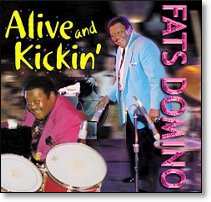
Fats Domino: Alive and Kickin' (2000 [2006], Tipitina's):
New Orleans rock and roll legend, scored 18 top-20 hits from "Ain't That
a Shame" in 1955 through "Let the Four Winds Blow" in 1961, enough for a
near-perfect single-CD compilation (e.g., The Fats Domino Jukebox)
but his non-hits rarely distinguished themselves (so don't expect many
surprises on his four-CD box). But he hasn't been a factor since then,
and hadn't released anything since 1980 until these live shots washed up
following Hurricane Katrina, when he was briefly reported as missing.
Not sure just when these were recorded ("all were recorded by 2000"),
and there are no revelations let alone classics, but he wasn't just an
oldies artist -- his one remake ages gracefully, and his obscurities
remind you what made him so likable.
A-
Gordon Grdina's Box Cutter: New Rules for Noise (2007,
Spool): Canadian guitarist, second album with this quartet: François
Houle (especially strong on clarinet), Karlis Silins (bass), Kenton
Loewen (drums). The guitarist brings a little noise, more groove, and
keeps it interesting.
B+(***)
New Lost City Ramblers: Volume II: Out Standing in Their
Field (1963-73 [1993], Smithsonian/Folkways): Founded in
1958 by Mike Seeger, John Cohen, and Tom Paley, they played old
time folk music on banjo-fiddle-guitar, introducing much of it to
a new generation. For that, see The Early Years: 1958-1962,
an essential album for any American folk collection. In 1963 Paley
was replaced by Tracy Schwartz, offerng a convenient dividing line,
with this sampler from seven albums sounding very nearly as classic.
A-
Trevor Watts/Peter Knight: Reunion: Live in London
(1999 [2007], Hi 4 Head): Alto/soprano saxophonist, an important
figure in the British avant-garde although he's gotten much less
credit than Evan Parker or John Surman (both 5 years younger) as
he's appeared much less often as a leader. Knight plays violin.
He's best known as a member of English folk group Steeleye Span,
but he played in Watts' Moire Music Sextet in 1987 and in Watts'
Original Drum Orchestra in 1989. One 56-minute improv piece, the
violin a deeply resonant duo partner.
B+(**) [bc]
Trevor Watts/Veryan Weston: Dialogues in Two Places
(2011 [2012], Hi 4 Head, 2CD): Two musicians with a long working
relationship, sax-piano duets, one disc from Guelph Jazz Festival
in Ontario, the other from a slightly earlier set in Toledo, Ohio.
Free improvs. Soprano starts shrill, but the alto balances nicely,
and the interaction is vigorous.
B+(**) [bc]
Notes
Everything streamed from Napster (ex Rhapsody), except as noted in
brackets following the grade:
- [cd] based on physical cd
- [cdr] based on an advance or promo cd or cdr
- [bc] available at bandcamp.com
- [dl] something I was able to download from the web; may be freely
available, may be a bootleg someone made available, or may be a publicist
promo
Ask a question, or send a comment.
Monday, October 30, 2017
Music Week
Music: Current count 28813 [28799] rated (+14), 405 [398] unrated (+7).
Rated count is the lowest of any week this year -- you probably have
to go back to a travel week to find one lower, although this month has
been consistently low: 18 last week, 15 the week before, 17 the week
before that. Three major reasons/excuses for this week: I took a day
off cooking dinner on my birthday (old family favorites, keeping it
relatively simple this year); I spent three days playing pretty much
nothing but a 5-CD box, American Epic: The Collection; and I
hurt myself rather badly, probably strains from moving some heavy (for
me, these days) equipment. I'm still feeling pretty crippled, which
is why yesterday's
Weekend
Roundup was so late and short, and this too will be brief. Also
brief will be tomorrow's October-ending Streamnotes -- brief because
of the light rated weeks all month long, but I doubt I'll write much
introduction either.
The equipment story: I finally replaced an old Yamaha receiver with
a new Harmon-Kardon unit. The Yamaha had developed an annoying buzz,
which I've suffered through for many months now. A friend came over
and conclusively proved that it was the Yamaha's fault, and recommended
the new unit. I'm very happy with it, but swapping it in wasn't easy.
The whole setup is in a large piece of furniture I built back when I
lived in New York, so close to forty years ago. It's taller than I am,
much wider, deeper too, and weighted down with all of my residual LP
collection (about 400 albums). It originally had three equipment shelves:
one for the turntable, one for one of those wedge-shaped Nakamichi tape
decks, and one on top for an integrated amplifier and tuner. The gear
it was built for has expired and been replaced, with one shelf returned
to albums, an old turntable resting on top of a CD changer, and now the
new receiver filling half of the top.
The problem was moving it all away from the wall to get access to the
wires in the back. I also had to add a power strip, since the new receiver
doesn't have secondary outlets. And, of course, it all needed cleaning.
I still don't have it all put back together. Meanwhile, we have another
equipment crisis: local wi-fi has been increasingly flaky. I've planned
on replacing it for quite some time, buying a new wi-fi router appliance
but never installing it. Looks like I need to do that soon. Unfortunately,
it involves getting down on the floor and moving cables. It also means
reconfiguring the firewall/router, and ultimately decommissioning a very
old Linux box (one I built in NJ before moving to Kansas in 1999). So,
some point next week everything breaks, then we scramble to put it back
together again.
I thought I might get away for a brief road trip this week, but the
way things are going I'm beginning to wonder if I'll ever go anywhere
again. Might not be so bad if I could report progress on book projects,
but all I can claim for last week are new ideas I haven't done anything
about. For instance, I thought a bit about writing an essay in the form
of "A Letter to the Democrats" -- partly reaction to reading Mark Lilla's
short and unconvincing The Once and Future Liberal: After Identity
Politics, and partly revulsion with much of what I hear from the
all-too-loyal opposition party spokespeople in Washington. (Although,
not that anyone cares, the Casey Yingling story here in Kansas could
offer a rich lode of material.)
Meanwhile, I've made no progress even on the most pedestrian of all
of my projects, the Jazz Guides. Still only 53% through the last of
the monster database files.
New records rated this week:
- Banda Magda: Tigre (2017, GroundUP Music): [r]: B+(*)
- Peter Bernstein: Signs LIVE! (2015 [2017], Smoke Sessions, 2CD): [r]: B+(**)
- Cortex: Avant-Garde Party Music (2017, Clean Feed): [r]: B+(***)
- Dylan Hicks: Ad Out (2017, Soft Launch): [r]: B+(**)
- Danny Janklow: Elevation (2015 [2017], Outside In Music): [cd]: B
- Roberto Magris Sextet: Live in Miami @ the WDNA Jazz Gallery (2015 [2017], JMood): [cd]: B+(***)
- Nicole Mitchell and Haki Madhubuti: Liberation Narratives (2016-17 [2017], Black Earth Music): [cd]: A-
- Paul Moran: Smokin' B3 Vol. 2: Still Smokin' (2017, Prudential): [cd]: B-
- Marta Sánchez Quintet: Danza Imposible (2017, Fresh Sound New Talent): [cd]: B+(**)
Recent reissues, compilations, and vault discoveries rated this week:
- American Epic: The Collection (1916-36 [2017], Third Man/Columbia/Legacy, 5CD): [cd]: A
- American Epic: The Best of Blues (1927-36 [2017], Third Man/Columbia/Legacy): [r]: B+(***)
- American Epic: The Best of Country (1927-34 [2017], Third Man/Columbia/Legacy): [r]: A-
- Sky Music: A Tribute to Terje Rypdal (2016 [2017], Rune Grammofon): [cd]: B+(*)
Old music rated this week:
- Jack DeJohnette: Made in Chicago (2013 [2015], ECM): [dl]: A-
- Fats Domino: Alive and Kickin' (2000 [2006], Tipitina's): [r]: A-
Unpacking: Found in the mail last week:
- Derek Bailey & Greg Goodman: Extracting Fish-Bones From the Back of the Despoiler (1992, The Beak Doctor): vinyl, November 1
- Rahsaan Barber: The Music in the Night (Jazz Music City): November 3
- Michelle Coltrane: Awakening (Blujazz)
- John Gruntfest & Greg Goodman: In This Land All the Birds Wore Hats and Spurs (1984-2008, The Beak Doctor): vinyl, November 1
- Taylor Haskins & Green Empire: The Point (Recombination): November 7
- Markley & Balmer: Standards & Covers (Soona Songs)
- Delfeayo Marsalis: Kalamazoo (Troubadour Jass)
- Frank Perowsky Jazz Orchestra: Gowanus (Jazzkey)
- Daniel Rosenthal: Music in the Room (American Melody): November 14
- Galen Weston: The Space Between (Blujazz)
- Eric Wyatt: Look to the Sky (Whaling City Sound)
- Dave Zinno Unisphere: River of January (Whaling City Sound)
Ask a question, or send a comment.
Sunday, October 29, 2017
Weekend Roundup
Just the bare bones this week.
Some scattered links this week:
Matthew Yglesias: 4 stories that mattered this week: Congressional
Republicans passed a budget; More sexual harassment shoes dropped;
Retiring Republicans blasted Trump; Opioid abuse is officially
an emergency. Other Yglesias posts:
There's less than meets the eye to the Trump stock rally: "German,
French, and Japanese stocks are all doing way better."
Lou Dobbs's Trump interview is a masterpiece of sycophancy and
nonsense: "precisely because the softball format leads to such easy
questions, Trump's frequent inability to answer them reveals the depths
of his ignorance better than any tough grilling possibly could."
Jeff Flake, Bob Corker, and John McCain need to start acting like senators,
not pundits.
Trump and a key Senate Republican are fighting on Twitter.
The real stakes in the tax reform debate:
Democrats have grown more critical of inequality in recent years with
Barack Obama proclaiming economic inequality to be the "defining
challenge of our time." Energy in the party shifted even-further-left
and fueled an unexpected level of support for Bernie Sanders and an
unprecedented level of skepticism about the basic fundraising model
of American politics.
Even more surprisingly, in the GOP camp Donald Trump ran hard to
the right on culture war issues while also promising a more egalitarian
form of economics -- promising to be a champion of working class
interests.
But in office, while Trump has continued to obsessively feed the
culture war maw, he is pushing a policy agenda that would add enormous
fuel to the fire of inequality -- enormous, regressive rate cuts flying
under the banner of "tax reform."
Yglesias touts a report by Kevin Hassett, head of the White House
Council of Economic Advisers, as "crucial because it's honest," but
even "honesty" doesn't help much when you're extraordinarily full of
shit:
Hassett's contention, in essence, is that the best way to benefit the
American worker is to engage in a global version of this subsidy game.
Instead of targeted subsidies for new investments from one particular
company, he and Trump want to offer a broad subsidy to all investment
profits -- old profits and new profits, real returns on productive
investments and returns on monopoly rents -- in the hopes of maximally
catering to investor interests. By catering to the interests of the
global investor class in this way, he thinks, we can do so much to
boost the growth of the American economy that almost everyone will
end up better off.
Even if "almost everyone will end up better off" by cutting the
taxes that rich people pay, that doesn't mean that tax cuts are "the
best way to benefit the American worker." Direct redistribution to
workers would be much more efficient. So would less direct approaches
such as increasing labor's leverage. But the supposition that "almost
everyone will end up better off" is itself highly suspect. The only
way giving the rich more money "trickles down" is when the rich spend
it to increase demand (which they don't do much of, although that does
account for a few jobs here in Wichita building private jets) or when
the rich invest more in productive capacity. The problem here is that
even at present -- before Trump's tax cuts kick in -- the rich have
more money than they know how to productively invest. A big part of
the problem here is that by sucking up money that working folks and
the government would be spending, their hoarding reduces aggregate
demand, and as such reduces the return on investments in productive
capacity. This effect is so large one has to wonder whether tax cuts
generate any tangible growth at all, much less growth so substantial
that "almost everyone benefits."
Yglesias goes further and notes that "Doug Holtz-Eakin, a well-regarded
former Congressional Budget Office director and current think tank leader,
believes that eliminating the estate tax will create lots of jobs." The
piece cited was written for the American Family Business Foundation, a
political front group founded to promote repeal of estate and gift taxes,
and is typical of the hackwork Holtz-Eakin has made a career out of.
Trump's latest big interview is both funny and terrifying: Before
the Lou Dobbs interview, this one with Maria Bartiromo, also of Fox
Business Channel. Subheds include: "Trump doesn't know anything about
any issue"; "Bartiromo keeps ineptly trying to cover for Trump"; and
"Trump gets all kinds of facts wrong."
Over the course of the interview, Trump also claims to be working on
a major infrastructure bill, a major welfare reform bill, and an
unspecified economic development bill of some kind.
Under almost any other past president, that kind of thing would be
considered a huge news-making get for an interviewer. But even Fox
didn't tout Bartiromo's big scoops on Trump's legislative agenda,
because 10 months into the Trump presidency, nobody is so foolish as
to believe that him saying, "We're doing a big infrastructure bill,"
means that the Trump administration is, in fact, doing a big
infrastructure bill. The president just mouths off at turns ignorantly
and dishonestly, and nobody pays much attention to it unless he says
something unusually inflammatory.
Dean Baker: The problem of doctors' salaries.
Julian Borger: Trump team drawing up fresh plans to bolster US nuclear
arsenal.
Alastair Campbell: The time has come for Theresa May to tell the nation:
Brexit can't be done: Fantasy from Tony Blair's former director of
communications, but the facts are sound enough, just the political will
is weak. Campbell has also written:
My fantasy Corbyn speech: 'I can no longer go along with a ruinous
Brexit'.
Alexia Fernández Campbell: Nurses returning from Puerto Rico accuse
the federal government of leaving people to die.
Danica Cotto: Puerto Rico Says It's Scrapping $300M Whitefish Contract:
Not clear how a 2-year-old company from Interior Secretary's Ryan Zinke's
home town managed to win a $300M no-bid contract, but the more people
look into it the more suspicious it seems. For instance:
Whitefish Energy contract bars government from auditing deal. For more:
Ken Klippenstein: $300M Puerto Rico Recovery Contract Awarded to Tiny
Utility Company Linked to Major Trump Donor; also
Kate Aronoff: Disaster Capitalists Take Big Step Toward Privatizing
Puerto Rico's Electric Grid.
Thomas Frank: What Harvey Weinstein tells us about the liberal world:
I'm not sure you can draw any conclusions about political philosophy
from someone like Weinstein, who more than anything else testifies
that people with power tend to abuse it, regardless of their professed
values. Still, this is quasi-amusing:
Perhaps Weinstein's liberalism was a put-on all along. It certainly wasn't
consistent or thorough. He strongly disapproved of Bernie Sanders, for
example. And on election night in November 2008, Weinstein could be found
celebrating Barack Obama's impending victory on the peculiar grounds that
"stock market averages will go up around the world."
The mogul's liberalism could also be starkly militaristic. On the release
of his work of bald war propaganda, Seal Team Six, he opined to CNN
as follows:
"Colin Powell, the best military genius of our time, supports the
president -- supports President Obama. And the military love him. I made
this movie. I know the military. They respect this man for what he's done.
He's killed more terrorists in his short watch than George Bush did in
eight years. He's the true hawk."
Ronald A Klain: He who must be named:
For decades, conservatives labored to make their movement more humane.
Ronald Reagan put a jovial face on conservative policies -- more Dale
Carnegie than Ayn Rand; George H.W. Bush promised a "kinder, gentler"
tenure; George W. Bush ran on "compassionate conservatism." . . .
That was then. Today, we are living the Politics of Mean. In the
Trump presidency, with its daily acts of cruelty, punching down is a
feature, not a bug. And the only thing more disquieting than a president
who practices the Politics of Mean are the voters who celebrate it. . . .
Since Trump's victory, his meanness has been infectious. We have
seen it in neo-Nazis marching in Charlottesville and elsewhere, students
chanting "build that wall" at Hispanic peers, and a rise of racial
epithets and anti-Semitic graffiti on college campuses. Puerto Rico,
again, provides a current example. As The Post's Jenna Johnson recently
reported, countless Trump supporters -- including some in Texas, who
themselves took Federal Emergency Management Agency aid after Hurricane
Harvey -- back the president's proposal to limit aid to Puerto Rico and
believe that fellow Americans there should "fix their own country up."
The obvious difference between then (1980-2000) and now is sixteen
years of endless war, although it's worth noting that conservatism has
always prided itself on being a hard way of life, a stance which never
took much prodding to tip over into meanness. Indeed, even while feigning
compassion conservative political pitches always started with playing on
people's prejudices -- primordially racism, as Reagan made clear when he
launched his 1980 campaign over the graves of slain civil rights workers.
Klain calls for a list of recent presidents and wannabes to stand up to
Trump's Politics of Mean. They should, of course, but it would be even
more helpful if they owned up to how their own errors got us here.
Julia Manchester: National Weather Service 'on the brink of failure'
due to job vacancies.
Rupert Neate: World's witnessing a new Gilded Age as billionaires' wealth
swells to $6tn.
Billionaires' fortunes increased by 17% on average last year due to the
strong performance of their companies and investments, particularly in
technology and commodities. The billionaires' average return was double
that achieved by the world's stock markets and far more than the average
interest rates of just 0.35% offered by UK instant-access high street
bank accounts.
John Nichols: Trump's FCC Chair Moves to Undermine Journalism and
Democracy.
Mark Perry: Are Trump's Generals in Over Their Heads? "For many in
Washington, they're the only thing standing between the president and
chaos. But their growing clout is starting to worry military experts."
One problem is that as more generals move into politics, the military
itself (at least at the top) becomes increasingly politicized. I would
add that the competency and maturity they supposedly possess are traits
with little real evidence to back them up.
Paul Woodward also adds:
The problem with viewing the former and current generals in this
administration as the indispensable "adult supervision" Trump requires,
is that these individuals are the sole source of legitimacy for
his presidency -- exactly the reason he surrounded himself with this
kind of Teflon political protection.
Instead of seeing Mattis et al as the only thing that stands between
us and Armageddon, we should probably see them as the primary obstacle
to the outright exposure of the fraud that has been perpetrated by Trump
and the cadre of visibly corrupt cronies he has installed in most of the
executive branch of government.
Speaking of the alleged competence of generals, see
Senior military officials sanctioned for more than 500 cases of serious
misconduct: That just since 2013.
Andrew Prokop: 6 charts that explain why American politics is so broken:
"The Pew Research Center's political typology report, explained." Actually,
I'm not sure he charts do explain "why American politics is so broken" --
for one thing, nothing here on the influence of money, which is by far the
biggest breaker. They do show several disconnects, including "Most Americans --
including a good chunk of Republicans -- want corporate taxes raised, not
lowered" and "It's only a vocal minority of Americans who are anti-immigrant."
Nor do most of the typology groups make much sense, although "Country-First
Conservatives" are defined exclusively by their hatred for immigrants.
Still, worth noting that "Solid Liberals" are more numerous than "Core
Conservatives" (16-13% among the general public, 25-20% among "politically
engaged."
Charlie Savage: Will Congress Ever Limit the Forever-Expanding 9/11
War?
Joseph E Stiglitz: America Has a Monopoly Problem -- and It's Huge.
Nick Turse: It's Not Just Niger -- U.S. Military Activity Is a "Recruiting
Tool" for Terror Groups Across West Africa.
Ask a question, or send a comment.
Monday, October 23, 2017
Music Week
Music: Current count 28799 [28781] rated (+18), 398 [402] unrated (-4).
As predicted (feared), another short week with many distractions.
Next week looks pretty similar, which means October's Streamnotes will
very likely be the year's shortest -- lowest monthly count so far is
111 in May (114 in March, 115 in April, 119 in August; top count was
156 in January, followed by 153 in February, 149 in June, 144 in
September). Current draft has 59 records, so that extrapolates to
about 83. I'd need a week (plus a day) with 52 reviews to match my
previous lowest monthly total this year.
Only three non-jazz albums below: Corey Dennison's blues album
actually came in the mail; Wooden Wand was suggested by a tweet
(actually an earlier album, not on Napster, so I tried the new
one); Twitter also led me to the latest release by Awesome Tapes
From Africa -- possibly the only label I actually follow
there.
I haven't made a serious attempt to survey new non-jazz released
in a couple months, so I have very little idea what to look for.
Still, quite a few jazz albums in the queue, and many more I'm not
serviced on. Unfortunately, I'm finding fewer than 50% of the new
jazz I look for. I expect this will add up to my poorest coverage
level since I started Jazz Consumer Guide in 2004.
New records rated this week:
- Borderlands Trio [Stephan Crump/Kris Davis/Eric McPherson]: Asteroidea (2015 [2017], Intakt): [cd]: A-
- Dee Dee Bridgewater: Memphis . . . Yes, I'm Ready (2017, Okeh): [r]: B+(**)
- Kyle Bruckmann's Degradient: Dear Everyone (2017, Not Two, 2CD): [r]: B+(**)
- Bobby Bradford/Hafez Modirzadeh: Live at the Magic Triangle (2016 [2017], NoBusiness): [cdr]: B+(**)
- Corey Dennison Band: Night After Night (2017, Delmark): [cd]: B+(***)
- Mark Dresser: Modicana (2016-17 [2017], NoBusiness): [cdr]: B+(**)
- Bob Ferrel: Bob Ferrel's Jazztopian Dream (2016 [2017], Bob Ferrel Music): [cd]: B+(*)
- Ghost Train Orchestra: Book of Rhapsodies Vol II (2012-17 [2017], Accurate): [cd]: B+(*)
- Ross Hammond + Jon Bafus: Masonic Lawn (2016 [2017], Prescott): [r]: B+(***)
- Hans Hassler: Wie Die Zeit Hinter Mir Her (2015 [2017], Intakt): [cd]: B+(*)
- Ahmad Jamal: Marseille (2017, Jazz Village): [r]: B+(**)
- Rudresh Mahanthappa's Indo-Pak Coalition: Agrima (2017, self-released): [cdr]: A-
- Alma Micic: That Old Feeling (2017, Whaling City Sound): [cd]: B+(**)
- Mike Stern: Trip (2017, Heads Up): [r]: B+(*)
- Wooden Wand: Clipper Ship (2017, Three Lobed): [r]: B
Recent reissues, compilations, and vault discoveries rated this week:
- Professor Rhythm: Bafana Bafana (1995 [2017], Awesome Tapes From Africa): [r]: A-
- Ton-Klami [Midori Takada/Kang Tae Hwan/Masahiko Satoh]: Prophecy of Nue (1995 [2017], NoBusiness): [cd]: B+(***)
Unpacking: Found in the mail last week:
- Sheryl Bentyne: Rearrangements of Shadows: The Music of Stephen Sondheim (ArtistShare)
- The Billy Lester Trio: Italy 2016 (Ultra Sound): November 3
- Roy McGrath: Remembranzas (JL Music): November 7
- Kyle Motl Trio: Panjandrums (Metatrope): November 6
- Gabriele Tranchina: Of Sailing Ships and the Stars in Your Eyes (Rainchant Eclectic)
- Mark Wingfield/Markus Reuter/Asaf Sirkis: Lighthouse (Moonjune): November
Ask a question, or send a comment.
Sunday, October 22, 2017
Weekend Roundup
I didn't get a head start on this -- in fact, started after dinner on
Sunday, so it's pretty quick and dirty, with a limited set of sources.
Still, it's so easy to find such appalling stories that posts like this
practically write themselves.
Some scattered links this week:
Matthew Yglesias: 4 political stories that actually mattered this week:
We got a bipartisan insurance stabilization deal: thanks to Sens.
Patty Murray (D-WA) and Lamar Alexander (R-TN), but: Republican leaders
don't seem to want a deal, like Paul Ryan, with Trump both waxing and
waning; The administration tested some new tax arguments, like
"corporate tax cuts boost wages" and "math forces tax cuts for the rich";
Nobody knows what's happening with NAFTA, hence no real story here,
but Trump's folks are blowing some smoke. Other Yglesias pieces this week:
The raging controversy over Trump and the families of fallen soldiers,
explained: well, more like summarized, as it's hard to explain how
tone-deaf Trump is in human interactions as straightforward (albeit no
doubt unpleasant) as issuing condolences.
Yet Trump has managed to completely and utterly botch this relatively
simple job less than a week after creating a major diplomatic crisis
with Iran for no particular reason. The humanitarian crisis in Puerto
Rico appears to be, if anything, intensifying as citizens cope with a
chronic lack of safe water. The president has willfully destabilized
individual health insurance markets without any clear plan and is
actively scuttling congressional efforts to stabilize the situation.
Other serious challenges are lurking out there in the world, yet the
Trump administration seemed incapable of issuing a simple condolence
statement or answering a question about it without unleashing a
multi-front political fiasco.
Trump aide says manufacturing decline increases abortions, death, and drug
abuse: "He might be right." Reviews research on "China shock" -- what
happens to areas hard hit by job losses due to cheaper imports. You can
blame this on trade deals, but it's also indicative of the frayed safety
net all across the country.
Republians say they can't figure out how to not cut taxes for the
rich: "It's really not very hard." If, say, you wanted to lower
rates on the first $100k of income, that would reduce taxes on those
who make more too, but you could offset that by increasing the rate
further up the income scale. Or you could do it lots of other ways.
And don't bother cutting the estate tax, something no one in the
middle class has to pay -- that's only a benefit for the very rich.
Trump says a big corporate tax cut will boost average incomes by $4,000
a year.
Sarah Aziza: How Long Can the Courts Keep Donald Trump's Muslim Ban at
Bay? Two federal judges issued injunctions against the third iteration
of Trump's travel ban last week.
Julia Belluz: White House officials think childhood obesity is not a
problem. Have they seen the data? Their campaign to wipe out
Obama's legacy (in this case, Michelle Obama's) continues apace.
Aida Chavez: House Republicans Warn Congress Not to "Bail Out" Puerto
Rico.
Jason C Ditz: What Are U.S. Forces Doing in Niger Anyway?: Four US
Special Forces were killed in an ambush a couple weeks ago, finally
pointing a spotlight on US intervention there (much like the Benghazi
fiasco).
Turns out that for five years Niger has been a toe in the expanding
American footprint in Africa, and has become a hub of U.S. military
activity (about 800 soldiers are serving as advisors and training
local forces there now) and, according to Nick Turse, the location
of a brand new $100 million drone base. Meanwhile, the region has
become a crossroads of Islamist activity, from Boko Haram in Nigeria
to al-Qaeda in the Islamic Maghreb across the Sahel. And now,
apparently, ISIS. . . .
Niger is far from the exception. In March 2012, the Pentagon
confirmed that U.S. troops were attacked in the southern Yemeni
city of Aden, and that a CIA officer was killed. This was the
first time officials confirmed that the U.S. had ground troops
operating inside Yemen at all. The revelation is even more stunning
when one recalls that the White House publicly ruled out sending
ground troops to Yemen several times in the years leading up to
this admission.
More war news from around the world:
Lee Fang/Nick Surgey: Koch Brothers' Internal Strategy Memo on Selling
Tax Cuts: Ignore the Deficit: After all, deficits only matter when
a Democrat is president and might use deficits for expanding services
and/or growing the economy -- things Republicans oppose and, especially,
want to make sure no Democrat gets credit for. But when Republicans are
in power, well, as Dick Cheney said, "deficits don't matter."
Sarah Kliff: Medicare X: the Democrats' supercharged public option plan,
explained: Specifically, Sens. Bennet and Kaine, a plan that makes
less sense than Bernie Sanders' Medicare-for-all but would involve less
turmoil by adding a Medicare-based plan to the Obamacare exchanges as a
public option, increasing competition for private insurance plans.
Paul Krugman: Lies, Lies, Lies, Lies, Lies, Lies, Lies, Lies, Lies,
Lies: A propos of the Trump's "new" arguments for slashing taxes,
Krugman explains:
Modern conservatives have been lying about taxes pretty much from the
beginning of their movement. Made-up sob stories about family farms
broken up to pay inheritance taxes, magical claims about self-financing
tax cuts, and so on go all the way back to the 1970s. But the selling
of tax cuts under Trump has taken things to a whole new level, both in
terms of the brazenness of the lies and their sheer number. Both the
depth and the breadth of the dishonesty make it hard even for those of
us who do this for a living to keep track.
He then comes up with a list of ten (see the article for details,
although you're probably familiar with most of them already):
- America is the most highly-taxed country in the world
- The estate tax is destroying farmers and truckers
- Taxation of pass-through entities is a burden on small business
- Cutting profits taxes really benefits workers
- Repatriating overseas profits will create jobs
- This is not a tax cut for the rich
- It's a big tax cut for the middle class
- It won't increase the deficit
- Cutting taxes will jump-start rapid growth
- Tax cuts will pay for themselves
One thing that's missing in this debate is what do we need taxes for.
Some people argue that taxes should be limited to a certain percentage
of GDP -- often the same people who don't understand why government
spends more now than it did under Coolidge or McKinley. I think it's
obvious that a lot of things that we need in today's economic world
are necessarily more expensive than they were in past eras (especially
things that didn't really exist back then). To figure this out, one
needs some kind of multifactor analysis, and I think especially one
has to ask what things are most efficiently produced and distributed
through public channels. I think this list is large and growing, and
may include things that surprise you. If this list is as large as I
think, we need to be looking not at ways to cut taxes but at ways to
grow them, and how to do so fairly and efficiently. As it is, the
relentless focus on cutting taxes is an attack on public spending,
and ultimately on the public taxes are meant to serve.
Jane Mayer: The Danger of President Pence: A profile of the
vice president, one which raises plenty to be alarmed about, not
least because his odds of being elevated to the presidency via
the 25th amendment (the one that says all it takes is a majority
of the cabinet to find Trump incompetent -- perhaps something
Trump should have considered before giving Pence so much say in
picking nominees). For more on the 25th, see
Jeannie Suk Gersen: How Anti-Trump Psychiatrists Are Mobilizing
Behind the Twenty-Fifth Amendment.
Anna North: A detained 17-year-old immigrant wants an abortion. The
government went to court to stop her. Here's a case where the
Trump administration isn't being run like a business -- try finding
an angle where it makes sense for the government to prevent a detained
emigrant from obtaining an abortion -- but more like a shady religious
cult. For more cultlike behavior:
Doe is not the only minor who's been affected by the policy, according
to the ACLU. In March, according to court documents filed by the group,
another minor at a shelter in Texas chose to have a medication abortion
after getting a judge's permission for the procedure. After she had
taken the first dose of the medication, ORR officials forced her to go
to an emergency room to see if the abortion could be reversed. Ultimately,
she was allowed to proceed with the abortion and take the remaining dose
of the medication. In another case, the ACLU said, Lloyd traveled from
Washington, DC, to meet personally with a young woman to try to convince
her not to have an abortion.
Jon Schwartz: It Didn't Just Start Now: John Kelly Has Always Been a
Hard-Right Bully: The former Marine General has had a tough week,
not only failing repeatedly to keep Trump from embarrassing himself,
but having his own Trumpian moment making baseless charges against
Rep. Frederica Wilson. The best Trump mouthpiece Sarah Sanders came
up with in Kelly's defense was
It's "highly inappropriate" to question John Kelly -- because he's a
general. Schwartz compresses "Kelly's worldview, as expressed in
2010" into this short list:
- No one outside of the military can legitimately question any
of America's wars.
- No one who is in the military ever questions any of
America's wars.
- America and its wars are and have always been good.
- America is under terrifying threat from incomprehensible
lunatics.
- Our country is hamstrung by its sniveling "chattering class."
I've run across many more links on Kelly and Wilson, but I'd rather
point out this one:
Alice Speri: Top Trump Official John Kelly Ordered ICE to Portray
Immigrants as Criminals to Justify Raids.
Matt Shuham: Forbes: Trump Drops on 'Richest Americans' List as Net Worth
Takes a Hit: Down $600 million to $3.1 billion, dropping 92 spots
(from 156 to 248). No real analysis here as to why. Certainly, it's not
because he's resolved his conflicts-of-interest and made it impossible
to use his office to feather his own nest. And this looks extra bad with
the stock market setting new record highs. On the other hand, leaving
his day-to-day business decisions in the hands of Jr. and Eric may not
ave been the smartest idea. And naming so many properties after himself
has politicized them, which makes their value at least partly subject
to his extraordinarily low popularity.
Ask a question, or send a comment.
Monday, October 16, 2017
Music Week
Music: Current count 28781 [28766] rated (+15), 402 [401] unrated (+1).
Second short-count week in a row, following a +17 last week. No
surprise for me, as we played host for a visiting friend from Boston.
I spent one day cooking a nice dinner -- Moroccan, main dish was cod
marinated in chermoula and baked over potatoes and tomatoes; sides
were a roasted eggplant salad, roasted red bell peppers with goat
cheese, a carrot salad, an olive-orange-onion salad, and a sweet
potato-olive salad; dessert was a mixed fruit salad with honey and
orange blossom water. Next day we drove out to Quivira NWR, Cheyenne
Bottoms, and back through Lindsborg. Ate at Country Crossing in Yoder
on the way out, and Swedish Crown in Lindsborg on the way back. Third
day we drove around Wichita, dining at Molino's (Mexican). Anyhow,
knocked about half of my week out, and I never really got back into
it.
I did manage a small bit of progress on the Jazz Guides. I'm up to
51% in the
Jazz 2000's file, which
puts me at Julian Lage, and gives me 1197 pages. One metric I've been
using suggests that I have 157 pages to go (1354 total), but that
doesn't account for group entries that I've set aside -- probably
another 50-75 pages. The 20th Century Guide is still stuck at 749
pages, so I'm 54 short of 2000 combined. That'll probably be a
milestone to mark with a
tweet, hopefully
later this week.
One minor note on the list below. I was reminded of the Mose Allison
compilation, which
Christgau had given an A- to, by its conspicuous (albeit alphabetical)
slotting on
Phil Overeem's latest list. The record isn't available on Napster, but
I was able to line up 23/24 songs, and figured that's close enough. Not
quite as good as I'd like, although I could imagine the booklet and a few
more plays pushing it over the line. One thing I'm pretty sure of is that
I could assemble an A- compilation, although I've yet to find any available
record that quite makes the grade.
I expect I'll get closer to 30 records next week, although I'm likely
to run into a few distractions. Also having trouble figuring out what to
listen to on Napster, although my own new jazz queue is pretty deep right
now, so there's that.
I should also note that some space has opened up on the server, so for
a while I should be back to normal there. Still think I should move it all,
but the immediate need is less urgent.
Laura Tillem had a nit to pick with my outrage at Trump and Tillerson
for withdrawing the US from UNESCO yesterday. She blamed Obama. I'm not
sure of the exact chronology or responsibility, but in 2011 the US stopped
paying dues to UNESCO because they admitted Palestine as a full member.
This was evidently mandated by a law passed by Congress -- I don't know
whether it was signed by Obama, but wouldn't be surprised if it was. In
2012, Obama asked Congress to restore funding for UNESCO, and was turned
down. In 2015 UNESCO passed a resolution that Israel took offense to --
something having to do with Jerusalem -- and at some point UNESCO designated
the Tomb of the Patriarchs in Hebron as a World Historical site, and made
the faux pas of designating it as part of Palestine. But disagreements
happen with international organizations. What I was more concerned with
was the American refusal to participate and engage, which is consistent
and largely dictated by neocon (imperialist) doctrine. Indeed, it should
be pointed out that Israel didn't announce that it's leaving UNESCO until
after the US did, supposedly on its behalf. I might also note that the
US-Israeli decision casts further doubt that either nation has any real
commitment to "the two-state solution," which has been official policy,
at least in the US, at least since the early 1990s. If the US actually
supported its own policy, you'd expect it to help establish international
recognition of a Palestinian state even before Israel formalized the deal.
Instead, since GW Bush the US has routinely subordinated its own policies
and interests to Israel -- a blank check surrender which Obama and Trump
have continued.
There is, I think, an interesting book to be written about how the
critique of internationalism and, especially, the UN, has grown from
a fringe cult like the 1950s John Birch Society into a hegemonic idea
that dictates American foreign policy, affecting both parties.
New records rated this week:
- Rez Abbasi: Unfiltered Universe (2016 [2017], Whirlwind): [cd]: B+(**)
- Ellery Eskelin: Trio Willisau Live (2015 [2016], Hatology): [r]: A-
- Andrew Lamb/Warren Smith/Arkadijus Gotesmanas: The Sea of Modicum (2016 [2017], NoBusiness): [cdr]: B+(*)
- Rob Luft: Riser (2017, Edition): [r]: B
- Liudas Mockunas: Hydro (2015-16 [2017], NoBusiness): [cdr]: B+(**)
- Mostly Other People Do the Killing: Paint (2017, Hot Cup): [cd]: B+(***)
- Johnny O'Neal: In the Moment (2017, Smoke Sessions): [r]: B+(*)
- Teri Parker: In the Past (2016 [2017], self-released): [cd]: B+(**)
- Wadada Leo Smith: Najwa (2014 [2017], TUM): [cd]: A-
- Wadada Leo Smith: Solo: Reflections and Meditations on Monk (2014-15 [2017], TUM): [cd]: B+(**)
- Yosvany Terry/Baptiste Trotignon: Ancestral Memories (2017, Okeh): [r]: B+(*)
- Charles Thomas: The Colors of a Dream (2017, Sea Tea): [cd]: B+(*)
- Lizz Wright: Grace (2017, Concord): [r]: B+(***)
Recent reissues, compilations, and vault discoveries rated this week:
- Mose Allison: I'm Not Talkin': The Soul Stylings of Mose Allison 1957-1971 (1957-71 [2016], BGP): [r]: B+(***)
Unpacking: Found in the mail last week:
- Ernesto Cervini's Turboprop: Rev (Anzic)
- Corey Christiansen: Dusk (Origin): October 20
- Richie Cole: Latin Lover (RCP): October 20
- Marc Devine Trio: Inspiration (ITI): October 13
- Sinne Eeg: Dreams (ArtistShare)
- ExpEAR & Drew Gress: Vesper (Kopasetic): November 15
- Lorenzo Feliciati: Elevator Man (RareNoise): advance, November 17
- Satoko Fujii Quartet: Live at Jazz Room Cortez (Cortez Sound): October 20
- Adam Hopkins: Party Pack Ice (Ad-Hop Music)
- Lisa Mezzacappa: Glorious Ravage (New World)
- Diana Panton: Solstice/Equinox (self-released)
- Roswell Rudd/Fay Victor/Lafayette Harris/Ken Filiano: Embrace (RareNoise): advance, November 17
- Idit Shner: 9 Short Stories (OA2)
Ask a question, or send a comment.
Sunday, October 15, 2017
Weekend Roundup
Every week since January has featured multiple stories about how
Donald Trump (and/or the Republicans) are corrupting government,
undermining democracy, degrading our short- and long-term economic
prospects, and quite often endangering world peace. Still, most of
those stories could be understood as some combination of the greed,
demagoguery, and narrow-minded ignorance that constitutes what passes
as the conservative world-view. But some things happened this week
that makes me think Trump has crossed a previously unknown line into
a qualitatively new level of, well, I'm groping for words, trying to
avoid "evil," so let's call it derangement. The US withdrawal from
UNESCO was the first such story, followed by the trashing of the
agreement with Iran to terminate their "nuclear program," but then
there was Trump's executive order to undermine Obamacare -- an act
of pure spite following the Republican failure to repeal the ACA.
As Ezra Klein's tweet explains:
Trump's new policy will increase premiums by 20%, cost the government
$194 billion, increase the deficit, destabilize insurance markets, and
increase the number of uninsured Americans. There is nothing it makes
better; it's pure policy nihilism.
Sure, I've often felt like Republicans generated their policy ideas
from a deep well of spite and vindictiveness, with scant concern for
consequences because deep down they really didn't give a shit about
anyone other than themselves (actually, a small subset of the fools
they manipulating into voting for them). But usually you could also
discern a positive slant, like their fondness for helping predatory
businesses rip everyone else off. Trump certainly isn't beyond that,
especially for his own businesses, but he mostly leaves such matters
to his subordinates -- after all, their experience in business and
lobbies gives them a command of detail he lacks, as well as motives
he doesn't disapprove of.
That's should have left Trump free to focus on "big picture" items,
but not understanding them either, he's been preoccupied with petty
feuds and tone-deaf publicity stunts, but his hatred for Obama is so
great that he'll gladly sign any executive order that wipes out any
hint of his predecessor's legacy. That's the source of much of his
policy nihilism, although he's occasionally broken new ground, as
with his UNESCO withdrawal -- ending 72 years of more/less trying to
work with the rest of the world's nations for the common good.
I suppose what this really means is that for the first time since
he took office, I've come around to the view that Trump is actually
worse than the run-of-the-mill Republicans in Congress and now in his
cabinet and office. I've long resisted that view, partly because the
media bend over backwards to excuse and legitimize the latter, and
partly because even though I disapprove of Trump's obvious character
flaws (e.g., racism, sexism, xenophobia, vanity, violence, mendacity,
ostentatiousness, sheer greed) I prefer to judge people on what they
do rather than what they think or believe. (Indeed, those flaws are
pretty common in America, but most people have enough of a superego
to try to limit their exposure and maintain social decorum -- Trump,
as is becoming more obvious every day, does not.)
On the other hand, let's not forget that Trump started to wander
off after giving his little rant about Obamacare, and it was Mike
Pence who grabbed him by the sleeve and dragged him back to actually
sign the executive order. That's an image to keep in mind if, say,
Trump is finally dispatched as too much of an embarrassment -- and
here I have to agree with Steve Bannon that the odds favor a cabinet
coup using the 25th amendment to Congress taking the more arduous
road to impeachment.
Some scattered links this week:
Aaron Blake: Almost half of Republicans want war with North Korea, a new
poll says. Is it the Trump Effect? Actually, a plurality, 46-41% in
favor of a preemptive strike against North Korea. Other polls produce
different results, possibly depending on how the question is phrased.
I doubt if even 1% of the Republicans polled have any understanding of
North Korea's preparations for responding to such an attack, hence of
the risks and likely costs of starting a war there. On the other hand,
one may expect Mattis, Tillerson, and the upper ranks of the uniformed
to at least have some idea: thousands of pieces of artillery that can
reach Seoul (population 10 million, metro area 25 million), the range
of rockets that can reach further (up to the US mainland), a few dozen
nuclear warheads (some with hydrogen boost), the vast array of defensive
tunnels, one of the largest military forces in the world. The latest
assessment I've seen is that the US would prevail in such a war (assuming
China does not intervene, as it did in 1950), but it wouldn't be easy
and the costs would be great. Tillerson was recently quoted as saying
he'll continue negotiating "until the first bomb falls" -- it's hard
to take much comfort in that given that Trump's been quoted as saying
his Secretary of State is wasting his time. Moreover, see
Choe Sang-Hun: North Korean Hackers Stole U.S.-South Korean Military
Plans, Lawmaker Says, including a "decapitation plan" for an
attack targeting Kim Jong-Un. Also note the report that
Trump Wanted Tenfold Increase in U.S. Nuclear Arsenal -- while
beyond ridiculous, such a report would play directly into North Korea's
paranoia. Indeed, Trump is playing Nixon's
Madman theory much more convincingly than the Trickster ever did.
(For a recent review, see
Garrett M Graff: The Madman and the Bomb. Among other things, this
article points out how elated Trump was in ordering the "Mother of All
Bombs" dropped in Afghanistan, adding "All the previous worries about
the potential of a deranged president to use a nuclear button irrationally
have been multiplied.") Lately Trump has made a number of bold unilateral
moves, evidently meant to reassure his base that he can act dramatically
on their prejudices. The more he senses support for striking North Korea,
the more likely he is to do it.
Tina Brown: What Harvey and Trump have in common: Harvey is Weinstein,
the movie mogul and current poster boy for serial sexual abuse. Brown left
her job at The New Yorker to work for him, and this is what she
found out:
What I learned about Harvey in the two years of proximity with him at
Talk was that nothing about his outward persona, the beguiling Falstaffian
charmer who persuaded -- or bamboozled -- me into leaving The New Yorker
and joining him, was the truth. He is very Trumpian in that regard.
He comes off as a big, blustery, rough diamond kind of a guy, the kind
of old-time studio chief who lives large, writes big checks and exudes
bonhomie. Wrong. The real Harvey is fearful, paranoid, and hates being
touched (at any rate, when fully dressed).
Winning, for him, was a blood sport. Deals never close. They are
renegotiated down to the bone after the press release. A business meeting
listening to him discuss Miramax deals in progress reminded me of the wire
tap transcripts of John Gotti and his inner circle at the Bergin Hunt and
Fish Club in Queens. "So just close it fast, then fuck him later with the
subsidiary rights." . . .
Harvey is an intimidating and ferocious man. Crossing him, even now,
is scary. But it's a different era now. Cosby. Ailes. O'Reilly, Weinstein.
It's over, except for one -- the serial sexual harasser in the White House.
For more Weinstein dirt, see
Ronan Farrow: From Aggressive Overtures to Sexual Assault: Harvey
Weinstein's Accusers Tell Their Stories. As for Trump, see:
Jessica Garrison/Kendall Taggart: Trump Given a Subpoena for All Documents
Relating to Assault Allegations.
Daniel José Camacho: Trump's marriage to the religious right reeks of
hypocrisy on both sides: Well, sure, but hypocrisy is an old friend
of Christianity in every stage of American history, and you can probably
find prime examples at least as far back as Constantine, who realized
how useful the religion could be for sanctifying his own political power.
Christianity is, above all else, a remarkably forgiving religion, as
long as you attest to its power by begging for its mercy. In country
music, for instance, whatever you do on Saturday Night can be atoned
for and made right on Sunday Morning, and the latter is all that really
matters to the clergy -- after all, confession confirms their authority.
The political right has never had a problem with that. They love the
idea of hierarchy so much they strive to emulate it on earth, ruled,
of course, by themselves, conferring favors upon their favored clergy.
Of course, if you don't buy into this arrangement, your cynicism may
lead you to charge them with hypocrisy. Indeed, the whole scam is as
easy to see through as "The Emperor's New Clothes," but that only makes
the believers more angry and vindictive -- hence, the rise of the
Religious Right parallels liberal secularization, with its increasing
militancy (and, looking at Trump, I'm inclined to add desperation)
bound up with a feeling of embattled isolation that right-wing media
and politicians have cynically encouraged. Still, the problem is less
Christian backlash against secular culture -- something that is real
but deeper and more complex than the political backlash it is often
confused with[*] -- than that con artists from Reagan to Trump have often
managed to wrap their scams up in various traditional pieties, as if
that excuses otherwise shameless behavior.
[*] Note that Christianity predates capitalism, so contains a strain
of anti-materialist sentiment that has never been fully reconciled with
modern commerce. It even predates Constantine's state religion, before
which it was resolutely anti-state and anti-war, so even today a large
segment of the peace movement finds its inspiration in religion (and
not just Christianity).
William D Hartung: Here's Where Your Tax Dollars for 'Defense' Are Really
Going:
The answer couldn't be more straightforward: It goes directly to private
corporations and much of it is then wasted on useless overhead, fat
executive salaries, and startling (yet commonplace) cost overruns on
weapons systems and other military hardware that, in the end, won't
even perform as promised. Too often the result is weapons that aren't
needed at prices we can't afford. If anyone truly wanted to help the
troops, loosening the corporate grip on the Pentagon budget would be
an excellent place to start.
The numbers are staggering. In fiscal year 2016, the Pentagon issued
$304 billion in contract awards to corporations -- nearly half of the
department's $600 billion-plus budget for that year. And keep in mind
that not all contractors are created equal. According to the Federal
Procurement Data System's top 100 contractors report for 2016, the
biggest beneficiaries by a country mile were Lockheed Martin ($36.2
billion), Boeing ($24.3 billion), Raytheon ($12.8 billion), General
Dynamics ($12.7 billion), and Northrop Grumman ($10.7 billion). Together,
these five firms gobbled up nearly $100 billion of your tax dollars,
about one-third of all the Pentagon's contract awards in 2016. . . .
The arms industry's investment in lobbying is even more impressive.
The defense sector has spent a total of more than $1 billion on that
productive activity since 2009, employing anywhere from 700 to 1,000
lobbyists in any given year. To put that in perspective, you're talking
about significantly more than one lobbyist per member of Congress, the
majority of whom zipped through Washington's famed "revolving door";
they moved, that is, from positions in Congress or the Pentagon to
posts at weapons companies from which they could proselytize their
former colleagues.
The weapons systems are the big ticket items, but there is much more,
including some 600,000 private contractors doing all sorts of things,
with little effective management, while companies like Erik Prince's
Blackwater lobby to privatize more combat jobs.
Sean Illing: 20 of America's top political scientists gathered to discuss
our democracy. They're scared. Many interesting idea here; e.g.:
Nancy Bermeo, a politics professor at Princeton and Harvard, began her
talk with a jarring reminder: Democracies don't merely collapse, as that
"implies a process devoid of will." Democracies die because of deliberate
decisions made by human beings.
Usually, it's because the people in power take democratic institutions
for granted. They become disconnected from the citizenry. They develop
interests separate and apart from the voters. They push policies that
benefit themselves and harm the broader population. Do that long enough,
Bermeo says, and you'll cultivate an angry, divided society that pulls
apart at the seams. . . .
Due to wage stagnation, growing inequalities, automation, and a
shrinking labor market, millions of Americans are deeply pessimistic
about the future: 64 percent of people in Europe believe their children
will be worse off than they were; the number is 60 percent in America.
That pessimism is grounded in economic reality. In 1970, 90 percent
of 30-year-olds in America were better off than their parents at the
same age. In 2010, only 50 percent were. Numbers like this cause people
to lose faith in the system. What you get is a spike in extremism and
a retreat from the political center. That leads to declines in voter
turnout and, consequently, more opportunities for fringe parties and
candidates. . . .
Consider this stat: In 1960, 5 percent of Republicans and 4 percent
of Democrats objected to the idea of their children marrying across
political lines. In 2010, those numbers jumped to 46 percent and 33
percent respectively. Divides like this are eating away at the American
social fabric. . . .
But for all the reasons discussed above, people have gradually
disengaged from the status quo. Something has cracked. Citizens have
lost faith in the system. The social compact is broken. So now we're
left to stew in our racial and cultural resentments, which paved the
way for a demagogue like Trump.
One thing I would stress here is that "the erosion of democratic
norms" -- voter suppression, gerrymandering, obstruction tactics,
tolerance for "dirty tricks," the ever-increasing prerogatives of
money -- has largely been spawned within the Republican Party, which
is to say the party most desperately committed to inequality, order,
privilege, and hierarchy. The article offers stats about the growing
number of Americans who look favorably on a military dictatorship,
but neglects to break them down by party. Still, it's worth noting
that Democrats have often played into the hands of anti-democratic
forces, especially those who have been most successful at toadying
for donors. Although Obama, for instance, campaigned against the
baleful influence of money in 2008, he managed to raise so much more
of it than McCain, so Democrats didn't bother to use their majorities
to address the issue.
Sarah Jaffe: Bernie Sanders Isn't Winning Local Elections for the Left:
"Bernie Wins Birmingham" is convenient shorthand for those who have no idea
what actually goes on in Birmingham. But Bernie Sanders and the group his
2016 campaign inspired, Our Revolution, are not winning elections in places
like Birmingham or Jackson, Mississippi, which in June elected a mayor who's
promised, "I'll make Jackson the most radical city on the planet." Activists
in Birmingham and Jackson and Albuquerque and Long Island are winning them --
left-wing activists who've toiled for years in the trenches, working with a
new wave of organizers from Black Lives Matter and other insurgent groups,
who bring social-media savvy and fired-up young voters into the mix.
Still, the title leans too hard the opposite way. Bernie is helping,
especially to provide a nationwide support framework. Conversely, helping
build local power bases helps build the nationwide movement, either for
Bernie (who certainly could have used some local help in Mississippi and
Alabama during the 2016 primaries) or whoever vies most successfully for
his movement. Conversely, although Hillary may have given up her dream
of running in 2020, her crowd is still more focused on containing (or
combatting) the left than on winning elections: see
Bob Moser: Clintonian Democrats Are Peddling Myths to Cling to Power.
Anyone who bothers to remember McGovern's tragic 1972 loss to Nixon
should heap shame on those Democrats who betrayed their party's nominee
for the most devious and crooked politician in American history -- much
more numerous than the tiny fraction of Sanders supporters who couldn't
stomach Clinton in 2016. The so-called New Democrats have discredited
themselves doubly: first by repeatedly surrendering the Party's New
Deal/Great Society legacy to increasingly regressive Republicans in the
name of political expediency, then by losing to the vilest candidate
the GOP could muster.
Fred Kaplan: Certifiable Nonsense: As usual with Slate, the link
title is better: "President Trump's Most Dishonest Speech Yet," adding
"His announcement on the Iran deal might also be his most dangerous
speech yet." Certainly true about his dishonesty, even though there's
lots of competition. But most dangerous? More dangerous than his
taunting of North Korea, which actually has nuclear warheads as well
as more powerful missiles? Well, the two are related:
Pulling out would also damage our posture, and possibly trigger catastrophe,
in other global hot spots. If our face-off with North Korea is to end without
war, it will require some sort of diplomatic settlement. But who will want
to negotiate with the United States, and who would believe any deal Trump
would sign or guarantee he would make, if he pulls out of the Iran deal,
even though Iran is abiding by its terms?
Also see:
Sarah Kliff: Trump's acting like Obamacare is just politics. It's people's
lives. This is the piece Klein linked to in his tweet above, so it
starts by spelling out the bottom line. One key thing Trump's order does
is to end payments to insurance companies protecting against losses due
to adverse selection. This wouldn't be a problem in a single-payer system
with truly universal coverage, but splitting the market into multiple
segments means that some will be cost more than others. If insurance
companies had to bear that risk, some would drop out and the rest would
raise their prices. And that's exactly what they will do under Trump's
executive order.
Ending these payments raises premiums for anyone who uses Obamacare:
older people, younger people, sicker people, and healthy people. And
it puts an already fragile Obamacare marketplace at greater risk of
a last-minute exodus by health plans who assumed that the government
would pay these subsidies -- and don't think they can weather the
financial hit.
The Trump administration has, since taking office, cut the Obamacare
open enrollment period in half. Instead of 90 days to sign up, enrollees
will now get 45. The Trump administration has cut the Obamacare advertising
budget by 90 percent -- and reduced funding for in-person outreach by 40
percent. Regional branches of Health and Human Services abruptly pulled
out of the outreach events they have participated in over the last four
years. . . .
Trump's larger presidential agenda has focused on unwinding Barack
Obama's legacy. He's more focused on destroying his nemesis than trying
to replace, to fix, or to improve Obama's biggest accomplishments from
the Iran deal to environmental regulation.
On health care, there are going to be immediate and very real
consequences for Americans. There are real people who stand to be hurt
by an administration that has actively decided to make a public benefits
program function poorly.
Also see:
Michael Kruse: The Power of Trump's Positive Thinking: Yet another
attempt to plumb Trump's psyche, trying to impose order on a mental
process that strikes most of us as supremely chaotic:
"I've had just about the most legislation passed of any president, in
a nine-month period, that's ever served," he said this week in an interview
with Forbes, contradicting objective metrics and repeating his
frequent and dubious assertion of unprecedented success throughout the
first year of his first term as president.
The reality is that Trump is in a rut. His legislative agenda is
floundering. His approval ratings are historically low. He's raging
privately while engaging in noisy, internecine squabbles. He's increasingly
isolated. And yet his fact-flouting declarations of positivity continue
unabated. For Trump, though, these statements are not issues of right or
wrong or true or false. They are something much more elemental. They are
a direct result of the closest thing the stubborn, ideologically malleable
celebrity businessman turned most powerful person on the planet has ever
had to a devout religious faith. This is not his mother's flinty Scottish
Presbyterianism but Norman Vincent Peale's "power of positive thinking,"
the utterly American belief in self above all else and the conviction that
thoughts can be causative, that basic assertion can lead to actual
achievement. . . .
What Peale peddled was "a certain positive, feel-good religiosity
that demands nothing of you and rewards you with worldly riches and
success," said Princeton University historian Kevin Kruse, the author
of One Nation Under God: How Corporate America Invented Christian
America. "It's a self-help gospel . . . the name-it-and-claim-it
gospel." . . .
Peale, then nearly 80 years old, officiated Trump's wedding in 1977.
In 1983, shortly after the opening of Trump Tower, Trump credited Peale
for instilling in him a can-do ethos.
The piece cites various critiques of various self-help pitches,
some of which fit Trump to a tee, then notes that no one who has
been studied has anywhere near the power Trump has, so "the Trump
presidency is uncharted territory." Of course, Peale is only one
significant influence on Trump's thinking and behavior. There's
also Roy Cohn, a very different and much more nefarious mentor.
And there's Trump's Nazi/KKK-aligned father, and probably a few
more. Some writer could build a great novel out of such clay.
Unfortunately, the real thing isn't a work of fiction.
Dara Lind: Leaked memos show Jeff Sessions's DOJ aims to undermine due
process for immigrants. Sessions is one of those "public servants" in
the Trump administration that's willing to overlook getting tweet-slapped
by Trump because he has important agenda work to do. This is one prime
example (others include ending civil rights and antitrust enforcement).
James Mann: The Adults in the Room: A piece on how the generals
(Kelly, Mattis, McMaster) and Boy Scout (Tillerson) Trump has surrounded
himself with are keeping the ship of state afloat, their "maturity" in
sharp contrast to the president's lack thereof:
Following the arrival of Donald Trump in the White House, the meaning
of the words "adult" and "grownup" has undergone a subtle but remarkable
shift. They now refer far more to behavior and character than to views
on policy. This is where Kelly, McMaster, Mattis, and (to a lesser extent)
Tillerson come in; "grownup" is the behavioral role that we have assigned
to them.
For the first time, America has a president who does not act like an
adult. He is emotionally immature: he lies, taunts, insults, bullies,
rages, seeks vengeance, exalts violence, boasts, refuses to accept
criticism, all in ways that most parents would seek to prevent in their
own children. Thus the dynamic was established in the earliest days of
the administration: Trump makes messes, or threatens to make them, and
Americans look to the "adults" to clean up for him. The "adults," in
turn, send out occasional little public signals that they are trying to
keep Trump from veering off course -- to educate him, to make him grow
up, to keep him under control. When all else fails, they simply distance
themselves from his tirades. Sometimes such efforts are successful; on
many occasions, they aren't.
Leaving aside the question whether Trump's immaturity is a matter
of his spoiled upbringing, sociopathy, or some kind of dementia (what
we usually mean when we speak of people his age undergoing "a second
childhood"), what I find most incongruous here is the notion that we
should consider generals to be grown-ups. We are, after all, talking
about people who dress up in uniforms with flashy medals, who prance
about and play with guns or, at their rank, maneuver soldiers around
battlefields. Those are all things that I enjoyed in my pre-teens but
rapidly grew out of, especially as I became conscious of the very grim
and senseless war my country was fighting in Vietnam. Ever since then,
I figured those who pursued military careers to be stuck in some kind
of adolescence, at least until PTSD disabuses them of their fantasies.
Maybe generals are different, although I don't see why, and I doubt
they often function well outside of the closed system that selected
them. (Tillerson, of course, didn't fall for the military fantasy, but
he got a taste of the worldview in the Boy Scouts, and his advancement
through the ranks of Exxon was every bit as cloistered -- something we
see in his performance as Secretary of State.)
I also couldn't help but notice this piece:
Eric Scigliano: The Book Mattis Reads to Be Prepared for War With
North Korea. The book is T.R. Fehrenbach's This Kind of War,
originally published in 1963, evidently focused on the importance of
putting "boots on the ground" while recognizing how little America's
scorched earth air bombardment had accomplished. No idea what lessons
Mattis draws from this, other than ego-stroking from a fellow Marine.
As I recall, the first thing I read about Mattis (back in early Iraq
War days) stressed what an intellectual he was, with his vast library
of war books. I flashed then on Robert Sherrill's book title, Military
Justice Is to Justice as Military Music Is to Music, and figured
"military intellectuals" were likely to be similarly debased.
Donald Macintyre: Tony Blair: 'We were wrong to boycott Hamas after its
election win': Only eleven years too late. I don't recall whether
Blair has issued his mea culpa for the Iraq War or any of the
dozens of other things he's famously screwed up, but it's worth noting
this one. One thing we should always work toward is getting groups to
lay down their arms and work to advance their cause through an electoral
framework. The Hamas electoral victory in 2006 offered an opportunity to
restart the "peace process" that Barak and Sharon aborted in 2000, with
broader Palestinian representation than was ever possible under Arafat.
Of course, Sharon wanted no part in any peace process, and Blair and
Bush sheepishly went along, not simply adding more than a decade to the
conflict but allowing Israel's illegal settlement actions to sink ever
deeper roots into the West Bank.
Andrew Restuccia: Bannon promises 'season of war' against McConnell, GOP
establishment: Specifically, "to challenge any Senate Republican who
doesn't publicly condemn attacks on President Donald Trump." On the one
hand, I'm tempted to say, "let the bloodletting begin"; on the other,
while it will be easy to characterize Bannon's insurgents as extremists,
his willingness to challenge oligarchy gives him a potential popularity
that establishment Republicans as Mitch McConnell lack. Bannon argues
here that "money doesn't matter anymore" -- while that's certainly not
true, his "grass roots organizing" was able to negate Hillary's huge
fundraising advantage. Seemingly unrelated, also note that:
[Bannon] also appeared to hint that the administration was planning to
soon declare that the Muslim Brotherhood is a terrorist organization
and move the U.S. embassy in Israel to Jerusalem, perhaps as soon as
next week.
But a senior administration official disputed that such an announcement
was in the works for next week.
Philip Rucker/Ed O'Keefe: Trump threatens to abandon Puerto Rico recovery
effort: Among the many things Trump has threatened to blow up this
past week, one of the most vexing is the quasi-colonial relationship of
the US to Puerto Rico. Trump has vacillated between taking responsibility
for recovery and attempting to disown the island, to write it off like
one of his bad debts. Here he declares Puerto Rico's infrastructure a
disaster before the storm. There he lectures on the sanctity of debts
accured by state and local government there. Political sentiment in the
US generally favors aid, but I suspect his base is more antagonistic.
The banks, on the other hand, would probably prefer a bailout before
anything drastic happens. Puerto Ricans recently voted for statehood,
which Republicans in Congress are likely to block if they think there's
any reason -- like a racist, xenophobic president -- doing so might not
add to the GOP majority. Indeed, Trump has already started to follow
through on his threats to withdraw aid by allowing a temporary waiver
to the Jones Act to expire.
Meanwhile, a couple recent reports from Puerto Rico:
Gabriel Sherman: "I Hate Everyone in the White House!": Trump Seethes as
Advisers Fear the President Is "Unraveling":
Stephen Colbert's comment on this headline was: "This means up until
now, he's been raveled." Inside you get lines like "One former official
even speculated that Kelly and Secretary of Defense James Mattis have
discussed what they would do in the event Trump ordered a nuclear first
strike." And: "According to a source, Bannon has told people he thinks
Trump has only a 30 percent chance of making it the full term." All very
gossipy. Too much smoke to tell where the fire actually is.
Emily Shugerman: US withdraws from Unesco over 'anti-Israel bias':
"The US helped found Unesco in the wake of the Second World War, with
the aim of ensuring peace through the free flow of ideas and education."
I found this shocking, even though it's long been clear that the US has
its most anti-education and anti-free speech administration in history,
and possibly its most anti-peace one as well. The most disturbing thing
here is the extent to which anti-UN prejudice has permeated Republican
ideology (and make no mistake about it, this is a purely partisan view).
But even as a go-it-alone (i.e., isolationist) "America first" stance,
it's pretty self-deprecating: if the stated rationale is true, this as
much as admits that tiny Israel has taken charge of US foreign policy;
the alternative theory, that "Mr Tillerson simply wanted to stem outgoings,"
also reflects poorly on the US, as much as admitting that "the richest
country in the world" can't afford to contribute to preserving heritage
and supporting education in poorer countries. Pieces by Matthew Yglesias this week:
Special bonus link:
Dalia Mortada: A Taste of Syria: A recipe for a Syrian dish, fatteh,
"a hearty dish of crispy pita bread beneath chickpeas and a luscious
garlic-yogurt-tahini sauce." I should note that the picture appears to
have a sprinkling of ground sumac (or maybe Aleppo pepper) not listed
in the recipe.
Ask a question, or send a comment.
Monday, October 9, 2017
Music Week
Music: Current count 28766 [28749] rated (+17), 401 [404] unrated (-3).
Light week all around. I spent several days working on a fairly
extravagant dinner. I had checked out a copy of The Gefilte Manifesto:
New Recipes for Old World Jewish Foods from the local library, thinking
I'd try a few dishes before I had to check the book back in. I made fourteen
of them, counting some basic ones that got folded into other recipes (like
the Apple-Pear Sauce, which went into Grandma Fay's Applesauce Cake, and
the Everything Bagel Butter, perfect for spreading on the Seeded Honey Rye
Pull-Apart Rolls). The cookbook has recipes for basic DIY ingredients: the
one recipe I botched was the Sauerkraut, needed for Wine-Braised Sauerkraut
and Mushrooms, itself a component to the Braised Sauerkraut and Potato
Gratin. So I wound up buying Bubbies Sauerkraut for the Gratin, but my
Sauerruben came out perfect, so I think the Sauerkraut would have worked
if I had been more careful to keep the cabbage submerged.
While cooking, I went back to the travel cases, so I listened to a
lot of great music, even if I have little to report. In fact, the two
A- records below were things I wrote a bit about last week, so it was
all downhill from last Monday. After cooking, I wrote up recipes and
notes on the meal, but they're in the notebook. I haven't been able
to update the website, so you probably won't be able to find them.
(But note: I see a bit of disk space opened up, so maybe I can wrap
this up and get it up there before it closes again. If you see album
covers, that's a good sign I managed an update.)
Next week is likely to be short as well. We have a guest midweek,
so will be spending time with her -- showing off the town, and maybe
some of the countryside, and cooking a bit (Moroccan tomorrow night).
New records rated this week:
- Tony Allen: The Source (2017, Blue Note): [r]: B+(*)
- Blue Note All Stars: Our Point of View (2017, Blue Note, 2CD): [r]: B+(**)
- Open Mike Eagle: Brick Body Kids Still Daydream (2017, Mello Music Group): [r]: B+(**)
- Yedo Gibson/Hernâni Faustino/Vasco Trilla: Chain (2016 [2017], NoBusiness): [cd]: B+(**)
- Gordon Grdina Quartet: Inroads (2017, Songlines): [cd]: B+(***)
- Dylan Jack Quartet: Diagrams (2017, Creative Nation Music): [cd]: B+(***)
- Pierre Kwenders: Makanda at the End of Space, the Beginning of Time (2017, Bonsound): [bc]: B+(*)
- Ian O'Beirne's Slowbern Big Band: Dreams of Daedelus (2016 [2017], self-released): [cd]: B
- Wojciech Pulcyn: Tribute to Charlie Haden (2016 [2017], ForTune): [bc]: B+(**)
- Tom Rainey Obbligato: Float Upstream (2017, Intakt): [cd]: A-
- Kamasi Washington: Harmony of Difference (2017, Young Turks): [r]: B+(*)
- Tal Yahalom/Almog Sharvit/Ben Silashi: Kadawa (2017, self-released): [cd]: B+(**)
Recent reissues, compilations, and vault discoveries rated this week:
- Chévere (2017, Parma): [cd]: B
Old music rated this week:
- Gordon Grdina's Box Cutter: New Rules for Noise (2007, Spool): [r]: B+(***)
- New Lost City Ramblers: Volume II: Out Standing in Their Field (1963-73 [1993], Smithsonian/Folkways): [r]: A-
- Trevor Watts/Peter Knight: Reunion: Live in London (1999 [2007], Hi 4 Head): [bc]: B+(**)
- Trevor Watts/Veryan Weston: Dialogues in Two Places (2011 [2012], Hi 4 Head, 2CD): [bc]: B+(**)
Ask a question, or send a comment.
Monday, October 9, 2017
Weekend Roundup
Very little time to work on this, but here are a few things I noted.
The big story of the week probably should be Puerto Rico, especially
how poorly America's quasi-benevolent gloss on colonialism has wound
up serving the people there, but that would take some depth to figure
out -- much easier to make fun of Trump pitching paper towels. Aside
from the Las Vegas massacre, the media's favorite story of the week
was Tillerson calling Trump a "fucking moron," then quasi-denying it,
followed by reports of his "suicide pact" with fellow embarrassed
secretaries Mattis and Mnuchim. Meanwhile the Caribbean cooked up
another hurricane, Nate, which landed midway between Harvey and
Irma, reported almost cavalierly after the previous panic stories.
How quickly even disaster becomes normalized these days!
Obviously, many more stories could have made the cut, if only I
had time to sort them out. Still, this is enough bad news for a taste,
especially since so much of it traces back to a single source.
Some scattered links this week:
Harry Enten: Trump's Popularity Has Dipped Most in Red States.
Thomas Frank: Are those my words coming out of Steve Bannon's mouth?
"My critique of Washington is distinctly from the left, and it's astonishing
to hear conservatives swiping it." I've long been bothered by how Frank's
taunting of the right-wing base got them to demand more from their political
heroes. It's also true that Frank's exposure of the neoliberal rot in the
heart of Washington's beltway has played into Trump rhetoric. Indeed, it's
probable that Frank's Listen, Liberal undercut Hillary much worse
than anything Bernie Sanders ever said or did -- a distinction that Hillary's
diehard fans don't make because most of Frank's readers supported Bernie.
Frank points out that Republicans offer no real fixes for his critiques.
So why don't Democrats pick up the same critique and flesh it out with
real solutions? Probably because Hillary and company were so content with
sucking up to their rich donors, but now that we know that doesn't work,
why can't they learn?
Josh Marshall: More Thoughts on the Externalities of Mass Gun Ownership:
This in turn cites
David Frum: The Rules of Gun Debate, which points out a basic truth
that hardly anyone wants to admit:
Americans die from gunfire in proportions unparalleled in the civilized
world because Americans own guns in proportions unparalleled in the
civilized world. More guns mean more lethal accidents, more suicides,
more everyday arguments escalated into murderous fusillades.
Marshall goes on to point out that the sheer popularity of guns is
making the problem worse for everyone -- he speaks of "externalities,"
although the game model is closer to an arms race. But Frum also notes:
o in a limited sense, the gun advocates are right. The promise of
"common sense gun safety" is a hoax, i.e. Americans probably will not
be able to save the tens of thousands of lives lost every year to gun
violence -- and the many more thousands maimed and traumatized -- while
millions of Americans carry guns in their purses and glove compartments,
store guns in their night tables and dressers. Until Americans change
their minds about guns, Americans will die by guns in numbers resembling
the casualty figures in Somalia and Honduras more than Britain or
Germany.
It's truly hard to imagine that this change will be led by law. . . .
Gun safety begins, then, not with technical fixes, but with spreading
the truthful information: people who bring guns into their homes are
endangering themselves and their loved ones.
Specifically on Las Vegas, note
I'm not going to criticize Caleb Keeter -- the guitarist who "has
had a change of heart on guns."
Dylan Matthews: Trump reignites NFL protest controversy by ordering Mike
Pence to leave a Colts game: Pence showed up for a Colts game to
stand for the national anthem, then left in protest of players who took
a knee during the anthem. Pure PR stunt, and a huge insult to NFL fans,
who pay good money to watch the game, even if that means enduring the
pre-game pomp. Worse, Trump is so locked into his echo chamber he thinks
he's making a winning point.
Jeremy W Peters/Maggie Haberman/Glenn Trush: Erik Prince, Blackwater
Founder, Weighs Primary Challenge to Wyoming Republican: Billionaire
brother of Betsy DeVos, like her made his money inheriting the Amway
fortune but built a lucrative side business providing mercenaries for
the Global War on Terror, most recently in the news lobbying the Trump
administration to privatize the war in Afghanistan -- if you wanted to
write a new James Bond novel about a megalomaniacal privateer, you
wouldn't have to spruce his bio up much. He hails from Michigan, but
isn't the first to think Wyoming might be a cost-effective springboard
to the Senate and national politics (think Lynne Cheney). Behind the
scenes here is Steve Bannon, who's looking for Trump-like candidates
to disrupt the Republican Party. He's likely to come up with some
pretty creepy ones, but Prince is setting the bar awful high.
Andrew Prokop: Trump's odd and ominous "calm before the storm" comment,
not really explained: This followed Trump's dressing down of Secretary
of State Rex Tillerson for trying to talk to North Korea (not to mention
Tillerson's description of Trump as a "fucking moron"). As Prokop admits,
there is no real explanation for Trump's elliptical remarks, but as I see
it, he's doing a much more convincing act of Nixon's Madman Theory than
the Trickster ever managed.
David Roberts: Friendly policies keep US oil and coal afloat far more
than we thought.
Dylan Scott: How Trump is planning to gut Obamacare by executive
order.
Matthew Yglesias: Puerto Rico is all our worst fears about Trump
becoming real:
To an extent, the United States of America held up surprisingly well
from Inauguration Day until September 20 or so. The ongoing degradation
of American civic institutions, at a minimum, did not have an immediate
negative impact on the typical person's life.
But the world is beginning to draw a straight line from the devastation
in Puerto Rico to the White House. Trump's instinct so far is to turn the
island's devastation into another front in culture war politics, a strategy
that could help his own political career survive.
One problem Trump has, even if it doesn't explain his administration
as a whole, has been the relative shortfall of news on Puerto Rico --
especially from the Trump whisperers at Fox (see
Druhmil Mehta: The Media Really Has Neglected Puerto Rico). A lot
of people, and not just immigration-phobes like Trump, have is seeing
Puerto Rico as part of the USA, even though everyone there has American
citizenship and are free to pick up and move anywhere in the country.
Also see:
Harry Enten: Trump's Handling of Hurricane Maria Is Getting Really Bad
Marks.
The notion that Trump hasn't done a lot of damage to the country
yet is mostly delayed perception. His regulatory efforts have allowed
companies to pollute more and engage in other predatory practices, but
it takes a while to companies to take advantage of their new license.
The defunding of CHIP (the Children's Health Insurance Program) didn't
immediately shot off insurance, but it will over several months. Those
who lose their insurance may not get sick for months or years, but
across the country these things add up. Trump's brinksmanship with
North Korea hasn't blown up yet, but it's made a disaster much more
likely. Some of these things will slowly degrade quality of life,
but some may happen suddenly and irreversibly. That people don't
notice them right away doesn't mean that they won't eventually.
One thing politicians hope, of course, is that bad things happen
they won't be traced back to responsible acts. Indeed, Republicans
have been extraordinarily lucky so far, to no small extent because
Democrats haven't been very adept as explaining causality. Yglesias
returns to this theme in
Trump's taste for flattery is a disaster for Puerto Rico -- and someday
the world;
The scary message of Puerto Rico -- like of the diplomatic row between
Qatar and Saudi Arabia before it -- is that a man who often seemed like
he wasn't up to the job of being president is, in fact, not up to the
job of being president.
At times, of course, his political opponents will find this comforting
or even to be a blessing. His inability to involve himself constructively
in the Affordable Care Act debate, for example, likely saved millions of
people's Medicaid coverage relative to what a more competent president
might have pulled off.
But when bad luck strikes, the president's problems become everyone's
problems. And in Puerto Rico we're seeing that the president's inability
to listen to constructive criticism -- and his unwillingness to incentive
people to give it to him -- transforms misfortune into catastrophe.
This tendency to cut himself off from uncomfortable information rather
than accept frank assessments and change course has impacted Trump's
legislative agenda, peripheral aspects of his foreign policy, and now
a part of the United States of America itself.
If we're lucky, maybe the global economy will hold up, we won't have
any more bad storms, foreign terrorists will leave us alone, and somehow
we'll skate past this North Korea situation. Maybe. Because if not, we're
going to be in trouble, and the president's going to be the last one to
realize it.
Yglesias says "we'd better hope Trump's luck holds up," but he doesn't
sound very hopeful. I'm reminded of the famous Branch Rickey maxim, "luck
is the residue of design." Rickey was talking about winning baseball games,
but losing is the residue of its own kind of design. It was GW Bush's bad
luck that the economy imploded on his watch, but his administration and
his party deliberately did a lot of things that hastened that collapse,
so it's not simply that they were unlucky.
Other pieces by Yglesias last week:
The 4 stories that defined the week: Dozens were massacred in Las
Vegas; Trump flew to Puerto Rico; Tax reform is looking shaky; and
Morongate rocked the Cabinet. One aspect of the latter story: "due
to the structure of his compensation and certain quirks of tax law,
[Tillerson will] be hit with a $71 million tax bill on the proceeds
[of cashing out his Exxon stock] unless he stays with the government
for at least a year." Other pieces:
Meet Kevin Warsh, the man Trump may tap to wreck the American economy:
to replace Janet Yellen as chair of the Federal Reserve;
After Sandy Hook, Trump hailed Obama's call for gun control legislation;
Trump's reverse Midas touch is making everything he hates popular;
After a year of work, Republicans have decided nothing on corporate tax
reform.
Ask a question, or send a comment.
Monday, October 2, 2017
Music Week
Music: Current count 28749 [28719] rated (+30), 404 [398] unrated (+6).
I wrapped up September's Streamnotes on Saturday. I couldn't update
the website, so the only workable link at present is
here. Inability to update means that eight cover pics of A- records
won't be found. Same for the seven A- records in the list below (only
one not in Streamnotes). Still no idea when I'll manage to straighten
this mess out. There are so many things to do I'm having trouble wrapping
my brain around it all.
The one new record was recommended by Phil Overeem, as he expanded
his 2017
My Fav-O-Rite New and Old Records of 2017 list to 85. I'm not much
of a Cajun fan, but the latest Lost Bayou Ramblers album hits the spot.
I tried closing the week on Sunday, but found a couple more incoming
records on my messy desk, so I figured I should at least add them, and
wound up updating the rated totals as well. One thing I notices was that
I hadn't recorded the grade (A-) for Samo Salamon Sextet: The Colours
Suite, so most likely that didn't get registered in its appropriate
Music Week post. Things slowed down after posting on Saturday. I've been
playing new jazz in FIFO order, but decided to let the September Intakt
releases jump the line. Both -- an Irène Schweizer duo with Joey Baron
and a second record by Tom Rainey's Obbligato quintet -- are somewhat
less than I hoped for (well, expected), but still close enough I wound
up sinking a lot of time in them. Schweizer has a lot of drummer duos
on record, and the ones with Han Bennink and Pierre Favre are nothing
short of astonishing. I've long admired Baron, but he doesn't bring out
the same spark in the pianist. Rainey's record is tougher to decide --
I'm not really much good with subtle, and there's a lot of that here.
I tried to catch up with
Robert Christgau's recent
picks, and was most impressed by L'Orange. The 2015 album with Jeremiah
Jae had the special mix of sound and words that Christgau recognized,
but I was every bit as taken by the 2016 collaboration with Mr. Lif,
in part because its Orwellian dystopia seems amusingly quaint next to
the actual hell we're (mostly) living through. I woke up this morning
to news of last night's mass shooting in Las Vegas, with TPM offering
as its lead story:
White House: 'Premature' to Talk Gun Control in Wake of Las Vegas
Shooting. "Too late" would have been more like it, but with an
average of one mass shooting per day (273 times in the first 273
days of this year, counting 4+ people shot as a "mass shooting"),
timing doesn't really seem to be the question. (For a level-headed
summary of the facts:
German Lopez: Gun violence in America, explained in 17 maps and
charts.)
I come from a family chock full of hunters, and I grew up with guns
in my home and in the homes of most of my relatives. My father took a
course on how to do taxidermy, so I also grew up surrounded by stuffed
dead animals -- they were my specialty at school show-and-tells (the
rattlesnakes were the biggest hits, but the badger and owl were the
stars). The Idaho relatives are more likely to have stuffed bear and
moose. One of them not only hunts; he makes his own antique rifles to
get back closer to the pioneer spirit. My father and most of his
generation served as soldiers, and that's still pretty common among
the Arkansas-Oklahoma relatives. So I'm not someone who gets riled
up easily over guns. Nor do I think it's government's job to protect
us from every possible harm -- especially self-harm (one of those
charts shows that guns kill many more people through suicide than
murder -- I'd like to see the same chart include accidents and
"justified" self-defense, which is surely the smallest slice of
the pie). Still, I do have a problem with stupid, and there's way
too much of that -- on both sides, but it's far from distributed
evenly.
It's also important to realize that when people understand a
problem, they can if not fix at least ameliorate it. In this
regard, I noticed two tweets today. One pointed out that "The
Onion has run this story verbatim five times since 2014, switching
out only city, photo, and body count"
(link).
The story title: "No Way to Prevent This," Says Only Nation Where
This Regularly Happens." The other was The Onion's own tweet:
"Americans Hopeful This Will Be Last Mass Shooting Before They
Stop On Their Own For No Reason." Probably the single most obvious
point one can draw from the Las Vegas shooting is that it would
have been much less destructive had a federal law banning assault
weapons not been allowed to expire back when Bush was president.
(The latest count I've seen is 59 dead, 525 injured. That takes a
lot of bullets over a mere 15 minutes.) Sure, it's not like Congress
authorized the massacre, but that Congress could have prevented it
(and some lesser cases) had they maintained existing law. You can
blame them not doing so on NRA lobbying ($3,781,803 donations to
current members of Congress), but I think it has more to do with
continuous war since 2001, habituating us to the notion that all
we need to solve problems is more firepower.
I bring up the lapse of law because Congress has just allowed
several other important laws to expire, replacing them with nothing
but anarchy and cowardice. As Rep. Joe Kennedy III listed them:
- Healthcare for low-income kids
- Community health centers
- Loans for low-income college students
This story is unlikely to make the network news, especially on a day
with so much bloodshed, but over time they will affect many more lives
than the shooter in Las Vegas, and some of those effects will be dire.
Again, these are not new things that we cannot do. They are
things that we have been doing -- things that we actually should be
doing better -- but are stopping because we've elected a Congress that
can't be bothered even maintaining a semblance of civilization. (Isn't
there a quote somewhere, to the effect that taxes are what we pay for
civilization? One reason these laws are lapsing is that Congress is
preoccupied with slashing taxes -- no doubt figuring that if they
focus on helping the wealthy civilization will take care of itself.)
Speaking of dead people, Tom Paley and Tom Petty passed in the
last few days. [The Petty report may have been premature.] The
former was a founder of the legendary folk group New Lost City
Ramblers. Their early work, before Paley left in 1962, was their
best. The latter is a well known rocker, although the first image
that pops into my mind is the girl in Silence of the Lambs
singing along to "American Girl" in the car on her way to being
kidnapped.
New records rated this week:
- Atomic: Six Easy Pieces (2016 [2017], Odin): [r]: B+(**)
- Lena Bloch & Feathery: Heart Knows (2017, Fresh Sound New Talent): [cd]: B+(*)
- Collective Order: Vol. 2 (2017, self-released): [cd]: B+(*)
- Fat Tony: MacGregor Park (2017, First One Up, EP): [bc]: A-
- Four Tet: New Energy (2017, Text): [r]: B+(**)
- Eric Hofbauer: Ghost Frets (2016 [2017], Creative Nation Music): [cd]: B+(***)
- Eric Hofbauer: Prehistoric Jazz Volume 4: Reminiscing in Tempo (2017, Creative Nation Music): [cd]: B+(***)
- L'Orange & Jeremiah Jae: The Night Took Us in Like Family (2015, Mellow Music Group): [bc]: A-
- L'Orange & Mr. Lif: The Life & Death of Scenery (2016, Mello Music Group): [bc]: A-
- Lost Bayou Ramblers: Kalenda (2017, Rice Pump): [r]: A-
- Matt Mitchell: A Pouting Grimace (2017, Pi): [cd]: B+(**)
- Chris Parker: Moving Forward Now (2017, self-released): [cd]: B-
- Rolling Blackouts Coastal Fever: The French Press (2017, Sub Pop, EP): [r]: B+(**)
- Irène Schweizer/Joey Baron: Live! (2015 [2017], Intakt): [cd]: B+(***)
- Lyn Stanley: The Moonlight Sessions: Volume Two (2017, A.T. Music): [cd]: B+(***)
- Stik Figa: Central Standard Time (2017, Mello Music Group): [r]: B+(***)
- Summit Quartet: Live in Sant' Arresi (2016 [2017], Audiographic): [bc]: B+(**)
- Fred Thomas: Changer (2017, Polyvinyl): [r]: B+(***)
- Nestor Torres: Jazz Flute Traditions (2017, Alfi): [cd]: B+(*)
- Trio Da Kali and Kronos Quartet: Ladilikan (2017, World Circuit): [r]: B+(*)
- Vector Families: For Those About to Jazz/Rock We Salute You (2017, Sunnyside): [r]: A-
- Ken Wiley: Jazz Horn Redux (2014 [2017], Krug Park Music): [cd]: B+(*)
Recent reissues, compilations, and vault discoveries rated this week:
- Rolling Blackouts Coastal Fever: Talk Tight (2015 [2017], Sub Pop, EP): [r]: A-
Old music rated this week:
- James Brown: Cold Sweat (1967, King): [r]: A-
- L'Orange & Stik Figa: The City Under the City (2013, Mello Music Group): [r]: B+(*)
- L'Orange & Kool Keith: Time? Astonishing? (2015, Mello Music Group): [bc]: B+(**)
- Fred Thomas: Everything Is Pretty Much Entirely Fucked (2002, Little Hands): [r]: B+(*)
- Fred Thomas: All Are Saved (2015, Polyvinyl): [r]: B+(**)
Unpacking: Found in the mail last week:
- Borderlands Trio [Stephan Crump/Kris Davis/Eric McPherson]: Asteroidea (Intakt): October 15
- Cowboys and Frenchmen: Bluer Than You Think (Outside In Music): October 13
- Jason Paul Curtis: These Christmas Days (self-released): November 24
- Jeff Dingler: In Transit (self-released)
- Hans Hassler: Wie Die Zeit Hinter Mir Her (Intakt): October 15
- Steve Hobbs: Tribute to Bobby (Challenge): January 8
- Bob Ferrel: Bob Ferrel's Jazztopian Dream (Bob Ferrel Music): October 6
- Danny Janklow: Elevation (Outside In Music)
- Alma Micic: That Old Feeling (Whaling City Sound)
- Nicole Mitchell and Haki Madhubuti: Liberation Narratives (Black Earth Music)
- Paul Moran: Smokin' B3 Vol. 2: Still Smokin' (Prudential): October 29
- Lewis Porter/Phil Scarff Group: Three Minutes to Four (Whaling City Sound)
- Adam Rudolph: Morphic Resonances (M.O.D. Technologies): October 20
- Samo Salamon/Szilárd Mezei/Achille Succi: Planets of Kei: Free Sessions Vol. 1 (Not Two)
- Marta Sánchez Quintet: Danza Imposible (Fresh Sound New Talent)
- The U.S. Army Blues: Swinging in the Holidays (self-released)
- Deanna Witkowski: Makes the Heart to Sing: Jazz Hymns (Tilapia)
- Mark Zaleski Band: Days, Months, Years (self-released): October 6
Ask a question, or send a comment.
prev -- next
|