|
Saturday, June 14, 2025
Loose Tabs
Unfortunately, I've dawdled much too long on this post, which
puts me into a position where for better or worse I simply have
to dump it out now. Sorry for the hit-and-miss nature of what
follows. I've been preoccupied with music matters, including the
Mid-Year 2026
Francis Davis Jazz Critics Poll, which is almost certain to
swallow up all of my remaining time and energy through roughly
July 15. (Voting deadline is July 5. Then I have to write some
sort of essay on the state of the art.)
It is possible that I will add bits and pieces to this after
initial posting. Otherwise, I'll store away items for next time,
whenever that may be. I'd like to carve out more short pieces
to go into
Notes on Everyday Life. Below you'll find an index of some
political pieces I've written there. The three Iran War pieces
and the two on Israel/Gaza are still relevant to understanding
the chaos that has so cluttered up the news there. I projected
a fourth Iran War piece, but we're presently stalemated in a
war that is basically between Trump's id and ego, things that
Iran seems powerless to affect. (Israel is another story.) A
rational analyst would point out that Iran should be willing
to forego its "nuclear program" (or "ambitions" or whatever
you're calling it) in exchange for real, credible security,
and complete freedom from sanctions. Also that they should be
willing to end military aid to Hezbollah and other "proxies" in
exchange for real, credible security for them. Also that they
should be entitled to considerable reconstruction aid, which
could be provided by accepting fairly modest tolls through the
Strait of Hormuz. Also that the US and Iran should normalize
relations, allow trade, investment, etc. And that Iran should
be willing to normalize relations when Israel when/if Israel
reaches a peaceful settlement of Palestinian grievances. Is
that too much to ask? All I'm asking for is normalcy, which
has been broken partly by Iran's anti-Americanism from 1979
(which, frankly, was hard earned), but mostly by America's
post-1979 grudge, stoked by Israel's cynical opportunism.
I could blow that last paragraph up into an essay, but that's
the gist of it, and pretty much everything else is ephemeral.
Sure, Americans will complain about Iran's missiles and drones,
but they're only a threat if underlying relations remain hostile.
That's actually true of the nuclear program as well, but Israel
and America are so used to using nuclear weapons for extortion
they can easily forget that most people just see them as some
kind of deterrent: one that works by recognition, not by use.
Meanwhile, their undoubted ability to close the Strait of Hormuz
is a pretty effective deterrent on its own, making the potential
of nuclear weapons issue moot. Meanwhile, the US and Israel have
effective nuclear deterrents of their own, so why should they
worry?
The problem, as I've tried to explain before, is that Netanyahu
regards peace as a political disaster — he's maintained his
longest term ever by repeatedly escalating, a promise that is bound
to collapse when Israelis see how little his wars have gained them
— and perhaps worse, given that he's still dodging criminal
charges. Trump faces similar perils in ending the war with only the
flimsiest claims to victory, but his war is already so unpopular
that he may be doomed anyway. On the other hand, his fixed term has
32 more months to run, so he may indeed simply not care.
There are, of course, many more stories below, plus much I
simply haven't gotten to. Political primary season is heating
up. Trump has been pretty successful so far in disciplining his
own party, as well as in motivating support for Democrats. The
net effect will be hard to ascertain until we start seeing them
compete against each other.
This is an occasional collection of newsworthy links and comments,
much less systematic than what I attempted in my late
Speaking of Which posts. The new name comes from my extensive
use of browser tabs. When I get around to cleaning up, I often find
tabs opened to old articles I might want to comment on and/or refer
back to. So
these posts are mostly
housecleaning, but may also serve as a very limited but persistent
record of what 20+ years ago I started calling "the end of the American
empire" and nowadays feels more like "the end of civilization." I
collect these bits in a
draft file, and flush them
out when periodically (12 times from April-December 2025).
My previous one appeared 33 days ago, on
May 12.
This one was initially posted on June 14. Any subsequent adds
will be marked with change bars.
By the way, I've been trying to write some more in-depth pieces on
major issues (and/or personal peccadillos), using Substack as an email
agent. I call this series
Notes on Everyday Life. Here's a list of recent ones, plus a
couple of oldies I've pinned because they still seem relevant here,
in LIFO order:
[05-29]:
But Reality Is Unscripted: Disturbing thoughts on Trump. [05-05]:
The Real Road to Serfdom: Tim Wu explains how monopoly power
leads to fascism. [05-02]:
Lookback: Iraq 2003: Why does the Iran war story sound familiar?
(with allowances for tragedy repeating as farce)? [04-27]:
Explaining Inflation: AI treats us like 5-year-olds. They leave
out a few things. [04-05]:
Iran War: The Big Question: How does it end? Or does it end at
all? [04-03]:
Iran War: The Three Questions: Why is this happening? [03-13]:
Days of Infamy: "Franklin Roosevelt knew how to sell a war."
Donald Trump doesn't. He only knows how to start one. [2025-10-21]:
Making Peace in Gaza and Beyond: "Looking beyond the Trump
points toward a peace we can all live with." [2025-10-17]:
Gaza War Peace Plan: "Twenty Trump points, for better or worse." [2025-08-10]:
Four Stories: My first post, which sets out the basic ideas
behind my effort, and takes its title from a very wrong-headed Vox
piece that offered some teachable moments. One sample quote I buried
in parentheses:
There is no problem that Trump is the solution to. But his slogan,
"Trump will fix it," suggests that some people thought we had problems
he could fix. I think Trump's slogan was very effective, especially
as Harris made little or no effort to show how very ridiculous the
boast was.
I also have a
Notes feed there. While I've done very little with it so far,
it occurs to me that I might be able to use it to publish Loose
Tabs items and Music Week reviews as I write them, instead of
having to wait for a long compilation post.
Table of Contents:
Special bonus: Lyrics for Carsie Blanton's
Everything Is Great!:
Everything is great
Everything is fine
Everything is getting better all of the time
Everybody knows that president's insane
Nobody wants to talk about what people do if their president's insane
It's the hottest summer in the history of man
For some reason yesterday we bombed Iran
Everybody knows we're starting world war three
But nobody wants to talk about what you should do if your government is starting WWIII
Everything is great
Everything is fine
Everything is getting better all of the time
Everybody knows that Luigi was right
But nobody wants to talk about what you should do when everybody knows that Luigi was right
They're shooting people lining up for bags of flour
You don't need the permission if you've got the power
Everybody knows that we're living in a death cult
Nobody wants to talk about what you should do if you're living in a death cult
That would be great
That would be fine
Light a little fire and drink a bottle of wine
Everybody needs a friend sometimes
We can sit around and talk about what we should do if the presidents
insane and starting WWIII and we're living in a death cult and
everybody knows that Luigi was right
And we can talk all night
New Stories
Sometimes stuff happens, and it dominates the news/opinion cycle
for a few days or possibly several weeks. We might as well lead with
it, because it's where attention is most concentrated. But eventually
these stories will fold into the broader, more persistent themes of
the following sections, or vanish altogether.
Last time: Cuba; Jerome Powell, David Warsh and the Fed; White
House Correspondents' Dinner; Gerrymandering around voting rights;
Spirit Airlines bites the dust.
David Warsh and the Fed: Trump's appointment to replace Jerome
Powell has been confirmed, so he's now in charge. Powell remains on
the board for now. Trump had tried to have Powell prosecuted to move
him out before his term ended, and Powell's decision to hang on may
relate to that. Otherwise, this basically confirms the pattern, where
Republican presidents nominate new chairmen who are more reliable
political food soldiers, while Democrats renominate Republicans to
keep from spooking the financial markets, and those Republicans
proceed to hold the economy hostage, so the Democrats wind up
looking bad. Granted, some left-leaning economists wound up saying
good things about renominating Powell and Bernanke, and also granted
that some of the front-running Democrats (like Summers or Volcker)
could have been worse.
Bess Levin [05-14]:
Kevin Warsh now gets to prove he isn't Donald Trump's 'sock puppet':
"How does the incoming Fed chair's background signal his approach to
inflation, interest rates, and dealing with you know who?" As for who
is Warsh?
The incoming Fed chief is a former investment banker who served on the
Federal Reserve Board of Governors from January 2006 to March 2011,
when he resigned in protest over the decision to buy $600 billion in
Treasury securities as part of a goal of lowering long-term interest
rates (more on that later!). Known during his time in Washington as
the "Federal Reserve's chief liaison to Wall Street," Warsh later
became a partner at billionaire Stanley Druckenmiller's family office
and was named a visiting fellow at the Hoover Institution and a
visiting scholar at the Stanford Graduate School of Business. Speaking
of billionaires: Warsh is the son-in-law of billionaire Trump donor
and Estée Lauder Companies, Inc., heir Ronald Lauder, through his
marriage to Jane Lauder. The soon-to-be Fed chair himself is worth
over $100 million, making him the richest Fed chief in the history of
the central bank. (In comparison, Powell is worth a paltry $19.5
million.)
Mike Konczal [05-15]:
The weirdness of Jay Powell's legacy: "I think [Jay Powell] did a
good job. I think he'll be remembered well" but "his legacy will be
a bit weird in the short term." Matt Peterson [06-02]:
Fed Chair Warsh makes first hires at central bank, including 'Project
2025' author: Paul Winfree, whose "contribution to the 'Project
2025' policy book set out potential reforms that go beyond Warsh's
calls for 'regime change' at the Fed."
AI Goes to trial: Elon Musk (xAI) is suing Sam Altman (OpenAI)
over who can be trusted with running the world through AI.
Trump and Putin Go to China: On May 13-15, Trump flew to
Beijing for a
state visit with Chinese leader Xi Jinping. The visit had been
planned for April, but was postponed due to the Iran War.
Lyle J Goldstein [04-22]:
War has significiantly altered major Trump meeting with Xi:
"Rather than a clash, these titans are likely tempered by the
Middle East war. The question, who now has the better advantage?"
Anatol Lieven [05-13]:
Picking up on the vibes in Beijing before major Trump-Xi visit:
"Insights from my trip two weeks ago: Beijing doesn't want to indulge
Trump's actions in Iran, nor lead international condemnation or an
'Axis of Upheaval.'" Joshua Keating [05-13]:
Trump's China policy is nearly the exact opposite of what everyone
expected: "As Trump heads to China, attention and resources are
being shifted from Asia to yet another war in the Middle East." I
think "from unconventional hawk to unexpected dove" is wrong on both
counts. "Hawk" and "dove" are tactical ploys for him, not ideologies.
I think you should look at Trump on two levels, and understand that
he's not coherent enough to consistently link them. One is rhetoric:
what he says is mostly independent of what he does, but it is highly
variable according to who he's talking to. In America, for domestic
political consumption, he's very hawkish about China, but when he's
face to face with Xi, he's very dovish, deferential even. But action
is something different. Trump, like any bully, understands that
actions are situational as well: there are some people you can beat
up, and some you can't. Often, he overestimates his power, and errs
on the side of aggression, as he has done with Iran. But what can he
actually do to China? He knows that simply talking a tough game will
not work. He doesn't have the firepower to cower China, and he doesn't
have the logistics to take the fight to them. He doesn't even have any
good opportunities for skirmishes. If he tried to send the Navy into
the South China Sea to secure some artificial islands, he's probably
get routed. If he could provoke China into attacking Taiwan, he might
be able to defend it, but nobody wants to test that. And if he tried
to turn China into an active enemy, there's a lot more they could do
to him than he could do to them. If China really hated us, they could
arm Iran, like the US did Afghanistan and Ukraine. China could extend
Iran a "nuclear umbrella," like the US offers to South Korea and Japan
(and maybe Taiwan?). Trump thought he could act unilaterally on tariffs,
but even there he's mostly had to back down. You could say he doesn't
have the guts, but really he just doesn't have the cards. Kate Lamb [05-14]:
What is the Thucydides Trap and why did Xi Jinping mention it in his
meeting with Donald Trump: I've heard the term, but couldn't give
you a definition off the top of my head, partly because I've had very
little interest in Greek and Roman precedents (I've been known to quip
that every bad idea in western thought can be traced back to some fool
Greek), partly because the "experts" who dwell on such things tend to
be assholes (e.g., Victor Davis Hanson, Robert D Kaplan; by the way,
there's a 2017 book by Graham Allison, Destined for War: Can America
and China Escape Thucydides's Trap?, so it's easy to see how Xi
might think that Americans recognize the term). Here's a definition:
"A staple of foreign policy commentary, including by Trump's former
chief strategist Steve Bannon, the Thucydides Trap refers to the idea
that when a rising power threatens to displace an established one, the
result is often war." David Smith [05-14]:
Trump delights in his deference to Xi, his strongman fantasy made
flesh: There are those who might regard Trump's showering of Xi
and China with flattery as demeaning for the frequently dubbed "most
powerful person on earth" — or would, if a Democrat came even
remotely close to such a display — but Trump seems to get a
bye, perhaps in deference to his reputed mastery of multi-dimensional
chess, or maybe just because we know him to be an inveterate liar?
But I figure it's just a quirk: as someone who expects and thrives
on flattery, Trump may figure it works on others, and it costs him
little. It also conveys the feeling that nothing serious is at stake,
and it's all meant to be quickly forgotten. Xi certainly understood
that part, loading the brief two-day schedule — they must have
spent as much time in the air as on the ground — with nothing
more than pomp and circumstance. My only takeaway is the menu:
The dinner was also notable for a menu that felt like fusion cuisine
to appease Trump's unadventurous palate: lobster in tomato soup,
crispy beef ribs, Beijing roast duck, stewed seasonal vegetables,
slow-cooked salmon in mustard sauce, pan-fried pork bun and trumpet
shell-shaped pastry, tiramisu and fruits and ice-cream.
Chas Danner [05-15]:
Did Trump's China trip accomplish anything at all? "Here's what
did and didn't happen, as far as anyone can tell." Not much, least
of all for public consumption. Amy Hawkins [05-15]:
What was actually achieved at Trump and Xi's 'stalemate summit' in
Beijing? Michael D Swaine:
Robert Wright [05-15]:
Trump's accidental triumph in Beijing. After taking some shots
at "dean of Blob scribes" David Sanger, Wright takes Trump's modest
posture in Beijing as good news (admitting, "I've always been a sucker
for peaceful coexistence"):
Imagine, for example, that the Iran War had gone according to plan:
Trump oversees a Venezuela-esque display of military mastery, installs
a puppet regime, starts exercising remote control over Iran's oil
spigot, and waltzes into Beijing as king of the world. In that
scenario, this summit might have had a different tenor, with Trump
demanding more and demanding it loudly, creating the kind of friction
he's so good at creating. And it's especially easy to imagine that
kind of summit if — to add a second power-of-contingency thought
experiment — some adviser had last year persuaded him to go easy
on the tariffs and other forms of economic warfare, in which case
Beijing wouldn't have been pushed to the point of chastening Trump by
playing its rare-earth minerals card.
But those are just thought experiments. In the real world, Trump
came to Beijing a humbled man (OK, OK, a closer-to-humbled-than-usual
man). What's more — and what makes me so emphasize the magnitude
of this moment — the things that humbled him have implications
that go well beyond US-China relations. True, his Middle Eastern
demonstration of the limits of American military power has, on the one
hand, implications for Taiwan (a fact that has no doubt crossed Xi's
mind). But it also has implications — tectonic implications
— for the Middle East itself. As the Beijing summit started,
there were reports that Saudi Arabia has proposed a non-aggression
pact between Iran and its Arab neighbors. That's the kind of thing you
propose when you realize that your guardian superpower can't keep you
safe — and it could turn out to be the kind of thing that
foreshadows the eventual withdrawal of that superpower from the
region.
The White House [05-17]:
Fact Sheet: President Donald J Trump Secures Historic Deals with China,
Delivering for American Workers, Farmers, and Industry: Not a place
I've ever done looking for information, as this is just the official
Trump administration spin. (So I was taken aback when I saw the pop-up
asking or email addresses under the head "Welcome to the Golden Age!"
So that's what this is?) Pjotr Sauer/Amy Hawkins [05-20]:
Same but different: how Xi and China welcomed Trump and Putin.
"The choreography of the two welcomes appeared deliberately mirrored,
designed to showcase Beijing's ability to host leaders from Washington
and Moscow with equal grandeur." Jake Werner [05-26]:
An alternative view of what's next after the Trump-Xi summit:
"Hawkish rhetoric from the national security establishment isn't
grappling with the complex challenges posed by China's rise."
The Hantavirus Outbreak: For background, see
MV Hondius hantavirus outbreak. The outbreak was confirmed
on a Dutch cruise ship, which departed from southern Argentina on April
1 to visit Antarctica and several islands in the South Atlantic. The
first passenger began showing symptoms on April 6, and died on April
11.
SpaceX IPO: The IPO happened on June 11, when SpaceX offered
some stock (555.6 million shares), which it sold, raising $75 billion.
As that implies the rest of the stock is worth as much per share,
this gives the company a valuation of $1.77 trillion. As Elon Musk
owns most of the reserved stock, that makes him, in theory at least,
the world's first trillionaire.
Bess Levin [05-21]:
SpaceX warns humans may suffer 'same fate as dinosaurs' in eye-popping
IPO pitch: Elon Musk's space company filed to go public, which
means they have to explain some things, like why "according to the
filing, the company thinks it could pull in $28.5 trillion —
yes, you read that right — in the future." Most of that ($26.5
trillion) is supposed to come from AI. (The "real GDP" of the US
economy is currently $24.2 trillion.) John Herrman [05-23]:
The SpaceX IPO reveals what really happened to Twitter.
As visible as X is in the outside world, though, and as integral as it
is to Musk's public image, in SpaceX's 150-plus pages of corporate
prospectus, it hardly shows up. And when it does, things don't look
great.
The numbers that are shared tell a story of decline, losses, and
liability. Advertising revenue fell by nearly $600 million in 2023,
bounced back a bit in 2024, and kept slipping again in 2025. As for
the subscription business, the company has reached "approximately 6.3
million active paid subscribers" to X and around 1.9 million to
versions of Grok (some X subscriptions come with expanded access to
Grok). The company recorded a onetime, $3.75 billion impairment
"primarily related . . . to the Twitter brand following its rebranding
to X." The prospectus describes hundreds of millions of dollars of
settlements stemming from Musk's massive, early, and chaotic cuts at
the firm after he took over; looking forward, it suggests Musk's other
businesses, including the profitable Starlink, face political risks
from their connection with X, citing the company's 2024 free-speech
battle with the Brazilian government.
Then there are the numbers we don't get, ones a company might be
inclined to share if they told a particularly good story.
Eleanor Davis-Diver [06-10]:
Elon Musk is about to make saving for retirement even harder:
"The upcoming SpaceX IPO will make investing in index funds for
retirement worse, while Musk and friends rake in millions." Freddy Brewster [06-12]:
The SEC is radically loosening trading rules for SpaceX: "For the
occasion, the SEC exempted Wall Street brokers from consumer protection
rules — potentially jeopardizing the assets of investors, including
401(k)s and pensions, if markets are volatile." Bess Levin:
Elizabeth Spiers [06-12]:
What Elon Musk's trillion-dollar payday is costing the rest of us:
"The tech mogul will leverage the initial public offering of SpaceX
into more sociopathic wealth-hoarding." - Paul Krugman [06-12]:
Elon Musk, human Ponzi scheme: "With Wall Street's help, you're
about to be forced to buy stock in SpaceX."
Brad Badertscher [06-13]:
SpaceX IPO: Why insiders like Elon Musk are much likelier to cash
in big than public buyers. Updated article,
originally published on April 2. Dean Baker [06-15]:
The AI bubble monitor: Few things seem more intuitively obvious
than that the SpaceX IPO is a massive fraud based on an incredible
economic delusion, but just in case, Baker works through the numbers
for you. One surprise for me is how consistently Tesla stock has been
overvalued. Another question I have, is: if Musk expects the federal
government to go bankrupt, who does he expect to buy SpaceX's inflated
products?
The Trump Slush Fund: Trump's Department of [In]Justice,
headed by his former personal attorney, signed off on a "settlement"
to his $10 billion lawsuit over an independent contractor leaking
Trump's tax returns while Trump was still president, agreeing to
set up a $1.77 billion slush fund that Trump could use to "compensate
victims of Biden's weaponized prosecutions" (e.g., of January 6
rioters), which also includes a promise to never again audit Trump,
his family, or any of his businesses. This jumps to the head of a
very long list of the most corrupt things anyone in the US government
has ever done (mostly over other Trump examples). There's a fairly
long quote under the Honig article below, detailing what Trump
tried to do, in no uncertain terms.
Nia Prater:
[05-22]:
Trump's weaponization slush fund is 'completely insane': Interview
with former New Jersey attorney general Matt Platkin on "the legality
of the controversial fund created by President Trump's IRS settlement."
Platkin is representing 93 members of Congress in challenging this. At
least one more lawsuit has been filed to block the "settlement." The
legal grounds for doing this ("blatant self-dealing makes this matter
a collusive suit") appear to be very shaky, which makes me doubt that
they'll get away with it, but strange things are happening every day.
One note here is that they "settled" just days before having to file
briefs before a court that could very well have thrown the entire suit
out. So there is an element of panic in how quickly this happened. But
that it happened at all shows that Todd Blanche was mostly concerned
with appeasing Trump, and that Trump was careless as to the optics of
such blatant corruption. [05-22]:
Everyone trying to cash in on Trump's slush fund: Some names:
Michael Cohen, George Santos, Mark and Patricia McCloskey ("the gun
toters"), Enrique Tarrio ("seditionist Proud Boy"), Mike Lindell,
Michael Caputo; and more generally, "members of the January 6 mob."
Kyle Cheney/Hassan Ali Kanu/Josh Gerstein [05-29]:
Judge pauses Trump administration's 'anti-weaponization' fund:
"The temporary order halts any payments from the controversial fund." Elle Honig [06-01]:
How a federal judge is blowing up Trump's slush fund: District
Court Judge Kathleen Williams "is clearly furious — at getting
played by the two Trump parties and at the slush fund itself." This
is worth quoting at some length:
The judge noted that the lawsuit involved the same party (Trump) on
both sides and raised concerns about whether the case might be
"collusive." Gee, Your Honor, you think? What tipped you off —
Trump's public declaration upon filing the complaint, "I'm supposed to
work out a settlement with myself"? . . .
That dismissal cleared the way for the settlement, and mayhem
ensued. Days later, the public learned that the bizarre deal included
creation of a $1.776 billion "anti-weaponization" slush fund to be
administered by five cronies chosen by Trump's sycophantic acting
attorney general, Todd Blanche (plus a bonus free pass for Trump, his
family, and his companies on any tax shenanigans they'd committed up
to 2026). The designated taxpayer money would pay off violent January
6 rioters and pretty much anyone else deemed by Trump's DoJ to be a
victim of an unfair political prosecution. The fund would remain
operative, conveniently enough, until December 15, 2028, just as the
Trump administration will be packing its bags. (Quick math: If we
assume roughly 2,000 claimants — 1,600 January 6 defendants plus
other assorted miscreants seeking to feed at the trough — the
average payout from the fund would amount to . . . $888,000.)
Pretty much everyone promptly and appropriately lost their minds at
the sheer grift of it all. Even Senate Republicans turned on the boss
and Blanche. For reference, this is largely the same group of
politicians who voted not to convict Trump after January 6. They can
conjure some way to justify almost anything — but not this. . . .
But then, a breakthrough: A group of 35 former federal judges came
up with an end run. The ex-jurists filed an amicus (friend of the
court) motion gently informing Judge Williams that she might have
screwed up by agreeing to dismiss the case to facilitate the
settlement and laying out a legal roadmap to double back and reopen
it. The judges weren't seeking to file or join a case as parties, so
standing was no impediment; they merely offered friendly professional
advice to a former colleague. The ex-judges explained to Judge
Williams that, under somewhat obscure rules of law and procedure, if
she finds she has been deceived by the parties and that the settlement
was actually a "product of collusion," she can reopen the case and
shut down the whole slush-fund mess borne of the settlement.
Ed Kilgore [06-01]:
Trump abandons toxic 'anti-weaponization' slush fund. Chas Danner [06-04]:
Trump's anti-weaponization slush fund may yet live. Nia Prater [06-12]:
Trump will have to defy court order to pay January 6 rioters:
Evidently, even after back-pedaling, he still thinks he can get
away with it.
The World Cup:
Alex Shepherd
Mark Hertsgaard [06-11]:
The hottest World Cup in history has arrived: "Science blames the
scorching hot temperatures on global warming, but will sports reporters
make the climate connection?" Flynn Coleman [06-11]:
The autocrat's game: "For nearly as long as the World Cup has existed,
autocrats have tried to exploit it. Trump is no exception." Benito
Mussolini got there first. Frances Nguyen [06-11]:
The world descends on an inhospitable World Cup: "As players and
fans arrive in an unfriendly United States for the quadrennial soccer
spectacle, civil society organizations are mounting an effort to keep
visitors safe." Adam Elder [06-14]:
The hater's guide to the 2026 World Cup: "Price gouging, sweltering
heat, and a healthy dose of Trump. What's not to love?" This is a pretty
long, really overwhelming list, from "The whole war thing" and "(Un)welcome
to America" all the way down to "The grift never ends," with occasional
sniping at the soundtrack.
Major Threads
War on Iran: Just as I'm scrambling to try to post this
compilation of over a month's news, I'm seeing headlines on the
New York Times [06-14]:
Now, back to our previous notes:
Sudarasan Raghavan [05-12]:
The art of the ceasefire: "How President Trump's approach to the war
in Iran is turning endless conflict, interrupted by fleeting pauses,
into the status quo." The title was foreordained, but also ridiculous,
as with Trump there is no art, just poorly considered impulses.
Historically, negotiating a ceasefire to end an international conflict
of this magnitude would have involved months, even years, of talks led
by skilled negotiators with large teams of experts, the help of
credible mediators such as the United Nations, and armies of diplomats
shuttling between the different sides to build trust. Peace proposals
are usually negotiated behind closed doors; threats are seldom made
publicly. With the Trump Administration, none of this appears to be
happening. Ceasefires are not treated as avenues to solve political
contradictions and pave the way to a lasting settlement, Bhamidipati
said. Instead, they have been reduced to tools of conflict meant to
speedily manage escalation, contain risk, limit spillover, and restore
short-term stability — a version of kicking the can down the
road. Ceasefires don't end wars; they only interrupt them. And, the
longer they continue without a real political resolution, the higher
the risks of even greater violence in the future.
Historically, this almost never happens. Ceasefires have two uses:
one is to limit the damage while a resolution is negotiated, which
can happen if both parties seek peace, or are willing to settle for
the status quo (as happened in Korea); the other is as a tactical
pause in aggression (Israel agreed to two ceasefires during 1948-50,
time when they used to rearm so they could launch new offensives).
Trump has found himself in the position where he can't politically
afford to make peace, but also can't afford to keep bombing at the
levels so far, so a ceasefire is useful for him. It's also agreeable
to Iran, which never wanted this war in the first place. Perhaps
there is some art to Israel's bad faith ceasefires — there
have been hundreds since 1950, nearly all violated by Israel on the
slightest pretext (or none at all). Muhammad Saad [05-13]:
Why Gulf data centers became deliberate targets in Iran War:
"Not only did the US make the placement and investment in these
tech warehouses a 'loyalty test,' they then made the dual use
for Washington's military." Trita Parsi:
[05-16]:
China's position on the Hormuz Strait: What 'open' really means:
"Beijing is not going to put itself in a position where it loses
access to Iranian oil, nor will it support a UN call for force." [05-18]:
Trump appears poised to restart the Iran war: "Tehran believes
fresh attacks will come over the next two days. Feeling emboldened,
leaders there are ready with new targets for retaliation." This is
quickly becoming old news, as Trump has already canceled a wave of
attacks planned for Tuesday, May 19, citing concerns of the Gulf
States, and "improved negotiations." [05-22]:
Are we on the verge of a US-Iran deal? A blip of optimism, as
China and regional nations have been active in mediating, and some
Chinese ships have been passing through the Strait of Hormuz. [05-23]:
Warmongers in meltdown as Trump heralds Iran deal:
[Same title also appeared on blog
here.] [05-26]:
Iran to Israel: You hit Lebanon, and we'll hit the UAE. Trump's
schizophrenia is making it very difficult for Iran to gauge when (if
ever) he's being serious, but the real test is whether he can commit
for (and discipline) Israel.
For Tehran, tying Israel to the ceasefire is ultimately a test of
America's willingness — and ability — to restrain its
closest regional ally. If President Donald Trump either cannot or will
not do so, then the value of any agreement with Washington comes
sharply into question. A ceasefire that leaves Israel free to reignite
hostilities at will — while the United States remains unable to
prevent itself from being dragged back into conflict — offers
little assurance of stability. Under such circumstances, the utility
of a deal with Washington diminishes dramatically.
[06-01]:
Why Trump may actually have told Netanyahu "everybody hates you!"
[06-03]:
Iran moved to change the US-Iran equation yesterday: The US
"disabled" a Botswana-flagged tanker. Rather than respond minimally,
Iran countered with attacks against US targets in Kuwait, Bahrain,
Jordan, Iraq, Qatar, and UAE. [06-13]:
So they tried to deport me . . . "The Free Press reported that
the State Department was preparing to deport me. But it appears the
hit piece was designed to trigger a deportation." Of course, the
people who planted this story are out to get Parsi not just because
he opposes Trump and Netanyahu's war, but because he's one of the
most knowledgeable people in America talking about the war. [06-14]:
With one strike, Netanyahu tries to kill two peace deals: "Netanyahu
knew exactly what he was doing when he defied Trump's red line and
struck Beirut this morning." Mark Mazzetti/Julian E Barnes/Farnaz Fassihi/Ronen Bergman
[05-19]:
Early War Goal Was to Install Hard-Line Former President as Iran's
Leader: "An Israeli strike designed to free Mahmoud Ahmadinejad
from house arrest in Tehran, US officials said, was part of an effort
to bring about regime change and put him in power." After spending
the entirety of his term propagandizing that he was the incarnation
of anti-US and anti-Israel evil. Isaac Chotiner [05-25]:
Why any plausible Iran deal is a humiliation for Trump: "Even as
the US claims to be nearing an agreement to end the conflict, Tehran's
ability to close the Strait of Hormuz and hold the global economy
hostage has reinforced the power of regime hard-liners." Interview
with Danny Citrinowicz, who is very explicit about the political peril
Trump and Netanyahu have brought upon themselves, with their inability
to budge Iran. Miranda Jeyaretnam [05-26]:
:
Trump threatens to 'blow up' Oman over Strait of Hormuz. Oman
has been "a strategic partner of the US for more than 50 years,"
but has tried to mediate the conflict with Iran, and has been
offered a stake in Iranian tolls through the Strait of Hormuz
(which at its narrowest is wholly within territorial waters of
Iran and Oman, allowing some legal basis for a toll regime). Luc Cohen [06-01]:
'We are in a war,' alleged Iran-backed militant exclaims in US
court: Mohammad Baqer Saad Dawood Al-Saadi, an Iraqi who was
captured and extradited from Turkey, charged with supporting
Kata'ib Hezbollah, which the US has defined as a terrorist group.
U.S. prosecutors say Kata'ib Hezbollah is directed by Iran's Islamic
Revolutionary Guard Corps.
They said Al-Saadi helped plan approximately 18 attacks in Europe
in recent months, not all of which occurred, and in March and April
plotted attacks in the United States, including against a New York
synagogue.
While Al-Saadi's individual role in all this isn't at all clear,
pretty much everyone expected that when Trump & Netanyahu started
their war with Iran, that individuals and groups sympathetic with
Iran would strike back asymmetrically, with acts of terror, mostly
against vulnerable symbolic targets. Such people are routinely
reported in our press as directed by Iran, which serves two purposes:
to deflect blame from those responsible for starting the war, and to
reinforce our understanding of Iran as intractable enemies, willing
to strike out at us in the most unprincipled of ways. Israel has
long made a point of blaming Iran for all manner of resistance,
as if Israel's own acts didn't generate resistance on their own.
Since the war started (or should I say escalated?) reports of
terrorist incidents have picked up, but Al-Saadi's is the first
face to be associated with such resistance. I first heard about
this on Fox News, where they were making a big deal about his
arraignment. But it's less of a victory than evidence that the
costs of war are mounting. Blaise Malley [06-03]:
Finally: House votes to end Trump's war with Iran: "Four
Republicans join all Democrats to pass War Power Act resolution
aimed at pulling US military from hostilities." Tanya Goudsouzian/Ibrahim Al-Marashi [06-04]:
Trump's art of the deal meets Iran's long memory of foreign
exploitation: "Washington may view these talks as a standard
business transaction, but history has taught Tehran that a compromise
with the West is a trap." Juan Cole [06-11]:
If Trump deliberately hit reservoir in Iran, it was a war crime &
endangers the whole Gulf.
Israel: Israel's Knesset voted to dissolve early, setting up
new elections for October 27, 2026. After the instability of four
elections between 2018-22, the current government was sworn in on
December 29, 2022. The maximum time for a government after election
is four years, so elections were previously scheduled to happen in
November. By dissolving, Netanyahu has managed to move the election
up before the US "midterm" elections in November. If Democrats win
Congress in November, that might weaken the spell Netanyahu seems to
have over Trump, and as such to encourage Israelis to elect a more
flexible government leader. On the other hand, Netanyahu has managed
to cling to power a long time after he started the mass destruction
of Gaza, the increased plundering of the West Bank, and peripheral
wars, especially in Lebanon and against Iran, with what is clearly
the most extreme racist and chauvinist right-wing government in
Israel's long history of such.
Jonathan Ofir:
Tareq S Hajjaj:
Michael Schaeffer Omer-Man [05-18]:
The dangerous allure of a post-Netanyahu Israel: "Naftali Bennett
and his emergent opposition in the upcoming election are just as
hardline on security but they want you to think otherwise." A
subhed here explains that "Netanyahu is not the problem," but
Netanyahu is very much one problem, and that may be the
only one Israelis can attempt to solve in the next election. I
agree that the driving forces behind genocide in Gaza and pogroms
in the West Bank have been Ben Gvir and Smotrich, who have become
Netanyahu's essential coalition partners, and who have encouraged
him to embrace a extreme religious (not just Kookist but Kahanist)
vision of Israel's destiny. As I've said before, Netanyahu's one
consistent political instinct is to never allow anyone to pass
him on the right. Sure, that may be impossible viz. Ben Gvir, but
Netanyahu's wars against Iran and Lebanon are very much matters
of his own choosing, supported by his right-wing allies mostly
because they provide cover for further "ethnic cleansing" in the
West Bank. So while Bennett is unlikely to break with Israel's
blob (the professional security state, which Moshe Dayan built
in 1967 and every Israeli politician since has had no option but
to serve), a break with the holy rollers is more feasible. While
it won't solve the fundamental inequity of Israel's ethnocracy,
it could take a bit of its sanctimonious arrogance off. Shatha Hammad [05-21]:
Israel has a master plan to relocate thousands of Palestinian
Bedouins to a giant ghetto: "The 'Shami neighborhood project'
will ethnically cleanse the Bedouin population of Jerusalem's
eastern wilderness as part of Israel's plan to take total control
over the strategic 'Greater Jerusalem' corridor, which would split
the West Bank in two." Qassam Muaddi:
Sari Bashi [05-21]:
Israel's death penalty drive enters next stage with Oct. 7 military
tribunal: "Lawmakers voted 93-0 to create a special court to try
accused Palestinian perpetrators, designed to subvert due process and
lead to mass executions." Israel has killed thousands of Palestinians,
some deliberately, many more as collateral damage, and lately more
or less indiscriminately, but since 1948 they have only executed one
prisoner, Adolf Eichmann in 1962 (although others have died in custody).
That is about to change with a new law and a special court ("designed
to subordinate due process to speed and punishment") for Palestinians
only.
Judges will have broad discretion to alter standard procedural and
evidentiary rules that normally apply in Israeli courts, including
those allowing defendants to access and challenge investigative
materials. Most hearings are to be conducted by video conference,
without defendants physically present, and some may occur without even
bothering to connect defendants remotely. The law also appears to
permit collective or mass trials, where judges have discretion to hold
proceedings behind closed doors or broadcast them on a dedicated
website.
William I Robinson/M Gürsan Şenalp [05-24]:
Pax Silica, the Gaza genocide, and the crisis of global capitalism:
"Gaza was the first AI war of the 21st century, and if Global Trumpism
succeeds, it will become a testing ground for its vision to dominate
the future: Pax Silica, or the merger of the high-tech military-surveillance
complex and transnational finance." I have to admit that I thought
Pax Silica was a joke, until I saw the picture with the banner
and flags. However, "Board of Genocide" is not an official title.
That's Trump's more Orwellian "Board of Peace." But both seem to
be part of a broader scheme which forces countries that want to
do business with the US to also cozy up to Israel. Shatha Yaish [05-27]:
In first since Oslo, Israel seizing land for army base inside West
Bank City: "The seizure order, near Jenin refugee camp, is the
latest move aimed at expanding military and settler presence in the
north of the occupied territories." Juan Cole [05-29]:
Netanyahu seeks 70% of Gaza in Israel's own Generalplan Ost. Jared Hillel [06-02]:
Why the plan to disarm Hamas is destined to fail: "The US and
the Board of Peace are ignoring the lessons of past, successful
peace settlement efforts." This compares Trump's Board of Peace
with other settlements where third-party arbiters at least tried
to be neutral:
In Gaza, obliging both parties to uphold the ceasefire is where the
Board of Peace has shown itself to be most biased.
According to the Gaza Health Ministry, over 900 Palestinians have
been killed by Israeli forces since the ceasefire began. Humanitarian
groups say the delivery of aid, which is entirely controlled by
Israel, has also been insufficient, leaving the population
malnourished and exposed to a growing rodent infestation. Hamas has
also been accused of ceasefire violations, having killed four Israeli
soldiers.
The Board of Peace has not treated these violations equally.
I still maintain that Hamas could have been disbanded and
effectively disarmed a month or two after Oct. 7, 2023, if only
Israel had turned Gaza over to a UN-directed administration to
implement independent self-rule in the territory. I wrote most
extensively about this in my pieces about the Trump "Peace Plan"
here and
here, but the same ideas
were expressed in my late 2023 blog posts, and the essential
element of Israel quitting Gaza has been a persistent theme for
many years. Israel has never wanted to run Gaza, and has repeatedly
proven itself incapable of doing so peacefully. It hasn't done so
for several reasons, some of which can be attributed to Palestinian
leaders who have insisted that all Palestinians should wait for a
common "national" solution. (Israelis care a great deal more about
the West Bank, and are adamant about refusing return of the refugees
from 1947-49. There should be room for negotiation there.[1]) Saliha Bayrak [06-05]:
Israel tortured these activists. Now they're speaking out. "Multiple
Gaza flotilla activists describe severe violence and psychological
torment while in Israeli detention." Hudda Mattar [06-10]:
Israel is abducting ordinary Syrians and seizing their land in
Quneitra: "In the Syrian governorate of Quneitra, Israel is
seizing land, attacking and abducting residents, mauling them
with army dogs, and spraying chemical agents over farmland.
The Syrian government remains silent." Alaa Serhal [06-14]:
Civil records for hundreds of thousands of Lebanese could be wiped
out by Israel's total war: "With whole towns leveled by Israel,
a quarter million Lebanese people may have lost the proof of who
they are and what they own."
[1] I've sketched out ways to do this before, and could well again,
but in my experience, anything less than a full right of return gets
rejected by "pro-Palestinians" (who can point to international law
for support, as well as more general principles), while Israelis are
not just as adamant but also have the power to enforce their views.
I don't disagree with the pro-Palestinian view here, but I am much
more bothered by the persistence of Israel as a racist and militarist
state, constantly at war with its neighbors and its own people (and
not just Palestinians, who they don't consider people at all; and I
might also note, increasingly at war with diaspora Jews, who they
may claim to represent but are increasingly an embarrassment, and
perhaps even a liability, to).
Israel-American-World Relations: I used to try to separate
out Israel-related pieces into several bins. The Iran war has its
own news section. The Israel section above pertains to security
operations in Gaza, Israel/Palestine, and Lebanon, as well as
internal Israeli political affairs. This one deals with America's
relationship to Israel, and possibly with the world's.
Rawan Abhari [04-04]:
Stop asking if Israel has a right to exist: It's rhetorical
trap, asking you to grant an innocuous premise, which is then
taken to justify murder and mayhem by a state that only represents
one "chosen" group of people. I would say that no state has a right
to exist, but we should accept all states that are constituted by
the consent of the governed. I'd also stipulate that all people
have a right to equal citizenship in the state that governs them.
Israel might arguably have met the first criteria from 1951, when
those Palestinians who were not driven into exile were granted
nominal political rights, to 1967, when Israel extended its land
but denied political rights to the people of the newly occupied
territories. After that, Israel ceased to be a legitimate state.
Even in the 1951-67 period, the case is shaky.
Michael Arria: Also see his piece on the
Democratic Party autopsy.
Nicholas Kristof [05-11]:
The silence that meets the rape of Palestinians: This is a
pretty major report, although it is far from the first allegation
of sexual abuse in Israel's prisons. I'm also bothered by the
repeated references to "the horrific abuse inflicted on Israeli
women on Oct. 7," as if both-sidesing this mitigates it somehow.
(Not an excuse, but Oct. 7 was one day of anarchy, whereas Israel's
prisons are long-term arenas of control and power.) Mitchell Plitnick:
[05-17]:
As support for Israel declines in the US, the 'Special Relationship
2.0' is starting to take shape: "Benjamin Netanyahu and his
allies in Congress have begun calling for an end to U.S. aid to
Israel, but this won't end the 'special relationship' between the
two countries. In fact, recent signs suggest it may only deepen
US military ties to Israel." I think they're just spitballing here,
trying to figure out ways to interlock the militaries of the US
and Israel in ways that look like we're giving Israel less, but
which allow Israel to take even greater funds, and to exercise
even greater levels of control and coordination with the US. [05-23]:
With signs of a possible Iran deal within reach, pressure is mounting
on Trump to return to war: "Political and economic realities are
pushing Donald Trump to pursue a deal with Iran, but he will need to
resist mounting pressure, including from Israel, to return to all-out
war." [05-31]:
Will Trump sideline Israel in order to make a deal with Iran?
"Donald Trump reportedly has a deal on the table to suspend fighting
and begin negotiations to end the Iran war and the resulting global
economic crisis. But Israel and Iran hawks see it as a disaster and
are working to undermine it. Who will win out?" Given that Netanyahu
will sabotage any deal Trump might make, the only way Trump will
ever get any sort of face-saving deal is by throttling Israel.
That he needs a deal to save what little's left of his political
carcass should be obvious even to him by now. But he's so vain
and stupid he keeps falling for the temptation to hit them one
more time, as if that will soften up Iran, and not simply look
like a weak-minded, untrustworthy foe. Netanyahu's political
life quite literally depends on keeping the war going. But who
in Trump's circle sees this and has any idea how to handle it?
[06-12]:
The time has come for Trump to choose between US and Israeli interests
in the Iran war: "The US can end the Iran war, but only if it
restrains Israel. Will Donald Trump muster the political will to end
this disastrous war of choice?" For me the notion that the interests
of the people of the US and Israel are even under consideration is
ridiculous. What passes for interests here are the vanities and
foibles of two politicians who have gone way out on a limb to start
this war, with no chance to back down gracefully. Netanyahu has no
interest in a solution, so he's always going to be an obstacle. That
means that if/when Trump wants a deal, he's going to have to force
it onto Netanyahu. That he has the power to do so seems likely. That
he has the will and/or the skill seems pretty unlikely. But if the
key for Iran is credible security, the only way Trump makes a deal
is if he faces down and boxes up Netanyahu. So Plitnick is right,
but there is little reason to be hopeful. Yakov Hirsch [05-21]:
How Jeffrey Goldberg weaponized Jewish trauma to pave the way for
war with Iran: "Over the past two decades, no one has done more
to shape US discourse on Israel than Jeffrey Goldberg. By relying
on tropes of eternal Jewish victimhood, Goldberg declared Iran an
existential threat to Jews and helped pave the way for war." There's
a lot of detail here. Whether Goldberg is really exceptional in his
service for Israel's propaganda line, or just so well positioned in
American journalism he makes an obvious target (Thomas Friedman is
another, and I'd hate to have to study enough to rate them, but
Bret Stephens is probably more dogmatically vicious than either)
is hard to say. I do find interesting that there is a whole section
here on "Goldberg's campaign against Ha'aretz." Ha'aretz is
one of the few papers in Israel that is willing to critically
examine Israel's right-wing politics and psychology, and this can
lead to doubts about the eternal rectitude of Israel's leadership
— doubts which in any other country we would celebrate as
proof of the viability of its democracy. Most liberals in America
would point to Ha'aretz as an example of Israel's virtues.
Only someone who's a slave to the official line would fret so.
Hirsch cites a couple of his own articles:
Alex Schultz [05-21]:
The man who explains Israel to John Fetterman: "How a little-known
writer became one of the senator's closest friends." David Safier. Moti Rieber [05-22]:
And now for your fleeting moment of outrage: "For a few days, let's
pretend that what Ben-Gvir did was somehow unique." Nope. "In fact,
Ben-Gvir is the unrestrained id of Israeli — the walking
talking personification [of] what the country has become." Alice Speri [05-26]:
Storied New York food co-op votes to boycott Israeli products after
contentious campaign: The Park Slope Food Coop. Ahmed Alqarout [05-28]:
Trump wants the Palestinians to pay for the US occupation of
Gaza: "Trump's Board of Peace is in financial crisis and
wants to use funds taken from the Palestinian Authority to pay
for Gaza's reconstruction. Palestinians would pay twice over:
money stolen from the West Bank would be used to cement Gaza's
occupation." In February, with announced $17B in pledges. So
far only $1B has been delivered to the fund (no info on what
they've actually spent rebuilding Gaza, but it's certainly
less than Israel has bombed since then). But the shakedown
continues. This never was anything but a criminal enterprise. Josh Ruebner [05-29]:
The time for a US arms embargo on Israel is now: "The US is
starting talks on a new military aid deal for Israel as support
for the country hits an all-time low. Israel's supporters are
feeling the pressure and pushing for cosmetic changes, but don't
fall for it. We need a full arms embargo now." Michael Leonardi [05-29]:
From Jabotinsky's Iron Wall to Gaza's graves: Zionism's Fascist
alliances then and now. David Masciotra [05-31]:
Antisemitism — left, right, and growing: He concedes that
"criticism of Israel and its conduct is fair game," while insisting that
"conspiratorial delusions about Zionism are not." Yet somehow he manages
to condemn everyone doing the former for the latter transgression.
He especially takes offense at Hasan Piker (a name I've run across
before, but who means nothing to me), and pulls quotes out of context
from various Democratic politicians (like Ro Khanna, Brandon Johnson,
and Graham Platner), trying to twist them into ominous spectres.
As for the right, few specifics, just the occasional name drop
(Hitler, of course, and Tucker Carlson — nine out of ten
anti-semites love Israel, but one bad apple and you never hear the
end of it). But the right doesn't worry him, despite the commanding
power of Trump and Netanyahu, who are doing a bang-up job of making
sure that millions of people who had no previous thoughts on the
matter see Israelis and Americans as monsters.
What does worry him is that "over 70 percent of Democrats believe
the 'genocide' myth." It's a myth because Israel hasn't killed
everyone yet (far from it, "if Israel imposed genocidal policies
on Gaza even before the war, as many anti-Israel critics claim,
the population of the Gaza Strip would not have grown 450 percent
since 1967"). (Nice sleight of "many" there. I can't think of
anyone who made such an argument before it became obvious in
2023, although there has long been much to criticize about Israel's
treatment of Gaza, especially since 2006, when Israel removed its
settlements, making it easier to inflict collective punishments
like sonic booms — a practice they gave up on because,
unlike shellings and "diets" it couldn't be contained within
the prison walls they erected.)
I grew up with no sense whatsoever of Jews until I started reading
about the Holocaust and The Murderers Among Us in the 1960s. I
later became aware that many people I admired on the left were Jewish.
As an American, I regarded anti-semitism as an example of racism, a
belief structure I rejected as soon as I became aware of it. The right
readily embraced anti-semitism, racism, sexism, other forms of bigotry,
because they started from a belief that some people are better than
others, and that formed a natural hierarchy of society. The left, on
the other hand, rejected hierarchy and inequality, so we naturally
opposed the whole panoply of prejudices. While some individuals who
moved to the left may have picked up some bad habits, the idea that
those habits could come from the left struck me as nonsense. Still
does.
Aside from the sophistry and deliberate confusion, there are
several things that really bother me about this and similar pieces:
the assumption that anti-semitism is somehow different from, and
more important than, any other form of discrimination; the notion
that any trope associated with anti-semitism proves the whole case;
the idea that bad thoughts by powerless people are equivalent to
bad acts by people with the power; the belief that victimhood gives
one (but not just anyone) license to victimize others. Those points
are so obviously false I don't see any need to refute them. I'm just
gobsmacked that anyone should have so little self-consciousness, or
so much arrogance, to propagate them. Worse still, I don't see why
they would.
For instance, let's say I set forth the argument that in the
aftermath of the Hamas revolt of Oct. 7, 2023, Israel embarked on
a program that was tantamount to genocide. I lay out my evidence,
as I've done elsewhere. So what do you, as a lover of Israel, do?
You can try to gaslight me: make me doubt the evidence and/or the
logic that moves from evidence to analysis, or you could concede
facts and try to convince me that what I took to be genocide is
actually justified. The latter strategy runs the risk that I may
conclude that it's just you who justifies genocide, which makes
you (in my mind, at least) complicit. If I had the power to do
anything about it, I might even wish to use that power to stop
you. More likely I would just argue back, but I don't have the
power to fire people, or to expel students, as has happened on
numerous occasions to people protesting Israeli genocide. If as
an Israel lover, you had that power, you might well jump straight
to that stage, skipping the denials, the faulty logic, and/or the
gaslighting. Of course, there is a further risk to using that power,
which is that it makes you look you're part of a conspiracy out to
harm us. While I trust my fellow leftists to sort fact from fiction
here, I wouldn't be surprised to find other people return your hate
and contempt in kind. That's just what people on the right like to
call "human nature."
Or you might consider the alternative, which is to use whatever
influence your love of Israel has gained you to get Israel to change
its policies and stop killing people, stop taking captives, stop
torturing them, stop denying them food and the necessities of life,
stop discriminating against them, and start treating others with
the respect and dignity you yourselves desire. If you succeed, you
might wind up with an Israel that actually deserves your love, and
one that the rest of us might learn to respect. If not, you have
a decision to make, which is whether you're willing to identify
with murderers, or break with Israel. It's really way too late to
simply pretend that none of this is happening.
The last question raised by the title is whether anti-semitism
is "growing"? If you buy the argument that opposition to anything
Israel does (like genocide) is anti-semitism, then sure, growing.
But that's simply because most decent people have always opposed
the atrocities and terrors that Israelis are committing: the growth
is in the number of people becoming aware of what's happpening,
and who is responsible for it. And when those people are told
that opposition to Israel is anti-semitism, some will laugh,
many will just focus on the real culprits, but some folks will
buy the pitch, and say "why not?" This is something to deplore,
but the solution is not to censor the news and stifle dissent.
The solution is two-fold: stop the slaughter and wreckage, which
the political powers in Israel and the US are responsible for,
and are quite competent to do if they decide they should; and
move politically to the left, where all people meant to be equal,
and free to live their lives in peace and security.
Since Piker came up:
Team Zeteo/Simone Zimmerman [06-11]:
Hasan Piker refuses to soften the truth: 'I don't care about
Zionists' feelings': "the much-discussed, much-maligned
Twitch streamer responds to accusations of antisemitism and
argues that the Democratic Party fears its own base." One of
many interviews Zimmerman has hosted recently with critics
of Israel, including Hannah Einbinder, Molly Crabapple, Tareq
Baconi, and
Yuli Novak (Executive Director of B'Tselem, who says "Israeli
society has become completely genocidal"). Zimmerman was a founder
of IfNotNow, a director of B'Tselem USA, and was featured in the
documentary
Israelism. Unfortunately, the episodes are paywalled
(although I was able to watch the one with Piker). Illy Pe'ery [06-04]:
Israel's curriculum for 'influencing public consciousness':
"A leaked Defense Ministry tender lays out the army's training
program for manipulating public opinion in Israel and abroad." Craig Mokhiber [06-11]:
The US and Israeli campaign to liquidate the ICC is working.
Countries of conscience must intervene. "The recent suspension
of ICC Prosecutor Karim Khan over allegations of sexual misconduct,
despite a lack of evidence, shows the US, Israel, and their Western
allies will stop at nothing to torpedo any effort to hold Israel
accountable for genocide." Current Affairs [06-11]:
"I won't be inclusive of child killers": Norman Finkelstein on
Israel's "genocidal society": Interview with the long-time Israel
critic. I've read several of his books, including two specifically
on Gaza, and found him to be a rigorous historian, as well as a
sharp political critic. One book from 2005 (updated 2008) that
seems especially prescient today is
Beyond Chutzpah: On the Misuse of Anti-Semitism and the Abuse of
History. Even while meticulously documenting Israel's many
assaults on Gaza, I doubt he had ever raised the "genocide" word
before 2023. But then something snapped. Israelis used to talk
about "crying and shooting," as if they had no choice, but now:
You know what's new about the new Israel? They don't cry anymore. No,
it's an interesting phenomenon. They've dropped the crying
routine. Now they do it with relish, and they do it with glee, and
they post it on social media. That's something new. I don't want to
say — it's hard. Look, you're a bright young man. It's hard to
say morally which is worse. Or to just do it gleefully and
happily. But as a factual matter, it's something new. The Nazis didn't
carry on like that. They did not. "We're supposed to see to this
terrible burden that was imposed on us by history." The Israelis are
in a class all their own. It has to be stressed.
The problem is not a genocidal regime; that's not correct. The
problem is not a genocidal state; that's not correct. The problem is a
genocidal society. And that's a real problem.
This makes me wonder to what extent the genocide was driven by
and/or was throttled by Israel's elites — not so much the
politicians like Netanyahu and Ben-Gvir, whose success depends on
their ability to gauge the pulse of the public, as the careerists
in the IDF, Shin Bet, etc., who actually implement, and have some
leeway to direct, whatever the political strategy is. At this point
we know quite a bit about the internal dynamics of the Nazi genocide,
which were much more complex than the simplistic views that either
Hitler alone or the entire German population were responsible (the
latter claim comes from Daniel Jonah Goldhagen's Hitler's Willing
Executioners: Ordinary Germans and the Holocaust). But we know
very little about such dynamics in Israel. What we do have is lots
of inflammatory statements from Israeli politicians and citizens
expressing a desire for genocide, and clear evidence that the
bombing and razing of Gaza has been extensive and systematic,
although one might quibble that the focus has been less on the
sheer numbers of killed (which was more clearly the Nazi metric,
although even they made allowances for extracting slave labor)
than on the general immiseration of the people, including much
psychological trauma. From a legal standpoint, I have no doubt
that adds up to genocide. But there is more going on here that
we don't fully understand. Still, the uncertainty is far less
than might give us doubts about the culpability of Israel's
leaders, and the general popular consent of the majority of
Israel's citizens.
Ukraine, Other Hot Spots, and World Politics:
Gillen Tener Martin [05-26]:
The French rejection: "Why Emmanuel Macron can't convince his
voters to rearm." Granted, Trump cannot be trusted to protect Europe
from its "enemies" — while Putin has been groomed to play the
role, more voters seem worried about the refugees being churned up
by the wars in the Middle East and the climate-fueled eco-disasters
coming from points south and/or east, a threat that NATO has done
more to promote than to stop. Key paragraph here:
European nations' best hope for security without the United States is
to bolster their militaries individually and forge a credible deterrent
bloc collectively. To make that happen, leaders must build national
consensus on defense spending; and despite his innumerable speeches
on the subject, Macron has failed to convince his own voters. Among
the most prominent of the 30 potential candidates clamoring to succeed
him, some are skeptical not only of remilitarization but also of the
EU and NATO.
We should realize by now that deterrence only works against states
that have no desire to attack in the first place, and that to the
extent that it has any effect at all, it is to provoke attacks that
are supposedly "defensive." US wars against Iraq and Iran were framed
as necessary to stop those countries from developing nuclear weapons,
even though the US already had a very credible deterrence against any
aggressive use of those weapons. (For that matter, so did Israel,
which may have initially developed nuclear weapons for deterrence,
but now uses them for intimidation and "nuclear blackmail." Iran's
"threat" wasn't that they would attack, but that by developing their
own deterrence, Israel would be inhibited from attacking them.)
I don't wish to excuse Russia's invasion of Ukraine, but that
war should be seen as a local border issue to Russia, not as a plot
to threaten let alone to conquer Europe. It is a war that can and
should be resolved diplomatically, and that solution should be a
first step toward a much broader disarmament in Europe. Russians
should understand that the arms race of the 1950s was ultimately
what bankrupted the Soviet system, and also that it was started
deliberately by the US because Americans knew their economy could
sustain such expenses much longer than the Soviets could. (Early
on, rearmament also stimulated the American economy, and it helped
produce some advances in science and technology. Europe would get
some similar benefits if it were to increase defense spending from
2.0% to 3.5% of GDP, as this article recommends. But they, like
America, would find most of the money to have been wasted, at a
time when there are much better things they could invest in.)
Connor Echols [06-02]:
Touting battlefield successes, Ukraine leans into peace talks:
"President Zelensky and his entourage now say securing a deal within
six months is 'realistic.'"
Andrés Arauz [06-12]:
Bolivia's streets have erupted. Here's why. "Ordinary people are
rising up against neoliberal orthodoxy." Wasn't Bolivia part of Latin
America's big shift to the right over the last couple years? Looks
like it's paying the price.
Trump's War Machine: I set this section up to deal with Trump's
threats of war. We're obviously beyond that now, so see the section on
Iran for more on that.
Timothy Snyder [05-09]:
On superpower suicide: "The United States has just spent
billions of dollars to lose a war that enriches its oligarchs,
impoverishes the citizenry, sabotages its alliances, and strengthens
its enemies. As justification for the self-destructive mindlessness,
the White House gestures towards Jesus and genocide." Interesting
how you can start with a premise that is utterly wrong, and still
make points that seem sensible. Stavroula Pabst
AFP/Reuters [05-15]
US seeks indictment of former Cuban leader Raul Castro: "The potential
charges relate to Cuba's 1996 downing of humanitarian planes, US media
outlets report." So, setting up another kidnapping exploit? Nick Turse:
Katherine Thompson [05-18]:
Can we please talk about WHY we are in a missile shortage?
"Lawmakers on Capitol Hill who are being cajoled into spending
billions more on the military budget need to read this first." Heather Digby Parton [05-21]:
Trump's anti-war claims blow up in his face after Iran fiasco:
"Opposition to the president's war with Iran among Gen Z MAGA
members could help create positive political change." Nia Prater [05-22]:
Tulsi Gabbard resigns as Trump's intelligence chief. So far, this
is being cast as voluntary (unlike the departures of three previous
cabinet women; her husband's health was cited as the reason). But
Gabbard's 2024 endorsement of Trump and subsequent appointment was
widely seen as buttressing his anti-war credibility, which is now
in tatters (something she's been conspicuously quiet about). Ken Klippenstein [05-26]:
The real reason Tulsi Gabbard resigned: "These stories all have
one thing in common: they cast Gabbard as a martyr. But that isn't
what happened. If you look at what Gabbard actually did, the picture
is less flattering." Al Jazeera [05-30]:
Congress advances US-Israeli military integration plan: "A
provision in the 2017 draft US defense bill could bind the two
countries' weapons industries closer than ever." When Netanyahu
talks about weaning Israel from US military aid, this is what
he's pushing: an integration which will give Israel increasing
influence over US military expenses, with less public overview.
Nathan J Robinson [06-09]:
The US is terrorizing Cuba to make rich men richer: "There's barely
any pretense that Trump cares about Cuban democracy. This is is about
privatizing Cuba's public assets and getting them into the hands of
Trump's cronies." There is a story here about a Canadian mining company,
Sheritt:
Sheritt has been operating in Cuba for over 30 years, but the Trump
administration's new threats to sanction any foreign business that
operates in Cuba resulted in Sherritt announcing it was pulling out
of Cuba entirely. But the company swiftly reversed course, announcing
it would remain in Cuba. Sherritt had reached an agreement to sell a
55 percent share of its company at a discounted rate to Gillon Capital
LLC, a financial office for the Washburne family, one of whose members,
Ray Washburne, was appointed by Trump in his first term to head the
Overseas Private Investment Corporation. In other words: companies
that do business in Cuba have to shut down, unless they are sold for
bargain basement prices to Trump cronies. The goal of handing public
assets to private companies is in no way disguised.
Politico reports that Cuba has been under pressure to "make
serious economic reforms" such as "privatizing many state assets"
and "allowing more foreign investment."
Trump Fights the Law:
Trump's Administration: Trump can't remake America in his own
image (i.e., destroy the country, culture, and civilization) just by
himself. He needs help, and having largely purged the government of
civil servants and replaced them with his own minions, this is what
they are doing (whether he's paying attention or not):
Dominic-Madori Davis [2025-12-03]:
Company backed by Donald Trump Jr.'s firm nabs $620M government
contract. Sorry I'm a bit late in reporting this one. The FDA approves vaping:
Mark Olalde [05-08]:
Trump exempted some of the nation's biggest polluters from air quality
rules. All it took was an email. Spencer Woodman [05-15]:
Trump administration curbs state oversight of crypto industry:
"The shift offers companies immunity from certain regulations —
and, critics say, weakens protections for scam victims." Julianne McShane [05-19]:
Abortion providers saw waves of threats in 2025 as Trump pardoned
their detractors: "The National Abortion Federation catalogued
death threats and harassment targeting its members — and cast
blame on the Trump administration." Zach Beauchamp [05-21]:
There's more to Trump's corruption than stealing money: "It's
transforming the US government at a cellular level." I suspect it's
not just affecting government but everywhere: government is merely
the most obvious, because we've long had a civil service system that
was at least nominally dedicated to the public good, as opposed to
the Trump system of graft and tribute. Business, on the other hand,
has always pursued private profit, but in a Trump-dominated world
there are fewer inhibitions against rank profiteering. Moreover
(and this is not a Trump innovation, although he's certainly made
it worse) businesses are finding that their best profit opportunities
are not in satisfying market demand but in exploiting government. Holly Baxter [05-28]:
There were some bizarre and telling interactions at Trump's Cabinet
meeting: "The president declared that he doesn't care about the
midterms, mused about blowing up Oman — and had some uncomfortable
things to say about Pete Hegseth." Chas Danner [06-02]:
11 job requirements Bill Pulte met to be Trump's new DNI. Well,
let's see:
- ✅ No intelligence or national security experience of any kind
- ✅ Willingness to weaponize the government against political enemies
- ✅ Unafraid to totally fail at weaponizing the government
- ✅ Someone Scott Bessent wants to beat the crap out of
- ✅ Zero qualms about fighting dirty in family feuds
- ✅ Knows where to find AI-generated Trump Jesus pics
- ✅ Passionate about bad policy ideas
- ✅ Abundant signs of sycophantic loyalty and devotion
- ✅ Already knows where things are on Air Force One
- ✅ Proficiency using personal X account for confusing other
government announcements
- ✅ Rubio-like ability to multitask
While that may have satisfied Trump, what Pulte didn't have was
support to get confirmed, so [06-11]
Trump picks new intelligence chief after revolt over Pulte.
Trump's new pick is Jay Clayton, who is currently US Attorney in
Manhattan. Clayton seems to have picked up considerable Democratic
support, "if only to push Pulte out of the acting role." Madiba K Dennie:
Kinnia Cheuk [06-12]:
Algae resurfaces in reflecting pool after multimillion-dollar fixes.
Donald Trump's Tremendous Content:
Margaret Hartmann:
[05-13]:
Natalie Harp is (sort of) to blame for Trump's worst posts:
"White House officials are 'frustrated' that she feeds Trump offensive
Truth Social concent, like the racist Obama post and Jesus picture."
Interesting factoid here: Trump (or whoever) has posted more than a
dozen tweets overnight 44 times so far. [05-15]:
Rush Hour 4 movie: All about Donald Trump's passion project:
"The president personally pressed Paramount to revive the buddy-cop
comedy franchise and even took Brett Ratner to China to scout locations."
[05-15]:
No one loves this 22-foot gold statue as much as Trump does: "People
at Trump's Doral golf course better assume a more worshipful attitude,
lest he move this thing to his DC sculpture garden." [05-19]:
Trump says ballroom is his 'gift' while demanding $1 billion: "The
ballroom is somehow both a generous present from Trump to American
taxpayers and a necessary security project we must pay for." [05-20]:
Trump mobile phone beats expectations by actually existing: "Don
Jr. and Eric's gold Trump phone is nine months overdue and the American
flag logo only has 11 stripes. But hey, it turns on!" [05-21]:
Trump gives absurd reason for skipping Don Jr.'s wedding. Looks
like fake news, deliberately planted as misdirection (to be charitable)
or provocation, as news broke that Don Jr. and Bettina Anderson
were married in Palm Beach on May 22. [05-28]:
Don Jr. & Bettina Anderson's wedding: The biggest snubs &
surprises: "Savage Melania gossip? Ivanka beach photos? Les
Misérables? Here's what you (and President Trump) missed from
Don Jr. and Bettina's Bahamas wedding." [05-29]:
Who is Bettina Anderson? Don Jr.'s socialite wife, explained:
"What happened at her Bahamas wedding? Did she vote Biden? Here's
a guide to the president's newest daughter-in-law." Or: "Socialite?
Does that count as a profession?" [05-29]:
Donald J Trump and John F Kennedy Memorial Center Dead at 5 months:
"Trump's stupid vanity project died on Friday when a federal judge
ordered that his name be removed from the living memorial to JFK." [06-01]:
Trump adds 'drone port' to White House Ballroom/Villain Lair: "In
new renderings, the ballroom looks like a henchmen-filled compound
James Brown must infiltrate to thwart Trump's evil plan." [06-01]:
Trump thinks dementia test proved his 'extreme intelligence':
"Trump announced the results of his health exam at Walter Reed,
revealing that he somehow aced an IQ test without even taking
one." [06-02]:
Pentagon bans fat troops from White House UFC: "Service members
who want tickets to the cage match on the South Lawn must meet the
required waist-to-height ratio." I'm reminded of this
old cartoon image where an Army Medical Examiner exclaims, "At
last a perfect soldier." [06-05]:
Poor Ivanka can't build $1.4 billion island resort in peace:
"Thousands of Albanians have taken to the streets in protest as
construction begins on Ivanka and Jared's Mediterranean luxury
resort." [06-08]:
Everyone's out to ruin Trump's White House UFC birthday bash:
"If a last-minute lawsuit doesn't stop the UFC Freedom 250 fights,
the weather might." [06-09]:
Trump gets booed at Knicks game yet insists 'NYC loves' him:
"He appeared to be sleeping during the game, so maybe he thought
the repeated booing was just a bad dream." [06-11]:
Did Kim Guilfoyle plot revenge with a chewing-gum tycoon? "If you
believe the latest gossip, Don Jr. and Bettina Anderson's relationship
survived a very silly scheme concocted by their exes." [06-12]:
UFC White House: Trump's birthday brawl, explained: Latest update
of her ongoing chronicle of this nonsense. Includes a link to:
Mike Stunson [05-27]:
Why are people comparing White House lawn to 'Idiocracy' movie?
One thing I find interesting here is the picture of Trump holding
up an artist rendering of what the cage stage would look like:
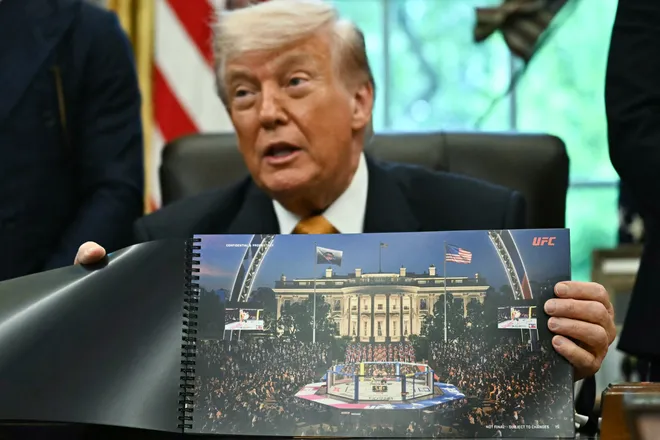

In the drawing, the canopy is mostly out of frame, with only
the back two arch legs visible. The actual photo squeezes the White
House into a diminished frame, reducing it to nearly nothing. The
rendering looks like a popular crowd scene, although the cage itself
is still somewhat anomalous. The photo looks like a giant insect is
about to devour the a much diminished White House. Christian Paz [05-14]:
A year of Trump is backfiring on the religious right: "Americans
don't really want 'Christian nationalism.'" Many poll charts here,
but I don't find them very enlightening. Most people have vague and
contradictory ideas about the role of Christianity in public life.
It makes a difference between asking whether politicians should
look to Christian values for their personal behavior and whether
politicians should use the state to force other people to follow
their religious beliefs. Chris Lehman [05-15]:
The hypocrisy of Trump's 9-hour prayer festival: "The claim that
the founders meant America to be a Christian nation isn't just bad
history — it's a declaration of war by the religious right." Sasha Abramsky [05-15]:
Trump is rooting around in the public trough: "Trump's second term
is unabashedly a project of self-enrichment and oligarchic rule." Molly Jong-Fast/Michael Tomasky [05-21]:
Donald Trump is finally cracking up for real: "His recent tirades
confirmed what more than half of America now believes: The president
is mentally unfit. How will we survive two and a half more years of
this? And what's he got in store for us?" This reminds me that David
Ogilvy used to say, "Develop your eccentricities while you are young.
That way, when you get old, people won't think you're going gaga."
Or at least they won't be sure. It's really hard to tell with Trump,
because different people have very different expectations about him,
and apply very different criteria to what they see and hear. The four
sections here:
- Age ("We Barely Talk About It")
- Dementia (Disinhibition and Digression)
- Arrogance (Too Much and Never Enough)
- Stupidity (Every Accusation Is a Confession)
I don't have time to unpack this, but I'd say the arrogance is
congenital, and the stupidity is a side-effect of never having to
learn anything. That he thinks he's smart is farcical. But then
he's usually been able to make farcical work for him. Most people
try to debate like boxers, guarding your vulnerabilities, looking
for the knock out punch. Trump debates like a wrestler. He's all
over you, relentless, constantly breaking rules, until he wears
you down. That's a different skill, one that people with any sort
of intellectual discipline find maddening. Does that make him mad?
I'd say so, but that's probably because I don't see any way that
a person could function as president without analytical skills.
He has a knack for giving you instinctive political takes, but he
isn't capable of analyzing and solving problems. He's pure reaction.
Add age to this, and certain things happen, pretty much to everyone.
You slow down. You drop a word here and there. You doze off. How
long you can function depends on what you're doing. Athletes lose
their edge by age 40. Most people slow down in their 50s, and start
forgetting things in their 60s. Even if you still seem competent at
80, it's a grind. But neither Biden nor Trump were ever very sharp,
but they had different weaknesses, which were more glaring in Biden,
because they were more normal in politicians, and because we were
less inclined to excuse them as eccentricities. Trump's decline may
seem less obvious, but he never was even remotely competent to be
president. If you were aware of that, everything he says and does
seems damning. If not, well, I don't know what to say. Jonah Raskin [05-28]:
Ivy Meeropol's cinematic celebration of E Jean Carroll.
Meeropol has a previous documentary on former Trump mentor
Roy Cohn, titled Bully, Coward, Victim. Carroll sued
Trump for rape, and won $83.3 million in damages. He's having
his [In]Justice Department investigate her now. Chas Danner [05-29]:
Trump's Great American State Fair is running out of acts:
"When a colleague first shared the announced headliners for this
summer's Great American State Fair concert series on the National
Mall, my first thought was, Is that a joke? It wasn't, but
now it sort of is." Ryan Cooper [06-09]:
Two simple steps toward de-MAGAfication: "A big reason why Trump II
is so much worse than the first time is that the world's richest man
bought Twitter and turned it into a fascist cesspit." I don't mean to
dispute the "fascist cesspit" description, although my own limited but
continuing use of X isn't that bad (for one thing, I use the "following"
thread, and an ad blocker). Nor do I doubt that Musk has reaped a big
windfall from his 2024 gamble on Trump. But the real difference between
Trump I and II is that first time he was a fluke outsider saddled with
a Republican establishment that didn't know what to do with him, not
least because they found him unreliable, erratic, and embarrassing
(although they still managed to get their tax breaks, deregulation,
and military build up, so they weren't unhappy). Second time, they
had a chance to plot, to come up with a plan ("Project 2025" was the
best known, but just one of many schemes) on how to use him and the
whole power of the presidency, a more politicized administration,
and a largely rigged court system. Trump is still the weak link in
this regime, unreliable, incoherent, sometimes just weird, and his
personal projects are ridiculous diversions, but he mostly does what
he's told, and even though he's sunk deep in the polls, he's probably
doing better than any other front man could. (Obviously, the art of
the shill has declined from Reagan through the Bushes, but Trump
still makes the coarseness of the UFC end of the pop culture work
for him. Fascists have to find their base wherever they can. Kelli Wessinger/Noel King [06-10]:
Will Trump ruin America's birthday? "Inside Trump's big plans to
celebrate himself — and maybe America, too." Spoiler alert: he
already has. Interview with Ben Smith. Michael Calderone [06-10]:
Pressuring The Wall Street Journal and other ways Team Trump
went into Epstein damage control: This is mostly derived from
a new book by Maggie Haberman and Jonathan Swan, specifically this
excerpt:
Michael Tomasky [06-12]:
The not-so-secret impulse behind Trump's vulgar, garish birthday
party: "In the real world, a weak and insecure Donald Trump is
being humiliated by Iran. Ah, but Sunday night, he'll be a manly
man among manly men."
It's sickening. Oh — and it's also, as we've come to expect with
Trump, deeply corrupt. First of all, the cost of constructing the
arena is around $60 million. Supposedly UFC is picking up that check,
but with Trump, who really knows? We taxpayers will undoubtedly be on
the hook for something. Meanwhile, the chief sponsor — surprise,
surprise! — is Crypto.com. There are in addition figurines of
some of the featured fighters. There's apparel — garish T-shirts
running $40. Over at TrumpStore.com, somewhat to my surprise, I didn't
see any merch specifically tied to the event, but you have to believe
that Trump's short-fingered hand is dipping into some till or another
here. A lawsuit filed by the group the Public Integrity Project to
block the event from taking place (it's pending as I write) states
that UFC set up a for-profit entity to manage this event, which is
selling seating packages that cost up to $1.5 million — and that
Trump previously bought $50,000 worth of stock in TKO, UFC's owner.
Donna Ferguson/Adam Gabbatt [06-13]:
Workers remove Trump's name from Kennedy Center after court rulings:
"In the dead of night, behind a screen, the president's name was
purged from the facade of the Washington building."
Cooper's program of "De-MAGAfication" still needs some work.
Even if X is as bad as he says, I don't buy this: "I conclude that
for the next president, the first, most straightforward, and arguably
most important task is to destroy X." I'm slightly more sympathetic
to "the next president could also target Musk himself." As Eddie
Murphy's character in Trading Places put it, "it occurs to
me that the best way you hurt rich people is by turning them into
poor people." One can have some fun with that, without (as Cooper
does) comparing Musk to Pol Pot. Musk's wealth is exceptional, but
as with all billionaires it's based on some poor political decisions
and attitudes given power in the 1980s. It's going to take more than
a wealth tax to reverse that, but lots of approaches are possible.
What one needs first is the political support to change things.
Cooper's second step is to add more seat to the Supreme Court.
No doubt the Court, as presently constituted, is a problem, and
that would be one way to work around it. But again the first step
is to build up the sort of majority support that even this Court
will have to listen to. FDR's "court-packing" scheme failed not
because he couldn't raise political support for New Deal policies,
but because after its initial tantrums the Court recognized that
it shouldn't stay in the way of blocking democracy. (As some wag
put it, this was "the switch in time that saved nine.") Perhaps
this bunch of Federalist Society grooms will stand their ground,
in which case expansion becomes an option of last resort. Or
maybe a couple of them recognize when they're beat, while new
justices arrive and shift the balance. Still, we need to focus
on more than just a couple malefactors, like Musk and Roberts.
I am increasingly of the view that the way to do this is not so
much "De-MAGAfication" as in trying to capture the MAGA base,
not by pandering to their prejudices, but by showing them who
their real enemies are. The MAGA crowd has one thing going for
them that conventional pro-business Democrats have struggled
with: they really hate those globalist elites. (Minor point,
but I'd change the "G" to Good, as Bill Moyers tried to talk
LBJ into calling his programs The Good Society.
Politicking: New section, covering elections, gerrymandering,
and other bipartisan mischief, with party-specific pieces to follow.
Ed Kilgore: Also see his piece on the
Democratic Party autopsy.
[05-12]:
The Supreme Court chose to upend the midterms: "The Callais
decision should have been timed to be implemented next year. Apparently,
the Court couldn't wait to blow up the Voting Rights Act." [05-13]:
What Republicans got out of their gerrymandering blitz.
Louisiana and Alabama have eliminated one black-majority House district
each, with Tennessee soon to follow. Mississippi, South Carolina,
and Georgia may hold off until 2028. "Including the recent Florida
GOP gerrymander and the Virginia Supreme Court decision overturning
a voter-approved Democratic gerrymander, that means Republicans will
roll into the midterms with 12 US House seats in their sights, all
of which Democrats thought they would control as recently as two
weeks ago." [05-15]:
When extreme polarization outlasts Trump, we know who to blame:
"Samuel Alito's poisonous Callais opinion is moving the center
stage in both parties' future plans." [05-15]:
Why the midterms battleground keeps shrinking: "The 2026 races will
effectively end with the primaries in much of the country." That's because
most districts are designed not to be competitive. [05-20]:
Trump gets revenge on Massie, but primary may haunt GOP: "The
president took down several Republican foes in last night's primaries.
But there was also good news for Democrats in November." [05-20]:
Trump's self-absorption spells midterms disaster for the GOP:
"Forget policy goals or even boosting his party. The president wants
his ballroom, his vengeance slush fund, and lots of payback." [05-21]:
Senate GOP turns on Trump, freezes ICE bill. Trump was hoping to
push the bill through by June 1. Senate Majority Leader John Thune
pulled the plug on that happening. [05-23]:
Trump is becoming the un-populist: "From the ballroom to Iran to
blatant self-dealing, he's ignoring the will of the people — to
his party's peril." Or to his party's delight, if you ask them. If the
ultimate goal of Republicans is "own the libs," just look at all the
ways he's winding them up. On the other hand, the most compact charge
one can make against a complete scumbag (or any political foe) is that
he lies, cheats, and steals. That he's a habitual liar has long been
obvious, but the cheating (like his attempts to rig congressional seats
and interfere with voting) and the stealing (like his $1.77 billion
self-dealt slush fund) have grown too blatant to ignore. [05-30]:
Democrats suddenly have a real shot at flipping the Senate: "When
the midterms cycle started, the Senate looked secure for the GOP. But
after many lucky breaks for Democrats, it's now a toss-up." [05-31]:
Why Democrats shouldn't write off the South: "Post-Callais,
Republicans are racing to lock in their power over the region. Democrats
have a moral and political obligation to fight back." [06-10]:
Hegseth's faith purge creates a holy mess: "The Defense secretary
drastically culled the Pentagon's list of recognized religions,
triggering a backlash from Mormons and other faith groups." I don't
care enough to go through the lists, but will note three venerable
protestant churches that appear to have been dropped: Disciples of
Christ (which most of my family attended), United Church of Christ
(I have a very good friend who is a retired minister), and Unitarian
Universalist (which my late sister belonged to). All three are major
exceptions to the generalization that Hegseth seems to subscribe to:
that to be a real Christian, you must also be a fascist. David Dayen [06-11]:
The threat of big insurance: "The industry is hugely lucreative,
with endless sums of cash to influence lawmakers. A new report tracks
25 years of health insurance industry donations."
Other Republicans:
Christian Paz [05-11]:
Marco Rubio is dreaming of a kinder, gentler MAGA: "Trump is floating
Rubio as a potential successor. His vision sounds very different than JD
Vance." Ross Barkan [05-14]:
Why Ben Shapiro's media empire is collapsing: "Not long ago, he
was the king of conservative media. A lot has changed in 2026." David Smith [05-16]:
Can a Republican defy Donald Trump and survive? Kentucky voters will
decide: "Congressman Thomas Massie, chastized by the US president
as a 'lowlife', will soon face the ballot box — setting up a
crucial test of Trump's political strength." John Herrman [05-26]:
Republicans are lost in the AI wilderness: "The Trump administration
went all in on AI. Then the public started hating it." The Republicans'
default stance seems to be that any angle to get rich is fine with them,
even if it's fraudulent and/or predatory. On the other hand, aren't they
as conservatives supposed to want to slow change down? Or at least to
dispell some of the uncertainty about what AI will do, who it will
do it to, and how it will make a very small number of people absurdly
rich? Democrats aren't very sure what to do either. Especially the
ones who feel like they should care about how AI impacts ordinary
people.
Democrats:
On That 2024 Autopsy Report:
Ed Kilgore [05-21]:
Autopsy report shows Democrats really are in disarray: So, "DNC
chairman Ken Martin has released an extremely unfinished draft of the
'autopsy' report, and those who wanted this to happen are going to be
very disappointed — or perhaps even horrified." Noah Hurowitz [05-21]:
DNC autopsy of 2024 loss doesn't mention Gaza or Israel at all:
"As the DNC blamed the author for the report's shortcomings, a
source who participated in the research said the author seemed to
grasp that Gaza 'clearly' hurt Harris." One thing I want to stress
here is that people don't have to understand the war, or feel like
they "have a dog in the fight," or even care, to blame Biden and
Harris for letting it go on so long. Michael Arria [05-22]:
It's the genocide, stupid: "The DNC finally released its
long-awaited autopsy of Kamala Harris's failed presidential
campaign, and it doesn't mention Gaza. The Democratic leadership's
refusal to acknowledge the party's shift on Israel could spell
another defeat in 2028." While I believe that most Americans do not
support Israel's genocide in Gaza[*], and further believe that most
of the Americans who continue to defend Israel is its wars since
2023 would change their mind if they had a better grasp of the
facts, I've long believed that what cost Harris the election was
not that crimes and great harm were inflicted on Palestinians,
but that Biden and Harris had failed to end the two major wars,
in Ukraine and in Gaza and around Israel, and worse still that
they failed to show any concern that those wars should be ended.
Sure, one may assert that Biden did not start those wars[**],
and that he had kept American troops out of the wars, so that
the human costs of those wars didn't fall on American citizens,
but his massive supply of armaments for those wars kept the wars
going, and made tidy profits for the US arms industries.
The reasons why Americans hated these wars wasn't sympathy
for the victims. Or that they had any scruples about contributing
to the massacre of foreigners, especially those they had been
assured were bad hombres who hated America. No, the reason was
that the wars were messy and stupid, inconvenient and expensive,
and that exposed the politicians responsible as reckless and
incompetent. Biden certainly looked the part, and the more Harris
said nothing meaningful the more she did too.[***] (While Trump,
in 2024, reaped the benefits with his anti-war posse of RFK Jr.
and Tulsi Gabbard, he's likely to find the shoe on the other foot
this year.)
[*] Whether it's still fair to call it that during the current
quasi-ceasefire could be debated, but in intent and in effect from
October 2023 until that time it was as clear cut a case of genocide
as any since WWII. It is still a war crime of stupendous proportions,
with myriad offenses against fundamental human rights. The main
reason for referring to Israel's operations in Gaza as genocide is
that there is a clear definition of genocide in international law,
and that law specifies remedies to bring the perpetrators to justice.
To some extent, this has been recognized by international courts,
and indictments have been issued, but that has still not stopped
the offenders in Israel. As the law notes, the speed or completeness
of the genocide does not affect the finding, which is first based on
intent (clearly stated by Netanyahu and members of his government,
especially Smotrich and Ben-Gvir) and tangible acts to implement
that intent (which the IDF has done on a massive scale). On the
other hand, I want to stress that there are many ways states and
their armed forces (and for that matter, especially in the West
Bank, their civilian populations) can violate human rights, and
these are no less objectionable if they don't quite add up to the
legal definition of genocide.
[**] I could also argue that both wars were the result of gross
negligence on the part of Biden, although I would also insist that
Biden's mistakes were built on top of comparable mistakes by his
predecessors, going back as far as Clinton's bungling of the Oslo
Accords and his expansion of NATO to threaten Russia, but Trump's
failures to mediate a solution to Ukraine (which blew up in 2014,
under Obama's watch) and to do anything to settle the Palestinians
(it was his "Abraham Accords" that conceded to Israel the right to
do whatever they wanted in Gaza and the West Bank) led directly to
the Russian invasion of Ukraine and the desperate Hamas revolt in
Gaza.
[***] As I recall, every time Harris was asked about Gaza, the
first thing out of her mouth was that "Israel has the right to defend
itself." What Israel called "defense" was indiscriminate slaughter
combined with the systematic destruction of all of the infrastructure
in Gaza necessary to sustain human life. "Self-defense" was Israel's
license to kill, and everyone understood that. So no matter how much
she lamented the death and destruction after her initial concession,
and promised to work "night and day" for a cease-fire, we (and Israel's
supporters, including Netanyahu) knew she would do nothing meaningful
about it. At the time, I suggested that all she had to do was to move
the self-defense sentence to the end, after she had expressed a bit
of humanity and/or reason, and she would have come off sounding much
better, even if the bottom line was the same. But she didn't dare do
even that much, which left her supporters high and dry, and most others
either irate or confused. Then, of course, she sent her most Zionist
spokespeople to Michigan, to further piss off the decisive Arab vote.
I wonder if that's in the autopsy? (Arria remembers: Liz Cheney and
Rep. Ritchie Torres.)
Zack Beauchamp [05-13]:
Are far-right politics just the new normal? "Liberals are preparing
for a longer war with right-wing populists than they once expected."
Reporting from something touted as "a recent conference for the
international left, featuring people like former President Barack
Obama and Canadian Prime Minister Mark Carney," where speakers are
still lamenting that the wonders of the Biden economy weren't
appreciated by the unkempt masses. How can anyone still confuse
these "liberal elites" with "the left"? Rather than just accepting
the "populist right" as a permanent fixture, shouldn't we try to
figure out how to redirect their anger against more appropriate
targets (like the superrich)? While they have many ill-considered
views, their basic sense that something is profoundly wrong, and
someone in power must be held responsible for it, is something
one can work with and build on. Makes a lot more sense than trying
to tell people that their problems are just in their heads. Errol Louis [05-13]:
AOC's plan to win the midterms: "To prevail in November, House
Democrats need to do more than oppose Trump." Focus on substantive
issues, and don't let the media get you sidetracked with speculation
about personal ambitions. Bill Scher:
[05-22]:
The Democratic Party is divided (but not how you think): "New polling
shows not so much ideological division among Democrats but a lack of
consensus about where the party should go." I think he means about
who can be trusted to lead the party. He opens with photos of Rahm
Emmanuel and Graham Platner. While Scher, perhaps the ultimate DNC
Centrist pundit, loathes Platner, his case for Emmanuel stresses how
"populist" Clinton's former chief wonk is trying to appear. While I
have my own reservations about Platner (his case for ending the
federal gasoline tax is plain wrong), unlike Emmanuel, he doesn't
reek of board room/country club effeteness and corruption. [05-27]:
Janet Mills should unsuspend her US Senate campaign: The former
Maine governor gave up after falling hopelessly behind in the polls,
but as Scher points out, she's still on the ballot, so the small
number of diehard Graham Platner haters (like Scher) still have
all the options they need. And the points they want Mills to score
against Platner will continue to be made by Republicans. Most of
the time Scher is arguing for pragmatic choices, so why not here?
Why waste her time and money trying to help Collins to another
term?
PS: Much more about Platner, both before and after the primary,
where Platner won the Democratic nomination with 72% of the vote.
I don't have time to organize a whole section, but here are a few
links:
Perry Bacon [06-10]:
Graham Platner is testing a new strategy to defeat Susan Collins:
Interview with Billy Kobin (no transcript). Dustin Guastella [06-13]:
The attacks on Graham Platner didn't just fail — they may have
backfired: "Graham Platner's primary victory in Maine says more
about the unpopularity of the Democratic party elite than any race
to date." I had similar thoughts before the election, when I commented
on Tom Carson's admission that he would "vote for Collins in a heartbeat"
against Platner:
Maybe this is my redneck coming out, but the more slime I see from
well-meaning liberals against Platner, the less I believe, and the
less I care. Granted, that's a common reaction from Trump voters, but
their problem was less their knee-jerk reaction against
Harris-Biden-Clinton-Obama than their ridiculous blind spot around
Trump. Democrats need candidates who can puncture that blind spot much
more than they need goodies who suck up to the rich thinking they can
turn their money into votes.
[05-29]:
If you called for Eric Swalwell and Tony Gonzales to be expelled,
then you should impeach Donald Trump: First, I never called
for their expulsion, nor would I have. I'm still upset about the
House's "exclusion" of
Adam Clayton Powell Jr. as the elected representative of Harlem
in New York City in 1969 (which, by the way, was later ruled
unconstitutional). Maybe there should be a recall process,
as some states enacted during the Progressive Era, which would
give voters a chance to second-guess their choices, but the
House itself should have no such powers. As for comparing the
misdeeds of Trump vs. those of Swalwell and/or Gonzales, they
precisely match, although Trump's exceeds the others by even
more than their net worths. The problem with impeachment isn't
the crimes, but the jurors. The only way Trump can be removed
from office is if his own Party decides to cut his losses and
do the thing (either impeachment or through the 25th amendment,
which would have to be initiated by Trump's toady cabinet, and
then ratified by Congress with the same 2/3 supermajority needed
for Senate conviction, which makes it virtually impossible without
Trump's consent). This isn't a very good system, but it is our
system, and changing it would be even more difficult than using
it. Republican Party unity is such that there is zero chance of
impeaching Trump now, so it's a moot issue. If Democrats win the
House in November, they could "impeach" Trump by minority vote,
but they would have to win over at least one-third of the Senate
Republicans to convict. It certainly isn't clear whether the two
times Trump was "impeached" during/after his first term in any
way hurt him in the 2020 or 2024 elections. While he is very
unpopular now, Republicans still balked at convicting him after
he instigated the January 6, 2021 siege of Congress. Democrats
have no reason to think they can construct a case to convince
them. Indeed, it seems like a waste of time to bother with a
remedy that is certain to fail. So let's just stipulate that
impeachment (or a cabinet-forced resignation) is an option for
Republicans. When sufficient numbers of them decide to make it
happen, they can expect Democrats to help them rid themselves
of this pestilence, but until they do, the only thing Democrats
can do is to make sure that people realize that it is Republicans
who are keeping Trump's reign of (t)error operating. They should
all pay the price next time the people get a chance to vote. Harold Meyerson [06-08]:
Encircling the royalists: "Democrats finally show up to the class
war." Greg Sargent [06-11]:
Why is Trump tanking in MAGA country? These Dems found a good answer.
"Some new research on working-class voters make it clear. They're furious
at Trump — and they want a message from Democrats that pledges
specific action." It's about time for Democrats to try to win over
districts where plenty of people are upset at how things are being
run. Cites this piece:
The Economy (and Economists):
Emmanuel Saez/Gabriel Zucman [05-26]:
The case for California's billionaire wealth tax. The opening chart,
of "the surging fortunes of California's ultrarich," which in constant
dollars for the top 0.0002% of Californians, has risen from $22 billion
in 1982 to $1.6 trillion in May 2026.
Technology (Including AI):
Eric Levitz
[05-21]:
The hidden way dictatorships are shaping what AI tells you:
"Authoritarian states may have accidentally brainwashed ChatGPT."
And casually calling China and Russia "authoritarian" while exempting
the US and Israel is what? AI only knows what it's been trained to
know, and it only "thinks" in ways that are consistent with fidelity
to its training materials. That could make it useful for propagating
an establishment worldview, as much in the US as in China, as the
rulers of each have no doubt already recognized. The difference may
be the degree of control they exercise: in the US, that's usually
been weak but certainly not neutral (e.g., consider how willingly
major media went along with the Cold War and the War on Terror,
where very distorted views of the world became ubiquitous and for
the most part unquestioned). [06-12]:
Trump's strange flirtation with AI socialism, explained: "Uncle
Sam and OpenAI may go in business together." Uh, whatever this is,
it isn't socialism. Ryan Cooper [06-10]:
Tracking the flood of AI political spending: Not unlike the
$245M the crypto industry spent in 2024, with Trump getting in on
both ends, profiting mightily from his own crypto scams. Jelinda Montes [06-12]:
AI data centers are taking over. These Americans are fighting back:
"Energy and water intensive AI projects are draining communities. The
revolt is just getting started." I must admit a considerable degree
of ignorance and/or skepticism about opposing AI data centers as a
political agenda item. (I recently heard
Astra Taylor on this, and know that
Bernie Sanders is concerned. I'll add some more links below,
but I really haven't thought this through.) I've long found it
interesting why so many people intuitively fear some things and
not others. Or perhaps, for complex issues like climate change
and AI, they latch onto some aspects but not others. I don't
quite get what they fear about AI, but what I fear is
capitalism: specifically, that AI might make it so efficient
its essential rotten core will become manifest, unfettered by
practicality and ethics.
Kate Aronoff [06-12]:
Anthropic CEO Dario Amodei wants us to think he's building a god:
"He acts like he has special knowledge about how best to regulate his
company. But he's a CEO like any CEO, and he wants what all CEOs want:
to write his own rules."
Regular Columnists
Sometimes an interesting columnist writes often enough that it
makes sense to collect their work in one place, rather than scatter
it about.
Dean Baker: All his
pieces are worth reading. But I didn't collect them regularly,
as I have in the past, so I thought of skipping this section.
But a couple stood out:
[05-20]:
Reforming bankruptcy laws: Getting tough on private equity deadbeats:
How private equity firms work should be well known by now. Josh Kosman
laid out the basics in his 2010 book
The Buyout of America: How Private Equity Is Destroying Jobs and
Killing the American Economy, just before Mitt Romney's
2012 presidential campaign gave us a case in point. Bankruptcy
laws are important here, as that's where most of the companies
bought by PE firms end up. Baker has some good ideas here, but I
have one I like better: I feel that bankruptcy law should attempt
to preserve businesses and jobs by giving them a fresh start, free
of the encumbrances PE firms saddle them with. I would turn those
companies over to their employees, and inject enough financing to
get them up and running again. And sure, this means screwing the
creditors. And if that makes banks less likely to finance perilous
PE deals, so much the better. [06-05]:
Friday morning book review: Cancelling Billionaires: The Urgent Case
for a Wealth Tax: The book, by two Canadians, is
Linda McQuaig/Neil Brooks: Cancelling Billionaires Before They
Cancel Us. (McQuaig, by the way, also has a 2019 book called
The Sport & Prey of Capitalists: How the Rich Are Stealing
Canada's Public Wealth.) I have mixed feelings about wealth
taxes. For one thing, assessments are hard to pin down (e.g., the
city thinks my house is worth 2.5 times what I paid for it; when
we sold my late father-in-law's house, it went for less than a
third of its assessment; if Elon Musk had to sell all of his stock,
it would certainly go for much less than its current valuation).
Worst case, you have to liquidate your property just to pay taxes
on it. Much better to tax transactions, where the money is there.
On the other hand, there are cases where wealth taxes do make
sense, especially for estates (where the marginal rates can be
quite high, because not dying isn't an option; you can, as we do,
exempt a sizable chunk before taxes, and liquidate the rest, so
you get an honest assessment of its value). I also think that
foundations should be forced to liquidate some share of their
equity each year, so they don't just become permanent tax shelters.
But at present, in the US at least, I wouldn't mind a wealth tax
on the super-rich. It's just that, like Baker, I'm more bothered
by how they managed to get so rich in the first place:
I prefer nailing the rich before they get their money, both because it
is much more efficient than trying to pry it back after the fact, but
also because it takes away the rich's shield, where they try to hide
behind the free market. A government that funds research upfront and
puts it all in the public domain is no less free market than a
government that grants patent and copyright monopolies. Similarly, a
government that taxes financial transactions, like every other item,
is no less free market than one that makes a special exemption for the
financial industry. And the market doesn't tell us how to structure
bankruptcy laws.
[06-08]:
Trump mistake #27,462: Chasing away immigrants doesn't help native
born workers: I doubt he's actually counting, but as a guestimate
this isn't obviously high or low. But the number is a distraction.
I don't really buy the old saw that "few people born in this country
want to work on farms picking lettuce or tomatoes or in meat-processing
plants." Sure, they don't want to work lousy jobs for poor wages, but
I doubt that immigrants want that either. They may be more willing to
settle because they have few better options. What American workers
need is more rights and leverage. Reducing competition from immigrants
might give them a bit more leverage, but that doesn't translate quickly
to rights. On the other hand, giving both native and immigrant workers
more rights does. Maybe this results in some jobs becoming unaffordable,
but if they really mattered, someone would find a way to make them
attractive enough for workers. [06-09]:
Just say no to Bernie Sanders' AI sovereign wealth fund.
I'm not sure whether Baker is being critical of sovereign wealth
funds in general — they mostly exist in countries that have
nationalized mineral wealth (mostly oil), allowing them to direct
those revenues to other business ventures — but one focused
on the AI bubble is certainly a bad idea. And not just because
like all bubbles, this one will break. And not just because such
a fund not only lose a lot of money, but will inevitably waste
even more trying to save itself. But also because we're confusing
the AI business with AI technology. Business develops technology
not because it's good for people but to make money off of them.
This predatory relationship may be tolerable if limited, but
nothing about this generation of AI moguls suggests that they're
into it for short of unlimited power and wealth. [06-12]:
The real abundance agenda: weakening patent and copyright monopolies:
Sure, he's written this piece many times before, and will do so many
times again. It's such an obvious and essential point that it's hard
to understand why more people aren't doing the same. I keep meaning
to write it up myself. I'd go so far as to say that there is no
justification whatsoever for granting patents. Moreover, you could
eliminate the entire system today, and innovation, development, and
industry would carry on without a hitch. (Sure, it would be bad for
patent lawyers, and possibly speculators, but we'd save so much
money elsewhere we could easily retrain them to do useful work,
or just pay them a generous amount not to bother us further.) The
situation with copyrights is a bit messier, because we don't have
a good alternative scheme to fund writers and other artists, but
the present copyright system doesn't work very well either (yet
lots of people still create things, for little reward). These
systems are really just another form of
tax farming. That's a horrible system, as all historical
instances show. Baker is responding to this piece:
Dylan Gyauch-Lewis [06-12]:
New documents detail nine-figure, Silicon Valley-funded abundance
movement: I should probably dig my way more carefully through
this, but the gist is fairly obvious: that the Klein-Thompson focus
on Abundance works for rich Democratic donors much like the
supply-side economics jargon did for Reagan Republicans: it offers
a way for government to make rich people even richer, while claiming
they're doing something for all of us. But this has been standard
policy for Democrats at least back to Clinton: pursue reforms, but
only ones that have substantial donor/business buy in. As such,
they never tackle things like patent rents that make health care
unaffordable. They're happy to invest money in "green energy"
businesses, but not conservation.
Tom Carson:
[05-12]:
Triomphe the insult comic's Arc de Trumpe. After being assured
by "sandbox-loving Trumpies, that we're the lucky owners of the most
powerful, most lethal, most all-around bitchenest military on the
planet and/or in world history," he points out that "this coming
August will mark the 81st anniversary of the last time we won a
war." (Then misses the opportunity to quibble over whatever the
hell we actually "won" in that war.)
Maybe I'm a born Eeyore, but the Trump administration's Epsteiniran
gamahuche strikes me as a poor candidate to liven up America's moldy
victory laps with a new lap dance. And that, my friends, is why we
need a Trumpian Arch of Triumph in Arlington, Va., to grandly fuck up
the view from the Lincoln Memorial to the Lee-Custis mansion on the
other bank of the Potomac. . . .
One unpleasant truth that can't be avoided is that his plans for a
gloriously Trumpified nation's capital resemble Albert Speer's designs
at Hitler's behest for a gigantic, pastless new postwar Berlin to be
known as Germania. Another, more reassuring truth is that Germania
never got past the stage of being a big 3-D scale model that the
addled Fuhrer spent increasing hours canoodling with as the war went
phhht. . . .
Yet in both cases, what porn connoisseurs call the money shot
— destruction on a vast scale — will already have been
accomplished. Berlin's hash got settled by American and British
bombers and Red Army artillery and tanks in 1945; whatever happens
next, the White House's East Wing is rubble for good. Don't bet
against the same being true soon of the Kennedy Center, a building,
concept, and Camelot talisman Trump hates so much that sticking his
name on it provided only inadequate and temporary respite. You know,
like a dog pissing on sumac to mark its own territory.
[05-18]:
Trump and what army? "As Memorial Day looms, let's take stock of
how POTUS values America's military." Having "grown up partly around
military people in Berlin during the Cold War," etc., he has a soft
spot for the military I've never shared, but I can count dozens of
relatives and a few friends who have done their bit, some at great
personal sacrifice, some merely gloating over the personal perks of
the closest thing America has to socialism, I can suspend my own
disdain for the military to allow those so inclined to show them
some respect. Especially when that respect runs counter to Trump:
Two particular features of Trump's reign that fascinate me. One is his
hostility to American history. Guy's really got a grudge against it,
wonder why. The other is his administration's truly extraordinary
disdain for the United States military. You can't say it exceeds any
prior administration's disdain only because no prior administration
has gone anywhere near the lunacy of expressing disdain at all. . . .
Trump's loathing of being seen with maimed combat veterans —
they didn't make him look good, he complained, underlining who the
only important guy in the visual was — makes George W. Bush like
he missed his calling as a battlefield surgeon. His craving for a
tank-crunchy military parade in D.C. disregarded how many —
sadly, not all — of the U.S.A.'s wars have been fought against
everything such images represent. His hatred of Black and female
generals and trans enlisted troops spits in the face of the one
government entity that, for all its sins, has been in the forefront of
literally embodying social equality.
There isn't space enough here to list all of Trump's
military-bashing insults and smears, and keep in mind I'm writing this
online. So let POTUS's ability to discern a competent and laudable
Defense Secretary in Pete Hegseth, who believes war is a continuation
of date rape by other means — a line I've used before, but screw
it, it's an evergreen — stand for the rest.
Jeffrey St Clair:
[05-15]:
Roaming Charges: Go down, Moses.
+ $109 billion: the amount Americans spent on lottery tickets in 2025,
more than they shelled out on movies, concerts, books, and sporting
events combined. It's the Crap Shoot Stage of Capitalism.[1]
[1] I knew a guy whose email signature was something like: "Lottery,
n. a tax on stupidity." I thought it was more like a tax on futile
hope. They see it as the only chance they might get to make enough
money to make a difference, and all it costs is something they'd
probably lose anyway. Sure, the odds are awful. But so is the rest
of their lot in life. [05-22]:
Roaming Charges: Peanuts from heaven. [05-28]:
A short history of the Iran War, so far. This is how it started:
Trump began his war on Iran during talks to prevent it. He said it
gave him the element of surprise. His missile strikes killed much of
the Iranian leadership, including some of the Iranians his team
thought might govern the country after the bombing ended. One of his
missiles hit a girls' school, another hit the compound of Mahmood
Ahmadinejad, one of the candidates Trump's people had in mind to run
Iran after they killed Ayatollah Ali Khameni, the Iranian religious
leader who, austere as he was, preferred negotiation over
confrontation.
Trump brushed off talk from some of his advisers that Iran would
likely respond by shutting the Strait of Hormuz and attacking other
Gulf States that had aided the US, either explicitly or covertly. His
aides were right. He and Hegseth were wrong. Then Israel killed Iran's
top negotiators. Suddenly, there was no one left to talk to. Trump
claimed that the Iranian military was completely destroyed. Iran
responded by downing US fighter jets, drones and surveillance
planes. It struck US military bases, ships and a CIA station
house.
Trump claimed Iran had no leaders and its government was in a state
of collapse. But the new regime quickly coalesced around Khamenei's
son, Mojtaba, and took a more radical, uncompromising stance. Trump
said the Kurds would invade Iran and arm Iranian dissidents. But the
Kurds, burned one too many times by the US, declined. And after US and
Israeli missiles hit neighborhoods, schools, hospitals, power plants
and oil refineries, the Iranian resistance turned against the US.
The Strait of Hormuz was shut down. The price of oil shot up and
Trump's poll numbers sank. The global economy was sent into
crisis. Trump asked the European nations he had refused to warn about
his plans to go to war against Iran for help. They refused. Spain,
Italy, France, Austria, and Switzerland went further. They either
blocked or restricted the use of their airspace, landing rights or
shared military bases for airstrikes on Iran.
It gets worse from there, including:
Unable to extort former US allies to bail him out or bomb the Iranians
into submission, Trump began to manipulate the market, announcing fake
cease-fire deals one week, threatening to make Iran glow the next. The
market spasmed up and down and people with inside knowledge, including
Trump, who made over 3000 trades, cashed in.
Trump may not understand the first thing about war, but he knows
how to run a graft. I'm not convinced that "Iran is now in a position
to dictate the terms of any deal," but they're certainly in a position
to reject any deal they find disagreeable, which means that Trump has
to do something he's incapable of, negotiating. [05-29]:
Roaming Charges: Hail the unconquering hero! Title a twist on the
Preston Sturges film. Starts with a reprise of his "Brief History,"
then moves on, finding Cory Booker even more hawkish than Trump.
+ Sam Altman: "We see a future where intelligence is a utility, like
electricity or water, and people buy it from us on a meter." This is
why they don't care if (and in fact don't want) your kids to learn to
read or write. They want to sell basic intelligence and the less you
know, the more they can charge you for telling you something you
should have learned in middle school.
+ Artificial intelligence is causing a net U.S. loss of 16,000 jobs
per month, according to an analysis by Goldman Sachs.
+ The Trump administration is now targeting people who oppose AI
and massive water hogging and power-hungry data centers under a new
threat category dubbed "anti-tech violent extremism," many of whom, by
all indications, are MAGA — along with the Pope, of course.
+ White House counterterrorism czar Sebastian Gorka says that the
Trump administration is going to label American Leftists "terrorists"
right alongside drug cartels. Will there be drone strikes? "We're
gonna label terrorists as terrorists, whether it's cartels, whether
it's jihadis, or whether it's sadly the le — the Americans who
are left wing, who are radical, and because they subscribe to some
anarchic, anti-fascist, or radically pro-transgender ideology."
+ Anthropic's CEO Dario Amodei, dropping an inconvenient truth
about the social and economic consequences of AI: "The signature of AI
is that it's going to take us to a world where we have very high GDP
growth, and potentially also very high unemployment and inequality."
[06-12]:
Roaming Charges: Data my eyes:
+ Dante himself couldn't have found a better spot in Hell to deposit
James Dolan, maybe the worst owner in all of professional sports (and
that's really saying something), than to lock him in a box next to a
farting, snoring, grunting Donald Trump as 24,000 Knicks fans jeer and
boo them both, while watching his team lose to the young San Antonio
Spurs, over and over again, night after night for all eternity . . .
Trump: "Look at the basketball ratings. They're down to very, very
low numbers. People are angry about it. They don't realize. They have
enough politics with guys like me. They don't need more as they're
driving down, going up for the shot. They don't need it. There was a
nastiness about the NBA the way it was done, too, so I think the NBA's
in trouble. I think it's in big trouble, bigger trouble than they
understand, and frankly, ice hockey, which is doing very well, they
didn't do that. They respected the mores. They respected what they're
supposed to be doing."
+ As for who is really watching what . . .
Stanley Cup NHL Finals (2026) viewership: 5.05 million (Game 3)
NBA Finals (2026) viewership: 28.7 million (Game 4)
+ 39: the number of times Trump has said a deal is imminent to end
the Iran war. Does President False Alarm continue to move the
market?
+ This week, Israeli troops conducting raids in Hebron shot a
seven-month-old, Sam Fahd Abu Haikal, in the head while he was held
in his mother's arms. . . . Israel has killed more Palestinian children
in the last 3 years than Palestinians have killed Israelis of any kind
over the last 80 years.
+ 97: Number of J6 rioters pardoned by Trump who have committed new
crimes since J6. Recidivism is the hallmark of a true Trumper.
+ Trump on Graham Platner (or is he engaging in a rare episode of
self-reflection?): "This guy's got a rap sheet, I've never seen
anything like it. He's a low-level thug, and he's running to be
senator . . . He's worse than any human being that's ever run for
office, probably." [Worse than Trump? Worse than Aaron Burr? There
must be some others on that level that are slipping my mind.]
His "Booked Up" includes a link to
Cory Doctorow, The Reverse Centaur's Guide to Life After AI: How
to Think About Artificial Intelligence Before It's Too Late.
TomDispatch: Tom Engelhardt's newsletter has come to an end,
with the world still badly in need of it. Reports are that Nick
Turse, a former intern as memory serves, and recently The Intercept's
top war reporter, will take over. No evidence of that yet.
William D Hartung [05-28]:
Donald (disaster) Trump: "And the fight for a humane future." Rebecca Gordon [05-31]:
Endings and beginnings: "About that arc of the moral universe,
sometimes it's more like a meandering sine wave." Tom Engelhardt
[06-04]:
A personal TomDispatch farewell (of sorts): The site's editor,
after 24 years, is retiring. I've followed the site regularly almost
since its inception. (As best I recall, my tip was just one step
removed from Jonathan Schell, an early writer there.) I tried to
get him interested in my writing a couple times, to no avail. The
dissolution of the American empire has been both his and my great
theme of the last 25 years, so I both appreciate all he has done,
and think I could add a little bit more. One thing I probably
would not do is always cycle back around to climate change. I
don't doubt that it's happening, or that its effect will be huge,
but I'd rather focus on other things, while treating it more as
something that can be adapted to, although the opportunity costs
of not working on it are huge. [06-08]:
War, what's it good for? "Absolutely nothing." He's moved on
to a Substack. [06-11]:
Reading the Times: "(And not just the paper)." [06-12]:
2025 wildfires were the costliest ever: why isn't that news?.
Seems to be an alternate title to "Reading the Times."
Miscellaneous Pieces
The following articles are more/less in order published, although
some authors have collected pieces, and some entries have related
articles underneath.
[Washington University]
Rebecca Dudley/Gloria Fall [05-06]:
WashU's financial mismanagement is jeopardizing our education:
Authors are PhD students at my almost alma mater. (I had a couple
summer school courses that would have met my BA hours total, but
some strange things happened, and I got shot down by an incomplete
on a course that I wasn't allowed to finish. It's a weird story I
should write up some time, including why I didn't much care about
the degree I missed out on. But that was 1973. The bit I find most
shocking here is the current $71,310 tuition. As I recall, it was
about $6000 then, which I could only handle with scholarship and
loans, which even then meant that most of my classmates were rich
kids.) Another item here is their use of some software called
Workday, which WashU "has spent over $265 million on." That in
turn has led to "massive layoffs." Also re Washington University:
John K Wilson [06-09]:
Academic authoritarianisn in a new attack on humanities scholars:
"There is virtually no evidence offered in the report for its sweeping
conclusions about the entirety of the humanities." I'll just add that
the destruction at Washington University started back in the 1970s
when I was a student there, and the administration decided to gut and
dismantle what had been one of the nation's most eminent sociology
departments.
[Vox]
Sara Fischer [05-20]:
Vox Media sells podcast biz, some publishing brands to James Murdoch's
Lupa Systems: This includes the Vox and New York Magazine websites,
which I often cite. Some other brands will remain independent, but none
I recognize (maybe The Verge). Vox Media co-founder/CEO Jim Bankoff
will join Lupa. James is one of Rupert Murdoch's sons, which raises
some sort of alarm.
[Biden]
Ben Terris [06-13]:
Building back the Bidens: "The urgent, embarrassing, and occasionally
convincing campaign to salvage their legacy." Sure, I could have filed
this under "Democrats," but they've moved on, and so should we. Two
things permanently destroyed his presidency. One was his indifference
to ending the wars in Ukraine and Gaza. Sure, that may largely be blamed
on Anthony Blinken and Jake Sullivan, who most likely will never work
in Washington again, but he was president, he could have done something,
and he only made bad situations worse. The other, perhaps even more
unforgivable, was losing to Trump, even disguised as Kamala Harris.
There's a story here about Biden trying to scrape up change to build
his presidential library in Wilmington, and how poorly he's doing
compared to Obama's foundation, with its "behemoth center in Chicago,
known as 'the Obamalisk.'" I seriously doubt that the legacies of
Obama and Clinton are going to wind up looking much better than
Biden's term, but at least they went out as "winners" (unfairly,
I'd say, given that both lost their Congressional majorities after
two years, and never recovered, leaving them six years to legislate
nothing of note for their constituents, while helping their donors
get rich, a favor amply returned through their foundations).
Books:
The Guardian [05-12]:
The 100 greatest novels of all time: Click bait, which often for
music and sometimes for movies I used as checklists, but I read so
little fiction this will likely prove useless. Fwiw, I've read one
(The Master and Margarita), started several others, have heard
of (can tell you the authors of) most of them, and have seen a couple
dozen in the form of movies or television series. One thing I have in
common with my wife is that we both started then abandoned Anna
Karenina, back in our teens, after a couple hundred pages. She's
gone on to read the majority of the list. One novel I did read and
liked so much I'm pretty sure it would hold up in this company is
Thomas Pynchon's V. But I gave up on Gravity's Rainbow
after 350 pages, and haven't attempted any of his later books. Michael Eby [05-14]:
Is antitrust enough?: "Tim Wu's Age of Extraction lays out
an antitrust strategy for fighting platform capitalism. But does the
challenge posed by Big Tech require a new playbook?" I've read Wu's
book, and there is much more to his solution than just antitrust.
Still, some business models are problems in themselves, a problem
that making them more competitive and less extortionate doesn't help
much.
Obituaries: I had been using the New York Times, but
they're giving me aggravation these days, so I'll switch over to
Wikipedia
(May, also
June),
which is probably better anyway. Roughly speaking, since my last
report on
May 12:
[05-13]:
Clarence Carter (90): American singer-songwriter ("Slip Away,"
"Patches," "Strokin'") [05-18]:
Sally Head (79): British trelevision producer (Cracker,
Prime Suspect, Jeeves and Wooster). [05-19]:
Barney Frank (86): Member of Congress (D-MA, 1981-2013). [05-20]:
Ron Escheté (77): American jazz guitarist. [05-21]:
Kyle Busch (41): NASCAR driver. [05-25]:
Sonny Rollins (95): Saxophone colossus. [06-03]:
James Blood Ulmer (86): American jazz guitarist and singer. [06-04]:
Robert Coles (97): American child psychiatrist and author of many
books, most famously his Children of Crisis series. [06-04]:
Marjane Satrapi (56): Iranian-French graphic novelist.
[06-06]:
Bob Packwood (93): US Senator (R-OR), 1969-95. New York Times
obituary is subtitled
Senator forced to quit in sex scandal. I remember him more for
taking an antiwar stand on Vietnam. [06-06]:
Lee Raymond (87), American oil executive, the guy who put Exxon
and Mobil back together again. He's the main character in Steve Coll's
Private Empire: ExxonMobil and American Power (2012). [06-07]:
Gordon S. Wood (92): American historian, author of:
The Creation of the American Republic 1776-1787 (1969);
The Radicalism of the American Revolution (1992);
Empire of Liberty: A History of the Early Republic 1789-1815 (2010);
and other important books.
David Waldstreicher [06-11]:
How Gordon S. Wood shaped the idea of America: "The acclaimed
historian, who died at the age of 92 this week, spent decades at
the center of a debate about the founding of the United States."
I've read quite a bit by Wood. I thought his first book was the
definitive history of the writing of the constitution, while his
later books were my principal sources for the founding generation
and, with Empire of Liberty, the early years of the republic. [06-11]:
David Hockney (88): English painter. [06-12]:
Gene Shalit (100): American journalist, media critic and
television personality.
David Everall [04-30]: Forwarded a post from Chalkie Davies,
noting that "Lester Bangs died on this day 44 years ago," and
including an obituary written by Robert Christgau (also available
here).
Steven Hendricks [04-27]:
Communication Con Job
As a former corporate communications and government affairs
executive, I've been watching Donald Trump answer questions with the
media for more than 10 years now. The confidence, the certainty, and
the way he controls media interviews. It's no wonder some people
"think" that he's a skillful communicator.
Every single time that Donald Trump is asked a question — any
question — he runs the same exact seven 'deceitful' steps
— the same exact order—without exception.
This is not one's personality, not confidence nor is it charisma
either. This is a deliberate repeatable "control the lie" formula
— and here is the formula. - KILL THE QUESTION (First
thing every time — make the question itself the problem.)
—"That's a stupid question." / "Fake news."
- KILL WHO ASKED IT (Destroy the source so the question has nowhere
to stand.) —"Your ratings are terrible. Nobody watches your
network."
- INSERT HIMSELF (Every topic. Every time. Without fail. It always
lands here.) —"Nobody has ever done what I've done."
- SCALE IT TO THE BIGGEST CLAIM POSSIBLE (Not good. Not great. The
greatest—ever— In history. Every single time.) —
"More than any administration — by far." / "Nobody has ever had
crowds like I've had in history, for any country."
- UNNAMED PEOPLE AGREE (Faceless. Countless. Unverifiable. Always
there.) — "Smart people are saying it. Great people. A lot of
people."
- VAGUE THREAT (Something bad will happen. Never specified. Always
implied.) — "All hell will break out." / "They know it. Believe
me."
- LOOP BACK TO HIMSELF (Different words. Same destination. Formula
complete.) — "It's been an amazing period of time. Page after
page of accomplishments."
The question was never answered — the formula was just
executed. Go back and watch any news clip, any interview, any topic,
any reporter. Count the steps — they're all there.
And this is the part that nobody wants to believe . . . A "control
the lie" formula runs the same seven steps whether the topic is war,
Epstein Files, or egg prices. Which means the response was never built
for the question; it was built for you—the listener; to feel
certain; to stop you from noticing that nothing was actually
answered.
And it worked — for years it has worked. It's why he lies
with such confidence, with such arrogance, with such certainty —
he's controlling the moment — and he's doing it without people
noticing.
Pull any news clip video, any interview transcript, any public
statement and count the steps yourself. This isn't about
politics. This is about controlling what you were never supposed to
notice — and Donald Trump is a master it!
MAGA Trumpublicans eat it up and they fall for Trump's
"communication con job" — every single time! Unfortunately, so
does a lot of other people!
Tom Carson: Picture of a guy who looks like Lindsey Graham in
a "69 47" T-shirt."
Astra Taylor: She seems to have a new book coming out, combining
forces with Naomi Klein, called "End Times Fascism: And the Fight for
the Living World." Book is scheduled for September release. Quote
from Naomi Klein:
Trapped in Bad Fiction
Must the future be this corny? Are we really doomed to live inside
the half-remembered childhood fantasies of overgrown teenage boys? To
be cast as bit characters in a misunderstood book that Elon Musk or
Peter Thiel may or may not have finished reading? Is it even possible
to write about those hackneyed futures without becoming a cliché
yourself?
Over the past year, as Astra Taylor and I have immersed ourselves
in what we call End Times Fascism, I have returned to these questions
often. Whether it's Musk's dreams of space colonization, Sam Altman's
prediction of an imminent machine-human merger, or Pete Hegseth's
Armageddon complex, it often feels as if we are trapped inside very
bad science fiction.
Our book comes out in September and now that we are through the
copyedit (and the fact check, and the legal review . . . ) I finally have a
little space to engage in real time conversations about how
apocalyptic stories about the end times are shaping the news cycle,
from everyone accusing everyone else of being the Antichrist, to
Donald Trump's obsessive drive to build a gilded ballroom over a
fortressed bunker (which I think of as a sort of drydock Titanic).
I love this new direction because it speaks directly to that
uncanny feeling, shared by so many of us, of being caught in somebody
else's kitschy version of the future — one we have all been warned
against countless times. The cold blues recall several classic Isaac
Asimov jackets, and the retro rocket ship brings the same scifi era to
mind.
Jim Stoddart, who designed the cover for Allen Lane, explains that
the rocket's exodus "illustrates the most extreme metaphor of the
super-rich believing they can escape the rest of humanity —
whether fleeing to islands on the other side of the globe or rocketing
off to Mars — while exacerbating devastation behind them." And,
of course, the Earth on the cover is imperiled, "being metaphorically
shrouded with poison intentions by the privileged few." But Stoddart
points out, all is not lost: "the planet has not yet been entirely
overwhelmed — and there lies the hope for the future."
Astra and I firmly believe that to be the case, which is why we
wrote the book and immersed ourselves in that poison since Trump
re-entered the White House. A huge part of the reason why a dystopic
future can feel inevitable is precisely because versions of that
violent story have been told and retold so many times, riffing off the
same template that appears in the Book of Revelation, which casts
armageddon as a necessary stage on the way to a frictionless, lifeless
heavenly utopia. Unfortunately, we have far less practice imagining
versions of the future in which we come together to fight for all that
is irreplaceable in the blessedly imperfect, friction-filled living
world.
And yet we are surrounded by examples of people doing just that,
from parched communities coming together to resist AI data centres to
the historic summit happening right now in Santa Marta, Colombia,
where 60 governments have convened to chart a path away from fossil
fuels, refusing to let the breakdown of climate negotiations at the
United Nations be the last word in the fight against climate
breakdown. With the U.S.-Israeli war on Iran showing us all —
yet again! — the enormous perils of fossil fuel dependence, the
summit comes at a critical moment.
Current count:
371 links, 26617 words (32677 total)
Ask a question, or send a comment.
|