A Consumer Guide to the Trailing Edge: June, 2006
Recycled Goods (#32)
by Tom Hull
 |
 |
At one point in writing this month's column, I dashed a letter off to a publicist, mentioning my "pet peeve" about compilations that don't provide recording or release dates. Thinking further about it, I think the problem is worse than that. New music is new, of the moment, even though it was actually, definitively, created a few days or more likely months ago. But the idea that old music can be timeless is just rhetorical fancy. Old music is necessarily bound up in his history, and if it's worth reissuing, it's just plain disrespectful not to provide details on where it came from and what its history is. There are many examples, both good and bad, this month. The most obvious is the contrast between Good for What Ails You and The Stuff That Dreams Are Made Of since they cover similar ground and in a blindfold would rate much closer than I graded them below. I don't have any sort of stock policy for factoring documentation or packaging into the grades, but I'm more likely to knock an offender down than to provide extra credit for admirable work above the music. The King Crimson boxes, for instance, are exceptionally well done, but the music is inessential. On the other hand, Hyena's Gospel Music took a big hit: with decent documentation it might have come in at A. Other cases are less clear. The Rough Guides always annoy me. They lack any sort of useful discography, and they frequently cover records that are nearly impossible to research. On the other hand, what documentation they do have is useful. Given that they publish record guides as their main business, I expect more from them -- hence the disappointment.
Ardecore (2005, Il Manifesto): Italian sources classify this as folk or folk-blues, although I suspect that this revisits old Rome much like the Mekons rework country and western or the Pogues recast Dublin. One clue is that the title translates as "Hardcore"; another is that the core of the band comes from Zu, a group that straddles the politics of the Mekons and the Ex but usually ventures further into avant-jazz territory. But here Luca Mai's bari sax burnishes the luxurious sway of classic Italian melodies, while Giampaolo Felici sings with the coarse authority of a griot or cantor. A-
Chieftains: The Essential Chieftains (1977-2002 [2006], RCA/Legacy, 2CD): The average Irish folk ensemble, but after recording and touring relentlessly for more than a quarter century, going everywhere and playing with everyone, their averageness may just be the norm they established. They couldn't be better served by a compilation. First is their baseline, the "roots" disc: standard fare, expertly done. Second is their "friends" disc, where their good-natured folkie syncretism extends beyond the usual suspects (Nanci Griffith, Emmylou Harris, Alison Kraus, Ricky Skaggs) to Mexico (Linda Ronstadt and Los Lobos) and Quebec (the McGarrigles) and a choice cut with Marianne Faithfull. B+
Downbeat the Ruler: Killer Instrumentals From Studio One (1967-75 [2006], Heartbeat): Clement S. "Coxsone" Dodd ran one of Jamaica's Big Three sound systems in the early '60s -- Duke Reid and Prince Buster were the other two. Together they were responsible for almost all of the ska that launched Jamaican music as we know it, and they continued to be major creative forces for decades, as ska evolved into rocksteady, reggae, roots, dub, and dancehall. Dodd's legacy comes to forty CDs on Heartbeat -- Reid's Trojan Records may have had more and bigger hits, but in a music that has been slammed as too samey, Dodd distinguished himself as its most steady norm. The base of Dodd's operation was his studio band, which comes through most clearly in the instrumentals. Killer may be an overstatement -- they're more like the meat and potatoes or the rice and beans of reggae, a fine meal in themselves. A-
Kenny G: The Essential Kenny G (1986-2004 [2006], Arista/Legacy, 2CD): It always seemed appropriate that Kenny Gorelick's degree was in business, not music. He has sold more than 30 million records -- he would be a major commercial venture in any style, but in jazz he's off the scale. He's also beyond the pale -- no other musician elicits such intense hatred. Part sour grapes, in that real jazz went underground so long ago that all the masses ever hear these days are the smooth poseurs of "contemporary jazz" radio. Part gut reaction to his unnaturally pretty soprano sax and his knack for profitable exploitation, such as his "duet" with Louis Armstrong. I've never had either reaction: I'm not so insecure about real jazz that I worry about what the likes of G might do to it, and I enjoy conventional beauty when I find it, but I do find that it doesn't take him long to get awfully tedious. At least, a compilation like this tries to mix things up a bit, but ultimately it just shows you how many ways he can annoy. C
Good for What Ails You: Music of the Medicine Shows (1926-37 [2005], Old Hat, 2CD): They were called medicine shows because the entertainment was just meant to attract crowds to hear sales pitches for patent medicines. Their heyday came in the late 19th century, but persisted into the era we have records for -- indeed, Porter Wagoner was still hawking for the Chattanooga Medicine Company on his '60s TV show. Picking from the early records of medicine show veterans, this compilation covers the gamut of rural Americana -- music that eventually got sorted out into country and blues but at the time was as complexly mixed as still-present minstrelsy. The music favors songsters, jug bands, and mountain fiddlers, with most of the songs dating well back -- old music that itself was old-fashioned. But delightful as the music is, the package sets a new standard in how such distant history should be presented. The 72-page booklet details every song and every artist, put in context by two expert essays and pictures that show more than can be said. A
Andrew Hill: Smoke Stack (1963 [2006], Blue Note): Blue Note has a distinguished history, but it hasn't always been clear sailing. The label cracked up in the late '60s after Alfred Lion and Francis Wolff retired. It had been sold to Liberty Records, absorbed into United Artists, and wound up in EMI's portfolio, eventually to be relaunched. In 1999 they launched the RVG Edition reissue series, named for famed engineer Rudy Van Gelder, who oversees the 24-bit remasters. Early on, they picked obvious titles, then moved on to lesser releases. The latest batch is mostly hard bop filler, except for this one. Hill was an avant-gardist, but well mannered, rooted in the tradition, but moving into new terrain. Blue Note recorded him extensively in the '60s, but he endured a long stretch of obscurity until recently -- which makes him a belatedly obvious pick for this series. This album is unusual in that it's not quite a piano trio, in that he uses two bassists, frequently playing arco. But it's a good example of how far he could push his piano, especially as he surfs over such volatile time shifts. A-
King Crimson: The 21st Century Guide to King Crimson, Volume One: 1969-1974 ([2005], DGM, 4CD): The idea of progress was still alive and well in the late '60s -- the notion that the next big thing will be bolder, fancier, heavier, further out than anything that came before it. In English this led to Prog Rock: roughly speaking, proto-heavy metal cut with something or other to make it more pretentious -- classical mostly, but blues, folk, and jazz also appeared. King Crimson was one an exceptionally enigmatic Prog Rock group. The confusion came from singers Greg Lake and Jon Anderson and lyricist-graphic designer Peter Sinfield. In retrospect, those were just masks for guitarist Robert Fripp, the only constant in the group's convoluted history. Still, Fripp was no auteur -- even in this canonical retrospective, as expertly crafted and succinctly informative as any box set I've seen -- consistent threads are hard to find. But one trend is clear, which is that they drifted into jazz -- well, heavy metal fusion -- on two axes: over time, and from studio to live. Two of the four discs are live, and they have a definite edge. B+
King Crimson: The 21st Century Guide to King Crimson, Volume Two: 1981-2003 ([2005], DGM, 4CD): Robert Fripp's solo years between his old and new bands were spent on guitar instrumentals, augmented by his frippertronics. During those years prog-rock went the way of the dinosaurs, punk and new wave came in. In reviving King Crimson, the brand name brought him back to under the lights, but the new band made no effort to sound like the old. Unlike the old band, this lineup proved stable: having started with Fripp, Tony Levin, Adrian Belew and Bill Bruford, two decades later the only change was Pat Mastelotto replacing Bruford. But the music evolved, initially new wave with Talking Heads rips, eventually gravitating toward postmodern sonic pastiche. Like its predecessor, this offers two discs each of studio and live, with a timeline that would be useful if the group much mattered. B
The Stuff That Dreams Are Made Of (1926-32 [2006], Yazoo, 2CD): The cover offers two possible subtitles: the descriptive "Super Rarities & Unissued Gems of the 1920s & '30s" and the hyperbolic "The Dead Sea Scrolls of Record Collecting!" The latter suggests revelations -- new insights into ancient history -- but the booklet is so preoccupied with the anal obsessiveness of record collectors that it scarcely provides any history, much less insight. When were these supposedly rare records released? On what labels? Who were these people? Isn't the main point of excavation what it tells you about history? Despite the R. Crumb artwork, I hate the packaging: the form factor waste; the lazy, frustrating booklet; the trick CD trays that won't release their wares without a struggle -- mine's already broken. As for the music, these are country tunes, black and white almost equally. Picking songs for their obscurity is as arbitrary as slotting them by chart position, and this suffers soundwise, but this still winds up as a better than average period sampler with a few transcendent moments. B+
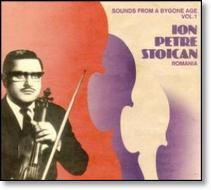
Ion Petre Stoican: Sounds From a Bygone Age, Vol. 1 (1966-77 [2005], Asphalt Tango): Bygone, but not a golden age in Romania, when smalltown musicians like Stoican had little chance to play except for weddings. Stoican got his shot at recording as a reward for catching a spy, and made the best of it, rounding up a 14-piece orchestra featuring cymbalom virtuoso Toni Iordache -- the only player with enough clout to get mentioned by name on an album attributed to the People's Orchestra. The record is dominated by Stoican's violin, which casts a dark, menacing shadow on music meant to be uplifting. In retrospect that shadow looms as sad, but also resilient, delivering an emotional wallop that gypsy music often skirts. A-
Briefly Noted
- George Benson: The Essential George Benson (1963-80 [2006], Columbia/Legacy, 2CD): A good jazz guitarist, but he never worked his way out of Wes Montgomery's bag; had considerable success as a gritless soul singer, which led him further astray; packed with sideman work, this cuts his smooth decline short and tries to focus on honest jazz. B
- The Best of Studio One (1967-80 [2006], Heartbeat): With so much to choose from, this seems arbitrary, skipping the ska years to focus on rocksteady stars -- Ken Boothe, Alton Ellis, John Holt, Slim Smith -- and the rasta roots movement -- the Abyssinians, the Gladiators, Wailing Souls -- and a little "Rub a Dub"; with so much to choose from, this holds up anyway. A-
- Oscar Castro-Neves: All One (2006, Mack Avenue): A grand tour through the life and loves of the Brazilian guitar master -- the sprightly guitar and flighty reeds are both typical and exemplary; Luciana Souza guests with two professional vocals, but his own rough sketches on chestnuts like "The Very Thought of You" are more touching. B+
- Cheap Trick: Dream Police (1979 [2006], Epic/Legacy): A pop metal band -- doesn't "pop metal" refer to those cheap, fragile castings made with a lot of tin? -- running out of ideas; aside from the title cut and the whiney ballad "Voices" this is pretty rote; "Gonna Raise Hell" might be funny from Blue Oyster Cult, but here it's lame. B-
- Cheap Trick: All Shook Up (1980 [2006], Epic/Legacy): The live "Day Tripper" bonus track suggests they came along too late, applying their limited talents in the wake of Led Zeppelin instead of the Beatles; hiring George Martin to produce should have been a sign, a plea for help, but all he did was twist knobs. C+
- Lee Dorsey: Yes We Can/Night People (1970-78 [2005], Raven): The singles he's most famous for ("Ya Ya," "Ride Your Pony," "Holy Cow," "Working in a Coalmine") were cut for Fury and Amy in the '60s and are periodically recycled for an essential comp -- all I've heard are out of print, but BMG/Camden's The Definitive Collection looks like a carbon copy of Arista's Wheelin' and Dealin'; this usefully collects Dorsey's two widely separated, otherwise out-of-print '70s albums -- false starts career-wise, or afterthoughts, but seductive all the same. A-
- George Duke: The Essential George Duke (1977-90 [2006], Epic/Legacy, 2CD): No career span here, just a double helping of warmed over funk -- half sounds like secondhand P-Funk, replete with Bootsy-like interjections; other half sounds like what Pedro Bell slammed as Turf, Hot Air & No Fire, except when the girls sing -- you know, Sister Sludge; first disc is further marred by a trip to Brazil, but the second, surprisingly, turns into tacky, sticky fun. B
- Irving Fields Trio: Bagels and Bongos (1959 [2005], Reboot Stereophonic): This could, and possibly should, be as tacky as its title and songs like "Havannah Nagilah" suggest, but it isn't, and that works too -- prim, proper, a light touch that keeps the piano up front, leaving the bagel- and bongo-rhythms wafting in the air, faint aromas of the exotic. A-
- Full Up: More Hits From Studio One (1967-82 [2006], Heartbeat): Aka Best of Studio One, Volume Two, which translates as more of the same, with Bob Andy and Delroy Wilson showing up on the rocksteady side, while Burning Spear and Culture nail down the roots angle; still strikes me as an arbitrary meander through the backwoods of a culture treasure. B+
- Dexter Gordon: Gettin' Around (1965 [2006], Blue Note): The last of the Blue Notes; Gordon sounds relaxed, his huge sound towering over light but sprightly accompaniment from Bobby Hutcherson on vibes and Barry Harris on piano. B+
- Gospel Music (1937-77 [2006], Hyena): In purely musical terms, one of the finest compilations of classic gospel music ever, able to raise the rafters, but also to hold them intact under the severest of storms; as history, useless, with Joel Dorn's liner notes just adding insult to injury. B+
- Louis Jordan: Number Ones (1942-48 [2006], Geffen/Chronicles): He dominated the jukeboxes in the '40s with his tight swing, quick wit, and relentless showmanship, with most of these R&B toppers also storming the Pop charts; there's a lot more where these came from -- this is just a no-brainer intro, nothing you won't want, nothing you shouldn't already have. A
- Gershon Kingsley: God Is a Moog (1968-74 [2006], Reboot Stereophonic, 2CD): Like Gutenberg, Kingsley's first thought on discovering a new technology was to use it to serve the Lord -- resulting in the "electronic prayers" of Shabbat for Today; the electronics take a back seat to the words, sung or lectured, declamatory or didactic; sounds like a much smarter Jesus Christ Superstar -- e.g., "poverty is a form of slavery/from the rich we must be free." B
- Rahsaan Roland Kirk: The Man Who Cried Fire (1973-77 [2002], Hyena): Scattered live bits -- clarinet, three-horn theatrics, talking, singing through his horn, honking, blues inside and out, a bit on New Orleans -- ordered with no flow, little rhyme or reason, except that the bits themselves are facets of a man unlike any other. B+
- Rahsaan Roland Kirk: Compliments of the Mysterious Phantom (1974 [2003], Hyena): Live in San Diego a year before his stroke, this lets Kirk loose to pursue his every idiosyncrasy, playing his gamut of instruments and musics, rapping and philosophizing, enjoying a band that includes Hilton Ruiz; check out the nose flute on "Fly Town Nose Blues," or his appreciation of "Old Rugged Cross." B+
- Rahsaan Roland Kirk: Brotherman in the Fatherland (1972 [2006], Hyena): One more live shot from the archives, a bit earlier and a lot louder, with less talk, more covers, fewer tricks -- although the booklet does have a picture of Kirk blowing three horns at once, and other bits of misdirection; live albums take on poignancy after an artist dies, functioning as memoirs for those who have memories, and curiosities for those who are merely curious. B+
- Frank London's Klezmer Brass Allstars: Carnival Conspiracy (2005, Piranha): The trumpeter behind Hasidic New Wave and the Klezmatics networks, pulling together forty-some musicians from eight countries to rip through songs in four languages interleaved with brassy instrumentals; cover sez "File under: USA / World / Carnival / Klezmer / Brass" -- it's all those things, but I also like the closer for its solemn soulfulness. A-
- Bob Marley & the Wailers: One Love: At Studio One (1964-66 [2006], Heartbeat, 2CD): Juvenilia, more identifiable by C.S. Dodd's studio groove than by the soon to be famous singers -- Peter Tosh and Bunny Livingstone as well as Marley; but even if "Simmer Down" was just a one-shot ska smash, "One Love" pointed forward, and Marley shared writing credits on both; not essential, but critical history. B+
- Hank Mobley: Dippin' (1965 [2006], Blue Note): Aside from a token ballad this could just as well be a Lee Morgan album, since trumpet runs roughshod over sax at will, at least when these two play; it holds up better than most because Harold Mabern and the rhythm section keep things moving, but also because Mobley gets to stretch out a bit on the ballad. B+
- Lee Morgan: Tom Cat (1964 [2006], Blue Note): With three horns this is a little busy up front, but Morgan's trumpet is never far from the spotlight; McCoy Tyner provides some slick interludes when he gets the chance, and contributes one song to make sure he does. B
- Lee Morgan: The Gigolo (1965 [2006], Blue Note): A brisk, chunky hard bop quintet, with Wayne Shorter playing second banana to the trumpeter, and perhaps more importantly pianist Harold Mabern cooking up the grits and gravy. B+
- Original Irish Tenors: The Legendary Voices of Celtic Song (1921-53 [2006], Columbia/Legacy): Vintage recordings, transferred cleanly so you can hear the deep, rich clarity of the voices, which is what this music is about -- well, also a certain drunken braggadocio. B+
- William Parker: Long Hidden: The Olmec Series (1993-2005 [2006], AUM Fidelity): The reissue component is "In Case of Accident," solo bass from an out-of-print self-release tacked on as an afterthought; avant-jazz bass solos aren't everyone's cup of tea, but this one is deep, intense, and powerfully moving, and only 14:09 long; the new stuff includes three milder bass solos, three solos on doson ngoni, and four complex rhythmic vamps by the Olmec Group, an experiment in Mesoamericana; this feels like a sketchbook, any piece of which could be developed into something substantial. B+
- John Rich: Underneath the Same Moon (1998-99 [2006], BNA/Legacy): This sat on the shelf until Rich hooked up with Big Kenny Alphin and sold some records as Big & Rich; mainstream country, nothing special except for the acappella gospel of "New Jerusalem." B
- The Rough Guide to Bhangra (1993-99 [2000], World Music Network): This promises "one way ticket to British Asia" but Asian Britain is more to the point -- bhangra is built for British clubs even as it draws on Punjabi beats and motifs; not exactly canonical, but pretty surefire. A-
- The Rough Guide to Bhangra Dance (1998-2005 [2006], World Music Network): A progress report, compiled by DJ Ritu, who repeats only Malkit Singh from the previous volume and doesn't try to sneak any ringers past this time; harder, more electro, perhaps due to the selector, but it's always been dance music, making this above all a second helping. A-
- Run the Road Volume 2 (2006, Vice): Lacks Volume 1's names, if indeed you consider Dizzee Rascal and Lady Sovereign names; these Brit DJs and rappers may gain recognition over time, but this is likely to remain a snapshot of the moment in grime or garage rap or whatever it is; meanwhile, they try to get by with hard beats, hardened attitudes, and lots of featured guests. B+
- Julia Sarr/Patrice Larose: Set Luna (2005, Sunnyside/No Format): Based in France, she sings starkly haunting ballads that owe je ne sais quoi to her native Senegal, while he plays flamenco-influenced guitar toned down to her speed; Youssou N'Dour joins for a duet. B
- Horace Silver: Silver's Serenade (1963 [2006], Blue Note): Silver's quintets were mostly interchangeable, but this line-up was a bit shy of the others: Blue Mitchell and Junior Cook tended to blare in unison, while Gene Taylor and Roy Brooks overreacted; center, of course, was Silver's piano, a rollicking gospel-tinged party machine. B
- Jimmy Smith: Softly as a Summer Breeze (1958 [2006], Blue Note): Standards fare with Smith comping lightly behind a series of light-handed guitarists -- Kenny Burrell, Eddie McFadden, Ray Crawford -- which despite some nice moments doesn't give you much of a feel for anyone involved; Bill Henderson sings on four bonus cuts -- he's not so incredible either. B
- Martin Taylor: The Best of Martin Taylor (1978-2004 [2006], The Guitar Label, 2CD): A light-fingered Scottish guitarist who apprenticed with Stéphane Grappelli, Taylor's large catalog and often dazzling style, most revealing in small groups or even solo, could use a showcase; but this leads off with Kirk Whallum's smooth jazz mayonaise and all too frequently indulges his taste for fondue. B
- Whiskey in the Jar: Essential Drinking Songs & Sing Alongs (1962-2003 [2006], Legacy, 2CD): Aside from famed tenor Frank Patterson, this collects two generations of Irish bar bands -- the Clancy Brothers and the Dubliners from the '60s, the post-punk Pogues and Dropkick Murphys from much later; reminds me of how obnoxious drunks are when one isn't drunk too. B-
Lead-in:
In an infinite universe, all the music you'll ever need already exists somewhere. We find more each month: Depression-era miscegnation, sounds of old Europe (Italy, Ireland, Romania), slick jazz (George Benson, Kenny G), Blue Notes (Andrew Hill, Dexter Gordon, Lee Morgan), Studio One reggae, boxes of King Crimson; many more (42 records).
Copyright © 2006 Tom Hull.