Latest
2026
Sep
Aug
Jul
Jun
May
Apr
Mar
Feb
Jan
2025
Dec
Nov
Oct
Sep
Aug
Jul
Jun
May
Apr
Mar
Feb
Jan
2024
Dec
Nov
Oct
Sep
Aug
Jul
Jun
May
Apr
Mar
Feb
Jan
2023
Dec
Nov
Oct
Sep
Aug
Jul
Jun
May
Apr
Mar
Feb
Jan
2022
Dec
Nov
Oct
Sep
Aug
Jul
Jun
May
Apr
Mar
Feb
Jan
2021
Dec
Nov
Oct
Sep
Aug
Jul
Jun
May
Apr
Mar
Feb
Jan
2020
Dec
Nov
Oct
Sep
Aug
Jul
Jun
May
Apr
Mar
Feb
Jan
2019
Dec
Nov
Oct
Sep
Aug
Jul
Jun
May
Apr
Mar
Feb
Jan
2018
Dec
Nov
Oct
Sep
Aug
Jul
Jun
May
Apr
Mar
Feb
Jan
2017
Dec
Nov
Oct
Sep
Aug
Jul
Jun
May
Apr
Mar
Feb
Jan
2016
Dec
Nov
Oct
Sep
Aug
Jul
Jun
May
Apr
Mar
Feb
Jan
2015
Dec
Nov
Oct
Sep
Aug
Jul
Jun
May
Apr
Mar
Feb
Jan
2014
Dec
Nov
Oct
Sep
Aug
Jul
Jun
May
Apr
Mar
Feb
Jan
2013
Dec
Nov
Oct
Sep
Aug
Jul
Jun
May
Apr
Mar
Feb
Jan
2012
Dec
Nov
Oct
Sep
Aug
Jul
Jun
May
Apr
Mar
Feb
Jan
2011
Dec
Nov
Oct
Sep
Aug
Jul
Jun
May
Apr
Mar
Feb
Jan
2010
Dec
Nov
Oct
Sep
Aug
Jul
Jun
May
Apr
Mar
Feb
Jan
2009
Dec
Nov
Oct
Sep
Aug
Jul
Jun
May
Apr
Mar
Feb
Jan
2008
Dec
Nov
Oct
Sep
Aug
Jul
Jun
May
Apr
Mar
Feb
Jan
2007
Dec
Nov
Oct
Sep
Aug
Jul
Jun
May
Apr
Mar
Feb
Jan
2006
Dec
Nov
Oct
Sep
Aug
Jul
Jun
May
Apr
Mar
Feb
Jan
2005
Dec
Nov
Oct
Sep
Aug
Jul
Jun
May
Apr
Mar
Feb
Jan
2004
Dec
Nov
Oct
Sep
Aug
Jul
Jun
May
Apr
Mar
Feb
Jan
2003
Dec
Nov
Oct
Sep
Aug
Jul
Jun
May
Apr
Mar
Feb
Jan
2002
Dec
Nov
Oct
Sep
Aug
Jul
Jun
May
Apr
Mar
Feb
Jan
2001
Dec
Oct
Sep
Aug
Jul
Jun
May
Apr
Mar
Feb
Sunday, October 30, 2005
Music: Current count 11182 [11157] rated (+25), 900 [919] unrated (-19). Had to break off my jazz prospecting to wrap up November's Recycled Goods. Didn't get much new, which leads to the unrateds dip. Actually having a lot of trouble getting backlog for Recycled, and getting tired of the grind each month.
- Bill Bruford: Feels Good to Me (1977 [2005], Winterfold): the prog rock drummer par excellence (Yes, King Crimson, Genesis), like many Bruford eventually gravitated toward jazz; his first solo album is neither fish nor fowl, with Dave Stewart and Allan Holdsworth engaging in light, swishy instrumental rock, while avant-gardist Kenny Wheeler adds a dollop of flugelhorn and vocalist Annette Peacock sings or raps on four tracks; most interesting for Peacock, whose own records (with Bruford drumming) are highly recommended. B
- Bill Bruford: One of a Kind (1979 [2005], Winterfold): second album, the group reduced to a quartet -- Holdsworth's guitars, Stewart's keyboards, Jeff Berlin's bass -- for the simple pleasures of prog fusion. B-
- Bill Bruford's Earthworks (1986 [2005], Winterfold): this was Bruford's official debut as a jazz artist, although there are still minor additions of electric keybs and drums, and at least one piece ("Bridge of Inhibition") sounds like it fell off King Crimson's oxcart; Bruford's partners here are Iain Ballamy (saxes) and Django Bates (piano), both notable players in their own right, and acoustic bassist Mick Hutton, with Ballamy and Bates contributing writing; the two bonus cuts are the most pleasing jazz pieces here. B+
- Bill Bruford's Earthworks: Dig? (1989 [2005], Summerfold): new bassist, but the core Bruford-Ballamy-Bates group remains intact, and they've continued to move toward the loose, slinky, semi-avant jazz favored especially by Bates, dropping the prog rock artifacts of Bruford's past -- still some electric keyb, but Bates keeps it interesting, avoiding the usual clichés. B+
- Choubi Choubi! Folk & Pop Sounds From Iraq (1970s-2002 [2005], Sublime Frequencies): Scrounged from old cassettes and LPs found in Syria, Europe, and Detroit, this provides a short course in the music of secular, socialist, Baathist Iraq, starting with three cuts from Ja'afar Hassan sometime in the '70s through the Saddam era. As with most records on this label, this was assembled on the cheap, with hit and miss scholarship -- good to know that Basta, Bezikh, Choubi, and Hecha are distinct styles, since otherwise our ears aren't tuned that fine. What we do notice is that the sound is usually cranked up to the point of distortion, which resonance to music powered by squelchy strings, hard beats, and harsh voices. Half of the artists are "unknown" -- the anonymity adds to the primal allure. One might hope that the whiff of freedom would unleash a renaissance in Iraqi music, but more likely that's been scotched by the tin-eared Texas oilmen and their shortsighted deals with the Islamic clergy. Compiler Mark Gergis worries about such things, his booklet including a picture of an oud smashed in the post-invasion looting. Looking forward from the wreckage, you have to wonder what sort of madness it takes to make a golden age out of Saddam's reign of horror. A-
- Elton Dean: Moorsong (1998-99 [2001], Cuneiform): The Soft Machine's saxophonist has put together a long and evidently notable career without me ever paying much attention. This is one of many points along the way -- hard to judge in itself. Strikes me as a bit overcomplex, but saxophonist holds up well. B+
- Mutant Disco #3 (1979-1992 [2004], ZE): leftovers following the 2CD Mutant Disco that inaugurated the reincarnation of Michael Zilkha and Michel Esteban's quintessential underground label, concentrating on their connection to Larry Levan's Paradise Garage, ground zero for the subduction of disco into the underground; too random and weird to work on the dancefloor, so random and weird you might want to listen to it anyway; recommended to historians: "Read My Lips" -- the dyslexic wit and wisdom of George H.W. Bush. B+
- Ol' Dirty Bastard: The Definitive Ol' Dirty Bastard Story (1995-99, Elektra/Rhino): two albums, three low chart singles, no real hits, but famous enough for his Wu-Tang connection, rap sheet, and death two days short of his 36th birthday that this is his second best-of, complete with DVD of his three crappy videos; he was a comic, a scam artist, an attitude with no superego, such a fuckup his death came as a relief, but the pieces here are solid popwise, and not just when RZA or the Neptunes were on hand to bait his hook. B+
- Bobby Pinson: Man Like Me (2005, RCA): I've had people ask me if this is Steve Earle. Pinson's got the voice, and he's got a lot more structure to his songwriting than you get with most country singers -- for that matter, more than Earle too. A-
- Putumayo Presents: Asian Lounge (1978-2005 [2005], Putumayo World Music): it takes extreme heat to fuse two elements into something new; short of that you just get a mixture, and here the mix is very cool indeed; Asia is a big place for such a thin selection -- India, Japan, Bali, not much in between -- with the synth beats and lounge singers further diluting the quaint strings. B
- Putumayo Presents: Celtic Crossroads (1998-2005 [2005], Putumayo World Music): the Scots-Irish brought celtic music to Appalachia, where it hybridized with Afro-America to form the backbone of bluegrass, so its appeal to me has always been in its primitiveness; this comp goes zip for eleven on any such scale, its mild, prim progressivism even blander than Ireland's cuisine. C
- Radio Pyongyang: Commie Funk and Agit Pop From the Hermit Kingdom (1995-2005 [2005], Sublime Frequencies): The Korean War ended in stalemate in 1953: Kim Il Sung failed in his effort to unify the peninsula under his rule, and the U.S. failed to purge Korea of communism. The shooting stopped then, but the cold war continued. The U.S. in victory had been gracious to defeated Japan and Germany, but the stalemate left both sides nurturing grudges -- even half a century later, when Bush accorded North Korea charter membership in an Axis of Evil. During that period, the U.S. worked to isolate North Korea, and North Korea in turn morphed into the Hermit Kingdom, far and away the strangest corner in the world: the only technologically advanced country untouched by globalization. Along the way Kim Il Sung's Stalinism evolved into a neopagan cult of "Dear Leader" Kim Jong Il, a strange mix of Stalin's self-fetishism and the ancient emperor cults of China and Japan. Still, background can't prepares you for the shock of this sampling of North Korea's music. Christiaan Virant taped most of this listening to Pyongyang radio from Beijing in 1995-98: bright pop, light opera, kiddie choruses, other things I can't begin to identify. Propaganda, of course, but the edit doesn't go overboard, and the cuts avoid the jarring juxtapositions of this label's other radio mixes. Like nothing else. B+
- Marion Williams: Remember Me (1968-92 [2005], Shanachie): an amazing gospel voice -- if anyone could wake God from the dead it would be her -- but she can be so overpowering I often feel battered and bruised rather than uplifted; this is Shanachie's third selection from her career, with twelve tracks previously unreleased, so this feels a bit picked over; but its predecessor, The Gospel Soul of Marion Williams, is no better or worse. B+
- ZE Records Presents: Undercover (1979-2004 [2004], ZE): all covers, mostly from ZE's 1979-83 heyday when the label encompassed no waver Alan Vega, postmodernist Don Was, zoot suiter August Darnell, mutant saxist James Chance, and various art-damaged poseurs like the marvelous Cristina; there's no common style other than a high level of outrage or in-joking or both, applied to a canon as diverse as "You Go to My Head," "Money," "Lili Marlene," and "Tropical Hot Dog Night." B+
- ZE Xmas Record Reloaded 2004 (1981-2004 [2004], ZE): like Phil Spector's Xmas album, Michael Zilkha's was a joke showcase for his label artists, but whereas Philles was all Phil, ZE's stable was stocked mostly with bomb throwing anarchists; the three new cuts are by far the most conventional, giving creedence to the notion that we've grown far less adventurous than we were a quarter century ago, but the balance, inconsistent and unruly, is unlike any other Xmas album ever; choice cut: James White, "Christmas With Satan." B
This continues last week's log of Jazz Consumer Guide prospecting. These aren't all first spins, but increasingly so. I have at least another week's queue to sort through, plus plenty to go back to and listen again. Grades in brackets are tentative. Came up short this week due to the Recycled Goods deadline. Should be converging on a column, but it hasn't come together yet.
Erik Truffaz: Saloua (2004 [2005], Blue Note): Don't know his earlier work, just that he's carved out a niche for himself in jazztronica, a latterday fusion project that typically uses regular synth beats. There's some of that here, including a soaring piece of fusion I don't find terribly appealing ("Spirale") and several, both hard/fast and soft/airy, that I do. But the album is front-loaded with vocals: four in Arabic from Tunisian Mounir Troudi and two (one overlap) in English from Swiss rapper Nya. Choice cut: "Yabous," with Mounir's wail setting up Nya's peace proposal: "Israelites and Ishaelites have to have equal rights and justice." Not inconceivable I could upgrade this. [B+(**)]
Uri Caine/Bedrock: Shelf-Life (2004 [2005], Winter & Winter): A very accomplished left-of-mainstream pianist, Caine's side projects have ranged from improvising on Schumann and Mahler to his very old school take on Tin Pan Alley to joining Questlove for The Philadelphia Project and his jazztronica group Bedrock -- a trio with Tim Lefebvre's bass and guitar and Zach Danziger's beats, but most importantly, Caine's electric keyboards. Important acoustic pianists from Chick Corea to Cyrus Chestnut always seem to lose touch when they dabble in electronics, but Caine somehow makes it work -- perhaps because he sticks to the instrument's range, supplementing the beats rather than trying to conquer them. This goes beyond the original 2001 Bedrock album by adding guests, including beat programmers Luke Vibert and DJ Olive, occasional horns, a couple of vocalists even. Closes with Bunny Sigler singing "Sweat" in a rare Philly soul moment that's both classic and futurist. A-
Ben Monder: Oceania (2004 [2005], Sunnyside): A guitarist I run across frequently in side roles, where he is often a notable asset. This shows the range of skills that makes him so useful on the side, but doesn't cohere into much. Two solo cuts, some with bass-drums, some with Theo Bleckmann, whose sounds more like a theremin than a vocalist. The common denominator is an icy coloration, joining the electric beat-heavy "Rooms of Light" and the Fripp-and-Eno-ambient "Spectre." B+(*)
Craig Harris: Souls Within the Veil (2003 [2005], Aquastra, 2CD): Composed to commemorate the 100th anniversary of W.E.B. DuBois' The Souls of Black Folk, a book so forward thinking we ain't got there yet. With three brass and four reeds there's a lot of wind in these sails. But the extra percussion Kahil El'Zabar adds to Billy Hart's drums and Cecil McBee's bass helps on the bottom. No piano. Most pieces follow a series of superb solos -- Steve Coleman, Hamiet Bluiett, Don Byron, Hugh Ragin, Graham Haynes, Oliver Lake, and the leader all have spots on the highlight reel. Likely to be upgraded when I get to spend more time with it. Unlikely to be in JCG, this time anyway, given that Francis Davis already praised it to the skies. Otherwise it would be a strong Pick Hit prospect, and may wind up in the year end list. A-
Warren Hill: Pop Jazz (2005, Native Language): The first cut is about as good a riff as you get in pop jazz. The second is "Come Together," a pretty safe change of pace. After that the ideas run thin. I mean, "Play That Funky Music (White Boy)" has been done already. B-
Dominic Frasca: Deviations (2003 [2005], Cantaloupe/Serious Music): Frasca plays guitar. Not sure if there's anything else on here -- percussion or treatments, but it at least sounds overdubbed. The music is close to minimalism -- tightly spaced rhythms, modulated here and there, but because it's guitar it has more angular momentum. I was into this kind of music -- its progenitors, that is, Philip Glass, Steve Reich, et al. -- back in the late-'70s, but haven't followed it in a long time. This is very appealing. Will take some further play to sort out, and it could get bumped a notch. [B+(***)]
Adam Simmons Toy Band: Happy Jacket (2002, Dr. Jim's): Simmons plays saxophones from bass to sopranino, plus a little bass clarinet and shakuhachi. In that mode this is good, clean avant fun. But the band's name reflects another dimension: all members also dabble in toy instruments. Don't do it enough that it takes over the album, but it does toss in the occasional oddball sound. B+(**)
Bill Charlap/Sandy Stewart: Love Is Here to Stay (2004 [2005], Blue Note): A very subdued make-out album, modelled perhaps on the Bill Evans/Tony Bennett album, but less so -- far less. Credit Charlap's lead billing to the marketing folks -- he barely plays, but then Stewart sings so measuredly that she leaves him little to work with. Stewart has a touch of opera in her voice, an instant turn-off for me, but your mileage may vary. As usual, a great song, like the title tune or "It Might As Well Be Spring," lifts the interpretation, but anything less reduces to affect. B-
Dave Douglas: Keystone (2005, Greenleaf Music): This is a set of music Douglas wrote to score a 1916 film by Roscoe Arbuckle called Fatty & Mabel Adrift. The package includes a DVD with the film and music, plus a CD with the music worked out into finished pieces. The music is mostly upbeat, scaled large with DJ Olive pushing the beats, and Marcus Strickland's saxophones filling in behind Douglas. After dismaying me at first, this sounds better with each play. Guess I need to look at that DVD. [B+(**)]
Rich Halley Trio: Mountains and Plains (2004 [2005], Louie): I'm so attuned to the sax-bass-drums trio format that I tend to practice reverse discrimination, lest these rather common records take over the CG. Hence, I've been resisting this one, even though, or precisely because, it's right down my alley. Halley is based in Oregon. Has a half-dozen or so well-regarded albums, none of which have crossed my path before. Plays tenor and soprano, mostly tenor. Penguin Guide describes his work as "freebop" -- it's close enough to the tradition for that description to fit. Pieces run fast and slow, and Halley's distinctive both ways. Bassist Clyde Reed and drummer-percussionist Dave Storrs help out -- I especially like a stretch with hand drums. Could hold out for another spin, but this time I think I'll go with my druthers. A-
Steve Lehman: Demian as Posthuman (2005, Pi): Twelve pieces run 36:30, not much more than an LP from the era when singles were king. Three are group pieces with Vijay Iyer on piano and Meshell Ndegeocello on bass. Most are duos with Tyshawn Sorey on drums, and a couple are solos. Lehman plays alto sax, or sopranino sax on one cut. Electronics happen, so the solo cuts are usually Lehman playing against his own programming. Short, sharp, eloquent. Don't quite have a handle on this yet, but he's certainly turning into an interesting figure. [A-]
Jabbo Ware/The Me We & Them Orchestra + Strings & Horns: Vignettes in the Spirit of Ellington (2001 [2005], Y'all of New York): Huge band, twenty-three pieces not counting Ware, who composed and conducts. The strings are limited to two each -- violins, violas, cellos, basses -- but they are secondary to the horns. The pieces show real muscle and sharp edges, slightly reminiscent of Ellington circa 1950 when he was hard-pressed to reassert himself in the face of bebop progressivism, but also this flows out of later Ellington-inspired groups like Vienna Art and Either/Orchestra. B+(***)
Gregg August: Late August (2003 [2005], Iacuessa): Bass player, writes all the pieces, plays one as a solo, one as a duo, one with guitar and drums, the rest with a crack quintet, joined once by Frank Wess. Mainstream with a latin twist; the group swings, the spotlight pieces less so. Good stuff, as far as it goes. B+(**)
Harris Eisenstadt: The Soul and Gone (2004 [2005], 482 Music): Sextet led by drummer Eisenstadt, with several familiar Chicago players: Jeb Bishop (trombone), Jeff Parker (guitar), Jason Roebke (bass). Also a couple of Jasons I'm unfamiliar with: Adasiewicz (vibes) and Mears (alto sax, clarinet). It may be that Eisenstadt's got too many resources here for his rather abstract music -- lots of little sounds pop out of nowhere and vanish as quickly. Interesting stuff, in principle, and listenable as well, but I suspect he could have done more with less. B+(*)
Nels Cline/Wally Shoup/Chris Corsano: Immolation/Immersion (2005, Strange Attractors): Starts out sounding absolutely hideous, and periodically returns to that state. The noisemakers are electric guitar, alto sax, and drums. Each can be interesting when not flailing insanely against the other, and there are some quieter moments when they're merely edgy. Moreover, not all of the noise bursts are unlistenable. But most are. For what it's worth, Cline is the biggest offender. C+
Thelonious Monk Quartet With John Coltrane: At Carnegie Hall (1957 [2005], Blue Note): Small world it was back in 1957. The program for Carnegie Hall's Thanksgiving Jazz concert -- two shows, top-priced tickets going for $3.95 -- lists a few other folks you might like to hear: Billie Holiday, Dizzy Gillespie, Chet Baker with Zoot Sims, Sonny Rollins ("introducing in concert the brilliant"), and "special attraction" Ray Charles. But Monk's two sets add up to 51:35, and satisfy our craving to hear something more substantial from his short-lived, rarely recorded Coltrane quartet than that cruddy-sounding Five Spot tape that was acclaimed as Discovery! back in 1993. It turns out that the concert was recorded by Voice of America for overseas broadcast, but the tapes have languished ever since in the Library of Congress vaults until Larry Appelbaum made his discovery. The sound is fine. Monk engages quickly, but Coltrane is revelatory, especially on the one non-Monk tune where he kicks everything up a gear, then sustains that level to the end. A
Friday, October 28, 2005
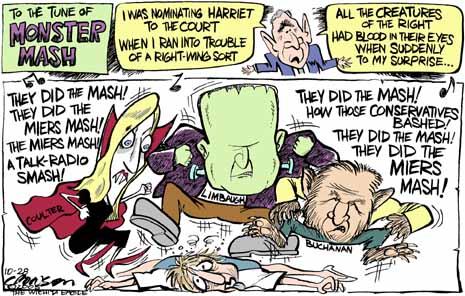
The Harriet Miers Supreme Court nomination collapsed even faster than I had predicted. The ultra-right is howling with glee today, but it's possible that their victory will come as some cost. For instance, the Wichita Eagle's mild mannered editorial cartoonist was moved to depict them in rather unfavorable light:
Beyond the public's perception of these ghouls, the next question is who will Bush nominate next. This is not the only time Bush has withdrawn a nomination -- Bernard Kerik for one -- but this one hits unusually close to home. Bush's loss here is not just personal -- it shows that he's lost control over his base. If he appeases them he surrenders his role as leader and loses his ability to appeal beyond his base. On the other hand, with his popularity imploding and the media and even some Democrats smelling blood, he desperately needs the right's attack dogs guarding his ass instead of chewing on it.
Meanwhile, Lewis Libby has been indicted for perjury and obstruction of justice -- the spin word is "technicalities," but that could still add up to 30 years in the slammer. Sure, it's a rather minimalist conclusion to an investigation that could have gone much deeper, but it also sounds like a slam dunk case. The case reminds me of three things: when first asked about the Plame leak, Bush went into a long, ambling discourse on how leaks in Washington are so ubiquitous it's usually impossible to identify who may have been responsible and we're unlikely to ever find out; that Josh Marshall countered by arguing that if the President actually wanted to find out who was responsible he could do so in minutes; that the first reports of who was responsible, well over a year ago, named Libby. In his news conference today, Fitzgerald as much as said that had Libby not lied the investigation would have ended a year ago. What he didn't say was that the time that Libby kept the investigation from concluding includes Bush's election. Libby's payoff will presumably be a pardon before Bush leaves office, which will allow Libby, like Elliott Abrams, to get out of jail and hold another highly placed job in some future neocon cabal. In the meantime, one has to wonder whether Bush knew the culprit when he made his own contribution to the cover-up.
Until recently, Bush somehow managed to walk a tightrope between the loony right and the gullible middle, but he's getting wobbly -- even if he's not back on the sauce. Of course, between the two he's always feared the right much more. Crowson's cartoon reminds you why.
Thursday, October 27, 2005
I've read a letter issued by "Friends of John Kerry, Inc." that points to excerpts from Kerry's Oct. 26 speech at Georgetown U. and proposes that we all sign a petition "to insist that President Bush puts forward a detailed plan with target dates to bring our troops home and stabilize Iraq." The gist of all this is that Kerry finally admits that the losing position he insisted on holding through the 2004 presidential election was wrong, but now he's figured it out and wants us to get behind him as he leads the antiwar movement. As the old saying goes, that's mighty white of him.
Kerry's newfound position might have done him some good a year ago, when he had a mandate to present himself as a real alternative to Bush. He has no such mandate now, having blown the election and clammed up for nearly a year while Bush's policies self-destructed. (Maybe the Bush people had a point last year about Kerry's leadership skills.) But even though the situation in Iraq is grimmer now than it was a year ago, back then there was ample evidence available that Bush's efforts to quell the resistance and establish a compliant pro-American would fail. Kerry's choice at the time was to accept the Bush program but quibble with its management. In doing so, he missed a golden opportunity to attack the clear political issues of how and why Bush led America into a disastrous war.
What Kerry should have said during the campaign was this: Yes, I voted to authorize force against Iraq because I was convinced that the President would only use that authorization to leverage Saddam Hussein into allowing UN weapons inspectors to return to Iraq, because I knew that the only way to settle the question of Iraq's WMD programs would be through the inspections process. At the time I expected that the US would go to war only if Hussein refused inspections and if the UN Security Council agreed that war was the only solution. I voted as I did because I believed that the President would only go to war as a last resort. This, as facts have proved, turned out to be a severe misjudgment of this particular President. As we saw, the resolution that I voted for did in fact convince Saddam Hussein to permit the UN weapons inspectors to return, but President Bush actively subverted their work, forcing them to quit when they were on the verge of showing what we now know to be true: that Iraq had no WMD. Moreover, Bush launched a pre-emptive war against Iraq, without the sanction of the UN Security Council, without further consultation by Congress, with only the barest ad hoc international coalition, with no clear plans for Iraq's future beyond decapitating the existing regime. As we also know now, the results of this hasty drive to war, which President Bush did mostly on his own authority, have been disastrous: they've ensnared us in the occupation of Iraq, they've cost us vital resources we needed for the war on Al Qaeda while creating a brand new training ground for anti-American terrorists. Yes, I made a grievous mistake in voting to authorize war against Iraq. But be clear just what my mistake was: My mistake was in trusting George W. Bush to defend and pursue America's best interests. As we now know, Bush cannot and should not be trusted to lead this country in matters of war. As we now know, the Bush Administration mislead Congress and the country with faulty or phony intelligence about Iraq's WMD programs. As we now know, the Bush Administration rushed to war, without adequate preparation, without due dilligence, without any freaking clue what they were getting us into. . . .
Kerry could then go on and point out that the mess that Bush got us into is a mess that the next President will inherit, and there's likely to be no easy solution to that. But the question that America has to face is not what we do next in Iraq, but whether we as a country continue to make the mistake that I made in voting to authorize this war, which is to trust the people who got us into this mess to somehow get us back out again. This is the sort of argument that Kerry could and should have made during the 2004 election campaign, when those arguments would make a meaningful distinction between his candidacy and Bush's re-election. But he didn't make any such argument. And while most of us voted for him anyway, it's easy to see why many Americans didn't see the basic difference between the two candidates. They were both, after all, spouting the same nonsense about training Iraqis to stand up so we can stand down.
Looking at Kerry's speech he's still rather befuddled about what's going on in Iraq. In particular, he describes the conflict there as being between Sunni and Shi'a. The plain fact is that the conflict is between Iraq and the United States, which we've disguised somewhat by promoting some Shi'a as a quasi-government while systematically excluding Sunnis, giving them no hope but to join the insurgency. Where Kerry is right is that the only way out is a political solution between all parties in Iraq, but he sorely underestimates the difficulty of such a solution, because he doesn't recognize how the Bush Administration's actions have poisoned that prospect. Even today Kerry places far too much trust in Bush. And that's why he is still, as Bush's propagandists put it, unfit for command.
Wednesday, October 26, 2005
The count of US soldiers who met their maker in Iraq has topped two thousand. Round numbers still get respect these days, so the "milestone" is being noted in various ways by those who care, which mostly means the peace (aka antiwar) movement. Billmon marked the event by constructing a graphic with ten flag-draped coffins per row, two hundred rows long. (A little more cut and paste and he'll be ready for next year.) Here in Wichita, and many other places, there have been or will be vigils. Of course, two thousand doesn't begin to count the real costs of this war. Hell, it doesn't even count all the dead Americans: it omits contractors and journalists and stray civilians, and it omits the other "theatres" of the War on Terror, like Afghanistan and that helicopter full of "advisors" that crashed in the Philippines. Nor does it count the Coalition of the Suckers, or their fellow travelers in the UN or the NGOs -- all those who poured into Iraq in the wake of invasion, some trying to help out, some out for a quick buck, some curious, some foolish, but who knows how many turned up dead? Nor does it count the other foreign fighters, the jihadis, and most of all it doesn't count the Iraqis, killed by one side or the other or no side at all. It's not that we have no concern for all those other deaths. It's just that no one is able or willing to count everyone. So we're stuck with the deaths of American soldiers as a metric of the costs of the war. It's a piss poor metric, but it's likely to correlate strongly with the overall costs. The question is leaves unanswered is what factor do you multiply US soldiers' deaths by to get to the big picture.
But when we look back on this war it's likely that US soldier deaths will be a small fraction of the real costs, even if we limit our concerns to America. Compared to past wars, two thousand isn't a very big number. The military works very hard at keeping those numbers as low as possible, at least relative to the intensity of the war. That's partly because those are the numbers that count, and partly because each one of those numbers maps back to someone known in our communities. But for every US soldier who dies in Iraq, many more are physically wounded or mentally scarred. The scariest statistic to come out of the war is the estimate that 25% of the US soldiers who come home from Iraq suffer physical and/or mental trauma. Do the math on that and you're looking at the better part of a hundred thousand. And remember that those soldiers are going to be returning to a country fast dismantling its safety nets. You think the Bush people are going to sacrifice their tax cuts to pay for the lives they wasted in Iraq?
Two thousand dead soldiers is one of those events that became inevitable once Bush learned to mouth the "stay the course" words. The course is a steady drip drip drip of blood. How much progress the US has made was demonstrated by three car bombs exploded around the plaza where Saddam Hussein's statue was toppled. I don't see any way to find hope in the news out of Iraq. The constitution was yet another ethnic identity plebiscite, all but unanimously opposed by the Sunni Arab minority, who have little political hopes except through the insurgency. America's divide-and-conquer strategy has backfired as we now find ourselves stuck defending factions that we foolishly legitimized in the first place. The new Iraqi military, where it exists at all, is little more than a veneer over factional militias. Liberating Iraq from the Baath has helped ally it with Iran. In frustration, the US is now lashing out at Syria -- if the goal there is to bring down the Baath the most likely beneficiary will be the Muslim Brotherhood. The worst case scenario there is the scenario that happened last time the US got into this sort of pickle: when Nixon's "incursion" destabilized Cambodia, leading to Pol Pot's murderous rampage.
Of course, one reason why we do count the deaths of US soldiers is that the warmongers view those deaths as investments. They argue that pulling out would deprecate the sacrifices of the dead -- that anything short of victory would signify that those Americans had died in vain. That's the ultimate dead end argument, a desperation ploy by politicians so wrongheaded they can't own up to their own folly. But the ruin is all around us, for all to see. Hell, even John Kerry, who stayed the course all the way to breaking our hearts, has started to recognize the hopelessness of the Iraq war cause. But Bush keeps pounding out the same old line. Any deviation there and his whole game falls apart. But no amount of resolve can stave off the real world forever.
Tuesday, October 25, 2005
My 55th birthday today. Stuck in an extended midlife rut that feels more and more like old age. I work at home, listening to records and sometimes writing about them, not making any money. I think about that philosophy book I've been thinking about for twenty years now -- as opposed to a whole string of books I've thought about all my adult life without ever tackling -- but make no progress. Every once in a while I spit out something into the blog, where it sits unnoticed. Read a lot -- but still am haunted by the notion that everything I've tried all my life to learn will vanish when I die (or maybe earlier). Unlike everyone around me, I grew up with delusions of greatness, and never achieved anything approaching that. Most likely I've been my own worst enemy, and now I feel stuck. On the other hand, I've been lucky a few times. And on a personal scale I feel like I've lived an honorable life -- have been blessed by friendship and love, have had opportunities to share and be helpful. So it's not so bad.
Fixed birthday feast again, scaled back considerably from previous years, but had eleven people show up, and food left over. Theme was Brazilian: a huge pot/platter of feijoada, sauteed collard greens, rice with a little onion and tomato, chayote salad. That's it -- don't know much about Brazilian food, but I've long wanted to tackle the national dish, basically a big pot of pork and black beans. For desert, fixed a double layer spice cake with maple meringue icing and a batch of vanilla ice cream.
Sunday, October 23, 2005
Music: Current count 11157 [11127] rated (+30), 919 [920] unrated (-1). Did nothing this past week except play new jazz records. I'll post notes on 45 or so such records sometime today. Most were rated on the spot; others were put back in the queue for further review. I have enough records rated now to do a Jazz CG, but I also and have enough records unheard to spend another whole week prospecting, and enough awaiting further replies to fill up yet another week. Meanwhile, I will need to interrupt next week to finish off November's Recycled Goods. So it goes.
- Anthony Braxton Quartet: 8 Standards (Wesleyan) 2001 (2001, Barking Hoop, 2CD): Same quartet as appears on two 4-CD Leo boxes, but two years earlier, and just one date. The superb boxes have been cherry picked from a number of concerts, and the later pieces tend to run longer. The eight standards here barely top the 80-minute mark, forcing a second disc (under 30 minutes). The rough promise certainly exists, and again Kevin O'Neil deserves exceptional praise. B+
- Lena Horne: Seasons of a Life (1994-2000 [2005], Blue Note): My advance says "in stores April 12, 2005," but I never got a final copy, and doubt that it was ever released. As I understand it, these were outtakes from her '90s albums for Blue Note. Ten songs, four by Billy Strayhorn, "Stormy Weather" to close; Rodney Jones listed as producer, various musicians. She sounds fine. No surprises, no gaffes, alas not much point. It's not like she's never done "Stormy Weather" before. B
This continues last week's log of Jazz Consumer Guide prospecting. These aren't all first spins, but increasingly so. I have at least another week's queue to sort through, plus plenty to go back to and listen again. Grades in brackets are tentative.
Herb Robertson NY Downtown Allstars: Elaboration (2004 [2005], Clean Feed): Since they're "allstars" we might as well start by listing them: Robertson (trumpet, cornet), Tim Berne (alto sax), Sylvie Courvoisier (piano), Mark Dresser (bass), Tom Rainey (drums). Courvoisier is a new one to me, but a quick check reveals my bad. AMG lists six albums plus ten more credits, and she's mostly worked with people I do recognize. Album contains one 48:28 piece. Starts slow, builds to something quite impressive, fades out, just like it should. I'm duly impressed, but I doubt that this would make much sense to a neophyte. Will make a note to pay more attention for Courvoisier. B+(**)
Jean-Marc Foltz/Bruno Chevillon: Cette Opacité (2003 [2005], Clean Feed): Ten duets. Foltz plays clarinet or bass clarinet, Chevillon bass. Don't know these people, but the action pins your ears from the start. Dark, abstract, difficult listening, but deeply moving. Interesting record; could move up a notch. [B+(**)]
Roundtrip: Two Way Street (2004 [2005], Jazzaway): Sax trio, from Norway, led by Klaus Ellerhusen Holm on alto and baritone, with Ole Morten Vågan on bass and Ole Thomas Kolberg on drums. Fiercely energetic avant group with a rockish flair -- not sure whether Vandermark influenced this scene or he merely found a second home among like-minded players. In any case, add Kolberg to the list of Scandinavian drummers who can really pound the skins. Fredrik Ljungkvist (of Atomic) wrote the liner notes. I like this mode a lot. This is a good, but not extraordinary, example. B+(***)
The Onus: Triphony (2003 [2005], Hipnotic): Trio led by clarinetist Darryl Harper, with Matthew Parrish on bass and Butch Reed on drums. The Onus has also appeared as a quintet with guitarist Jeff Ray, in what's been described as a Benny Goodman-Charlie Christian lineup. But Harper doesn't sound at all like Goodman: more like a cross between Don Byron and Jimmy Giuffre, but also factor in a more direct influence from Yusef Lateef. Like Lateef, he works in a little exotica, but he also manages to push postbop into territory that is inventive but clear and accessible. Sounds terrific at first, but at 78 minutes it gets to be pretty long. [B+(**)]
Anthony Braxton: 20 Standards (Quartet) 2003 (2003 [2005], Leo, 4CD): Four more CDs from the same tour that yielded last year's 4-CD 23 Standards (Quartet) 2003. The bounty comes from Braxton picking fresh songs each show -- jazz pieces more often than the usual chestnuts, with old favorites Brubeck and Desmond most prominent. The pieces stretch out leisurely, with Kevin O'Neil's deft guitarwork often the highlight, and Braxton's saxes favoring the high registers. Smart and cool, the most accessible and simply pleasurable set he's done. (That I'm aware of, anyway. Braxton's catalog is probably the largest of working saxophonist -- Lee Konitz, with a two-decade head start, might come close; younger players like David Murray and Ken Vandermark have approached Braxton's pace, but not for nearly so long.) A
Anders Aarum Trio: Absence in Mind (2002-03 [2004], Jazzaway): Piano trio, slightly left of mainstream, smart and tasty with a little edge especially in the drums, but too subtle for me to grasp in one somewhat distracted pass. [B+(*)]
Morthana (2004, Jazzaway): Group name appears to come from drummer Morten Olsen and guitarist Anders Hana, leaving little acknowledgment of Andrew D'Angelo's reeds (bass clarinet, alto sax). Judging from the sound that probably is the pecking order, although the back cover credits are alphabetical and/or front-to-back. Mostly a noise group -- bracing at best, annoying otherwise. B
Jazzmob: Pathfinder (2003, Jazzaway): Norwegian quintet led by alto saxist Jon Klette. Hard to pigeonhole, since avant-trad-fusion doesn't clarify much of anything. Except perhaps by suggesting a cosmic wormhole to the similarly named Sexmob, who do a better job of keeping what they're spoofing straight. B
Mats Gustafsson & David Stackenås: Blues (2003 [2005], Atavistic): In his liner notes, Ken Vandermark argues that the main difference between American and European jazz musicians is that the former string time together whereas the latter deconstruct it. What makes these blues unrecognizable as blues is that they have no rhythm at all. That leaves us with sounds that erupt rather than flow: electronics from Stackenås' guitar, faint approximations of bass and drums from Gustafsson's bari sax. As an American I find it all rather peculiar, but as a low-key, swingless noise album it's not without interest. B+(*)
Triptych Myth: The Beautiful (2005, AUM Fidelity). Another second album where a first album title has mutated into a band name. The real artists are Cooper-Moore, Tom Abbs and Chad Taylor. Their previous album on Hopscotch was a coming out party for reclusive pianist Cooper-Moore, especially combined with his mostly piano-less duo album with Assif Tsahar, America. Until then, the only prospect one had of recognizing Cooper-Moore was by checking the fine print on William Parker's In Order to Survive group, or more lately his work with Tsahar's wife, drummer Susie Ibarra. He's a remarkable pianist, roughly similar to Horace Tapscott, who also developed a uniquely expansive style in similar obscurity on the opposite coast. This one is less explosive than its predecessor, so it takes longer to settle in, but it does. A-
Billy Childs Ensemble: Lyric: Jazz-Chamber Music Vol. 1 (2004 [2005], Lunacy Music): This is so far away from anything that interests me that I have to punt. More specifically, this has all the hated accoutrements of euroclassical music: a string section, the minor wind instruments of classical orchestrae (oboe, bassoon, french horn, flutes up the wazzoo), harp even. Childs' piano fits right in, without a trace of swing or stride or even bebop. On the other hand, I have to admit that it doesn't churn my stomach like ye olde classics so often do, and when the orchestra melts away to reveal the piano it can be quite pretty. Note that the longest piece, called "Hope, in the Face of Despair," was inspired by Art Spiegelman's Maus. B
Charlie Peacock: Love Press Ex-Curio (2005, Runway): I don't really know anything about Peacock. AMG lists him under CCM, and most of his records on gospel label Sparrow, but this one sez "File Under: Jazz." On hearing it, I don't see why not. Musically it straddles smooth and mainstream, maybe even a bit left of mainstream. Guests range from Kirk Whallum to Ravi Coltrane, with Ralph Alessi on most cuts, and James Genus and Joey Baron on some. Synth beats appear, and are reasonably well integrated. Peacock plays piano, and rarely fails to impress. It's all a little slick and fancy for my taste, but it tries to do a lot, and mostly succeeds. [B+(*)]
Niacin: Organik (2005, Magna Carta): Upbeat organ trio. Irrepressibly upbeat, tediously upbeat even. John Novello's occasional insertions of piano into the mix occasionally add a bit of welcome crunch, but they don't last, so it's back to Hammond B3. Read the song titles ("Barbarian @ the Gate," "Nemesis," "Blisterine," "Hair of the Dog") and it comes clear what they're after: heavy metal soul jazz. B-
Red Mitchell/George Cables: Live at Port Townsend (1992 [2005], Challenge): Seems like an odd little piece to dig up these days, but bassist Mitchell and pianist Cables make a fine pair. But perhaps it's meant as a memorial -- Mitchell died shortly after, so it may be his last recording. Mitchell's vocal is a throwaway, and that's its charm. B+(**)
Nnenna Freelon: Blueprint of a Lady: Sketches of Billie Holiday (2005, Concord): Holiday has become so iconic that she's everyone's choice target, but looking at the booklet photos I get the sense Freelon's aiming more at Diana Ross. Her voice is closer to Ross too, but she doesn't want to concede even that -- she wants to show how different, hip, unique she is. In the cases of "God Bless the Child" and "Strange Fruit" -- two songs never associated with anyone else -- her risks pay off. But on covers there's nothing to tie her performances to Holiday's, which makes for a weird kind of tribute. Especially unsettling is her take on "All of Me" -- latin beats, emphasis shifted, no swing. And just to show there's no center here, "Balm in Gilead" goes off over the other deep end. B-
Nils Wogram & Simon Nabatov: The Move (2002 [2005], Between the Lines): Duets between trombone (Wogram) and piano (Nabatov), some loose and free, some snap to a beat and pick up speed. Both are players I've never heard before, but they come with strong reputations, and they flesh these pieces out in interesting and unexpected ways. I've heard a lot of stripped down avant duos, but few as consistently intriguing as this. B+(***)
Gerry Hemingway Quintet: Double Blues Crossing (2002 [2005], Between the Lines): Interesting sounds here and there, but after two plays I'm still confused. The sound mix comes from Frank Gratkowski's reeds (clarinet, bass clarinet, alto sax), Wolter Wierbos' trombone, and Amit Sen's cello. Hemingway's compositions, including the five-part title suite and three more pieces, are less clear. Been distracted while listening to this, and need to move on. Later. (The closer, "Slowly Rising" is a terrific piece, built around an elementary vamp beat which the gang plays off of.) [B+(**)]
Jazzanova: Blue Note Trip (1949-75 [2005], Blue Note, 2CD): The mixes don't change the original sources much, so this is almost an oldies compilation, selected by DJs according to DJ logic. This suggests two review approaches: one for its historical (i.e., educational) value, the other utilitarian. In either case, the mix favors early '70s Mizell Brothers fusion material -- i.e., the stuff they put out on their way down after Alfred Lion retired and the founders faded. Then the next layer back comes from hard boppers, especially Horace Silver. Finally, there are a few oddities -- Sam Rivers, Sheila Jordan, Charlie Rouse, the most interesting stuff here. But overall it looks too random for historians, if not for history. Utility is harder to gauge, but it doesn't do much for me. B-
Gini Wilson/The San Francisco ChamberJazz Quartet (2005, Music Wizards): Alternate title, SFCJQ -- sometimes it's hard to tell, and sometimes you wonder whether the artists know either. The ChamberJazz name is fitting: the group projects a polite and cozy intimacy. Wilson plays piano and wrote most of the pieces. Steve Heckman plays soprano and tenor sax, clarinet, and flute. Both are appealing, but the framework feels rather constrained. Several pieces with guest vocalist Jackie Ryan are neither here nor there. B
Alexander Schimmeroth Trio: Arrival (2004 [2005], Fresh Sound New Talent): First album by the German pianist, relocated to New York, which is where Jordi Pugol finds most of the new talent he showcases on his Spanish label. He is quite good. His trio-mates, Matt Penman and Jeff Ballard, are quite good. And this is a very nice album. B+(**)
Peter Kenagy: Little Machines (2003 [2005], Fresh Sound New Talent): Young (b. 1977) trumpet player from Seattle, based in Boston. This is his first album, a sextet with two saxes, guitar, bass and drums, on a thoughtful but slow moving program. B+(*)
Wayne Horvitz/Ron Samworth/Peggy Lee/Bill Clark/Dylan van der Schyff: Intersection Poems (2003 [2004], Spool/Line): Four musicians from Vancouver, one from Seattle, meet for free form improvisation, with no one much in control, and no real direction in mind. Sometimes it sounds like something might come of it, then it wanders off again. I certainly haven't paid it the attention it might deserve, but then I expect records to tell me when they're important, and this one didn't. B
Rutherford/Vandermark/Müller/van der Schyff: Hoxha (2004 [2005], Spool/Line): Van der Schyff recorded this international summit in Oregon, then passed the tape on to his Canadian label. The idea of pairing Vandermark with England's avant trombone legend is enticing, but it doesn't quite come off. Rutherford is spotty and chaotic, never on long enough to pull his thing together. Vandermark plays as much clarinet as tenor sax, perhaps looking for an Evan Parker vibe, but willing to settle for Brötzmann, Gustafsson, or whomever. The bassist is mostly lost in the mix, so the drummer is the only one who really impresses. But the chaos does come together now and then, especially in "Dagahra" (with Vandermark on tenor sax). B+(**)
Gold Sparkle Trio With Ken Vandermark: Brooklyn Cantos (2002 [2004], Squealer): Gold Sparkle is Andrew Barker (drums), Adam Roberts (bass), and Charles Waters (reeds, mostly alto sax with some clarinet), with Barker and Waters splitting the writing chores. The addition of Vandermark here adds a second set of reeds (tenor sax, clarinet, bass clarinet) -- I'm reminded of an old gum jingle that goes, "double your pleasure, double your fun." Free shenanigans open, but the record closes with a straight and lovely ballad ("Autumn Ever") and a New Orleans-style party romp ("Carpet Quarterbagger"). B+(***)
John Butcher/Mike Hansen/Tomasz Krakowiak: Equation (2002 [2003], Spool/Field): Hansen's credit is "record players" -- presumably he's the one who laid down the static noise that forms the backbone of two suites based on physics equations. Butcher's saxophones and Krakowiak's percussion never change the texture of the material -- any way you slice it, this remains high concept/low yield noise. Not my thing, really, and even less likely to be yours, but this is one of the few such albums that holds my attention. Not sure whether that makes it a success for its type, or a failure. B+(*)
James Carter/Cyrus Chestnut/Ali Jackson/Reginald Veal: Gold Sounds (2004 [2005], Brown Brothers): The idea of doing a jazz album based on Pavement songs is interesting enough. And, of course, anything that lets Carter blow is cause for celebration. Still, there's something off about this record. Not sure whether it's the fragility of the songs or the slapdash approach to them -- probably both. Handicapped by rock's most uncharismatic singer, that Pavement's best songs held together at all seemed miraculous. Here they lose both their framework and their surprise, in other words their integrity -- instead, they are reduced to fodder for the postbop changes machine. Chestnut flops between piano, organ and synth, but he's so old school he never seems comfortable on the electronic keyboards. Meanwhile, Carter swaps tenor and soprano sax -- the former deep and dirty, the latter nondescript. Most interesting player here is drummer Ali Jackson, probably because he sticks closest to the texts, doing things you don't expect in a jazz drummer. Of course, Carter's blowing is impressive enough to occasionally make me suspend my reservations, but they keep coming back. I'll keep this open: could rise up, but also could sink into the Duds list. [B]
James Carter Organ Trio: Out of Nowhere (2004 [2005], Half Note): On reading first reports that Carter was working with an organ trio I imagined a postmodern synthesis of Gene Ammons, Willis Jackson and Stanley Turrentine, able to go hard or soft, fast or slow, d and to throw in more than a few of his tradmeark pops and clicks along the way. This doesn't deliver on my expectations, but it makes amends when guests James "Blood" Ulmer and Hamiett Bluiett show up. Ulmer sings "Little Red Rooster," but his guitar is even more welcome. Bluiett caps the show. B+(**)
Will Calhoun: Native Lands (2005, Half Note): Don't know when these cuts were recorded, but the constantly shifting cast suggests not all at once. Comes with a DVD which I haven't viewed, but that might explain more. Meanwhile, hope it doesn't cost you extra. (Looks like it doesn't.) My problem with this album is that it spends much time showing you all the things Calhoun can do instead of building on a few things that really work. But maybe that means I just wish he had kept Pharoah Sanders around for more than five cuts -- Sanders leads off the first four cuts, and the album never hits that level again. The rest are mostly stripped down beat pieces, with Wallace Roney playing Miles on a couple; Antoine Roney's soprano sax and Gregg Marret's harmonica are the only other lead voices. Fascinating album. Maybe I should look at that DVD. B+(***)
Mary Stallings: Remember Love (2004 [2005], Half Note): Without stopping to count them, there must be at least six distinct types or niches of jazz singers. Like Billie Holiday (but not Ella Fitzgerald), Dinah Washington (but not Sarah Vaughan), and Carmen McRae (but not Betty Carter), Stallings is a classic black pop singer, her jazz credentials limited to interpretive grace, ye olde American songbook, and good taste in musicians. She opens and closes with one of Washington's signature songs, and sparkles on everything mid-tempo, while keeping a respectful distance from the slow ones. Geri Allen herds the musicians, and she can call on a choice horn anytime she wants the effect -- Frank Wess, Vincent Herring, Wallace Roney. As neatly done as I've heard in years by this particular type of jazz singer. A-
Jacob Fred Jazz Odyssey: The Sameness of Difference (2005, Hyena): Reed Mathis' weird bass effects take a back seat this time, turning this group into a more conventional piano trio. This record is anchored in two jazz standards, one by Mingus, the other by Brubeck. More numerous are the rock songs -- Hendrix, Björk, Neil Young, Brian Wilson, Lennon & McCartney -- but they are neatly tucked into the flow, bound together by five originals. B+(**)
The Vandermark 5: Alchemia (2004 [2005], Not Two, 12CD): Five nights in Krakow, two sets each night, plus a couple of jam sessions, every note preserved. In theory one can plot out the variations in multiple takes of songs, or pick up the first performances of three new pieces that reappeared later in The Color of Memory, much like critics claimed you could do with Miles Davis' Complete Live at the Plugged Nickel. But more likely you'll just pick discs at random and savor the rough and ready excitement each one brings. A-
The Vandermark 5: The Color of Memory (2004 [2005], Atavistic, 2CD): It's tempting to assert that this could have been edited down to a superior single disc release, but harder to figure out where to cut. Certainly not the longer pieces on the second disc, which start and end with muscular sax, while the longest piece spreads out. The first disc is harder to get a handle on. The ballad pieces feel unfinished, and the idea of jamming the late greats -- Ray Charles, Elvin Jones, Steve Lacy -- into one is a bit of a rush job. Part of the reason may be the announced departure of trombonist Jeb Bishop, a charter member, and replacement by cellist Fred Lonberg-Holm -- a different cat altogether. This album may be shaded more toward Bishop, although it's hard to be sure. More certain is that this one doesn't have the tight, spin-on-a-dime snap of the previous two -- largely made possible by the growth of Dave Rempis. Which makes this one more ordinary, but in the end there's something impressive in every piece. A-
FME: Cuts (2004 [2005], Okka Disk): Ken Vandermark's configurations each have their own name, but the names don't always map well to the music. Free Music Ensemble sounds like a chamber group, with someone like Paul Lovens on drums and a bassist -- well, Kent Kessler would do. But Vandermark went punk instead, with Spaceways Inc./Tripleplay bassist Nate McBride and School Days/Free Fall/Atomic drummer Paal Nilssen-Love. Most pieces have both hard and soft parts. The soft ones are free fragments, often with Vandermark on clarinet with minimal counterpoint. But the hard ones burst into some of Vandermark's most roughhouse blowing. Possible pick hit. A-
John Coltrane: One Down, One Up: Live at the Half Note (1965 [2005], Impulse, 2CD): Radio broadcast tapes, long circulated as bootlegs, finally cleaned up for an official release. Sound is still a bit thin. The group is Coltrane's famous quartet -- McCoy Tyner, Jimmy Garrison, Elvin Jones -- near the end of their run. Only four songs (plus announcements), the closer a 22:47 "My Favorite Things." Welcome, of course, but I doubt that this will settle out in the forefront of live Coltrane, of which there is quite a bit available. [B+(**)]
Kevin Norton's Bauhaus Quartet: Time-Space Modulator (2003-04 [2004], Barking Hoop): The title's a play on Lazlo Moholy-Nagy's light-space modulator, a gadget built of clear plastic and light bulbs that splashes a room with complexly patterned light. How this translates through sound into time isn't obvious, but the key is probably to focus on drummer Norton and bassist John Lindberg, while letting Dave Ballou's trumpet/cornet and Tony Malaby's tenor/soprano sax fall where they may. At least that's a theory. Not quite there yet. [B+(**)]
Paal Nilssen-Love: Townorchestrahouse (2002 [2005], Clean Feed): The Norwegian is fast becoming one of the most notable drummers around. Still, it's unclear why he gets top billing here: the three pieces -- two approaching the half-hour mark -- are group improvs attributed to all four players, and the guy with the lead instrument, Evan Parker, is far better known than Nilssen-Love, if not pianist Sten Standell or bassist Ingebrigt Håker Flaten. The pieces strike me as typical for Parker, with the first (long) and third (short) on tenor sax, the second (long) on soprano. Everyone else makes solid contributions, with Standell's piano making the most of his space. [B+(**)]
Abbey Rader/Dave Liebman: Cosmos (2001 [2003], Cadence Jazz): Rader is a drummer who came to my attention while researching Billy Bang. He more than held up his end of Echoes, a duo with Bang, and he holds up his end here as well. The bigger surprise is how adroitly Liebman handles these duets. His little used tenor sax is gruff and puckish, but even the soprano, which has become his main axe of late, retains its tartness. B+(**)
Nicola Stilo/Toninho Horta: Duets (1999 [2005], Adventure Music): Horta plays guitar and sings in Brazil's chanson lite. Stilo plays flute, inevitably more lite. The result has some appeal, in large part because it seems so unpolished, but it's still awful lite. B
Antonio Arnedo: Colombia (2000 [2005], Adventure Music): Arnedo is a Colombian saxophone player. Doesn't specify what kind(s) of saxophone, but my ears and one booklet picture lean toward soprano. There's also a picture of him playing a long skinny instrument, presumably the gaita (different from the Spanish bagpipe of the same name). Recorded in Brooklyn, the rest of the musicians are US-based, with guitarist Ben Monder and percussionist Satoshi Takeishi most prominent here. Rough and exotic, with the first half-plus just bubbling up from the percussion -- every time I hear Takeishi I'm more impressed. B+(***)
Modern Traditions Ensemble: New Old Music (2003 [2005], Adventure Music): New versions of Brazilian choro classics, done by a five piece group led by pianist Benjamin Taubkin, with guitar, mandolin, soprano sax/clarinet, and percussion. Nice. B+(**)
Mike Marshall: Brazil Duets (2005, Adventure Music): Not as egregious as most duets albums these days -- no singers, just a choice of second instrumentalists to go with Marshall's mandolin or guitar. Marshall initially established himself in bluegrass, but took such an interest in Brazilian choro that he founded Adventure Music, a label that has done a fine job of connecting the dots between Brazil (and other parts of Latin America) and the U.S. He manages to do some interesting stuff here, but the common problem is that the music winds up thin with just two players -- and none of the seconds add to the percussion -- and from song to song the feel shifts strangely. Maybe he took duets too literally. B
String Trio of New York With Oliver Lake: Frozen Ropes (2004 [2005], Barking Hoop): This approaches the 25th anniversary of the John Lindberg-James Emery group, with Rob Thomas the current holder of the violin chair. The trio is in typically resplendent form, but the extra attraction here is Lake, who's been popping up in surprising places over the last year or two and always making a splash. Still on the cusp here; could go higher. [B+(***)]
Moutin Reunion Quartet: Something Like Now (2005, Nocturne): Bright, bouncy mainstream jazz from France, led by Moutin brothers François and Louis on bass and drums, with a fine pianist in Piere de Bethmann and the wonderful Rick Margitza on tenor sax. First rate, but unexceptional. Good to hear Margitza again. B+(*)
Amina Figarova: September Suite (2004 [2005], Munich): September, as in September 11, you know what, you know where, you know why. Song titles march through the emotions: "Numb," "Emptyness," "Denial," "Photo Album," "Rage," "Trying to Focus," "When the Lights Goes Down," "Dawn," "For Laura" -- the latter unexplained, the rest pretty easy to guess at. "Numb" is repeated again as a "bonus track." The slow pieces are powerfully moving. The fast pieces -- "Denial," "Rage" -- are less certain of their emotion. The group is tight, with little individuality -- this is plainly a composer's record. As theme, this may have come too late, or too early. Figarova grew up in Baku, but her notes speak of waking up in Brooklyn with the plume of smoke in the air. Been there, done that too. It's not something one forgets easily, and there's something to be said for bringing back one's first impressions, before the posturing took over and the politicos made a perfectly awful tragedy even worse. [B+(**)]
Saturday, October 22, 2005
Back in September-October 2001 I was opposed to the US going to war in Afghanistan, and I've never had second thoughts about my position there. For starters, I never bought the idea that Al Qaeda's terrorist acts constituted a real war, and never doubted that unleashing the US military would constitute a real war -- one which we would soon lose control of. I've never been much for revenge, especially when we're talking about the revenge of the rich upon the poor, or the powerful upon the weak -- cases where proportionality is impossible because the starting points are so unequal. But also because I'm well aware of how self-consuming and self-damaging the desire for revenge can become. (Indeed, is there any more heavily worked theme in literature?) Also, I don't regard the connections -- from the terrorists to Bin Laden to the Taliban -- as so solid as to be actionable. I also recognized that when the US shifted its attention from Bin Laden to the Taliban the mission would creep and unfocus, leaving American soldiers in a land where they were likely to be shot at (and certain to return fire in excess of provocation) without clear and achievable goals. I also worried about the people running the US then and now. But mostly I just didn't see how anything good could come out of more warfare -- even if I didn't clearly understand that what would ensue would be at terrible as what's happened in Iraq.
All that said -- and it should be clear from that list why I still think I was right -- I don't often worry much about what America is doing inside Afghanistan. Admittedly, the rationale for going in -- to capture Bin Laden and break up Al Qaeda -- has been a bust, while the mission morphed into something completely different: a rather pathetic attempt at nation building combined with a generally inept counterinsurgency task. But neither of those efforts is anyway near as destructive and hopeless as what the US has done in Iraq. There are several reasons why the situation in Afghanistan is relatively benign, including: greater international participation and support; a genuine effort to install a consensus caretaker government, built around but not limited to a pre-existing coalition with substantial local and neighboring support; a poor, war-weary population that is not strongly disposed to view the US as its enemy. It may also help that Afghanistan doesn't sit on any "sea of oil," and that the US moved most of its firepower and concentration on to Iraq -- neglect by Bush and Rumsfeld can't help but help. On the other hand, civil war does trudge on in Afghanistan, poverty is extreme, education and the resources to build a civil society are scarce. But those things were also true under the Taliban, and bad as the new government has been it's really tough not to rate as an improvement.
Still, every now and then the US manages to do something really stupid over there: bombing a caravan of tribal leaders, torturing and killing a stray taxi driver, scoring a decisive firefight with the Canadians, killing a NFL star wearing their own uniform. Last week they pulled off another doozy: they burned a couple of killed Taliban fighters, hoping to taunt their comrades into coming out to be slaughtered. Even if such an act wasn't sacrilege to Muslims, you'd think they'd remember how they felt when American contractors were strung up and burned in Fallujah. Maybe if the whole thing hadn't been videotaped they could have contained the outrage, but unlike all those good old wars it's hard to hide what you're doing these days. But the bigger problem lies in the mixed messages that emanate from Bush, Rumsfeld, et al. (You'll remember the concept of mixed messages from the 2004 presidential campaign -- it was what Bush accused Kerry of propagating.) On the one hand, they tell us that we're in Afghanistan and Iraq to help people achieve their legitimate democratic aspirations with freedom and prosperity and all the good things that go with it. On the other hand, they tell us that our goal there is to kill or capture the enemy, which is everyone who opposes us, an ever-increasing population. Soldiers have a tough time reconciling these contradictions, but many of them joined up out of blanket hatred of Arabs and Muslims, and most have come to realize that shooting first is a policy that the brass almost never comes down on -- even when it gets taped and broadcast, as is the case this time.
Juan Cole, whose reluctance to insist that US troops get the hell out of Iraq has been painful to witness, came out after this incident urging the US troops (but not NATO) to leave Afghanistan. Sounds right to me. Without foreign support the Taliban aren't a serious threat -- Pakistan and Saudi Arabia bankrolled them the first time. And it's not like the US is hot on Bin Laden's tail: he's still a fugitive; if he pops up anywhere in the area he'll be busted. Of course, some real economic development would do wonders to help stabilize friendly governments on both sides of the Khyber Pass. But America's damn near broke, so we wouldn't be much help there anyway -- even if we wanted to, which of course we don't.
Wednesday, October 19, 2005
One thing I meant to write yesterday in the comment on Tim Dickenson's "War Over Peace" essay was that the war over peace -- that is, the assault against the very idea of peace -- cranked up almost immediately on Sept. 11, 2001. And this was done by liberals as well as conservatives, even by people I knew and generally considered dependable allies. At the time I remember cautioning people that they shouldn't be hard on pacifists because sooner or later we were going to need them. The worst of this is probably over, but still we read people attacking the antiwar movement in their frustration and disappointment over the vile fruits of war. Gary Kamiya's, in his Salon review of George Packer's The Assassin's Gate, writes:
Packer's support for the war is inseparable from his critique of the antiwar movement, and contemporary liberalism in general. He dismisses antiwar protests as naive: "The protesters saw themselves as defending Iraqis from the terrible fate that the United States was prepared to inflict on them. Why would Iraqis want war? The movement's assumptions were based on moral innocence -- on an ability to imagine the horror in which Iraqis lived, and a desire for all good things to go together, for total vindication. War is evil; therefore, the prevention of war must be good."
Packer has many blind spots here, but the most telling is that he thinks this is only about Iraq -- that both prowar and antiwar forces are performing some kind of equations based on Iraqi suffering caused vs. prevented by a US intervention. This ignores the obvious need to factor in Iraqi responses to US invasion and occupation -- you can argue that the anti-US resistance didn't have to make matters worse, but that's a bit like arguing that a rape victim would be better off relaxing and enjoying it. But even more central is the fact that this is an American war -- it's about us, how we view the world, and how we treat others. It shouldn't have taken a lot of introspection to recognize that we are unfit to judge matters of life and death in Iraq, or that trying to do so would compromise us further. Not that war judges -- it's far to indiscriminate for that. To characterize war as evil is to simplify unconscionably. War is far worse than evil -- it not only intends harm, it generates destruction beyond our intentions, it invites retribution. Those who opt for war play god, becoming the ultimate blasphemers. The truly naive are the ones who don't see this -- more invidious still are the ones who see it in general but think they can make it work. You don't have to be an inveterate America-hater to recognize that we're not good judges of what's best for others. Indeed, our cult of self-interest confounds our own domestic affairs so frequently that it's a shame to inflict it on anyone else.
Kamiya picks at Packer's position while trying to preserve his own illusions about what war's good for:
Packer is not completely wrong about the moral innocence, and political naiveté, of much of the antiwar movement. But his characterization of it is surprisingly reductive. In his haste to reject liberal realist arguments as "cautious" and "soft-headed," Packer never engages with the robust body of morally engaged liberals and leftists who opposed both Saddam and the war on powerful realist grounds. . . . A corollary is that he fails to grasp the importance of historical context. About Arab or Muslim grievances, in particular the U.S. support for despotic Arab regimes and the crucial Israeli-Palestinian conflict, he has almost nothing to say.
The truth is that many opponents of the war knew perfectly well how dreadful Saddam was, but opposed the war not out of moral innocence but because it was too risky for the United States and for the Iraqi people, because it was illegal, and because it was being waged by George W. Bush.
And also because war is evil. Yes, sometimes wars must be fought. The battle for the freedom of humankind against the Axis, the humanitarian interventions in Kosovo and Bosnia, the self-defensive strike against the Taliban -- those were all justified wars. But Kosovo is not Iraq, and Saddam Hussein was no Hitler. The pages of the newspapers for the last two and a half years prove it: War itself is a terrible thing, and making war is almost always a sign of total failure.
Actually, I chopped that last sentence off while he was ahead: war is failure. As for war sometimes being necessary, the further back you go in time the fewer peaceable options you find, and the stronger martial traditions become. But in the past fifty years no nation has built its economy on plunder, and few have engaged in any sort of war, even by proxy. (That this has gone unnoticed by most in the US says much about how exceptionally belligerent we have become.) Meanwhile, we've built a standard of living, unprecedented in human history, that depends on peace. (True for the US as well: we haven't suffered a war on our own turf for more than a century, and built our economic dominance during WWII when much of Europe and Asia were destroyed.) The fad idea that war can be humanitarian is only held by the overarmed, and only maintained by ignoring much evidence to the contrary.
Kamiya's examples aren't very convincing. The interventions in Yugoslavia and Afghanistan came after prolonged hostilities -- in the latter case, over 25 years of active external promotion of local warring factions, much sponsored by the US and USSR in their global tryst, whereas Yugoslavia bears similar scars somewhat more obliquely. And both nations limp along with crippled economies and continued strife, so much so that it's hard to see just where the benefits from being on the wrong end of US bombing runs are. As for Hitler and/or Saddam Hussein, the less said the better. The real question here isn't how evil the enemy is, but what can be done about it. The US was in a relatively good position at the start of WWII -- attacked by Japan, whose allies Germany and Italy were already engaged in a war to conquer most or all of Europe, we provided a unique combination of innocence and clout to end those wars in rather quick fashion. But even there the long-term psychic damage was considerable, with our triumph egging us into the long "cold war" that followed, that set the stage for further tragic wars (including Yugoslavia and Afghanistan). Conversely, in Iraq we have no such innocence, and not enough clout to quell even a small scale uprising. The result has been a war that compounds itself into further wars, with no real prospect of a resolution.
Most people have some trigger point where they resolve to fight back. For isolationist America in 1941 that point was tripped by Pearl Harbor. Anyone who calls that "the good war" has a pretty selective memory, but the conclusion of that war presented us with two optional paths. One was to build a fair-minded international framework of laws and institutions to prevent further wars from happening. The other was to use America's tremendous economic and political power to police an international Pax Americana. Both paths were approached, but with typical faith in self-interest, the Pax Americana approach prevailed. Post WWII struggles pitted capitalism vs. communism, imperialism vs. national liberation, and ultimately rich vs. poor. As this progressed, the US became hopelessly corrupt, ultimately succumbing to George W. Bush, the very face of corruption. Along the way, those international laws and institutions either fell under America's thumb or were rendered dysfunctional. The result is that we don't have what it takes to prevent the failure of war -- a result so dire that liberals like Packer, and sometimes Kamiya, have turned to the US war machine for hope. That they've become disenchanted is hardly surprising. They'd be monsters otherwise.
Maybe someone should have stood up to Saddam Hussein long before the US did. But to do so you first need to build a framework that can do so without making matters worse. The US alone cannot do so, and given its history since WWII the US has become so punch drunk it should not even try. The US cannot escape the self-interests of its rulers, and the world cannot forget the dirty deals the US made along the way. Anyone who seriously wants to grapple with the many wrongs around the world needs to hold his fire and rebuild first. And that system needs to develop positive results, to help achieve a fairer world, not just to punish wrongdoers. That will be hard. But the easy temptation to sick the US war machine on people you dislike doesn't work at all. The US may once have been a beacon of freedom and progress for the world, but increasingly we are seen as arrogant, self-righteous, malevolent agents of exploitation and dominance. Before we can right ourselves we must first stop wronging others. And that means we have to swear off war.
Tuesday, October 18, 2005
Tim Dickinson has a piece in Rolling Stone called "The War Over Peace," where he asks the question: "While vets march against the war and gold-star mothers mourn their sons killed in action, leftists rant about global colonialism. Is the anti-war movement too fractured to be effective?" He then spends the whole article dumping on the left for tainting the antiwar movement. In a highlight box, he declares, "Bashing Bush is hardly a blueprint for bringing the troops home quickly." Evidently we're not supposed to acknowledge that Bush was the one who put them there, and that Bush is the one who keeps them there. Dickinson quotes one antiwar veteran complaing that groups like ANSWER "hijacked" the antiwar protest, then quotes Todd Gitlin on how ANSWER spells "easy marginalization."
The truth is that the left got to the antiwar movement before anyone else. And the reason that happened is that the left had already made the connections to see how badly the war would turn out. ANSWER's edge was that they had already organized to oppose neoliberal globalization, so they were ready when the Iraq war leaped to the top of their priority list. Same thing can be said for the pacifists (not the same as the left), who again got the the right connections before the wheels fell off. One really should credit both groups for their prescience and at least consider what else they have to offer. But more often than not, even those who came around to oppose the war insist on reasserting their anti-left, anti-pacifist prejudices.
The net effect of this carping about the peace movement is to turn the tables, accepting some or all of war movement's premises. Dickinson illustrates this when he writes:
President Bush and his men certainly aren't worried about the opposition. "There is no real anti-war movement," Karl Rove reportedly declared before the September rally. "No serious politician, with anything to do with anything, would show his face at an anti-war rally." Rove knows that beyond its simplistic sloganeering about "Out now," the peace movement has failed to develop a pragmatic exit strategy -- one that mainstream Democrats can embrace without being blasted as part of Cut and Run. Opponents of the war have to do more than pillory the president's policy -- they must bring a serious alternative to the table.
The first faulty assumption here is the notion that only "serious politicians" count. If that were true Bush's people could afford to be blasé about public opinion on the war, but most evidence suggests that they suffer from periodic panic attacks, especially as polls show a majority of voters concluding that the whole war was a big, stupid mistake. Even if the war defenders score points attacking the antiwar movement as leftist and/or pacifist, the erosion of popular support for the war tracks the war itself, not the spin.
The second faulty assumption is the assertion that lack of "a pragmatic exit strategy" disqualifies the antiwar movement from serious consideration. This weasel wording seeks to obscure the real issue, which is that the war defenders have no exit strategy (pragmatic or otherwise). "Out Now" may not be an optimal solution, but it's a clear alternative to their "Out Never" -- perhaps the point of disagreement would be clearer if we just said "Out!" But there are two main problems with trying to articulate an alternate strategy: one is that we don't have the power to implement it; the other is that it divides the movement, since war opponents range from pacifists and isolationists to internationalists and flat-out anti-imperialist revolution symps. To do as Dickinson suggests and purge the antiwar movement of its non-mainstream elements doesn't cut our numbers so much as it deflects the focus away from where it should be: the war, and the people who led us into it and keep us there.
The unwillingness of the Democrats to oppose the war just shows how effective people like Rove have been at shaping the mainstream political dialogue in America. The only conclusion we can draw from that fact is that the political system in America, as practiced by both parties, is based not on popular will but on the ability of the partisan elites to manipulate elections. As such, one thing the antiwar movement does is to show up the undemocratic nature of the system. That doesn't guarantee change, but it focuses attention, and we know from experience that without attention change will never come.
We should thank God for the antiwar movement. Without it, we would be lost.
Monday, October 17, 2005
A couple more news notes, while I'm thinking of them.
It seems likely to me that the Harriet Miers nomination will collapse and disappear. If so, it won't be the Democrats' doing, and it won't even be the ultra-right who feel cheated out of their just desserts. It will be because of two things:
For starters, she's a profoundly mediocre choice. At least one could make a case that Roberts understands and recognizes the law. That may make him no more than Scalia to Miers' Thomas, but if you're a US Senator that may be all the difference you need. (And personality-wise, Roberts doesn't appear to have Scalia's Napoleonic complex, another plus -- or more properly, another avoidance of a huge minus.) Even if Miers has as much hidden intelligence as she claims Bush has, nobody on earth is going to think that she got the job for any reason other than Bush's favoritism. What will do Miers in is when someone in the middle of the Republican spectrum turns on her -- especially someone like Orrin Hatch, but there are other Republicans who could profit by showing some independence on this issue, including Chairman Specter.
The reason any crack in the Republican wall will tear down the whole nomination is that Bush is in a whole heap of trouble. The more mediocre Miers looks, the more arrogant Bush looks for nominating her. His next nominee is going to be much the same politically as Miers, so ideology isn't an issue. Which means that this is the one opportunity Republicans will have to show they're not totally under Bush's thumb -- and given Bush's polls that's one place they won't want to be.
Of course, if Bush went to the wall for Miers he'd probably squeeze out the needed votes -- making up for his Republican losses with spare Democrats, but even the latter are likely to be shamed into opposition. Bush has a record of fighting to win regardless of the consequences, but one consequence he can ill afford is to lose leadership face over the Republican party -- compared to which screwing Miers is small potatoes. This is all reminiscent of LBJ's Abe Fortas nomination -- cronyism on a similar scale by another president dogged by another disastrous war. LBJ not only lost the nomination; he lost his party as well.
The Miers nomination is one more instance of David Ogilvy's old adage: "first rate people hire first rate people; second rate people hire third rate people." Bush not only hires them. Once they've proven their incompetence, he gives them medals and/or promotes them.
It looks like Iraq's "constitution" passed its arcane hurdles, although the early reports from Mosul smell pretty bad, and the sunni non-vote may exceed the sunni no-vote. That it passed means the sham can continue; otherwise, the shame would merely have been recycled. None of these elections broach the real issue, which is getting the US out of Iraq. At least in this regard, our experience is the same as Iraq's: Americans didn't get to vote on getting in or getting out either. Makes you wonder what kind of democracy we live in.
Saddam Hussein will be tried this week on one very narrowly circumscribed issue, where 100+ shiites were killed in response to an assassination attempt. This suggests what we've long suspected: that it will be hard to prosecute Saddam's grosser crimes without raising questions about his relationship to the US.
The sudden interest of high Republican politicos in avian flu intrigues me. First hint I had was when Sen. Pat Roberts wrote an op ed in the Eagle about how important the threat was. Given that the only problem that Roberts has ever been clear-headed enough to recognize on his own was the threat to agribusiness posed by any drop in wheat price supports, it was reasonable to surmise that someone else was pulling his strings. Then the Bush regime got worked up. Probably searching for a crisis they can look like they're on top of, at least until it happens. Also little doubt there's money for the pharmaceuticals in the deal. Mike Davis argues that avian flu is "the monster at the door" -- but I doubt that they came up with this from reading him.
Saw a news story tonight on how Americans are feeling all tapped out donating for disaster relief lately. The death toll in Pakistan's earthquake has passed 50,000, but as Stalin might say, that's just a statistic. Hurricane Stan killed more than a thousand in Central America, but that's just a hurricane that missed the US -- someone else's problem. (Unlike the remnants of Tropical Storm Tammy, which have caused extensive flooding along the US East Coast. And while we're at it, note that Hurricane Vince, the first V-name storm ever in the Atlantic, was also the first hurricane on record to hit Spain. The world's disaster zones are spreading.) There are so many lessons buried in this story that it's hard even to list them. One is that disasters are not just nature -- they are compounded by human developments. One aspect of that is that disasters in areas of widespread poverty take a much higher toll in lives. (On the other hand, disasters in areas of wealth ring up higher insurance claims.) Another is that private charity doesn't work very well. Even in the best of circumstances it isn't very efficient, and over time generosity wanes. But even governments are hard pressed to respond to large disasters -- especially when they shunt much of their spending off into military adventures, as the US and Pakistan have done.
Yesterday's TV reports on the Iraq constitution referendum bought the spin, specifically that increased sunni voter turnout shows that the sunnis are abandoning the resistance and buying into the system. That pretty blithely ignores the fact that those who showed up to vote voted against the system, and got screwed for the effort. That only reinforces the insurgents' position. We shouldn't lose sight of the basic fact that democracies work only when all but the most marginal of criminals participate. The war will only win when the insurgency -- not just a few sunnis -- joins the government, and that can only happen when the US withdraws. Anything short of that just fuels further war, which makes reconciliation all the harder.
Sunday, October 16, 2005
Music: Current count 11127 [11101] rated (+26), 920 [935] unrated (-15). A week with very little but prospecting for Jazz Consumer Guide. The task was so daunting that I started with marginal prospects mostly to move them out of the way. The few surprises got refiled for further listening, and their numbers swelled as the week wore on, so my rating pace slowed. Still haven't done the most basic cleanup -- presumably that happens this coming week.
- Living Things: Resight Your Rights EP (2003, DreamWorks, EP): Four songs, bit more than thirteen minutes. Three of the songs appear on Black Skies in Broad Daylight, their import-only LP, belatedly remixed with three replacements for US release as Ahead of the Lions. The band consists of three brothers from St. Louis with girl names. They sound like late-'80s hard alt-rock, like the Replacements, but with more politics, and probably more intellectual baggage. The song not everywhere else goes: "Where's the future? Where's the Future? Everybody thought we had a future." B+
- Derrick Morgan: Moon Hop: Best of the Early Years (1960-69 [2003], Trojan/Sanctuary, 2CD): these days the ska star is known for two songs: "Forward March," which should be Jamaica's national anthem, and "Tougher Than Tough," which leant its name to the canonical anthology of Jamaican music; nothing else here matches either, but you get plenty of context and choice filler. B+
- The Red Krayola: God Bless the Red Krayola and All Who Sail With It (1968 [1993], Collectables): Mayo Thompson's group recorded two albums in the late '60s, then re-emerged in the late '70s with or without Art & Language. The latter projects fit into the general mold of post-punk British agit-rock (e.g., "A Portrait of V.I. Lenin in the Style of Jackson Pollock"), but reports are that the first Red Krayola (or Crayola) album was in the vein of Texas psychedelia (cf. the 13th Floor Elevators). If so, I suppose this could be viewed as transitional, but it may just be weird. I've never been able to decide. Lots of very short pieces, some interesting. B
- Tricky With DJ Muggs and Grease: Juxtapose (1999, Island): Featuring Mad Dog, D'NA, Kioka, Bob Khaleel. Usual grooves, couple of good songs. Short. B+
What follows is one week's worth of notes on listening for the next Jazz Consumer Guide. These were written on my first play in this cycle, although I've played some of these records before. Grades in brackets are tentative: I figure I need at least one more play before I can be certain of my rating. The B+ grades also have 1-3 stars. In practice, the 3-star records will probably turn up as Honorable Mentions, and the 1-star records won't. All B+ records are good records, consistently enjoyable or sporadically brilliant, but probably not both. The ratings help me sort out what to write about. The notes are just stops on the way to writing the reviews. Some words may survive, especially if I come up with a catchy phrase, but at this stage I don't worry much about phrasing and conciseness. I'm putting this into the blog partly to document how I work, and partly because I feel guilty that most of these records won't eventually show up in a published Jazz CG.
Eric Alexander & Vincent Herring: The Battle: Live at Smoke (2005, HighNote): Presumably the model is Jug and Sonny, but Herring's alto is short of weight and tends to slip into the tenor's harmonics. Surprisingly, Alexander doesn't seem to be up for the challenge either. The semi-slow one doesn't develop much juice. Pianist Mike LeDonne plays fast, taking several leads. B
Alexander McCabe: The Round (2005, Wamco): First album for a journeyman alto saxist (credits include Ray Charles and Chico O'Farrill big bands, Harold Mabern and Clifford Jordan). Nice tone and use of space on opener, "Floating." Pianist Joe Barbato switches to accordion for the title track, an interesting harmonic effect. The rest ranges from straight bebop to post-bop, somewhat more relaxed and generally quite pleasant. B+(**)
Tim Coffman: Crossroads (2004 [2005], BluJazz): Three horns (piano, bass and drums) is typically an arranger's lineup, not something I normally look forward to, but it does improve the odds a bit that the leader plays trombone. Songlist mostly comes from the hard bop era, with Juan Tizol's "Caravan" the only throwback -- and one of the nicer things here, although the arrangement breaks no new ground. Nothing here excites me, but it's all tastefully crafted, the horns interlocking smoothly, with generous solo space for the trombone. B+(*)
Donald Harrison/Ron Carter/Billy Cobham: New York Cool: Live at the Blue Note (2005, Half Note): Same lineup as Heroes, an album recorded in 2002 that challenged Harrison to work in a tight trio context, but helped him out with an extraordinary rhythm section. But this reprise has the easy structure of a concert performance, with traditional fare, long pieces, even a healthy-sized drum solo. In other words, nothing so challenging -- even if much is enjoyable, including the drum solo. B
Cinzia Spata: 93-03 (2003 [2005], Azzurra Music): She's a Sicilian vocalist who loves to scat, or just let her voice float around melodic curves. I feel rather indifferent about what she does -- for pure texture, give me Donny McCaslin's soprano sax. But the hidden gem here is Marc Copland's piano, which impresses even when he's just filling in cracks. B+(*)
Rebecca Shrimpton and Eric Hofbauer: Madman's Moon (2005, CNM): Hofbauer's a guitarist who has done good work in the past, but is so low key here it's hard to notice him. Shrimpton is a dusky vocalist who never gets out of second gear. B-
Andrea Wolper: The Small Hours (2002 [2005], Varis One Jazz): Another slow vocalist. Her voice is more flexible than Shrimpton's, and in this context Ron Affif's swing-influenced guitar works better. Bassist Ken Filiano is also a plus, and Frank London makes a tasteful appearance on trumpet. All of which add up, but not to much of a margin. B
Joan Crowe: Bird on the Wire (2004, Evensongmusic): Her background as an actress, and maybe her summers spent on her grandparents' dairy farm in Deutschland, led her to cabaret. Don't know about her much touted comic skills, but she's a keen interpreter and runs a band that's always there for her without ever intruding, let alone tripping her up. A wide range of songs, with one original, called "Petite Southern Woman," certainly not autobiographical. She even tackles "Twisted," which she slows down and inches into, like trying out an especially weird costume. Title song from Leonard Cohen. Closing "Ich bin von Kopf bis Fuss" straight out of Marlene Dietrich. B+(**)
John Sheridan's Dream Band: Easy As It Gets (2005, Arbors): Sheridan is a fine stride pianist, rooted in the old swing styles he encountered as a child on Benny Goodman records. He calls his band "the dream band" -- you would too if you stepped into his shoes. The seven instrumental cuts swing lightly but definitively, with the title piece the choicest of cuts. Ron Hockett's clarinet stands out, but everyone contributes, and the band hangs together to properly sum up its parts. The other eight cuts feature singer Rebecca Kilgore, who fits nicely into the swing, but is almost a distraction in this company. But she does ace the closer, "I'm Sitting on Top of the World." B+(***)
The Kenny Davern Quartet: In Concert, Albuquerque, 2004 (2004 [2005], Arbors): The veteran clarinetist with guitar (James Chirillo), bass and drums. About what you'd expect. W.C. Handy's "Ole Miss" sounds quite archaic these days, "Careless Love" only slightly less so. "Summertime" and "These Foolish Things" are hardly innovative let alone needed, but not unwelcome. "Somebody Stole My Gal" and "Royal Garden Blues" soar. So, about what you'd expect. B+(**)
Sara Caswell: But Beautiful (2004 [2005], Arbors): Caswell is a young violinist, well schooled both in classical and jazz -- her parents are both musicologists, and her sister Rachel sings on three cuts here, plays cello (but not here), etc. Songlist doesn't fit Arbors' usual return-to-swing curriculum -- "The Way You Look Tonight" starts out there, but Monk, Shorter, Ron Carter, Billy Joel, and someone named Mihanovich also make the list, plus a couple by good ol' "traditional" and one original. The point, I suppose, is to showcase her versatility, but I can't discern any other. Good pianist in Lynne Arriale, underused. "Shenandoah" is a nice closer, even with the vocal scat. B
The Deborah Weisz Quintet: Grace (For Will) (2004 [2005], Va Wah): Rather complicated free-based music, with the leader's trombone, Andrew Sterman's tenor sax, and "special guest" Olivier Ker Ourio's chromatic harmonica making for a spotty but exacting front line, and Sheryl Bailey's guitar supplementing bass-drums. Sometimes vigorous, often interesting, but rarely all that compelling. B+(*)
Sonido Isleño: ¡Vive Jazz! (2005, Tresero): Interesting mix of Cuban, Dominican and Puerto Rican elements, simmered in the melting pot of "New York, the largest Caribbean City in the world." The chef is Benjamin Lapidus, who signs his liner notes "Ph.D." without saying what in. Lapidus plays guitar and various percussion instruments, and is joined by 17 others on one or more tracks -- most credited with percussion, but also tenor sax (Paul Carlon), piano (Matt Ray), vocals (Pedro Pablo Martínez). Don't quite know what to make of it yet. [B+(**)]
Peggy Lee Band: Worlds Apart (2004, Spool/Line): The jazz cellist from Vancouver -- I suppose it's one measure that she's established herself that AMG answers a search for her with the choice "Peggy Lee [Cello]" in the same bold type as "Peggy Lee [Vocals]." AMG now credits her with 5 albums and 48 appearances, although a half-dozen or more of those look like mistaken links to the singer's work. This record doesn't parse readily, I suspect because the cello is relatively inconspicuous in a sextet led by trumpet (Brad Turner) and trombone (Jeremy Berkman), whose dithering enhances the abstract expressionism. [B+(**)]
Sarah DeLeo: The Nearness of You (2005, Sweet Sassy Music): Young vocalist, identifies with singer Peggy Lee, not cellist Peggy Lee; a passel of standards, mostly backed with guitar (Chris Bergson), bass and drums, sometimes with keybs, two cuts with trumpet. So competent, and so likeable, the ups and downs merely mirror the songlist. B+(*)
Lizz Wright: Dreaming Wide Awake (2004 [2005], Verve Forecast): Only three originals (counting two co-credits), so she's still not much of a singer-songwriter. The only recognizable covers are by Neil Young and Chester Powers ("Get Together" -- Youngbloods hit, also Chad Mitchell, We Five, Carpenters, Ray Stevens, Indigo Girls), so it's not clear that she's an interpretive singer either. Interesting voice, but with the guitar leading the slow, unsexy grooves she sounds much like Tracy Chapman -- more cosmopolitan than folkie, to be sure, but maybe that's just her producers? Several songs caught my interest, but didn't sustain it. Probably an improvement over Salt. B
Jamie Cullum: Catching Tales (2005, Verve Forecast): I can think of a half-dozen definitions of what it means to be a jazz singer at this date, but this doesn't fit any of them. Maybe there's a historical explanation -- I didn't bother chasing down his previous album, let alone its obscure predecessors. But what I hear here is: that his vocal chops are genuine and impressive, and adaptable like an actor; this his guitar, keyboards and drum programming are nothing special; that his songwriting is rock-based and prematurely geriatric; that his gimmick for covers is to slow them down, often by breaking their kneecaps; that his arrangements aim for smooth jazz filigree, but rarely achieve it. Covers like "Our Day Will Come" and "I Only Have Eyes for You" play to his strengths, plus they have indelible melodies. His own songs don't, even when Allen Toussaint and Dan Nakamura try to help out. Probable Dud. C+
Either/Orchestra: Éthiopiques 20: Live in Addis (2004 [2005], Buda Musique, 2CD): Francis Falceto's Éthiopiques series provided a comprehensive survey of Ethiopia's short-lived pop music flowering in the early '70s, a period soon choked off by infertile war and revolution. Now Falceto has come full circle with new recordings, both of Etiopians and of western musicians who discovered Ethiopia through his unique series. A few years back, Russ Gershon rearranged several pieces from Éthiopiques 13 for his big band. That led to Gershon's Either/Orchestra playing an extended program of Ethiopian music at a festival in Addis Ababa, recorded here. The session starts with five west-meets-east pieces where the orchestra's discipline doesn't tame the source material so much as muscles it up. But it keeps its African roots, especially thanks to guest percussionist Mulatu Astatqé. After that start, more Ethiopian guests join in -- several singers, and explosive saxophonist Gétatchèw Mèkurya. A-
Lars-Göran Ulander Trio: Live at Glenn Miller Café (2004 [2005], Ayler): The booklet includes Ulander's discography: seventeen records, all on tiny Swedish labels, most from 1963-77, all sideman roles even though he plays alto sax, only two leaders I've heard of (Phil Minton, Per Henrik Wallin). Jan Ström has made a specialty out of releasing albums under the names of semi-legendary musicians who have rarely (if ever) led groups before -- Arthur Rhames and Mongezi Feza from old tapes, more opportunistically Henry Grimes on a recent visit with Hamid Drake and David Murray in tow -- and he insists that Ulander deserves a little spotlight too. Sure does. The trio features veteran bassist Palle Danielsson and hot shot drummer Paal Nilssen-Love, both superb. Ulander is less spectacular, but he picks his way through the free improvs with considerable aplomb. B+(***)
Aaron Weinstein: A Handful of Stars (2005, Arbors): Most of the teenage prodigies who've turned to jazz recently have come out of the euroclassical straightjacket, flashing technique but little sense of jazz. This 19-year-old fiddler looks the part, but in taking Joe Venuti as his muse he's slipped into a surlier crowd. The booklet says he picked the musicians here, and he did right. Joe Ascione's keeps this lively with his light swing touch on drums, plus a little djembe for a change. Even more important is Bucky Pizzarelli in the critical Eddie Lang role -- he hasn't sounded so focused in years, which lets Weinstein off the hook. Cameos by Houston Person and John Pizzarelli don't hurt, even when the latter apes Chet Baker on the only vocal, the sublime "Let's Get Lost." The kid plays fine, too. If, when he grows up, he turns into the new Johnny Frigo, we all should be happy. B+(***)
Richie Hart: Greasy Street (2005, Zoho): Hart's last one, Blues in the Alley, was such a straightforward blues romp I was reluctant to file it under jazz. This one is certainly jazzier, with a preference for shimmering notes. Not dislikeable, not even when Dr. Lonnie guests. Sweet even, but weren't they aiming for greasy? B
Hilary Noble & Rebecca Cline: Enclave (2004 [2005], Zoho): Noble is a Boston-based saxist-percussionist with one previous album (good title, Noble Savage). Cline's a pianist I know nothing about, except that on this evidence she sounds like the young Joanne Brackeen. They play latin jazz with a lot of edge -- sharp corners even. Don't have a good sense of Noble yet, as a saxophonist anyway -- his percussion array is pretty impressive. Not sure how well this will hold up, but for now it goes back into the queue for further study. [B+(***)]
Tim Ries: The Rolling Stones Project (2002-04 [2005], Concord): Nine Rolling Stones songs (or ten -- "Honky Tonk Women" gets two takes) followed by a chilldown piece by Ries. Each gets a distinct studio treatment, with 25 guest musicians weaving in and out of the lineup, including Ron Wood for one cut, Keith Richards for two, and Charlie Watts for five -- the most appearances of any guest. Most tracks have vocals, with Lisa Fischer up three times, Sheryl Crow, Norah Jones and Claudia Acuña onc each. Guitarists include Bill Frisell, Ben Monder, and John Scofield, as well as the aforementioned Stones. Ries plays tenor and soprano sax. He put this together over a couple of years, and the care and patience shows. This struck me as a bad idea from the start, mostly because tributes with guests tend toward crass commercial opportunism -- John Scofield's Ray Charles album is a recent example. Indeed, the industry's so desperate for sales that the temptation's unavoidable. Moreover, even when a promising idea does emerge, it gets abandoned with the next guest star. And vocals skew close enough to the originals that they often beg comparison. Still, this doesn't come off so badly. For starters, the songbook holds up, especially less obvious songs like "Slippin' Away" and "Waiting on a Friend." Frisell is interesting everywhere he appears, especially so on his near-solo "Ruby Tuesday." Norah Jones' "Wild Horses" is a choice cut. The ravers have more problems, but at least they have a first-rate drummer. B+(**)
Stich Wynston's Modern Surfaces: Transparent Horizons (2004 [2005], TCB): Guitarist Geoff Young wrote six songs to drummer (and to a lesser extent, pianist) Wynston's four. The quartet fills out with saxophonist Mike Murley and bassist Jim Vivian. Recorded in Canada, the group maintains affinities to Paul Bley and Kenny Wheeler, a soft and spacious strain of avant abstraction. Pleasant enough as wallpaper, but hard to tell where it's going. B+(*)
Euge Groove: Just Feels Right (2005, Narada Jazz): Born Steve Grove, the moniker wishful thinking, or maybe a sly joke. Relentlessly pleasant smooth jazz. B-
Charlie Hunter and Bobby Previte as Groundtruther + DJ Logic: Longitude (2005, Thirsty Ear): More fusion than anything else, Hunter works on his power guitar moves, Previte complements on drums. DJ Logic adds some electro-murk, reinforcing the guitar more than anything else. Not as consistent as I'd like, and nothing really compelling, but I'm not sure another spin won't make some sort of difference. [B+(**)]
Charlie Haden Liberation Music Orchestra: Not in Our Name (2004 [2005], Verve): The front cover reprises the first LMO album, recorded way back in 1969. The picture on the back cover of the booklet is modelled after an old Soviet poster, with a man and a woman locked shoulder to shoulder, gazing off into the bright future of the new world. Carla Bley, her face mostly bone, her hair straw, still fits, but Haden, slouching behind sunglasses, looks lost, and soft. It's an ambivalent picture, as is the cover -- between the two veterans all we see are the usual motley crew of musicians, all relatively young, some younger than the first LMO album. I've had a tough time sorting this record out, in no small part because at first blush it's a rehash of Bley's Looking for America. The arrangements could hardly be the work of anyone else, and the tactic of weaving bits of old patriotic songs into the tapestry is repeated. Still, the opening bars of this "America the Beautiful" fills me with sadness -- even though the musicians can't help but rejoin the song's climax. It's been a long, sad retreat from "Song for Ché" to "Not in Our Name" and "This Is Not America" as the positive strengths that once were our assumed baseline we now hopefully cling to like life preservers. In the end we're left with the sheer beauty of the music, and sadness. A-
Kenny Barron Trio: The Perfect Set: Live at Bradley's II (1996 [2005], Sunnyside): The title overreaches, but this is a trio with a lot of snap (Ray Drummond, Ben Riley). A standard, two Barron originals, two Monk tunes. Nothing they couldn't have done any day of the week. Will have to play it again to see if it overcomes my skepticism, but it might. [B+(**)]
George Russell and the Living Time Orchestra: The 80th Birthday Concert (2003 [2005], Concept Publishing, 2CD): This is a little oversimplistic, but the original emergence of a jazz avant-garde in the latter half of the '50s -- i.e., before Ayler, before Coltrane flipped out, before all that other '60s revoltion -- can be traced to four singular musicians: Charles Mingus, Ornette Coleman, Cecil Taylor, and George Russell. (In retrospect, Steve Lacy might have been a fifth, but at the time he was associated with Taylor.) Russell is the least well known of the four (or five): more composer than pianist, more theorist than composer, he moved to Europe and only sporadically appeared with recordings bearing little resemblance to anyone else's jazz. But he made it to age eighty, and here finds himself fêted by a superb big band as they work through two of his longer pieces, plus fragments of two more, plus his arrangement of Miles Davis' "So What" that turns into the perfect vamp for introducing the band. Marvelous music, breathtaking sweep. Need more time to absorb it all, so grade could improve. Possible pick hit. A-
Michaël Attias: Renku (2004 [2005], Playscape): Saxophone trio with John Hebert (bass) and Satoshi Takeishi (drums). All three are players I've noticed working on records I admire and enjoy, but this is Attias' first album as a leader. Studiously avant, thoughtful yet open-ended. Not a real distinctive sound, especially with Attias dividing his time between soprano, alto and baritone saxes, but first-rate group interaction. [B+(**)]
Rake-Star: Some Ra (2003 [2004], Spool/Line): The booklet has pictures but no excuses. Funny to watch a bunch of white guys who look like they just came down from Saturn. Impressive how much they sound like their models, too. B+(***)
Pat Metheny/Ornette Coleman: Song X: Twentieth Anniversary (1985 [2005], Nonesuch): Anyone even roughly familiar with Coleman's evolution from Science Fiction in 1971 up through Virgin Beauty in 1988 will instantly recognize the real author here. Metheny got top billing because he made the deal that got the album released. Likewise, the reissue is part of Metheny's deal with his latest label. This makes for some interesting contrasts that have little to do with music. Metheny has enjoyed rare commercial favor thoughout his career, receiving major label support everywhere he's gone. Coleman, on the other hand, never worked consistently with a label after his early Atlantics and Blue Notes, and often has opted not to record rather than to feed the exploiters. One result of this is that only two Coleman albums from the '70s and '80s are still in print -- making him far and away the most obscure genius in jazz. So maybe you don't know those albums? In the '70s Coleman started working with electric guitar and bass, producing albums that were true fusion -- in the sense that fusion produces new elements plus copious energy, not just a mix of the old compounds. Metheny had early on recorded an album of Coleman pieces, and had worked quite a bit with Coleman bassist Charlie Haden, so however strange Song X may seem within Metheny's crossover-dominated catalog, he clearly knew what he was doing here, and plays with exceptional skill. Haden and Jack DeJohnette also work to steady the platform, letting Metheny and Coleman cut loose. The result is a satisfying mix of old-and-new Ornette, an interesting contrast to Coleman's own 1985 album, In All Languages, where he kept his new and reformed old groups separate. The new issue adds six scraps that didn't fit the original LP length, putting them seemlessly up front where they warm up the themes the album proper extends. A
Randy Reinhart: At the Mill Hill Playhouse: As Long As I Live (2004 [2005], Arbors): I'll have to play this again to be sure, but on first play this sounds like the perfect storm of the Arbors set. John Sheridan, Dan Barrett, and especially Kenny Davern play even more impressively than on their own recent Arbors albums, with frequent collaborator James Chirillo making comparable moves on guitar. Reinhart plays cornet on this, his first album, and has a blast. Given the instrumentation, this is more trad than swing. [A-]
Poncho Sanchez: Do It! (2005, Concord Picante): Veteran conga player, apprenticed in Cal Tjader's band, then set out on his own around 1980. This is my first taste of his work, and I have damn little idea how to evaluate it. The percussion is slicker than the Afro-Cuban things I've been liking. The brass is tight and punchy. Two vocals aren't awful. Overall sounds pretty good, but I can't begin to quantify that. [B+(*)]
Herbie Hancock: Possibilities (2005, Hear Music): I hate the game that dismisses unorthodox variants as "not jazz," but this isn't any kind of jazz that I can recognize. Hancock plays piano behind singers -- ten songs, each song with its own singer, none of whom have any sort of jazz rep, nor do the songs have any repertory standing. Hancock has a couple of nice moments on piano, but they hardly qualify as solos. The singers are an odd mix of has-beens (Sting, Paul Simon, Annie Lennox) and wannabes (Jonny Lang, Joss Stone, John Mayer, Damien Rice, Raul Midon) -- Christina Aguilera singing Leon Russell may qualify for both simultaneously. Nothing here is awful -- well, Trey Anastasio comes close, and three or four others are on rather shaky footing -- but from any sort of artistic standpoint it is a complete waste. Most likely the business plan is a lot more interesting than the record. The main idea here is to trigger impulse buys at Starbucks, so the range of singers are really cross-marketing vectors. Given that songs sells records, think of each one as a trap -- if Aguilera jailbait doesn't attract you, maybe Sting will. Or maybe they do just sell you the song. But in the end the real value in the deal isn't the music at all -- it's the tiny patch of counter-space at Starbucks. Given the relative values, I wouldn't be surprised to find that the guests had to pay to get their names on the cover. [C+]
Peter Epstein/Brad Shepik/Matt Kilmer: Lingua Franca (2003-04 [2005], Songlines): The back cover suggests to file this under "jazz/world fusion" -- a new genre or category to me. There are hints of divers world beats here and there. Epstein studied with Charlie Haden, James Newton and John Carter, which in turn led him to west African, Indian and Balkan musics -- all evident here in miniscule quantities. Shepik worked with Dave Douglas' Tiny Bell Trio, which explored Balkan motifs. The album is lovely but feels slight, like the idea was to suggest much while revealing little. Kilmer is modestly credited with "percussion" but must be using a wide range of hand drums and other devices. Shepik is credited with "guitars" although some of what he plays is sitar-like. Epstein's alto and soprano sax are more straightforward, adding a light voice and bright tone on top of the shuffle. I've played this a lot; wish I understood it better. A-
More next week. (Especially more avant-garde.) I'm also working on a clean-up from last time's leftovers. I'll post that when I'm done. Sure, I should have done it first, but that's just the way it's worked out.
Friday, October 14, 2005
News items:
NBC News' lead story on Thursday wasn't Bush's clumsy, down-homey interview with a set of ordinary American soldiers in Iraq. No, it was how the event had been staged, the soldiers selected and coached. The report even put this particular badly faked event into the context of how every encounter between Bush and the public had been scripted and stage-managed. Stories of such events have been percolating closer and closer to the surface, especially with the New Orleans photo-ops. But it's usually taken a Michael Moore to actually put the back story on screen.
US Ambassador Zalmay Khalilzad's constant dicking with the so-called Iraqi constitution has only served to make the sham even more absurd. Again, this shows the Bush administration's contempt for due process, even when they invented the process in the first place. Again, this shows their contempt for the Iraqi people. One would expect that in a nation where pass elections have been so corrupt that Saddam Hussein could win unanimously that the US and UN would go out of their way to show the importance of honest and fair elections, but for Bush the only point of an election is to win, and whatever that takes they're willing to do. How surprised should we be that such a cynically partisan occupation has wound up doing business with equally cynical Iraqi politicos? As for the referendum itself, they've turned it into a lose-lose proposition. Meanwhile, Iraq descends ever deeper into chaos and civil war.
The latest monthly inflation figures were the highest in decades, attributable almost exclusively to sky high oil costs. Inflation is the great bugbear of bankers, so their champion, Alan Greenspan, usually reacts by cranking up interest rates. The idea here is to starve the economy of credit, thereby reducing demand and bringing prices back into line. This is usually targeted at labor -- the fear that rising prices will drive workers to seek higher wages to maintain their living standards, which will in turn add to business costs, ultimately spiraling into even more inflation. But at this point labor has been so completely routed that more employment seems like cruel if not unusual punishment. More importantly, the hurricanes on their own are causing a drop in economic activity -- alongside the inflation, which is really a transfer to the oil industry on top of Bush's latest round of tax breaks and subsidies -- so it would be particularly perverse for Greenspan to add injury to insult by raising rates again.
Manufacturing layoffs are continuing at a steady pace here in Wichita, at least in the aircraft industry. Most of this takes the form of outsourcing or moving jobs out of the country. The most common thing I've heard about the last few months is moving wire harness work to Mexico. Balancing this to some extent, the main source of new jobs seems to be call centers -- the sort of work that is famously being moved to India, so that doesn't look like much of a longterm gain.
Kansas Senator Pat Roberts was one of nine Republicans to vote against John McCain's anti-torture amendment. Sez it's important that detainees fear the prospect of torture, and he doesn't want to take that edge away from our brave soldiers who've earned our trust. As head of the Senate's "Intelligence" oversight committee you'd think he more than anyone would know better than that. After all, he's had access to all those Abu Ghraib pictures that haven't been released to the public yet. And Roberts is spozed to be our Moderate senator; Brownback's the one with crackers for brains.
Nick Turse wrote a piece at TomDispatch called "The Fallen Legion: Casualties of the Bush Administration" which provided thumbnail sketches of 42 veteran US government workers who were fired or resigned under pressure or disgust from their jobs because of Bush policies. This piece is most likely just the beginning, but it starts to document how Bush has undermined competency and public spirit in the federal government. To get to the full depth of the problem, one will have to dig further into the budget cuts and malappropriations, the efforts to undermine unions, the privitization schemes, etc.
The Harriet Miers nomination, the DeLay and Frist scandals, the Plame investigation: I haven't paid much attention to these stories, but at least they're making the Bush cabal and their ultra-right supporters squirm. The Plame story has always had this unreal air to it, because it always made us wonder who in their right mind would think that Wilson's CIA connection via his wife (Plame) would discredit his revelation that the Niger yellowcake story was fraud? Moreover, we can't be talking about just one random idiot here -- the information was passed through several hands, including several reporters. Also, we've yet to hear much about Bush's own role in this. I clearly recall him spreading horseshit about how it's impossible to identify sources of leaks in Washington, so we may never know who did it. Given what we now know, that sure sounds like part of a conspiracy to cover up. The other interesting angle here is the behavior of the reporters, and not just Judith Miller, who clearly identify more with their sources than their professional responsibilities to report the news. Sounds like a bad case of Stockholm syndrome.
Thursday, October 13, 2005
I never cared much about antiquity, so never learned much about it. The idea of rooting all of western civilization in the Greeks never had much appeal to me. When I did survey the ancient philosophers I saw that every misbegotten idea in the western canon could be attributed to one fool Greek or another. The Romans were scarcely any more appealing. Every subsequent empire to emerge in Europe took them as a model -- Britain, especially -- making them an enduring scourge. Nonetheless, in the interest of rounding out my sense of history, I've been reading Tom Holland's Rubicon: The Last Years of the Roman Republic. To some extent this was provoked by the HBO series Rome -- I like to know some background, and wonder about America's newfound fascination with past superpowers.
Writers like Robert Kaplan wax eloquent over the enduring relevancy of Thucydides' accounts of the Pelopennesian War, but that's just their way of trying to keep war romantic -- timelessly rooted in human nature. War today is certainly not romantic, and certainly not in most people's nature. Nowadays war's mostly rooted in greed and outlandish notions of personal glory. That much appears to have changed little since antiquity. One can even find Roman examples of rhetoric about civilizing missions, but for the most part the Romans were, compared to us, refreshingly crass about their motives. And, of course, none more so than Crassus, the senior member of the triumvirate that dominated Rome in the late days of the Republic.
For Romans, greed and glory were filled by war and plunder, which came from the margins of the Empire. The alliance between Crassus, Pompey, and Caesar enabled them to move out from Rome as proconsuls, ruling far-flung provinces, marshalling legions, looting whatever they found. As the richest and most powerful man in Rome, Crassus chose Syria as his stomping ground, the gateway to the riches of the east. Pompey settled for Spain, which Crassus and Caesar had previously conquered. Caesar headed to Gaul on his way to HBO. The following quote tells us what happened to Crassus (p. 259-260):
All was ready. In the spring of 53 [BCE] Crassus and his army crossed the Euphrates again. The great adventure had begun.
At first the emptiness appeared to mock the scale of Crassus's preparations. Ahead of his army, to the east, nothing could be seen save the haze of the heat. Then, at length, the advance guard came across hoofprints, the tracks of what appeared to be a large cavalry division. These turned aside from the road and vanished into the desert. Crassus decided to follow them. Soon the legions found themselves marching across a desolate plain with not a stream, nor even a blade of grass, in sight, only scorching dunes of sand. The Romans began to wilt. Crassus's ablest lieutenant, a quaestor by the name of Cassius Longinus, urged his general to turn around, but Crassus, so skilled at making strategic retreats in the political arena, would not hear of it now. On the legions advanced. Then came the news for which their general had been hoping. The Parthians were near, and not just a cavalry division, but a large army. Eager to ensure that the enemy did not escape him, Crassus ordered on his legions. They were now in the heart of the baking, sandy plain. They could make out horsemen ahead of them, shabby and dusty. The legionaries locked shields. As they did so, the Parthians dropped aside their robes to reveal that both they and their horses were clad in glittering mail. At the same moment, from all around the plain, came the eerie sound of drums and clanging bells, a din "like the roaring of wild predators, but intermingled with the sharpness of a thunderclap." To the Romans, it seemed barely human, a hallucination bred from the shimmering heart. Hearing it, they shuddered.
And all that long day was to have the pattern of a bad dream. The Parthians fled every effort to engage them, fading like mirages across the dunes, but armed, as they wheeled and galloped away, with steel-tipped arrows, which they fired into the sweating, parched, immobile ranks of legionaries. When Publius led his Gauls in pursuit, they were surrounded by the enemy's heavy cavalry and wiped out. Publius himself was decapitated, and a Parthian horseman, brandishing the head on a spear, galloped along the ranks of Romans, jeering them and screaming insults at Publius's father. By now the legions were surrounded. All day long the Parthians' deadly arrows rained down on them, and all day long, doggedly, heroically, the legions held out. With the blessed coming of dusk the shattered remnants of Crassus's great expedition began to withdraw, retracing their steps to Carrhae, the nearest city of any size. From there, under the resourceful leadership of Cassius, a few straggling survivors made their way back across the Roman frontier. They left behind twenty thousand of their compatriots dead on the battlefield, and ten thousand more as prisoners. Seven eagles had been lost. Not since Cannae had a Roman army suffered such a catastrophic defeat.
Crassus himself, stupefied by the utter ruin of all his hopes, was lured by the Parthians into a parley. Having tricked so many, he now found himself tricked in turn. Caught up in a scuffle, he was struck down. Death spared Crassus a humiliating ordeal.
There is a certain poetic justice in that the Roman Empire, the Pax Romana that so inspired the advocates of Pax Americana, found its limits so rudely in the desert of Iraq. That the Romans' civilizing mission, their legacy of republicanism, only thinly veiled Crassus' greed and quest for glory, shouldn't be much comfort for Bush. That the US can't possibly suffer a similar defeat may well be hubris -- there's certainly plenty of that in this administration, and indeed in the nation as a whole. Of course, the Roman Empire lasted almost 500 years after Crassus' defeat. But it only took four more years before the Republic fell to Caesar, and war became not a ticket to win elections but an increasingly desperate struggle to fend off the have-nots -- the so-called barbarian invasions.
Monday, October 10, 2005
The front page headline in the Wichita Eagle today, with about 2/3 of the page -- dwarfing the earthquake in Pakistan, dwarfing Dennis Rader even -- is "Students protest abortion protest." Last week a group of anti-abortion activists, led by "visitors" from Waco TX, staged a demonstration at Wichita High School West. Aside from their usual rant about abortion, featuring gorey pictures of dead fetuses, the group carried hate signs against muslims and homosexuals. Some of the students at West then decided to respond with a demonstration of their own, outside a church, the Spirit One Christian Center, which has been hosting the "visitors" -- representatives of a group that calls itself "Operation Save America." The counterprotest focused not on abortion but on the hate speech. One sign featured in the front page photo reads "Separation of Church & Hate." I don't have any inside info on these events, but the amount of press they've generated is unmatched, at least since I moved back to Wichita. Picketing a public high school seems to have crossed a significant line. Picketing a church crossed another.
This wasn't the first time Wichita has been targeted by outside agitators. "Operation Rescue" came here in 1993 for their extended "Summer of Mercy" campaign to harrass local clinics -- an event which looms large in Thomas Frank's What's the Matter With Kansas?. I wasn't here when that happened, so my info was always secondhand. My impression, though, was that most Wichitans were offended by the tactics used by Operation Rescue, so I was surprised to find that Frank considers the campaign to have been the pivotal event in the ultra-right's takeover of the Republican Party here. But he's right that the most extremist politicians in the state -- Todd Tiahrt, Sam Brownback, Jim Ryun, Phill Kline -- took off in its aftermath. That's a tribute to the power of the issue, not its popularity.
The abortion issue is the great tragedy of American politics. The anti-abortion position runs against the single most dominant thread in the last 500 years of history, which is our increasing ability to control nature and thereby to make critical decisions about our lives. Few decisions are more personal and momentous than childbirth. It also runs against dominant political trends, which are toward more personal freedom and more respect for privacy. It also runs against general political and economic concerns: raising children to be productive members of society demands a large, willing commitment from parents. Anti-abortion activists want to deny the right to decide whether to have children. They want to force women to bear unwanted, in most cases unsupportable, children. Whether they realize this or not, they want to fill the world with unsatisfied, unhappy people, and in doing so they seek to make the world a poorer, more downtrodden, more dangerous place.
Of course, there are many other terrible ideas in politics. What makes this one tragic isn't just that it's a bad idea. What's tragic about it is how its advocates have been manipulated for other agendas, and how it is used to crowd out rational discussion of real political issues. This happens because abortion is always a small issue in a broader context. Most obviously, it is one of several means of birth control, but opponents manipulate those options opportunistically. Birth control itself is connected to the conditions of heterosexual sex, which in turn is connected to the social and economic status of women. And all of this fits within broader contexts like population and the environment, not to mention political demography. Opponents pick and choose issues to press their advantages; abortion rights defenders are stuck with defending the whole complex context, even when some cases (rape, protecting pregnant women's health) are so clear cut they should settle the need for abortion rights on their own. Plus both sides tend to get squeamish over sex and gynecology. As an issue, this leads to asymetrical debate, with the opponents attacking relentlessly, the defenders preferring to duck the fight. The latter is because no one really advocates abortion: in the context of other options, abortion is always the last resort. So defenders tend to get defensive about it, which smells like blood to the attackers.
The anti-abortion pitch works for several reasons. By conflating fetuses and babies, they liken abortion to baby-killing, which hits hard at the instincts of mothers. Such babies could be put up for adoption, so abortion is just something selfish women do. And if they really wanted to choose not to get pregnant, they wouldn't have had sex in the first place. These arguments all depend on not making crucial connections or recognizing exceptions. But that's only part of the opponents' campaign: critically, they depend on the assumption that the state should be used to enforce prohibition against abortion. Even short of prohibition, they try to use their political clout to obstruct and harrass doctors and patients. And they bundle other issues behind their anti-abortion engine: working against any sort of birth control in poor countries that are severely hampered by population growth, undermining science education in the schools, lobbying against medical research involving stem cells. The real question isn't so much why so many of the gullible fall for this pitch, or even what the manipulative politicos behind it are really up to, but why powerful people who should know better go out of their way to protect and promote the issue.
As I start a new Jazz Consumer Guide cycle, these are notes from the old bk-flush file. In this particular case, they are all comps of old music that I reviewed in Recycled Goods.
- Louis Armstrong: Jazz Moods: Hot (1926-29 [2005], Columbia/Legacy). Fourteen run-of-the-mill picks from the Hot Fives and Hot Sevens, the mother lode of jazz. If you're at all serious go straight to the 4-CD complete set (also on Legacy or, cheaper, on JSP) rather than settle for this teaser. A
- Art Ensemble of Chicago: Phase One (1971 [2005], Free America/Verve). Just the five of them, each credited with multiple instruments as well as "etc." -- a lot of percussion gadgetry, but more importantly a sense of limitlessness. Both pieces start slow and fart around before ultimately climaxing as the Great Black Music they advertised. A-
- Chet Baker: The Very Best (1954-56 [2005], Pacific Jazz). Baker never really changed but he got old surprisingly fast -- his pretty face turned craggy, the freshness and naivete of his first music taking on an air of nostalgia if never self-parody; of all the slices of his discography, this is where it starts, at least without dragging Gerry Mulligan in; the six vocals cover his range, and a couple are classic; the instrumentals are smogless. A-
- The Best of Chet Baker (1952-59 [2004], Riverside). Aside from two early cuts led by Gerry Mulligan, this sticks to Baker's 1958-59 tenure with Riverside even though Fantasy had other options. The three vocal cuts are deeper and smoother than his earlier work on Pacific Jazz. The trumpet is slower and sometimes more poignant, showing that to the extent he evolved at all, which wasn't much, he got old young. B+
- Chet Baker: Jazz Moods: Cool (1974-75 [2005], Columbia/Legacy). Sony owns a tiny sliver of Baker couresy of Creed Taylor International, which means Don Sebesky orchestration, and even there they had to slip in a 19:14 cut from Jim Hall and two live cuts with Gerry Mulligan to fill this out. It's surprisingly lovely with Baker's trumpet filling in rather than standing out -- Mulligan and Paul Desmond, Hall and John Scofield make the major impressions -- and two of his usual puny vocals. B+
- Chet Baker: Career 1952-1988 ([2005], Shout! Factory, 2CD). Two good ideas here: one is to put the instrumentals and vocals on separate discs; the other is to document Baker all the way to the end of his career. He recorded prolifically throughout his career but never stayed on one label long -- the Pacific Jazz records that established him as a star cover a mere four years, and even then he also recorded elsewhere -- and during the '70s and '80s most of his records were cut for small European labels. Shout! Factory doesn't chase them all down -- nothing from his well regarded Criss Cross releases, nor from Philology or Red, but they did manage to license prime material from Enja and Steeplechase, and they make good use of widely scattered pieces on U.S. labels. The wide range of band contexts and material would trip up the flow of the record for anyone else, but Baker was such a steady trumpeter and such a preciously limited singer that he's able to hold together everything from quartets to the NDR Big Band and Creed Taylor's megaproductions. A-
- Bix Beiderbecke: Young Man With a Golden Horn: 1924-1930 ([2003], Jazz Legends). White, played cornet, dead at 28, such a storybook legend he's come to overshadow his bandleaders Jean Goldkette and Paul Whiteman and his underrated sidekick, C-melody saxophonist Frankie Trumbauer. He may be a bit overrated, but that's partly because his unique sound had to contend with less supple bands and singers (not to complain about Bing Crosby). Compares to Louis Armstrong like Clifford Brown compares to Dizzy Gillespie. A-
- Tony Bennett: Jazz Moods: Cool (1957-67 [2005], Columbia/Legacy). Not my idea of a cool singer, but after Chet Baker who is? Here they go for swing tunes with a little snap to them, like "I Get a Kick Out of You" or "That Old Black Magic" -- the latter with Dave Brubeck, a second choice to Bennett's work with Bill Evans -- giving the impression that he could've been a pretty decent jazz singer. B+
- Bob Brookmeyer: Bob Brookmeyer & Friends (1964 [2005], Columbia/Legacy). The valve trombonist is, as always, an elegant arranger and a considerate host, but some friends are bigger help than others, and Getz deserves top billing. Uncredited on the cover, Tony Bennett sings one song. B+
- Tina Brooks: True Blue (1960 [2005], Blue Note). A neglected figure: this was the only Brooks album to appear in his lifetime, and was only briefly available on CD as part of Blue Note's limited edition Connoisseur Series; Brooks played hard bop with uncommon eloquence and grace at all speeds; he's joined here by a dazzling Freddie Hubbard. A-
- Dave Burrell: After Love (1970 [2005], Free America/Verve). Alan Silva's cello and violin create a background buzz that quickly moves this music into some other dimension, and Roscoe Mitchell's reeds keep it there, with Burrell's rollicking piano providing the propulsion; second long piece starts with solo fragments before they pull it back together, again. A-
- Cab Calloway: The Hi-De-Ho Man: 1930-1933 ([2003], Jazz Legends). A flamboyant song-and-dance man, Calloway took over a first rate hot band called the Missourians in 1930 and developed them into one of the most successful jazz orchestras of the era. His later work is easier to find, especially the late '30s period with tenor sax great Chu Berry, but his biggest hit came early, "Minnie the Moocher," and it set the stage for all the "Hi-De-Ho" that followed. (Like Peggy Sue, Minnie spawned a marriage day sequel.) Classics and JSP have more exhaustive compilations, but this is the basic starter package. A
- June Christy: Ballads for Night People (1959-61 [2005], Capitol Jazz). Bob Cooper and Bud Shank are the constants among three crack west coast bands that pop up at opportune moments while the cool one has her way with a mess of standards. (The three drummers are Mel Lewis, Stan Levey and Shelly Manne.) Two by Ellington have rarely been done more elegantly, and the big band "All You Need Is a Quarter" finally melts the ice. B+
- King Cole Trio: Hit That Jive: 1936-1946 ([2004], Jazz Legends). Obvious choices, but then Cole's light jive trios recorded so many indelible hits that compilers find it easy to choose but hard to distinguish themselves, even though there are hundreds of fine songs to choose from. "I'm an Errand Boy for Rhythm" is one unobvious cut that lets them jam. A-
- The Best of John Coltrane (1956-58 [2004], Prestige) A late bloomer, Coltrane was fast but indistinct during his yeoman years at Prestige, where his collected works fill sixteen discs of a big box few take seriously. Boiled way down to a single disc this is warm and flavorful but hardly suggestive of the giant steps only a year away. B+
- John Coltrane: More John Coltrane for Lovers (1959-65 [2005], Verve). Two albums provide six of ten cuts, Ballads and John Coltrane and Johnny Hartman, as they have for every "gentle side" Coltrane compilation ever issued, but they are anomalies, sidesteps from an urgent and troubled path. Hartman was a soft, almost affectless crooner who left little room for Coltrane's Quartet, but Ballads holds up nicely if you want to hear Coltrane at his most civil; the rest of the padding only makes sense where it came from. B
- The Best of Eddie "Lockjaw" Davis (1958-62 [2004], Prestige). Davis worked big bands from Cootie Williams to Count Basie to Oliver Nelson, but mostly raised hell in small organ groups, with Shirley Scott present on eight of twelve cuts here, and Don Patterson on two more. What's missing are his multi-sax jams like The Tenor Scene with Johnny Griffin and Very Saxy with Buddy Tate, Arnett Cobb, and Coleman Hawkins. A-
- Miles Davis: The Very Best: The Early Years (1949-54 [2005], Blue Note). Spoiled rich kid moves to New York to hang with Charlie Parker and shoot skag. Catches break fronting for Gil Evans, getting credit for inventing cool jazz. Fronts band for Art Blakey and Horace Silver, getting credit for inventing hard bop. His early years were 70% dumb luck, and he never stopped getting credit for other folks' genius, but his own genius was never to be far from the spotlight, and never to be so undeserving of his fame that he could easily be dismissed. Ends ironically with a great, and not so early, Davis song issued under Cannonball Adderley's name. B+
- The Dirty Dozen Brass Band: Jazz Moods: Hot (1987-92 [2005], Columbia/Legacy). Credits would help here, especially as they like to sneak guests in the back door. Kirk Joseph's sousaphone is their link to old New Orleans, but they try hard to be progressive, including "Moose the Mooche" (Charlie Parker) and "Eyomzi" (Johnny Dyani) in their repertoire, with a result that's neither here nor there. B
- Tommy Dorsey: The Early Jazz Sides: 1932-1937 ([2004], Jazz Legends). The trombonist was a popular bandleader of the era, best known today for his 1940-42 association with Frank Sinatra. His early big band and the slightly smaller Clambake Seven played urbane, upbeat swing, with Bud Freeman's tenor sax a delight and Edythe Wright's occasional vocals an amusing diversion. B+
- Duke Ellington: Volume 1: Mrs Clinkscales to the Cotton Club (1924-29 [2005], JSP, 4CD). RCA, which owns most of the masters to America's Greatest Composer's early work, hasn't managed to keep even a good selection in print, so thank God for England's recyclers of old 78s. The first disc starts in November 1924 (not 1926, as the cover says), and the early going is purely historic, but that all changes with "East St. Louis Toodle-Oo" -- the first of several versions coming 16 songs in. The rest is history. A-
- The Essential Duke Ellington (1927-60 [2005], Columbia/Legacy, 2CD). The word "essential" has no definition that allows one to reduce Ellington to just two discs. RCA made an admirable attempt in 1994 with a small box called Beyond Category -- limited to their own catalog, but that included crucial material from the late '20s, the '40s, and '60s. Columbia owns most, but nowhere near all, of the rest, including Ellington's grossly neglected '30s and a mixed bag from the '50s. The Sony-BMG merger promised to bring these catalogs together, but this first post-merger release is overwhelmingly Columbia-based, with just five RCA cuts and two licensed from other sources. Columbia's been down this road before, and never with very satisfactory results -- partly because the expansive and idiosyncratic '50s cuts never sat well with the tight singles of the '30s, partly because the canonical versions of Ellington's most famous songs were cut for RCA. There are some interesting tradeoffs here: I'm happy to hear the 1937 versions of "Dimuendo in Blue" and "Crescendo in Blue" instead of the famous Newport version; I'm happy to hear the punched up 1953 "Satin Doll" instead of the more familiar versions; I'm delighted that Newport 1956 is represented by "Jeep's Blues." On the other hand, in the imposed scarcity of a mere 2-CD set, every choice is a tradeoff against many other possibilities -- in Ellington's case there are scores of pieces that could have cracked this lineup. A-
- Ella Fitzgerald & Louis Armstrong: For Lovers (1956-57 [2005], Verve). Three albums -- two utterly charming classics and a less compelling Porgy and Bess -- have generated scads of compilations, but the slice-and-dice options are finite, and concentrating the slow ones is the lamest configuration yet. Of course, even this keeps a few of those utterly charming classics. B
- Aretha Franklin: Jazz Moods: 'Round Midnight (1961-69 [2005], Columbia/Legacy). The low repute of her Columbia recordings has nothing to do with her voice, as awesome and soulful as it was when she moved to Atlantic and became a star. The problem is everything else -- the songs, the arrangements, the strings. B
- Dizzy Gillespie: Career 1937-1992 (1937-92 [2005], Shout! Factory, 2CD). It's harder to stuff Gillespie into a 2-CD box than Baker, not just because there's more undeniable Gillespie: the intense joy and pure excitement of the music defies containment. They missed an opportunity to spin separate small group and big band discs, but the flow is hardly hampered, and the big band tracks convincingly expand on the ideas while driving home their magnatude. My only complaint is how much they missed. Every track here suggests an alternative they didn't take. A
- Dexter Gordon: Manhattan Symphonie (1978 [2005], Columbia/Legacy). Nothing fancy here, just a good solid quartet outing, with George Cables on piano, a couple of years after Gordon's triumphal homecoming; a little more subdued than his live recordings at the time -- Live at Carnegie Hall, Nights at the Keystone -- a fine stretch of records. B+
- Dexter Gordon: Jazz Moods: 'Round Midnight (1976-85 [2005], Columbia/Legacy). A little too rough for ballads, although he does connect mightily with "'Round Midnight" -- from the first album in the series, Homecoming. Pretty uneven for a comp, mixing barebones quartets with big band atmospherics and a singer on one cut. B-
- Grant Green: Ain't It Funky Now: The Original Jam Master, Volume One (1969-72 [2005], Blue Note). Green's first stretch with Blue Note yielded twenty albums in a five year span, ending in 1965. Most featured Green's clean and vibrant guitar lines in simple groups -- often organ trios or with piano-bass-drums, some with a horn or two. Green's roots were in blues (Born to Be Blue) and spirituals (Feelin' the Spirit) where he exuded easy-going soulfulness, but he could also keep up with Blue Note's more avant artists like Joe Henderson and Bobby Hutcherson on Idle Moments. Blue Note's heyday coincided with Green's tenure, but following Alfred Lion's 1967 retirement the label struggled to stay afloat, turning more and more to commercial fusion. Green returned from 1969-72, cutting seven funk-fusion groove albums, with electric bass, electric piano or organ, and secondary roles for horns, vibes, and/or congas. This series reconceives the albums as three discs, each consisting of a song or two from five or six albums, sorted by temperature. This is the tepid one, with tunes by James Brown, Smokey Robinson, the Isleys, and Kool & the Gang, and Claude Bartee's tenor sax warm enough to notice. But the only notable player here is the guitarist. B+
- Grant Green: For the Funk of It: The Original Jam Master, Volume Two (1969-72 [2005], Blue Note): with all the real funk tunes on Volume One, this has softer beats and looser textures, but overall holds up about as well -- mainly because the guitarist gets more space for more licks, and he's the one who matters. B+
- Grant Green: Mellow Madness: The Original Jam Master, Volume Three (1969-72 [2005], Blue Note): third helping, aren't you sated by now? the pieces are longer, slower, more aimless, except for Sgt. Pepper's "A Day in the Life," which grows in stature; they could have filled a Volume Four, but they were probably right to let the funk stop here. B
- Lionel Hampton: Founder of the Jazz Vibes: 1930-1944 ([2003], Jazz Legends). Not just the first major vibes player, Hampton was a networker who parlayed connections to Louis Armstrong and Benny Goodman into a legendary series of late-'30s all-star sessions -- how does a one-song lineup with Dizzy Gillespie, Benny Carter, Coleman Hawkins, Chu Berry, Ben Webster, and Charlie Christian grab you? -- and in the '40s led his own r&b-flavored juggernaut, represented here by both the Illinois Jacquet and Arnett Cobb versions of "Flying Home." This touches on all the bases, but leaves out some obvious ones. Hampton sings seven of eight pieces with vocals -- a sly and disarming singer. A-
- Coleman Hawkins: The King of the Tenor Sax 1929-1943 (1929-43 [2003], Jazz Legends). This skips past Hawkins' early work with Fletcher Henderson and others where he established the tenor saxophone as the central instrument in swing orchestras -- two cuts with the Mound City Blowers and one with Red Allen already look forward -- and focuses on his improvisational ideas within small groups. Hawkins' key innovation was his ability to improvise around the melody and finally to posit wholly new melodies based on the changes to old ones: the definitive example was his 1939 recording of "Body and Soul" -- completely novel, brilliantly formed, nothing short of majestic, a challenge for the listener to reassemble into something familiar. That performance sits midway here, whereas all other early Hawkins comps end with it, and all modern Hawkins comps begin with it. It's presaged by Benny Carter's famous arrangement to "Honeysuckle Rose," where Hawkins' solo leaps into the stratosphere, and a sax-piano duo of "Stardust" nearly as clever. The second half follows Hawkins through the development of modern jazz as the art of improvisation, up to a singular version of "The Man I Love." If you tried to simplify jazz sax to a model as simple as a tree, the trunk would be Hawkins, with Sonny Rollins standing on his shoulders. Everyone else is just a branch. A
- The Best of Coleman Hawkins (1958-62 [2004], Prestige). An inconsistent series of albums, poorly organized and indifferently recorded, but especially on ballads Hawkins breaks through with his usual brilliance. The best-of samples but scarcely improves on the best of the albums, which I make to be Soul, At Ease, and The Hawk Relaxes. A-
- Ahmad Jamal: The Legendary Okeh & Epic Recordings (1951-55 [2005], Epic/Legacy). a treasure trove of early piano trios, with Ray Crawford's sweet guitar and Eddie Calhoun or Israel Crosby on bass; Jamal's exceptional commercial success was a tribute to his touch -- his sense of rhythm and use of space which let him freshen up familiar standards. A-
- Jazz in Paris: Champs Elysees 1917-1949 (1927-75 [2005], Gitanes/Universal, 3CD). first disc straddles cabaret and jazz, with Jean Cocteau, Josephine Baker, Benny Carter and Don Byas as highlights; two more discs move into the bebop era with occasional retro glances, and René Thomas supplanting Django Reinhardt; the early stuff most interesting, the picture of Duke Ellington admiring the brothers Reinhardt priceless. B+
- Jazz in Paris: Montmartre 1924-1939 (1933-62 [2005], Gitanes/Universal, 3CD). the golden age starts with five cuts from Louis Armstrong, poorly recorded but unmistakable, then works through little known players like Danny Polo; the second disc is the most concentrated set of Reinhardt and Grappelli in all the boxes, and possibly the finest single disc; the third is post-WWII, mostly local, including some players I'd like to hear more from, like Alix Combelle and André Ekyan. B+
- Jazz in Paris: Rive Gauche, Rive Droite 1956-1959 (1955-73 [2005], Verve, 3CD). here Paris re-centers on left bank bohemia, the jazz focus from prewar Cocteau to postwar Boris Vian; most prominent are the jazz soundtracks to films like À bout de souffle, Ascenseur pour l'échafaud, Un témoin dans la ville, Les liaisons dangereuses, with Barney Wilen emerging as a major voice. B+
- Jazz in Paris: Saint-Germain-Des-Prés 1946-1956 (1947-56 [2005], Verve, 3CD). the best organized of the boxes, with one disc of "Moldy Figs" (featuring Sidney Bechet), one of "Sour Grapes" (modernists in low spirits, including Clifford Brown and Chet Baker), and one disc with elements of both; tight chronology and careful attention to flow elevate all three discs, with the sour grape natives providing most of the surprises; Hubert Fol is one who merits further research. A-
- Budd Johnson: The Stanley Dance Sessions (1958-67 [2005], Lone Hill Jazz). Johnson is the link between Coleman Hawkins and Ben Webster, and I mean literally: Webster was a pianist before Johnson taught him to play the tenor sax. Johnson doesn't have much under his own name, but he shows up on dozens of recordings from the '30s until his death in 1984, especially in the employ of Earl Hines. He rarely dominates a record, but he usually adds something distinctive. And even when you don't notice him, he's the sort of player who just seems to make everyone around him better. In 1958 critic Stanley Dance produced a series of mainstream swing albums, including one called Blues à la Mode with Johnson, Charlie Shavers, and Vic Dickenson. It's hardly a stretch for anyone involved -- just a lovely little exercise in effortless swing. Lone Hill is a new Spanish label which is making a specialty of rescuing out-of-print '50s obscurities. They've done a nice job here, supplementing the original album with four '67 Earl Hines cuts, including two ear openers with Johnson on soprano sax. A-
- Thad Jones & Mel Lewis: Live at the Village Vanguard (1967 [2005], Blue Note). The Jones-Lewis big band was a triumph of will over history, proving that the economics and aesthetic trends that drove everyone else into small groups weren't fate -- they were mere obstacles. Jones, like Dizzy Gillespie with half the chops but his own sneaky genius, was a modernist committed to big band bebop. Lewis was the drummer who kept Stan Kenton's juggernauts on track. They worked steadily at the Vanguard -- even after Jones died Lewis stubbornly kept the orchestra going -- but at this point the band was especially huge, and the sound glorious. A-
- The Best of Jackie McLean (1956-57 [2004], Prestige). McLean appeared in Ken Burns' Jazz documentary, but only to talk about Charlie Parker, and most of the stories made McLean out to be nothing more than Parker's go-fer. McLean was very young when he was chasing Bird, but he was hardly an imitator. From the start, as shown by this useful sampler of a half-dozen Prestige quickies, he was slower and bluesier than Parker, with a tone uniquely his own. Nothing here qualifies as important, at least not compared to his later work on Blue Note, where he quickly emerged was faster and even riskier than Ornette Coleman -- so much so that when the two of them did an album together Ornette retreated to trumpet. But Burns isn't the only one who sells McLean short. Downbeat keeps a Hall of Fame which has not only bypassed him thus far -- McLean's name isn't even on the ballot. Which makes him something like the most underrated jazz musician of all time. A-
- Glenn Miller: Jazz Moods: Hot (1939-42 [2005], Bluebird/Legacy). Hot and heavy, like a train barrelling around the bend, going where you expect because it wouldn't dare jump free of its rails. Seven of fourteen tracks are dupes from Essential, but the mix is less vocal, more brass. B+
- The Essential Glenn Miller ([2005], RCA/Legacy, 2CD). I had one of those moments when you realize you're getting old back in the late '80s swing band craze when I ran into two teenagers gushing about Glenn Miller, their latest discovery. Miller had died before I was born, but not so far back that his immediate influence had waned much. The pre-rock pop of the '50s could trace roots back as far as vaudeville, but Miller was the point where big bands tipped from jazz to pop. In the '50s big bands had been reduced to little more than backdrops for crooners, and much the same could be said about Miller, except that the name you know wasn't Ray Eberle or Tex Beneke -- it was Miller, the trombonist-leader. Miller's jazz standing is almost nil: his band could play hot and swing hard, but nobody soloed, and most songs set pieces for pop singers. Well-crafted pop, of course, and the harmonic sophistication of "Moonlight Serenade" is wondrous, but I can't help but wonder what Miller's newfound teenybopper fans might make of Jimmie Lunceford or Chick Webb. B+
- Thelonious Monk: The Very Best (1947-52 [2005], Blue Note). It doesn't surprise me that the most consistent of the samplers of Monk's early works features Art Blakey and/or Milt Jackson on 12 of 13 tracks -- Monk's always been a genius, but it took the world a while to get the hang of him, and Blakey and Jackson were the first to figure him out. A
- The Best of Thelonious Monk (1955-60 [2004], Riverside). Monk's second stage expanded to include horns -- he famously chided Coleman Hawkins and John Coltrane for their failures to follow his notoriously difficult music; the box fills twelve discs, so omissions are easy to pick on -- this completely misses my two favorite albums from the period -- but otherwise it's redoubtable, as it should be; like many samplers of major oeuvres, its utility depends on your budget. A-
- Lee Morgan: The Very Best (1957-65 [2005], Blue Note). One could quarrel, but I wouldn't leave out his star turn in Bennie Golson's "I Remember Clifford" even though he was born to burn, not just smolder. Two classic hard bop anthems, no real blowouts, nothing from Search for the New Land either. A-
- Gerry Mulligan: Jeru (1962 [2005], Columbia/Legacy). Before Mulligan, the baritone sax was almost exclusively a big band instrument -- the most famous practitioner was Harry Carney, who toiled for Duke Ellington from 1927 until their deaths in 1974. Mulligan, too, came out of the big bands, making a name for himself as an arranger for Gene Krupa while still in his teens. In 1948-50, he made a major contribution to Miles Davis' Birth of the Cool nonet. By 1951, the 24-year-old was secure enough as a writer and arranger that he titled his first album Mulligan Plays Mulligan. In 1952-53 his "piano-less" quartet with Chet Baker epitomized cool jazz -- retrospectively granting the Davis sessions their name. He established the baritone as a lead instrument, but even so he rarely recorded as the sole horn -- making this otherwise conventional sax-piano-bass-drums quartet the exception, and quite an exception! His partner here is Tommy Flanagan, one of the very few pianists who ever worked effectively with Sonny Rollins. There's nothing rushed here, nothing flamboyant, just thoughtful, engaging improvisation. A lovely record, easily the best place to hear him play. A
- Gerry Mulligan: The Age of Steam (1971 [2004], Artists House, DVD+CD). long out of print, this is one of Mulligan's more successful big band albums, with the intricate melodies and richly textured harmonies he is famous for; the CD is bundled in a DVD package with a DVD providing the sheet music, interviews, and a "master class" -- making this a textbook in the fine art of jazz arrangment. B+
- New Thing! (1956-84 [2005], Soul Jazz, 2CD). "New Thing" is a phrase immortalized in a 1965 album title by John Coltrane and Archie Shepp. For me, it's always signified a style of saxophone playing meant to peel paint and raise the rafters, an evolution of r&b honk amplified into massive dissonance. The style's godfather was Albert Ayler, and it's current masters include Charles Gayle and David S. Ware, but it's just one thread in the much broader domain of the avant-garde (another phrase Coltrane latched onto for a 1960 album title with Don Cherry). But compiler Stuart Baker takes "new thing" in a different direction, following Shepp into what I'm tempted to call "social music" -- church roots, black power, proto-funk, cosmic groove. But there's far less emphasis on the words than in recent years' black power compilations, and a lot more spaciness. Most songs date from the early '70s, with Sun Ra way ahead of his time in '56 and a couple of throwbacks from the '80s. More interesting to connoisseurs of rare funk than of avant jazz. Could use a little more skronk, I'd say. B+
- Art Pepper: Omega Sessions: The Complete Master Takes (1957 [2005], Fresh Sound). Same as disc three on Mosaic Select, except omits three alternate takes but finds two cuts that Mosaic and Blue Note missed: "Blues Rock" and "Rock Blues," fair titles with Carl Perkins (the jazz pianist, not the rockabilly great) in full-tilt boogie mode. Booklet and artwork are superior, music is magnificent. A
- The Best of Art Pepper (1957-80 [2004], Contemporary). Too many riches to do justice to. Art Pepper Meets the Rhythm Section (1956) was a slapdash studio date with the back end of the Miles Davis Quintet that turned to magic. Art Pepper + Eleven (1959) was Marty Paich's bible for west coast arrangers. Smack Up (1960) and Intensity (1960) were two quickies, the former sparring with Jack Sheldon, the latter just intense Pepper. Gettin' Together (1960) met up with another Miles Davis rhythm section. This sampler picks nine cuts from those five albums, making it a fair survey of Pepper's second period, but each of the albums stands perfectly straight on its own, and mixed together they get jumbled. But the last four cuts, from Pepper's final period (1975-82), barely scratch the surface, with two cuts from Winter Moon (1980) -- the most sublime sax plus strings ever recorded -- and none of his work with George Cables. Unbalanced and insufficient, but no complaints about any of the music. A-
- Esther Phillips: Jazz Moods: Hot (1972-75 [2005], Epic/Legacy). Well into a career that started as teenage Little Esther, this sticks to three out of nine albums she cut on Kudu, probably because those were the ones Creed Taylor powered with his facsimile of a jazz orchestra. An exceptionally strong singer with occasionally strong material. B+
- Bud Powell: The Very Best (1949-58 [2005], Blue Note). Three or four cuts each from the three most amazing volumes of The Amazing Bud Powell -- classic bop singles from 1949-53 and a 1958 session that proves that even if he had lost it by then he could still find it on occasion. Only the first two cuts have horns: Fats Navarro and a teenaged saxophone colossus named Sonny Rollins. A
- Lou Rawls: The Very Best (1966-92 [2005], Blue Note). A mild-mannered soul singer, whose 21 Capitol albums from the his '60s prime yield two cuts, the rest coming from three 1989-92 Blue Notes, the last steady work of his career. Sidemen include jazz notables, but only Steve Khan and Hank Crawford sent me to the credits. Rawls can impress as a singer, but the best songs remind me that someone else has done them better. B-
- The Best of Sonny Rollins (1951-56 [2004], Prestige). A sequence of records that culminates in the aptly named Saxophone Colossus and his signature calypso "St. Thomas," this is young Rollins full of fire but adaptable and still willing to please others. Still, an odd and somewhat unsatisfying selection, with early MJQ and an Earl Coleman vocal that gives Rollins little to do but schmooze, but nothing from Plays for Bird; Prestige's 7-CD box is a reasonable alternative, not an extravagance. A-
- Sonny Rollins: The Vest Best (1956-57 [2005], Blue Note). Two sessions with Rollins struggling to overcome a second horn (Donald Byrd and J.J. Johnson), one with just piano (Wynton Kelly) interfering, and one cut from his legendary trio performance at the Village Vanguard. A thin slice early in his career, as he broke out of small group bop to emerge, as his most famous album put it, as saxophone colossus. B+
- Artie Shaw: His First Three Bands: 1936-1940 ([2003], Jazz Legends). His career, both as clarinetist and bandleader, follows Benny Goodman's model, but more wreckless, both because he was more cerebral and more passionate. He never built up the talent reservoir that Goodman enjoyed, possibly because the the speed with which he assembled and discarded his bands -- three in these five years, with more to come, until in a snit he hung up his clarinet, never to play again for the last fifty years of a remarkable life. A-
- Artie Shaw: Jazz Moods: Hot (1938-45 [2005], Bluebird/Legacy). In accordance with the "hot" theme, these tracks were picked more for their shiny, pounding brass than for the leader's plucky clarinet, but Shaw's bands could play in Woody Herman's league as well as in Benny Goodman's. The overlap from the earlier comp is the inevitable "Begin the Beguine." B+
- The Essential Artie Shaw (1936-53, Bluebird/Legacy, 2CD). Two pre-1938 and three post-1941 offer just a taste of where he came from and where he went, but the concentration on his 1938-41 Bluebirds isn't just the usual corporate chauvinism -- it's where the focus should be. Whereas his early bands weren't much different than others, his use of strings in the 1940 band that released "Frenesi" and "Temptation" was unprecedented and unmatched. A-
- Woody Shaw: Stepping Stones: Live at the Village Vanguard (1978-79 [2005], Columbia/Legacy). The last of the classic series of hard bop trumpeters plays cornet for boppish speed and flugelhorn as a change of pace. Fast, hard-edged, conventional, the saving grace is ultimately in the leader's solos. Carter Jefferson plays tenor sax proficiently enough, but Onaje Allan Gumbs' fast but uninteresting piano lead goes on way too long. B
- George Shearing: The Very Best (1955-69 [2005], Capitol Jazz). The blind British pianist worked most often with a quintet, adding vibes and guitar to the usual trio, sophisticated wrinkles which if anything leavened the loaf, as did his fondness for latin rhythms. Cuts with extra strings or big band add a sour note but not much gravity. Even his famous bop anthem, "Lullaby of Birdland," was meant to put you to sleep. B
- The Horace Silver Quintet: Silver's Blue (1956 [2005], Epic/Legacy). The title blues is a prototype for many more to come, a good idea that Silver would eventually hone into a brilliant one. There are other bright spots, especially when Hank Mobley plays, but as a whole the album never quite clicks. B
- Horace Silver: The Very Best (1954-66 [2005], Blue Note). The opening bars to "Song for My Father" will be familiar to any Steely Dan fan: it's where "Rikki Don't Lose That Number" came from. That's just one of eight pieces of pop, not just jazz, genius collected here. Silver called one of his later albums The Hard Bop Grand-Pop, but even that claim short-changes him. He was the first leader of the Jazz Messengers, and while drummer Art Blakey kept the name, Silver's quintets over the next dozen years kept a tighter, more distinctive sound than Blakey's bands ever had -- even though the trumpets and tenor saxes changed at least as frequently. The secret was that Silver wrote while Blakey depended on his band for compositions. Also that Silver had an amazing knack for pulling blues and gospel hooks out of thin air. Bebop freed the musician to ply his tricks outside of the musical matrix; hard boppers like Silver brought the tricks back down to earth, to serve the music. A+
- Jimmy Smith: The Very Best (1956-86 [2005], Blue Note). Two trio pieces with guitar show how the organ master could pump up the excitement. Five with a saxophone show how he could duck and weave with another lead instrument. The latter three with Stanley Turrentine are more subtle than you'd expect from Mr. T, and more soulful than you'd expect from a guy whose first name was Incredible. A-
- Sonny Stitt: It's Magic (1969 [2005], Delmark). Like many of his 300+ albums, this trio with Hammond B3 ace Don Patterson is a quick confection of standards and vamps, but for all the times he's been accused of sounding like Charlie Parker, this time he sounds more like Johnny Hodges. A-
- John Surman/John Warren: Tales of the Algonquin (1971 [2005], Vocalion). Surman's early work -- under his own name, in a group called the Trio, and as a sideman with John McLaughlin, Mike Westbrook and others -- is remarkably diverse and adventurous, the work of an immensely talented young multi-reedist at a point when history when jazz in England made a sudden leap from trad to avant with scarcely a glance at bebop orthodoxy. But what makes this album unique is its size and sweep: the big band features six brass, five reeds, piano, two basses, two sets of drums. The brass is tightly arranged by Warren, mostly for color and power, while the reeds shoot the stars with an explosive series of solos. The combination marks an interesting midpoint between latterday swing bands like Basie and Kenton, with their crack discipline, and the emerging free orchestra like Globe Unity. As such, it is a direction that few of these people explored further, making it all the more interesting as a period curio. A-
- Tease! The Beat of Burlesque (1952-61 [2005], Verve). Ends (or should I say climaxes?) with David Rose's "The Stripper" -- you know that one, whether you realize it or not; for foreplay, compiler Joey Altruda scoured the back catalog for risqué blues -- the most respectable Charlie Parker's bland "Funky Blues," the oddest something Roland Kirk did on flute. B+
- Clifford Thornton: The Panther and the Lash (1970 [2005], Free America/Verve). A pan-African ethnomusicologist with an agenda -- his panther song is called "Free Huey" -- Thornton rarely recorded, but when his scattershot cornet and shenai give way to valve trombone the music steadies itself, poignant and powerful. B+
- The Best of Bobby Timmons (1960-64 [2004], Riverside). A hard bop pianist much in demand in the late '50s/early '60s, not least because he wrote songs like "Moanin'" (when he played for Art Blakey) and "Dat Dere" (which Oscar Brown Jr. added a lyric to). This picks from his seven Riverside albums, mostly trios, with two solos and two cuts with a horn (Blue Mitchell). B+
- Stanley Turrentine: Jazz Moods: Cool (1971-75 [2005], Epic/Legacy). He's the poor man's Ben Webster -- less vibrato, but a whole lot of soul. Creed Taylor's fancy backgrounds are an unnecessary complication for someone who did his best work in front of little more than wife Shirley Scott's organ, but he rarely fails to soar away. B+
- Fats Waller: A Handful of Keys: 1922-1935 ([2003], Jazz Legends). His fleet fingerwork is much admired by formalists who never warmed to the humor of his songs or his sly, jiveass way of singing and wisecracking on the fly. Fans of the latter find the pianistics to be a diversion; the compilers here try nobly to cover all the bases, including some of his early organ jams, inevitably disappointing both camps. The obvious thing would be for Sony/BMG/Legacy, which now owns the catalog, to do a 2-CD Essential with one disc of each. Me, I'm ticked off that Bluebird let their complete series go out of print before I picked it all up. B+
- The Complete Roulette Dinah Washington Sessions (1962-63 [2004], Mosaic, 5CD). Ruth Lee Jones got her start with Lionel Hampton's early '40s big band, recorded extensively for Mercury, moved on to Roulette in 1962, and died from an accidental pill overdose in 1963, not yet 40. She was a totally self-possessed singer. It's often said that she could sing any kind of music, and she did, but she made it all sound much the same -- a reflection of her own magnificence. She worked hard for eighteen months at Roulette, singing pop songs and delving back into her blues songbook -- always backed with big bands, more often than not with strings, toiling skillfully but anonymously. Only once in these five-plus hours was I moved to look up a guitar (Billy Butler) and saxophone (Illinois Jacquet), but there was never any doubt about the voice or the singer. The completism is remarkably consistent, but it's also the dead end of big band singers. One can only wonder what she might have done had she lived into the era of black power and feminism. B+
Sunday, October 09, 2005
Music: Current count 11101 [11065] rated (+36), 935 [952] unrated (-17). Procrastinating, on new jazz anyway. Surely I have to get going on that task, tomorrow if not today. Still managed one of the highest rated counts in months, taking a good size bite out of August's Detroit trip haul, as well as building up for November's Recycled Goods -- 30 albums more/less done, more than half way there.
- Mahmoud Ahmed: Éthiopiques, Vol. 19: Alèmyé (1974 [2005], Buda Musique): this makes three Ahmed discs in this admirable series; he was the closest thing Addis Adaba came to growing a pop star during Ethiopia's brief flowering in the '70s; this sits midway between the earlier Almaz and the later Erè Mèla Mèla, chronologically at least, all other distinctions being too fine to bank on; most impressive here are the long slow ones, which wend their way through trance-like grooves and favor his rich and subtle baritone. A-
- Ben Allison & Medicine Wheel: Riding the Nuclear Tiger (2000 [2001], Palmetto): There's some interesting stuff going on here, certainly in the writing. My main quibble is that I don't much care for the sound of the horns: Michael Blake and Ted Nash on saxophones, Ron Horton on trumpet and flugelhorn, the combination producing soft harmonics rather than distinct lines. So this is a composer's record. Only the second one I've heard by Allison. It's not impossible that he will sort out as one of the main movers in the postmodern mainstream. B+
- Back to Mine: New Order (1967-97 [2002], DMC): One of a series of various artist sets, selected and possibly mixed by some well known artist -- in this case the guys in New Order. Idiosyncratic selection: Captain Beefheart, Velvet Underground, Roxy Music, Can, Cat Stevens, Mantronix, Donna Summer, Missy Elliott, Primal Scream, others. B+
- Billy Bang: Big Bang Theory (1999 [2000], Justin Time): This may be the least avant group Bang has worked with -- Curtis Lundy and Cody Moffett are pros who mostly lean toward hard bop, while unknown pianist Alexis Hope sounds forthright without betraying any particular predelictions. The song selection tries out various directions without settling on any one. Short takes of "Swing Low, Sweet Chariot" and "One for Jazz" -- Bang's poem for his longtime drummer Dennis Charles -- are more lushly orchestrated than they are elsewhere in Bang's oeuvre. But the one that comes together strongest is "Little Sunflower," the closer penned by Freddie Hubbard. So hard bop wins out in the end. B+
- Bix Beiderbecke and the Chicago Cornets (1924-25 [1992], Milestone): Relatively early material from Beiderbecke, but the legendary cornet player only plays on the first 19 cuts: the first 15 Wolverines cuts, two by the Sioux City Six (the only cuts here with Frankie Trumbauer), and two by Bix and His Rhythm Jugglers. Also includes are two Wolverines cuts with Jimmy McPartland in his place, plus seven cuts by the Bucktown Five with Muggsy Spanier on cornet. Pretty good stuff, but nothing spectacular. B+
- Blackalicious: The Craft (2005, Anti-): One more. No time to sort it out, but it's there. A-
- Bush Taxi Mali: Field Recordings From Mali (1998 [2004], Sublime Frequencies): these are Tucker Martine's field recordings, the aural equivalent of home movies, not unlike the ethnomusicological tracts of the '30s, when the future third world was still presumed to be in its natural, savage state; of course, by now Mali's pros have moved on to Lagos or Paris, but this does a fair job of capturing the sounds of the folk, including simply picked kora, start griots, and crowds of children. B
- Arnette Cobb/Guy Lafitte: Tenor Abrupt: The Definitive Black & Blue Sessions (1980 [2003], Black & Blue): Recorded in France. Lafitte is a similar player, a few years younger (1927-98, vs. 1918-89 for Cobb). I haven't tried to figure out who played what -- most of the time only one plays at a time, and the booklet doesn't offer any clues. But whoever played "Que Reste-t-il de nos Amours" has a marvelous ballad tone. Special treat: pianist Roland Hanna. This series was put together by Jean-Michel Proust and Jean-Marc Fritz as they tried to track down surviving swing giants. Among the best sessions are ones with Illinois Jacquet and Budd Johnson. This one comes close. B+
- Vinente Fernández y Sus Corridos Consentidos (2005, Sony Discos): Hailed as "king of the rancheros," Fernandez wears stereotypical western duds, with a broad boat of a hat and a bandalero of bullets framing a face with thick eyelashes and a thicker moustache. He projects a studied intensity that our own relatively gentile "king of the cowboys" (Gene Autry) never had. His career goes well back into the '70s, perhaps further, and his discography is huge. His voice is deep and ripe and vibrant, with the music approaching operatic intensity. Soundwise, at least, he's Mexico's version of Conway Twitty. All of which would be impressive if I actually cared for the music, but it strikes me as way over the top. B-
- Folk and Pop Sounds of Sumatra, Vol. 2 ([2004], Sublime Frequencies): Sumatra's location in Indonesia's far west opened it up first to Yemeni traders, to Arabic culture, and to Islam, which then spread throughout the archipelago; still, it's surprising how deeply Arabic these '60s-to-'80s vintage records sound, and not just the oud-based orkes gambus that outnumbers half-a-dozen other styles; could use better notes, but compiler Alan Bishop seems more interested in exotic thrills than musicology. B+
- Bill Frisell: Blues Dream (2001, Nonesuch). Music was commissioned and first played Nov. 1999. Don't know when it was recorded. As blues this has much of the same languid creaminess that Frisell's country music has, although blues benefits from a bit more predictable structure. Small bits with horns seem promising, but don't go very far, soon returning to that creaminess. It's possible that more detailes listening here might reveal something interesting. Also possible that the record could sink further. For now: B
- Global Hip-Hop: Beats and Rhymes -- The No World Culture (1998-2003 [2004], Manteca). Suppose you have no command of English but want to pull together a globe-straddling hip-hop compilation: you'll probably want something by Run-DMC, but you'll probably pick something like "Rock Box," with its overwhelming musical force, over "Sucker M.C.'s," which hangs on words you can't grok anyway. That's basically why this collection doesn't sound much like hip-hop at first: rap is a music of words, but words are trapped in languages that don't travel well. Beats, on the other hand, travel fine, so they predominate here. But again, these are rarely the beats we associate with domestic hip-hop: they are local beats, in this case from India and Lebanon, from Mexico and Chile and Brazil, from Senegal and Tanzania and South Africa, from Greece. So if the words are impenetrable and the beats are eclectic, what holds this together? The attitude, the fresh attack on all forms of folk and pop orthodoxy. As the Sona Family puts it in one of the few lyrics I do get, "go crazy." A-
- Kem: Album II (2005, Motown): Young soul singer, seems to love God more than his dick, which may not be the smart choice. B
- Rahsaan Roland Kirk & Al Hibbler: A Meeting of the Times (1966-72 [2004], Warner Jazz). Hibbler, best known for his tenure with Duke Ellington in the '40s, sings five songs -- the first side of the original LP. Kirk schmoozes adoringly behind him, playing flute as well as his panoply of reeds with exceptional restraint and good taste, then takes over for the instrumentals on the second half. Sensing the LP was a little short, the producer dug up a leftover "Dream" from 1966 with a Leon Thomas vocal. Ellington songs tie both halves together, and one of Kirk's originals has its head there ("Carney and Begard Place"). A
- Jon Lloyd: Four and Five (1998 [1999], Hatology): Lloyd plays alto and soprano sax in a quartet with cello, bass and drums. I don't know much about him, but I like how the pulse runs though much of this, and how the cello contrasts with the sax. The exceptions don't confirm the rule -- they show that the rule was at most a first approximation. A-
- Every Now and Then: The Very Best of Claire Martin (1991-2000 [2001], Linn): Cool-toned British jazz songstress, highly touted by the Penguin Guide, but in two previous attempts I have yet to connect to her work. This divvies up songs from seven albums. I don't get this one either, although I do like "Chased Out" and "Off Beat" -- the former from the better of the two records I've heard. But then I may just be trying to tune in on the jazzier bands, and that may not be the point with her. One thing I am pretty sure of is that this loses more in consistency and flow by jumping around than it gains by picking up blow-away songs. There just aren't any. B
- Mase: Harlem World (1997, Bad Boy): Like Too Short, substitutes '$' for 's' -- don't you hate that? I missed this when it came out, which means now I know he went nowhere -- which both diminishes his stature and softens his appeal. Several appealing pieces here; some dubious philosophy, too. B+
- Massive Attack: Mezzanine (1998, Virgin): Bug on the cover, murk in the grooves, consistent enough to impress me a bit, others much more. B+
- Nas: The Lost Tapes (1999-2002 [2002], Columbia): Another strong rap record from the backlog pile. B+
- Nine Men's Morris: It's a Wonderful Life (2004, Segue): Three New Yorkers who, according to AMG, "aren't immune to the charms of Ben Folds Five, Weezer, the Gin Blossoms, or Oasis." Don't know those bands, except Oasis, somewhat, but I gather that puts them on the Beatles side of the rock spectrum, but that's about it. One cover, from Andrew Gold, "Lonely Boy" -- not an auspicious choice, especially as it puts their own popcraft to shame. Title song is pap, but not bad. C+
- Evan Parker: The Ayes Have It (1983-91 [2001], Emanem): I don't doubt that Parker is the most important saxophonist Britain has produced -- sure, the competition doesn't extend much beyond John Surman, and Scotsman Tommy Smith would bristle at being included. But in my light sampling of Parker's work -- eight albums under his own name, as many or more with others, but his discography runs past three score -- this one lives up to his rep as one of the most formidable improvisers of our times. A-
- Radio Palestine: Sounds of the Eastern Mediterranean (1985 [2004], Sublime Frequencies): Alan Bishop's mixes Arabic music, news blasts, advertisements, and radio static into a dizzying time capsule unique to its place and time; the music is certainly worth pursuing further, but it's hard to focus when the channel changes on you several times per minute; on the other hand, the news is best forgotten, but one line in English brought the surrealism of the '80s back into focus: "the Reagan administration is wary of a substantive summit." B-
- Radio Zumbido: Los Últimos Días del AM (2002, Palm): Guatemalan Juan Carlos Barrios uses small snatches from the radio like DJ Shadow, slipping them into the breaks between patches of electroriddims so subtly that you have to look out to notice them at all. A-
- RJD2: Deadringer (2002, Definitive Jux): He (Jon Krohn) is a producer, not a rapper, so this gravitates toward dance beats when he doesn't have a guest to lay down the word. He offers a review in the second piede ("Salud"), which seems pretty fair. Don't have time to quote it, but to sum it up: B+
- Sonny Simmons Trio: Transcendence (1996, CIMP): An unusual trio configuration, with two reeds and drums. Simmons plays alto sax. Michael Marcus complements him, playing strich and manzello, the odd reeds Roland Kirk first brought to our attention. The drummer is Charles Moffett. (Had to look this up: this one is Charles Sr., 1929-1997, father of bassist Charnett, drummer Codaryl [aka Cody], vocalist Charisse, trumpeter Mondre, tenor saxophonist Charles Jr. Charles Sr., who is best known for playing with Ornette Coleman, died a little less than a year after this date.) The two reeds gallop together then twist and turn off in various directions, the tones close but contrasting. It's an unusual setup, and works marvelously here. A-
- Elliott Smith: From the Basement on the Hill (2003 [2004], Anti-): Unfinished album, stitched together and released a year after Smith's suicide. He had a solid critical following, and this record got favorable reviews when it was released, but I haven't listened to him much. What I do recall from XO is some tunesmithing skills, but that's much less in evidence here. One hard rocker, "Shooting Star," stands out like a sore thumb; other than that, everything here presents a stripped down, whiney pop sound, influenced by the Beatles but nowhere near accomplished. C+
- Curtis Stigers: I Think It's Going to Rain Today (2005, Concord): Got this from the library, which is why I'm not tracking it with the new jazz releases. Also, it's not that great, nor that bad. He has sort of a sleazy voice, about midway between a slacker like Mose Allison and a dynamo like Kurt Elling. Most pop songs he lightens up a bit ("That's All Right," "Crazy"), but Sting just sort of sits there like a dead fish. Best thing is a Mose Allison song, but I also like his "Take Me Out to the Ballgame" -- a "bonus" here because it already appeared on a soundtrack. B
- Cecil Taylor: Student Studies (1966 [2003], Fuel 2000): Scott Yanow calls this one of Taylor's most accessible, and he's right: it's a nicely balanced quartet with alto saxist Jimmy Lyons framing the pieces and helpful contributions from Alan Silva and Andrew Cyrille, with Taylor's atonal piano locked in a politely conventional framework; on the other hand, Taylor's most exciting records come when he breaks out and smashes up the place. B+
- United State of Electronica (2004, Sonic Boom): This was Michaelangelo Matos' pick for the best record of 2004 -- perhaps a piece of local chauvinism since Matos moved to Seattle, but an interesting record nonetheless. I found this off-putting at first, but chalk that up to misperceptions -- Matos' preferences tend towards more minimalist electronica, where this is anything but. Reminds me first of disco, but loud, cheesy, garrulous, almost cartoonish. Many voices, many machines. Technotronic was somewhat similar. A-
- Weather Report (1971 [1992], Columbia/Legacy): First record by erstwhile jazz supergroup (Joe Zawinul, Wayne Shorter, Mirosalv Vitous, Airto Moreira, Alfonse Mouzon). Zawinul dominates over Shorter, who does near-nothing here regardless of how much he plays. Vitous is second banana. Two percussionsists and no beat? Well, not quite, but close: most of the record is taken up by noodling. Despite all which, a couple of things here have some potential interest. B
Friday, October 07, 2005
The fact that most of the public critics of Bush's nomination of his lawyer/confidant Harriet Miers have come from the far right is only moderately amusing. From a practical standpoint, such opposition has no net effect: for every Republican Miers might lose -- and there's not likely to be many once the powers-that-be crack the whip -- there will be a Democrat voting for her under the excuse that this just proves that she's a moderate. The amusing part is that it's finally dawning on the far right that Bush can't be trusted -- something we knew all along -- and this is likely to resonate for several reasons, not least is that untrustworthiness is in Bush's genes. But also maybe some of them have noted Thomas Frank's big point: that no matter how much lip service the Republicans give to the new Inquisition, they're really in it only for the money, and never actually deliver on such hot button issues as abortion. (But then from my standpoint Frank is overselling what was undelivered. It looks to me like they've done plenty of damage already.)
What's not so amusing about it is that this exemplifies what Gary Wills calls ruling from the fringes. The incessant attacks from the far right against any dissension or doubt of their dogmas inevitably drag the debate onto their home court and frame it in their terms. How successful they are can be seen in how they've forced Bush et al. to spend more time and effort arguing that Miers really is a staunch conservative when the opinion polls would normally drive them into pretending that she's a plain old moderate. Bush has in fact often shaped his rhetoric toward the middle, and the right always seemed to wink and nod before. One thing that's different this time is that they view the Supreme Court as their jackpot -- they don't just want a sympathetic ear on the court, they want their Torquemada, and they feel it's well nigh time they got their due. But also Bush has been wobbling a lot lately, and with his polls slipping so badly they must feel some extra urgency to get theirs while the gettin's still good.
For all the populist bombast on the far right, the underlying mood is still profoundly fearful of democracy. It's like they know their days are numbered, so they struggle to make tax cuts "permanent" -- even advancing constitutional amendments like the "taxpayers bill of rights" making the rounds here in Kansas, that would prevent future majorities from changing tax rates. So they try to stack the courts with their true believers. So they launch wars meant to last forever. So they push deficits and environmental degradation to further burden our future. Obviously, these trends can't last, but if Jesus doesn't come soon to save their sorry asses, sooner or later they'll wake up in the hell on earth they've created. So you can understand why they want gratification now. That's all the further they can see.
Wednesday, October 05, 2005
My piece on jazz violinist Billy Bang is the lead piece in this week's Village Voice. A little bit of background about this piece: Back when I was working on the Jazz Consumer Guide that eventually came out in August, I made an off-the-cuff comment to editor Robert Christgau that it looked like Bang would wind up dominating the CG. Christgau, recognizing that I've been building up logjams behind every column, suggested I break them out into a separate piece. The big Bang list started early in the year with the Sirone Bang Configuration album on Silkheart -- blew me away, but I slipped up and didn't write it up at the time, so it slipped a couple of columns. The Ahmed Abdullah and Kahil El'Zabar albums came next, sounding like solid Honorable Mentions -- although I eventually fell hard enough for Abdullah I upgraded it to A-. Meanwhile, I tracked down the reissues on 8th Harmonic Breakdown. Finally, Bang's Vietnam: Reflections kicked in after a bit of initial disappointment. That made three or four A-list albums, plus the HM for El'Zabar -- pretty dominant. (Ken Vandermark is looking comparably pretty for next JCG, but later for that.)
But I prioritized the JCG and a John Prine piece higher than Bang, so the latter stalled in my queue. Meanwhile, Francis Davis wrote a short "sidebar" piece on Vietnam: Reflections. I usually don't follow up on records Davis writes about. For one thing, it's rare for me to disagree with Davis. (Maria Schneider is prime exception. Even there he may be right, but I hear so little of it that I wound up dissenting.) For another, I always have plenty more fish to fry, and precious little space to do it in. If you follow my Year 2005 listings, you'll notice that Davis favorites like Vijay Iyer's Reimagining, Ted Nash's La Espada de la Noche, Marc Ribot's Spiritual Unity, John Surman's Way Back When, Sonny Rollins' Without a Song, Ravi Coltrane's In Flux, Randy Sandke's Outside In, and Dave Holland's Overtime rate on my A-list.
So we kicked around the question of what my Bang piece should look like, or even whether I should still write it. Some amusing arguments popped up, including the notion that there is a select list of players so important both Davis and I can write about them. (Sonny Rollins headed that list, but after that it got dicey fast, including, believe it or not, Wynton Marsalis.) I bit on that, arguing that if I wrote about Bang after Davis had it would prove that Bang belongs on that list. I didn't get a concession on that point, but was still stuck with doing the piece. The idea came up that the piece should be some sort of general overview. I hemmed and hawed, working on other stuff. Finally, I mentioned to Christgau that Bang would be playing as part of the Stone's Don Cherry series. Christgau jumped on this, giving me a deadline that would let the Voice run the piece as a preview. That made no more sense than anything else here, but it lit a fire under me to get the piece done. I smoldered, taking three full days just to come up with a first line. Eventually, the words came, and two days past my deadline I handed in a little over 1000 words -- the assignment was for 667. Christgau "boiled it down," trimming a lot of words, sometimes whole sentences. Seems like a fair edit, but I haven't gone back to the original to see what was lost. But let's at least bring back the first paragraph for another look:
Three observations: 1) We've started to see a vast expansion in the number of jazz violinits. 2) None of the newcomers sound anything like Billy Bang. 3) Bang is at the pinnacle of a thirty-year career, at a point rare in jazz where everything he does takes your breath away. Before Bang, jazz violinists were few and far between, mostly coming out of folk traditions -- Stéphane Grappelli, Joe Venuti, Bob Wills. Recent growth comes from the expansion of jazz programs at music schools, siphoning off some of the legions of young violinists trained for the Euroclassics. Bang stands out because he forged his sound from scratch -- or more precisely, by listening to the sounds the instrument could produce with ears tuned to Trane, Ornette, and the AACM.
The article says that, but loses a lot of detail. This doesn't matter much viz. Bang, but a whole other article could have been written fleshing that paragraph out. The history of jazz violin is relatively thin, and perhaps more interesting, discontinuous. Grappelli and Venuti played behind legendary guitarists -- in both cases surviving them by many decades. They may have come from the same musical roots but developed them on different continents. Other violinists pop up almost at random, with nothing much to connect them: Eddie South, Stuff Smith, Sven Asmussen, Ray Nance, Claude Williams, Johnny Frigo, Jean-Luc Ponty, Leroy Jenkins, Michal Urbaniak, Mark O'Connor. Bob Wills is usually considered country, but he's as similar to the older names on this list as they are to each other. Violin is still a rare jazz instrument, but over the last 5-10 years I've noticed more and more -- maybe five this year, five last year, not huge numbers, but they start to add up. They generally play much cleaner than the old players, which adds to my guess that they come out of classical programs in the music schools, often jumping to jazz before graduation, or continuing to do both. That's just the way it works these days. And sure, there are wrinkles, like Jason Kao Hwang, who started with Chinese classical music, or Mat Maneri, who started with his father's microtonal system. It will eventually be an interesting project to sort the new people out.
Bang's story and his unique role in jazz history are so interesting that the records got short shrift. So I'd like to close this posting with a Billy Bang Mini-CG.
Here's a quick rundown of the Billy Bang albums I'm familiar with. This covers about half of what I would cover if I had everything to choose from, with most of the spottiness in the early years. Among the missing are four of five String Trio of New York albums, two albums on Soul Note, several self-released items on Amina, his early Dennis Charles duo Bangception, more work with Kahil El'Zabar, a CIMP Spirits Gathering, bass duos with John Lindberg and William Hooker, his Forbidden Planet project, more sidework (Frank Lowe, Marilyn Crispell, Sun Ra, Ronald Shannon Jackson, others), a recent David Taylor-Steve Swell project where he's one of three strings behind the trombones, and so forth.
String Trio of New York: First String (1979, Black Saint): This has come to be viewed as bassist John Lindberg's group, although guitarist James Emery has also remained a constant. But over 26 years the violinists have shuffled in and out: Billy Bang, Charles Burnham, Regina Carter, Diane Monroe, Rob Thomas. Here on their first album, each member wrote one piece, with Lindberg's sweeping "East Side Suite" filling up one LP side, while Bang and Emery split the other side. Bang's piece makes me wonder how much he had listened to East Asian violin, as it already evinces the distinctive sonority of the East. B+
John Lindberg Quintet: Dimension 5 (1981 [1982], Black Saint): The String Trio of New York bassist expands his pallette, working with Hugh Ragin on trumpet and Marty Ehrlich on alto sax and flute. The pieces are complex and abstract -- take some attention to follow, and don't always cohere. Bang is impressive on his solos, helpful otherwise. B+
Billy Bang Quintet: Rainbow Gladiator (1981, Soul Note): Not his debut, but in many ways his coming out party. Charles Tyler and Michelle Rosewoman compete for front-line space, and the interplay is exhilarating more often than not. A-
Billy Bang: Sweet Space/Untitled Gift (1979-82 [2005], 8th Harmonic Breakdown, 2CD): Two early albums reflecting the New York loft scene. The first is a septet with three horns up front, parrying off simple vamps with featured Frank Lowe the main threat. Bang takes a couple of turns with the horns, but mostly fills in. The second album is a quartet with Don Cherry on pocket trumpet. The smaller group leaves Bang much more space, and his tone and attack have become much more distinctive. Both records are exhilarating. A-
Billy Bang Quartet: Valve No. 10 (1988 [1991], Soul Note): "September 23rd" is one of Bang's most striking forays into spoken word, with its fractured jazz background at one point breaking into a chant of "a love supreme." Sirone sounds big on bass. Frank Lowe sounds restrained, like he's working inside the tradition rather than trying to knock it down -- one of his tastiest performances. Dennis Charles is as steady as ever. "Bien-Hoa Blues" has a bit of Vietnam in it. A-
Billy Bang With Sun Ra, John Ore, Andrew Cyrille: A Tribute to Stuff Smith (1992 [1993], Soul Note): A rare piece of repertory in Bang's discography. It's interesting to think of Smith as the mainstream counterpart to Leroy Jenkins in Bang's background, but he came to Smith later, possibly through the pianist here. Not breathtaking, but certainly a delight. A-
Billy Bang: Commandment (For the Sculpture of Alain Kirili) (1997, No More): A solo showcase for a gallery opening. The cover photos show him standing in the midst of Kirili's abstract thigh-high sculptures, like he's serenading midgets. Lack of a drummer leaves him ambling a bit, but his radical deconstruction of "Swing Low Sweet Chariot" is memorable, and his introductions are disarming. B
Billy Bang: Bang On! (1997, Justin Time): Some standards ("Sweet Georgia Brown," "Yesterdays," "Willow Weep for Me") to go with Sun Ra and a batch of originals, all played with formidable intensity. No horns, nothing to detract from the violin except D.D. Jackson's rough-hewn piano. A-
Rader Schwarz Group: The Spirit Inside Us (1998, Timbre): Abbey Rader is a drummer who developed in the SoHo lofts before heading to Europe, where he hitched a ride in Gunter Hampel's big band. Gunter Schwarz is a tenor saxophonist with no other credits that I'm aware of, but he matches up well with Rader. Zam Johnson contributes some electronic squelch to go with Ed Schuller's bass and Bang's violin. It all makes for a nicely balanced, somewhat understated set of free jazz. B+
Kahil El'Zabar/Billy Bang: Spirits Entering (1998 [2001], Delmark): A duo with the Chicago omnipercussionist, whose everyday-from-everywhere beats form a fascinating backdrop. Bang has played with El'Zabar frequently since 1994's Big Cliff, but has rarely enjoyed so much space, and responds with touching eloquence. A-
Billy Bang: Big Bang Theory (1999 [2000], Justin Time): This may be the least avant group Bang has worked with -- Curtis Lundy and Cody Moffett are pros who mostly lean toward hard bop, while unknown pianist Alexis Hope sounds forthright without betraying any particular predelictions. The song selection tries out various directions without settling on any one. Short takes of "Swing Low, Sweet Chariot" and "One for Jazz" -- Bang's poem for his longtime drummer Dennis Charles -- are more lushly orchestrated than they are elsewhere in Bang's oeuvre. But the one that comes together strongest is "Little Sunflower," the closer penned by Freddie Hubbard. So hard bop wins out in the end. B+
Abbey Rader/Billy Bang: Echoes (1999, Abray): Rader gets top billing because this came out on his label. Bang wrote all but one of the songs, and leads throughout -- even recites his poem for Dennis Charles. Still, the drums help to pace and steady the violinist, and they add the echoes of the title. B+
Frank Lowe/Billy Bang Quartet: One for Jazz (2001, No More): A quarter century past their initial collaborations, two years before Lowe's death, this is a group at home with itself, playing music that only outsiders might view as on the edge. So much of their personalities come through in the music that it's a rare pleasure just to kick back and listen. A-
Billy Bang: Vietnam: The Aftermath (2001, Justin Time): Bang writes, "This project has been in my mind for at least thirty years. . . . At night, I would experience severe nightmares of death and destruction, and during the day, I lived a kind of undefined ambiguous daydream." Bang did a year stretch in Vietnam, in infantry, out in the boondocks, a black man killing yellow men for the delusions of some white men in Washington. Given all this background, I suppose the Far East vamp of "Yo! Ho Chi Minh Is in the House" can be pretty spooky. Certainly, it doesn't take much imagination to be creeped out by "TET Offensive." Bang's violin has always been haunted by an oriental tone, but here it comes into its own, and he works it hard. Aside from Bang, the key person here is conductor Butch Morris, who holds a large group together in tight formation. The record of a lifetime. A
William Parker Violin Trio: Scrapbook (2002 [2003], Thirsty Ear): The program here is a new set of Parker pieces based on reminiscences -- dressing for church, watching children in colorful clothes. There's remarkable music throughout, interesting rhythms, striking phasing between bass and violin. Parker's intro to "Holiday for Flowers" is a good example of his virtuosity, but Bang's violin stars throughout. This may be the single best example of his sound and dynamics. A
F.A.B. (Fonda-Altschul-Bang): Transforming the Space (2003, CIMP): His fans have been known to tout this trio record as the real, unadulterated Billy Bang, and they have a point, up to a point: this trio is a typical jazz showcase for Bang's work, especially as an improviser. This is also a strong outing for Barry Altschul and Joe Fonda, although CIMP's finicky audiophile mix can make it tricky to get the volume right to bring out the details in Fonda's bass. A-
Billy Bang: Vietnam: Reflections (2004 [2005], Justin Time): Second installment to what's now been reconceived as a trilogy. The music is more open, relaxed, generous than on its precedessor -- the contrast opens up a broader vista of Vietnam than the necessarily limited view seen by US soldiers. Several pieces are reworked Vietnamese traditionals, and two musicians are Vietnamese-Americans: Co Boi Nguyen sings on three pieces, and Nhan Thanh Ngo plays dan tranh (related to the dulcimer). A-
Ahmed Abdullah's Ebonic Tones: Tara's Song (2004 [2005], TUM): Four of five musicians here are Sun Ra alumni, including Bang, who shines on his solos and fills in otherwise. The odd man out is Alex Harding on baritone sax. Abdullah plays robust trumpet and sings two Sun Ra lyrics, plus a note perfect "Iko Iko" that appears out of nowhere to close. B+
Sirone Bang Ensemble: Configuration (2004 [2005], Silkheart): A live recording from CBGB's in New York, the sound a bit thin and hollow, the applause real but hardly rapturous -- not a real jazz venue, I guess. But the pairing of the Revolutionary Ensemble bassist with violinist Bang was meant to generate lots of friction, and for good measure they brought along Charles Gayle, who for once blows within the limits of his name, as opposed to his usual hurricane force. Perhaps in honor of the venue, there's a certain rockishness to their approach. In particular, "Freedom Flexibility" works a call-and-response motif where straight lines are answered freely. Don't know where they found drummer Tyshawn Sorey, but he has a blast. A-
Kahil El'Zabar's Ritual Trio: Live at the River East Art Center (2004 [2005], Delmark): Bang guests with the trio in this remembrance of late-member Malachi Favors (Yosef Ben Israel fills the empty slot), and adds cutting counterpoint to Ari Brown's tenor sax. As usual, I could do without El'Zabar's singing (let alone his preaching). B+
Tuesday, October 04, 2005
Kansas Sen. Sam Brownback and Rep. Todd Tiahrt introduced a bill yesterday to make it harder for murderers to be buried with full honors in US military cemeteries. This is another case of tailoring the law to fit personal prejudices informed by a single case. The provocation this time is Dennis Rader, Wichita's famous BTK serial killer, who is otherwise entitled to a proper military burial by virtue of his armed forces service. The new bill isn't even an original idea: all it does is tighten up a similarly special-case law passed to deny Oklahoma City terrorist Timothy McVeigh a military burial. I don't care about either bill/law, but I do find it ironic, hypocritical even, to exclude murders from military honors. We are, after all, talking about people who were trained to kill by the military. Killing is what the armed forces do -- what these days we call their "core competency." That some killers resume their habits after their discharge strikes me as inevitable. But then I don't regard military service as an honorable calling. The only problem I have with the Brownback-Tiahrt bill is how it seeks to whitewash a bloody occupation. And sure, the overwhelming majority of US soldiers are able to put their training behind them and resume civil lives when they leave the military.
The roots of American military idolatry go back a long ways, but it has only been since WWII that such fetishism has been used to perpetuate a massive "peacetime" military and to shield it against any criticism of militarist policy. When pressed, politicians from LBJ to Bush reflexively retreat to military bases and VFW conventions for safe ground to defend disastrous policies. Moreover, soldiers are so sacrosanct these days that antiwar critics not only give lip service to "supporting the troops" -- they are increasingly dominated by veterans and their families, as with Cindy Sheehan today. One unacknowledged side-effect of all this is that we're never able to discuss what serving in the military and, especially, fighting in war does to the young men and women who join. Sure, we know the dead and the injured as statistics. And we can see the physical injuries, if we bother to look, but what happens inside soldiers heads remains a mystery. We don't know, for instance, whether the military made Timothy McVeign crazy, or whether he joined because he was crazy -- but we do know where he learned how to blow things up, but even so we don't normally count the people he killed in Oklahoma City among the casualties of Desert Storm. That's something to think about next time some jerk wants to start a "small, successful war" to build political capital.
Monday, October 03, 2005
Static Multimedia has posted the October 2005 Recycled Goods column. It includes longer or shorter reviews of 53 albums, including three cheats I haven't heard. The latter are records I know from elsewhere -- you don't have to replace your old records just because someone comes out with a new version, but some people might be interested in knowing about the new version. I don't track down everything worth mentioning, especially when I'm happy with my old edition. It seems like the last six months or so I've had so much backlog I haven't felt the need to go out and round up more stuff I barely have time to listen to. One consequence of this is that Sony/BMG's Legacy reissue label has taken over more and more of the column -- 19 titles this month. Partly that's because they release lots of records, partly because they make it easy for me to pick the ones I'm interested in, but it's also partly because they send me stuff I don't even ask for. But at fifty records per month I'm down to about a month-and-a-half of backlog, so it may be time to start doing some scrounging.
One idea I had was to do a "ringer of the month," where I'd write up one featured new album. I don't get a lot of new non-jazz, but -- at least until I get Terminal Zone working -- that's largely because I don't have good outlets for new non-jazz. Thought I'd put in a plug for Amy Rigby's Little Fugitive, which looks to have firmly secured a spot in my year-end top-ten. But everyone I raised this idea to thought it was a lousy idea, and when I logged Rigby in my notebook I was busy doing something else and barely wrote anything. I've probably listened to less new rock (or anything but jazz) this year than any year in the last decade -- or three decades if we skip past the early '90s, when grunge and gangsta dominated, sending me off on my jazz tangent.
Also newly posted is my Billy Bang piece in the Village Voice. I'll do another post on Bang later this week, when I get a chance to clean up my notes. Next priority will be work on the next Jazz Consumer Guide. The backlog there looms ever larger.
The following quote comes from Tom Engelhardt at TomDispatch. This refers back to various news reports contrasting the dysfunctional occupation-sanctioned Iraqi army and police forces with the resilience and resourcefulness of the insurgents -- the weak motivation of one with the strong motivation of the other. The quote provides a good laundry list of what the US has "accomplished" in Iraq:
Or to propose a novel theory, what if the "huge cultural shift" [Thomas] Friedman mentions was us? What if we turned out the lights and smashed the switch. What if we invaded a country under false pretenses; occupied it; began building huge, permanent military bases on its territory; let its capital and provincial cities be looted; disbanded its military; provided no services essential to modern life; couldn't even produce oil for gas tanks in an oil-rich land; bombed some of its cities, destroyed parts or all of others; put tens of thousands of its inhabitants in U.S. military-controlled jails (where prisoners would be subjected to barbaric tortures and humiliations); provided next to no jobs; opened the economy to every kind of depredation; set foreign corporations to loot the country; invited in tens of thousands of private "security contractors," heavily armed and under no legal constraints; and then asked large numbers of Iraqis, desperate for jobs that could be found nowhere else, to join a new "Iraqi" military force meant to defend a "government" that could hardly leave an American fortified enclave in its own capital. After that, our military trainers, our generals, our politicians, our reporters, and our pundits all began fretting about this force for not fighting fiercely, being independent, taking the initiative, or "standing up." The question should be, but isn't: Standing up for what?
It's commonplace by now that most Americans come up a little short in the memory department, and aren't much for looking in mirrors. The few mirrors -- the media, the politicos, the churches -- they do use are most often selected for how they flatter us. Self-adulation takes many forms, not least the ubiquitous displays of patriotic paraphernalia. But more than anything else it blinds us not so much to the bad things done in our name as to the most heretical of all ideas: that behind bad acts may dwell bad intentions. Adding to the will to disbelieve is the Bush adminstration's penchant for obfuscation: not only are their own deliberations impenetrably opaque, their public pronouncements are so consistently misleading that an occasional truth could slip in without us ever noticing.
As the laundry list indicates, there is more to the US occupation of Iraq than mere incompetence salted with a little corruption. Sure, the most cynical interpretations are improbable, but sometimes I have to wonder whether the whole point wasn't just to grind Iraq down to the stone age, leaving a permanently fractured and impoverished wasteland in what was once the cradle of civilization. The US history viz. Iraq looks like this: encouraged both sides in the Iran-Iraq war -- the longest, deadliest, most destructive war of the post-Vietnam period; launched Desert Storm as a pure wrecking spree, especially targeting civilian infrastructure; green-lighted Saddam's atrocities against both Kurds and Shiites, both before and after Desert Storm; imposed sanctions which did massive damage to Iraqi standards of living while Saddam tightened political control; then the current war/occupation, with its promotion of sectarian strife and civil war. That's quite a list. How naive do you have to be to spin that list into a show of American generosity?
Bush's Iraq polls have taken a nosedive recently, but one doubts that the dissatisfaction has anything to do with these lists. The two big events during this period have been Katrina and the turmoil surrounding Iraq's constitution. Katrina made us think that maybe we should spend our reconstruction dollars here in America instead of in Iraq. The constitution fiasco made us doubt the worthiness of the Iraqi politicians we've worked so hard to secure democracy for. So here we are, pouring billions or dollars -- which we now find out we need desperately at home -- into a country that doesn't appreciate us, run by pro-Iranian Islamists and Kurdish separatists, with an army that won't stand up, in a country that's nothing but bad news. All of a sudden, Iraq seems so unworthy of us.
I remember a period back in 7th grade when it seems like everyone around me learned a new word: conceited. All of a sudden it became the ultimate put-down, used by nearly everyone against everyone else. But these days conceited has become our national way of life. But if you look at what we have actually done to Iraq, our self-image is all illusion. How long can that last?
Sunday, October 02, 2005
Music: Current count 11065 [11042] rated (+23), 952 [961] unrated (-9). Recycled Goods done, posted soon. Spent most of September listening to recycled, building up a bit of a cushion for November. Backlog is down a bit, so I may have to start prospecting again. Billy Bang piece done, to be published this coming week in Voice. Caught up with a few new records, too. Big jazz push starts sometime this coming week.
- Horace Andy: The Prime of Horace Andy: 16 Massive Cuts From the 70s ([1998], Music Club): Some really superb reggae singles here, especially toward the end of the disc. Still, I'm inclined to hold the grade back a notch because: a) no discographic information; b) it's a bit short; c) I don't have any competing anthologies to compare it to; d) it seems real likely that a better one is possible. That said, this is a pretty worthwhile taste. I did try to map out the dates. Some songs are clearly dateable to 1972-73 albums. More show up in a 1973-75 comp, more still in a 1970-76. "Natural Mystic" doesn't show up until a 1979 album, except on a best-of bracketed 1973-78. Booklet says Andy got his first break in 1971, but doesn't ID the single. So I'll go with 1971-78 for now. Could be narrower, like 1972-76. Will be looking out for more. Also possible that this could be the best. B+
- Hayes Carll: Little Rock (2005, Highway 87 Music): Second album, don't know the first. Fringe country singer-songwriter. One third-party song, two co-credits, one with Guy Clark, the other with Ray Wylie Hubbard. Sounds a bit like Steve Earle, at least when he's not laying the Dylan on too heavy, but one called "Friends" has a neat jazzy lilt. I get a dozen or so alt-country things every year, mostly from desperate unknowns, most pretty decent records. Excepting Amy Rigby, this is the best one I've heard in a couple of years. A-
- Johnny Cash: The Legend (1955-2002 [2005], Columbia/Legacy, 4CD): I don't know how many songs Cash recorded. A thousand? Maybe more. The booklet here pictures seventy album covers -- like the discs, that doesn't even touch the hundreds Cash recorded for Rick Rubin. His 1955-58 Sun records still astonish, as much for the Tennessee Two's rhythm as the most unmistakable voice in country music. His 1958-86 Columbias hit and miss as country albums are wont to do, but they include many signature songs. The 3-CD Essential box released in 1992 -- not to be confused with the 2-CD edition released in 2002 -- got the balance right, and remains canonical. But Cash recorded so much so distinctly that there are many ways to slice up his catalog besides just looking for the hits. This box cuts both ways. The first two discs hit the usual high points in two parallel tracks, each proceding chronologicaly. The third collects his versions of old songs -- the prologue to Rubin's recordings. And the fourth collects his collaborations and guest shots, a fad I generally find annoying. Even here, where Cash's voice inevitably adds gravity and grace to less worthy artists, it's the weakest side, but it saves you from having to buy albums by Rodney Crowell and U2 to get must-hear performances. With seven previously unreleased cuts, and many more that are new to me, this is neither an introduction nor an overview. Just a noble effort to size up a giant. A
- E.S.T.: Strange Place for Snow (2001 [2002], Superstudio Gul/Columbia): The Esbjörn Svensson Trio. Haven't heard their well-regarded early work, but this, like the later Seven Days of Falling, is a thoughtful, engaging record, with the occasional electric keyboard adding to the iciness. I slightly prefer the later record. B+
- The Best of a Flock of Seagulls (1982-85 [1991], Jive): A British new wave group with a scrawny little beat and thin vocals, popcraft that recedes into the background, where it subtly brightens up the room. A-
- The Go-Betweens: Oceans Apart (2005, Yep Rock): The sound is similar to what they've been doing all these years. Songs are more impressive than anything they've done since the break-up and solo years, but I'm unlikely to spend enough time with them to be able to say how they stand up against Tallulah or 16 Lovers Lane. Looking at Christgau's CG page on them, I realize that I've missed a few things, but mostly I haven't spent the time, or more precisely, the attention on them. I tend to rationalize these differences by reminding myself that Christgau is a lit man whereas I'm something else -- scientist, engineer, philosopher, but none of those things explain how I listen to these records differently. The simpler explanation is that I react to the music subverbally. When you strip the words away all Go-Betweens albums sound more/less the same. The words give critics a way to differentiate, but I find that differentiation only marginally useful. At least in this case. But it's also true that music keeps me sane -- it shapes and comforts my world, and this group has a knack for doing just that. This is probably one of their best. A-
- The Essential Barry Manilow (1974-97 [2005], Arista/Legacy, 2CD): never trusted him after I found out that the guy who wrote the song about writing the songs was Beach Boy sub Bruce Johnston; never took him seriously after the day I accidentally mispronounced his name as Barry Cantaloupe; never expect to play this again, even though I suspect that someone with ears who cared could whittle this down to a B; one thing they'd keep would be a Kid Creole mambo that couldn't crack the latter's top 100, but suggests that maybe Barry Pincus is smarter than you think. C+
- Radio Sumatra: The Indonesian FM Experience (2004, Subliminal Frequencies): captured live from multiple FM radio stations in Medan, Padang, and Bukitinggi during July/August 2004, this moves us one step further from records that are already too far fetched to grasp; Indonesia, the world's fourth most populous nation, appeared suddenly in 1948 as a thin veneer over hundreds of separate tribes, an artificial super-nation with no center or depth, so its music comes from everywhere, a melange doubly mixed up by the radio mix, only hinting at even greater strangeness. B
- Amy Rigby: Little Fugitive (2005, Signature Sounds): Twelve songs, all winners, even the retro-psychedelia of "So You Know Now" -- especially the retro-psychedelia of "So You Know Now." Should write more, but no doubt about grade. A
- Darrell Scott, Danny Thompson & Kenny Malone: Live in NC (2003 [2005], Full Light): Obscure country singer, with sideman ties to Garth Brooks. He appears here with veteran Nashville drummer Malone and British bass legend Thompson, a grizzly rough group. B+
- Shakira: Fijación Oral, Vol. 1 (2005, Epic): Good record. Probably not a great one. At least not so great that it can overcome the language barrier. We Gringos still await Vol. 2. B+
- Ten in Texas (2005, Icehouse Music): Ray Benson (Asleep at the Wheel) produced, with special thanks to Dixie Chicks paterfamilias Lloyd Maines; the concept is ten new recordings of ten old Texas songs by ten Texas performers; standout tracks: Ruthie Foster spicing up "Texas Cooking," and Dale Watson's deep baritone on "The Grand Tour" -- compared to these, Willie seems like an afterthought; but I don't get why they're doing this (or why they stopped at ten when twenty would've fit and wouldn't have been a stretch) -- maybe penance for the state's politicians? B+
- Wide Right: Wide Right (2003, Poptop): Tight rock and roll band, lead by Leah Archibald, sounds generic, but they keep up the front longer, and keep it harder, than most pretenders. Likely single goes, "You better start playing nice or I'll take out my kryptonite." Called "Kryptonite," natch. I only got to this one after its follow-up. This one is samier, but same is a bit faster, and better for it. A-
 |
Sep 2005 | Nov 2005 |  |