Latest
2026
Sep
Aug
Jul
Jun
May
Apr
Mar
Feb
Jan
2025
Dec
Nov
Oct
Sep
Aug
Jul
Jun
May
Apr
Mar
Feb
Jan
2024
Dec
Nov
Oct
Sep
Aug
Jul
Jun
May
Apr
Mar
Feb
Jan
2023
Dec
Nov
Oct
Sep
Aug
Jul
Jun
May
Apr
Mar
Feb
Jan
2022
Dec
Nov
Oct
Sep
Aug
Jul
Jun
May
Apr
Mar
Feb
Jan
2021
Dec
Nov
Oct
Sep
Aug
Jul
Jun
May
Apr
Mar
Feb
Jan
2020
Dec
Nov
Oct
Sep
Aug
Jul
Jun
May
Apr
Mar
Feb
Jan
2019
Dec
Nov
Oct
Sep
Aug
Jul
Jun
May
Apr
Mar
Feb
Jan
2018
Dec
Nov
Oct
Sep
Aug
Jul
Jun
May
Apr
Mar
Feb
Jan
2017
Dec
Nov
Oct
Sep
Aug
Jul
Jun
May
Apr
Mar
Feb
Jan
2016
Dec
Nov
Oct
Sep
Aug
Jul
Jun
May
Apr
Mar
Feb
Jan
2015
Dec
Nov
Oct
Sep
Aug
Jul
Jun
May
Apr
Mar
Feb
Jan
2014
Dec
Nov
Oct
Sep
Aug
Jul
Jun
May
Apr
Mar
Feb
Jan
2013
Dec
Nov
Oct
Sep
Aug
Jul
Jun
May
Apr
Mar
Feb
Jan
2012
Dec
Nov
Oct
Sep
Aug
Jul
Jun
May
Apr
Mar
Feb
Jan
2011
Dec
Nov
Oct
Sep
Aug
Jul
Jun
May
Apr
Mar
Feb
Jan
2010
Dec
Nov
Oct
Sep
Aug
Jul
Jun
May
Apr
Mar
Feb
Jan
2009
Dec
Nov
Oct
Sep
Aug
Jul
Jun
May
Apr
Mar
Feb
Jan
2008
Dec
Nov
Oct
Sep
Aug
Jul
Jun
May
Apr
Mar
Feb
Jan
2007
Dec
Nov
Oct
Sep
Aug
Jul
Jun
May
Apr
Mar
Feb
Jan
2006
Dec
Nov
Oct
Sep
Aug
Jul
Jun
May
Apr
Mar
Feb
Jan
2005
Dec
Nov
Oct
Sep
Aug
Jul
Jun
May
Apr
Mar
Feb
Jan
2004
Dec
Nov
Oct
Sep
Aug
Jul
Jun
May
Apr
Mar
Feb
Jan
2003
Dec
Nov
Oct
Sep
Aug
Jul
Jun
May
Apr
Mar
Feb
Jan
2002
Dec
Nov
Oct
Sep
Aug
Jul
Jun
May
Apr
Mar
Feb
Jan
2001
Dec
Oct
Sep
Aug
Jul
Jun
May
Apr
Mar
Feb
Sunday, April 30, 2006
Music: Current count 11815 [11792] rated (+23), 841 [832] unrated (+9). Jazz Consumer Guide done. Sent in, anyway. Haven't heard back from the new editor. Just started on May Recycled Goods, so that's going to be a bit late, but is under way.
- The Electric Light Orchestra: No Answer (1970-71 [2006], Epic/Legacy): First album, with Roy Wood as well as Jeff Lynne, so this is basically the tawdrier, more pretentious side of the Move on cellos; not following in any evolved footsteps, they lumber and blunder their way through classical sounds in rock time. B-
- The Electric Light Orchestra: ELO II (1972 [2006], Epic/Legacy): Roy Wood still plays on two cuts, but Jeff Lynne has taken charge. Back in the Move Lynne contributed the pop hooks while Wood provided the oblique humor, so you can see where this is going, but it's not there yet. Meanwhile, Lynne gets his humor on the cheap, rolling over Chuck Berry to let Beethoven have the last word. Bonus tracks include a real song, "Baby I Apologise," as well as alternate mixes of the album cuts. B
- George Jones: The Essential George Jones (1954-99 [2006], Epic/Legacy, 2CD): If I had free hand to put an introduction to George Jones together, I'd insist on three discs. The first would cover his years with Pappy Dailey, 1954-70, where he started as a hardcore honky tonker and peaked with such classic country fare as "The Window Up Above" and "She Thinks I Still Care." The second would cover the Billy Sherrill years, 1972-88, when Jones evolved into the definitive country crooner. The third would pick through his later work -- his reign as the godfather of neo-traditionalism. The three eras aren't perfectly balanced, but filling the third would be no sweat, and the first two force painful omissions. Maybe I'd add a bonus fourth disc -- fill it up with duets and novelties. No such comps exist. The closest is a 2-CD box called The Essential George Jones: The Spirit of Country ([1994], Columbia/Legacy), then this one, with four fewer songs -- only one post-1988 -- as well as an abbreviated title. Turns out that only 21 songs were deemed essential enough to make the cut both times, but how indelible the other halves are just prooves my case. On balance, the changes balance out, but one absence strikes me as glaring this time: "Walk Through This World With Me." My mother was a big fan, and we played this song at her funeral. A
- Roy Orbison: The Essential Roy Orbison (1956-88 [2006], Monument/Legacy, 2CD): He was America's greatest opera singer, possessing a high, piercing voice that expanded with volume to mind-boggling proportions. But while his voice always amazed, his hits came from a short 1959-64 window, when pre-Beatles rock was ruled by Brill Building schlock. Orbison grew up in the oil patch, got his first break with a Sun rockabilly hit, and spent much of his career plowing Marty Robbins country, but Fred Foster's strings set his voice free, letting the hits flow: "Only the Lonely," "Crying," "Blue Bayou," "Oh, Pretty Woman." This is touted as his only career spanning compilation -- "Ooby Dooby" from 1956, five cuts from Mystery Girl, his much hyped comeback album, posthumously released in 1989, plus the usual ephemera from soundtracks and concerts. The first disc, ending in 1964, is magnificent, but the same thrills are available elsewhere: e.g., For the Lonely: 18 Greatest Hits (Rhino), 16 Biggest Hits (Monument/Legacy). The second disc is surplus -- the voice breaks free on occasion, but more often lurks indecisively. B+(**)
Jazz Prospecting (CG #9, Part 9)
I turned a draft of Jazz Consumer Guide #8 in on Friday, April 28, so this marks the end of prospecting for that particular column. Don't know when it will run. Some of the following were written after the ship date, but judging from the past a quarter of what I turned won't fit on the page, so will be kicked back for next time anyway. Barring unexpected bad news, prospecting for CG #10 starts next week, although I've been known to take a break between columns, and I have a couple of pressing things on my plate: the Recycled Goods column for May, and a Voice Jazz Supplement record guide to David Murray.
I've collected all of the prospecting notes for this round in a single file. Including ungraded carryovers, I wrote prospecting notes on a total of 198 records. The last piece of this cycle will be to weed through the "done" file (currently 144 records) and weed out those with no realistic prospect of making the next Jazz CG. These will be shuttled into the surplus, and posted when I'm done -- probably around the time the column runs.
Gidon Kremer: Johann Sebastian Bach: The Sonatas and Partitas for Violin Solo (2001-02 [2005], ECM New Series, 2CD): I grew up with an intense hatred for euroclassical music, so severe that stuff by that Beethoven dude could turn my stomach. The indelible trademark of all that I hated there was the violin section. I eventually came to concede that some early and late items have merit, but still have no more interest in exploring the fat middle period of romance and imperialism than undergoing psychoanalysis. Two discs of Bach done as violin solo seems like a tough prospect, but this is consistently listenable. I've heard Kremer before, playing Piazzolla's Maria de Buenos Aires (1998, Teldec), most impressively. I have no framework for figuring out how good this is, but Laura likes it a lot. B+(***)
Shaynee Rainbolt: At Home (2005 [2006], 33 Jazz): Standards singer. Don't know much about her, other than that this is her second album. Lee Musiker, who works with Tony Bennett, plays piano and arranged the torchier pieces, so that may provide a hint as to orientation and ambition. I was much more struck by the more uptempo items, including some delectable guitar -- Gene Bertoncini, of course. B+(*)
Planet Jazz: In Orbit (2005 [2006], Sharp Nine): One expects this to be labelled "A Spike Wilner Joint," but I doubt that Wilner would ever do anything that obvious, let alone crass. Still, this is clearly his group: seven pieces, as mainstream as they get. Five of eight songs were written by a drummer Johnny Ellis, who died in 1999 at 44. Ellis played with Mike LeDonne and Michael Hashim in the Widespread Depression Orchestra -- presumably circa 1980, but I haven't confirmed the credits. Ellis had a later band, circa 1991, called Planet Jazz, which most of the musicians here -- pianist Wilner, saxophonist Grant Stewart, trumpeter Joe Mangarelli, guitarist Peter Bernstein, bassist Neal Miner -- worked in, so this is a reunion. The other three songs are covers, arranged by Wilner: from Charlie Shavers, Hampton Hawes, and Duke Ellington-Johnny Hodges. The covers are more immediately appealing, especially for Bernstein's guitar. The Ellis originals call for another listen. [B+(*)]
Liquid Soul: One-Two Punch (2006, Telarc): Back in the mid-'90s Mars Williams and Ken Vandermark had one foot each in the avant-garde -- when Hal Russell died, Williams became leader of the NRG Ensemble and recruited Vandermark to fill the void, while Williams also joined the Vandermark Five -- and what came to be called acid jazz. Vandermark ran his Crown Royals as a sideline, abandoning them after Funky-Do came out in 1999 for a much more rigorous immersion in the avant-garde. Williams went the other way, leaving the Vandermark Five -- which has certainly prospered with replacement Dave Rempis -- to found Liquid Soul. I've only heard two of four previous albums, but until now they haven't amounted to much. But this one, on a new label four years after the last, starts to deliver -- largely because there's more DJ input, more hip-hop, but also because Williams blows harder, and starts to slip in references to Gillespie and Ayler he would have dumbed out before. One cut even risks the question, "is this the best you can do?" Probably not, but it's getting there. [B+(***)]
Grismore/Scea Group: Well Behaved Fish (2004 [2006], Accurate): This starts dramatically with a shot of Ornette Coleman's symphony riff, "Dancing in Your Head." We tend to associate fusion with the Miles Davis Keyboard Alumni Association -- Hancock, Corea, Zawinul, Jarrett (who got over it quickly enough) -- in part because the equally important guitarists never quite panned out: McLaughlin discovered God and/or Santana before he could consolidate; Sharrock never got the credit or the opportunity; Mike Stern just wasn't that great. But when Coleman went electric, he did so without keyboards, leaving less legacy for his future alumni. The opening cut announces that Guitarist Steve Grismore and saxophonist Paul Scea work out of Coleman's fusion stream, even if they keep a trumpet -- Brent Sandy here, Tim Hagans on previous albums -- for those little Miles riffs. But they don't really do Coleman, even on their cover. They seem to be searching for greater density rather than the improbability that Coleman could somehow pull out of the most awkward situations. That may mean nothing more than they realize they're not geniuses -- don't know yet. But fusion's no cheap obsolete joke. It's how stars create new elements. [B+(***)]
Aaron Goldberg: Worlds (2003 [2006], Sunnyside): Piano trio, plus guitarist Kurt Rosenwinkel on one cut, vocalist Luciana Souza on another. The latter I would find distracting even if I didn't find it annoying. As for the rest, the world he seems to like best is Brazil, and he makes us comfortable and more than a little amused in that world. B+(**)
Jay McShann: Hootie Blues (2001 [2006], Stony Plain): A live set from the Montréal Bistro, in Toronto, and a plain delight. McShann was never a great singer, but at 85 his throwaway lines have developed a beguling slyness. But his piano still has more than a hint of boogie woogie, which loosens up this set of blues-tinged standards. With sax, bass and drums. I haven't listened to much of his post-Parker output, which I imagine is much in this vein. Ends with a 24-minute interview; worth hearing. Among other things, he remembers when Wichita had its big jazz scene. B+(**)
Chuck Redd: Remembers Barney Kessel: Happy All the Time (2005 [2006], Arbors): Tribute albums tend to three flavors. One is the conventional look back into the tradition thing, like Randy Sandke plays Bix Beiderbecke, or Scott Hamilton plays Zoot Sims. Usually these follow an instrument. Another is the tangential sideman memoir: a personal connection, like Mal Waldron on Billie Holiday. These most likely shift the instrument. The third is what we might call the contrived connection, neither organic like the first nor personal like the second. These are usually marketing concepts, although on occasion they pan out, as with Bud Shank (or Joe Lovano or Ruby Braff) on Sinatra. This is a good example of the second, replete with reminiscences and photos of days when vibraphonist Redd played with guitarist Kessel; also photos and a warm note from Kessel's widow. Five Kessel originals, plus standards that lend themselves to his easy swing. Howard Alden and Gene Bertoncini contribute some guitar, but it's not central. Redd does a lovely job of swinging the vibes, and that does the trick. B+(**)
Bernd Lhotzky: Piano Portrait (2005 [2006], Arbors): Solo piano from a young guy who seems to be Germany's answer to Dick Hyman. He plays stride and swing with some authority and a particular fondness for Willie "The Lion" Smith. This is volume 15 in the Arbors Piano Series. I haven't managed to come up with a complete list of those volumes, but all appear to be solo piano, with John Bunch and Johnny Varro launching the series. Not as adventurous as Concord's Maybeck Hall series -- which started with Joanne Brackeen, but has at least two intersections in Eddie Higgins and Dave McKenna -- but it does serve to underscore that Arbors picked up the ball Concord's VC's fumbled. B+(*)
Jeff Healey & the Jazz Wizards: It's Tight Like That (2005 [2006], Stony Plain): Unless I've gotten two people confused, Healey is a Canadian who went blind at age one, learned guitar, recorded four blues-rock albums for Arista that I never the least bit of attention to, then shifted gears into classic jazz, picked up the trumpet, and eventually found himself in a club in Toronto enjoying the company of Chris Barber. The British trombonist has been playing this kind of music for more than fifty years -- he's reason enough to explain Britain's peculiar fascination with trad jazz. Barber's a slicker crooner (three cuts) than Healey (six), whose rough voice stays in the game by enthusiasm. The other vocal is Terra Hazelton on "Keep It to Yourself," and she's even rougher than Healey. I'm a sucker for this kind of music, but I don't get enough of it -- hear me, Stomp Off? Lake? Jazzology? Hep? who else? -- to have a good feel for how this sorts out. Certainly way ahead of the Squirrel Nut Zippers. Not quite up to Barber's Panama! (1991, Timeless). But somewhere in there. [B+(***)]
Nik Bärtsch's Ronin: Stoa (2005 [2006], ECM): Citing James Brown as well as Kurosawa, Bärtsch's "Zen-funk" is minimalism that doesn't stick in any one groove long enough to risk inscrutability. Bärtsch plays piano, giving the dominant figures an acoustic ring. Clarinet, bass, drums and percussion develop as extra parts in the mechanisms, relating to rhythm like harmony to melody. The notes concede that whatever this is it isn't really jazz. But it hooks the listener with the immediacy of its performance. That's close enough to jazz for me. A-
Ralph Towner: Time Line (2005 [2006], ECM): Yet another solo guitar album. That makes five going back to 1973's Diary, or more going back to 1972's Trios/Solos. On first approximation, sounds much like all the rest. He does, after all, do this for a reason. B+(*)
And these are final grades/notes on records I put back for further listening the first time around.
Béla Fleck & the Flecktones: The Hidden Land (2005 [2006], Columbia): Jeff Coffin tips this over into jazz and maybe even jazz-world fusion territory with a cornucopia of reeds and flutes signifying as marginal exotica. Fleck's antique banjos aren't really flexible enough to make his mark in bebop, so he falls back into the rhythm section, which is where banjo belongs. The rhythm is interesting too, but the achievement still leaves me with doubts, about where they've come from, where they're going, and why it matters. A pretty good album from a group I've never really trusted. B+(*)
Moncef Genoud: Aqua (2004 [2006], Savoy Jazz): This is, by any reasonable standards, a very good record. I'm reluctant to push it onto the A-list, but the closest thing to an explanation I can think of is that it does too many things too well. Genoud is a pianist, born in Tunisia in 1961, raised in Switzerland. This is his tenth studio album, but the first with any real US distribution, and given the supporting cast -- more on them later -- is his gala coming out party. I haven't heard any of the others, but The Meeting With Bob Berg has to be worthwhile, and Together with Youssou N'Dour is bound to be interesting. Not sure how well known he is in Europe, but he hasn't appeared in the Penguin Guide yet. He's blind, which is neither here nor there, but tempts me to liken him to Tete Montoliu, although I can't swear by that. He is both a mainstream player and rather idiosyncratic, a guy who plays within given frameworks in his own way. Six cuts here are straight piano trio, with Scott Colley and Bill Stewart as solid as you'd expect. Three evenly spaced cuts add Michael Brecker saxophone, rising majestically from the mix -- one fast, one slow, one just right. Brecker has a huge rep, but I've never warmed to, or even been much impressed by, what Branford calls "that Mikey shit." Still, Brecker's faultless here. The tenth cut reverts to Genoud's European trio, with Dee Dee Bridgewater singing "Lush Life" about as authoritatively as it can be sung. So, every facet of this album impresses. Can I knock him for trying too hard? Guess not. A-
Donny McCaslin: Soar (2005 [2006], Sunnyside): He's very fast, and very slick, on tenor sax. His pieces here lean Latin, with the very able Antonio Sanchez and Pernell Saturnino pushing the beats. And he's got a lot of able help, including Ben Monder, Orrin Evans and Scott Colley. But this strikes me as de trop, especially when layers voices as harmonic icing on top of the most complex confections. One thing I can't complain about is the flute: the short closer, "Merjorana Tonosieña," is the nicest thing here, perhaps because it's so basic. B+(**)
David Sills: Down the Line (2005 [2006], Origin): Nice mainstream album, with Sills playing tenor sax, Gary Foster alto sax, Larry Koonse guitar, Alan Broadbent piano, Putter Smith bass, Tim Pleasant drums. Pleasant indeed. Foster and Broadbent recorded one of the better Concord Duos albums, so you expect them to be a well matched team. Sills' website lists eight albums since 1997, including two by the Acoustic Jazz Quartet. B+(**)
Ben Goldberg Quintet: The Door, the Hat, the Chair, the Fact (2004 [2006], Cryptogramophone): As Goldberg describes his tutoring by Steve Lacy, one imagines a Zen master. Goldberg's learning is similarly oblique, as is his tribute -- recorded three days after Lacy died, but conceived when the event was foretold. Goldberg plays "Blinks," but otherwise the connections aren't all that easy to decipher. Perhaps Carla Kihlstedt's little vocal is meant to remind us of Aëbi, but it's far less starchy. Throughout what's most fascinating here is the rhythm -- loose and open for the most part, buoyant on "Song and Dance," hypnotic on "I Before E Before I." But the most un-Lacy-like thing here is Goldberg's avoidance of the spotlight. Makes the record more obscure than it ought to be. And more curious than it would be otherwise. B+(***)
Charles Lloyd: Sangam (2004 [2006], ECM): Which Way Is East was two discs of home recordings of Lloyd and Billy Higgins farting around with world music beats, reeds and flutes. After Higgins died, Lloyd rounded up some pros for a trio with the same aim: tabla master Zakir Hussain and trap drummer Eric Harland. With nothing but rhythm to work against, Lloyd breaks free, and the Coltrane-isms he's earned the right to call his own come home to roost. A-
Bob Belden: Three Days of Rain (Original Soundtrack) (2001 [2006], Sunnyside): Jazz's utility for movie soundtracks has been demonstrated again and again, although less frequently than should be the case. Dark, dreary, endless rain can easily turn into cliché, but it also provides some unity -- one common problem with soundtracks is that the need to exaggerate dramatic tension leads to a hodgepodge of sounds. Belden scored this, but doesn't play. He leaves that job to a range of players who add their distinctive sounds: piano trios led by Kevin Hays and Marc Copland, guitar by Al Street, trumpet by Scott Wendholt, above all Joe Lovano, who plays a little clarinet and a lot of tenor sax. Movie's set in Cleveland, so you couldn't think of picking anyone else. B+(***)
William Parker: Long Hidden: The Olmec Series (1993-2005 [2006], AUM Fidelity): The reissue component is "In Case of Accident," solo bass from an out-of-print self-release tacked on as an afterthought because there was a bit of space left. Avant-jazz bass solos aren't everyone's cup of tea, but this one is deep, intense, and powerfully moving -- and at 14:09 long doesn't commit you like a full album does. The new stuff includes three milder bass solos, three solos on 8-string doson ngoni, and four complex rhythmic vamps by the Olmec Group, an experiment in Mesoamericana. It all feels like a sketchbook, any piece of which could be developed into something substantial. B+(**)
Marcos Amorim: Sete Capelas (Seven Chapels) (2005 [2006], Adventure Music): One thing that makes Brazilian guitarists sound so much alike is the soft chime of nylon strings; matched with bass, drums and flutes, this veers close to stereotypical samba, a mild seasoning that disguises its cleverness with innuendo. It does help when the pace picks up a bit. B+(**)
Jovino Santos Neto: Roda Carioca (Rio Circle) (2005 [2006], Adventure Music): Perhaps it's the northeast roots or the 12 years he's lived in Seattle, but this is one Brazilian record that doesn't pull its punches. Neto plays piano, melodica, flutes, and accordion -- the latter on the exuberantly Tango-ish "Coco Na Roda" is what kicks the album into overdrive. B+(***)
Tuesday, April 25, 2006
Jane Jacobs
I see that Jane Jacobs has passed away, in Toronto, age 89. She was an idiosyncratic thinker, one who made a big impression on me by taking positions that were often contrary to my expectations. Her book Dark Age Ahead has haunted my own thinking since I read it last year. Her point that civilizations forget all the time -- indeed, progress in learning is always an uphill struggle -- was both simple and profound. Her examples weren't necessarily the best one could do, but plenty of other examples come to mind.
I read her first book, The Death and Life of Great American Cities, back when I was deeply immersed in my Marxist studies phase. I've always been a very slow reader, so the first course I enrolled in when I belatedly went to college back in 1972 was a speed reading course. The first book I tried reading with my new techniques was Jacobs. I breezed through the book in about three hours, and felt like I got it all. Next book I tackled was one by Jürgen Habermas. Read it every bit as fast, and didn't get a word of it -- can't even recall the title now. So I gave up on speed reading, and went back to my slow slog through the Frankfurters. But I never did make any sense out of Habermas, and Jacobs' view of the disorderly denseness of urban life stuck with me, even if I never reconciled hers with my other views.
Also read The Economy of Cities. Bought, but somehow never got into, one or more of her other books: Cities and the Wealth of Nations, Systems of Survival and The Nature of Economies. So I still have stuff to learn from her, but that would surely be true as well if all I were to do is to re-read those books I read all too quickly already.
Isolated paragraphs from the New York Times obituary:
At a time when both common and inspired wisdom called for bulldozing slums and opening up city space, Ms. Jacobs's prescription was ever more diversity, density and dynamism -- in effect, to crowd people and activities together in a jumping, joyous urban jumble.
Ms. Jacobs moved to Toronto in 1968 out of opposition ot the Vietnam War and to shield her two draft-age sons from military duty. But she quickly enlisted in Toronto's urban battles. No sooner had she arrived than she led a battle to stop a freeway there.
Her major books followed a logical progression, each leading naturally to the next. From writing about how people functioned within cities, she analyzed how cities function within nations, how nations function with one another, how everyone functions in a world of conflicting moral principles, and, finally, how economies grow like biological organisms.
Patrick Pinnell, an architect associated with this school [Neo Urbanism], said "Death and Life" represented almost the last expression of optimism about American cities.
In an interview in Azure magazine in 1997, Ms. Jacobs recounted her habit of carrying on imaginary conversations with Thomas Jefferson while running errands. When she could think of nothing more to tell Jefferson, she replaced him with Benjamin Franklin. "Like Jefferson, he was interested in lofty things, but also in nitty-gritty, down-to-earth details," she said, "such as why the alley we were walking through wasn't paved, and who would pave it if it were paved. He was interested in everything, so he was a very satisfying companion." Years later, she realized that she had developed her talent of working through difficult ideas in simple terms by practicing them on her imaginary Franklin.
She came to see prevalent planning notions, which involved bulldozing low-rise housing in poor neighborhoods and building tall apartment buildings surrounded by open space to replace them, as a superstition akin to early 19th-century physicians' belief in bloodletting.
She perhaps perceived of herself as an intellectual adventurer ready and able to follow her quixotic, often brilliant instincts into ever more fascinating terrain. In "Systems of Survival," one of her characters worries that he is not qualified. "Why not us?" replies the man who has invited the group together. "If more qualified people are up to the same thing, more power to them. But we don't know that, do we?"
One thing I got from Jacobs was a sense of the limits of trying to rationalize cities, communities, life. That was a hard lesson to swallow for me, someone who sometimes thought he might be happiest working as an architect. Jacobs was a contrarian, a critic, an exception to the rules, and to the rulers, but she was also in her own peculiar way a systematizer, one who searched high and low for true rules. So she had to be peculiar -- it's not like the straight rules ever really worked.
Sunday, April 23, 2006
Music: Current count 11792 [11779] rated (+13), 832 [827] unrated (+5). Shifting from prospecting to actually writing on Jazz Consumer Guide, so I've spent a fair amount of time listening to records I've already rated A- or better -- a pleasant exception to the usual slog. Should finish JCG this coming week. Haven't really thought about Recycled Goods this month, but time for that is fast approaching too. Still behind on paperwork, so not everything in house has been added to queue. But last week was like that too, so the distortion isn't getting too far out of hand.
- Cliff Bruner and His Texas Wanderers (1937-50 [1997], Bear Family, 5CD): A western swing fiddler, historically notable, but only available in this overly complete, overly expensive, but lavishly documented German box -- further proof that nobody appreciates classic American music more than Europeans, much less is able to afford it. B+(***)
Jazz Prospecting (CG #9, Part 8)
Nearing the end here. Shifted this week from prospecting to mop up, going back and writing entries for several previously graded items. Even wound up bumping two A- grades up to full A: Bernardo Sassetti's Ascent (Clean Feed) and Alexander von Schlippenbach's Monk's Casino (Intakt). Main thing left to do is the Dud. Column should be done mid-week, Friday at the latest. Next week's prospecting post will be the last under this column.
On the other hand, what happens once I turn the manuscript in isn't at all clear. Village Voice Music Editor Chuck Eddy has been fired. He's been a big supporter of the Jazz CG since its inception, as has Doug Simmons, also fired. Robert Christgau is still employed, but he tells me he won't be editing music pieces in the future, so that affects me. The new Music Editor is Rob Harvilla, formerly of East Bay Express. Don't know him, or anything about him. Haven't had any contact. Don't even know if he's on the job. So at this point it's harder than ever to say what the future will hold. I've had a ball doing this column, but it's also been an insane amount of work, and other things I could (and perhaps should) do never seem to get done. Presumably we'll know more next week.
Lew Tabackin Trio: Tanuki's Night Out (2001 [2006], Dr-Fujii.com): I've always thought of Tabackin as a tenor saxophonist, but he lists flute first on his resume, and leads off with it here. He plays flute on three of seven pieces. If you discount the covers of "Body and Soul" and "Rhythm-a-Ning" that make up the encores that would be a majority. Not that you'd discount them -- distinctive and robust, they are standards only in name. Still, perhaps Tabackin is right to advance his flute. For an instrument that tends to be light and airy, he makes something substantial out of it. [B+(**)]
Ugetsu: Live at the Cellar (2005 [2006], Cellar Live): The Cellar is a jazz club in Vancouver -- as they put it, "often compared to the Village Vanguard for its ambience and acoustics." The group name appears to derive from a 1963 Art Blakey album title, although a famous 1953 Japanese movie lurks somewhere in the background. This particular group is led by drummer Bernie Arai and alto saxist Jon Bentley and is part of a strong Vancouver jazz scene. But it is completely distinct from another Blakey-inspired Ugetsu, based in Europe and led by bassist Martin Zenker and trumpeter Valery Ponomarev. The latter group has four albums, including globetrotting stops in Shanghai and Cape Town, so the potential for confusion is manifest. Group is a sextet, with trumpet, trombone, piano and bass joining the leaders. It's a nice group, making pleasant, enjoyable MOR jazz. B
The Chad Makela Quartet: Flicker (2004 [2005], Cellar Live): First thing that stood out here was trumpeter Brad Turner -- already noticed him as perhaps the strongest link in the Ugetsu group. Makela plays baritone sax, a less flashy instrument, but even within that context he isn't a particularly aggressive player -- not to say he doesn't deliver in the end. The back end, bassist Paul Rushka and drummer Jesse Cahill, also contribute, providing steady propulsion that keeps the horns afloat. B+(*)
David Berger & the Sultans of Swing: Hindustan (2005 [2006], Such Sweet Thunder): "There is nothing more rewarding than writing for a big band," Berger exults. He wrote five pieces here and arranged the other eight. On the other hand, I've yet to catch his enthusiasm. I do rather like the pieces with vocalist Aria Hendricks, but the rest seems a little flat for someone who aspires so obviously to Ellington. [B]
Daniel Smith: Bebop Bassoon (2004 [2006], Zah Zah): As advertised, no more, no less. Smith is well known in the classical catalogue, but this is his first attempt to tackle a jazz program. Starts with the jaunty "Killer Joe," then gets a bit tricker with "Anthropology" and "Blue Monk." All ten songs are well known. The bassoon gives them an odd sound, split by the double reeds. Seems like a chore just to play, much less improvise in. B
Metta Quintet: Subway Songs (2005 [2006], Sunnyside): Second album by this group. The musician I'm most familiar with is Marcus Strickland, but he's a newcomer this time, along with pianist Helen Sung. The carry-overs are alto saxist Mark Gross, bassist Joshua Ginsberg, and drummer H. Benjamin Schuman, who founded the JazzReach Performing Arts & Education Association, which releases the group's records. Don't have a good handle on this. It strikes me as a sort of fancy postbop transmodernism -- lots of intricate pieces moving together, impressively done but to what purpose? The subway theme is similar to Randy Sandke's, but more backgrounded. Later. [B+(*)]
Marc Mommaas with Nikolaj Hess: Balance (2005 [2006], Sunnyside): Two solo pieces on tenor sax, the rest with Hess added on piano. Very interesting from start to finish -- the sax cogent, with a well measured tone, while the piano juxtaposes abstractly. [B+(***)]
Dave Douglas: Meaning and Mystery (2006, Greenleaf Music): This is the sort of record I don't much like, done by folks too good to dismiss out of hand. Reportedly the third album by "this quintet" -- Donny McCaslin replaces Chris Potter from The Infinite (2002), but I'm not sure what the other one is, unless he's counting the Bill Frisell-enriched Strange Liberation (2003 -- one of the few Douglas albums I've missed). Uri Caine plays Fender Rhodes, a bit like a Formula One driver whipping a monster truck around, a skill that few have let alone make something of. James Genus and Clarence Penn round out the line-up. As a composer, Douglas works in his most complex, convoluted mode, which puts it way beyond what I can follow, much less comprehend. As a trumpeter he is without peer, as usual. McCaslin is, if anything, even slicker than Potter. So it's a fucking tour de force. So what? B+(*)
Diego Urcola: Viva (2005 [2006], CamJazz): This is one of those records where after two plays I still have no real idea what I've just listened to. That's certainly not a good sign, but it's hard to say why. Urcola comes from Argentina, plays trumpet and flugelhorn. His credits go back to 1991, including work with Guillermo Klein, Paquito D'Rivera, Dave Samuels, Jimmy Heath, Conrad Herwig, Edward Simon, and Avishai Cohen (bass) -- all but Klein return the favor here. Most of his credits count as Latin Jazz, but despite the presence here of percussionists Antonio Sanchez and Pernett Saturnino this one didn't strike me much one way or another. Guess I need to give it another spin. [B]
Sarah Hommel: A Sarah Hommel Drum All (2003 [2006], Sahara Ford): Six percussionists, counting Bill Ware's vibes, marimba and xylophone, doing pieces written or arranged by Hommel. Like all drum orgy records, this must have been more fun to perform than to listen to. The live sound strikes me as a bit subdued, especially at a couple of points when someone -- presumably Hommel -- sings along. But the vocals give it a little lift at the end, justifying the applause. B+(*)
And these are final grades/notes on records I put back for further listening the first time around.
Chris Potter: Underground (2005 [2006], Sunnyside): Title piece isn't all that deep underground, but it's a good example of how powerfully he can blow, and it gives guitarist Wayne Krantz some space to boot. Then the record closes with "Yesterday" -- slow almost to the point of unrecognizability, but it marks the return of that thin pot-metal tone I've never cared for. The earlier tracks are similarly mixed. B+(**)
Dave Douglas: Keystone (2005, Greenleaf Music): I held this back, figuring I should watch the DVD to see the 1916 Fatty Arbuckle film that Douglas wrote this music for. Didn't help me a whole lot, but it's an interesting piece of silent slapstick. The music suffers from the usual soundtrack taint, but DJ Olive pushes the beats, Marcus Strickland can wail, and the most upbeat material sweeps you away like Fatty and Mabel's cabin. B+(***)
Jens Winther European Quintet: Concord (2005, Stunt): Basic hard bop line-up, with Tomas Franck's tenor sax complementing Winther's trumpet, Antonio Farao on piano, and most importantly Palle Danielsson driving the bass line. Nothing unusual or special, but a fine example of the archetype one thinks of first when asked to imagine a first rate contemporary jazz ensemble. B+(**)
Rabih Abou-Khalil/Joachim Kühn: Journey to the Centre of an Egg (2004 [2006], Enja/Justin Time): Kühn is best known in these parts for his duets with Ornette Coleman, but here he goes further, playing alto sax as well as piano. Either way, he is an attentive partner, pricking and prodding but never overwhelming Abou-Khalil's surprisingly muscular oud. Jarrod Cagwin's frame drums move things along, providing spare but effective propulsion. A-
Ulf Wakenius: Notes From the Heart (2005 [2006], ACT): This rather quiet, unassuming album has developed inito one of my favorites. I reached for it first in a very stressful moment and found it blessedly calming. Since then it's been a staple for similar moments, and increasingly I've been noticing its melodic charms. The music originated with Keith Jarrett -- more attractive figures to base improvisations on than fully worked arrangements. I'm not sure that Wakenius does much with them, but the simple charms of his acoustic guitar suffice. Lars Danielsson and Morten Lund complete the trio, with Danielsson playing a bit of piano as well as bass and cello. A-
Marc Johnson: Shades of Jade (2004 [2005], ECM): Tough to rate records like this -- supremely accomplished, but lacking the sort of tension that impresses you with how hard they worked. The "they" is appropriate here: at the very least it acknowledges Eliane Elias, who not only plays her usual lush life piano but wrote most of the songs and even gets co-producer credit along with the inevitable Manfred Eicher. According to my best info, Johnson and Elias are married -- her marriage to Randy Brecker is better documented, but evidently over. Johnson is a notable bassist, presumably responsible for the lovely arco on the doleful Armenian song that closes the album -- although it sounds more like cello. The "they" also includes drummer Joey Baron; organist Alain Mallet, not very conspicuous here; and two others who hardly need introduction, especially when they play so close to form: Joe Lovano and John Scofield. B+(***)
Bill Bruford/Tim Garland: Earthworks Underground Orchestra (2005 [2006], Summerfold): A 20th anniversary shindig for Bruford's "particularly British sort of institution, this takes Earthworks pieces from the first through last albums and scales them up to a largish group of nine pieces, or ten when Robin Eubanks adds a second trombone. Bruford strikes me as a supremely adaptable drummer -- before moving into jazz he held down the drum seats in what seems like most of the UK's famous prog rock outfits, but his jazz groups have little or no fusion feel, and the groups with Iain Ballamy and Django Bates veered toward the avant-garde. But this one builds around Garland, such a slick, loquacious reedist-flautist that he's managed to get featured billing. This one is fast and lush -- not my favorite combination, but impressive when it all comes together. B+(*)
World Drummers Ensemble: A Coat of Many Colors (1996-2005 [2006], Summerfold): Four drummers -- Bill Bruford and Chad Wackerman from the rock-jazz fusion world, Doudou N'Diaye Rose from Senegal, Luis Conte from Cuba -- make a small subset of the world, and one rather biased towards the north at that. Nonetheless, N'Diaye seems to have the edge here, although Conte also contributes to the hand drums. The trap drummers, on the other hand, start out with a few ideas but eventually devolve into martial beats. B
Friday, April 21, 2006
Vermin
Matt Taibbi on Tom DeLay in Rolling Stone (May 4, 2006):
Tom DeLay was the Stalin of the Republican revolution. The difference is we caught him in time.
The right-wing revolution started out as all revolutions start out: as a piece of upper-class political theater that used the unwashed masses as a stage prop, a pair of crossed pistols on the wall. It wa salways absurd, this idea of a savage campaign against "elites" being led by a poofy wordsmith like Rush Limbaugh, a Harvard fatty like Grover Norquist, a dickless academic like Newt Gingrich, and a diaper-dumping oligarch like George W. Bush. They were just another band of mischievous aristocrats who played at being the voice of the common man -- these new wingers sold themselves as the champions of the fucked-over little guy, in this case the terminally frustrated boobus Americanus, who for decades had been made to sit idly by while ethnics stole his job, evil liberals mocked his religion and his simple way of life, and media "elitists" shut out his views and sent porn and married queers into his living room via the television set.
What made Tom DeLay different is that Tom DeLay was a little guy. . . . He came from the dirt of the South, with a drunken reprobate for a father and nothing but white trash in his family tree. . . . [He] dropped out of Baylor after being inveigled in a childish campus-vandalism scandal. His pre-politics career as a rat and bug killer was marked by a continual failure that has to be considered shocking in a state so teeming with vermin: An exterminator failing in southeast Texas is like a pimp failing in Bangkok during tourist season.
Gingrich and Limbaugh only played at being an American loser; Tom DeLay actually was one. . . .
In the Russian Revolution, Stalin was the penniless, crude, tongue-tied seminary dropout kept in the movement as a hanger-on by brilliant, swashbuckling orators and theorists like Trotsky, Lenin and Bukharin, who all cynically pretended at fellowship with their darkish brute ethnic comrade. Stalin knew better, and by the time he solidified his grip on power, it was those same handsome intellectuals who ended up crawling ont he floors of Moscow garages with bullets in their livers. The famously vengeful DeLay was on the way to remaking his party in the same way, disdaining charistmatic talkers like Gingrich and Bob Livingston and replacing their type in the apparatus of Washington -- not onlyin Congress but in the lobbies and the think tanks, who were often forced to comply with his litmus-test hiring preferences -- with his faceless, dependable, snake-mean Christian cronies.
What was terrifying about DeLay was that he was the barking voice of that afternoon talk-radio caller given full reign of Washington. He was that same angry lout, not invoked and used by clever academics and con men, but actually in charge: a narrow, selfish, envious, mean-spirited prick who had the whole capital on its kneew. What kind of man was he? He only went into national politics in the first place because the federal government had banned a potentially carcinogenic pesticide called Mirex that DeLay had used to kill ants. That was his idea of injustice.
Same issue has a piece by Sean Wilentz assessing whether George W. Bush is the worst president in US history. Haven't read it yet, but you know the answer as well as I do. Notable that the title graphic shows Bush and Cheney in black heist gear with the latter clutching a pile of gold.
If you scan back through American history, one thing you notice is how many mediocrities wound up in the White House, and another is that the trend has mostly been downhill. The only post-WWII presidents who had actually accomplished anything before they got into politics were Carter and Eisenhower -- Reagan's acting career doesn't count, since his presidency was an extension, and trivialization, of his acting -- and both were diminished by the job. Kennedy and Clinton may have thought of politics as a noble public service, but for both it was also a tremendous ego trip, not to mention a good way to get laid.
Still, one lesson of the modern age is that politics is a lousy job. Otherwise, why is it that so many lousy people not only gravitate toward it but wind up as its major success stories. You'd think that a nation as successful as America clearly is, with so many brilliant, dedicated, hard-working people, would be able to support a respectable class of politicians and public servants, but that doesn't seem to be the case. For most of recent history, the powers in the private sector have muddled through by controlling the politicians' purse strings, but more and more narrow-minded con artists like DeLay, Abramoff, Cheney and Bush have learned how to scam the system.
Chinese Prime Minister Hu shrewdly read this system in paying his first respects to Boeing and Microsoft before making a rather pointless, purely ceremonial curtesy call on Bush. He correctly recognized that Bush isn't the leader of a great nation. He's just the stooge who occupies the White House.
Wednesday, April 19, 2006
The Mentality of Looters
Tom Engelhart's report on the status of the Bush Administration starts with the poll numbers, then works its way through various piles of dirty laundry. Amidst all this, one paragraph strikes me as getting especially close to the heart of the matter:
What makes the last few years so strange is that this administration has essentially been losing its campaigns, at home and abroad, to nobody. What comes to mind is the famous phrase of cartoonist Walt Kelly's character, Pogo: "We have met the enemy and he is us." Perhaps it's simply the case that -- in Rumsfeldian terms -- it's hard for people with the mentality of looters to create a permanent edifice, even when they set their minds to it.
The most suggestive word there is that nobody. Time and again Bush has been able to act with little opposition and scrutiny, yet still the policies crumple under the dead weight of their bad design, or more pointedly their ill intentions. The other word to note is looters. They seek to strip the government of its mandate to serve and protect any sort of public interest. They do this directly by curtailing government, indirectly by undermining the tax base, and nefariously by turning into a monster of war and inequity. They understand that their acts are unpopular, so as much as possible they work in secret, and they cover their tracks with lies and innuendo.
The puzzling thing about the Bush-Cheney Administration isn't that ordinary befuddled white folks fall for their manipulations, but that the rich do. Sure, some obviously profit from the loot -- the oil industry, defense contractors, a few others -- but most businesses don't benefit from war, few benefit from the sinking dollar or the negative savings rate or the increased exposure to risk both natural and man-made.
Speaking of looting, Robert F. Kennedy Jr. wrote the following in the Apr. 20, 2006 issue of Rolling Stone:
Gale Norton stepped down as Secretary of the Interior on March 31st, ending her ferocious five-year assault on the lands and wildlife she was charged to protect. A former lobbyist and lawyer for the mining and timber industries, Norton made it her goal as secretary to give away as many of our publicly owned resources as she could to the energy, timber and mining interests, often for free or at fire-sale prices. She opened tens of millions of acres of key wildlife habitat to oil and gas tycoons, industrial logging barons and reckless developers. She blocked hard-won plans to control the use of snowmobiles in Yellowstone National Park and campaigned tirelessly to open the Arctic National Wildlife Refuge to oil drilling. She suppressed dozens of scientific studies and punished scientists when their findings challenged corporate profit-taking. She put polluters and their lobbyists in charge of virtually all of the agencies that are supposed to protect Americans from polluters. She even refused to reprimand her deputy, the former mining and oil lobbyist Steven Griles, after an investigation by the Interior Department's inspector general found that he had doled out multimillion-dollar favors to his former clients.
Now that she is leaving, Norton says she is setting her sights on "the private sector." Her record suggests she has been working for the private sector all along.
It's hard to recall anything that the Bush-Cheney Administration has done that won't have to be undone once sanity returns. Not that it's all that clear that sanity will return. But experience has shown that trends that can't be sustained indefinitely won't be. Bush has kept his political juggernaut afloat by converting public assets into private favors. Those assets are finite.
Sunday, April 16, 2006
Music: Current count 11779 [11768] rated (+11), 827 [834] unrated (-7). Didn't get much done last week. Didn't get much of the incoming catalogued either, so the unrated drop is misleading.
- Ham Hocks and Cornbread: The Pounding, Pulsating Roots of Rock 'N' Roll (1945-53 [2005], JSP, 4CD): Before bebop took over, jazz was a social music, meant for dancing and getting down. The output of the small swing groups that dominated jukeboxes in the late '40s is better known now as rhythm & blues or jump blues. The major records by major artists have been compiled into several near-canonical sets -- the first disc of Rhino's 6-CD The R&B Box, the two jump blues volumes in Rhino's Blues Masters series, and most usefully Hip-O's 3-CD The Roots of Rock 'n' Roll. None of those classics show up here, and half of the names are folks I don't recognize -- most of those I do recognize survived the period as minor blues or jazz artists. In other words, this is the average matrix the gem collections were extracted from. Indeed it succumbs to sameness, with sax lick after sax lick, blues shout after blues shout, boogie piano break after boogie piano break, all reiterated ad infinitum. But fun nonetheless: just goes to show how broad and fertile the moment was. B+(**)
- Western Swing and Country Jazz: An Expertly Selected Package (1935-40 [2005], JSP, 4CD): Another mop-up operation, this time collecting sizable chunks of obscure western swing bands: Ocie Stockard & the Wanderers (14 cuts), the Range Riders (6), Bob Dunn's Vagabonds (5), Roy Newman and His Boys (15), Modern Mountaineers (11), Jimmie Revard & His Oklahoma Playboys (25), Smoky Wood & Wood Chips (8), Cliff Bruner & His Texas Wanderers (3), Swift Jewel Cowboys (14). Bruner is the best known, but Stockard, Newman and Wood show up in John Morthland's bible (The Best of Country Music, published in 1984 and still the only country music guide worth owning), and "Everybody's Truckin'" (Modern Mountaineers) shows up on the occasional comp. Western swing has been preserved as country music, obscuring its jazz roots and referents -- for a revelation, compare Django Reinhardt and Bob Wills, then seek out Hank Penny and Hank Thompson working their way through the Woody Herman songbook. But jazz is the common denominator here, and not just a preference for horns over pedal steel -- the jazz here is race music, and not just the "darkies truckin'." We get two versions of "Black and Blue" -- a song all the more painful for those of us who grew up on James Brown, but there can be no doubt that Harry Palmer worships Louis Armstrong. Maybe these guys had more black inside than they figured. B+(***)
Jazz Prospecting (CG #9, Part 7)
Didn't get much done this past week, other than surviving to try again next week. After I got back from hospital, I started out slow with some old and only tangentially related boxes.
Ham Hocks and Cornbread: The Pounding, Pulsating Roots of Rock 'n' Roll (1945-53 [2005], JSP, 4CD): Nothing more famous here than Cecil Payne's "Ham Hocks," Hal Singer's "Cornbread," Joe Houston's "Cornbread and Cabbage Greens," and Calvin Boze's "Safronia B." Fewer than half are by names I recognize, many of them because their careers slopped over into more conventional blues or jazz territory. No classics either, even when a Jimmy Rushing or Joe Turner or Little Richard shows up: this is the average matrix the gem collections were extracted from, with the sameness of sax lick after sax lick, blues shout after blues shout, boogie piano break after boogie piano break. But sameness at this level of excitement amounts to consistency. B+(**)
Western Swing and Country Jazz: An Expertly Selected Package (1935-40 [2005], JSP, 4CD): A mop-up operation, but the most jazz-oriented of early western swingers -- Ocie Stockard, Bob Dunn, Roy Newman, Jimmie Revard, Smoky Wood, Cliff Bruner, Swift Jewel Cowboys, Modern Mountaineers (of "Everybody's Truckin'" notoriety) -- have remained exceptionally obscure. One reason is that western swing has been preserved as country music, but it started with one foot and a trick elbow in jazz -- try sequencing Django Reinhardt and Bob Wills for an object lesson. Deeper and more problematic these days is the race crossing. I'm especially struck by two versions of "Black and Blue" here -- all the more painful for those of us who grew up on James Brown -- presumably done by whites who have more black inside than they admit. Harry Palmer, in particular, obviously worships Louis Armstrong -- as do we all. B+(***)
Bell Orchestre: Recording a Tape the Colour of the Light (2005, Rough Trade): Québecois group, nominally classified as Post-Rock/Experimental, related to the Arcade Fire, reportedly influenced by Arvo Pårt and the Penguin Cafe Orchestra. Nothing here suggests a jazz ontogeny, but with no vocals one can point to some form of convergence. After all, even certified jazz musos sometimes offer thoroughly composed pieces, and swing isn't de rigeur unless you're narrow-minded enough to make it so. Still, this strikes me as more of an attempt to fill the postclassical void than anything else. The use of horns and drums reminds me of classical music. The beat is more consistent, but not driving -- the intent is clearly to layer color and mood. Due to our habitual focus on specialization, I don't normally listen to much music in this vein -- AMG lists a half dozen "similar artists" but they're all unfamiliar to me, excepting the ill-chosen Kronos Quartet -- which leaves me short of framework. This one I went out and got because Christgau made it a Pick Hit. He may be right, but at this point I'm inclined to caution. B+(***)
Aki Takase/Lauren Newton: Spring in Bangkok (2004 [2006], Intakt): Just as I'm inclined to broaden the jazz search to include the broad range of non-jazz instrumental music, I've become increasingly skeptical about the jazz worthiness of so-called vocal jazz. Clearly, most such records work out minor variants of (often archaic) pop music. But there's nothing pop here. Newton's voice is pure instrument -- at times horn-like, sometimes string-like, or even beat-box, but rarely word-bound. (The exception is the semi-spoken "Das Scheint Mir," in amusingly orchestrated German.) Takase's piano is more than adequate accompaniment. Stark, abstract, beautiful in its own strange way. [B+(***)]
Saadet Türköz: Urumchi (2005 [2006], Intakt): Not a jazz record, but on a jazz label. Türköz comes from East Turkestan to Switzerland via Turkey. This album reverses the journey, recorded in Almaty, Kazakhstan and Beijing, China. The instruments are local, the songs traditional or originals in that mold -- mid-tempo or slow, with sparse strings and haunting voice. [B+(**)]
Reuben Hoch and Time: Of Recent Time (2006, Naim): Recorded in a church in Florida by Ken Christianson, who seems to have a reputation in audiophile circles. I know very little about Hoch, the drummer and leader here, except that he has another group called the Chassidic Jazz Project. This group is a piano trio with Don Friedman and Ed Schuller. Hoch and Friedman wrote one tune each, the others coming from post-'60s jazz stalwarts, on average a bit left of center. Friedman has a strong reputation going back to the early '60s when he was on Riverside's roster with Bill Evans. This one sounds good, moves smartly. B+(**)
Pete Malinverni: Theme & Variations (2005 [2006], Reservoir): He's a pianist I have a high regard for. This is a solo album, which for me at least is always a problem. It's also a virtual clinic in the art, and it never loses interest or the ability to please. B+(*)
And these are final grades/notes on records I put back for further listening the first time around.
Gianluca Petrella: Indigo 4 (2004 [2006], Blue Note): Italian trombonist, not yet 30 when this was recorded, with a couple of unheard albums under his belt. Blue Note picked him up because they're part of EMI's multinational megacorp and jazz is bigger in Europe than in its homeland, and he's exactly the sort of prospect that makes majors think jazz has a viable future: well studied but eager to take that extra step and distinguish himself. The covers are Ellington, Monk, Tony Williams, Sun Ra, and "Lazy Moon." The originals weave in and out in complementary ways. As a trombonist he draws on Roswell Rudd, which among other things means he doesn't hesitate to get down and dirty. He also dabbles in electronics -- almost de rigeur these days, especially in Europe. He's complemented here by Francesco Bearzatti on tenor sax and clarinet. The band's one of those piano-less quartets, the two horns free to wheel and deal, with Bearzatti taking advantage of his more nimble horns. But despite his friskiness, Petrella stays within the boundaries of modern postbop: he's an integrator, a constructive traditionalist. B+(***)
Ingrid Jensen: At Sea (2005 [2006], ArtistShare): Elegant, intricate postbop, smartly constructed, beautifully played, with Geoffrey Keezer's worldy keyboards, a touch of exotic beats on cajon and djembe, some notable guest guitar from Lage Lund, and the leader's sterling trumpet. B+(**)
Jason Kao Hwang: Graphic Evidence (2000 [2005], Asian Improv): A specialist in Chinese classical music, it's hard to hear his violin without framing it in his ancestors' homeland. Fellow Asian-Americans Tatsu Aoki and Francis Wong reinforce the location. Aoki's bass complements the violin, as does Wu Man's pipa (a Chinese lute) on two cuts. Wong plays soprano sax -- an instrument Coltrane discovered a new role for by pointing east. Wong too points east, on our globe completing the circle. B+(***)
Francis Wong: Legends & Legacies (1997 [2004], Asian Improv): Two of Lawson Inada's poems detail the beginning and the end of America's WWII internment of Japanese-Americans, while a third testifies that the human spirit still offers "something grand." Glenn Horiuchi's shamisen and Miya Masaoka's koto are the sounds of the past, while tuba and Wong's reeds flesh out a jazz band of the future, straddling the globe they came from. The odd piece out is about police harassment of Latinos. For those who still know history, that's nothing odd at all. A-
Gutbucket: Sludge Test (2005 [2006], Cantaloupe): I like the concept -- an electric guitar-bass-drums-sax quartet that's racks up dense riffs and isn't afraid to get noisy -- but I wonder whether they're too fancy, especially in the shifty time dynamics that seem to be their main vector of idiosyncrasy. Reminds me of ye olde prog rock when the least we can expect these days, especially given the noise, is post-punk. B
Anouar Brahem: Le Voyage de Sahar (2005 [2006], ECM): The Tunisian's oud is less engaging and more atmospheric than the Lebanese Rabih Abou-Khalil. The easy explanation might be producer Manfred Eicher, who does tend to soften and blur, but I suspect that Abou-Khalil frames his work more thoroughly in the improvisatory tradition of Arabic music, which leads him to look for similar qualities in his European collaborators. Brahem, on the other hand, fits more snugly into European frameworks -- here working with piano and accordion from Provence, for a light, folkish, but smooth mix. It is, at least, quite attractive. B+(*)
Saturday, April 15, 2006
The Indigestion of the Warriors
The lead story on the news recently as been the revolt of various retired generals against Defense Secretary Donald Rumsfeld. One is always tempted by the heuristic that the enemy of my enemy must be a friend, but that's unlikely the case. It's unlikely that the peace movement has a dog in that fight, as they like to say. The generals certainly haven't converted to pacifism. The Democrats may like this dispute more, since it question about Rumsfeld's competency tend to leave more fundamental questions unexamined. Indeed, the generals' revolt is most likely an attempt to salvage the military from any responsibility for the debacle in Iraq. This repeats what happened after Vietnam, when the military retrenched into its "professional" guise, allowing it to recover its political credibility.
This is a profound misreading of history. What Iraq tells us now is what Vietnam should have told us in the '60s: that military force, regardless of how overwhelming it may appear, is a self-limiting and self-damaging political tool, a dysfunctional absurdity. Rumsfeld has two problems: one is that he has single-mindedly pursued the accumulation of naked military power more aggressively than any past Secretary of Defense, especially in his programs for militarizing space and promoting tactical nuclear weapons; the other is that he has exposed the folly of doing so by blundering into an actual war. The military always looks most awesome when it isn't fighting, which was its good fortune for most of the post-Vietnam period. On the other hand, even such lopsided assaults as Panama and Iraq I bring it down to human scale -- at least temporarily. The long, unraveling wars in Afghanistan and Iraq expose the uselessness and sheer madness of the military all the more thoroughly.
Judging from George Packer's recent New Yorker Letter from Iraq, "The Lessons of Tal Afar" (April 10, 2006 issue; doesn't seem to be online), the context for the generals' revolt is a debate within the military between those who believe that a much smarter occupation can still prevail and those who believe that Iraq is lost and the only way to keep the military from losing as well is to redeploy as tactfully as possible. Packer, for reasons more nuanced than George Bush but not much more convincing, claims that the reoccupation of Tal Afar has been a success and points the way, showing how more politically sensitive military commanders might stabilize Iraq. That's hardly the only view of Tal Afar -- Juan Cole listed it high in his list of the top ten US blunders in Iraq in 2005. But both camps have plenty of axes to grind with Rumsfeld, especially for the cavalier way Rumsfeld entered the war and finessed and muffed the early occupation.
Calls for sacking Rumsfeld go way back. The problem with singling out the Secretary of Defense is that it lets the President and his policies off the hook. Rumsfeld no doubt acted with enough discretion that he bears personal responsibility for many details of how the war was actually prosecuted, but the overall direction of the war was set by Bush -- at least in his name and with his approval. (In theory, the policies could have been limited by Congress or the courts, perhaps in recognition of international law, but that hasn't happened.) As long as Bush knows what Rumsfeld is doing and countenances it, the one to sack is Bush. If you're against the war, you start with Bush; if you single out Rumsfeld, you're accepting the war and merely disagreeing with its implementation. That was, lamentably, what happened back in 2004 when Kerry focused on the need to replace Rumsfeld.
This doesn't mean that Rumsfeld himself shouldn't be fired. He should, and much more: he deserves to be brought before a war crimes tribunal, along with his bosses and individually culpable subordinates -- some names that come to mind include Wolfowitz, Feith, Cambone, Sanchez, and Miller. That way we not only dispose of those figures; we do so in a way that helps us to learn from their mistakes, much as the Germans and the Japanese learned from the war crimes trials of their leaders. Short of wholesale regime change, sacking Rumsfeld is just a matter of the war party trying to sort out its own dirty laundry. They may indeed be successful, especially if they can frame the case as negligence due to arrogance, swagger, bluster -- the very things Midge Dichter so swooned over back when Rummy looked like such a hot stud. I always enjoy the arrogant being taken down a notch, so good luck to them.
Packer, perhaps inadvertently, has some interesting things to say:
A field-grade officer in the 101st Airborne said, "The algorithm of success is to get a good-enough solution." There were, he said, three categories of assessment for every aspect of the mission: optimal, acceptable, and unacceptable. He made it clear that optimal wasn't in the running. "We're handing a shit sandwich over to someone else," the officer said. "We have to turn this over, let them do it their way. We're like a frigging organ transplant that's rejected. We have to get the Iraqi Army to where they can hold their own in a frigging firefight with insurgents, and get the hell out." The Iraqi national-security adviser, Mowaffak al-Rubaie, who chairs a high-level committee in Baghdad on American withdrawal, gave the same forecast that was mentioned by a planner on General Abizaid's staff, at Central Command: fewer than a hundred thousand foreign troopsin Iraq by the end of this year, and half that number by the middle of 2007.
In other words, "conditions-based" withdrawal is a flexible term. The conditions will be evaluated by commanders who know what results are expected back in Washington. I suggested to Senator Chuck Hagel, the Nebraska Republican, who has been a critic of the Administration's war policy, that this sounded like a variation on the famous advice that Senator George Aiken, of Vermont, gave President Johnson about Vietnam, in 1966: declare victory and go home. "In a twenty-first-century version, yes, probably," Hagel said. "It won't be quite that stark." The Administration, he said, is "finding ways in its own mind for backdoor exits out of Iraq." He added, "We have an election coming up in November. The fact is, we're going to be pulling troops out, and I suspect it'll be kind of quiet. We're going to wake up some morning, probably in the summer, and all of a sudden we'll be forty thousand troops down, and people will say, 'Gee, I didn't know.'"
[ . . . ]
The pressure is partly driven by the strain on the military, and partly by the fear that thousands of junior officers and senior sergeants, who face future deployments, may quit if the war extends many more years. Divorce rates among Army officers have doubled since the war began. The Army is so short-staffed that it has promoted ninety-seven per cent of its captains. "If you're not a convicted felon, you're being promoted to major," a Pentagon official said.
This withdrawal looks just like Nixon's withdrawal from Vietnam. It reduces the body counts -- both in service, where they're unable to staff, and in body bags -- but it prolongs the war. It also sets up the scenario for defeat, while postponing the event. In many ways the real war the Bush Administration has waged is between the their present corrupt power grab and the future. Surely they know there will be some sort of reckoning -- with the debt, the trade balance, the class balance, the job drain, the brain drain, global warming, all sorts of things. They people who will pay the harshest price for this cynicism will no doubt be the few Iraqis they lure to do our bidding while we set them up for the fall. Same as with Vietnam, except that compared to what we're seeing in Iraq, Ho Chi Minh was an old-fashioned gentleman. While this line of retreat may go down painlessly in easily-forgetful America, do you think any Iraqis who plan on living their whole lives in their home country won't see the writing on the wall?
Another quote:
Beyond the White House, various analysts have offered alternative strategies, all of them based on the notion that 2006 is the year in which Iraq's long-term future, for better or worse, will be decided. Barry Posen, a political scientist at M.I.T., has offered a more radical proposal than any officials have dared to entertain. In a recent article in Boston Review, Posen concluded that a unified, democratic Iraq is highly unlikely and that American interests require a strategic withdrawal over the next eighteen months. Posen is known as a foreign-policy realist; when I met him at his office at M.I.T., he said, "I've been depicted as a villain. I just want the American polity to consider all sides of the equation before undertaking armed philanthropy." Posen has decided that America can afford to leave behind a civil war in Iraq -- one that we will "manage" on our way out, so that its result will be, in his words, "a hurting stalemate." If one side seems about to win, the U.S. can tip the board in the other direction. "We managed a civil war in Bosnia from the outside," Posen said. "Whether we knew it or not, we were generating a hurting stalemate." In the end, after much violence, Iraq's factions will conclude that no one can win, and then they will come to their own arrangement.
Posen's version of withdrawal is realpolitik with a vengeance, offering the cold comfort of hardheaded calculations rather than grand illusions, but it's difficult to imagine how America, without troops in Iraq, could control events on the ground any better than it can now. When I asked Posen about the moral obligation to Iraqis, who will surely be massacred in large numbers without American forces around, he replied, "No one talks about the terrible things that can happen if we stay the course. The insurgents are trying for a Beirut Marine-barracks bombing." He added that he doesn't imagine his ideas will be heard in Washington. "These people are stubborn. A rational person would think that they've learned something about the limits of American power. They've learned nothing."
Hard not to close on that note. But nothing matters more than that we learn the real lessons of this folly. After Vietnam we settled just for the relative tranquility of peace, allowing all sorts of hideous myths to fester. And that's how we got to Iraq. We need to do better now that we got another clear cut example.
As it happens, the same issue of The New Yorker has a cartoon that depicts near perfectly the Bush program for peace and prosperity in Iraq, and for that matter the rest of the world:
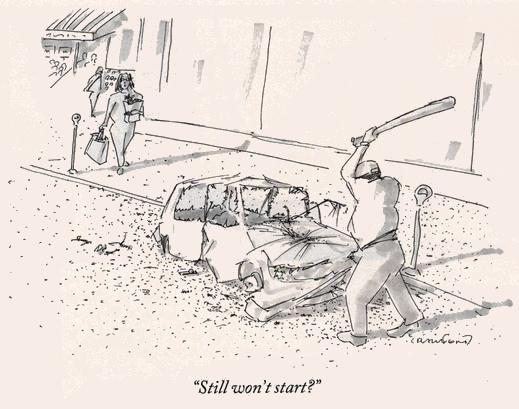
If at first you don't succeed, bang it again. Show it who's boss. The only way you can lose is if you give up.
Friday, April 14, 2006
Dementia Contra Iran
Seymour Hersh's New Yorker piece on US planning for unprovoked military attacks on Iran hasn't showed up in our mailbox yet, but it's already eliciting commentary. I read a transcript of an Amy Goodman interview with Hersh earlier today, but Billmon's post is worth even more. Billmon calls his post "Mutually Assured Dementia," and goes on to speculate about possible reaction, both domestic and worldwide, to an unprovoked nuclear first strike on Iran. To call such a strike "preemptive" concedes way too much ground. Thus far, no nation that has actually developed nuclear weapons has come close to using them against the US. Iran is not necessarily even working on nuclear weapons. And thus far the most aggressive act Iran has taken against the US was to send a mob of students into the same US embassy in Tehran that orchestrated the 1953 coup that ended Iran's democracy and installed Shah Mohammed Reza, whose dictatorial regime had just been overthrown.
Hersh's reporting to date has been dead on. He evidently has extraordinarily reliable sources deep within the security aparatus, and he manages to depict them as principled enough that one has to conclude that there are still isolated pockets of sanity in the DOD and CIA, even while the civilian political rulers are out to lunch. So there can be little doubt but that such plans are actively being worked on. Which raises two questions: 1) how can they be so demented? and 2) why is there no significant political opposition to such plans? As Billmon puts it:
But to the extent there is a rational excuse for treating a nuclear strike on Iran as the journalistic equivalent of a seasonal story about people washing their cars, it must be the cynical conviction that the Cheneyites aren't serious -- they're just doing their little Gen. Jack Ripper impression to let the Iranians know they really mean business.
This may seem plausible -- that is, if you were in a catatonic stupor throughout 2002 and the early months of 2003 (which is just another way of saying: if you were a member in good standing of the corporate media elite). But the rest of us have learned that when Dick Cheney starts muttering about precious bodily fluids, you'd better pay attention. He really does mean business, and when Dick Cheney means business, bombs are likely to start falling sooner rather than later.
Maybe the idea of the United States would launch a nuclear first strike -- albeit a "surgical" one -- is too hard for most Americans, including most American journalists, to process.
This raises an old question -- one that's entered my mind many times, but for fear of transgressing Godwin's Law I've refrained from publishing. Yep, this has to do with Nazi Germany, but please bear with me. My question is: At what point did a significant number of Germans realize that Hitler and the Nazis were leading Germany to doom and becoming a collective national embarrassment? Or, to put the point more starkly, at what point did most Germans realize that Germany would be better off to be unconditionally defeated in war? This latter state certainly set in after WWII ended -- unlike the aftermath of WWI, there were no significant number of sore losers in post-WWII Germany. But did any significant number of Germans, beyond such obvious Nazi targets as Jews and Communists, harbor such reservations before the war started in 1939? Or before the war started to turn in Stalingrad?
I don't know the answer to that, but I suspect not. I suspect that it's really difficult for people in a well aligned modern nation to recognize when their leaders cross the line from being eccentric to self-destructively insane. Nazi Germany and Imperial Japan are two very good examples of this. The Soviet Union under Stalin and China under Mao may be two more, and tellingly so because they only fell out of favor after they had died and their successors had started to admit and tried to repair the damage. There just seems to be a major cognitive problem with a nation accepting the fact that its leaders -- even manifestly undemocratic ones -- are totally crackers, at least while they're in power.
Now, I'm not saying that Bush is like Hitler or Stalin or Hirohito or anything like that, nor that the Republicans are Nazis or Fascists or the like. But their actual war in Iraq and their hypothetical -- gamed, or fantasized -- war against Iran are seriously demented. In principle, a representative democracy should make it impossible for such nutcases to achieve any significant level of power. Sometimes that's even worked in the US, as when David Duke and Oliver North lost elections in normally far-right states. But something is way out of whack here: for starters, a mainstream media and a political class that dares not challenge the President and his Administration on matters as fundamental as war and peace, but also a populace that can't begin to recognize a disaster until after it's already happened. We may not be led by Nazis, but that doesn't mean we won't follow our leaders until it is much too late.
Wednesday, April 12, 2006
Production Lost
Semi-strangers often write me notes that seem to go out of the way to wish me good health. That may just be a curtesy I never got socialized enough to appreciate, but sometimes I wonder what they know, or whether they're reacting to something I've said in passing and mostly forgot. "How are you?" is another one -- on a bad day most likely to elicit a biting response than the usual good natured slough off. Actually, I've been remarkably healthy all my life, especially for one who has put so little effort into it. But I'm 55 now, and I've collected some symptoms of my family's customary grim reaper. So when I experienced chest pains Monday afternoon, I let my worries get the best of me, and went to see my cardiologist -- who didn't have time to see me, but checked me into a hospital for tests. A little over 48 hours later I'm back home -- my initial complaints have now faded into a hazy background of new damage caused by the tests and the rigors of patient life in modern hospitals. The good news is no evidence of cardic blockages that could have caused the chest pain. I'm told the pain could have been caused by thousands of other sources, but in ruling out my heart they've ruled out the one that could bring me to an end most immediately. So once again I'm lucky in health.
Meanwhile, I've gotten nothing done, except for finishing Richard Manning's far-reaching Against the Grain: How Agriculture Has Hijacked Civiliation, and starting Gareth Porter's Perils of Dominance: Imbalance of Power and the Road to War in Vietnam. Manning stalks his subject like the hunter-gatherer he aspires to be. Having no taste for hunting myself, I tend to start from the assumption that agriculture is a given -- how else can six billion people coexist? But he raises an insightful question when he asks why one would choose a life of agriculture over hunting and gathering. As he points out, the latter is fun, while agriculture is back-breaking hard work. This sort of basic insight is similar to the one he revealed in Grasslands when he described fallow farmland as a clearcut grassland. Agriculture leads not just to more work but to worse health. It does support more people, surpluses even, which in turn lead to hierarchical societies, accumulation of wealth, spread of poverty, war, and empire. But closer to home, he gets into the history of processed food, the industrial expanse of commodities (corn, wheat, rice, sugar), the politics of subsidies and the subsidization of politics. One of the most striking points he makes is that the only ideas that attract any development funding are ones that lead to selling more products. This makes for an additive model: more fertilizers, more pesticides, more of whatever accomplishes more growth. Makes me wonder something I've been wondering quite a while, which is whether growth is worthwhile. If you start to have doubts there, lots of things come into doubt -- including most of economics.
Meanwhile, I've lost three days of doing what I do -- no progress on any of my writings, no records rated, haven't even opened my mail. All because of a niggling concern with my own personal health.
Sunday, April 09, 2006
Music: Current count 11768 [11746] rated (+22), 834 [831] unrated (+3). Mostly working on Jazz CG. Did a lot of prospecting -- almost catching up there -- but wasn't all that decisive. Spent a day on Jackie McLean too.
- Arctic Monkeys: Whatever People Say I Am, That's What I'm Not (2006, Domino): Seems to be this year's alt band hype, like the White Stripes, the Strokes, the Hives, the Libertines, the Yeah Yeah Yeahs, how many more have there been? AMG sez they grew up "memorizing hits by the White Stripes and the Vines," so they can't be very old. Musically they're tighter and I'd say better than any of the bands I've listed thus far, but not Rancid. Lyrically, well who knows, and who cares? (The vampire song is suspicious.) A-
- Ry Cooder/Manuel Galbán: Mambo Sinuendo (2003, Nonesuch/Perro Verde): Pleasant, mild-mannered instrumental album featuring Cuban guitarist Galbán with help from Cooder on guitar, tres, steel guitar, organ, whatever. Jim Keltner drums and Cachaito plays bass. No one breaks a sweat. Regardless of how sinuendo this is meant to be, it seems to be missing something. B
- Celia Cruz: Mi Diario Musical (1950-61 [1992], Polydor): Accompanied by Sonora Matancera, this is a sample -- no idea how representative or exemplary -- of Cruz's early claim to fame. Short -- twelve cuts, 3:01 max -- with a health dose of brass. No doc, but at least it has dates. B+(**)
- Rhett Miller: The Believer (2006, Verve Forecast): I don't know what the mission statement of this subdivision of UMG's putative jazz division, but it doesn't seem to be jazz. I think this is the first album they've released in the last two years that they didn't send me, and the first that I actually wanted. It's not jazz -- not even as close as Blue Note's post-Norah prestige signings of Al Green and Van Morrison. But it's a pretty good pop album, with a couple of songs -- including "Singular Girl" and "I'm With Her" -- better than that, and others not quite. B+(***)
- Alfredo Rodriguez: Cuba Linda (1996 [1997], Hannibal): Cuban pianist, b. 1936, moved to New York 1960, Miami in '70s, on to Paris in 1985. The program here is varied, starting with a stridently polyrhtymic jazz thing then making the circle of more regular forms, much like the newer Nachito Herrera album -- makes me think that these infrequently recorded Cuban masters feel some need to show off the whole kit when they get a chance, rather than specializing, developing a more limited but possibly more accessible point. Several points here could be developed much further. B+(**)
- Compay Segundo: Las Flores de la Vida (2000 [2001], Nonesuch): One of the singers discovered at Buena Vista Social Club, Segundo was born in 1907 and presumably well into his nineties when he cut this. His voice remains powerful, almost too much so -- comes from a generation who learned to sing without microphones. B+(*)
- Selfhaters: The Abysmal Richness of the Infinite Proximity of the Same (1996, Tzadik): Like the group name, especially as part of Tzadik's Radical Jewish Culture series. Like most of the musicians here: Anthony Coleman is the probable leader, with Michael Attias, Fred Lonberg-Holm, Jim Pugliese, and Doug Wieselman in tow. The music, however, is one of those slow, fracture avant things that never develops -- the idea most likely is to draw you in to listen more closely. I hate it when they do that. B
Jazz Prospecting (CG #9, Part 6)
In theory I should be closing down this column. I have enough new jazz records rated to fill out a healthy column. I have notes on them all -- the finished reviews only come to a bit more than half way, but it shouldn't be too hard to flesh out the rest. Made a big push this week to sort through the incoming. Not much left there except for advances and reissues. Looks like 30-40 prospected but unrated records on that shelf, most of which are marginal and can be put off for next time. A week ago I said I could be done in two weeks. Still looks like it could be two weeks, but no more.
Sathima Bea Benjamin: Musical Echoes (2002 [2006], Ekapa): A set of carefully measured standards sung by the South African vocalist, in a return to Capetown after a long exile. The pianist and co-producer is Stephen Scott, in fine form. The others are South Africans: bassist Basil Moses, whose clear pulse is one of the highlights, and drummer Lulu Gontsana. Well done, and welcome to anyone who remembers her early work with the former Dollar Brand and their surprise mentor, someone named Ellington. B+(*)
Karen Blixt: Spin This (2006, Hi-Fli): This album contrasts rather sharply with the Erin Boheme one. The similarities include a shuttling in and out of guests and a few originals (with co-writers) slipped in amongst the standards. Also a fairly generous booklet with a lot of photography. On the other hand, the hair, makeup and photography budgets are far removed. Boheme has the more intriguing voice, but it's clear that her corporate sponsors selected her as much for her looks, which became the focus of their marketing campaign. I wouldn't describe Blixt as ugly, but plain isn't far off the mark, and her voice isn't much above that. But she also appears much happier in her photos, and that carries through to the album. Her guests are more fun, too -- especially organist Joey DeFrancesco, who also takes a duet vocal on a cheery "When You're Smiling." It also helps that the covers are old friends -- it's not like we need another "Night and Day," but it's always welcome. B+(**)
Jamie Davis: It's a Good Thing (2005 [2006], Unity Music): The new singer for Basie's ghost band splits the difference between Little Jimmy Rushing and suave Joe Williams. The band carries on the late testament tradition -- an orchestra of overwhelming brass with no rough spots or standout soloists, but the harshness of the "atomic" era sound has been ironed out. They may be anonymous as individuals, but they've never been more comfortable as a unity. Package includes a "Making Of" DVD. Haven't watched it, but might be fun. B+(***)
Bob Belden: Three Days of Rain (Original Soundtrack) (2001 [2006], Sunnyside): This ties into a film directed by Michael Meredith, loosely based on six Chekhov stories set under continuous rain in present-day Cleveland. The film came out in 2002, possibly just to festivals, then was picked up by Wim Wenders for limited US release in late 2005. Belden composed the pieces, but doesn't play. His saxophonist of choice, Cleveland-native Joe Lovano, appears on five cuts -- one a clarinet solo. Belden builds around two piano trios: one led by Kevin Hays aims for low barometer atmospherics, with Lovano and/or trumpeter Scott Wendholt joining in; the other led by Marc Copland gets a slightly edgier sound. One more piano piece is "End Title," a solo by Jason Moran which closes the film and record on an uncertain note. My uncertainty concerns the easily clichéd motifs of dark, dreary rain. I'm sure this is appropriate to the film, but why care about such a single-minded mood on record? For one thing, it's well done. [B+(***)]
The Eddie Daniels Quartet: Mean What You Say (2005 [2006], IPO): Plays clarinet and tenor sax. I'm not familiar with his work, which goes back to a 1966 album and includes a stretch with the Thad Jones-Mel Lewis Orchestra. He appears to have had some pop items in his closet, but this one is solidly mainstream, benefitting from a rhythm section that guarantees its interest: Hank Jones on piano, Richard Davis on bass, Kenny Washington on drums. Starts with a Thad Jones piece, continuing with a range of bop-to-swing standards and one original. Solid playing throughout. B+(*)
Chris Walden Big Band: Winter Games (2006, Origin, EP): Actually just a 3:52 single ("full version"), followed by a 3:10 "radio edit." The theme is attractive enough, but the orchestration is neither as clean nor as dirty as I'd like, and it's all section work -- no individual development. If I had to deal with a full album like this I'd probably bury it with a middling grade -- unless it got to be really annoying. But given my system singles are annoying by definition. C
Bobby Previte: The Coalition of the Willing (2005 [2006], Ropeadope): Easy to tell this is a drummer's album -- the drums are mixed up front and plenty loud. Easy to classify it as fusion too, with Jamie Saft's keyboards and Charlie Hunter's guitars the usual instruments, and both doubling on electric bass. Previte gets extra help on drums from Stanton Moore. Also on hand is Stew Cutler on harmonica and slide guitar, Steven Bernstein on trumpets, and Skerik on saxes. In effect, Previte has swallowed Garage à Trois [Hunter, Skerik, Moore] whole -- their own Outre Mer album is as tuneful a piece of fusion as I've heard in several years, but much lighter than this armada. Still undecided whether all the extra firepower is worth it, but this has some promise. Unlike another "coalition of the willing" you might recall. [B+(**)]
François Carrier: Travelling Lights (2003 [2004], Justin Time): The artist sent this along for background along with his new Happening. The quartet includes pianist Paul Bley, bassit Gary Peacock, and drummer Michel Lambert. Carrier, on alto and soprano sax, is a good deal younger than that group. In these improv pieces, named for continents and geographical concepts like "Sea" and "Island," he plays cautiously, often deferring to Bley and Peacock, who are in exceptional form. I liked Carrier's earlier album Play quite a bit, although it was little more than a thoroughly modern sax trio on the road. This shows more depth -- could rate higher with some more careful listening, but for these purposes it's just background. B+(***)
François Carrier: Happening (2005 [2006], Leo, 2CD): Spacious avant improvs, set for dancers or something to happen. The leader's alto or soprano sax is set against Mat Maneri's viola and Uwe Neumann's exotica -- sitar, sanza, Indian talking drums -- as well as bass and drums. The combination is striking and seductive. [A-]
Ben Allison: Cowboy Justice (2006, Palmetto): Don't have recording dates -- one of those little details squeezed off the cheapo promo Palmetto hands out. The group here is a quartet with Allison on bass, Jeff Ballard on drums, Steve Cardenas on guitar, and Ron Horton on trumpet. Two takes on "Tricky Dick" -- that would be Cheney -- frame the album, while "Midnight Cowboy" was plucked from the movie soundtrack and given new significance. As a politico, Allison isn't as far out as Charlie Haden, but as a bassist and composer he's very much in the game. Cardenas is especially fine here, and Horton is terrific, especially on the chatter-happy "Talking Heads." [A-]
The Roy Hargrove Quintet: Nothing Serious (2006, Verve): Then why bother us with it? Loose-limbed hard bop, with Justin Robinson racing the scales on alto sax, and Ronnie Matthews tinkling ivories. Bassist Dwayne Burno's "Devil Eyes" caught my ear, as did the closer, where Slide Hampton bum rushes the stage for a 'bone solo, and everyone else gets their licks in. I'm torn here between being moderately amused by the harmlessness of it all and somewhat annoyed by the waste. Probably not worth knocking as a dud, but when I see a guy's mug on the cover of Downbeat, I suspect a candidate is heading my way. [B]
The RH Factor: Distractions (2006, Verve): This is Roy Hargrove's funk diversion -- the second such album, if memory serves. The off-handed title refers to four pieces, each numbered, that serve as instrumental interludes. The rest have vocals, credited to Hargrove and Renee Neufville, except for one shot that D'Angelo dropped in for. Much of this sounds warmed over, but one called "A Place" bears a pretty slick P-Funk brand. [B+(*)]
Duke Robillard: Guitar Groove-A-Rama (2006, Stony Plain). For some reason jazz magazines from Downbeat to Cadence have a side-interest in blues, establishing an affinity that hasn't really existed over the last 30-40 years -- not since blues shouters like Big Joe Turner, Jimmy Witherspoon and Jimmy Rushing fronted jazz bands. Since then the blues genre has narrowed down into a main stream of guitar slingers who make up a narrow, conservative genre under rock, plus a couple of creeks off to the side for folkie-musicologists like Taj Mahal and soul holdovers like Etta James and Solomon Burke. I've wondered whether about slipping a straight blues record into my jazz guide, and actually did once, with Billy Jenkins' When the Crowds Have Gone. But that was pretty far out in left field. James Blood Ulmer's Birthright tempted me -- like Jenkins, Ulmer's catalog is for the most part solidly positioned as jazz. I don't get much blues, but I figure when I do get something there's no harm in at least prospecting it, even if it's unlikely it will qualify for the jazz guide. Robillard is a comfortable mainstream guitar slinger. He paid his dues with the Fabulous Thunderbirds and Roomful of Blues before going solo. He's got nothing much to say, but he's happy to be here, happy to be the end of the title cut's jukebox history of the blues, which started with his best Muddy Waters impersonation and worked its way down the ages. B+(*)
World Drummers Ensemble: A Coat of Many Colors (1996-2005 [2006], Summerfold): Four drummers make for a rather small subset of the world. Bill Bruford and Chad Wackerman have rock roots and jazz moves with slightly jiggered but conventional kits. Luis Conte adds a taste of Cuba with congas, timbales, and cajon. Doudou N'Diaye Rose represents Africa, or more precisely Senegal -- percussion, like the human gene, is more varied in Africa than in the rest of the world combined, so representation isn't exactly possible. But Cuba and Senegal have a distinctive bilateral cross-development, so the hand drums blend together into a flexible core for the others. This works as well as any similar project I've heard -- Art Blakey and Max Roach tried to put together cross-cultural drum suites circa 1960, so it's not all that new an idea. On DualDisc, with two pieces only on the DVD side, so I haven't heard them. [B+(**)]
Nachito Herrera: Bembé En Mi Casa (2005, FS Music): All bembé, no siesta here -- this is Afro-Cuban jazz at its most aggressive. The first piece in particular, called "Song in F" and described as Latin jazz, goes way beyond my ability to parse or track or make any sense of. It's built from multiple rhythm motifs, overlayed in ways that make no sense to me. Other pieces are built around traditional styles -- danzón, bolero, guaguanco, guaracha, cha-cha -- making them simpler, easier to follow. Herrera plays piano. The group is a sextet with electric bass, sax, trumpet, and percussion -- congas, timbales, drums. A lot of action for a relatively small group. Too much? B+(**)
Oscar Castro-Neves: All One (2006, Mack Avenue): A veteran Brazilian guitarist -- his credits go back to the '60s, including a song "Morrer de Amor" written in 1965 and reprised here with Luciana Souza singing. This album takes a grand tour through his life and work, but it is never more engaging than when his guitar is out front. Gary Meek adds the flighty flutes, clarinets and saxes you expect. Souza sings two pieces, but his own rough vocal on "The Very Thought of You" is more touching. B+(**)
Industrial Jazz Group: Industrial Jazz a Go Go! (2004 [2006], Evander Music): The previous record by Andrew Durkin's group confused me with its intricate scoring and fancy counterpoint -- what's industrial about that? This one feels like they've had a Sex Mob transplant, but it's still on the fancy side. The most prominent sources, cited in "Apologies/Thanks To" along with Dion and Elmore James, are Perez Prado and Oliver Nelson -- that should give you a good idea what this sounds like, and not just for the three pieces with Spanish titles. Durkin plays piano, but the seven horns are so domineering you rarely hear him. B+(***)
Randy Sandke and the Metatonal Big Band: The Subway Ballet (1988-2005 [2006], Evening Star): Sandke's metatonal harmonic theory is over my head -- something about overlaying harmonics slightly off from the usual ones, which makes his music a bit odd and a bit dangerous. No surprise that someone interested in harmonics should gravitate toward big bands. That there is no piano may just mean that he isn't interested in getting his harmonics cheap. Whatever. The unchoreographed ballet is conceived of as a subway trip from Brooklyn Heights to Harlem, which is good for encounters with a range of possible dancers: downtown punks, Wall Street brokers, Hassidic diamond merchants, a blind beggar, a Korean peddler, midtown career women. You can sort of guess the music that goes with each, but remember that it will be a bit odder and more dangerous. The high point arrives with the Hassids, who here at least include David Krakauer. The end, which moves out onto the street, is less obvious. It also doesn't fill the whole disc, so Sandke tacked on four cuts from an unreleased 1988 album with supposed metatonal emanations, but the smaller bands -- two cuts are just Sandke with drum machine, and two find him playing guitar instead of brass -- make the harmonics less obvious. Last cut sounds like an outtake from Pink Floyd. [B+(***)]
Pierre Dørge & New Jungle Orchestra: Negra Tigra (2005 [2006], ILK): The jungle this time is Vietnam, which appears most clearly in "Vietnam Xong" and "Streets of Ha Noi" -- the usual oriental motifs appear much like in Billy Bang's first Vietnam record, but with horns dominant. Five interludes are versions of a boisterous piece called "Negra Tigra," the last one erupting in a shout of "anybody seen that tigra?" in a clever loop back to the Original Dixieland Jazz Band. This record marks the 25th anniversary of Dørge's big band -- what a long, strange trip it's been -- and this is the most avant I've heard them. Much credit for that no doubt goes to the guest this time, trumpeter Herb Robertson. [B+(***)]
Fattigfolket: Le Chien et la Fille (2005 [2006], ILK): Swedish/Norwegian quartet, with trumpet (Gunnar Halle) and alto sax (Hallvad M. Godal) up front, bass (Putte Frick-Meijer) and drums out back (Ole Morten Sommer). Godal and Frick-Meijer do most of the writing. First half of the album is calm, measured, rather haunting, after which they kick up the heat a bit. Don't know much more, but worth listening to further. [B+(**)]
Francisco Pais Quintet: Not Afraid of Color (2004 [2006], Fresh Sound New Talent): It took a while to get the feel of this complex postmodern cool or whatever. Pais plays guitar, layered intricately with Leo Genovese's keyboards and Chris Cheek's reeds. One cut I noticed each time through was "Transfiguration," partly because the pace picks up a bit, but mostly due to Ferenc Nemeth's drums. B+(*)
Odean Pope Saxophone Choir: Locked & Loaded: Live at the Blue Note (2004 [2006], Half Note): Pope's Saxophone Choir includes a piano-bass-drums rhythm section, so in many ways it's more like a big band than any of the sax-only ensembles. No brass cuts down on the color, but with nine saxes here -- five tenor, three alto, one baritone -- not counting guests he has a lot of options. The guests are Michael Brecker, Joe Lovano, and James Carter -- the latter featured on the high-powered closer, a choice cut called "Muntu Chant." [B+(*)]
Anita O'Day: Indestructible! (2004-05 [2006], Kayo Stereophonic): Well into her 80s, she doesn't swing as hard as she used to, and her voice is more gone than not, but she inspires a couple of near-faultness bands. Roswell Rudd rumbles on three tracks, including "Gimme a Pigfoot and a Bottle of Beer." Joe Wilder stands out on the other tracks. O'Day's post-prime recordings have always been a matter of taste and sentiment: you have to like her a lot to see past the decline. But I, for one, can't see not liking her. B+(**)
Rhett Miller: The Believer (2006, Verve Forecast): I don't know what the mission statement of this subdivision of UMG's putative jazz division, but it doesn't seem to be jazz. I think this is the first album they've released in the last two years that they didn't send me, and the first that I actually wanted. It's not jazz -- not even as close as Blue Note's post-Norah prestige signings of Al Green and Van Morrison. But it's a pretty good pop album, with a couple of songs -- including "Singular Girl" and "I'm With Her" -- better than that, and others not quite. B+(***)
Roy Nathanson: Sotto Voce (2006, AUM Fidelity): This got me to wondering whether there's ever been two great jazz versions of a pop song as annoying as "Sunny" before. The other one is on Billy Jenkins, True Love Collection, which is full of '60s pop tripe turned into avant psychedelia. Here it's just one of nine stops that I'm having trouble making sense out of -- some jive, some poetizing, something Brechtian, a story about a guy shooting his finger off to escape from a war. The monotone wordplay is always up front, the fractured blips of sax, violin and trombone flying off to the side. I like the music quite a bit, especially on the rare occasions it gets intense. The voce I'm more ambivalent about. [B+(**)]
The Bennie Maupin Ensemble: Penumbra (2003 [2006], Cryptogramophone): The booklet claims that the last song was recorded on Dec. 11, 2006. Last time I checked, that's still eight months into the future. That's the second such typo I've found this week. Folks in the future are going to get plenty confused by things like this, but the more alarming problem is that this sort of sloppiness seems to be steadily growing. It's worth noting that the Voice doesn't do any fact checking on my Jazz CG or on Christgau's CG, and doesn't do much fact checking anymore on anything else either. I've made a few mistakes I know about, and I've caught a few of Christgau's on their way to his website. It's a neverending struggle to get such basic info right, and it pays to be as much of a stickler as possible, but it's a drag cleaning up other people's messes, too. As for the record, this strikes me as similar to Charles Lloyd's ECM efforts -- it's like at a certain age one decides to do whatever you feel like and not worry how it fits into your style or sound or career path or whatever. This has a very open feel, in large part designed so bassist Darek Oleszkiewicz comes through clearly. The beats come from Michael Stephans' drums and Daryl Munyungo Jackson's percussion for a loose, worldly mix. Maupin plays reeds and a bit of piano, with bass clarinet most prominent, and his tenor sax actually sounding like Lloyd. An attractive, low key album. [B+(**)]
The Jeff Gauthier Goatette: One and the Same (2005 [2006], Cryptogramophone): Gauthier plays violin, often electric with effects. Guitar (Nels Cline) and bass (Joel Hamilton) add to the string resonances, while keyboards (David Witham) and drums (Alex Cline) don't overwhelm them. The tempos tend to race, but there's little density, and the violin never tightens up the way someone like Billy Bang plays. So this doesn't sound like a lot is happening, but it's appealing nonetheless. B+(*)
Joe Locke & Charles Rafalides: Van Gogh by Numbers (2005 [2006], Wire Walker): Seems like a very limited concept at first: duets between vibes and marimba. But while the sonic palette is narrow, especially with the marimba setting the pace, and this takes a while to get in gera, it does develop into a pleasing complexity. B+(*)
And these are final grades/notes on records I put back for further listening the first time around.
The Mary Lou Williams Collective: Zodiac Suite: Revisited (2000-03 [2006], Mary): Williams bridges the swing and post-bop eras, not conceptually but as someone who's been there, done that. The Zodiac Suite itself dates from 1945, and was part of a movement from danceband jazz toward "America's classical music," very much in parallel with Ellington's initial interest in suites. Arranged for piano trio, this suite makes for engaging chamber music -- people like Fred Hersch do this sort of thing nowadays, but Williams was decades ahead of anyone else. Without recourse to the original, I'd guess that the main thing Geri Allen and Buster Williams add here is state of the art sonic presence. The whole project is too humble to expect much more. B+(*)
The Dutch Jazz Orchestra: The Lady Who Swings the Band: Rediscovered Music of Mary Lou Williams (2005 [2006], Challenge): Historically notable as an effort to put unrecorded charts to music. If it sounds exceptionally Ellington-esque, one reason may be that the Dutch Jazz Orchestra has made a cottage industry out of Billy Strayhorn. Another is that Williams wrote several of these arrangements for Ellington right after Strayhorn died. Not sure this transcends its historical significance, but it sometimes comes close. Francis Davis wrote about this and the Zodiac Suite album in the Voice. B+(**)
The Derek Trucks Band: Songlines (2006, Columbia): Enough interesting idea here to make me think an interesting album is possible, even if not necessarily in the works. Pieces by Roland Kirk, Toots Hibbert, Nusrat Fateh Ali Khan, as well as some trad blues. The vocals wander some -- the leader doesn't sing, but several band members do, making for a curious eclecticism. B+(***)
Ahleuchatistas: What You Will (2005 [2006], Cuneiform): Punk rockers who listen to Charlie Parker too much -- check the name -- and evidently don't know anyone up for singing. I'm not much for vocals either, but when you lay out titles like "Remember Rumsfeld at Abu Ghraib," "Ho Chi Minh Is Gonna Win!" (reality check: he did), "Last Spark From God," "What Are You Gonna Do?" -- these could use some more development. B+(*)
Ran across this: the 1967 Playboy All-Star Jazz Band. Image is hacked up in top left corner, cutting off three skinny black chicks (later identified as The Supremes).
- Leader: Henry Mancini
- Male vocalist: Frank Sinatra
- Female vocalist: Nancy Wilson
- Piano, instrumental combo: Dave Brubeck
- Trumpets: Miles Davis, Al Hirt, Louis Armstrong, Dizzy Gillespie
- Trombones: J.J. Johnson, Si Zenter, Kai Winding, Bob Brookmeyer
- Alto saxes: Cannonball Adderley, Paul Desmond
- Tenor saxes: Stan Getz, John Coltrane
- Baritone sax: Gerry Mulligan
- Clarinet: Pete Fountain
- Guitar: Charlie Byrd
- Bass: Charles Mingus
- Vibes: Lionel Hampton
- Drums: Joe Morello
- Vocal group: The Supremes
Article also includes three Playboy Jazz Hall of Fame selections: Duke Ellington, Ella Fitzgerald, Count Basie. The list of previous members: Louis Armstrong, Dave Brubeck, Frank Sinatra. Runners-up were: Miles Davis, Benny Goodman, Stan Getz, Barbra Streisand, Ray Charles, Nat "King" Cole, Henry Mancini, Charlie Parker, Al Hirt, Gene Krupa, Stan Kenton, Dizzy Gillespie, Ramsey Lewis, Gerry Mulligan, Dean Martin, Tony Bennett, John Coltrane, Paul Desmond, Sammy Davis Jr., Billie Holiday, Lionel Hampton, Thelonious Monk.
The obituary list started with Bud Powell, dead at age 41.
A quote: "But young voices and new sounds continued to replenish the jazz reservoir. Gaining wider recognition in the past year were tenor saxophonist-leader Charles Lloyd; Albert and Don Ayler; trombonists Roswell Rudd and Grachan Moncur III; alto saxophonists Marion Brown and Byron Allen; reed men Pharoah Sanders and Giuseppi Logan; clarinetist Perry Robinson; violinist Jean-Luc Ponty; vibist Bobby Hutcherson; pianists Andrew Hill and Keith Jarrett; bassists Richard Davis, David Izenson, Eddie Gomez and Cecil McBee; drummers Sonny Murray [sic], Milford Graves and Joe Chambers; and singer Betty Carter. After years of struggle, pianist-composer Cecil Taylor was finally being acknowledged as a pervasive influence on the new jazz, and John Coltrane remained its continually self-renewing patriarch." Coltrane died later in 1967.
There was also an "all-star musicians' poll," which selected the following:
- Leader: Duke Ellington; Count Basie; Woody Herman; Dizzy Gillespie; Thad Jones-Mel Lewis, Gerald Wilson.
- Trumpet: Miles Davis; Dizzy Gillespie; Freddie Hubbard; Nat Adderley, Doc Severinsen, Clark Terry
- Trombone: J.J. Johnson; Bob Brookmeyer; Kai Winding; Carl Fontana; Urbie Green, Bill Harris.
- Alto sax: Cannonball Adderley; Paul Desmond; Johnny Hodges; Phil Woods; Sonny Stitt.
- Tenor sax: Stan Getz; John Coltrane; Zoot Sims; Ben Webster; Paul Gonsalves.
- Baritone sax: Gerry Mulligan; Harry Carney; Pepper Adams; Cecil Payne; Charles Davis.
- Clarinet: Buddy DeFranco; Benny Goodman; Tony Scott; Jimmy Giuffre; Jimmy Hamilton.
- Piano: Oscar Peterson; Bill Evans; Hank Jones; Dave Brubeck; Herbie Hancock.
- Guitar: Wes Montgomery; Jim Hall; Kenny Burrell; Grant Green; Charlie Byrd.
- Bass: Ray Brown; Richard Davis; Steve Swallow; Ron Carter; Charles Mingus.
- Drums: Buddy Rich; Elvin Jones; Joe Morello; Philly Joe Jones; Shelly Manne.
- Miscellaneous instrument: Milt Jackson (vibes); Jimmy Smith (organ); Lionel Hampton (vibes); John Coltrane (soprano sax); Roland Kirk (manzello, stritch).
- Male vocalist: Frank Sinatra; Joe Williams; Tony Bennett; Ray Charles; Mel Tormé.
- Female vocalist: Ella Fitzgerald; Sarah Vaughan; Carmen McRae; Nancy Wilson; Peggy Lee.
- Instrumental combo: Dave Brubeck Quartet; Modern Jazz Quartet; Oscar Peterson Trio; Miles Davis Quintet; CAnnonball Adderley Sextet.
- Vocal group: Double Six of Paris; Swingle Swingers; Hi-Lo's; Anita Kerr Singers; Four Freshmen.
Records of the year:
- Best big band LP: Count Basie, Basie Meets Bond (United Artists)
- Best small combo LP: Herb Alpert's Tijuana Brass, Whipped Cream & Other Delights (A&M)
- Best vocal LP: Frank Sinatra, Strangers in the Night (Reprise)
The piece has vote totals for the readers poll. Biggest landslide was for baritone sax, with Gerry Mulligan getting 11,866 votes to runner-up Bud Shank's 1,196. The strangest sequence of votes came for the two tenor sax positions. Getz had 12,466 votes, followed by Coltrane at 6,249. Evidently two votes were allowed, and Getz appeared on nearly all the ballots -- no one got more votes for any category (followed by Mulligan, J.J. Johnson, Cannonball Adderley, Miles Davis). However, the peculiar third choice for tenor sax was Boots Randolph, at 1,972 votes leading Coleman Hawkins, Sonny Rollins, Zoot Sims. Similar things happened elsewhere; e.g., at piano the 3-4-5 were Peter Nero, Oscar Peterson, and Thelonious Monk; on drums the 5-6-7 were Sandy Nelson, Elvin Jones, Art Blakey.
Then I found Playboy's 1969 results. Readers poll was pretty much the same, except: Beatles beat out the Supremes; Herb Alpert muscled his way to first trumpet, bumping Dizzy Gillespie off; Boots Randolph replaced the late John Coltrane at second tenor sax; Jimi Hendrix blew Charlie Byrd away at guitar; Buddy Rich displaced Joe Morello; Aretha Franklin topped Nancy Wilson; and Ravi Shankar took the odd instrument category instead of Lionel Hampton.
The new Playboy Jazz Hall of Famers were Herb Alpert, Wes Montgomery, and Miles Davis. (The 1968 group were Ray Charles, John Coltrane, and Benny Goodman.)
Flag Day
Laura got a letter reprinted in the Eagle today:
People who complain about Mexican flags at demonstrations are forgetting that Italian flags are carried at Columbus Day parades, Irish flags are carried at St. Patrisk's Day parades, and Israeli flags are carried at pro-Israel parades.
Either people are forgetting that, or there is prejudice against Mexicans and Mexican-Americans. Grow up.
LAURA TILLEM
Wichita
The letter was included in a section called "Reader views: immigration," following a letter harping on Mexican flags.
Billmon came up with some more examples.
Wednesday, April 05, 2006
More on Iraq's Neo Breakdown
I got the following lette from a reader, Peter Su. Thought it best to try to answer his questions here, and start with the letter:
After we executed worshippers in a Sadr City mosque one week and sent Rice to pressure Jaafari to step down the next, I'd started suspecting, even before reading "Iraq In and Out of the News," that we were intentionally keeping Iraq in chaos to keep their oil off the market.
Then, scrolling up, I find you've already discarded the pseudo-conspiracy theory after reading Schwartz on TomDispatch. But after finishing both your "It's the Economy, Stupid" and his piece, I can't find anything in either to explicitly reject the notion of Bush intentionally failing in Iraq; as you say, "that theory fits the evidence well enough."
The closest I found was the reporting of a brief post-invasion boom in Iraq, before the shit really hit the fan. Since that sort of empty, dangerously inflated boom prosperity seems economic dogma among Bush's kind, do you mean that, if they were really trying to wreck Iraq to keep it off the market, they would have implemented policy that THEY thought would fail (and, who knows, might actually have worked?). Or am I missing something between the lines that a better educated reader would infer?
If the latter, and if your time and inclination permits, would be grateful to see a post from you on why our failure in Iraq was more via incompetence than intent. I'm reasonably well-read, so if I missed some economic inference in both the TomDispatch piece and your own, I don't think I'd be the only one who would especially appreciate its explication.
I did shift gears between the two posts -- a mere day apart -- in response to the new (or poorly remembered) data that Schwartz brought up. As both posts argue, ever since the Bush invasion of Iraq in 2003 the net effect of US policy has been to damage Iraq: in particular, to undermine the bonds of civil society, in turn wrecking Iraq's economy and dramatically reducing living standards. The question is whether this effect had been Bush's intent all along. Intent is always hard to establish -- all the more so given the secrecy under which Bush et al. developed their policies and the deliberate confusion caused by their many false statements about what they wanted to do and why.
It seems to me that intent is worth discussing, but it has two distinct sides. One is that there is a distinct political need now to try to nail down what America's intent is in Iraq. Bush has been very slippery in this regard -- indeed, it often looks like they're making it up as they go along. If we can start to nail this down, we can start to assess progress (or lack thereof) and start to rationally adjust the tactics and/or the goals to reality.
The other is historical: what was the real intent at the moment they decided to invade? I suspect that the answer there is a cluster of ideological views that center around the idea that the US has ought to assert its power more aggressively to remake the world in our image. The most succinct expression of this was formulated by Madeleine Albright when she called the US "the indispensible nation"; she in turn drew on a long legacy of self-flattery known as American exceptionalism and the mythic aura of "the American Century" -- how American economic vitality and military prowess increasingly loomed over the world throughout the 20th century. This core idea spawned two main ideological threads: the economic doctrine of neoliberalism and the political doctrine of neoconservatism. Both were rooted in the Cold War, and reflect its twin axes: neoconservatism was directed against political foes, above all the Soviet Union; neoliberalism's enemy was any political support for the working class or the world's poor. Both doctrines ultimately depended on self-deceptions: the naked pursuit of self-interest required a cloak of high moral principles, which the neos appropriated almost indiscriminately. By focusing so tightly on their faith, they in turn developed a blindness to the world around them, especially to how adverse effects that followed application of their theories.
Neoliberalism is actually the broader framework, in that it mostly works through seduction with only a hint of force. The masters of capital offer debt to developing countries, then demand concessions when the debt cannot be serviced. The concessions typically grant further private access and control to capital while undermining any efforts to build self-sufficiency, leading to cycles of debt and disaster while capital extracts its profits. The least productive of all such loans are those stolen by elites and recycled as the local elites join the rarefied ranks of world capitalists. All this activity is touted as development aid, but all it really develops is capital. Developing countries face the choice of "aid" that works against them or isolation.
Neoliberalism is insidious; neoconservatism gets much nastier. You can think of them as two arms of the mob: the loanshark and the muscle guys. When the Soviet Union collapsed, Russia and Eastern Europe surrendered to neoliberalism, resulting in a drastic deflation of their economies -- from which Russia, in particular, has never recovered. That left small, scattered groups of isolated nations -- the so-called rogue states. What the neoconservatives believed was that by demonizing those states and flounting American power they could complete the task of integrating the world's last holdouts into a single worldwide system dominated by private capital: a world of the rich, for the rich. In order for this to happen, the rich needed their own captive state, a service that the increasingly corrupt US political system provided -- especially in electing George W. Bush, a man instinctively eager to defend Dubai oil princes against overwhelming American public opinion.
For the neos Iraq was the jackpot. Its oil reserves were second only to safely privatized Saudi Arabia, yet it remained stubbornly outside the system, despite over twenty years of harrassment and isolation. The neos had no patience to wait for a Soviet-style collapse. They managed to convince themselves that the US had the power to flip Iraq into the system, and that the Iraqis would love them for it. There are many reasons why this couldn't and wouldn't work, but the whole march up to the war was swallowed up in the falsehoods expedient to sell the war, a program so unpopular that the neos coulnd't afford to admit, even to themselves, that the post-war might be even tougher than the pre-war. But then the neos already had vast experience at rationalizing the unsavory effects of their past successes.
Until Bush invaded Iraq, neoconservatism was mostly an untested theory. The credit the neocons took for the collapse of the Soviet Union is suspicious given that far harsher sanctions on much weaker countries ranging from Cuba to North Korea to Iraq had failed to do anything but lower living standards and harden resistance to the US. Afghanistan didn't prove much either -- the key there was a diplomatic deal to flip Pakistan, depriving the Taliban of their crucial international supporters. On the other hand, neoliberalism has been tested extensively. It is a theory that for the most part has worked to make the rich richer, at least in the short term. Of course, if you're not rich, you might think differently -- and you can point to masses of data that show that neoliberal policies depress wages, reduce safety nets and worker protections, curtail government support of infrastructure, and prematurely kill local businesses that could be real seeds of development.
Even neoliberalism's "rich get richer" dividend needs some qualification. What the neos try to do is to create a virtuous circle between wealth and political power, so they appeal most strongly to the subset of the rich whose wealth depends most on political connections. Two prime examples are oil, which is based on a legal claim to a natural resource, and arms, which primarily sell to states. Those industries are the core of the Bush junta, with mining, chemicals, pharmaceuticals, agribusiness and banks similarly aligned to benefit from political favoritism. The neos, in turn, have privatized government services to create an industry that functions as a new patronage system. One thing to recognize here is that the neos' agenda, in and of itself, is intrinsically unpopular in America: it serves the special interests of a small fraction of Americans (and others), and often works against the best interests of the majority. So politicians like Bush have had to wrap their neo agenda up in a broader, more popular program of social conservatism. They've been very successful at that, but the whole game depends on their ability to convince enough of us that they know what they're doing and that what they're doing is right. They've studied carefully enough to know that the essence of sales is conviction, and that's why they have to keep a straight face -- hence, no admission of mistakes.
This is a long, roundabout way of getting back to the question. It doesn't make sense that the invasion of Iraq was meant just to wreck the country and run up gas prices, even though that's about all they've actually accomplished, for two reasons. The first is that there were simpler, more surefire ways of accomplishing those goals -- indeed, twelve years of sanctions and random bombings was doing a pretty effective job of it. The second is that occupying Iraq risked a failure of such magnitude that it would expose the entire conceit of their ideology -- which is pretty much what has happened, although the magnitude of their failure is only beginning to sink in. Clearly, the war's architects believe that they could make their gamble pay off. They had convinced themselves that US military power packed such shock and awe that Iraqis would sensibly give up their independence and submit to American direction. They had convinced themselves that the US political and economic system was so productive, so superior in principle, that Iraqis would be happy to lift themselves up through their prescriptions. To say that they were wrong would be an extreme understatement. They were fucking insane, which is what happens to crooks whose scams are so successful their fantasies are freed from any effective checks and balances.
On the other hand, there's no real evidence that, even faced with overwhelming evidence of failure, the Bush administration has altered any of their fundamental goals in Iraq. They've yielded some tactical ground on democracy, but continue their manipulations to get something resembling the complaisant government they've always wanted. They still strike out at anyone who crosses them -- lately the Shiite militias in addition to whole Sunni cities. They continue to build their "enduring" bases. Bush has ruled out any discussion of leaving as long as he's still president. Evidently, they still believe that their plan is the right one, and that it will succeed unless the folks back home get all chickenshit and vote them out of office. Meanwhile, the Iraqis fighting them and otherwise misbehaving are just hurting themselves.
The latter point illustrates one of the neos' most critical traits: the ability to blame their victims. This both protects their sense of their own innocent high principles and inures to the consequences of their acts. The conservative mindset has always assumed that the hard life of the poor is an inevitable consequence of the human condition. The neos, by aggressively promoting the interests of the rich, make the inevitable happen all that much more. It must be nice to blunder through life with nothing tugging at your conscience. But if they really had no inkling of the damage they do, you'd think they'd be less secretive, and less cautious about avoiding the docket in the Hague.
How much of the destruction of Iraq was caused by Bush's economic policies as compared to the military occupation is hard to determine. The policies very quickly put a lot of people out of work, and a lot of firms out of business, but so did the chaos and terror -- and as Schwartz pointed out, the brutal repression of dissent tremendously accelerated the armed resistance and still more brutal repression. Resistance itself was inevitable, and the surge of looting as soon as Saddam's regime melted away established chaos as a norm in a way that the US never got a handle on. The temporary surge in business as foreigners sold cell phones and used cars wasn't a real bubble in any economic sense -- it was just another form of looting. Once the resistance reached critical mass, reconstruction halted, and with it any chance to stabilize the country. Since then the US has been far too busy dodging defeat to accomplish anything.
It's easy to become cynical about the use of military force, since its destructive power is so obvious. If Bush wanted to pound Iraq back to the stone age, all it would take is a little more of what they're already doing anyway. But neoliberal economics is a subtler weapon of mass destruction. Thus far no one has suggested that it is being wielded for any reason more nefarious than mere greed. The neos don't deny greed so much as try to rationalize it as an engine for what little of the common good they can grasp. So it's unlikely that they meant to destroy Iraq through their economic and political ideologies. But it's inevitable that they did. And it's essential to their nature that they deny their culpability and blame the Iraqis and all those other evildoers who butted in -- the most dangerous of which are the antiwar masses back home.
Monday, April 03, 2006
Jackie McLean
I just found out that Jackie McLean died on March 31, at his home in Hartford CT. He was 74 years old, born in 1931. (AMG and other sources say 1932. I don't know which is correct.) If all you knew about jazz was what you gleaned from Ken Burns, you probably figured McLean was little more than Charlie Parker's gofer. Like every other alto saxophonist of his age -- possibly excepting Lee Konitz -- McLean chased Bird, but he caught up, both literally and figuratively, then he worked a health dose of Ornette Coleman into his craft as well. McLean recorded albums under his own name from 1956 up to 2000, but his key period was with Blue Note from 1959-67. His skill at adopting other people's innovations may have left him underrated, but his sound was uniquely his own -- he had a tight, shrill bite that made him instantly identifiable -- and few others managed to bridge bop and avant-garde so effectively. I've long been astonished that he isn't in Downbeat's Hall of Fame -- even more so that he hasn't been on the official candidate list. I've written his name in the last three years running. I can think of other musicians I'd like to vote for, but until McLean's in they'll have to wait.
The following records are some highlights from McLean's career, including some key sideman performances. He was extensively documented by Prestige (1956-57) and Blue Note (1959-67), more erratically by Steeplechase (1966-74), and rather lightly since then, eventually returning to Blue Note (1996-99). He also developed a reputation as an educator, but I know little about that. I've done this quickly, mostly out of memory. I've skipped a few things I like quite a bit, and don't have it all -- especially no doubt formative stretches when he worked for Miles Davis (1951-54) and Art Blakey (1956-57). But the following records are good starting points:
Lights Out! (1956, Prestige OJC): Prestige's modus operandi was to record often and cheap. This was the first of nine McLean cut in a twenty month stretch. A quintet with Donald Byrd, Elmo Hope, Doug Watkins and Art Taylor. Just turn the recorder on and let them play some blues or something. B+
Charles Mingus: Pithecanthropus Erectus (1956, Atlantic): Already established as a bass great, this established Mingus as a major composer fearlessly advancing beyond bebop. McLean may not have agreed with the program, but his shrill alto provides much of the edge here in a brilliant breakthrough. A
McLean's Scene (1956-57, Prestige OJC): My favorite of the period, stitched together from two sessions -- a quintet with Bill Hardman and Red Garland, and a quartet with Mal Waldron -- for a bit of variety. Another good choice is The Best of Jackie McLean (1956-57 [2004], Prestige; re-released as Prestige Profiles [2005]), which samples the series more liberally. A-
Sonny Clark: Cool Struttin' (1958, Blue Note): A marvelous pianist, with his usual trio -- Paul Chambers and Philly Joe Jones -- augmented by McLean and Art Farmer in a superb, elegant synthesis of hard and cool bop. A
Charles Mingus: Blues and Roots (1959, Atlantic): McLean only appeared on two Mingus albums, but both were landmarks -- this one more for the songs, touched by Mingus's nonpareil skill at taking the tradition and making it not just fresh but dangerous. A
New Soil (1959, Blue Note): His second session at Blue Note, a few months after some of the pieces that wound up in Jackie's Bag. This was to McLean what Giant Steps was to Coltrane. A
Swing, Swang, Swingin' (1959, Blue Note): A step back from the edge into the mainstream, but one of the most ebullient records anyone ever cut. A
Freddie Redd: Music From "The Connection" (1960, Blue Note): McLean was featured in the play and the film -- played a junkie, something else he learned from Charlie Parker -- as well as on the soundtrack, which he runs away with. Redd was a west coast pianist, and they did another fine album together, Shades of Redd (1960, Blue Note). A-
Jimmy Smith: Open House/Plain Talk (1960, Blue Note): McLean was probably the most adventurous saxophonist Smith ever played with -- Lou Donaldson and Stanley Turrentine appear frequently -- so this quickly develops an exceptionally sharp edge. A-
Bluesnik (1961, Blue Note): Typical hard bop mode, in a first rate quintet with Freddie Hubbard, Kenny Drew, Doug Watkins and Pete La Roca, on a set of blues-based pieces. B+
Let Freedom Ring (1962, Blue Note): Significant further advance, especially as McLean takes idea from Ornette Coleman to expand his range far beyond hard bop. He's the only horn, so he gets a lot of space to ring. A
One Step Beyond (1963, Blue Note): The first of three fascinating albums with trombonist Grachan Moncur III and vibraphonist Bobby Hutcherson -- the third released under Moncur's name as Evolution (1963, Blue Note). A-
Destination . . . Out! (1963, Blue Note): Purely in retrospect this McLean-Moncur collaboration seems surprisingly mild, partly because Hutcherson is featured liberally, but also because their "out" has increasingly become our "in" -- the new mainstream may not contain all of the old avant-garde, but this mild-mannered innovation is too clever to pass up. A-
Right Now! (1965, Blue Note): Another typical sax-heavy quartet, with a lovely turn on a ballad and the usual set of barn-burners, including two takes of the title piece. A-
Lee Morgan: Cornbread (1965, Blue Note): Perhaps the best -- certainly the most famous -- of six Morgan albums McLean played on. Anthemic hard bop, the hot brass cut by McLean's acid tone. I also like the tuneful Charisma (1966, Blue Note), but all feature solid work. A-
Dr. Jackle (1966, Steeplechase): The first of McLean's albums on a Danish label that became home for such Blue Note refugees as Dexter Gordon and Duke Jordan. This was a live set from a club in Baltimore. McLean is crackling hot here, but the rest of the band are barely on the same planet. B+
New and Old Gospel (1967, Blue Note): A program of and for Ornette Coleman, who joins McLean's quartet but not on his usual alto sax -- nothing to be gained interfering much less competing with McLean. On trumpet Coleman combines Donald Ayler chops with a lot more in terms of ideas. A-
Live at Montmartre (1972, Steeplechase): Another live blow-out, this one from Copenhagen on a program heavily laced with Charlie Parker. Sound is good, form often spectacular. A-
Jackie McLean/Michael Carvin: Antiquity (1974, Steeplechase): A very interesting duo -- not just sax-drums, as both players explore other instruments in their pursuit of ancient African spirits. A unique items in both musicians' discographies. How interesting it might have been for McLean to have developed this direction further. B+
Mal Waldron/Jackie McLean: Left Alone '86 (1986, Evidence): McLean and Waldron played together frequently in the '50s, including their original Left Alone (1959, Bethlehem), but both players moved far since then. This isn't a duo, but two adventurous veterans in definitive form. A
Dynasty (1988, Triloka): A quintet featuring son René McLean on tenor sax, who wrote four songs to Jackie's two, and sounded every bit the heir apparent. Brilliantly hot, relentlessly swinging. A-
Sunday, April 02, 2006
Recycled Goods #30: April 2006
Static Multimedia has posted my April 2006 edition of Recycled Goods. They've come up with a new layout where the actual content is squeezed into small type in a tiny middle column, mostly by the 300-pixel Cingular ad in the right column. The effect is that once you get past the links and ads all you see is a ribbon of small black type against a huge white background, and the ribbon goes on and on, narrowing further in the Briefly Noted. Also annoying is that they left my name off, although I expect that at least will be fixed before long. This is one of those things that makes me wonder how good a vehicle Static is for my column.
I've worked with Static since 2003. Originally I was courted by Michael Tatum, music editor at the time. He had initially gotten in touch to help out on the Robert Christgau website. I saw it as an opportunity to do something I had long wanted to do: a reissues consumer guide. I first tuned into popular music in the early '60s, but didn't take it very seriously until around 1973-75 when I started writing rock crit. I stopped around 1980, but kept up with new stuff more or less well. The less well period was in the early '90s, the grunge and gangsta period, when I found it much more interesting to dig back into the older music I had missed. My command of jazz and pre-1960 country, blues, and r&b largely dates from the mid-'90s, when I scoured record guides and made a serious effort to listen to all of it. The column let me use what I had learned, plus push it some more. This month's column is the 30th in the series, covering 1254 albums. In addition to whatever Static has managed to preserve, the columns are available on my website. This month I've split up the two index files, one for artists, the other for compilations. A project that always seems to slip further into the future is to collate these reviews over at Terminal Zone.
Music: Current count 11746 [11727] rated (+19), 831 [830] unrated (+1). Recycled Goods done and up, more or less. Otherwise, the week has suffered the expected distractions. When I've been able to, I've mostly worked on keeping up with the incoming jazz. One very minor note is that this week saw the first non-jazz, non-world A-list record of 2006: Jenny Lewis, and just barely. A couple more are on the shelf, looking unpromising.
- Fiona Apple: Extraordinary Machine (2005, Clean Slate/Epic): Probably shouldn't be rating this. I haven't gotten to a point where I'm all that sure of the grade, which is a standard requirement. But I'm working off a copy from the library, and it's damaged -- skips near the end, with the last two songs unclear. In any case, two plays aren't really enough, especially given that several songs sharpened up considerably on the second play. Other people I generally trust rate it higher. I'll keep looking for a cheap copy. Meanwhile, I'm hedging. B+(***)
- Merle Haggard: 40 #1 Hits (1966-96 [2004], Capitol, 2CD): Haggard's re-recorded his hits so many times that any compilation without solid discographical notes should arise suspicion. This one is probably legit: Capitol has no reason to cheat itself, while MCA and Epic get credit where credit is due. Still, the compilation concept is thin and the doc lazy, and there's something arbitrary to organizing him this way. His best songs didn't always go #1, and those that did weren't always tops. A-
- Blaine Larsen: Off to Join the World (2005, BNA): Another remarkably solid country album from last year. Been looking for it for a while, finally finding a copy at the library, leading to this quick turnaround. Not sure how it might ultimately settle out, but the songs keep coming up with new notes of interest. A-
- Jenny Lewis With the Watson Twins: Rabbit Fur Coat (2005 [2006], Team Love): A solo debut or spinoff from Rilo Kiley's lead singer. Not as radiantly pop, but the small songs focus in interesting ways. Nothing on the album explains the Watson Twins -- presumably pictured on the front and back cover, but not inside the booklet. According to their website, they are Chandra and Leigh Watson from Louisville KY, and they offer "a unique and lush fusion of vocal harmonies, intimate songwriting and beautifully arranged melodies." I suppose that's useful, but the booklet says all songs written by Lewis. A-
- Reba McEntire: Greatest Hits Volume III: I'm a Survivor (1990-2001 [2001], MCA): Three new bait cuts: the title one is the hoariest cliché in the business, "(I learned to love) Myself Without You" only trails it slightly, and "Sweet Music Man" is a Kenny Rogers dish (done rather nicely). The others wax and wane -- two or three remind you why she once mattered, but her basic tactic when faced with a bad song is to sing it louder, and there's a lot of that here. B-
- Reba McEntire: My Kind of Country (1984, MCA): Her basic album, trad sounding, soft-spoken, some good songs. B+
- The New Pornographers: Twin Cinema (2005, Matador): Highly rated in last year's polls. The strong crunch to the music is no doubt one reason, but I'm having trouble focusing beyond that. B+(*)
Jazz Prospecting (CG #9, Part 5)
Another short, indecisive week of jazz prospecting. The focus this week has been on keeping the incoming from getting out of hand. Grades in brackets are first guesses, pending further listening. When said further listening is done, another note will be posted. I hope to shift gears the next two weeks and close out the column. At this point I have enough records to fill it out, including 3-4 pick hit candidates and several idea for the dud spot. Just don't have all of those things written up yet.
Erin Boheme: What Love Is (2006, Concord): She could become a substantial star, but at this point you can still see the price tags on the fancy packaging. Credits include Hair & Makeup, Stylist, Art Direction, and Package Design. Nominally a jazz singer, this is roughly half standards, half originals, the latter co-credits. Musicians come and go, including four pianists, two guitarists, four bassists, four drummers, and three conductors for countless strings. Horns only appear for the lightest of blush, with young stablemate Christian Scott on trumpet for four cuts and old studio hack Tom Scott on sax for two. She has a distinctive voice, girlish and coquettish. B
Taylor Eigsti: Lucky to Be Me (2005 [2006], Concord). I'd like to think that the capital influx Norman Lear et al. dumped into Concord is going to be good for jazz -- that somehow they're going to figure out how to start growing an audience that has been shrinking pretty steadily, at least in the USA, over the last 50-60 years -- but the odds are that what's good for Concord will be bad for everyone else. Eigsti is a hot young property -- a 21-year-old piano whiz on his third album -- and now he's got some money behind him. The album credits include Grooming and Stylist, so he looks as good as he sounds. His everyday trio has been replaced by Christian McBride and Lewis Nash, or by James Genus and Billy Kilson, with horns and guitar added sparingly. He writes a bit, but mostly works a repertoire designed more to show his range than what he can do with it: Coltrane, Porter, Björk, Bernstein, Van Heusen, Eddie Harris, Mussorgsky, the theme song to The Sopranos -- the latter done up-tempo with a horn section then slowed down, at odds with the rest of the album, but I bet Concord has some marketing data to justify it. By itself, this isn't a bad album, and I'm sure he's a nice enough kid -- smart, hard working, should have a long, fruitful life ahead of him. Still, I'm reminded of two things here. One is that Frank Hewitt, a pianist with subtle skills but great erudition, never got the major label contract he coveted because the labels were always looking for young guys who they hoped might expand the market by attracting young fans instead of serving the market that jazz actually has. The other is that Eigsti's choice of a Cole Porter tune, "Love for Sale," begs comparison with another pianist who tackled the same tune near the start of his career. That was Cecil Taylor, 47 years ago. B
Chick Corea: The Ultimate Adventure (2006, Stretch): Another record, another helping of L. Ron Hubbard. This one is far less annoying than the last one. It stays away from the fusion cliché of To the Stars, riding instead on steady waves of percussion, courtesy of Airto Moreira, Hossam Ramzy, and/or Rubem Dantas. The other main component here is flute, either from Hubert Laws or Jorge Pardo. Not sure where this will wind up. Don't even know who does Corea's hair. [B]
The Bob Sneider & Joe Locke Film Noir Project: Fallen Angel (2005 [2006], Sons of Sound): I'm not at all clear on the concept here -- what these pieces have to do with film noir, or what film noir has to do with jazz. The purple prose of liner notes by Allen Coulter and Frank Aloi don't quite parse, let alone inform. The music, however, has a cool, smoky air, with a range of instruments -- the leaders' guitar and vibes, John Sneider's trumpet, Grant Stewart's tenor sax, Paul Hofmann's piano, Phil Flanigan's bass and Mike Melito's drums -- used sparely. I like it enough I'll work on it some more. [B+(**)]
Bob Sneider & Paul Hofmann: Escapade (2004 [2006], Sons of Sound): It's not much clearer what's going on in this duo, but my working theory is not a whole lot. Pianist Hofmann has the upper hand in everything but billing order. More listening might help to sort out Sneider's guitar, but I doubt that it will make much of a difference. B
Jimmy Amadie Trio: Let's Groove! A Tribute to Mel Tormé (2006, TP): With similar tributes to Frank Sinatra and Tony Bennett, Amadie's piano trio is working its way through the standards songbook much as the singers did -- but without the vocals that defined those singers. Or maybe there's another connection I'm missing, given that five of these eight songs are credited to Amadie. I don't have much to say about him as a pianist, and don't mean any disrespect by that. It's just that in this case the trio is supplemented by "special guest" Phil Woods, who sweeps the boards. Woods' days as a bebopper are long past. When he slowed down he discovered the clean, elegant swing of Benny Carter. When Woods and Carter played together their sounds were distinct, but now that Carter's gone Woods feels free to channel -- never more than here. B+(***)
Michael Carvin: Marsalis Music Honors Michael Carvin (2005 [2006], Marsalis Music/Rounder): This is one of two new albums Branford Marsalis has produced featuring important but relatively unheralded drummers. (The other one is Jimmy Cobb.) Presumably this launches a series. Certainly there's no shortage of musicians who could use the commercial clout Marsalis brings to the party. But the decision to frame both albums as quartets (sax, piano, bass, drums) takes the focus away from the honored drummers, fudging the presumed point. Carvin has been working steadily since 1970, with six previous albums under his own name, plus many appearances. (How many isn't clear. His website claims "over 150," but I only count 34 on AMG's credits list.) I know him mostly for a 1974 duo album with Jackie McLean where he pulled out all the stops and played up a storm. But this one is mild mainstream, with "In Walked Bud" the most upbeat and a long, slow "You Go to My Head" getting no more than a light brush treatment. Marcus Strickland plays sax. B
Jimmy Cobb: Marsalis Music Honors Jimmy Cobb (2005 [2006], Marsalis Music/Rounder): Cobb has fewer albums under his own name -- this is his 5th -- than Carvin, but is less likely to need an introduction: Cobb worked for Miles Davis circa Kind of Blue, in a rhythm section with Wynton Kelly and Paul Chambers that also worked with John Coltrane, Art Pepper, and Wes Montgomery. As with the Carvin disc, this is a quartet, this time with Ellis Marsalis on piano, Andrew Speight on alto sax, and Orlando Le Fleming on bass. There's nothing all that special here but much to like in this -- a strong swing impulse from both the bass and drums, movement on the piano, impressive work on sax. B+(**)
The Skip Heller Trio: Liberal Dose (2006, Skyeways): Recorded live at the Flying Monkey, Huntsville, AL, but when? Don't know. My copy is a black cardboard sleeve with a light blue label wrapped around the spine. Reminds me of old Folkways LP covers, which may be the point -- first song here is a tribute to Pete Seeger. Other tributes include Dave Alvin, Emily Remler, and Johnny "Guitar" Watson. Also a dedication to Tom DeLay -- Mahler's "Funeral March" played on the morning DeLay got indicted. So I like the note sheet, but have some trouble mapping it to the music. I suspect the Chris Spies' organ, which neither leads nor follows nor gets out of the way. But when Heller's guitar overpowers the organ on the Watson piece, I wonder why he didn't do that sooner. Don't suppose I'll stick with this long enough to figure that out. B
Mario Pavone Sextet: Deez to Blues (2005 [2006], Playscape): Pavone describes this music as upside down, with the piano and bass carrying the melodic line while the horns provide counter motion. That's certainly part of it -- especially why Pavone's bass so often winds up on top, but there's much more going on with convoluted density of Peter Madsen's piano. Also, left out of the equation is Charles Burnham's violin, which can take the high road with Pavone, or more likely the low one with, or in place of, the horns. The hornmen, by the way, are Steven Bernstein (trumpet, slide trumpet) and Howard Johnson (tuba, baritone sax, bass clarinet). They add a lot in small ways but never threaten to run away with a piece. The opening cuts here are as stimulating as anything I've heard this year. The later ones may take more concentration, but the rewards are evident. And no need to ask what "Second-Term Blues" is about -- what the blues has always been about: survival. Grade is a baseline. I'll be auditioning this for a Pick Hit. A-
Thomas Storrs and Sarpolas: Time Share (2005 [2006], Louie): Storrs is actually Dave, a drummer based in or near Oregon. Thomas is Rob, a violinist who lately has been playing with the String Trio of New York. The Sarpolas are Dick and George, who play bass and percussion respectively. The latter started out in Oregon but moved east to New York, where they all hooked up and spent a few hours improvising in the studio, yielding this album. It's quite a bit of fun -- dominated by the violin, of course, but with a lot of bright interplay. [B+(***)]
Jeannette Lambert: Sand Underfoot (2004 [2006], Jazz From Rant): Lambert describes herself as a "jazz vocalist/poet" -- I figure the poet came first, but she's worked hard on the jazz end, and it pays off on one piece where she scats a bit. Her husband, Michel Lambert, is a drummer, on the free end of the spectrum, and consistently interesting here. Far better known are bassist Barre Phillips and pianist Paul Bley, each doing characteristic -- which of course means excellent -- work here. So there is much of interest here, but it is partitioned out rather discretely: most cuts are duos or trios -- only one cut features all four -- with the vocalist herself appearing on only seven of thirteen pieces. B+(**)
Carmen Lundy: Jazz and the New Songbook: Live at the Madrid (2005, Afrasia Productions, 2CD): Don't know her work, but she seems like a strong, straight jazz interpreter in the Carmen McRae tradition. The songs don't register all that strongly here, but the band and the singer are impeccable. B+(*)
Charles Lloyd: Sangam (2004 [2006], ECM): I rather cavalierly dismissed last year's Lloyd album, Jumping the Creek, as just another Charles Lloyd album, but I can't say as I've ever taken the trouble to figure out just what that means. I don't know his early records, and don't understand much of what I've read about them. But he impressed me strongly with Voice in the Night, cut shortly after he turned 60, and the home-recorded duets with Billy Higgins (Which Way Is East) was too pleasurable to kvell over. This one seems too easy: a live recording with two percussionists -- drummer Eric Harland and tabla master Zakir Hussain. And I could do without Lloyd's flute or Hussain's singing, although I don't really mind either, and the percussion with sax is delightful. [A-]
Anouar Brahem: Le Voyage de Sahar (2005 [2006], ECM): Oud, piano, accordion. The leader hails from Tunisia, but both of the other instruments, as well as their musicians, suggest an orientation north towards Provence rather than south across the Sahara. Manfred Eicher's productions tend to soften and blur, which may be why Brahem seems so muted compared to Rabih Abou-Khalil. Or maybe there's some other reason. Don't have a handle on it yet. [B]
Jovino Santos Neto: Roda Carioca (Rio Circle) (2005 [2006], Adventure Music): A pianist from Brazil, although he's spent a good deal of time in the US up around Seattle. The core here is a piano-bass-drums trio, although Neto also plays melodica, flutes and accordion, and various guests drop in for extra percussion, mandolin, guitar, harmonica -- most famous is Hermeto Pascoal for one of his pieces, but also a pretty good vocalist identified only as Joyce. Mostly upbeat. Don't have a good feel for it yet. [B+(*)]
Marcos Amorim: Sete Capelas (Seven Chapels) (2005 [2006], Adventure Music): Brazilian guitarist, in a quartet with bass, drums/percussion, and flutes (Nivaldo Ornelas). The latter aren't prominent except on the slow title piece, which leaves me slightly queasy. On the other hand, the guitar and percussion are vibrant. [B+(***)]
Roseanne Vitro: Live at the Kennedy Center (2005 [2006], Challenge): I like her Ray Charles record quite a bit, but this one doesn't make something out of a well worn chestnut until "Black Coffee" comes around, and then it's over. Playing at the Kennedy Center must have brought out her good intentions -- the main song sequences includes things like "Please Do Something," "Commitment," "Tryin' Times." B
Janis Siegel: A Thousand Beautiful Things (2006, Telarc): The band is solidly Latin -- Edsel Gomez (piano), John Benitez (bass), Steve Hass (drums), Lusito Quintero (percussion), with Colombian Edmar Castañeda playing "Columbian harp" and Brian Lynch's brass on two cuts. The songs with one or two exceptions start elsewhere -- Björk, Stevie Wonder, Anne Lennox, Raul Midón, Suzanne Vega, Paul Simon -- so the gimmick is to Latinize them, although you can only be sure when Quintero is on the case, at which point it becomes obvious. The harp is interesting. The singer is proficient, but the songs don't amount to much. B
And these are final grades/notes on records I put back for further listening the first time around.
Pat Martino: Remember: A Tribute to Wes Montgomery (2005 [2006], Blue Note): I go back and forth on Montgomery, without caring much which way I lean at any given moment. Like Charlie Parker, he was an innovator and an individualist who loomed so large over his instrument that he became a standard for emulation -- so much so he sometimes seems like a plague. If anything Montgomery is even more ubiquitous today than Parker -- and while secondhand Parker amuses me, secondhand Montgomery just seems like a shortage of ideas. This one is especially devoid of ideas -- semi-famous veteran guitarist plays a bunch of tunes associated with legendary dead guitarist and if anyone wonders why it's just like the model, well, that's what a tribute is, isn't it? This is hardly news, but the originals were better. The saving grace here is that Dave Kikoski gets to pretend he's Wynton Kelly. Kelly was better too, but Kikoski gets to enjoy himself more. B
String Trio of New York With Oliver Lake: Frozen Ropes (2004 [2005], Barking Hoop): John Linderg and James Emery are constants for 25 years now, while the violin slot has pretty much annointed the who's who of the instrument -- Billy Bang, Charles Burnham, Regina Carter, Diane Monroe, now Rob Thomas. Lindberg is, or should be, well known from his own albums. But the one I keep noticing here is Emery. His guitar tends to add color, but in this mix that makes a difference. And his lead piece, called "Texas Koto Blues," is both the simplest and the most striking thing here -- you just know Albert King would get a kick out of it. It's also the one piece where Lake fits in most seemlessly. Elsewhere he challenges the group, mostly for the better. B+(***)
Saturday, April 01, 2006
Dissent on Immigration
Some 400 Wichita North and East High School students left class yesterday and marched downtown to demonstrate opposition to the anti-immigrant bill passed by the House recently. School officials are livid, threatening to suspend all the students, or at least any who didn't have written permission from their parents. A poll (no scientific claims here) by the Eagle is running 60-40 in favor of suspension. A typical comment is:
Students who skip school are suspended. That's the law. Breaking the law, by thinking that students are standing up for themselves in a political event should not be an exception to this law. . . . There are many aliens in the US, it's the illegal ones who are questioned. Illegal means illegal. . . . If aliens want to come to the US, then do it legally and if they can't or won't then they have no reason to be here.
This is a pretty simple way of looking at the world -- that's no doubt a big part of its attraction. Don't like something? Pass a law against it. That doesn't stop it? Make the punishment harsher, and the enforcement more certain. Surely some level of penalty and some degree of willpower will do the trick. This is an idea that is very attractive to the right, where order means everything and bloodshed means little. But the world is more complicated and confused than the view allows. Even murder never vanishes completely, no matter how rigorously prosecuted. Some people are nuts, some think they can get away with it, some don't care, some just make the wrong decision at the wrong moment. But the curious thing here is that if you took the harsh penalties away, the murder rate might rise, but not by much. Most people don't commit murder not because they fear punishment but because they have their own personal rules against it. But even that isn't consistent across all times and places: a big part of one's personal rules comes from the social context one lives in.
Down at the other end of the law and order spectrum, there's truancy. It may be the law to publish truancy with suspension, but that strikes me as pretty wrong-headed, even from a sheer punishment-mad perspective. As I recall, I was truant for about 30% of 9th grade. I never got suspended for that, but frankly suspension would have made my life a lot simpler. My case may have been unusual in some respects, but the common denominator was the realization that school had little if anything to reward my attendance. So suspension has the perverse effect of punishing those who benefit from school while liberating those who don't. That may cause the first group to straighten up and the others to move on to more antisocial behaviors. But neither case helps the problem, and we as a society suffer both ways.
The political tantrum over immigration hinges on this same notion: that illegal immigrants are illegal, a violation of our law and order, and therefore should be prosecuted to whatever extent is necessary to get to a point where illegal immigrants are no more. That is, roughly speaking, the point of the House immigration bill. The punishment mandated there is very harsh: an estimated eleven million people would immediately be judged felons, and anyone who knowingly or otherwise aids any of those new felons would become accomplices to a felony. If we put the first group in jail, which is what we normally do with felons, that would increase the US prison population five times. (Merely dumping them in Mexico would be like inviting them back.) The second group is harder to estimate, but would at least decline as more and more illegals are locked up. There is also something about building some sort of wall the length of the US-Mexican border -- a structure comparable to the Great Wall of China, but presumably more effective.
It's tempting to say that such a law would be insane, but in fact we already have laws like that on the books: the laws that prohibit marijuana and other "recreational" drugs. Indeed, there have long been more illegal drug users in the US than there are illegal immigrants, so we can estimate some of the effects and much of the ineffectiveness of the House immigration bill from what we've seen with drug prohibition. I can't list them all -- that would be another long project -- but I do want to point out one key problem that is common to both: that many (perhaps most) people don't really consider the individual drug users or illegal immigrants they know to be real criminals. This provides networks of protection that law enforcement only occasionally penetrates, leading to an arbitrary pattern of enforcement that reinforces the sense that the law is applied unjustly. This both discredits the law and leaves the targets of the law -- in both cases they number in the millions -- outside of its protection, which makes them more likely to break other laws or to be victims of criminals. Criminalizing such common and relatively harmless activities not only increases crime -- it multiplies crime, as the history of prohibition shows.
But is illegal immigration all that harmless? Aside from the issues introduced by criminalization itself, there appear to be two real problems and one phantom problem. One problem is that immigrants compete for jobs which has the effect of reducing wages, especially for unskilled labor. The other is that immigrants who work at low wage jobs tend to use more public services than they pay for through taxes. Both of these problems are real enough, but they're unlikely to be very significant except in locales where illegal immigrants are concentrated. But it's worth noting that the perception of these problems is heightened because there are other political forces working both to depress worker wages and to eviscerate public support programs. Arguing for more liberal immigration policy by itself makes those problems worse. On the other hand, immigration adds to the aggregate economy, although that fact may not be appreciated if the benefits are concentrated among the rich, as is too often the case.
The phantom problem has to do with the imagined effect that skewing the American population toward more immigrants might have on politics, society and/or culture. This is a persistent fear among the Samuel Huntington set and less intellectual bigots, but in the US at least such fears have always proven wrong. In American history, wave after wave of immigrants have arrived and over the course of a generation or two integrated themselves into an American mainstream that has changed remarkably little, except to have been enriched by a slightly broader view of the world. (In Europe, where so many nations are narrowly defined by a single ethnic group, this might be less so; on the other hand, one might note that the French politician who took a leading role in suppressing, or agitating, the recent round of "immigrant" riots was himself only slightly removed from his Polish ancestry.)
The current immigration debate mostly seems to be divided along two distinct axes. One is economic, ranging from the rich who seek to profit from depressing labor costs to the native working class who find their jobs and wages threatened by immigrants. The other is cultural, ranging from nativists who for one reason or another seek to isolate the US from the world to liberals who instinctively react against the racism or chauvinism of the former group. These axes bisect both political parties, although the Republicans are most visible because their ends of these two axes are the most activist. The Democrats tend to be reactive -- not an uncommon situation, and all too often a confused and dangerous one.
Rich, wage-depressing Republicans have been promoting "guest worker" programs similar to those used in the Persian Gulf, which legitimizes imported workers while keeping them on a tight leash -- Bush is very much in this camp, as is Sam Brownback, although the latter has some peculiar ideology going on as well. Tom Tancredo has made himself the leader of the nativist wing, as represented by the House bill. A likely scenario is a compromise that combines the two -- an extreme crackdown on illegals combined with enough guest workers to suppress wages -- but the political weakness of the Bush camp offers the extremists little incentive to give ground. Indeed, their ability to paint undocumented immigrants as strictly illegal would melt in compromise, and they're likely to pick up Democrat votes on economic grounds. On the other hand, the Bush camp might be just as happy to leave the current non-system as is: they get the wage suppression effect they want from the illegals.
My own view isn't very well formed. The House bill is obviously a very dangerous, very wrong-headed proposition: the sweeping criminalization deprecates law, undermines justice, and promotes crime; the great wall is expensive, likely to be ineffective, and above all sends a terrible message to the world. I'm also opposed to any guest worker program that is more dead-ended than the current green card system for legal immigration. If we need immigrants, we should want them to become citizens, and make that possible. The main problem with the illegals here already is that by being illegal they don't have adequate legal protection -- they are easily victimized and have little if any recourse. We need to come up with some way to give those workers legal status, and we need to make it attractive enough that the immigrants identify themselves, because we can never be effective enough at enforcement to solve the problem that way. Effectively, I'm arguing for some form of "amnesty" -- a word nobody on any side of the issue wants to be tarred with. The grant shouldn't be citizenship, but it should allow the immigrants to continue working but with legal protections.
Once illegal immigrants have a path to become legal, it becomes much easier to crack down on those who continue to employ illegals. This takes away much of the "pull" that promote more immigration. The "push" side, however, is on the other side of the border. Here US policy has done much to contribute to the problem, especially in how subsidized US agricultural exports have undermined the wages of agricultural workers in countries like Mexico. There are many other aspects to this part of the problem, but the bottom line is that if Americans truly want to reduce immigration we need to help provide improvements to the livelihood of those currently tempted to migrate here. That's a tall order, and can't be fulfilled any time soon, but that's no reason not to work on it. In the long term the best solution is to permit free movement of labor, but for that to work equitably means that all economies must achieve some degree of equilibrium. Until that happens, national boundaries can act as baffles which prevent a sudden worldwide rush to the bottom -- provided we have the political smarts to recognize and act on the need.
But getting back to the original point here, we need to develop a more realistic sense of law and order. It's foolish to try to outlaw things that people are going to keep doing anyway -- to do so just creates more outlaws, which ultimately means more trouble for all of us. And we can't overcome the impossible by escalating the enforcement. Proof of this is all around us.
 |
Mar 2006 | May 2006 |  |