Latest
2026
Sep
Aug
Jul
Jun
May
Apr
Mar
Feb
Jan
2025
Dec
Nov
Oct
Sep
Aug
Jul
Jun
May
Apr
Mar
Feb
Jan
2024
Dec
Nov
Oct
Sep
Aug
Jul
Jun
May
Apr
Mar
Feb
Jan
2023
Dec
Nov
Oct
Sep
Aug
Jul
Jun
May
Apr
Mar
Feb
Jan
2022
Dec
Nov
Oct
Sep
Aug
Jul
Jun
May
Apr
Mar
Feb
Jan
2021
Dec
Nov
Oct
Sep
Aug
Jul
Jun
May
Apr
Mar
Feb
Jan
2020
Dec
Nov
Oct
Sep
Aug
Jul
Jun
May
Apr
Mar
Feb
Jan
2019
Dec
Nov
Oct
Sep
Aug
Jul
Jun
May
Apr
Mar
Feb
Jan
2018
Dec
Nov
Oct
Sep
Aug
Jul
Jun
May
Apr
Mar
Feb
Jan
2017
Dec
Nov
Oct
Sep
Aug
Jul
Jun
May
Apr
Mar
Feb
Jan
2016
Dec
Nov
Oct
Sep
Aug
Jul
Jun
May
Apr
Mar
Feb
Jan
2015
Dec
Nov
Oct
Sep
Aug
Jul
Jun
May
Apr
Mar
Feb
Jan
2014
Dec
Nov
Oct
Sep
Aug
Jul
Jun
May
Apr
Mar
Feb
Jan
2013
Dec
Nov
Oct
Sep
Aug
Jul
Jun
May
Apr
Mar
Feb
Jan
2012
Dec
Nov
Oct
Sep
Aug
Jul
Jun
May
Apr
Mar
Feb
Jan
2011
Dec
Nov
Oct
Sep
Aug
Jul
Jun
May
Apr
Mar
Feb
Jan
2010
Dec
Nov
Oct
Sep
Aug
Jul
Jun
May
Apr
Mar
Feb
Jan
2009
Dec
Nov
Oct
Sep
Aug
Jul
Jun
May
Apr
Mar
Feb
Jan
2008
Dec
Nov
Oct
Sep
Aug
Jul
Jun
May
Apr
Mar
Feb
Jan
2007
Dec
Nov
Oct
Sep
Aug
Jul
Jun
May
Apr
Mar
Feb
Jan
2006
Dec
Nov
Oct
Sep
Aug
Jul
Jun
May
Apr
Mar
Feb
Jan
2005
Dec
Nov
Oct
Sep
Aug
Jul
Jun
May
Apr
Mar
Feb
Jan
2004
Dec
Nov
Oct
Sep
Aug
Jul
Jun
May
Apr
Mar
Feb
Jan
2003
Dec
Nov
Oct
Sep
Aug
Jul
Jun
May
Apr
Mar
Feb
Jan
2002
Dec
Nov
Oct
Sep
Aug
Jul
Jun
May
Apr
Mar
Feb
Jan
2001
Dec
Oct
Sep
Aug
Jul
Jun
May
Apr
Mar
Feb
Monday, March 31, 2008
Music: Current count 14316 [14303] rated (+13), 740 [740] unrated (-0). Very low rated count this week. Spent most of my time playing already rated jazz for JCG reviews. Made some progress, which means things are finally looking up.
Jazz Prospecting (CG #16, Part 9)
It's been a better week, even though I have relatively little to show for it below. I spent a lot of time last week listening to records I had previously rated, trying to come up with words for the actual Jazz CG reviews. In many cases it proved difficult to say something significant in such short space, but I managed often enough that I'm now confident enough to say that the column will be finished before the end of next week. At this point, all I have left is to go back and find some words that do justice to a few duds, plus sort out the favorable reviews into two piles: one to run this time, the other to run next time. Current album count: 43. Current word count: 2251. I manage about 30 records per column, so I'll probably have to hold back a third, leaving me half-done for next time. That's about how it usually works out.
There will be one more week of jazz prospecting in this round, not so much to find anything new for now as to catch any loose ends. Got a tentative date for publication: April 30.
Vijay Iyer: Tragicomic (2007 [2008], Sunnyside): This took a while to sink in. The turning point may been when I flashed on the notion that Iyer is a new generation McCoy Tyner. Iyer has equivalent facility with the keyboard, although he rarely if ever lapses into Oscar Peterson swing -- he draws the line at, well, McCoy Tyner, but more often favors rhythmic repetition and variation rather than line development. Like Tyner, he generally works in a sax quartet, and like Tyner he often overshadows, indeed overpowers, the horn. One might also note that Iyer's saxophonist, Rudresh Mahanthappa, has a strong Coltrane-ish streak, but that's not so evident here. Mahanthappa has strong and weak outings, and he didn't make much of a first impression here. He only plays on 7 of 11 cuts, often making little more than a buzz around Iyer's prodigious piano. The trio cuts open up more, not least because they give Stephan Crump on bass and Marcus Gilmore on drums more room to shine. One solo cut is further dampened, but logically impeccable. A-
Lionel Loueke: Karibu (2007 [2008], Blue Note): Guitarist, born in Benin, moved to Côte d'Ivoire, then to Paris, then to Boston (Berklee), then to California (Thelonious Monk Institute of Jazz), now seems to be based in Bergen County, NJ. He's appeared in quite a few credits since 2001, including some relatively high profile ones -- Terence Blanchard, Charlie Haden (Land of the Sun), Herbie Hancock (The River: The Joni Letters). This is a trio with bassist Massimo Biolcati and drummer Ferenc Nemeth -- mostly: he also picks up a pair of distinguished guests, Herbie Hancock and Wayne Shorter, one cut together, one more each. Mixed bag, especially when he sings, but the closer "Nonvignon" is my favorite track here, and he sings on it -- reminds me of pennywhistle jive. [B+(*)]
The Michael Pedicin Quintet: Everything Starts Now . . . (2007 [2008], Jazz Hut): A/k/a Michael Pedicin Jr. Born 1945, plays tenor sax. Father was a musician, but he don't have any details, other than Jr. saying that father introduced him to Frank Sinatra, Tony Bennett, etc. Most likely the father recorded as Mike Pedicin (b. 1917, Philadelphia, band leader, played alto sax): Bear Family has a 1955-57 collection by Mike Pedicin Quintet called Jive Medicin -- AMG likens it to Bill Haley. Jr. has several albums out since 1980. Lives in NJ now, but this one was recorded in Philadelphia, with Johnnie Valentino on guitar, Mick Rossi on piano, Chris Colangelo on bass, Michael Sarin on drums: a strong group that carries the album -- Valentino and Rossi have albums I've recommended in the past -- setting up the saxophonist. [B+(***)]
And these are final grades/notes on records I put back for further listening the first time around.
John Chin: Blackout Conception (2005 [2007], Fresh Sound New Talent): Three trio cuts let postbop pianist Chin stretch out and show you what he's got up his sleeve. The other four cuts add tenor saxophonist Mark Turner, who predictably steals the show. Good showcase, but slightly uneven as an album. B+(**)
Josh Nelson: Let It Go (2007, Native Language): Pianist, works in some electric keyboards, but mostly stays acoustic when the Seamus Blake plays tenor sax, getting a little sharper contrast that way. The first-rate band also includes Anthony Wilson on guitar, Derek Oleskiewicz on bass, and Matt Wilson on drums. Serious talent, impressive work, leans toward the side of postbop I find more artful than interesting. B+(*)
Gonzalo Rubalcaba: Avatar (2007 [2008], Blue Note): It seems to me that the Cuban pianist has moved beyond the rhythmic conventions of Afro-Cuban jazz into a whole new realm of personal idiosyncrasy. His quintet has the traditional bebop/hard bop lineup, with Mike Rodriguez on trumpet, Yosvany Terry on various saxophones, Matt Brewer on bass, and Marcus Gilmore on drums, but none of the traditional forms, veering between progressive postbop and points I don't know how to characterize. Choice cut: "Hip Side" (one of three Terry pieces). B+(**)
Jostein Gulbrandsen: Twelve (2006 [2007] Fresh Sound New Talent): I doubt that I would have noticed the leader's guitar had I not first fallen for Jon Irabagon's tenor saxophone. Irabagon plays in Moppa Elliot's "terrorist bebop band" Mostly Other People Do the Killing, where he has plenty of competition on trumpet. Here he has the field to himself, playing high octane avant-skewed runs that I find utterly captivating. Also a bit of clarinet, much lower keyed. The guitarist adds some licks to the high-speed stuff, but emerges more when the sax quiets down. A-
Ila Cantor: Mother Nebula (2006 [2007], Fresh Sound New Talent): Guitar-sax-bass-drums, same lineup as Jostein Gulbrandsen's record on the same label, but different players, and that makes all the difference. Cantor's guitar is rockish, funky, and the bass-drums (Tom Warburton, Joe Smith) follow suit. Tenor saxophonist Frederik Carlquist, on the other hand, lacks Jon Irabagon's avant edge nor does he try to honk his way through. Rather, he plays the straight man in the group: soft-toned, articulate, logical. I like him quite a lot. Never did track down Cantor's group, the Lascivious Biddies. B+(***)
Steven Bernstein: Diaspora Suite (2007 [2008], Tzadik): A little overblown, but what do you expect in a suite? Using the Nels Cline Singers, plus extra guitar, as the core of his rhythm section, Bernstein gets by with two brass and two reeds, and sounds Ellingtonian in the bargain. What confused me at first was that by styling this as a Robert Altman tribute, I figured he was aiming for Basie. A-
Raymond MacDonald/Günter Baby Sommer: Delphinius & Lyra (2005 [2007], Clean Feed): Duo, free saxophone (mostly alto, some soprano) over drums. MacDonald is little known but worth following if you're into this sort of thing. Sommer is a veteran avant-gardist, his discography including previous duos with Cecil Taylor and Irène Schweizer -- a good partner for this sort of thing. B+(**)
Jason Kao Hwang/Edge: Stories Before Within (2007 [2008], Innova): Dense shades of Chinese jazz fiddle, tarted up by Taylor Ho Bynum's cornet. Plus bass and drums, of course. B+(***)
Vince Seneri: The Prince's Groove (2007 [2008], Prince V): Seneri not only plays the Hammond B3 Organ, he sells them through a company called Hammond Organ World. He puts on a good demo, too, with first rate guest stars -- Dave Valentin takes the fast latin pieces on flute, Randy Brecker splatters his trumpet on the funky ones. The only time the groove lets up is the obligatory sax ballad, which Houston Person aces. B+(***)
Anthony Braxton: Solo Willisau (2003 [2007], Intakt): For Alto redux, 35 years to the wiser, no longer shocking, but still a contrarian puzzle. For one thing, I don't understand why he still insists on fishing sounds out of the horn that neither God nor Adolph Sax ever imagined. Most folks play alto for its smooth control at whiplash speeds, and Braxton has shown that he's second to none in that regard -- compare his Charlie Parker record to the relatively lead-footed originals. But at times he huffs and puffs here like he's playing bagpipes (which he has done, and I swear they're even uglier than For Alto). So I don't get it, but I'm way past minding. He's one of the geniuses of our age. B+(**)
Vandermark 5: Beat Reader (2006 [2008], Atavistic): Downbeat's review mentions a second disc, included with the first 1500 copies, something called "The New York Suite: Part One's for Painters (for Willem De Kooning, Hans Hoffmann, Jackson Pollock, and Mark Rothko), Part 2: Composers (for Earle Brown, John Cage, Morton Feldman and Christian Wolf), Part 3: Improvisers (for Don Cherry, Steve Lacy, Archie Shepp and Cecil Taylor)." Didn't get my copy until well after initial release, and when it did come it didn't include the bonus disk. Previous teaser discs were eventually rereleased as Free Jazz Classics, Vols. 1-4. Every review I've read focuses on the integration of cellist Fred Lonberg-Holm into the group -- this is the second album since he replaced Jeb Bishop. I don't really hear it or understand it. The cello lacks the volume and dynamics to compete with the horns, but one reason it does emerge more here is that there are a couple of softer pieces that lead with cello, and it matches up well against Vandermark's clarinet. But most of the pieces crank up the volume, and the one thing that emerges most clearly there is how terrific Vandermark has gotten on the baritone sax. This makes 13 albums in 11 years. The only one I didn't much care for was Simpatico, back in 1998, and the last one I held short of the A-list was Burn the Incline in 2000. Nothing here to complain about. A-
Some corrections and further notes on recent prospecting:
I complained about not having the recording dates to Nik Bärtsch's Ronin's Holon, mostly because the label (ECM) is usually very dilligent about providing that information. My bad. Buried deep in the booklet is a note that says: "Recorded July 2007/Studios La Buissonne, Pernes-les-Fontaines." ECM's publicist wrote in to point that out, more precisely that the dates were July 23-25, 2007. She also thought I should have asked before writing, which is a good idea but hard to do given the way I work. I also wondered about bass clarinet/alto sax player Sha. His name is Stefan Haslebacher. In the info on Bärtsch's 2006 album Stoa, he was described as 22 years old, an "making waves in the Swiss 'new minimal' scene." Should probably ask when his birthdate was, and what the "new minimal" scene is all about, but don't really need to know just now. I still harbor some hope of converting all these notes into some kind of reference website, at which point securing those facts will become more important.
Searching through some old mail, two notes from musicians I had recalled as offering corrections could almost be read as fan mail. Matt Lavelle wrote "you got me man, . . . i think you got my captured my sub-conscious intent. . . . your review has helped me take a closer look, and helped me get a better understanding of myself." Of course, that's not the purpose -- at best a lucky side-effect. What was the purpose was to find good records, most of all ones that weren't getting recognized. Lavelle sought me out in that record, so I should be thanking him.
Melody Breyer-Grell also said "you got me there!" but the subject was the gap in her timeline, which she explains: "as a severely depressed failed opera singer I spent 10 years looking at the ceiling . . . the truth is I was practicing and practicing till I thought I sounded and felt credible enough to make a cd." She has a credible record now (maybe two -- haven't heard her first). Those gaps aren't uncommon -- especially with female vocalists, but I've run across a bunch of others with big gaps, many not making their move until retirement age. She's younger, but I still don't know her age. Payoff line in the letter for me was: "I would like to address some things you said because they are so right on that I feel that you are in my head somehow!"
Unpacking:
- Misha Alperin: Her First Dance (ECM): advance, May 6
- The Black Keys: Attack & Release (Nonesuch)
- Derrick Gardner and the Jazz Prophets: A Ride to the Other Side . . . of Infinity (Owl Studios)
- Tobias Gebb & Trio West: An Upper West Side Story (Yummy House)
- Wayne Horvitz and Sweeter Than the Day: A Walk in the Dark ()
- Wayne Horvitz Gravitas Quartet: One Dance Alone (Songlines)
- Dick Hyman/Chris Hopkins: Teddy Wilson in 4 Hands (Victoria)
- Evan Parker: Boustrophedon (ECM): advance, May 6
- Poolplayers: Way Below the Surface (Songlines)
- Bobby Previte & the New Bump: Set the Alarm for Monday (Palmetto): advance
- Putumayo Presents: African Party (Putumayo World Music)
- Bill Stewart: Incandescence (Pirouet)
- The Michael Thomas Quintet: It Is What It Is (2006, JazHead Entertainment)
Sunday, March 30, 2008
Browse Alert: Iraq
Helena Cobban: Is This What the Current Fighting in Basra Is About?. Looks like the US is building one of its huge enduring but not exactly permanent military bases near Basra, an area they've mostly left to the British until lately (e.g., as the Brits are leaving). They will need some kind of force presence to protect vital supply lines from Kuwait, and having the whole region largely controlled by the Mehdi Army evidently doesn't give them much of a comfort level.
Late breaking news is that Sadr has pulled his fighters back in a deal that was brokered in (if not necessarily by) Iran. It looks as though Maliki, at least, has realized his miscalculation. I doubt that anyone in the US chain of command has learned much, so this is likely nowhere near the end of the story.
Saturday, March 29, 2008
Beyond Civil War
I suppose we should have known we were in for big trouble last week (March 24, to be exact) when Frederick Kagan announced, "The civil war in Iraq is over." The Surgemeister has never been right yet, but even by his standards this is pretty spectacular. With Dick Cheney and John McCain touching base in Iraq recently, with General Petraeus due for a DC dog and pony show on how the Surge has brought peace and prosperity to Baghdad, with the withdrawal promised back at the start of the Surge on indefinite Pause, it looks like all the planets were aligned to tug Kagan's brain even further than usual out of orbit.
I've read a few theories about why Maliki decided to lapse from his well established habits of do-nothingism to pick a war with the Sadr faction of Iraqi Shiism that brought him to power, but I haven't read anything convincing. Most likely the orders came from Washington, given how readily everyone from Bush on down fell into line, with US air power and tanks already taking over much of the fighting. But why Washington would push for a plan like this is hard to fathom. You'd think they'd be happy just to leave well enough alone and try to play out the clock, leaving the mess for the next administration. But that line of thinking assumes they're conscious enough to realize they're fucked and there's nothing much they can do about it. Since they have done something about it, we need to focus on dumber lines of reasoning, since clearly they're not smart enoguh to stay clear of this mess.
One question is whether they think they can effectively defeat Sadr. One problem is that the military damage they do manage to inflict will be self-limiting: the more dominant they are, the more they will drive the Mahdi Army underground into a protracted guerrilla war. Their chances at a military rout of a well armed, popularly supported, and increasingly decentralized movement are vanishingly small. The far bigger problem is political: it's inconceivable that US-backed Maliki unleashing war in Shiite neighborhoods will do anything but boost the Sadr movement's legitimacy as the only credible force willing and able to stand up against the US and their Iraqi cronies.
Any way you slice it, this sure looks like a losing move. So why? Here you have two basic choices. On the one hand, you can guess that the US thinks it can win this war, because the idiots-in-chief always think they can win everything no matter how often they're proven wrong. With Bush and Cheney, it's hard to dismiss this possibility no matter how stupid it looks. On the other hand, it's doubtful that Maliki is that stupid, which raises the other option. It's possible that Sadr, working behind the scenes of his cease fire, was on his way to putting together some sort of alliance that could send the US packing and Maliki into hiding. That might make one desperate enough to wage a preemptive strike, even if the prospects of it working for long were slim -- and with the US time is especially important.
As you'll recall, the US occupation was on the ropes back in spring 2004, with the US fighting Sadr as well as the Sunnis, and losing spectacularly on both fronts, but more dangerously with Sadr backing the Sunnis. The US backed off, making deals with both sides, most of all to keep them separate. Sadr, for his part, hurt himself immensely when he sat by idly while the US punitively destroyed Fallujah after the 2004 election. His sectarian Islamism and fanatical anti-Baath stance undercut his appeal as an Iraqi nationalist, and that's kept him on the sidelines ever since. But nobody else's in a position to do what needs to be done. Right-wingers like Fred Barnes have been saying all along that sooner or later the US has to take out Sadr. For them, later is coming sooner now -- hitting Sadr later in the election may be too much, and waiting until the election's over may be too late. They may figure this is the best chance they're going to get, so caution be damned.
One side effect of the siege that we're already seeing is the shutdown of Iraq's remaining oil exports, pushing pump prices up to soon-to-be record levels. Presumably that's not the reason, but Cheney may find the synergies gratifying.
Glenn Greenwald: Fred Kagan on Monday. The Kagan quote and more, including several updates.
Other than Bill Kristol and Fred's brother, war cheerleader Robert Kagan, nobody has been more wrong about more things with regard to Iraq than supreme war theorist Fred Kagan. He's also deemed by the establishment media and the Bush administration to be the most respectable and knowledgeable expert on Iraq. Within that depressing contradiction lies most of the answers as to why we have destroyed that country and will continue to do so indefinitely.
Fred Kaplan: Warlord vs. Warlord. An early attempt to sort out what's happening in Basra. I like the parenthetical line: "The lively blogger who calls himself Abu Muqawama speculates that Bush officials have embraced ISCI because, unlike Sadr, its leaders speak English." ISCI is the former SCIRI -- founded, trained, and armed originally by Iran, but close to the US occupation, unlike Sadr's group, which is wholly based in Iraq with no foreign entanglements. This points to the sort of shallow reasoning the US specializes in, even though it leads to all sorts of insane confusion about which bad guys Iran must be backing even though Iran's real allies in Iraq are actually our so-called good guys.
Patrick Cockburn: Iraq Implodes as Shia Fights Shia. Another report:
Mr Sadr's followers believe the government is trying to eliminate them before elections in southern Iraq later this year, which they are expected to win. [ . . . ]
The supporters of Mr Sadr, who form the largest political movement in Iraq, blame the Americans for giving the go-ahead for Mr Maliki's offensive against them and supporting it with helicopters and bomber aircraft.
Cockburn notes that Sunnis seem to be supporting Maliki, seeing the Mehdi Army as little more than a death squad. This suggests Sadr hasn't made much progress in forming a united anti-US front. His short-sighted failure to do so is what allows the occupation to carry on, despite its destruction and unpopularity.
If these events prove anything, it's that the argument that the US has any sort of moral obligation to stay in Iraq to fix or at least steady things that it wrecked is completely at odds with the actual US presence in Iraq. Balancing conflicting forces and nudging them toward some sort of political compromise might be desirable, but that's not part of the skill set Bush et al. have brought to the country. They persist in picking sides, backing favorites, working out longstanding grudges. They think force works, and they see politics as just another means to extend their force. If it was ever going to work, you'd think you'd see some sign by now. As this proves, there is no such sign.
Friday, March 28, 2008
Eretz Israel Cake
I just posted an updated recipe page on something called Eretz Israel Cake. Joan Nathan published the recipe in her cookbook, The Foods of Israel Today. I've made it three times now, and the latest was possibly the best cake I've ever made. The ingredients include marzipan, dates, and lots of oranges -- touted as the taste of the land of Israel. Of course, under a different twist of history it could just as well be Land of Palestine Cake.
I made it for a potluck dinner we had to discuss Sandy Tolan's remarkable book, The Lemon Tree: An Arab, a Jew, and the Heart of the Middle East. Seemed like an appropriate thing to bring.
I've long had a section on the website here with a collection of recipes, mostly cribbed from cookbooks with minor annotations. One reason is just that it gives me easy recourse to look up old favorite recipes, especially when I'm travelling and don't have access to the usual cookbooks. But I've only updated the cache occasionally, and right now it's in limbo between two designs and indexing schemes. A lot of things should be there but aren't, but if you rummage around you'll find some very good recipes -- mostly international (Spanish, Turkish, Indian, and Chinese are staples here) plus a few down home favorites (like my mother's chicken and dumplings).
I also have a website section for books -- another longterm, slow-evolving project, although I've been giving it a lot more attention lately. The link above to The Lemon Tree puts you there. I originally started collecting comments I had written on books I've read, but that soon evolved into collecting quotes (with or without annotation). Most of these have been posted at one point or another in the blog, but they're more accessible in the books section. The page on The Lemon Tree should give you a pretty broad sense of the book.
The books section currently lists 35 books on Israel. I've read two-thirds of them (plus a few others, some showing up in other categories). A couple more are on my shelf, and a few more are books that I've written something about based on a review (e.g., Dennis Ross, who is very, very low on my reading priority list). Tolan's book is especially good for how it personalizes the conflict, but also for the extreme rigor of its writing. Avi Shlaim's The Iron Wall: Israel and the Arabs is probably the best general history up to 1998 or so, but it misses the Barak-Sharon destruction of the Oslo Peace Process. Richard Ben Cramer's How Israel Lost: The Four Questions has a lot of insight into the politics of perpetual war in Israel, although subsequent events have overtaken him as well. I don't think anyone has taken full account of how morally corrosive the Bush administration, with W's dead certain faith in the clarifying power of force, could have been to Israel. (The news today from Iraq, along with Bush's musings on the need to confront outlaws, are one more instance of this mindset.)
At some point I should add cookbooks to the books section, and cross-reference the recipes. Nathan's cookbook is rife with Israeli propaganda, as well as Israeli glosses on mostly middle eastern recipes, plus a few specialties of Arik Sharon's wife. Still, the Eretz Israel cake is a wonder. Like Bashir and Dahlia's lemon tree, it's something we all can savor.
Thursday, March 27, 2008
Browse Alert: Political Economy
Austan Goolsbee: The Next President's Plan. Finally got to Obama's brief economic agenda today, following pieces from the McCain and Clinton camps the last two days, occasioning last night's post. This one was written by Austan Goolsbee, an economics professor at the University of Chicago serving as Obama's senior economic adviser. It's relatively straightforward and sane, starting with a housing program that would help "low- and middle-income borrowers" to obtain affordable, stable 30-year fixed-rate mortgages, and moving on to a few more issues, like some kind of "infrastructure plan" that would create much needed jobs doing much needed work. Last but not least is providing some real oversight on a financial system that's run amok.
William Greider: Hillary's Economic Plan. Evidently, Clinton's solution is to appoint "an emergency working group on foreclosures" including eminences like Robert Rubin and Alan Greenspan -- i.e., the people who got us into this mess. Conclusion: "There will be no surprises when she gets to the White House. Her long experience tells her to stick with her friends and make the same mistakes her husband made, all over again."
Andrew Leonard: Obama's Plan to Change the Economy. Some info from Obama's Cooper Union speech. Good line on McCain:
The comparison with Senator John McCain's speech on Tuesday could not be more stark. Obama's jibe -- that McCain's "plan . . . amounts to little more than watching this crisis happen," is not off the mark.
The link gets you to an earlier post: "John McCain's plan to ignore the economy."
Paul Krugman: The Age of the Anti-Cassandra. All of Krugman's recent columns are worth reading -- titles include "Betting the Bank," "The B Word," "Partying Like It's 1929," and "Taming the Beast." Good stuff on his blog too, but this one struck me as especially right:
Reading some of today's news, it suddenly struck me: we're living in the age of the anti-Cassandra.
Cassandra had the gift of prophecy -- she saw, correctly, what was coming -- but was under a curse: nobody would believe her.
Today, our public discourse is dominated by people who have been wrong about everything -- but are still, mysteriously, treated as men of wisdom, whose judgments should be believed. Those who were actually right about the major issues of the day can't get a word in edgewise.
What set me off was the matter of Alan Greenspan; as Dean Baker like to remind us, news analyses of the housing and financial crisis almost always draw exclusively on "experts" who first insisted that there wasn't a housing bubble, then insisted that the financial consequences of the bubble's bursting would remain "contained."
It's even worse, of course, on the matter of Iraq: just about every one of the panels convened to discuss the lessons of five disastrous years consisted solely of men and women who cheered the idiocy on.
Wednesday, March 26, 2008
Exile on Main Street
Gene Sperling wrote a book a couple of years back, called The Pro-Growth Progressive: An Economic Strategy for Shared Prosperity (2005, Simon & Schuster). He was touted as one of the top gurus of Clintonomics. The book looked to be short on insight and long on bullshit, but I had some minor interest in how he might try to play it, especially given the traps that Bushonomics dropped along the way. So I thought I might wait for the book to come out in paperback, but that still hasn't happened. Now he seems to be Hillary Clinton's economics spokeswonk. The Wichita Eagle has been running a series of columns -- McCain and Clinton down, Obama to go -- on how each of the presidential candidates proposes to address the economy. Sperling wrote Clinton's piece. It is as lamebrained as McCain's (written by Douglas Holtz-Eakin) was incoherent. (Both are here, on the Washington Post's website. Sperling leads off:
To solve the current crisis, Hillary Clinton believes we need sorely missed proactive policies that ask what is best for families on Main Street.
He then repeatedly refers back to this "Main Street Test" (always capitalized, sometimes in quotes), as in "Sometimes the best way to meet the Main Street Test is to directly assist those who live there." He even gets witty at one point, asking "can't we afford $30 billion to prevent Main Streets from turning into mean streets?" -- the $30 billion referring back to her proposed Emergency Housing Fund and/or the Bear Stearns bailout.
As someone who literally grew up on Main Street, I can relate to this notion as well as anyone, even though I'm skeptical that the 1,000 sq. ft., $30,000 houses on my block -- my parents bought one for less than $8,000 in 1949, and lived in it until they died in 2000 -- are Clinton's idea of Main Street. The mortgages going belly up these days are more likely to be on suburban cul de sacs, because that's where the overreach is: the gap between how well we think we're living and how poorly we're actually doing. Clinton seems to think Main Street is just another word for her chosen demographic, the sanctified Middle Class -- of "American Dream" fame, now every bit as illusory as Main Street.
But where the Middle Class is a time-tested cliché, and Main Street is a hoped-for cliché, the really lame thing is the Test. She's done this before with her Commander-in-Chief Test. Indeed, this seems to be her specialty: making up bogus standards, then declaring oneself to have passed while the competition fails. Maybe she likes the pass-fail aspect, or maybe she just likes playing games. But even if you take this at better than face value and assume that by Main Street she means people with more/less median incomes, wealth, and security, and that she would really like to do something to help those people, it still makes no sense to say that the Main Street Test holds the answer to every economic problem. Preventing the entire financial house of cards from collapsing is a much bigger matter than just how it affects Main Street.
Similarly, there are many other economic problems that are not all that well viewed from the middle. In particular, the poor have a much clearer view of economic risk and lack of opportunity than median earners have -- part of this is that the poor show what can happen to the currently better off if/when misfortune strikes, but the reasons for addressing these problems shouldn't be limited to the Middle Class fear of falling. There are other cases where the rich offer a clearer view -- often times as bad examples, but not always.
One quasi-interesting thing about the Fed's actions to date is that thus far they've enjoyed pretty much across-the-board support. That's basically because no one wants to see the whole system fall to its knees, and that's about all these stopgaps can try to prevent. But there are much bigger political problems, which hardly anyone is up to raising -- least of all presidential candidates. But the problems aren't likely to be avoidable for long.
Tuesday, March 25, 2008
Head and Heart
 Garry Wills: Head and Heart: American Christianities (2007,
Penguin Press)
Garry Wills: Head and Heart: American Christianities (2007,
Penguin Press)
My first encounter with Garry Wills was Nixon Agonistes, a long book that dealt so sympathetically with the great political monster of my formative years that I always figured Wills for a deep conservative. This sympathy helped Wills expose deep veins in the America that made and was exploited by Nixon, which made the book valuable as history and informative as political theory. I always imagined that Wills' book on Reagan did the same service for a younger generation, but found Reagan so transparently false that I never saw the need to dig deeper, let alone appreciate any nuances in his political culture. (Probably a mistake, given how Reagan has been canonized. The next thing I read by Wills was his book on John Wayne's America, another book that met America more than half way. Lately I've gathered that Wills' politics are on the liberal side, if not necessarily on the left. (He did write a book called Confessions of a Conservative in 1979, so I may not have been so far off.) His essay on Bush's Fringe Government is one of the basic keys for an understanding of a third generation of Republican monsters. But most of what Wills has written about recently has been religion. I have a copy of What Jesus Meant, and will get to it shortly. At least it looks agreeably short.
His latest is a history of Christianity in America, Head and Heart. I took a look at the book in the store, my first notion to look up what he had to say about Mormonism, a prime example of 19th century American protestantism's penchant for sectarian invention. But the index has no entries for Mormons, Latter Day Saints, or Joseph Smith. Wills evidently has something else in mind. Patrick Allitt, in his New York Times Book Review, explains that Head and Heart follows the gnarly threads of Enlightenment deism (head) and evangelicalism (heart) through American history, ending in a current-day political tirade. Not sure from the review whether the book is worth spending much time with, but I wanted to comment on one paragraph in Allitt's review:
Historians and sociologists for nearly a century have wondered about America's resistance to secularization. Why, they ask, has religion thrived so much more in America than in the rest of the industrialized democracies (where, by now, only tiny minorities still go to church)? Because, says Wills, religion is not entangled with the state. Both benefit from separation, and neither is distorted by the other. Conversely, he believes that both have suffered from periodic attempts to reduce the separation, like Prohibition in the early 20th century or George W. Bush's faith-based initiatives in the early 21st.
Actually, I think that if you go back to the eve of World War II you'll find that America was more/less as secular as western Europe. Two things happened then that made all the difference in the world. The first is that the American and European experiences of the war were vastly different because the devastation took place in Europe (and Asia), not here, where America underwent an economic boom and an enthralling sense of solidarity. If you're inclined to attribute varying fortunes to God, you're likely to feel blessed in America and cursed in Europe. Postwar Europe was very disillusioned with the dominant civilization that had brought two such damning wars upon itself, and religion was one particularly disposable part of that. America suffered no comparable loss of faith.
The second thing was the Cold War. For various reasons, after WWII the US establishment adopted a strategy of opposing Communism all around the world, and one propaganda tactic they found useful was to build up religion as a bulwark against Marxist atheism. At the time, the US was dominated by the Democratic party, which had attracted imperialist-minded businessmen as far back as Wilson. The Republicans decided to join in, and even tried to outflank the Democrats on their right, and they were successful enough to pin the Democrats' backs to the wall. Most of the "under God" pledges and slogans date from the early Cold War period, the same stretch of time that brought us Taft-Hartley and McCarthyism. This had many effects, one being that it made religious belief mandatory for anyone with political aspirations. Without any sort of political legitimacy, atheists were forced to the sidelines, and Christian opportunists were able to press for ever more public testaments of faith. Troubled people are easily attracted to religion, especially in this self-reinforcing framework of a "nation under God," questioned by only the most marginal of characters.
I'm not saying that Wills' point about separation of religion from politics isn't valid. It certainly is true that the lack of a legally established church opens up the market for faith-based hucksters. Anyone in the market for religion can find plenty of options to choose from. By keeping religion personal, it also limits most folks' concerns about others' beliefs, letting most religions go uncontested. Wills is also right that when religious figures do push too hard they generate a backlash, and that's when people do start to publicly challenge religion. That has started to happen in response to Bush and the Republicans. But the question of America vs. Europe is pretty clearly political. We have been very slow to realize the costs of taking such an extreme anti-Communist stance following WWII -- one that put the US in league with fascists, militarists, and clerics all over the world, united primarily by their opposition to workers and peasants, a strategy that turned us into the world police for the protection of international capitalism.
Monday, March 24, 2008
The Precipice
John McCain's latest view of the future: "Today in Iraq, America and our allies stand on the precipice of winning a major victory against radical Islamic extremism." Precipice? My dictionary gives two definitions: 1) An extremely steep or overhanging mass of rock; 2) The brink of a dangerous situation. Even the less metaphorical first defintion begs a question: how many allies can you fit on a precipice? (About as many as the US has?)
In the Wichita Eagle's article on the 4000th US soldier killed in Iraq, they go on to report a few more events of the day:
In Sunday's worst attack, a suicide bomber blew up a tanker laden with explosives at the entrance to an Iraqi army base in Mosul, a northern city described by the US military as the last urban stronghold of Sunni militants loyal to the group al-Qaida in Iraq.
At least 12 Iraqi soldiers were killed and 30 others injured along with 12 civilians, said army Brig. Gen. Mohammed Ahmed.
Another suicide car bomber attacked an Iraqi army checkpoint in Mosul, killing one officer and injuring 10 other people, police said.
Militants pounded the capital with at least 16 rockets and seven mortar rounds Sunday, including three barrages aimed at the Green Zone, the Interior Ministry said. US officials did not immediately say who was responsible for the attack, but typically they blame rogue elements of radical Shiite Muslim cleric Muqtada al-Sadr's Mahdi Army militia for such attacks.
Sadr has ordered the militia to stand down until August, a move US officials credit with helping to reduce violence in Iraq. But a series of clashes with US and Iraqi security forces in Baghdad and south of the capital in recent days has frayed the truce.
Shiite neighborhoods also were hit in Sunday's rocket and mortar fire, which police said killed at least 13 people and injured 29, suggesting Sunni militants may have been firing rounds.
Gunmen in three cars sprayed bullets at commuters waiting to board minibus taxis, killing seven people and injuring 16 others in the mostly Shiite southeastern neighborhood of Zafaraniya, police said.
In the northwestern Shiite neighborhood of Shula, police said a suicide car bomber attacked a line of people waiting for gasoline, killing seven of them and inuring 12. The US military described the method of attack as a parked car bomb and put the toll at five dead and seven wounded.
Police in Baghdad also recovered the bodies of six people killed execution-style.
Northeast of the capital, two police officers were killed in drive-by shootings in Baqubah and Balad Ruz in Diyala provine, police said. Two other policemen were injured in the Baqubah attack.
South of Kirkuk, a roadside bomb exploded near an Iraqi military convoy, killing four soldiers, police said.
In other developments, the US military said it had verified the identities of six people killed in a helicopter strike near Samarra the previous day and determined that none of them were members of a US-backed neighborhood guard force known as the Sons of Iraq. A military statement said they were killed after five people were spotted conducting "suspicious activity" in an area known for raodside bombs. An Iraqi army commander and a local guard leader had said the men were manning a Sons of Iraq checkpoint.
The decision of tens of thousands of mostly Sunni Arab fighters to defend their neighborhoods against the insurgents they once backed or tolerated was another decisive factor in the ebb in violence. But tensions are building after a series of mistaken US strikes against the guards.
Meanwhile, George W Bush concluded: "The surge is working. And as a return on our success in Iraq, we've begun bringing some of our troops home. The surge has done more than turn the situation in Iraq around -- it has opened the door to a major strategic victory in the broader war on terror."
It's hard to imagine what Bush could possibly mean by victory. But McCain has a point about the precipice: it's the point from which every direction heads down, most (for lack of a better word) precipitously.
Michael Schwartz: How to Disintegrate a City. The history of the Battle of Baghdad. The Bush and McCain quotes above come from Tom Engelhardt's introduction. Schwartz has a book coming out in June, based on his remarkable series of TomDispatch posts: War Without End: The Iraq War in Context.
Music: Current count 14303 [14284] rated (+19), 740 [746] unrated (-6). Haven't listened to a goddamn thing but jazz this week, even though I have practically nothing to show for it. I'm in a bad fucking mood. Sure wish this was over.
Jazz Prospecting (CG #16, Part 8)
Not a happy week. Having a lot of difficulty writing, especially on the records I should be shepherding into the finished Jazz CG. They still sound good enough, but the words aren't coming. Very frustrating. I so wish I was done with it.
Lauren White: At Last (2006 [2007], Groove Note): Singer, from Dallas-Fort Worth area, reported to be 20 years old. Three songs look like originals, credited to "(L White, W White)"; rest are covers, mostly Gershwin-Porter era standards, but also Roy Orbison's "Blue Bayou," Leon Russell's "Superstar," and Lee Ann Womack's "Why They Call It Falling." Some good musicians, including tenor saxophonist Ricky Woodward on 4 cuts, guitarist Anthony Wilson on 4, and pianist Bill Cunliffe on 3. All that suggests good taste, albeit nothing distinctive or idiosyncratic. Not much of a jazz singer, though. B-
Duke Ellington Legacy: Thank You Uncle Edward (2007 [2008], Renma): Nine-member group, eight instruments plus vocalist Nancy Reed, at least for this record -- website shows two other lineups, the common denominators being leader-saxophonist Virginia Mayhew, trumpeter Mark McGowan, pianist Norman Simmons, drummer Paul Wells, and namesake guitarist Edward Ellington II, Mercer's son, Duke's grandson. Two guests here are Joe Temperley on bass clarinet/baritone sax and Wycliffe Gordon on trombone. (If you're counting, that leaves bassist Tom DiCarlo.) Ellington songs (one from Mercer, the rest from Duke) aside from the well disguised "Toe Tickler" by Mayhew. Five vocals, mostly unexpected -- e.g., Jon Hendricks vocalese on "Cottontail." The arrangements are big and bold, and the band swings hard. Didn't much notice the guitar. B+(**)
Virginia Mayhew Septet: A Simple Thank You (2007 [2008], Renma): Saxophonist, plays tenor and soprano here. b. 1959 San Francisco, based in New York since 1987. Sixth album. Might as well think of the Septet as a small big band: the hornplay, with two brass and two reeds, is constant and complex; the rhythm of guitar, bass and drums is inconspicuous but capable of pushing the horns hard. Best thing here is the closer, "Sandan Shuffle," for just that reason. Didn't much care for the intricate postbop until then, but going back I find more hot spots, including a rousing "Rhtyhm-A-Ning." B+(**)
David Liebman/Roberto Tarenzi/Paolo Benedettini/Tony Arco: Dream of Nite (2005 [2007], Verve): Never got a final copy of this. I gather from the cover scan Liebman is David, not Dave, like my copy of the credits says. Also looks like it was originally released on EmArcy in Italy, then picked up by Verve here, and came out last November. Recorded in Italy, live (I think), with a local group, none of whom I recognize. Pianist Tarenzi wrote two tunes; if drummer Arco is the same as A. Arcodia, he wrote one also. Last two pieces are Liebman's, and they do one from M. Davis. Benedettini plays double bass. The band is pretty sharp, especially Tarenzi, and they keep Liebman on his postbop toes. For once, I can't even complain about the soprano. B+(*) [advance]
Bo's Art Trio: Live: Jazz Is Free and So Are We! (2007 [2008], Icdisc): Bo is Bo van de Graaf, Dutch saxophonist (soprano, alto, tenor). Don't have much background, but he's been around since 1976, discography since 1981, mostly on BVHaast. Has some sort of relationship with film composer Nino Rota. He formed Bo's Art Trio in 1988 with pianist Michiel Braam and drummer Fred van Duijnhoven. Like much of the Dutch avant-garde, the operative concept here is humor -- most obviously on the two pieces where Simon Vinkenoog shouts poetry over Braam's jokey, crashing piano chords: D.H. Lawrence's "A Sane Revolution" from 1928 and a "Jazz and Poetry" original, in Dutch, I believe. Those pieces may limit the appeal. Van de Graaf's saxes are bright and edgy, bursting with joy. B+(**)
Maurice Horsthuis: Elastic Jargon (2007 [2008], Data): One thing I've found is that there's usually an exception to any generalization one might make. By now, you know how much I hate the sound of massed violins, how lame I find classical string quartets, maybe even how estranged I feel from so much advanced contemporary composition (or whatever you call it -- maybe only because I get so little opportunity to follow it). Even at best I figure those things are projects, something that, given more exposure and understanding, I might some day learn to sort of like, a little bit at least. But here's an exception: all strings (4 violins, 2 violas, 3 cellos, double bass, and electric guitar), a very limited pallette with a lot of sawing back and forth, but it's really flowing, with waves of ideas, crashing and bubbling. Need to hold it back as a sanity check. Horsthuis plays viola. He's part of Amsterdam String Trio, which has at least four albums. He's also played with Misha Mengelberg's ICP Orchestra back in the 1980s; also with Han Bennink and Maarten Altena. Group name could be Maurice Horsthuis' Jargon, in which case album name might be Elastic. [A-]
Plamen Karadonev: Crossing Lines (2007 [2008], Mu): Pianist (also plays keyboards and accordion), from Bulgaria, where he studied at the Academy of Music and played for the National Radio Big Band. Got a scholarship to Berklee in Boston, where he's currently based. First album: in fact, a good example of what we might call First Album Syndrome, where a new artist tries to show off as many friends, connections, styles, and skills as possible. Originals, covers (Cole Porter, John Coltrane, Ivan Lins), a take on Schuman, expansive piano pieces, two guest shots for trombonist Hal Crook and two more for saxophonist George Garzone, three cuts with vocals by Elena Koleva. The individual pieces are impressive enough -- even the rather limited vocals come through. Garzone, of course, is always a treat, but the piano more than holds up, and the accordion solo on the Lins piece is lovely. B+(*)
John Ellis & Double Wide: Dance Like There's No Tomorrow (2007 [2008], Hyena): Saxophonist, mostly tenor (also soprano and bass clarinet here), originally from rural North Carolina, now in New York, with an identity-forming stop in New Orleans along the way. Fifth album: one in 1996; another on FSNT in 2002; three now on Hyena, where he's been going for a soul-funk vibe, which he mixes up a little more than usual this time. This is a quartet, with Gary Versace on organ and accordion, Matt Perrine on sousaphone (a marching band tuba filling in for bass), and Jason Marsalis on drums. He's got a distinctive tone on tenor sax, which the deep brass only adds to. B+(**)
Lisle Ellis: Sucker Punch Requiem: An Homage to Jean-Michel Basquiat (2005 [2008], Henceforth): Ellis is a bassist, also interested in electronics. Originally from Canada. Three previous albums, plus three more as part of What We Live, plus scattered credits, mostly avant-garde. I can't tell you what if anything this has to do with Basquiat, a painter and drug casualty evidently quite fond of jazz, except that Ellis pulled "sucker punch" out of a bit of Basquiat graffiti. Group here strikes me as an odd bunch. Pamela Z's electronically filtered vocals add an air of high church to the requiem, and I suppose Holly Hofmann's flute could signify angels. Mike Wofford is a first-rate pianist who works a lot with Hofmann. Susie Ibarra is an interesting percussionist formerly associated with David S. Ware and Assif Tsahar. They work hard to hold this together, but George Lewis is pretty inscrutable on trombone. On the other hand, the one thing you really do notice here is the sax, unmistakably the work of Oliver Lake. B+(*)
Jacob Garchik: Romance (2007 [2008], Yestereve): Trombonist, originally from San Francisco, in New York since 1994. Second album. Side credits include Lee Konitz's New Nonet, John Hollenbeck's Large Ensemble, Frank London's Klezmer Brass All Stars, and Slavic Soul Party. I recall liking Abstracts, his first album, but didn't manage to write more than a note on it -- "free jazz, sharply played." This isn't, even though it's the same trio (Jacob Sacks on piano, Dan Weiss on drums). Slow, arty, even more abstract. Judith Berkson adds her voice to two cuts. More dead weight. B-
Marc Copland: New York Trio Recordings, Vol. 1: Modinha (2006, Pirouet): Got this for background after listening to Vol. 2. Gary Peacock plays bass on both, but the drummers change: Bill Stewart here, Paul Motian there. One thing I always remember about Stewart is how he completely slam dunk aced a blindfold test a few years back (in Jazz Times, I think). That almost never happens: not only did he recognize everyone, he provided a lot of detail on why. Clearly, he knows his trade and its lore. Compared to Motian, however, he's very straightforward, which makes him hardly a factor in these fine piano trio recordings. Three covers here provide some melodic highlights -- especially lovely is the closer, "Taking a Chance on Love." B+(**)
Marian McPartland: Twilight World (2007 [2008], Concord Jazz): A piano trio, with Gary Mazzaroppi on bass and Glenn Davis on drums -- not names I recognize, and not all that important here. A hard record for me to judge, not just because I rarely have much to say about piano trios, but also because this is so straight mainstream it's hard to discern anything that signifies this is jazz -- except her erudition and fine sense of musicality. B+(**)
Paolo Fresu/Richard Galliano/Jan Lundgren: Mare Nostrum (2007 [2008], ACT): Fresu's trumpet and flugelhorn finally got an ear when Carla Bley tracked him down last year. This is a good chance to hear more. Lundgren's piano is a little short on rhythmic push, but has to do. At least he punctuates the lushness of Galliano's accordion. Not quite prepared to deal with this right now. Wouldn't be a bad idea for me to revisit Bley's record, either. [B+(***)]
Dave Douglas & Keystone: Moonshine (2007 [2008], Greenleaf Music): I don't doubt for a moment that Douglas is brilliant, but often find that he is either over my head or beyond my ken. As near as I can tell, he does two things here: especially on the first half, he concocts postbop so tricky it puts classical music to shame; and he returns to his electronics experiments, mostly as coloring, but DJ Olive finally gets the upper hand with "Kitten." One piece in the lurch is called "Flood Plane," with a Bush sample mumbling something about terrorists as Douglas conjures the lost spirits of New Orleans over Olive's scratching. Relatively small group, with Marcus Strickland taking over the sax spot, and Adam Benjamin on Fender Rhodes. Interesting, but after four plays I'm still stumped. [B+(**)]
Delirium Blues Project: Serve or Suffer (2007 [2008], Half Note): I suppose "What Is Hip" is intended to be delirious. It is the least blue of these nine songs, with Lil Green's "In the Dark" the most archetypal, "Don't Ever Let Nobody Drag Your Spirits Down" the most ordinary, and pieces by Tracy Nelson, Joni Mitchell, and Mose Allison not much one way or another. Kenny Werner is the leader, arranging the songs and playing keyboards. Never thought of him as a blues guy -- Copenhagen Calypso is one of his more memorable titles. Roseanna Vitro sings. I liked her Ray Charles record quite a lot, but these songs rarely fit. The band has some all-stars, and they deliver a couple of scorching solos -- Ray Anderson on trombone and James Carter on tenor sax are standouts, and Randy Brecker has some moments on trumpet. Recorded live at the Blue Note. B
And these are final grades/notes on records I put back for further listening the first time around.
João Lencastre's Communion: One! (2006 [2007], Fresh Sound New Talent): Recorded at the Hot Club de Portugal, with a couple of well-known Americans -- trumpeter Phil Grenadier and pianist Bill Carothers -- in the drummer's band. Covers from Ornette Coleman, Freddie Hubbard, George Gershwin, and Bjork, sandwiching group improvs. Postbop, a little slow and fussy for my taste, but full of interesting little details. B+(**)
Marc Copland: New York Trio Recordings, Vol. 2: Voices (2006 [2007], Pirouet): The change from Vol. 1 was to replace Copland's usual drummer Bill Stewart with veteran maestro Paul Motian. Motian has made a whole career out of teasing pianists, and Copland is notable enough he'll slot right into a long list that starts with Bill Evans and extends through and beyond Marilyn Crispell. Gary Peacock plays bass. He has a long history with Copland, and takes a large role here -- in addition to his solo time he wrote four songs to Copland's three (Miles Davis' "All Blues" is the only cover). B+(***)
The Willie Williams Trio: Comet Ride (2007, Miles High): Sax-bass-drums trio, nothing fancy, just hard, fast bop, swinging especially hard on the closing "Caravan." B+(**)
Adam Kolker: Flag Day (2007 [2008], Sunnyside): Very pleasing, easily listenable sax quartet, where three notable sidemen each have something distinctive to add: John Abercrombie on guitar, John Hebert on bass, Paul Motian on drums. Mellow sax, subtle surprises. B+(***)
Marty Ehrlich & Myra Melford: Spark! (2007, Palmetto): Deceptively calm sax-piano duets from two musicians used to playing on the edge, but not so calm they slip into the background. Not sure what the idea behind the title was, but by removing all the tinder their spark never gets engulfed in fire. B+(**) [advance]
Omer Klein: Introducing Omer Klein (2007 [2008], Smalls): Let me start with one more pitch for Klein's earlier Duet with bassist Haggai Cohen Milo, on Fresh Sound New Talent a couple years back. That's where I got introduced, and was impressed with his subtle melodicism. Still, this is an advance, and not just because added drums and percussion push a much more upbeat rhythm -- actually, bassist Omer Avital may have as much as anyone to do with that. B+(***)
Unpacking:
- Bernard Emer Lackner Ferber: Night for Day (Bju'ecords)
- Dawn Clement: Break (Origin)
- Alexis Cuadrado: Puzzles (Bju'ecords)
- The Roger Davidson Trio: Bom Dia (Soundbrush)
- Bryan Doherty Band: Rigamarole (Origin)
- John Ellis & Double Wide: Dance Like There's No Tomorrow (Hyena)
- Alex Graham: Brand New (Origin)
- Anne Mette Iverson: Best of the West + Many Places (Bju'ecords, 2CD)
- Jacob Fred Jazz Odyssey: Lil' Tae Rides Again (Hyena)
- Matt Jorgensen + 451: Another Morning (Origin)
- Lionel Loueke: Karibu (Blue Note)
- Carmen Lundy: Come Home (Afrasia)
- Ellis Marsalis Quartet: An Open Letter to Thelonious (ELM)
- Liz McComb: The Spirit of New Orleans (GVE/Sunnyside)
- Augustus Pablo: The Rockers Story: The Mystic World of Augustus Pablo (Shanachie): advance, sampler for 4CD+DVD box set, June
- Shot x Shot: Let Nature Square (High Two)
Sunday, March 23, 2008
Barak
Evidently the number one obstacle in Israel to any sort of peace deal with Abbas isn't the opposition Likud or the rump-Sharonist party of Ehud Olmert but the new leader of the Labor Party, also Defense Minister, Ehud Barak. Helena Cobban recently had this to say about Barak, and I think it's worth quoting at length:
In the west, Ehud Barak is generally widely thought of as a relative "peacenik" among Israeli political leaders. In 1999, when he was head of the Labor Party, he was indeed elected PM on a strongly pro-peace platform. ("I will complete the negotiations with the Palestinians within 6-9 months," etc.) He failed miserably. In fact, he was hustled at the speed of light out of being the IDF's chief of staff into being head of Labor, and never had time to learn anything at all about politics or diplomacy along the way. Hence, the coalition that he headed in Israel fell apart in almost record time, because of his total lack of political skills. The "peace process" fell apart disastrously, too, bringing us in short order Sharon's disastrous September 2000 visit to Al-Aqsa Mosque, the outbreak of the Second Intifada, and Sharon's amazing triumphant re-entry into national leadership just 17 years after the Kahan Commission had said he should be banned from high office for life.
Along the way, Barak did make what could be described as two "drive-by, quickie" attempts at peacemaking. One with Hafez al-Asad, which failed miserably because of Barak's arrogance and duplicity (and Bill Clinton's complicity with both those aspects of Barak's behavior.) That failure almost certainly helped kill Hafez al-Asad. After that one failed, Barak turned those same attributes in Yasser Arafat's direction, forcing him to the completely ill-prepared Camp David 2 summit from which both Barak and Clinton emerged vociferously and in a quite one-sided way blaming Arafat.
My best friends in the Israeli peace movement heap a lot of blame on Barak for killing the Israeli peace movement at that point. By successfully spreading the (significantly inaccurate) story that he had made Arafat a "generous offer" and that Arafat had turned it down out of hand, Barak spread the idea very broadly in Israel and the US that the Israelis had "no partner for peace" on the Palestinian side.
Israel's Labour Party has always been a flawed vehicle for any hopes of concluding a just and sustainable peace. One problem with the party since its inception has been the extremely incestuous relationship between its leadership and that of the Israeli military. Some of the IDF's retired generals have become voices of good sense regarding the need for peacemaking; but many more of them have not. People like Ephraim Sneh, Binyamin ("Fouad") Ben-Eliezer, and Ehud Barak have taken into the party's upper echelons the mindset of bulldozers and bullies. They are also very much aware of the huge interests many of their friends and former colleagues have in the success of Israel's massive military-industrial complex.
A lot more could be said about Barak. I think his low point was after all but throwing the 2001 election to Sharon, he asked Sharon to return the favor and make him Defense Minister. Now he's finally made it, under Sharon's successor. He probably thinks of that as some form of vindication. More likely Olmert's just trying to figure out how to blow off the shotgun deal that Rice is trying to rope Olmert and Abbas into. He may figure that if anyone can sabotage a deal it is Barak. After all, Barak not only opposed Oslo from the start; he took a fall as the most incompetent Israeli Prime Minister ever just to kill Oslo in the end.
Saturday, March 22, 2008
Browse Alert: Iraq
A couple of links on Iraq. I'm sure many more would be possible.
Patrick Cockburn: Iraq is a country no more. Like much else, that was not the plan. This is the new Iraq we have wrought: a space on the map hopelessly divided into waring factions:
Five years of occupation have destroyed Iraq as a country. Baghdad is today a collection of hostile Sunni and Shia ghettoes divided by high concrete walls. Different districts even have different national flags. Sunni areas use the old Iraqi flag with the three stars of the Baath party, and the Shia wave a newer version, adopted by the Shia-Kurdish government. The Kurds have their own flag.
Fred Kaplan: Have five years of war achieved anything in Iraq? He weighs this out and concludes no. One quote on Rumsfeld's own special interest in the war plan:
In other words, it is not the case, as many critics charge, that Rumsfeld "miscalculated" how many troops would be needed for the mission of stabilizing post-Saddam Iraq. Rather, he wasn't interested in that mission. [ . . . ] With the Iraq war (and the Afghanistan conflict before it), he wanted to send rogue regimes and other foes a message: Look what we can do with one hand tied behind our back. If we can overthrow Saddam (and the Taliban) so easily, we can overthrow you, too.
Another quote:
Gen. Petraeus made the point in the Army's field manual on counterinsurgency that he supervised before returning last year to Iraq. Such wars, the manual says, are by nature prolonged and costly; they are difficult to win, easy to lose; they require soldiers to be extremely creative and citizens to be ceaselessly patient.
One unstated lesson of the field manual is that our political leaders should think very carefully before plunging into war.
Marc Lynch: Thinking Through Withdrawal. A thought piece on what would happen if the US withdraws from Iraq (assuming a 16-18 month withdrawal period, the timing less important than a clear signal of intent to completely withdraw). Lynch sees the big political split within Iraq as not between Shia and Sunni but between the "Green Zone political class," which depends the most on US support, and non-Green Zone actors, which include Sadr and the Sunni Awakenings movement. Reconciliation is of little import to the Green Zoners, not least because it would allow the US to start to withdrawal. A firm US commitment to withdrawal, on the other hand, would push the Green Zoners to find new bases of support, possibly positioning for further sectarian conflict, or to reconcilation. It largely depends on whether the Green Zoners can broaden their base to work with presently excluded forces which have strong potential to disrupt the state.
Tony Karon: Iraq, an American 'Nakbah'. Starts with a picture of Bush, Cheney, Rumsfeld and Rice out for a stroll, captioned "American Taliban council of war." As anyone's who's followed the Palestinians knows, nakbah is Arabic for catastrophe. Karon trots out the usual statistics, then goes back and rifles through pieces he wrote in 2002-03, before the war, to show how obvious even then the case against the war was. He talks about the lack of evidence for WMD, the spurious Al-Qaeda connection, the media manipulations, the "Feith-Based Initiative," how an invasion and occupation would play into Al-Qaeda's hands. The section on "The Liberal Hawk Fallacy" is particularly quotable:
The idea that the best reason for going to war in Iraq is to overthrow the noxious Saddam and replace him with a democracy is simply wishful thinking. Democracy has never been the organizing principle of U.S. foreign policy, and to imagine the Bush administration as a kind of Lincoln Brigade of selfless internationalists going out to fight the good fight is simply delusional. These are the same people who helped empower Saddam Hussein in the 80s -- Rumsfeld was Reagan's point man in cutting deals with him.
Friday, March 21, 2008
The Wages of Destruction
Thought I'd do something on the 5th anniversary of Bush's Iraq invasion -- five years ago I described it as a "day of infamy," and there's no reason to reconsider those words. But it's been a very distracted day, so here's a book review piece I had ready to go. The title shows not just that war doesn't pay. It hasn't paid for a long time.
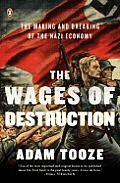 Adam Tooze: The Wages of Destruction: The Making and Breaking
of the Nazi Economy (2007, Viking)
Adam Tooze: The Wages of Destruction: The Making and Breaking
of the Nazi Economy (2007, Viking)
Big book, 802 pages, not much of a priority, but Richard J. Evans' New York Times Book Review (Dec. 20, 2007) review sums up some points worth noting:
Between 1924-35 the United States was already the wealthiest nation in the world. Some GDPs compared to the US: Great Britain 89%, France 72%, Germany 63%, Soviet Union 25% (p. 76):
European contemporaries were very much aware of these facts: and none more so than Adolf Hitler. Already in his unpublished "Second Book," written in 1928, he was declaring that "the European, even without being fully conscious of it, applies the conditions of American life as the yardstick for his life." For Hitler, who read the Wild West novels of Karl May during his childhood and adolescence, it seemed obvious that America had achieved its industrial advantage and high standard of living through its conquest of the West and its extermination of the Native American population. If Germany, as Europe's leading power, did not do something similar, the "threatened global hegemony of the North American continent" would degrade all the European powers to the level of "Switzerland and Holland." Far from being the revival of some medieval dream of conquest sparked by the example of the Teutonic Knights, Hitler's drive to conquer Eastern Europe was based on a very modern model, a model of colonization, enslavement, and extermination that had its parallels in the creation of European empires in Africa an Australia, or the nineteenth-century Russian conquest of Central Asia and Siberia.
(p. 76):
Hitler's drive to rearm was so obsessive, so megalomaniacal, that he was prepared to sacrifice almost anything to it. In particular, consumers suffered as resources and foreign exchange were diverted into arms expenditures. Cotton imports, for example, were hard hit, and people started to complain about the poor quality of the synthetic-fiber clothing they were forced to wear. Tooze here completely explodes the German historian Götz Aly's recent claim that the Nazi regime deliberately cushioned the civilian population for fear of alienating it. Contrary to what Aly suggests, Tooze points out that Germany's population was the most heavily taxed in Europe.
(p. 77):
Looked at from an economic perspective, indeed, the cards were stacked against the Germans from the outset. Tooze perhaps overstresses the point when he describes Germany, as he frequently does, as a "medium-sized European power"; even according to his own figures it far outclassed all other European states with the exception of Britain and the Soviet Union. The point was, however, that by the end of 1941 it had arrayed against it the combined might not only of these two countries, together with the British Empire, still at this time the largest the world had ever seen, but also of the United States.
To try to counter this, Hitler more or less abandoned the construction of costly and generally ineffective battleships and poured resources into the U-boat campaign with which he hoped to cut off British supplies from across the Atlantic and force a separate peace. Yet there were too few submarines to make an impact, especially against an enemy that organized an effective convoy system and had the advantage, thanks to the Ultra decoder, of being able to decipher German signals in advance of the operations they unleashed. Once more, the raw materials needed to build and fuel a submarine fleet large enough to overcome these obstacles were simply lacking.
Tooze points to a similar problem with the projected invasion of Britain in the summer and fall of 1940. Irrespective of whether Hitler was really set on this course, he simply lacked the resources to establish the air superiority that was the sine qua non of a successful crossing of the English Channel. A third of the initial strength of the German air force, the Luftwaffe, had been lost in the western campaign in the spring. The Germans lacked the trained pilots, the effective fighter planes, and the heavy bombers that would have been needed. Moreover, before long, the German attempt to gain control over the oil-rich Middle East and also threaten British control over the vital artery of the Suez Canal had suffered a fatal blow when Britain defeated a German-sponsored uprising in Iraq and seized Syria from the Vichy French.
Germany, of course, had at its disposal the resources of conquered countries in Europe, from France in the West to Belarus in the East. The Nazis had no compunction in ruthlessly exploiting the defeated nations to their own advantage. Tooze notes that by 1944 the Germans had taken nearly four million shells, over five thousand artillery pieces, and more than two thousand tanks from the French. Nearly half of all German artillery guns in March 1944 were non-German. Enough tin and nickel was seized after the victories in the West to cover German needs for a year, enough copper for eight months. France was drained of almost all its gasoline supplies. Yet such exploitation contributed to a collapse of the French economy in 1940, and the confiscated resources did not last for very long. This was another reason for Hitler's avoiding any further delay in pushing on with the invasion of the Soviet Union.
(p. 77):
When German armies marched into the Soviet-controlled part of Poland in June 1941, they soon scored a series of stunning victories, surrounding and killing or capturing millions of Red Army troops. Here too, shortages of fuel and ammunition quickly affected the German armies as their rapid advance stretched their supply lines to the breaking point. More serious still was the food situation. It was no use commandeering the Ukrainian collective farms if there was no gasoline to run the tractors and combine harvesters. Millions of German troops had to be fed, and more resources still were needed to sustain the civilian population back home, not to mention the foreign workers who were being forced into the country by the millions to boost the labor supply.
The Nazis and the German military decided to deal with this problem through the planned starvation of the native population of the occupied areas of Eastern Europe. At least three and a third million Soviet prisoners of war were deliberately killed in German captivity, allowed to die of starvation, disease, and neglect, or simply shot. Nearly three quarters of a million people perished during the German siege of Leningrad as a deliberate result of the blockade. German plans for the region envisaged the deaths of up to 30 million of its civilian inhabitants over the following years as German settlers were moved in to populate its towns, cities, and manor houses. This was mass murder on a historically unprecedented scale.
One thing that seems clear is that World War II was decided primarily by economic depth and reach. Germany tried to compensate with its blitz tactics, but the largest foe they were able to defeat that way was France. Britain was sufficiently protected by its moat. Germany pushed deep into Russia, but couldn't push deep enough. Russia was able to move much of its production back to the Urals and Siberia, wear down the onslaught, and turn it back. Japan fared little better against China, even though they had little trouble with colonial regimes in southeast Asia. Neither Germany nor Japan had any chance against the US.
The economic resilience which allowed the US to defend against the Axis powers has only increased since 1945. Aside from the vulnerabilty that all nations fear from nuclear attack -- which the US is uniquely able to deter, assuming that makes a difference -- it is inconceivable that any nation or realistic alliance of nations might threaten the US. It's also increasingly unlikely that anyone would try: WWII took place in an era still drunken with imperialism, but everything since then has shown that empires are unsustainable and not very desirable. As such, the US for its own defense needs no more and probably a good deal less funding than in 1939. Yet we see the opposite: the US spends over 50% of the entire world's military budget. The very fact that no other country considers an arms race with the US shows that what the US spends is almost totally wasted.
Thursday, March 20, 2008
How the World's Working
Andrew Leonard: The crash in Republican economics. For most of us, what happened over the weekend, not just to Bear Stearns but to capitalism as we know it, is nearly impossible to fathom. Leonard's been writing a column called "How the World Works," and he's come as close to tracking it as anyone I've found. This is a very important article, which needs (and deserves) to be read very carefully. The following quote only sets the stakes:
The consequences of Bear Stearns' failing are simply too great to allow ourselves the moral satisfaction of watching the guilty and the greedy drown in their self-inflicted gore. If anything has been conclusively demonstrated by the past year of market follies, it is that the world's financial institutions are bound together more closely than they have ever been before in a web that is extraordinarily fragile. If one string unravels, the whole structure seems poised to disintegrate -- a process that will inflict pain on a far greater number of people than those who go to work in buildings on the southern tip of Manhattan.
Another quote:
But whether or not the current ills afflicting the economy do bloom into something much worse, it's hard to argue with the thesis that the rhetoric of market fundamentalism hasn't looked this threadbare since Ronald Reagan won office in 1980. Deregulated markets were given their chance. They didn't work, or, at least, they now look to be in need of serious overhaul.
He then tails off by looking at what the presidential candidates have to say about all this. Not much, folks (although you won't have any trouble handicapping them). As for Bush, there's an entry in "How the World Works" that I can only quote whole (title: "George Bush's reality distortion field"):
The president addressed the economy Monday morning. Referring to an economic update provided to him by Henry Paulson, secretary of the treasury, he said:
You've reaffirmed the fact that our financial institutions are strong and that our capital markets are functioning efficiently and effectively.
How the World Works finds itself incapable of summoning up the appropriate level of sarcasm necessary to comment on this quote. Truly, the end times are nigh.
Nicholas von Hoffman: Economic Chaos, Political Consequences. Not much optimism in the what-does-it-all-mean department:
We are in unknown territory facing situations that have never arisen before and taking measures that have never been tried. For the present we know that Bear Stearns/J.P. Morgan has been saved -- sort of. We suspect that some thousands of Bear employees will lose their jobs in the near future; we know that the news of the latest Fed actions was quickly followed by a fall in stock prices in Asia and another dip in the value of the dollar.In a few weeks this latest insult to the once-imperial Yankee dollar will express itself in higher gasoline prices. That will hurt, but it may be the least of our pain. No body, no government agency, no clutch of economics professors, certainly nobody on Wall Street can lay out a plan of action. We do not know the dimensions of the storm buffeting us but that it is huge and enormously dangerous there can be no doubt.
Of course, what makes these events newsworthy is that now we're finally talking about economic events that hurt rich people -- that in fact threaten to blow their whole financial house of cards into dust. When it was just jobs that were being lost, when it was just the private and public sector safety net that was being shredded, when the infrastructure that supports our way of life was eroding, when the spreading gap between rich and poor was undermining the notion that we live in a just society, those were all things that could blithely be swept under our carpet faith in free markets, as the media quickly moved on to report the Dow Jones numbers. For a long time now, but especially since the 2001 recession that was compounded and exacerbated by 9/11, the federal government has been stuffing money into rich people's pockets to prop up the illusion that they are the health of the economy. What we're finding is that the rot at the bottom is increasingly hard to cover up with the riot at the top.
Von Hoffman thinks that we're going to be so busy bailing out the rich that there won't be any money for aspiring politicians to fix any problems:
There will be no health insurance for everyone. No long-needed increases in teachers' salaries, no big infrastructure projects, no decent-paying new jobs for those laid-off workers in Ohio, Michigan and Pennsylvania, and nothing for single-parent (read mothers) households. There is no money. As things stand now we may have to spend hundreds of billions to prevent millions of people from being thrown out of their homes and billions more to prop our crooked, avaricious, heedless and duplicitous financial system so it does not come crashing down on all of us.
It isn't clear to me that these things are either/or, although they will be if it isn't recognized that the finance problems are symptomatic of more serious structural problems: in particular, the growing chasm between rich and poor. The Keynesian money pump is a way of compensating for short-term slumps in demand, but doesn't add to persistent demand unless it increases the wealth of people at the bottom end of the scale. The current vogue for stimulating the economy via tax cuts and low interest rates for the rich has remarkably little effect. The only thing that stands a chance of actually reversing the hollowing out of the US economy that we've witnessed over the last few decades is to start putting not just money but power into the lower classes, to build up the sense of worth that drives long-term demand. The Fed won't be taking the lead there. To do so requires political change. But it wouldn't be unprecedented: that's pretty much what did in fact happen in the New and Fair Deals.
Postscript: In another How the World Works column ("Easy money days are here again?"), Andrew Leonard notes that the net effect of the ultra-low interest rates that Alan Greenspan pushed from 2001 through Bush's 2004 election, against the backdrop of an otherwise stagnant economy, sent Americans off on a spending spree at the cost of accumulating $3 trillion in household debt. Now that interest rates are dropping again, will the same thing happen? Well, starting out $3 trillion deeper in debt makes it that much harder to convert newly available money into consumer demand. We already saw from 2001-04 that the low interest didn't go into new capacity. It mosty went into the pseudo-growth of asset inflation (i.e., the real estate bubble). With debt past any resemblance of sane limits, and assets deflating like crazy, it's hard to see where the money can go -- although I suppose some people will try to use it to pretend nothing disastrous is happening. Last thing anyone would think of doing with it would be to spend it on poor people, helping them live a little better and becoming more productive.
Wednesday, March 19, 2008
Army of Shadows
 Hillel Cohen: Army of Shadows: Palestinian Collaboration With
Zionism, 1917-1948 (2008, University of California Press)
Hillel Cohen: Army of Shadows: Palestinian Collaboration With
Zionism, 1917-1948 (2008, University of California Press)
The Nation (Mar. 24, 2008), Neve Gordon has a long review of Cohen's book. Gordon introduces the subject by drawing on examples of Israel's targeted assassination program which has to date killed over 400 Palestinians. The following quotes are from Gordon's review.
(p. 24):
Army of Shadows chronicles a tragic chapter in the people's history of Palestine, one that many Arab scholars have refrained from writing because it contradicts the dominant ethos of Palestinian national unity. Zionists have abstained from recording it as well because it undermines their claim that the Palestinians were able to unify and fight against the establishment of a Jewish state after the UN partition resolution of November 29, 1947. Cohen reveals that many Palestinians signed pacts with the Zionists during the 1948 war and that some even fought with the Jews against the Arab armies.
Collaboration is a very thorny issue, primarily because of its corrosive blend of betrayal, exploitation and deceit, so it's not surprising that Army of Shadows created a stir when the Hebrew edition was published in 2004. Both liberal Jews and Palestinians found the book difficult to digest because each group found its side portrayed in unflattering terms. Many Jewish readers were upset by Cohen's revelation that the prestate Zionist intelligence agency, Shai, and the Jewish Agency's Arab bureau exploited almost every honest Jewish and Palestinian relationship to advance narrow Zionist interests. There were, Cohen notes, many Jews who desired only friendship or good business relations with Palestinians but were eventually identified by the Shai, which used them to collect information and enlist Palestinian collaborators. The Jewish Agency even helped establish and finance Neighborly Relations Committees, which initiated mutual visits and Jewish-Palestinian projects, ranging from pest control to the sending of joint petitions to the Mandatory government. The rationale for the creation of these committees was not only to enhance coexistence but also to recruit informers.
Ezra Danin, head of the Shai's Arab department from 1940 to 1948, identified twenty-five occupations and institutions in which Jews and Palestinians mixed company, among them trucking, shipping, train and telecommunications systems, journalism, Jewish-Arab municipalities, prisons and the offices of the British Administration. He proposed that the Jews in these walks of life enlist Arab collaborators, adding that "such activity should be similar to the way the Nazis worked in Denmark, Norway, and Holland -- touching on every area of life." Cohen explains that this approach was different from that of the British intelligence, which allowed only political and military organizations and subversive bodies to be targeted as pools for potential informers. This revelation, besides shedding light on some of the ruthless tactics employed by the intelligence agencies, helps explain why, from Zionism's very beginnings, it was almost impossible for many Jews to develop loyal relationships with indigenous Palestinians.
Army of Shadows also disturbed Palestinian readers because it reveals for the first time the extent of Palestinian collaboration with the Jews during the Mandate period and the ensuing 1948 war. Some Palestinians were opportunists who collaborated with the Zionists to make money or advance their careers -- these were primarily land brokers and people seeking administrative jobs. Others were mukhtars [village leaders] who wished to advance their regional or village interests or, in cases of internal competition, to solidify their leadership with the Zionists. Still others can be characterized as Palestinian patriots who simply disagreed with the dominant national leadership. Finally, there were those who had Jewish friends and did not view Zionist immigration as a catastrophe. The problem, though, as Cohen points out, is that regardless of the motivation, collaboration contributed to the fragmentation of Palestinian society at a time when its very fate was being determined.
(p. 26):
Cohen documents numerous cases of Palestinians refusing to attack Jews. This unwillingness to do battle pervaded the country. In December 1947, Cohen writes, "the inhabitants of Tulkarm refused to attack Jewish towns to their west, to the chagrin of the local Holy Jihad commander, Hasan Salameh. Sources in Ramallah reported at the same time that many were refusing to enlist, and reports from Beit Jibrin indicated that 'Abd al-Rahman al-'Azzi," the head of a very influential family, "was doing all he could to keep his region quiet. The villagers of the Bani-Hassan nahiya southwest of Jerusalem decided not to carry out military actions within their territory, and the people of al-Mahila refused to request from 'Abd al-Qader al-Husseini to attack the Jewish neighborhoods of Mekor Hayyim and Bayyit va-Gan." In these places as well as in many others, fear of the Jewish forces was the source of reluctance; and in still others it was friendship that had survived many years of national strife. "Palestinian Arab interest in fighting the Jews seems not to have been very high," Cohen concludes.
The review also discusses a second, still untranslated, book by Cohen called Aravim Tovim (Good Arabs), which carries the stories of Palestinian collaborators into the 1948-67 period. As Gordon points out, Israeli use of collaborators continues to the present day. Gordon concludes with an example (p. 28):
Today a request to exit the Gaza Strip to receive medical treatment, visit a dying relative or study in the West Bank or abroad is often contingent upon one's willingness to collaborate. In early January a number of patients were referred from Gaza -- where they could not receive medical treatment -- to Maqassed Hospital in East Jerusalem, and received permits to leave the region. At the border, though, they were interrogated by Israeli security service officers, who demanded that they become collaborators. According to Hadas Ziv of Physicians for Human Rights, Israel, those patients who refused had their travel permits annulled and were sent back home. While these patients managed to resist the temptation to collaborate, despite their medical ills, others do not. The persistence of collaboration is a result of not only the historical processes Cohen eloquently describes but also the harsh conditions under which Palestinians currently live.
Every occupation has depended on collaborators, and every insurgency
has found it necessary to dissuade collaboration, often with violence
against their own people. William Polk's Violent Politics: A History
of Insurgency, Terrorism, and Guerrilla War, From the American Revolution
to Iraq, has numerous examples (including a chapter on Palestine).
In the worst cases, the struggle between insurgents and collaborators
reaches the proportions of a civil war -- Iraq is one such case. But
even where the violence level is relatively mild, collaboration leads
to an immense psychic rift within a people -- France under Nazi Germany
and its Vichy client state is a good example where the resistance was
never as strong as one liked to remember, in large part because the
taint of collaboration never faded away.
One thing that Bush et al. certainly did not think of when they invaded Iraq was what would ultimately happen to the thousands of Iraqis they were able to recruit to try to secure the occupation. They really needn't have thought back any further than Vietnam. Tens (or maybe hundreds) of thousands of Vietnamese who had foolishly allied themselves with the US occupation sought refuge here after the war. Thus far the US has allowed no more than a few dozens of the millions of displaced Iraqis to immigrate here, but as the US presence ends, the moral pressure to provide sanctuary will only increase. Will our kneejerk nativists welcome those Iraqis with the flowers Bush expected awaited the Americans in Baghdad?
Postscript: I was wrong about Polk having a chapter on Palestine. The lineup: America (vs. England), Spain (vs. Napoleon), Philippines (vs. US), Ireland (vs. England), Yugoslavia (vs. Nazi Germany), Greece (vs. Nazi Germany, England, US), Kenya (vs. England), Algeria (vs. France), Vietnam (vs. France, US), Afghanistan (vs. England, Soviet Union), and Iraq.
Tuesday, March 18, 2008
Bush's Civil War in Iraq
There was a gathering in a park here in Wichita last Saturday to mark the 5th anniversary of the Bush invasion of Iraq. Laura Tillem gave a short speech, and this is what she said:
Let's talk about why getting out soon is better for the Iraqis.
Let's be clear: what the US as represented by the Bush administration does in Iraq has not been and will not be concerned with the interests of Iraqi people. They are interested in having a power base in Iraq with which to exercise power over the entire Middle East. Refusing to leave now that we have sowed destruction has nothing to do with stopping a civil war (in fact we are arming the Sunnis so when we do have to leave the civil war will be more deadly). Instead it is because they do not want to give up the idea of a pliant government there and they do not want to admit what the whole world knows: the US cannot just impose its will on another people.
But let's talk about this idea that staying can help fix Iraq. That is, fix what we have broken. As though it was not us that destroyed the institutions that ran Iraq and replaced them with nothing but Halliburton boondoggles.
Staying in Iraq means, at best, the level of violence in spring 2005. This means that in a nation that used to have the highest educational levels in the Middle East, it is now and will be mostly impossible to send your kids to school.
Staying in Iraq means forcing more Iraqis to be branded collaborators if they oppose militias. Forget secular and feminist organizing -- the US has taken up all the space for those ideas.
We should focus instead on what is not there because we are there. For example, no other country will come to help the Iraqi people while we are there. Recently a group of Iragis called for UN to replace US for security. This cannot happen while the US is there.
So think about that. By staying there we doom them to have the most incompetent and illegitimate force possible, the US, trying to fix things. Not that the soldiers are incompetent but they are led by nincompoops and nuts like Bush and McCain.
Another bad result of our staying there is that it makes it impossible for the different factions to come to terms with each other. We prop up a government that has so little legitimacy it cannot stand without us. Maybe if we get out, then the Sadr movement will find an accommodation with the Sunnis. Maybe not, but it sure won't happen while we are there.
Put it this way. We know what will happen if we stay: the same thing that has been going on for 5 years. We don't know exactly what will happen when we leave, but it cannot get better while we are there.
The point about collaborators is one that we've been thinking a lot about lately, partly because of Neve Gordon's review of Hillel Cohen's book, Army of Shadows: Palestinian Collaboration With Zionism, 1917-1948. Actually, collaboration is an essential concern in any counterinsurgency. No foreign occupation can stand without considerable support from the local population providing information about insurgents and assuming roles in support of the occupation. Conversely, no insurgency can possibly succeed without persuading, by force if necessary, the local population not to collaborate.
This is a constant theme throughout the dozen or so cases of insurgencies that William R. Polk surveys in his recent book, Violent Politics: A History of Insurgency, Terrorism, and Guerrilla War, From the American Revolution to Iraq. In the case of the American Revolution, Polk points out that at the start of hostilities, only about 2 in 10 Americans were against the British, 2 in 10 were loyalists, the rest were undecided or unconcerned. In that context, the insurgents fought not only the British troops and crown, but also anyone who might collaborate with the British. (If you watched HBO's John Adams series, you've seen some examples of this, including tar and feathers.) In the end, the British didn't lose the military engagement so much as they lost any chance of restoring loyalty.
So this is key: the American Revolution was from its very start, and necessarily so, a civil war between Americans against and in favor of the British crown. These same dynamics force every insurgency into civil war, and that civil war persists as long as the insurgency fights and is opposed. Polk's examples show that insurgencies only end under two cases: when the foreign occupation withdraws, or when the insurgency accepts some sort of accommodation -- possibly because the insurgency is exhausted, but even then usually with some sort of tangible gains. (The IRA in Northern Ireland is an example of the latter.)
It shouldn't be had to see how Iraq fits into all of this. Iraq was primed for an insurgency before the US invaded. There were many reasons for this which hardly need to be listed given that the insurgency (or several) actually happened. The first thing the insurgency did was to divide the country between the insurgents and those who collaborated with the occupation, and that was the start of the civil war. In other words: the occupation was met with an insurgency which in turn engendered civil war. The civil war would have happened even in a completely homogeneous population where the only difference was collaboration, but it really took off given the existing fault lines, which were readily manipulated by the occupation and the insurgents.
Of course, it's possible by now that the Iraqi civil war will take on a life of its own, following the grim cycle of atrocity and revenge. But what started it all was the US invasion and occupation, the revolt of a self-sustaining number of Iraqis against that occupation, and the struggle of both sides for the collaboration of the people. There is no chance that this will end in the submission of all Iraqi resistance to US hegemony. That leaves only one way to end the conflict, which is for the US to bow out, to give up on struggle for collaborators.
Some people will argue that the US has been making headway in recruiting collaborators, and that the more this happens, the more marginalized the "dead enders" become, the closer to "victory" we are. The levels of violence don't support any such optimism: Iraq is still far too dangerous to make any sort of reconstruction and economic recovery. The terms that the US has accepted to gain collaboration also appear to be exceptionally temporary: the Mahdi Army agreed to a truce, the Awakening to fight limited skirmishes while building up its own armed strength. For now, all sides have reasons to bide their time. This is mostly because the American people, unlike Bush and McCain, see little or no reason to cling to a thin and tattered tissue of sovereignty in Iraq. For all the talk about "staying the course," the inevitable course has always been that sooner or later the US would quit Iraq. The vast destruction that we have wrought only starts with the bombs and bullets the US has spent there. More profound is how we've deranged the country, split it into civil war camps, by coercing and/or tempting collaborators. Needless to say, the longer we stay, the more such damage we produce, and the harder it will be to heal.
Monday, March 17, 2008
Music: Current count 14284 [14261] rated (+23), 746 [746] unrated (+0). Listened to nothing but jazz this week, but didn't get much out of it. Slouching towards end of Jazz Consumer Guide cycle. Hope I get it nailed this week. Would love to move on to something else.
Jazz Prospecting (CG #16, Part 7)
Pretty mediocre week, with only one Honorable Mention added to the Jazz CG draft, and the following mixed bag of prospecting. One thing I'm encouraged by is that after six days scrounging through the new stuff, on Sunday I went back to the replay shelves and the writing finally improved. May not do a lot more prospecting for this column. I need to spend some time writing up what I already know about, which when you get down to it is quite enough -- I'd even say a lot. Still trying to cut this cycle short, while there is a window of opportunity at the Voice.
Helena: Fraise Vanille (2007 [2008], Sunnyside): Stage name for Helena Noguerra, b. 1969 in Belgium, her parents Portuguese immigrants, her older sister the estimable pop star Lio. Based in Paris. Started as a model. Branched out into acting, music, and has written at least one novel. Bunch of records. This one is a tribute to songwriter Serge Rezvani. With its acoustic guitar it strikes me as folkie, with a lithe eurobeat. B+(*)
Soul Summit: Live at the Berks Jazz Fest! (2007 [2008], Shanachie): I filed this under producer-keyboardist Jason Miles, then backed off a bit and listed it as Soul Summit -- the only name on the spine, although the cover is more verbose (lines separated by slash): "Jason Miles Presents/Soul Summit/Bob Babbitt, Karl Denson, Richard Elliot, Steve Ferrone,/Mike Mattison, Maysa, Jason Miles, Susan Tedeschi, Reggie Young/Live at the/Berks Jazz Fest!" The name list leaves out a couple of trumpets (Barry Danielian, Tony Kadlek), guitarist Sherrod Barnes, saxophonist David Mann, backup vocalist Emily Bindinger. The idea is to knock off a set of old-fashioned soul, starting with a bang with "Shotgun" and ending on the one with a James Brown medley -- both with smoking tenor sax solos by Elliot. (Never had any reason to take him seriously before. Looks like he worked for Motown and Tower of Power before sliding into smooth jazz.) Denson, on the other hand, takes 3 of 4 solos on flute, but remains palpably funky. Most cuts have vocals -- Maysa can easily outsing Tedeschi, but the latter lays credible claim to "Son of a Preacherman." B+(**)
Susie Arioli Band: Live at Le Festival International de Jazz de Montreal (2006 [2008], Justin Time, CD+DVD): Canadian singer, originally from Toronto, now based in Montreal; interprets standards mostly from the swing era, although she's also shown a special fondness for country tunesmith Roger Miller -- two of his songs here. Band credit adds "featuring Jordan Officer" -- Officer plays guitar, wrote a couple of instrumentals, has been a fixture in Arioli's band since 1998, but the band also features a second guitarist, Michael Jerome Browne, as well as bass (Shane MacKenzie). Drummer Rémi LeClerc is listed here as a special guess, but Arioli plays a snare with brushes, and that mostly suffices. DVD repeats the live CD tracks in slightly different order, adding 5 songs (or 6 counting "Nuages" in the extras). Hype sheet says she's sold 200k copies over 4 previous albums. Crowd is packed, mood is romantic, music mellow and tasteful. B+(**)
Matana Roberts Quartet: The Chicago Project (2007 [2008], Central Control): Saxophonist (alto, I think), originally from Chicago, AACM member, now based in New York, but returned to Chicago to pick up this band, including Fred Anderson (tenor sax), Jeff Parker (guitar), Josh Abrams (bass), and Frank Rosaly (drums). She's part of a group called Sticks and Stones with Abrams and drummer Chad Taylor, and also seems to be involved with Burnt Sugar. Got this as an advance last fall. Didn't come with much info, and I never got a final copy, so it's just been sitting on the shelf, although I did notice it in a couple of year-end lists. Two plays and I don't have a very clear picture of what's going on here: free riffing, alternately rhythmic and disjoint, patches of interesting guitar, but mostly overwhelmed by the horns. [B] [advance]
Charles Lloyd Quartet: Rabo de Nube (2007 [2008], ECM): The young rhythm section -- Jason Moran on piano, Reuben Rogers on double bass, Eric Harland on drums -- were born a good decade into Lloyd's career, and are if anything more mainstream, but no slouches when it comes to running a groove. The live date in Basel is relatively conventional for Lloyd as well: Coltrane tenor sax, a boppish alto flute feature, a little exotica on the tarogato. All originals, except for the title cut from Silvio Rodriguez, a nice chill down piece. B+(**)
Grupa Janke Randalu: Live (2007 [2008], Jazz 'n' Arts): Bodek Janke, percussion; Kristjan Randalu, piano. Randalu comes from Estonia. His parents were classical pianists. He studied in Germany and England, then came to New York (Manhattan School of Music) in 2003. Currently splits time between New York and Germany, teaching in Karlsruhe. Sixth album since 2002 (first I've heard). Janke is Polish, b. 1972, based in New York, "a cultural commuter between the USA, Kazakhstan, Russia, Poland and Germany," with a wide range of folk and world as well as jazz influences. This flows well, is consistently engaging; may be a little more percussive without a bass, but doesn't seem lacking. First rate, but one I haven't pinned down yet. [B+(**)]
Sacha Perry: The Third Time Around (2007 [2008], Smalls): Pianist, from Brooklyn, b. 1970, third album as a leader, plus side credits with other "Smalls scene" artists, especially Chris Byars and Ari Roland. Standard bop piano trio, with Roland on bass, Phil Stewart on drums. Nicely done, but doesn't leave me with a lot to say. B+(**)
Eric McPherson: Continuum (2007 [2008], Smalls): Drummer. First album, but has an impressive list of credits starting around 1990. Studied with Jackie McLean, and has some sort of relationship to Max Roach (M'Boom). Other credits include: Jesse Davis, Abraham Burton, Myron Walden, Avishai Cohen, Steve Lehman, Jeremy Pelt, Luis Perdomo, Andrew Hill, Steve Davis, Jason Lindner, Charnett Moffett. Burton was the name that caught my eye. An alto saxophonist with roots in Belize, he cut two of the best albums of the 1990s (on Enja, look for 1995's The Magician) but has scarcely been heard from since. He appears here, playing tenor and soprano as well as alto, plus a bit of flute, and he's rivetting on all but the flute. Relatively short at 39:39, cut over three sessions with two bassists and occasional guests, this is a little scattered, but the pieces are interesting in their own right. Carla Cherry does a spoken word piece over drums and Trevor Todd's yirdaki (Australian instrument, may or may not be same as didgeridoo). One cut subs Shimrit Shoshan's Fender Rhodes for David Bryant's piano. But mostly, hope to hear more from Burton. B+(***)
Frank Hewitt: Out of the Clear Black Sky (2000 [2008], Smalls): Fifth posthumous album, another piano trio, cut in two late-night sets live at Smalls. Ari Roland plays bass, Jimmy Lovelace drums. Mostly covers, including two from Rodgers and Hart, Dizzy Gillespie's "Manteca," Tom Jobim's "The Girl From Ipanema," and two takes of Erroll Garner's "Misty." It's probably a good sign that the more familiar a piece is, the more intriguing Hewitt's machinations become -- "The Girl From Ipanema" is plumbed for ideas instead of atmosphere. Fairly mild-mannered bebop, witty inside stuff, not a lot of flash. People may wonder why Hewitt didn't get noticed, but he didn't do the sort of things that get noticed, nor did he settle into a university and cut records to bolster his résumé. He just hung out in the underground and played stuff. B+(***)
Sun Ra: The Night of the Purple Moon (1964-70 [2008], Atavistic Unheard Music Series): Obscure even by Sun Ra standards, a quartet session from 1970, given a catalog number for a 1972 ABC-Impulse! release but appeared only on Ra's Saturn label, now augmented by Wurlitzer and Celeste solos from 1964. Ra plays various electric keyboards, including one Ra calls a roksichord (RMI's Rocksichord). Two horns -- Danny Davis on alto sax, alto clarinet, and flute; John Gilmore on tenor sax -- but both players spend most of their time rotating on percussion, offsetting the goofball keyboards. The fourth is Stafford James on electric bass. The horns go straight for the jugular -- wish there was more of them, to put some meat on the minimalism. But the keyb vibe is pretty unique. B+(***)
Sun Ra: Some Blues but Not the Kind That's Blue (1973-77 [2007], Atavistic): A 6-track LP recorded in 1977, released on Saturn in 1978, plus an extra "Untitled" cut from the same session, plus two 1973 takes of "I'll Get By" done as trios (one with John Gilmore on tenor sax, the other with Akh Tal Ebah on flugelhorn). The 1977 sessions were cut with 10 musicians -- John Corbett describes this as a small group, but it's not much below Arkestra weight. Mostly covers, such as "My Favorite Things" and "Black Magic." I don't know Sun Ra well enough to have a good sense of how his discography fits together -- that may seem overly modest given that I have 30 of his albums in my ratings database -- so my rule of thumb is to lay back and see how pleasantly surprised I become. By that standard, this one fares pretty well. The familiar songs go off in curious directions. The horns cut grease, but this isn't really that much of a horn album. That's mostly because the tunes keep returning to the piano (or organ on the 1973 tracks), and Ra's mix of stride, bebop, and something from the outer reaches of the galaxy is pretty amazing. A-
Brian Harnetty: American Winter (2007, Atavistic): A musician from Ohio, teaches at Kenyon College. This record is built around Berea College's sound archives, a 75+ year collection of Appalachian field recordings, radio programs, and oral history. Some are sung, bringing out the twang of deeply felt voices. Some are just interviews, old stories. A bit of radio broadcast focuses on the WWII draft. Most have been augmented with musical flourishes, mostly percussive. Seems like a highly repeatable formula, but for now it sounds unique. Harnetty's discography lists 17 items since 2003, mostly self-released, this the only one on a label I've heard of. AMG files this as folk, but it's pretty avant for that. [A-]
Ted Kooshian's Standard Orbit Quartet (2007 [2008], Summit): Kooshian is a pianist, originall from California, since 1987 in New York. Plays in Ed Palermo's big band. Second album under his own name. Standard Orbit Quartet includes Jeff Lederer on saxophones/clarinets, Tom Hubbard on bass, Warren Doze on drums. The standards include a few rock songs (Led Zeppelin's "Black Dog," the Police's "Message in a Bottle," Peter Babriel's "Don't Give Up") and a bunch of TV and movie themes ("Top Cat," "Captain Kangaroo," "The Simpsons," "Batman," "Buffy the Vampire Slayer," "Bullitt," "Spider Man," etc.). Plenty of opportunities for laughs, but they play it pretty straight and come up with an exceptionally listenable mainstream jazz album. B+(*)
Matt Haviland: Beyond Good & Evil (2002 [2006], Connotation): Trombone player, born 1961 in Iowa, graduated Berklee in 1983, then moved to New York. Looks like much of his experience is in big bands, with Illinois Jacquet, Steven Bernstein's Millennial Territory Orchestra, and Slide Hampton's World of Trombones names that stand out from the list -- for me, anyway; you may be more impressed with Maria Schneider. First album. I'm tempted to call his near-all-star band a hard bop group: Vincent Herring on alto and tenor sax, Benny Green on piano, Ugonna Okegwo on bass, Gene Jackson on drums, plus Scott Wendholt on trumpet for two tracks. Haviland wrote 7 pieces, all but "But Beautiful," Cedar Walton's "Bolivia," and a 1:07 bass intro. Straight stuff, but proficient, heady even. B+(**)
Avery Sharpe: Legends & Mentors: The Music of McCoy Tyner, Archie Shepp and Yusef Lateef (2007 [2008], JKNM): Three sections, each starting with a Sharpe original, followed by two pieces written by the subject. Sharpe is a bassist, born 1955, has 6-8 albums under his own name, a substantial list of credits, starting with Shepp's Attica Blues Big Band, 25 years with Tyner, and a stretch with Lateef in the early 1990s that includes one called Tenors of Yusef Lateef & Archie Shepp -- hard to find on Lateef's YAL label, but one of the great sax jousts of all time. The band here features John Blake on violin, Joe Ford on reeds and flute (Lateef, you know), Onaje Allan Gumbs on piano, Winard Harper on drums. Gumbs is a pretty good Tyner substitute, and the first section swings hard. Shepp is a tougher nut to crack, but Lateef's spaciness opens things up again. The violin is a nice touch. Usually don't expect much from tributes, but this one is growing on me. [B+(**)]
The Whit Williams' "Now's the Time" Big Band: Featuring Slide Hampton and Jimmy Heath (2004 [2008], MAMA): Pretty descriptive title, as best I can parse it. Williams came from North Carolina, settled into Baltimore after the Korean War, and has run an unsung local big band since 1981. This is their first album. Hampton and Heath are guest stars, and they brought big chunks of their books with them, joining three Williams originals, "Una Mas" (Kenny Dorham), and "Little Rootie Tootie" (Thelonious Monk). Crisp solos, solid section work, plenty of swing, pretty much what you'd expect in a big band these days. B+(*)
Felipe Salles: South American Suite (2006 [2007], Curare): Originally from Sao Paulo, Brazil; now based in New York, since 1995. Plays reeds and flutes: 7 cuts break down to 5 tenor sax, 4 soprano sax, 3 flute(s), 3 alto flute, 2 bass clarinet, 1 clarinet, 1 baritone sax. Group includes Jacam Monricks on flute and alto sax, Joel Yennior on trombone, Nando Michelin on piano; alto bass, drums, percussion. Not sure how far beyond Brazil the South American theme strays: references include samba, choro, frevo, afoxé, xote -- all Brazilian, mostly nordeste. Rhythms twist around quite a bit, providing the suite-like movement; the flute(s) dance around, but the sax provides a focal point. Salles has two previous albums on Fresh Sound New Talent -- haven't heard them. B+(***)
Jovino Santos Neto: Alma do Nordeste (Soul of the Northeast) (2008, Adventure Music): Pianist, also plays melodica (2 cuts) and flute (1 cut). Born 1954, Rio de Janeiro, studied in Montreal, lives in US now. I picked this out of order after seeing him write about the Felipe Salles record, which he wasn't otherwise involved with. Compared to Salles, this seems to be the real Brazilian Nordeste, with its tumbling profusion of rhythm, guitar, accordion, and flutes. Neto ties it together with piano. I prefer Salles' record because the sax pulls it back into a recognizable jazz context. Three cuts with tenor sax here, three more with soprano, are barely recognizable. B+(**)
The Gust Spenos Quartet: Swing Theory (2007 [2008], Swing Theory): By day Spenos is a neurologist in Indianapolis; by night he plays old-fashioned tenor sax. He has some clever math to explain swing. More importantly, he has a rhythm section that make it work -- Marvin Chandler on piano, Frank Smith on bass, Kenny Phelps on drums. He also taps some guests here: Eric Schneider, who claims four years experience with Earl Hines and two with Count Basie, adds alto sax and clarinet; Everett Greene sings two songs; and Wycliffe Gordon plays trombone and sings one more. The vocals probably limit how high I can go on this, but I love the basic sound enough to keep listening. [B+(***)]
Manhattan New Music Project: Performs Paul Nash: Jazz Cycles (2004 [2007], MNNP): Two Paul Nash entries in Wikipedia, neither right in this case. This Paul Nash is a composer, educator, jazz guitarist, born 1948, died 2005. He founded the 10-piece Paul Nash Ensemble in 1977. After some time in Bay Area, he returned to New York in 1990 and founded the Manhattan New Music Projec, which survives him. Seven piece postbop group with some names: trumpet (Shane Endsley), saxes (Bruce Williamson and Tim Ries), piano (Jim Ridl), guitar (Vic Juris), bass (Jay Anderson), drums (Grisha Alexiev). Suite-type material. The horns are pretty sharp, and the rhythm section moves gracefully. B+(**)
The Pete McGuinness Jazz Orchestra: First Flight (2006 [2007], Summit): Trombonist, born 1963, based in New York since 1986, most of his credits are with big bands, starting with DMP Big Band's Glenn Miller Project, with Maria Schneider's Concert in the Garden and Mike Holober's Thought Trains among the highlights. Hype sheet also connects him to the Lionel Hampton Band, the Woody Herman Orchestra, and the Jimmy Heath Big Band. John Fedchock wrote his liner notes, and he's got a half dozen or so New York musicians I recognize in the band, including pianist Holober. Pretty slick as these big bands go. McGuinness also sings on two cuts, including a run of scat. B+(**)
Fergus McCormick: I Don't Need You Now (2008, CDBaby): I used to get a couple of country albums per month, mostly alt/obscure stuff, good for a couple of A-list albums per year, including some things hardly anyone else noticed. Sometimes I think that if Christgau had asked me to do a Country Consumer Guide instead of a Jazz Consumer Guide, I'd have been just as happy, and in the long run it'd have been a lot less work. As it is, the jazz has been crowding out everything else, and now I'm down to, well, this may be the only country-ish album I've gotten this year. It doesn't belong here, but I don't have anywhere else to put it either. Singer-songwriter, based in New York; Wikipedia describes him as British-American, but he grew up in Flemington NJ, played in Princeton, went to college at Reed in Portland OR, toured from Colorado to Maine, the north of England to east Africa and Rio de Janeiro. Third album. No evidence that he spent any time trying to come up with a label name. Guitar-centered, easy strum, although there's piano, bass, drums, strings even. Soft tone to his voice, some topical songs including one for New Orleans, and smart personal stuff. B+(**)
Giacomo Gates: Luminous (2007 [2008], Doubledave Music, CD+DVD): Vocalist, born c. 1950 in Connecticut; spent 12 years in Alaska, operating bulldozers and working as a bouncer; caught Sarah Vaughan at a festival in Fairbanks -- she encouraged him, not least to get the hell out of Alaska. Cut his first record in 1995, and now has four. Hype sheet argues that he is "the acknowledged heir to the Eddie Jefferson/Jon Hendricks tradition of jazz singing." He does do some of their vocalese -- the DVD has two Charlie Parker pieces with Jefferson lyrics, and the singer and band's relief at getting through them without stumbling is palpable. They're not my favorite spots on the album, nor is the scat, although both are proficient. What I do like are the talky intros that effortlessly move into song, the idiosyncratic song selection -- one of the best is an original, "Full of Myself," passed off as a bonus track -- and the band's genteel swing. Didn't expect to bother with the DVD until I heard the CD. It's not much -- just four cuts, with a different band, plus interview which rifles through a lot of names. [A-]
Kassaba: Dark Eye (2007, CDBaby): Group, quartet, seems to be based in Cleveland. Group has two pianists, Candice Lee and Greg Slawson, who alternate, doubling on percussion. Bassist Chris Vance and saxophonist Mark Boich also have percussion credits (they claim "25 exotic percussion instruments"). Lee is originally from Edmonton (Alberta, that's Canada), but got her music degrees at Cleveland Institute of Music. Vance hails from Buffalo, the rest from Cleveland, although Boich studied at Berklee -- another George Garzone student. They claim inspiration from jazz, classical, and world music. The loose world beats are beguiling, especially when Boich blows abstractly against the grain. The closer, "Hin Rizzy," makes their classical case -- feels kinda static to me, like Bach. [B+(***)]
Giacomo Merega/David Tronzo/Noah Kaplan: The Light and Other Things (2006 [2008], Creative Nation Music): Merega plays electric bass, came from Genoa in Italy to Boston and on to Brooklyn. Tronzo is a guitarist, originally from Rochester. He's almost invariably described as a legend. I've heard very little by him, and have come to no firm conclusions. Kaplan also came to Brooklyn via Boston, with California his starting point. He plays tenor and soprano sax. Both Merega and Tronzo are credited prepared as well as unadulterated instruments. They produce grungy, abstract string sounds. Kaplan can either riff over them or try to blend in. It's the sort of thing we used to think might be really interesting if we had really good drugs. I don't, but I'm moderately amused nonetheless. B+(*)
Charlie Hunter Trio: Mistico (2007, Fantasy): Around the eighth cut, "Special Shirt," it finally dawned on me what this is: jazz bubblegum. Maybe I'm oversimplifying. Title cut came next and it's more phantasmagorical, almost a Pink Floyd instrumental. The 7 or 8 out of 10 cuts are just slinky fusion guitar over cheesy keybs and drums -- pop jazz, but before the dark ages set in. B+(**)
And these are final grades/notes on records I put back for further listening the first time around.
Mark O'Leary: On the Shore (2007, Clean Feed): Avant guitarist, has a lot of work out lately, and I'm way behind the learning curve. This one was evidently influenced by Arvo Part, mostly atmospheric trending towards ethereal, sometimes with a couple of trumpets, mostly shading, occasionally to pick up the pace and thicken the mix -- indeed, it all comes together in a choice cut called "Point Mix." He remains a future project. B+(*)
Júlio Resende: Da Alma (2007, Clean Feed): I guess you can call this Portuguese soul jazz, dreamy flights of fancy tethered to Resende's piano. Not that it all trends toward evanescence. Some cuts are tied down to rhythmic piano figures, and they're very much awake. B+(***)
Gerald Wilson Orchestra: Monterey Moods (2007, Mack Avenue): A big band with a lot of star power -- nearly everyone on board is a name I've heard of, the five trumpets starting with Jon Faddis and ending with Terrell Stafford, the rhythm section Renee Rosnes, Peter Washington, and Lewis Nash. The material is more hit and miss, but "Latin Swing" really takes your breath away, and "Blues" follows strongly, with son Anthony Wilson finding a solo role for the guitar. Wilson père didn't spend a lot of time on titles: three swing, two waltz, one goes "Allegro," one is just "Bass Solo." B+(**)
Westchester Jazz Orchestra: All In (2007, WJO): Close enough to New York that music director Mike Holober -- who did a good big band record under his own name called Thought Trains a few years back -- can draw on plenty of top-notch musicians, bringing this up to above-average in all the usual respects. But I'd advise against tackling any Beatles song (much less "Here Comes the Sun") given badly they've been chewed up and spit out as muzak. This one is better than I expected, but still not good enough. B+(*)
John Surman: The Spaces in Between (2006 [2007], ECM): Basically a sax with strings record, the strings coming from a classical string quartet d/b/a Trans4mation plus Chris Lawrence on double bass. Surman plays baritone sax, soprano sax, and bass clarinet, so the sound shifts away from the norm. But he also lets the strings go on their own at length, making for a cerebral chamber music, but the tone gets monotonous -- never had much taste for such things. The baritone works because it provides the most contrast. B+(*)
Frode Haltli: Passing Images (2004 [2007], ECM): Accordion, an instrument with folk referents, although this comes closer to chamber music, with trumpet and voice for highlights -- not that there are many -- and viola for extra density. B
Unpacking:
- Jo Allen Trio: I Am I Am (Sunnyside): April 15
- Boston Horns: Shibuya Gumbo (Boston Horns)
- Marilyn Crispell: Vignettes (ECM): advance, April 22
- Dapp Theory: Layers of Chance (Contrology): advance, April 1
- Delirium Blues Project: Serve or Suffer (Half Note)
- Taylor Eigsti: Let It Come to You (Concord): advance, May 6
- Paolo Fresu/Richard Galliano/Jan Lundgren: Mare Nostrum (ACT)
- Enrico Granafei: In Search of the Third Dimension (Miles High)
- Rigmor Gustafsson: Alone With You (ACT)
- Vijay Iyer: Tragicomic (Sunnyside)
- The Spencer Katzman Threeo: 5 is the New 3 (6V6)
- Make a Rising: Public Record (High Two)
- Chris McGregor's Brotherhood of Breath: Eclipse at Dawn (1971, Cuneiform)
- Arturo O'Farrill and the Afro-Latin Jazz Orchestra: Song for Chico (Zoho)
- Perez: It's Happenin' (Zoho)
- Dafnis Prieto: Taking the Soul for a Walk (Dafnison)
- Claudio Roditi: Impressions (Sunnyside): April 15
- The Stance Brothers: Kind Soul (Ricky Tick)
- Stebmo (Mount Analog)
- Marcin Wasilewski Trio: January (ECM): advance, May 6
- Norman Winstone: Distances (ECM): advance, May 6
Sunday, March 16, 2008
Red Flag Blindness
I figured it was only a matter of time before someone figured out a way to make Obama's race an issue without getting obviously racist about it. We've seen a few badly muffled attempts, like last week's doozy with Geraldine Ferraro. But the flap over Rev. Jeremiah Wright seems to have scored. I don't really know what this is all about, and I don't much care -- otherwise I'd be talking about Rev. John Hagee, if you know what I mean -- but the bottom line complaint seems to be that Obama consorts with black people, and this gives him a strange and dangerous view of America, no matter how polite or respectable he appears in public. Here's a couple of links, which is about as far as I've investigated the matter:
- Paul Woodward: Rising to the Wright Challenge
- Eric Kleefeld: Obama's Church: Pillorying Wright an Assault Upon African-American Culture
Looking through the comments in the latter piece I gather that it was the "God damn America" like that did it. I always thought it was Pat Robertson who said that.
Meanwhile, here's Richard Crowson's Wichita Eagle editorial cartoon today -- a What's the Matter With Kansas? classic:
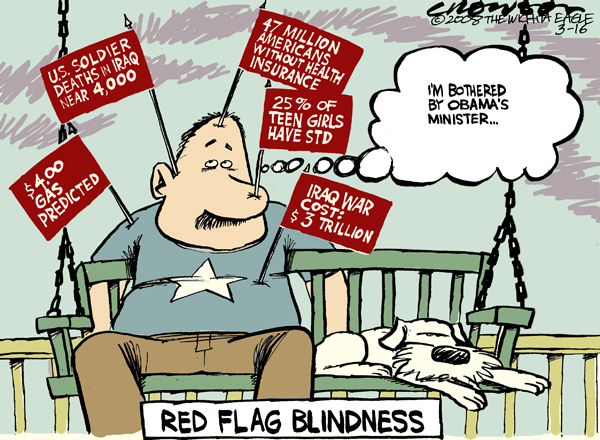
Since we're on candidates, might as well give the others some notice. Media Bistro as an interview with Matt Taibbi, where they ask him "who or what disgusts you the most this primary season?" His answer:
That's a tough question. I think Hillary disgusts me more than anyone else. Obviously, I wasn't a big fan of Rudy Giuliani and I'm still not a fan of John McCain, for a lot of reasons. The way he talks about the war is unbelievably irresponsible and kind of scary, but Hillary is the one who really, really gets to me. I was at an event that she did in Youngstown, Ohio the other night, and she comes in there ranting and raving and presenting herself as this great ally of the working man, and she's talking about how NAFTA has to be fixed and free trade agreements have had such a terrible effect on communities like yours, but she supported every free trade agreement that ever crossed her desk.
Three months ago, she voted to expand NAFTA to Peru, and she's got one of the biggest union busters in the country, Mark Penn, working as her chief campaign strategist. She's sat on the board of directors of Wal-Mart for years while they crushed unions, one after the other, and without skipping a beat, she presents herself as a modern day Samuel Gompers. All politicians do that -- I get that -- but there is something about the way Hillary Clinton presents herself as a critic of the war even after she voted for it. People forget before the war that she was one of the first people to talk about how Saddam Hussein was harboring Al Qaeda. I guess it's normal political behavior, but there is something about the way she does it that really, really gets me.
There was a letter in the Eagle today from someone who said she was so disgusted with Clinton that if Obama wasn't nominated she'd sit this election out. I'm still not inclined to go that far, but ask me again after Denver.
One thing that heightened my nervousness is reading an account of the 1976 and 1980 presidential elections that put a lot of emphasis on how divisive primary challenges weakened Ford and Carter, with both going on to defeat. The Democrats are becoming at least that divided this year -- "disgust" is a pretty strong word. You can tell yourself that November is still a long ways away, and that McCain will prove to be a powerful unifying force. But the next few weeks without any actual primaries to help clarify things look to be discomfiting.
Saturday, March 15, 2008
Another Evening of Book Browsing
In looking up the books I noticed in my library/bookstore venture I ran across a few more that would have fit my criteria had I actually found (or noticed) them. Some weren't there because they're not out yet [publication dates in brackets]. A couple are books that I have but haven't gotten to yet, so I figure they're still fair game. I cut the search off rather arbitrarily one day after the library/bookstore notes. I could have kept going, and no doubt would have found more items of interest. (The last one added was Ned Sublette, and I'm sure glad I found it.) I've had to go mostly on the basis of what Amazon has to say, which often isn't enough.
Alice H Amsden: Escape From Empire: The Developing World's Journey Through Heaven and Hell (2007, MIT Press): Focus here is on how the US changed from a relatively benevolent source of development aid ("heaven") to a considerably more malign one ("hell"). I'm curious about how that maps to the political and economic changes within the US. (Curious but not likely to be very surprised.)
Greg Anrig: The Conservatives Have No Clothes: Why Right-Wing Ideas Keep Failing (2007, Wiley): Not sure if this passes my criteria -- I have a copy on my desk, and meant to get to it next until a couple of other books got in the way -- but it deserves a mention anyway. The right spent all that time market testing ideas to use as tools to seize power and came up with a bunch of things that sound good but just flat out don't work. This is a catalog.
Bill Bishop: The Big Sort: Why the Clustering of Like-Minded America Is Tearing Us Apart (2008, Houghton Mifflin): Bishop uses the phrase "way-of-life segregation" -- makes me think of those housing developments clustered around golf courses that have their own internal draw and external exclusion. Not sure if he's only concerned with this sort of microdivision, since sorting occurs at all levels on just about every axis. I don't see it as entirely bad -- the concentration of like-minded people can be intensely creative; e.g., Black Mountain, or the old Jewish Lower East Side -- but it often makes it harder to recognize and respect diversity. Robert Reich had a whole riff on how upscale suburbs are seceding from the rest of the country -- one obvious political impact is that it makes it real easy to see poverty as someone else's problem. [May 7]
Philip Bobbitt: Terror and Consent: The Wars for the Twenty-First Century (2008, Knopf): Almost skipped this after seeing blurb praise from Tony Blair, and I still have my reservations: why, really, do we need wars in, let alone for, the 21st century? Big book (688 pages), claims to have the solution for terrorism. Bobbitt previously wrote the even bigger (960 pages) The Shield of Achilles: War, Peace, and the Course of History, frequently described (and not just by Blair) as "breathtaking" and "magisterial" -- sounds like hyperintellectual war porn to me. [May 1]
Robert Bryce: Gusher of Lies: The Dangerous Delusions of "Energy Independence" (2008, Public Affairs): The good news is this book does a hatchet job on the platitudes politicians spew about energy independence, mostly by showing how nothing they propose actually does the job. The bad news is that leaves us back with fossil fuels, and he may not have much of a sense of how limited that is. Previous books: Pipe Dreams: Greed, Ego, and the Death of Enron and Cronies: Oil, the Bushes, and the Rise of Texas, America's Superstate.
Jonathan Chait: The Big Con: The True Story of How Washington Got Hoodwinked and Hijacked by Crackpot Economics (2007, Houghton Mifflin): The story of "supply side economics," a/k/a "voodoo economics," a theory I thought was long dead. It was originally cooked up to justify tax cuts on the rich, but nowadays the Republicans don't even need theories to do that -- it's burned into their DNA, isn't it?
Ha-Joon Chang: Bad Samaritans: The Myth of Free Trade and the Secret History of Capitalism (2007, Bloomsbury Press): Another promising book I have lined up in my queue. One of the big problems in the world today is development, and there is little reason to think the self-interested superpowers are helping anyone else to improve their standards of living.
Amy Chua: Day of Empire: How Hyperpowers Rise to Global Dominance -- and Why They Fall (2007, Doubleday): One more comparative macro history. Her concepts -- tolerance is key to rising empires, which fall when they lose it -- may be worth exploring, but I keep thinking the whole notion of hyperpower is so outdated these days this winds up being a curio study, and it may not be the best one. I read her World on Fire: How Exporting Free Market Democracy Breeds Ethnic Hatred and Global Instability, which was marked by her broad learning and marred by her overgeneralizations.
Gregory Clark: A Farewell to Alms: A Brief Economic History of the World (2007, Princeton University Press): 440 pages isn't my idea of brief, but it is a big subject. Seen mixed reviews, which may mean he bit off too much, or didn't chew enough.
Victoria Clark: Allies for Armageddon: The Rise of Christian Zionism (2007, Yale University Press): The rabid support of apocalyptic Christians for Israel has long struck me as the dirty understory of Zionism -- for one thing, the core concept is profoundly antisemitic. Author is English, so presumably she won't neglect David Lloyd George, but most recent examples are American.
Peter Clarke: The Last Thousand Days of the British Empire: Churchill, Roosevelt, and the Birth of Pax Americana (2008, Bloomsbury Press): That would be a little over three years, presumably backdated not from the British withdrawal from Aden or Kenya but from India in 1947 -- Palestine was slightly later in 1948 (I guess the British saw how well their partition of India turned out). Even so that doesn't leave a lot of overlap with Roosevelt. One question I'm unclear about is to what extent the US chose to supplant the British empire (as happened most clearly in the Persian Gulf) as opposed to merely dismantling it. This may have some answers, although I'm just as inclined to go back to Gabriel Kolko's The Politics of War and The Limits of Power, books from the early 1970s still worth consulting. [May 13]
Patrick Cockburn: Muqtada: Muqtada al-Sadr, the Shia Revival, and the Struggle for Iraq (2008, Scribner): One of the best correspondents covering Iraq -- cf. his The Occupation: War and Resistance in Iraq. [April 8]
Hillel Cohen: Army of Shadows: Palestinian Collaboration with Zionism, 1917-1948 (2008, University of California Press): An important, little known story about how the Zionists used collaborators to seize control of Israel. Collaboration has always been critical to any successful colonial dominance, but one major effect here is how it hollowed out any prospect for a middle ground between the immigré Jews and native Palestinians.
Brian Coleman: Check the Technique: Liner Notes for Hip-Hop Junkies (paperback, 2007, Villard): Expanded version of the author's Rakim Told Me: Wax Facts Straight from the Original Artists -- The '80s with short essays that provide necessary background info on critical hip-hop albums. Probably the essential music book of the year. I only put off buying it because I was hoping to get a freebie. Hasn't happened, and I haven't had time.
Steve Coll: The Bin Ladens: An Arabian Family in the American Century (2008, Penguin Press): Coll's Ghost Wars: The Secret History of the CIA, Afghanistan, and Bin Laden, from the Soviet Invasion to September 10, 2001 is the main book on the CIA misadventure in Afghanistan. This is another big one (688 pages). [April 1]
Paul Collier: The Bottom Billion: Why the Poorest Countries Are Failing and What Can Be Done About It (2007, Oxford University Press): This is regarded as one of the better books around on world poverty and development, which may just mean that it sticks to tried and failed formulas. (Nicholas Kristof calls it "the best book on international affairs so far this year" -- which doesn't resolve the question one way or the other.)
Jonathan Cook: Israel and the Clash of Civilisations: Iraq, Iran and the Plan to Remake the Middle East (paperback, 2008, Pluto Press): English journalist, writes quite a bit about Israel -- as I recall, he's based in Nazareth, a mostly Palestinian town within Israel proper. Cook also has a 2006 book, Blood and Religion: The Unmasking of the Jewish and Democratic State.
John Darwin: After Tamerlane: The Global History of Empire Since 1405 (2008, Bloomsbury Press): 592 pages, which qualifies as brief given his macro subject. I can see why he wants no truck with Tamerlane, who blew through the old world like an influenza epidemic leaving nothing but death and destruction in his wake. That leaves him with Europe vs. a few old empires in Asia that more/less resisted and a couple in the Americas that succumbed very fast (although I don't know that he covers them, maybe because he's more interested in the more resilient Asian empires).
David Brion Davis: Inhuman Bondage: The Rise and Fall of Slavery in the New World (2006, Oxford University Press): Returns to the subject of his 1966 breakthrough, The Problem of Slavery in Western Culture, which I more/less read not long after it came out in paperback. The short of it is that slavery was more/less invented to solve labor problems in exploiting the new world, and racism was more/less invented to justify slavery. This book likely goes more into abolition, which is another perspective on those issues. Davis has spent a lifetime on this subject, and he should be worth revisiting. [Paperback April 18]
John W Dean: Broken Government: How Republican Rule Destroyed the Legislative, Executive, and Judicial Branches (2007, Viking Adult): Should mention this because I did bother to read his Conservatives Without Conscience -- but not the earlier Worse Than Watergate: The Secret Presidency of George W Bush. He's got a bug up his ass and, well, good for him. Dean also has another book coming April 15: Pure Goldwater, co-written with Barry Jr. Oh well.
Brian Doherty: Radicals for Capitalism: A Freewheeling History of the Modern American Libertarian Movement (2007, Public Affairs): A mixed bag, most likely way too long (768 pages). I've long admired Murray Rothbard, but don't think his utopianism really works. Most of the rest of the cast of libertarian heroes have pretty tawdry careers, with Milton Friedman the worst because he was by far the most effective. [Paperback May 26]
Brian Fagan: The Great Warming: Climate Change and the Rise and Fall of Civilizations (2008, Bloomsbury Press): A big subject, presumably related to global warming, but book is relatively modest (308 pages). I have to wonder how much evidence he really has, and how useful that evidence really is. While comparative methodologies can be enlightening, they can also be mere exercise. Fagan has several more books along these lines, like Floods, Famines, and Emperors: El Nino and the Fate of Civilizations, and The Long Summer: How Climate Changed Civilization.
Susan Faludi: The Terror Dream: Fear and Fantasy in Post-9/11 America (2007, Metropolitan Books): An account of "America's nervous breakdown after 9/11": that much seems on target. Could be insightful, but I don't have a lot of tolerance for Kulturkritik these days, which seems inevitable here.
Douglas J Feith: War and Decision: Inside the Pentagon at the Dawn of the War on Terrorism (2008, Harper Collins): I figure all political memoirs are self-serving cons until proven otherwise, and this is certainly no exception. I'm just wondering whether Tommy Franks will get to write a blurb. [April 8]
Peter Gay: Modernism: The Lure of Heresy (2007, WW Norton): Another big (640 pages) book not big enough for its subject. I've seen it said that anyone who reads this and Alex Ross' The Rest Is Noise: Listening to the Twentieth Century deserves an advanced degree. I remember buying a copy of Gay's The Enlightenment: An Interpretation: The Rise of Modern Paganism when it first came out in paperback back around 1967-68, lauded with all sorts of prizes. Never finished it.
John Ghazvinian: Untapped: The Scramble for Africa's Oil (2007, Harcourt): A report on the oil industry in Africa, especially Nigeria and Angola. Don't know how deep he goes, but the political strife over Nigeria's oil is certainly easy enough to find. The interests of the US and China are also obvious. [Paperback April 14]
Marshall I Goldman: Petrostate: Putin, Power, and the New Russia (2008, Oxford University Press): Short book on where Russia stands in the world today -- the collapsing criminal economy of the 1990s having some measure of order restored by Putin, to no small extent pumped up by Bush oil prices. I've read a couple of books on the 1990s, and could use an update. This at least seems saner than Edward Lucas' The New Cold War: Putin's Russia and the Threat to the West. It's a pretty peculiar viewpoint that thinks Russia is threatening the West rather than the other way around. [May 30]
Glenn Greenwald: A Tragic Legacy: How a Good vs. Evil Mentality Destroyed the Bush Presidency (2007, Crown): Constitutional lawyer, got upset by Bush's legal advisers and started blogging, spinning off a short book called How Would a Patriot Act? Defending American Values from a President Run Amok, worth reading, especially if you don't know better. Judging from his blog, this is likely bigger, broader, deeper. He claimed to be apolitical before Bush. Not any more. [Paperback April 8]
Glenn Greenwald: Great American Hypocrites: Toppling the Big Myths of Republican Politics (2008, Crown): New book in the works. Not sure who he has in mind. Don't recognize the dude in the cowboy hat. [April 15]
Howard Hampton: Born in Flames: Termite Dreams, Dialectical Fairy Tales, and Pop Apocalypses (2007, Harvard University Press): Big (496 pages) collection of film and music reviews. As I recall, Hampton and I wound up inadvertently reviewing the same William Parker album for the Village Voice once. [Paperback April 15]
Chris Harman: A People's History of the World: From the Stone Age to the New Millennium (paperback, 2008, Verso): New edition, originally published in 1999. Title parallels Howard Zinn's US history primer. Clearly, a comparable survey of world history would be useful. But, but all things considered, concise (760 pages). [April 7]
Chris Hedges/Laila Al-Arian: Collateral Damage: America's War Against Iraqi Civilians (2008, Nation Books): Read an excerpt from this in The Nation already. It's important to realize how inevitable, widespread, and counterproductive all this killing is. [June 2]
Richard Heinberg: Peak Everything: Waking Up to the Century of Declines (2007, New Society): Another book in my queue. I think Heinberg's understanding of energy issues (e.g., peak oil) is quite solid -- his The Party's Over: Oil, War and the Fate of Industrial Societies is the best book I can recommend on the subject (much better than anything Michael Klare has done). Here he ventures beyond his strong suit into water, food, climate, etc. Should be interesting.
Molly Ivins/Lou Dubose: Bill of Wrongs: The Executive Branch's Assault Against America's Fundamental Rights (2007, Random House): Was tempted to buy this the moment I saw it, no doubt for sentimental reasons. The more I looked at it, the more it read like a Lou Dubose book. While I agree with all this stuff about rights, it's not something I'm all that interested in reading about.
Dahr Jamail: Beyond the Green Zone: Dispatches from an Unembedded Journalist in Occupied Iraq (2007, Haymarket). Covers a lot more turf than the mainstream media. Much of this is probably old news by now, but things haven't change as much as they'd have you believe.
Tony Judt: Reappraisals: Reflections on the Forgotten Twentieth Century (2008, Penguin Press): A collection of previously published essays, most from New York Review of Books, which is to say most already read, most very sharp. I've read his huge Postwar: A History of Europe Since 1945, and recommend it highly. (Lots of quotes in my Books section.) [April 17]
Bill Kauffman: Ain't My America: The Long, Noble History of Antiwar Conservatism and Middle-American Anti-Imperialism (2008, Metropolitan Books): Has an elephant with peace signs on the cover, possibly a tribute to Ron Paul, who likes the book. I think it's about time someone wrote up this history. [April 15]
Ian Kershaw: Fateful Choices: Ten Decisions That Changed the World, 1940-1941 (2007, Penguin Press): In particular, they changed the world by starting WWII including the Holocaust. This presumably goes into the strategizing that made those decisions appear rational at the time. I suspect much of this is groupthink, the conventional racism and militarism of the period. Nicholson Baker's Human Smoke looks like it clarifies the context within which these details were debated.
Michael T Klare: Rising Powers, Shrinking Planet: The New Politics of Energy (2008, Metropolitan Books): For better or worse, Klare is the guy who's been following the problems of shrinking resources (especially oil) and mapping them to geopolitics. TomDispatch has published an excerpt from this, which had nothing new but also nothing terribly wrong. [April 15]
Steve LeVine: The Oil and the Glory: The Pursuit of Empire and Fortune on the Caspian Sea (2007, Random House): One of largest oil bonanzas in play today -- probably the largest, but also problematical politically (check the map and see if you can figure out how to get all that oil to Houston) and also technically. For me, how good this book is depends on how technically savvy it is. The politics, after all, is open and shut stupid, at least for the forseeable future.
George E Lewis: A Power Stronger Than Itself: The AACM and American Experimental Music (2008, University of Chicago Press): Big book (672 pages), an essential slice of jazz history that has rarely been written about before. Lewis is a brilliant avant-garde trombonist who's worked with most of these people. Should be a fine historian as well. [May 1]
Mark MacKinnon: The New Cold War: Revolutions, Rigged Elections, and Pipeline Politics in the Former Soviet Union (2007, Carroll & Graf): This covers the upheavals and conflicts on Russia's periphery (especially Georgia and the Ukraine), with various degrees of influence and interference by both the US and Russia. Unlike the continuing stream of hysterical books promoting renewed cold war conflicts with Russia and China, this is about something already started.
Jules Marchal: Lord Leverhulme's Ghosts: Colonial Exploitation in the Congo (2008, Verso): Relatively short (256 pages) book on King Leopold's murderous program, set up by British entrepreneur Lord Leverhulme, of forced labor to extract rubber wealth from the Congo. Introduction by Adam Hochschild, whose King Leopold's Ghost covers at least some of this story. It seems to me that one could expand this to cover the whole era of Belgian control, and expand it further backwards into the slave trade and forwards through Mobuto to start to get a sense of how severely the Congo has been wracked by its encounter with Europe. [June 9]
Stephen A Marglin: The Dismal Science: How Thinking Like an Economist Undermines Community (2008, Harvard University Press): The core idea makes sense, and can be plumbed for further insights (not sure about 376 pages worth). Clearly, economics has its place and its limits, and framing that is something that needs to be done. What I'm less clear about is community, which, being a creature of my locale and time, I don't take to be an unalloyed good.
William Marsden: Stupid to the Last Drop: How Alberta Is Bringing Environmental Armageddon to Canada (And Doesn't Seem to Care) (2007, Knopf Canada): This is about oil shale, which Canada has an awful lot of, which looks really yummy in a world that is otherwise starving for oil, but which is hell to extract, and not likely to get much better, like, ever. [Paperback September 30]
Arno Mayer: Ploughshares into Swords: From Zionism to Israel (2008, Verso): One of the great historians of our times. His Why Did the Heavens Not Darken? The "Final Solution" in History showed his ability to freshly contextualize things you thought you already knew all too well -- just one example is his characterization of the two World Wars as "the 30 Years War of the 20th Century." That's what I expect here -- the title itself is a powerful start. [June 9]
John J Mearsheimer/Stephen M Walt: The Israel Lobby and US Foreign Policy (2007, Farrar Straus and Giroux): Stirred up a storm of controversy when it came out, mostly from the Israel lobby. Shouldn't have been much of a surprise. It's hard to reconcile anything resembling a realist foreign policy with Israel off in some sort of weird fantasyland. [Paperback September 2]
Martin Meredith: Diamonds, Gold, and War: The British, the Boers, and the Making of South Africa (2007, Public Affairs): Big (608 pages) book on the makings of colonial South Africa, with the discovery of diamonds in 1871 playing a particularly large role, followed by the Boer War and independence. Meredith has also written Mugabe: Power, Plunder, and the Struggle for Zimbabwe's Future, recently in paperback; also: The Fate of Africa: A History of Fifty Years of Independence.
Ilan Pappe: The Ethnic Cleansing of Palestine (paperback, 2007, One World): Looks like this concentrates on the 1948-49 expulsions, which are still at the root of the whole conflict. Mazim Qumsiyeh suggested doing reading groups using either this or Sandy Tolan's The Lemon Tree. We're doing one on the Tolan book, which is uniquely poignant. Should get a copy of this as well.
Ilan Pappe: The Bureaucracy of Evil (2008, One World): New book, not much info on it, seems to be about the Israeli occupation machinery: the laws and bureaucracies that govern the Palestinian occupied territories. There's much more to this than just the obvious "security" layer -- the checkpoints, jails, house demolitions, barrier building, etc. It's a story that's not nearly as well known as the expulsions. [May 25]
Harvey Pekar: Students for a Democratic Society: A Graphic History (2008, Hill and Wang): Illustrated by Gary Dumm. Paul Buhle is listed as editor. Evidently Pekar's text is mixed with other first-person stories, and presumably Buhle has something to with that. Most likely you had to be there to care, but young people have been so misinformed on the whole era that they might learn something.
Kevin Phillips: Bad Money: Reckless Finance, Failed Politics, and the Global Crisis of American Capitalism (2008, Penguin Books): Not much info, but money played a key role in his American Theocracy: The Peril and Politics of Radical Religion, Oil and Borrowed Money in the 21st Century, and the world of finance isn't getting any firmer. [April 15]
William Poundstone: Gaming the Vote: Why Elections Aren't Fair (and What We Can Do About It) (2008, Farrar Straus and Giroux): I've read a couple of books by Poundstone, quite a while ago, about game theory if I recall correctly. He brings that expertise to bear here.
Gerard Prunier: Darfur: The Ambiguous Genocide (revised and updated edition, 2007, Cornell University Press): Helena Cobban recommended this as the most useful book on Darfur. I've read some stuff by Prunier on Darfur -- he's also written on Rwanda -- and found him to be persuasive, unlike a lot on Sudan that's highly politicized. Other books on Darfur: Alex de Waal/Julie Flint: Darfur: A Short History of a Long War; many authors: War in Darfur and the Search for Peace.
Dina Rasor/Robert Bauman: Betraying Our Troops: The Destructive Results of Privatizing War (2007, Palgrave Macmillan): Second order dirt -- all this graft wouldn't exist if it weren't for the war in the first place. I doubt that any of it has a real effect on the outcome, which would be dismal even if Bush could manage it honestly and competently. Of course, he can't, for the same reasons that got him into the war in the first place. [Paperback April 29]
Graham Robb: The Discovery of France: A Historical Geography, from the Revolution to the First World War (2007, WW Norton): A view of French history from the provinces, looking at how they became integrated into the Paris-centered nation. Part bicycle travelogue; the author has also written biographies of French writers like Hugo and Balzac, so most likely there's some of that too.
John Robb: Punk Rock: An Oral History (paperback, 2007, Ebury Press): Well, obviously, interviews with punk rock musicians -- UK division, 100 or so (576 pages). Presumably not the same John Robb who wrote Brave New War: The Next Stage of Terrorism and the End of Globalization. I don't know enough to decide whether the latter book is misguided or just nuts.
Paul Roberts: The End of Food (2008, Houghton Mifflin): I haven't read Roberts' previous The End of Oil: On the Edge of a Perilous New World, which seems like the best known book on the peak oil problem. This is the next logical step, given how much oil goes into growing the food that has allowed world population to expand so exorbitantly over the last century. Take the oil away and it'll start to impact the food chain and before long people -- 1.1 billion already undernourished -- will starve. Michael Pollan and Bill McKibben have advance pitches for the book. Title bumps into Thomas F Pawlick's The End of Food: How the Food Industry Is Destroying Our Food Supply -- and What We Can Do About it. [June 4]
Mort Rosenblum: Escaping Plato's Cave: How America's Blindness to the Rest of the World Threatens Our Survival (2007, St Martin's Press): Seems pretty obvious. Not familiar with Rosenblum, but he's previously written a book on Olives: The Life and Lore of a Noble Fruit, and A Goose in Toulouse and Other Culinary Adventures in France.
AJ Rossmiller: Still Broken: A Recruit's Inside Account of the Intelligence Failures, from Baghdad to the Pentagon (2008, Presidio Press): More dirt on the Defense Department's disinformation and bungling before and after the invasion of Iraq.
Aram Roston: The Man Who Pushed America to War: The Extraordinary Life, Adventures and Obsessions of Ahmad Chalabi (2008, Nation Books): You know, maybe Rumsfeld (or Feith, or whoever) was right: hand Iraq over to the crook, draw the troops down as fast as you can, and let him fend for himself. I figure he would have been dead within 3 months, but, hey, stuff happens. The more momentum behind withdrawal, the harder it would have been to reverse it. And dumb as the idea of putting Chalabi in charge was, Bush sure topped it with Bremer. Looking forward Chalabi hardly merits a biography, but maybe this ties some loose ends up.
Robert Scheer: The Pornography of Power: How Defense Hawks Hijacked 9/11 and Weakened America (2008, Twelve): I don't think there's a lot of mystery here, but it could be useful to sort through the steps and the logic. No idea what pornography has to do with it. I do recall a book by that title back c. 1970, something psychological about personal power. Trying to sex up the US military is pretty much a waste of time. [June 9]
Peter Dale Scott: The Road to 9/11: Wealth, Empire, and the Future of America (2007, University of California Press): Don't know how good this is, but there's certainly a story to be told -- precisely the one that no one in a position of power in the US wanted aired on 9/12. Scott has a couple more conspiracy books: Deep Politics and the Death of JFK and Drugs, Oil, and War: The United States in Afghanistan, Colombia, and Indochina.
Mark W Smith: The Official Handbook of the Vast Right-Wing Conspiracy 2008: The Arguments You Need to Defeat the Loony Left This Election Year (paperback, 2008, Regnery): Know your enemy stuff. I've thumbed through it and found stuff (e.g., on Israel) laughable. Not sure how consistent it is for calibrating the mindset, but it's probably a good first approximation.
Stephen J Sniegorski: The Transparent Cabal: The Neoconservative Agenda, War in the Middle East, and the National Interest of Israel (2008, IHS Press): Looks like a pretty thorough review. [June 1]
Ned Sublette: The World That Made New Orleans: From Spanish Silver to Congo Square (2008, Lawrence Hill Books): A history of New Orleans, presumably with a strong focus on the music, since Sublette is a musician, and his history of Cuban Music, Cuba and Its Music: From the First Drums to the Mambo is masterful. I'm still expecting a second volume on Cuba, since the first one shut down in 1953.
Matt Taibbi: The Great Derangement: A Terrifying True Story of War, Politics, and Religion at the Twilight of the American Empire (2008, Spiegel & Grau): He takes four angles on the current state: the military, the system, the resistance, and the church. Reportedly a new book, not a collection of essays, but the first two (on Iraq and Congress) he's done elsewhere -- not that they don't deserve a few more whacks. [May 6]
Nick Turse: The Complex: How the Military Invades Our Everyday Lives (2008, Metropolitan Books): Cover has more words, an alternate subtitle: "Mapping America's Military Industrial Technological Entertainment Academic Media Corporate Matrix." I've read some of this at TomDispatch, which features Turse regularly. Usually skip him because my tolerance for Pentagon nonsense isn't very high.
Bernard Wasserstein: Barbarism and Civilization: A History of Europe in Our Time (2007, Oxford University Press): Huge book (928 pages), ranging from WWI to misgivings over recent muslim immigration. Title strikes me as overcharged. I've read two other books by Wasserstein, both on Israel, both sane and smart.
Eyal Weizman: Hollow Land: Israel's Architecture of Occupation (2007, Verso): Looks at Israel's occupation of the Palestinian territories through the prism of architecture: the settlements, the barriers, the checkpoints, Israel's control of air space and water, the roads, etc.
Matt Welch: McCain: The Myth of a Maverick (2007, Palgrave Macmillan): A first crack at deconstructing McCain, starting with the public's most obvious misconception about the man. I expect there will be more, starting with David Brock and Paul Waldman, Free Ride: John McCain and the Media, out in paperback March 25.
Hugh Wilford: The Mighty Wurlitzer: How the CIA Played America (2008, Harvard University Press): About all the front organizations the CIA set up, especially in the 1950s and 1960s. Most of these are old stories, but people tend to forget that Richard Wright, Arthur Schlesinger Jr., and Gloria Steinem were once CIA tools (or fools).
Matthew Yglesias: Heads in the Sand: How the Republicans Screw Up Foreign Policy and Foreign Policy Screws Up the Democrats (2008, Wiley): Well known blogger; somehow I've never read him, but recognize the name. Obviously, he has a topic one can write reams about. [April 21]
Fareed Zakaria: The Post-American World (2008, WW Norton): Further evidence that the goose is cooked? Zakaria writes, "This is not a book about the decline of America, but rather about the rise of everyone else." To the zero-sum minds of the American right there is no difference. For them the idea of a post-American world is catastrophic. Zakaria strikes me as a guy who's earned his ticket to the inner sanctums of imperial power, but still has a feel for the world outside and a sense of what it means to be looking in. He'll argue that such world changes needn't be catastrophic, but that they must be recognized and acknowledged. It will be a tough pill for some to swallow. [May 5]
Idith Zertal/Akiva Eldar: Lords of the Land: The War for Israel's Settlements in the Occupied Territories, 1967-2007 (2007, Nation Books): Probably the one book to to read on Israel's settlement movement. (Gershom Gorenberg's The Accidental Empire: Israel and the Birth of the Settlements, 1967-1977 came out in 2006 and covers similar ground, but seems to find the movement a touch mysterious.) Zertal's 2005 book looks interesting: Israel's Holocaust and the Politics of Nationhood (similar to Tom Segev's The Seventh Million: Israelis and the Holocaust).
Howard Zinn/Mike Konopacki/Paul Buhle: A People's History of American Empire (paperback, 2008, Metropolitan Books): Based on Zinn's A People's History of the United States, starting with 9/11 and referring back to empire-related events in the past. Illustrated as a comic by Konopacki. [April 1]
Also beware that there's a new Thomas Friedman book coming out in August: Green Is the New Red, White and Blue. Oy veh!
Friday, March 14, 2008
An Evening of Book Browsing
I spent the better part of an evening, first in the library, then in a bookstore, jotting down a couple lists of books that struck me as worth reading, or at least skimming through, if one had anything near enough time to do so. I generally avoided writing down books that I've put on previous lists like this, as well as ones that I've actually read or bought with the intent of reading. I might as well combine the lists, sorted alphabetically by author. Basically just an exercise to keep track of what's out there.
Matt Bai: The Argument: Billionaires, Bloggers, and the Battle to Remake Democratic Politics (2007, Penguin Press): Could be that this is just a pissy attack on web-oriented Democratic Party activists, in which case it's not an argument I much care to get into -- I'm more concerned with what's wrong in the real world than I am about nitpicking people trying to change it. [Paperback July 29]
Nicholson Baker: Human Smoke: The Beginnings of World War II, the End of Civilization (2008, Simon & Schuster): Long (576 pages) series of short chronological vignettes -- news items, I guess, but only if we had a much smarter media than we do now or then. Few subjects have been distorted by self-serving myth as the origins of WWII. This looks to be an antidote to most of them, and if it creates a case for pacifism, so much the better. Possibly the most intriguing book I found this trip.
Donald T. Critchlow: The Conservative Ascendancy: How the GOP Right Made Political History (2007, Harvard University Press): General history of US right from early post-WWII. Checked this out from library and started reading it, so you'll hear more.
Larry Diamond: The Spirit of Democracy: The Struggle to Build Free Societies Throughout the World (2008, Times Books): Sort of a globetrotting grade card on democracy metrics everywhere. Diamond wrote an Iraq insider book, Squandered Victory: The American Occupation and the Bungled Effort to Bring Democracy to Iraq, so you might say he's learned his subject the hard way. If, indeed, he's learned it.
Robert Draper: Dead Certain: The Presidency of George W. Bush (2007, Free Press): One more political biography; seems likely to have some insights, not that we need them any more. [Paperback March 25]
Charles Enderlin: The Lost Years: Radical Islam, Intifada, and Wars in the Middle East, 2001-2006 (2007, Other Press): Follows up on Enderlin's Shattered Dreams: The Failure of the Peace Process in the Middle East, 1995-2002, the first clear book on what went wrong at Camp David. Plenty more has gone wrong since.
Drew Gilpin Faust: This Republic of Suffering: Death and the American Civil War (2008, Knopf): An account of the US Civil War that focuses on the staggering destruction of the war.
David Gelernter: Americanism: The Fourth Great Western Religion (2007, Doubleday): Looks like a horrifying piece of patriotic onanism, but the very conceit -- not least the idea that America was the original Zionist chosen land -- clarifies an attitude that is otherwise hard to fathom. American imperialism makes so much more sense when you realize that we believe that the rest of the world is just yearning to worship us.
Barry Glassner: The Gospel of Food: Why We Should Stop Worrying and Enjoy What We Eat (paperback, 2007, Harper Perennial): Saw this right next to Michael Pollan's In Defense of Food: An Eater's Manifesto -- don't know how redundant they are. I have Glassner's previous book on the shelf but never got around to it: The Culture of Fear: Why Americans Are Afraid of the Wrong Things.
Jack Goldsmith: The Terror Presidency: Law and Judgment Inside the Bush Administration (2007, WW Norton): Cover photos: Cheney, Bush, Gonzales. Insider account: Goldsmith worked in DOJ's Office of Legal Counsel until he quit in disgust. You know what they were up to.
Martin Goodman: Rome and Jerusalem: The Clash of Ancient Civilizations (2007, Knopf): First century CE conflicts and revolts, a subject I only have a rough outline for. Got rather mixed reviews, and is long (624 pages).
David Halberstam: The Coldest Winter: America and the Korean War (2007, Hyperion): Major work on Korean War, possibly also on early phase of Cold War. Reportedly focuses heavily on MacArthur while missing other aspects of the war.
Fred Halliday: 100 Myths About the Middle East (paperback, 2005, University of California Press): Copy in store was shrinkwrapped, so I couldn't peer inside. Halliday writes for New Left Review. Looks like basic remedial education.
Chris Hedges: I Don't Believe in Atheists (2008, Free Press): A short attack on Sam Harris, Christopher Hitchens, possibly others. Before he became a war journalist, Hedges did time in a seminary, and he still hasn't gotten over it. I've read three of his books, including Losing Moses on the Freeway: The 10 Commands in America, which is most pointedly a book of his sense of religion. He hasn't improved my opinion of God, but I do have a lot of respect for Chris Hedges.
Jacob Heilbrunn: They Knew They Were Right: The Rise of the Neocons (2008, Doubleday): Covers similar ground to James Mann's Rise of the Vulcans: The History of Bush's War Cabinet, which I've read, but probably concentrates more on the ideologues, bench jockeys and backseat drivers.
Edward Humes: Monkey Girl: Evolution, Education, Religion, and the Battle for America's Soul (paperback, 2008, Harper Perennial): On the political struggle over intelligent design vs. evolution, especially the Dover, PA case, although there's also quite a bit on Kansas here.
Susan Jacoby: The Age of American Unreason (2008, Pantheon): Hard to tell how good or bad this is, since the old saw of dumb people getting dumber has long been a standard rant of the highbrow cultural right. On the other hand, there is something to write about. Inspired by Richard Hofstadter, which I take to be a good sign. Previously wrote Freethinkers: A History of American Secularism, which is probably interesting.
Bill James: The Bill James Gold Mine 2008 (2008, ACTA): I'm far removed from the days when I knew everything there was to know about baseball, in large part because I read everything Bill James ever wrote. He hasn't written that much lately, which may be part of my problem. Spent some time with the book. Quizzed myself on how many players per team I had even heard of (Arizona: 0; Atlanta: 3; Baltimore: 0; don't recall the others, but I think Boston was 5 and the Yankees 8). A lot of bare tables and trivial comparisons; a few short essays. Not sure if it's worthwhile, even for sentimental reasons.
Derrick Jensen: Endgame, Vol. 1: The Problem of Civilization (paperback, 2006, Seven Stories Press): A fairly encyclopedic doomsday book. Intriguing inasmuch as I think a lot of the things he digs up are indeed serious problems, but it's also possible that he's a crackpot. Has a lot of books in a short time, including a Vol. 2 where he gets activist, and a graphic book called As the World Burns: 50 Things You Can Do to Stay in Denial.
David Cay Johnston: Free Lunch: How the Wealthiest Americans Enrich Themselves at Government Expense (and Stick You with the Bill) (2007, Portfolio): Well, sure. Johnston also wrote Perfectly Legal: The Covert Campaign to Rig Our Tax System to Benefit the Super Rich -- and Cheat Everybody Else, out in paperback. I can't get excited about these books, although they may well be eye-opening for some people. Reminds me of a short book by Dean Baker: The Conservative Nanny State: How the Wealthy Use the Government to Stay Rich and Get Richer.
Robert D Kaplan: Hog Pilots, Blue Water Grunts: The American Military in the Air, at Sea, and on the Ground (2007, Random House): Sequel to Imperial Grunts, where the militarism became de trop for me, even though I've read virtually everything else he's written. Good writer, useful historian and observer (although I've seen Tom Bissell shred him on specifics), dangerously defective thinker.
Parag Khanna: The Second World: Empires and Influence in the New Global Order (2008, Random House): One of those books about which nations/regions are growing, which are likely to be global powers, pushing which others around, etc. Its value (if any) is in the details.
Naomi Klein: The Shock Doctrine: The Rise of Disaster Capitalism (2007, Metropolitan Books): Seems to be a major effort at summing up what globalized capitalism is doing. Something turns me away from her: haven't read any of her books, not sure I've even managed to finish one of her Nation columns. Strong activism, weak economics. Probably a lot of research here worth knowing. The notion that capitalism depends on disaster doesn't make any sense to me, although there are plenty of examples of capitalism leading to disaster.
Philippe Legrain: Immigrants: Your Country Needs Them (2007, Princeton University Press): English economist, makes the case for free labor markets, clearly out of step with the US right although not necessarily with the GOP money people. Previously wrote Open World: The Truth About Globalization, about as trustworthy as any other book with "truth" in the title.
Norman Mailer: On God: An Uncommon Conversation (2007, Random House): With Michael Lennon, presumably asking the questions Mailer responds to. Poked through this a bit and found it idiosyncratic and interesting. I read quite a bit of his stuff long ago -- mostly but not quite all nonfiction -- but it's been a long while.
Geert Mak: In Europe: Travels Through the Twentieth Century (2007, Pantheon): Big (896 pages) survey of European cities, filling in historical background.
Howard Mandel: Miles, Ornette, Cecil: Jazz Beyond Jazz (2008. Routledge): Davis, Coleman, Taylor; important musicians, an interesting sequence in that they substantially overlap but peeled off on different tangents. More interested in Taylor, personally, although he's the odd player out in one regard: the only one of the three not to experiment in fusion.
Mark Matthews: Lost Years: Bush, Sharon and Failure in the Middle East (2007, Nation Books): Covers much the same ground as Charles Enderlin's The Lost Years. (Looks like the book got cut out. Amazon has it for $5.99.)
Greg Mitchell: So Wrong for So Long: How the Press, the Pundits -- and the President -- Failed in Iraq (paperback, 2008, Union Square Press): Editor of Editor & Publisher, writes a good blog called Pressing Issues. You know the basic story. This just sorts the details out in good form for reference.
Charles R Morris: The Trillion Dollar Meltdown: Easy Money, High Rollers, and the Great Credit Crash (2008, Public Affairs): It's the economy, stupid.
Cullen Murphy: Are We Rome? The Fall of an Empire and the Fate of America (2007, Houghton Mifflin): Comparisons, seems like a stretch to me, but I could stand to learn more about Rome. [Paperback May 5]
Grover G Norquist: Leave Us Alone: Getting the Government's Hands Off Our Money, Our Guns, Our Lives (2008, William Morrow): Normally I wouldn't bother with a book by a right-wing ideologue, much less a political power broker, but rumor has it he's the guy who pulls all the vast right-wing conspiracy strings.
William R Polk: Violent Politics: A History of Insurgency, Terrorism, and Guerrilla War, from the American Revolution to Iraq (2007, Harper): About ten case studies of insurgencies over more than two centuries: Spain against Napoleon, Philippines, Ireland, Yugoslavia in WWII, Greece after WWII, Kenya, Algeria, Vietnam, Afghanistan. Lessons should be obvious. Checked this out from library, but not sure if I'll have time to get to it.
Michael Pollan: In Defense of Food: An Eater's Manifesto (2008, Penguin Press): I waited for The Omnivore's Dilemma: A Natural History of Four Meals to come out in paperback, and will probably do the same thing here. It seems unlikely that he has much more to add, but it would make sense to organize what he's learned into a tighter and more coherent argument, and that's what I imagine he's done here.
Samantha Power: Chasing the Flame: Sergio Vieira de Mello and the Fight to Save the World (2008, Penguin Press): Read the New Yorker excerpt focusing on Iraq, which had a lot of good stuff in it. Much bigger book (640 pages), probably a lot more perspective on what's good and bad about the UN. Couldn't bring myself to buy her previous book, The Problem from Hell: America and the Age of Genocide -- mostly because I suspect she thought the US should have intervened in Rwanda. I don't think the US is sane enough to intervene anywhere. In fact, I think the US is so insane with guns it's reckless to suggest otherwise.
Robert B Reich: Supercapitalism: The Transformation of Business, Democracy, and Everyday Life (2007, Knopf): I imagine that this is a smarter version of Thomas Friedman's The World Is Flat, but it could be something else. He has written thought-provoking books in the past, but most of the thoughts he provokes are in opposition. I didn't bother with his previous book, Reason: Why Liberals Will Win the Battle for America, or its predecessor, The Future of Success: Working and Living in the New Economy. A common denominator to his books is his idiot belief that no matter how wrenching the changes caused by capitalism it will all work out for the better in the end. I'm still looking for one of those high paying jobs he promised NAFTA would lead to. As far as I can tell, he's the only one who got one.
Arnold Relman: A Second Opinion: Rescuing America's Health Care (2007, Public Affairs): One of many books on how to resolve the health care mess. Probably one of the better ones -- several others I didn't bother to jot down. Advocates single payer, argues that the rush to commercialize medicine harms physicians and patients. (I notice that Jonathan Cohn's Sick: The Untold Story of America's Health Care Crisis -- and the People Who Pay the Price will be in paperback May 5.)
Marc Sageman: Leaderless Jihad: Terror Networks in the Twenty-First Century (2007, University of Pennsylvania Press): Short (176 pages) essay. As I understand it, his thesis is not just that the Al Qaeda jihad has broken up into numerous, even if like-minded, small groups, but that jihadi terrorism is likely to be self-terminating as its followers, for various reasons, become dissatisfied with violent tactics. Sageman also edited the much longer Unmasking Terror: A Global Review of Terrorist Activities.
Charlie Savage: Takeover: The Return of the Imperial Presidency and the Subversion of American Democracy (2007, Little Brown): Didn't initially write this down, but I saw copies both in library and book store. Maybe I'm jaded: all this "end of democracy" stuff makes me ask, "you think this is new?" Maybe there are too many Savages writing these days. This one won a Pulitzer for stories about Bush's signing statements. Something new there, after all. [Paperback April 11]
Jonathan Schell: The Seventh Decade: The New Shape of Nuclear Danger (2007, Metropolitan Books): On the threat of nuclear war, still present, still a spectre.
Philip Shenon: The Commission: The Uncensored History of the 9/11 Investigation (2008, Twelve): Seems pretty innocuous, but evidently there's still plenty of dirt under the surface.
Michael Scheuer: Marching Toward Hell: America and Islam After Iraq (2008, Free Press). I liked him better when he was Anonymous, trying to make the CIA look smarter than they are. No idea how this balances out, but there are other people who are smarter, not to mention saner, on terrorism.
Peter Silver: Our Savage Neighbors: How Indian War Transformed Early America (2007, WW Norton): One thesis is that Indian-hating was a unifying force among immigrants.
Barbara Slavin: Bitter Friends, Bosom Enemies: Iran, the US, and the Twisted Path to Confrontation (2007, St Martin's Press): Probably useful, but a second choice after Trita Parsi's Treacherous Alliance: The Secret Dealings of Israel, Iran, and the United States, which I've read.
Jonathan Steele: Defeat: Why America and Britain Lost Iraq (2008, Counterpoint): British author. Most books on the subject act like Bush and the Americans lost Iraq all on their own.
Joseph E Stiglitz/Linda J Bilmes: The Three Trillion Dollar War: The True Cost of the Iraq Conflict (2008, WW Norton): Read much of this in the early reports, although the numbers keep going up and up. I still doubt that they've counted them all.
John B Taylor: Global Financial Warriors: The Untold Story of International Finance in the Post-9/11 World (paperback, 2008, WW Norton): Insider account. Taylor was Under Secretary of Treasury for International Affairs on 9/11, so he got involved in trying to track down Al Qaeda financial flows. Also has stuff on financing wars in Afghanistan and Iraq, the impact of all this on IMF, etc. Doesn't seem to be an irate whistle blower. Someone in the Bush Administration was competent? Don't know.
Alex von Tunzelman: Indian Summer: The Secret History of the End of an Empire (2007, Henry Holt): That would be the end of the British Empire in India. One of several recent books on India that look interesting. (First on my list is William Dalrymple's The Last Mughal: The Fall of a Dynasty: Delhi, 1857, just out in paperback.)
Tim Weiner: Legacy of Ashes: The History of the CIA (2007, Doubleday): Sprawling (702 pages) history. My impression is that he's way too sympathetic to them, but the book is likely to be pretty damaging anyway.
Jacob Weisberg: The Bush Tragedy (2008, Random House): Slate editor, tries to sum up the whole nightmare ("the book that cracks the code of the Bush presidency"). Tired subject, but Amazon has a reader review with extensive notes that make it seem useful.
Garry Wills: Head and Heart: American Christianities (2007, Penguin Press). Big (640 pages) book on history of christianity in US, particularly the enlightened/evangelical split and how this relates to politics. Not a general history: first thing I did when I saw it was look in the index for Mormons (Latter Day Saints, Joseph Smith, etc.), and found nada.
Robin Wright: Dreams and Shadows: The Future of the Middle East (2008, Penguin Press): Veteran Middle East correspondent, wrote an early book on Iranian revolution. This ranges all over the region, searching for moderates and hope. Huge list of positive blurb reviews, including one from Rami Khouri, a lot more trustworthy than Joe Biden or Richard Lugar.
The US Army/Marine Corps Counterinsurgency Field Manual (paperback, 2007, University of Chicago Press): Forwards by John Nagl, David Petraeus, others. Basic reference material. I bet it'd be absolutely maddening to try to read.
I'll follow up with a second batch -- books I didn't find -- probably tomorrow.
Thursday, March 13, 2008
Structuring
I keep looking for news and running into Elliot Spitzer. Consequently, I know more about the affair than I cared to. Not enough to talk about details, thank God. But enough to come to one conclusion: if this shows anything, it's that some people have more money than they need, more than is even good for them. Most likely, a lot of crimes in America wouldn't happen if poor people had more money (or cheaper drugs), but "structuring" (as Spitzer's particular money laundering offense seems to be called) is something that takes a lot of money to get into. As for the prostitution angle, the only thing noteworthy there is the money. I ran across a piece at Slate on the high-end sex market (lost the link), and again the striking thing is that this market exists only because people like Spitzer have the money to bid it up.
We live in a nation that takes for granted the notion that there's no limit to how much money a person can or should have. The keyword the Republicans keep using is "marginal tax rates" as if the upper margins of the rich should never be slowed down in their pursuit of ever greater riches. Robert Reich, in his Clinton administration memoir Locked in the Cabinet, had numerous stories about how when anyone suggested raising taxes on the rich they'd immediately be overruled by the exclamation "confiscatory": evidently we're not allowed to consider confiscatory taxes, even in the open-and-shut estate tax case. (Confiscatory estate taxes would help slow down the formation of an aristocracy of inherited wealth and the problems those elites entail.)
I'm not complaining about money in general. Like food, it's good up to a point, but unlike food, when it spoils few rich people have the good sense to throw it out. That seems to be Spitzer's problem in a nutshell. On the other hand, now at least he has something to do with his surplus money: pay lawyers.
One more little note. After two terms of George Bush and six previous years of Newt Gingrich, you'd think that Democrats would wise up to the notion that they need to live up to a higher standard of public service than the Republians have shown. This thing with Spitzer, and a similar recent brouhaha with KS Attorney General Paul Morrison, are really personal betrayals of people who have suffered so much under the Republicans. The politicians may think it's all about themselves, but it isn't. They represent people, and it's a disgrace when they pay them back like this.
Wednesday, March 12, 2008
Self-Preservation
TPM published the following item titled "Like cats to water":
The House last night voted to create an outside panel to review ethics complaints. Let's just say that it passed over very strenuous objections from some quarters.
We've put together some of the best quotes from the debate.
My favorite, from Rep. Todd Tiahrt (R-KS): "If you have a single ounce of self-preservation, you'll vote no."
Tiahrt was an actual employee of Boeing before he got elected to the House. No doubt he'll be back on the payroll, with a substantial raise, when we finally get rid of him. Meanwhile, he's been so far up Boeing's corporate ass even Bush has taken to calling him Tanker Todd. He's also been deep into Tom DeLay, who gave him an Appropriations Committee seat. In turn, Tiahrt kicked some of his Boeing money into DeLay's slush fund. I've never gotten the impression that Tiahrt's fingers are particularly sticky, but clearly he knows how money works in Washington. He's a hardcore ideologist, but he doesn't assume that God looks out for him. He's done a lot of practical and expedient things to keep getting re-elected in what isn't a sure Republican district. The one thing he takes more seriously than any principle is self-preservation.
PS: Salon's War Room also singled out Tiahrt's quote.
Tranker Travail
Michael D Shear and Matthew Mosk: McCain staff tied to Airbus lobbying. The Kansas political world, which is totally in Boeing's hip pocket, is livid over the Air Force awarding its $35 billion tanker boondoggle to Airbus (technically, Northrop Grumman) over Boeing. Caught in the crossfire is John McCain, one of whose few good deeds was working to derail Boeing's previous scandalous one-bid tanker contract in 2004. McCain still cites his role there as preventing $6 billion in fraud. Several Boeing execs wound up in jail as a result, and the whole thing got restarted, with Airbus lobbying hard to get in on the graft. Looks like they won the contract at least partly on merit, but it no doubt helped that they've made major strides in playing Boeing's political game. And while I believe McCain when he says that he never personally lobbied on the issue, it turns out that he's close enough to plenty of lobbyists that it isn't hard to connect dots.
McCain has spoken out for years against the influence of special interests in Washington, but his campaign includes a number of prominent Washington lobbyists, including campaign manager Rick Davis, who founded a lobbying firm.
McCain finance chairman Tom Loeffler and Susan Nelson, who left Loeffler's lobbying firm to be McCain's finance director, both began lobbying for the parent company of Airbus in 2007, Senate records show. William Ball, a former secretary of the Navy and frequent McCain surrogate on the trail, also lobbied for Airbus, as did John Green, who recently took a leave from Ogilvy Public Relations to serve as McCain's legislative liaison.
The conspicuous presence of lobbyists in McCain's campaign has been noted elsewhere, but hasn't really sunken into the public mind, which has conveniently forgotten that McCain only started wearing his scruples on his sleeve after getting caught up in the savings and loan scandal as one of the notorious Keating 5. Given how much play this is getting in Kansas, where Boeing's congressional flunkies are all Republicans, you can imagine how it'll play in Washington, where Democrats predominate -- both support Boeing slavishly, but the exporting jobs issue plays to their base instincts, and they have no reason to cut McCain any slack.
 Meanwhile, Wichita Eagle editorial cartoonist Richard Crowson
has been groping with the question of why Boeing's having such
a hard time competing with Airbus. An earlier cartoon suggested
several reasons, like the old saw about government subsidies.
(You think Boeing is unsubsidized? Aside from all the cost-plus,
reuse-the-technology Defense deals, Kansas has financed Boeing
with billions of dollars in state-backed bonds, and every city,
state, and country Boeing builds or contracts in has had to
pony up for the privilege.) But today Crowson settled on health
care costs, and picked an appropriate way to represent them.
The little dog in the lower left corner says: "Didn't I see
you in Detroit?"
Meanwhile, Wichita Eagle editorial cartoonist Richard Crowson
has been groping with the question of why Boeing's having such
a hard time competing with Airbus. An earlier cartoon suggested
several reasons, like the old saw about government subsidies.
(You think Boeing is unsubsidized? Aside from all the cost-plus,
reuse-the-technology Defense deals, Kansas has financed Boeing
with billions of dollars in state-backed bonds, and every city,
state, and country Boeing builds or contracts in has had to
pony up for the privilege.) But today Crowson settled on health
care costs, and picked an appropriate way to represent them.
The little dog in the lower left corner says: "Didn't I see
you in Detroit?"
I'm not sure that really explains it in Boeing's case, but then I know some folks Boeing laid off for being diabetic, so I figure they're pretty much on top of their costs there, as they are elsewhere. (Boeing is self-insured, so they have a lot of incentive to grind those costs down.) Still, Crowson is right in general, and it's good to see the point made.
The Eagle also published a letter today from a Merlin C. Hussey, under the title "Boeing is not without blame." It's worth quoting in its entirety:
Some media and politicians argue that awarding the tanker contract to Northrop Grumman and the European Aeronautic Defence and Space Co. would compromise our national security and American jobs. This may be true, but what has Boeing done to negate either of those factors? Twenty percent or more of the 767, including the wing box, is built by Japanese companies in Japan.
In a 2005 paper, authors David Pritchard and Alan MacPherson demonstrated the loss of jobs and transfer of aircraft development technology to Japan by Boeing. They contended this was a result of Boeing's contracts with Japanese airlines and Boeing's low level of research and development and capital investment compared with Airbus.
Example: In 2003, Airbus allocated 9.5 percent of its total revenues toward research and development, compared with 3.5 percent for Boeing. In the same year, Boeing allocated only 0.97 percent of its total revenues to capital investment, compared with 9.1 percent for Airbus. In addition, a minimum of 35 percent of the 787, possibly up to 70 percent, will be built in Japan.
Adding to our selective reasoning is the focus on France and the rest of the European Union while still ignoring the impact of China on U.S. jobs and national security. In 2007, imports from China exceeded exports from the United States by a whopping $256 billion. In 2007, our trade deficit with the entire EU was only $107 billion.
Shouldn't we be asking if the tanker issue is real, or whether we are trying to compensate for our federal government's foreign trade and economic policy failures?
One thing I haven't seen pointed out at all here is that Airbus is working at an enormous disadvantage given how badly the dollar has fallen vs. the euro -- as I recall, the euro has gone from about $0.90 to $1.50 since Bush took office. That in itself makes European labor more than 60% more expensive that it already was, which it already was given that Europe has more effective unions. Boeing is in a constant state of whine about how they have to get their costs down to compete, but it never shows up in the prices of their products, least of all when the US government is buying. Rather, Boeing's entire "competitive advantage" has hitherto been their superior ability to grease political palms. They built this game, and now that they've lost a hand it's hard to see anyone else to blame -- not that they haven't been trying nonstop since the contract dropped, pulling out every stop, even the very real problem of exporting manufacturing jobs, which is something else they've pioneered.
Of course, at this point I hope they do manage to scuttle the Airbus deal. The last thing we need is more tankers able to project American power to the far corners of the earth, imbrogling us in more disastrous wars.
Tuesday, March 11, 2008
Browse Alert: Iraq
William R. Polk: The Iraq War and the Presidential Election. Well, not so much about the election, which is just as well. The first long section is about what the war is costing "us" -- which at this point is probably the Achilles heel of the misadventure. It seems impossible to reach any sort of consensus on whether Iraq would be better off or worse off without US troops there, but deep down it's hard to find any Americans who actually care about Iraqis -- from day one the war has always been about us, and the Iraqis have never been more than pawns or collateral damage. On the other hand, the question of whether our costs justify the cheap thrills and petty vanities of the politicians who started the war -- that's a question that deserves to be kept front and center. I don't think Polk has identified all of the costs, and many of them are incalculable -- e.g., the war was presumably the reason Bush was elected in 2004, leading to four more years of all sorts of mischief. But this is a good list to start from, to show to doubtful friends and to consult for 5th anniversary speachmaking. Polk writes:
A leading member of the Neoconservatives, James Woolsey, a former director of the CIA, said he hopes it [what he calls "the Long War"] will not last more than 40 years. The cost of such a generational conflict has been estimated at more than $17 trillion dollars.
More important, in the long period of stress, the American way of life would be severely challenged, perhaps irreparably damaged. The real cost could be the destruction of the world in which we live and the replacement of our civic, cultural and material "good life" by something like nightmare George Orwell predicted in his novel 1984.
Polk also summarizes some of two of his books. One is called Violent Politics: A History of Insurgency, Terrorism, and Guerrilla War, from the American Revolution to Iraq, which takes about ten cases widely scattered in space and time and draws out common themes, like the near impossibility of crushing such insurgencies. The other was coauthored with George McGovern, Out of Iraq: A Practical Plan for Withdrawal Now -- would be a very useful book if anyone in a position to get out of Iraq actually wanted to.
Dean Baker: The War and the Recession. Baker writes usefully about the present costs of the Iraq war and cites some chilling modelling on future costs of extended war ("by the tenth year, the economy was projected to have lost about half a million jobs, mostly in manufacturing and construction"), but he argues that the real cause of the recession is the $8 trillion housing bubble collapse.
News today (aside from the 8 US troops killed in Iraq, a bit of a bump from the usually reported tranquility): Admiral William Fallon resigned at Centcom commander. Fallon has recently been quoted as saying that the US won't attack Iran on his watch, so I guess that promise has expired. It seems likely that's what did him in: the Bush hawks like the principle of keeping the option of nuking Iran on the table even if they don't intend to do it. Otherwise, like, the enemy might think we're rational, and, like, we can't have any of that get out.
PS: Also looks like Fallon was pushing to draw down some troops from Iraq, and clashed with Petraeus over that.
Other news is that Obama won the Mississippi primary today, something like 60% to 38% for Clinton. It looks like that was closer than it would have been due to open votes. Salon reports some exit poll breakouts: Republicans voting in the Democratic primary favored Clinton 77-23; voters with favorable opinion of John McCain favored Clinton 71-29. Some guess as to the size of the crossover vote can be made based on the fact that the race breakdown of voters was 49-49, where normal expectations were that the Democratic primary electorate would be 60-70% black. This doesn't look like just some casual drift. Of course, it could just be Republicans trying to fuck with Democrats heads. It doesn't necessarily mean that Republicans like Clinton more than Obama, or hate Obama more than Clinton, but most likely it does mean that they'd rather run against Clinton. Maybe she's not as vetted as she thinks?
PS: Here's a report about Republicans crossing over in the Ohio primary.
Monday, March 10, 2008
Browse Alert: VP
Greg Mitchell: In case you thought she would stop with this. My favorite quote of the week:
Maybe Hillary should run as McCain's VP? That would solve the Democrats' problem, and give Rush Limbaugh a fit, besides.
Her instinct to make nice to McCain only serves to remind us of her past (and possibly future) support for the Iraq war. She really should have enough presence of mind to recall who she's running against, and what she's running for. Or at least the good taste not to turn all those answers back into herself. Of course, Clinton is even less likely to get the nod than Joe Lieberman, but that's not the point. The point is that while she's desperately working to undermine Obama, she's helping to sanitize and legitimize the real monster of the campaign. Video requires Flash, so I didn't follow it.
In a later post, Mitchell quotes Bill Kristol arguing that McCain should pick Clarence Thomas as his running mate. Didn't catch the reasons, but you have to figure message discipline is one. The best you can say about Kristol is that this is nowhere near the dumbest idea he's ever had. It's pretty easy to come up with all sorts of fitting matches for McCain. For instance, Rush Limbaugh himself would make a state-of-the-art Agnew for McCain's Nixon. Too bad Curtis LeMay is dead.
Mitchell's blog seems to be running 3-6 short posts per day, a useful survey of the press. Just added his book to my shopping cart: So Wrong for So Long: How the Press, the Pundits -- and the President -- Failed on Iraq, released in paperback. Figure it will be a useful reference, even though by now the story's old news.
Music: Current count 14261 [14238] rated (+23), 746 [757] unrated (-11). Recovering. Medical issues did some damage to the week, and I can't say that there wasn't some psychic toll as well. More or less broke even with jazz prospecting. Calendar moves on, and I should get moving, too. The two big boxes below were a holding action.
- Benny Carter: The Music Master (1931-52 [2004], Proper Box, 4CD): Another case where there's so much to choose from they can hardly go wrong. They've cut Carter's 1930s recordings back from the 3CD Affinity set to 2 discs, leaving out a lot of stuff that has dated poorly (e.g., Carter's starched shirt singing), but also they skipped over the legendary "Crazy Blues" sessions with Coleman Hawkins and Django Reinhardt that show up everywhere -- I must have a dozen or more copies. Moving into the 1940s, they do sample the sadly out-of-print 1946 Arnold Ross Quartet sessions, some of Carter's best work ever. A-
- Illinois Jacquet: The Illinois Jacquet Story (1944-51 [2002], Proper Box, 4CD): Born in Louisiana, but figure him for one of the great Texas Tenors. His early records were mostly honking jukebox r&b, and that's the bulk of what you get here. Blue Moon, Classics, and Mosaic have collected more/less completist subets, but I've never managed to hear them through. This may benefit from being a bit more selective, but leading off with a big chunk of Jazz at the Philharmonic really sets this up right, and "Flying Home" deserves two takes. A few cuts with vocals, mostly by trumpeter Russell Jacquet, but they just root this deeper in the r&b dirt. May also have helped that I picked this out for a miserable day when I really needed something to pick me up. A
Jazz Prospecting (CG #16, Part 6)
Another lousy week, but it's over now. I was so down early in the week I spent a good chunk of time with a couple of 4-CD Proper Boxes that had been sitting around forever: Benny Carter's The Music Master was good as expected; The Illinois Jacquet Story was even better. Jacquet's late-'40s jukebox hits have never been collected so well, and a big chunk of the first Jazz at the Philharmonic concert really jump starts the box. Managed to get a little prospecting done, and was starting to feel better toward the end of the week, but I was still beset with distractions. Got the blogging back on track, including some book reports. It's starting to feel like spring here. Still possible we'll get hit with another blizzard, but it seems unlikely now that we'll get that new winter snow record.
It's about time to start thinking about how this Jazz Consumer Guide cycle will wind up. Nothing really compelling on the pick hits or duds fronts, but plenty to write about.
Pat Metheny: Day Trip (2005 [2008], Nonesuch): Guitarist, from the Kansas City suburbs, cut his first record in 1975, has worked steady ever since, about as big a star as any jazz guitarist can be. (Don't have any sales figures, so that's just a guess.) I've never been much of a jazz guitar fan, and I've paid him especially scant attention over the years -- just 6 records in my database, including the great Ornette Coleman vehicle Song X and a bunch of stuff I didn't care for, most of which can be blamed on Lyle Mays' cheezy keybs. No Mays here: just Christian McBride on bass, Antonio Sanchez on drums, giving this a lean sound, reminiscent of Metheny's Charlie Haden duo, Beyond the Missouri Sky. The clarity is certainly welcome, although I'm still on terra incognita. [B+(***)]
Stanley Jordan: State of Nature (2008, Mack Avenue): Another well-known guitarist, one I've paid even less attention to than Metheny -- I have him filed under pop jazz, which may or may not be fair. Jordan had a run on Blue Note 1984-90 with at least one gold record, but hasn't recorded much since. Not much info to go with this advance copy: no musician credits, although Charnett Moffett, David Haynes, and Kenwood Dennard are somewhere, and there is something about Jordan playing guitar and piano simultaneously. Piano is fairly prominent on some pieces, including Horace Silver's "Song for My Father" and the quasi-classical "Healing Waves." Some of the guitar is quite elegant -- don't have an ear for his famous "tapping" method, which doesn't seem much in play. Mix bag of pieces, ranging from Latin to Mozart. Might as well wait for more info. [B+(*)] [advance: Apr. 22]
Bob Brozman: Post-Industrial Blues (2007 [2008], Ruf): Guitar collector, particularly fond of National Resonator guitars, with half a dozen models featured here, as well as lap steel, 7-string banjo, dobro, a resophonic ukulele, and a closet full of exotic instruments (sanshin, chaturangui, gandharvi, etc.) that mostly turn out to be disguised guitars. Studied ethnomusicology at Washington University in St. Louis, probably about the same time I was there. Has a dozen-plus albums, half or more blues-themed (like this one), the other half more worldly, ethnomusicologically speaking. The blues are straightforward, although the guitar is a little bent. Two more/less non-originals, the Doors' "People Are Strange" and Nat Cole's "Frim Fram Sauce," renamed "Shafafa." B+(**)
Cannon Re-Loaded: An All-Star Celebration of Cannonball Adderley (2006 [2008], Concord Jazz): An assembled studio band, doing ten songs more/less associated with Adderley. Group leader and alto saxophonist is Tom Scott, the all-star of L.A. studio hacks. He doesn't break any new ground, but he's got a gorgeous sound, swings hard, and carries the album. Playing Nate is an underutilized Terence Blanchard. The keyboards are doubled up with Larry Goldings on organ and George Duke on everything else. Marcus Miller plays bass, spelled by Dave Carpenter on two cuts. Steve Gadd is the drummer. I could do without Nancy Wilson singing two songs, but have to admit that "The Masquerade Is Over" ain't half bad. The Adderleys were respectable hard boppers who somehow were remarkably popular, an equation that doesn't seem to be repeatable any more, even though it's hard to imagine how anyone could dislike them. This is an honest, somewhat obvious attempt to bring them back and make them sound contemporary. Works about as well as it can -- but 50 years ago we were different, mostly younger (as I recall). B+(**)
Vandermark 5: Beat Reader (2006 [2008], Atavistic): After a record every fall on the dot for six years or more, this one slipped past New Year's Day. This is pretty much the same record as the last one, A Discontinuous Line (2006), which marked the arrival of cellist Fred Lonberg-Holm. Where the previous records with trombonist Jeb Bishop turned on their crack horn section arrangements, the Lonberg-Holm records are throwbacks to the earlier improv discs. That's just fine, especially when they break loose as emphatically as on the 6th and 8th cuts, "Compass Shatters Magnet" and "Desireless." After three plays, I'm holding back only because I'm already jammed with A-list records, and I haven't rated anything they've done lower since 2000's Burn the Incline. Plus I hope to play it some more. [B+(***)]
Alex Sipiagin: Out of the Circle (2008, Sunnyside): Trumpeter, b. 1967 Yaroslavl, Russia; won a competition in Rostov in 1990, then moved to New York in 1991. Eighth album, first I've heard (6 others are on Criss Cross, an important Dutch mainstream label that has never answered my inquiries). Fancy postbop, with a large cast of slick players -- Donny McCaslin (tenor sax, soprano sax, flute), Robin Eubanks (trombone), Adam Rogers (guitars), Henry Hey (keyboards), Gil Goldstein (accordion), Scott Colley (bass), Antonio Sanchez (drums), Daniel Sadownick (percussion) -- a sort of creamy tone I've never cared for, a lot of rhythmic flex. Two songs have vocals by wife Monday Michiru, the first over a perky Latin groove, the other a torchy ballad. She's a good singer. He's taken a tack that I'm not very inclined to follow and made it work well enough I can't much complain. B+(*)
Bill Dixon With Exploding Star Orchestra (2007 [2008], Thrill Jockey): Dixon is an avant-garde trumpet player, probably best known for his 1966 appearance on Cecil Taylor's Conquistador. He has a fairly thin discography since then, mostly on the Soul Note label in Italy, mostly small groups, many duos. He's something of a legend, but often a tough slog. Exploding Star Orchestra is a large ensemble of Chicago avant-gardists led by Chicago Underground cornet player Rob Mazurek. Long list of familiar names here, including: Nicole Mitchell (flute), Matt Bauder (bass clarinet, tenor sax), Jeb Bishop (trombone), Jeff Parker (guitar), Jim Baker (piano), Jason Adasiewicz (vibes), a half dozen more. Three sprawling pieces, two by Dixon sandwiching one by Mazurek. A slog, with moments of amusing clarity. Haven't made up my mind yet. For that matter, I still have last year's Exploding Star Orchestra on the replay shelves. [B+(**)]
Kali Z Fasteau/Kidd Jordan: Live at the Kerava Jazz Festival: Finland (2007 [2008], Flying Note): Credit can/should also include drummer Newman Taylor Baker, whose name is on the front cover in smaller print on the cover but not on the spine. Jordan is a veteran from New Orleans who plays raw avant tenor sax, a throwback to the 1960s when ugliness was creed. Fasteau plays all sorts of things, taking nine songs on nine different instruments: mizmar, piano, nai flute, cello, synthesizer, voice, violin, drums, soprano sax. She offers a wide range of contrasts to Jordan's constant. Gets loud, weird, sometimes mesmerizing. Audience has fun. B+(*)
Ryan Blotnick: Music Needs You (2007 [2008], Songlines): Guitarist, b. 1983 in Maine, studied in Copenhagen, and recorded this album in Barcelona, although his home base these days looks to be Brooklyn. First album. Website lists a number of interesting musicians he's played with, but doesn't provide any further discography, and AMG lists no side credits. Quintet, with Pete Robbins (alto sax), Albert Sanz (piano), Perry Wortman (bass), and Joe Smith (drums). I've run across Sanz and Smith before on Fresh Sound, while Robbins had a good album a couple of years back on Playscape. Split the difference between those labels and you should get cool-toned postbop with a quietly subversive avant edge, which is about what Blotnick delivers here. I might even go further and say that this is what cool jazz would sound like if anyone was still making any. Mostly slow, but sneaks up on you. Robbins doesn't stand out until six cuts in, one called "Liberty." Could be I'm calling this prematurely, but it's awful subtle. B+(***)
Cuong Vu: Vu-Tet (2007 [2008], ArtistShare): Trumpet player, fond of electronics, born 1969 in Vietnam, emigrated to Seattle 6 years later, moved to New York in 1994. Fifth album since 1999. Also has a significant credits list, including key roles over several albums each with Chris Speed's Yeah No, Myra Melford's The Tent and Be Bread, and Pat Metheny Group. (Other creditss: Orange Then Blue, Bobby Previte, Andy Laster, Jamie Saft, Dave Douglas, Gerry Hemingway, Assif Tsahar, Satoko Fujii, Matthias Lupri, Mark O'Leary/Tom Rainey.) Quartet here, with Speed on unspecified reeds, Stomu Takeishi on bass guitar, and Ted Poor on drums. These are interesting musicians, but here at least together they tend to congeal into sludge. The bass lines don't go much beyond heavy metal, the electronics aren't clear, and I don't have a clue what Speed is doing. At least the trumpet has some contrast. B
Nick Vayenas: Synesthesia (2007 [2008], World Culture Music): Usually the first thing I do when I put a record on is write down the song list and the personnel list, noting instruments broken down by track. The requisite information is available here, on the inside of the cardboard gatefold cover, but it's formatted using abbreviations of names and instruments that require several mappings, all printed in microscopic all caps type with little contrast and registration blur (semi-white on semi-brown). My eyes just aren't up to it. Vayenas was born in Boston, studied at Berklee, plays trombone. First album, or second counting one co-led by saxophonist Patrick Cornelius (on board here). Other musicians here, as far as I can tell, are: Aaron Parks, Matt Brewer, Janek Gwizdala, and vocalist Gretchen Parlato, none of which clearly accounts for the synth fusion bubbling beneath the horns. I like the trombone, of course, and Cornelius shows some flashy sax, but the synthy stuff doesn't quite come off, and Parlato's vocal wash is de trop. B
The Puppini Sisters: The Rise & Fall of Ruby Woo (2008, Verve): Vocal group, modelled on the Andrews Sisters, led by Marcella, last name Puppini. Her "sisters" are likely ringers, one named Kate Mullins, the other Stephanie O'Brien. Their previous album, Betcha Bottom Dollar, hewed more closely to the concept. Here they try to move on, you know, advance artistically. Puppini writes three songs, Mullins one. "Jilted" would be more than adequate filler if their covers held up better, but they range from "Old Cape Cod" to "Walk Like an Egyptian," stumbling badly on "Spooky" and "Could It Be Magic" -- not for Barry Manilow, not here either. B
Peter Brötzmann/Peeter Uuskyla: Born Broke (2006 [2008], Atavistic, 2CD): Duo, stripped down from the trio that recorded the excellent Medicina in 2004. The loss of the bassist limits the color and shadings, but drummer Uusklya breaks loose impressively. Brötzmann is credited on the back cover with tenor sax and clarinet, but the booklet photos show him on alto sax with some other instruments sitting off to the side, possibly his trusty taragato. Does sound more like tenor, though. One can argue that he's mellowing a bit, but that's sort of like saying the Himalayas are eroding. First disc has three pieces totalling 57:51; second one piece at 38:24. The thin, harsh sound wears over time, but the rough hewn musicianship can be dazzling. B+(***)
Scott Robinson: Plays the Compositions of Thad Jones: Forever Lasting (1992-2005 [2008], Arbors): Not the best of concepts. Robinson's specialty is in antique reed instruments, like C-Melody sax, bass saxophone, and contrabass sarrusophone, to which he adds various flutes and clarinet and a couple of brass instruments -- echo cornet, french horn, flugelhorn. He trends toward trad jazz and swing, whereas Thad Jones was postbop before bop even ran its course. Brother Hank Jones plays piano on one cut, but Richard Wyands handles most of the others, and Mike Le Donne chimes in on Hammond B-3 on five -- indeed, the album's dominant sound motif is bass sax over organ. Listed as "Great American Composers Series, Vol. 3." Vol.1 was Louis Armstrong (Jazz Ambassador), a better fit. Don't recall seeing a Vol. 2. B
Aaron Weinstein & John Pizzarelli: Blue Too (2007 [2008], Arbors): Don't have a birth date for Weinstein, but when his first album (A Handful of Stars) came out he was still in his teens. A violinist, cites Joe Venuti at the head of his list of influences. For his debut, Weinstein tapped Bucky Pizzarelli for his Eddie Lang. Here he settles for the son, who turns out to be a pretty good match, and a steady next step after his star-studded debut showed so much taste and erudition. B+(**)
Hadley Caliman: Gratitude (2007 [2008], Origin): Tenor saxophonist, started in Los Angeles in the 1950s -- website says he's 77, booklet says 76, AMG says born 1932. Had an eponymous record in 1971, a couple more over the years, but this is the first one in a good while. Recorded in Seattle. Quintet: Thomas Marriott (trumpet), Joe Locke (vibes), Phil Sparks (bass), Joe La Barbera (drums). The vibes are a nice touch, lightening and sharpening a fairly conventional west coast bop group. B+(**)
Mitch Paliga: Fall Night (2006 [2008], Origin): Originally from Montana, based in or near Chicago since 1990, teaches at North Central College in Naperville, IL. Plays soprano sax, leading a quintet with an interesting postbop mix: Jo Ann Daugherty (Fender Rhodes, accordion), John McLean (guitar), Patrick Williams (acoustic bass), Ryan Bennett (drums). Bright and lively, doesn't get caught up in overly fancy harmonics. B+(**)
Chris Gestrin: After the City Has Gone: Quiet (2007, Songlines, 2CD): Canadian pianist, from near Vancouver, graduated from Berklee. Has a mixed bag of side credits (Randy Bachman, Loudon Wainwright III, K-OS, DOA, Nickelback, Swollen Members, Bruno Hubert's B3 Kings), 4 or 5 albums on his own. This is a set of 28 solo, duo, and trio pieces, mostly with other Vancouver musicians I recognize -- Jon Bentley (saxes), JP Carter (trumpet), Ron Samworth (guitar), Gordon Grdina (guitar, dobro), Peggy Lee (cello), Dylan van der Schyff (drums). They are mostly slow, quiet, and abstract -- chance encounters of sound without much thought to melody. Several instruments are prepared and/or processed. Didn't sound like much at first, and it seems like a lot to slog through it all, but I find it growing on me. Should probably keep it pending, but it's been on the shelf a long time already, and I'm doubting I'll find the time it needs. B+(*)
Walt Blanton: Monuments (2006 [2008], Origin): Plays trumpet, based in Las Vegas, evidently teaches at UNLV, has two previous albums. This is a trio with Tony Branco on piano and John Nasshan on drums, also Las Vegas based. Improv set, free jazz, not so far out but holds your interest, full of little surprises. At least I'm surprised -- needs another play. [B+(***)]
Sam Barsh: I Forgot What You Taught Me (2008, RazDaz/Sunnyside): Plays electric keyboards more than piano. Based in New York since 2001. Plays in bassist Avishai Cohen's groups. This first album is a quartet with vibes (Tim Collins), bass and drums. Mostly groove pieces, the keyboards plasticky but not quite cheesy. Plays some melodica too, which fits. B+(*)
Amos Hoffman: Evolution (2007 [2008], RazDaz/Sunnyside): Israeli guitarist, mostly plays oud now. Spent some time in New York, but is now based in Tel Aviv. Third album. Strong middle eastern flavor, with alto flute (Ilan Salem), bass (Avishai Cohen), and percussion (Ilan Katchka). Cohen contributes an unnecessary vocal, also plays some piano, but the string interplay predominates. B+(**)
And these are final grades/notes on records I put back for further listening the first time around.
Charmaine Clamor: Flippin' Out (2007, FreeHam): Filipino singer, recasts "My Funny Valentine" as "My Funny Brown Pinay" and enlists the Pakaragulan Kulintang Ensemble for her 5-part "Filipino Suite," which doesn't push the exotica all that hard. Her torch ballad "Be My Love" drags a bit, but she shows a sweet tooth with some R&B grit on "Sugar in My Bowl" and "Candy." B+(*)
Kurt Elling: Nightmoves (2007, Concord): Live in Chicago led the Penguin Guide to exult: "what an electrifying performer Elling is!" They went on to dub Man in the Air "the jazz vocal album of the last decade." He seems to be the consensus male jazz vocalist pick. I don't think he has a lot of competition, but I've never heard anything from him that caught my ear. He does some vocalese, awkwardly forcing his voice through word mazes, with little vocal reach. The small groups here are too intimate to give him much cover. Fussy, arty, deadly dull, except for Randy Bachman's "Undun," which has a genuine pop hook and swings a little. I don't know his records well enough to know how this compares, but something is amiss. C+
Diane Hubka: Goes to the Movies (2005-06 [2007], 18th & Vine): Clear, clean, articulate voice, as good as the songs, which as you know with movie music isn't always that good. But with 13 songs from 42 years (1937-79) they don't sink too far -- the mixed flow is the main distraction. The small group helps, especially Carl Saunders on trumpet/flugelhorn and Larry Koonse on guitar. B+(*)
Little Annie & Paul Wallfisch: When Good Things Happen to Bad Pianos (2007 [2008], Durtro Jnana): The former leader of Annie and the Asexuals, a/k/a Annie Anxiety or sometimes even Annie Bandez. Rough, rockish voice, more attitude than art, but that suffices, especially on songs that pay dividends in kitsch -- "Song for You," "Private Dancer," "I Still Haven't Found What I'm Looking For," but also "Yesterday When I Was Young" and "It Was a Very Good Year" and "One for My Baby (And One More for the Road)." Wallfisch plays piano. Doesn't live up to the destruction of the cover photos. Probably just as well. B+(**)
Unpacking:
- The Cannonball Adderley Sextet: In New York (Keepnews Collection) (1962, Riverside)
- Cryptogramophone Assemblage 1998-2008 (1998-2008, Cryptogramophone, 2CD+DVD): Apr. 22
- Toumani Diabaté: The Mandé Variations (Nonesuch)
- Dave Douglas & Keystone: Moonshine (Greenleaf Music)
- Bill Evans Trio: Portrait in Jazz (Keepnews Collection) (1959, Riverside)
- Jacob Garchik: Romance (Yestereve)
- Milt Jackson/Wes Montgomery: Bags Meets Wes! (Keepnews Collection) (1961, Riverside)
- Charles Lloyd Quartet: Rabo De Nube (ECM)
- The Bennie Maupin Quartet: Early Reflections (Cryptogramophone): Apr. 22
- Marian McPartland: Twilight World (Concord Jazz)
- Blue Mitchell: Blue Soul (Keepnews Collection) (1959, Riverside)
- Thelonious Monk: Brilliant Corners (Keepnews Collection) (1956, Riverside)
- Moss (Sunnyside): Apr. 8
- Orchestra Baobab: Made in Dakar (Nonesuch): advance
- The Michael Pedicin Quintet: Everything Starts Now . . . (Jazz Hut)
- The Gust Spenos Quartet: Swing Theory (Swing Theory)
Sunday, March 09, 2008
Browse Alert: Clinton/Obama/McCain
Matt Taibbi: Hillary's Last Stand. Can't find the link on Rolling Stone's byzantine website. Some insightful comments on why women identify with Clinton, but here's the payoff quote:
So what happened? It really isn't that hard to figure out. Both Hillary and her husband represent something very specific, and that something got banged at the polls by a slightly newer model. The Clintons always represented the notion that the old Democratic Party of unions and LBJ liberals was a thing of the past and that the way forward involved making nice with big business and the military. Her husband passed NAFTA, deregulated Wall Street, rammed through welfare "reform," bombed Kosovo, chided Sister Souljah, opened the Lincoln bedroom to any foreign nation with spare cash and won two elections.
Winning convinced both of them that they were saviors of everything right and decent in the world. They'd discovered the winning formula, and we were welcome to kiss their asses for finding it. And so what if that formula involved selling out the unions on a series of draconian and insane trade deals, or cozying up to one of the most regressive employers in the world in Wal-Mart, or hiring an evil lobbyist stooge like Mark Penn to be your chief campaign strategist, or voting to give George Bush the authority to launch an illegal invasion of Iraq?
As Taibbi points out, Clinton's got support from people who oppose (and evidently don't blame her for) most of that long list of things that got her and her husband to where they are now. One reason Bill Clinton fared so poorly is that he spent eight years ducking Republican flak. (On the other hand, people do identify and sympathize with getting the crap kicked out of them by Republicans, and the repeated experience seems to have helped the Clintons, if nothing else than by lowering expectations.) It's possible that if Hillary is nominated and elected she'll have a Congress she can do something with, if only she has a clue as to what.
Rolling Stone followed this with three pieces on Obama -- Jann Wenner's endorsement, Tim Dickinson on Obama's campaign, and Robert S. Boynton interviewing Cornell West. I didn't bother reading them. It takes a remarkable set of skills and a discomforting series of compromises for anyone to mount a serious campaign to be president, and I don't see a lot of point on dwelling on either, especially with Clinton and McCain the only surviving alternatives. That Obama has come from so far off the beaten path is itself impressive. Clearly he does at least have a sense of where he came from and what it took to get him this far. You have to respect that, and it's OK to think that coming from so far outside the elite and making it largely on his own he might react a little differently than your standard issue politician. On the other hand, the main ingredient to his success is his ability to raise money, and that puts him at the service of the people who have money to spare (or invest in political favors).
The Democrats (at least some of them) have managed to pull even (or ahead) of the Republicans in fundraising this year. The main reason is that eight years of Bush haven't been much of a blessing for the rich. Sure, some folks have done well -- defense contractors, security services, oil companies -- and the tax benefits have been generous, but the dollar has lost about 40% of its value against the euro, which hasn't been good news for anyone with dollars. The economy as a whole is sinking into recession, and everywhere you look there are ominous signs. Unless you got a big cut out of the war, unless you're a big-time polluter, unless you're making a killing off your foreign investments, unless you're selling out to foreigners stuck with too many dollars, you're unlikely to come out ahead when all the bills come due. Clinton's appeal to the rich is pretty straightforward, because she (or at least he) has a solid track record. Obama's appeal is more nebulous, but in desperate times that may be a plus. In any case, that fact that he's raising competitive money means he's learned how to play the game. That's probably a mixed blessing, but nobody's going to do as well as he's done by railing against big business.
So we'll see how this goes. Despite the closeness of the race and Clinton's presumed insider advantages, the fact that Obama is still in the race and by most accounts in the lead is a remarkable achievement. Even if the nomination winds up decided by established superdelegates, they may do well to recall how little help the last Clinton was to the fortunes of their party. The following quote is from Paul Woodward at WarInContext:
[Hillary Clinton] came into the primaries way ahead in the polls yet still suffered a string of defeats. She may right now be enjoying a tactical advantage but when it comes to displaying organizational and strategic mastery, if the Clinton campaign itself foretells the nature of a Clinton presidency -- makeshift, discordant, reactive and uninspired - we're in for trouble.
Obama on the other hand need go no further than present his own campaign as a model for his ability to craft and steer an organization. It's been knocked off course recently and he needs to do a better job of showing that he can steer it back and do so without kowtowing to the Clinton campaign's rebukes -- dumping Samantha Power was a big mistake -- but make the campaign the focus of the campaign by holding it up as a blueprint of the presidency and then go back to that red phone question. Who does America want to take the call? A defensive curmudgeon, a presidential poseur, or someone who's relative inexperience is amply counterbalanced with sound judgment, a cool temperament, and a passion to lead by raising up the country rather than a passion for trying to destroy his opponents?
Matt Taibbi: McCain Resurrected. Some quotes:
[McCain]'s survived because Onward to Victory is the last great illusion the Republican Party has left to sell in this country, even to its own followers. They can't sell fiscal responsibility, they can't sell "values," they can't sell competence, they can't sell small government, they can't even sell the economy. All they have left to offer is this sad, dwindling, knee-jerk patriotism, a promise to keep selling world politics as a McHale's Navy rerun to a Middle America that wants nothing to do with realizing the world has changed since 1946. [ . . . ]
This arrogant refusal to be a craven imbecile is what makes McCain suspect in the eyes of Limbaugh and Coulter, who are terrified at the prospect of a Republican president uninterested in book burnings.
Unfortunately, McCain has chosen to handle his conservative "problem" the way any self-respecting politician would: by changing his mind about everything he ever stood for. [ . . . ]
My guess is that Republican voters are not going to mind that McCain's candidacy might drive a stake through the heart of the weenie fascism of Rush and Hannity, once they figure out that the candidate is a solid bet to deliver them World War III.
Robert Dreyfuss: Hothead McCain. Basic background on McCain the patron saint of the neocons. A good example of his recklessness is his attitude toward Russia:
McCain seems almost gleeful about provoking Russia. [ . . . ] "We need a new Western approach to . . . revanchist Russia," wrote McCain in Foreign Affairs. He says he will expel Russia from the Group of Eight leading industrial states, a flagrant and dangerous insult, one likely to draw stiff opposition from other members of the G-8. He refuses to ease Russian concerns about the deployment of a missile defense system in Eastern Europe, saying, "The first thing I would do is make sure we have a missile defense system in place in Czechoslovakia [sic] and Poland, and I don't care what [Putin's] objections are to it." And he's all for rapid expansion of NATO, to include even the former Soviet republic of Georgia--and not just Georgia but also the rebellious Georgian provinces of Abkhazia and South Ossetia.
On McCain and the neocons:
"He's the true neocon," says the Brookings Institution's Ivo Daalder, a liberal interventionist who conceived the idea of a League of Democracies with Robert Kagan. "He does believe, in a way that George W. Bush never really did, in the use of power, military power above all, to change the world in America's image. If you thought George Bush was bad when it comes to the use of military force, wait till you see John McCain. . . . He believes this. His advisers believe this. He's surrounded himself with people who believe it. And I'll take him at his word."
Patrick Cockburn: Why Iraq Could Blow Up in John McCain's Face. Not really about McCain, nor much inclined to prognosticate about what will happen in Iraq between now and November, but plenty of detail about the present impasse. Cockburn likens the US forces to Syria's occupation of Lebanon from 1976-2005: "The Syrian army prevented the civil war escalating, but also stopped anything being resolved between the different communities." The violence may be down, but not as much as reported, and still worse than anywhere else in the world. The improved security hasn't led to much in the way of reconstruction or economic development. The political space is still fractured, and the outs are better armed than ever.
One thing Cockburn doesn't mention is that pretty much every year there has been a seasonal downturn over the winter months with a resurgence of violence in the spring. The seasonal nature of fighting in Afghanistan is more widely recognized. The path of McCain's surge platform isn't likely to be smooth.
Treacherous Alliance
Posted book review and notes for Trita Parsi: Treacherous Alliance: The Secret Dealings of Israel, Iran, and the United States (2007, Yale University Press). See here for text.
Saturday, March 08, 2008
When a Crocodile Eats the Sun
 Peter Godwin: When a Crocodile Eats the Sun: A Memoir of
Africa (2007, Little Brown)
Peter Godwin: When a Crocodile Eats the Sun: A Memoir of
Africa (2007, Little Brown)
A couple of quotes from Joshua Hammer's New York Review of Books (Dec. 20, 2007) review of Peter Godwin's Zimbabwe memoir:
Rhodesia under Ian Smith declared independence from Great Britain in 1965, creating a racist government in a nation where whites made up less than 1 percent of the population. Smith's government fell to Robert Mugabe in 1980, who then had to balance off colonial economics against majority rule (p. 32):
[Zimbabwe]'s six thousand white-owned commercial farms were the engines of the new nation's prosperity. White farmers employed nearly 40 percent of the black population, and, although a de facto system of apartheid remained intact on their farms, more enlightened whites paid their workers good wages and built schools and health centers on their properties. Hard currency poured into Zimbabwe through agricultural exports -- mostly tobacco -- tourism, and minerals. This newfound wealth allowed the black-majority government (whites still served in the country's parliament and in the judiciary) to invest in schools, roads, and other infrastructure, bring in Western goods, and otherwise modernize the country.
Godwin doesn't dispute that a major land-redistribution plan was necessary to correct a century of injustice. But he blames the country's failure to do so earlier on Mugabe as much as on the country's white-racist past. A British-funded voluntary redistribution program did turn over 40 percent of white-owned land to blacks before it disbanded in the 1990s -- done in, Godwin says, by Mugabe's lack of interest in the program and by the British government's disgust over Mugabe's channeling much of the property to well-heeled loyalists. By that point, land redistribution had become a low priority for most Zimbabweans, thanks to urbanization, widespread literacy, and growing prosperity. [ . . . ]
Mugabe's real aim, of course, has not been to right colonial injustices, but to keep himself in power, whatever the cost. And white farmers are hardly his only victims.
(pp. 34-35):
Nearly four years after Godwin ends his narrative (with the death and cremation of his father in early 2004), the degradation and the suffering continue in Zimbabwe. Eighty-five percent of the population is jobless. Most schools and hospitals have collapsed. The rate of inflation reached 7,500 percent last June; the same month, the government declared a price freeze and arrested thousands of merchants who defied it. Production came to a standstill. The United Nations now estimates that some four million Zimbabweans -- about one third of the population -- will face food shortages or famine by the first quarter of 2008. [ . . . ]
The United States and the European Union have imposed sanctions on Mugabe and his cronies that have frozen their overseas bank accounts and keep them from traveling abroad; but the measures have been largely ineffective. Many African leaders continue to rally around Mugabe, championing him as a living symbol of black liberation. Thabo Mbeki, the president of Zimbabwe's powerful neighbor, South Africa, has refrained from publicly criticizing him, and has saved Zimbabwe from total paralysis by providing the government with fuel, power, and occasional dollops of cash.
Friday, March 07, 2008
Chasing the Flame
 Samantha Power: Chasing the Flame: Sergio Vieira de Mello
and the Fight to Save the World (2008, Penguin Press)
Samantha Power: Chasing the Flame: Sergio Vieira de Mello
and the Fight to Save the World (2008, Penguin Press)
The Jan. 7, 2008 issue of The New Yorker has a piece by Samantha Power called "The Envoy: The United Nations' doomed mission to Iraq." The article is presumably excerpted from Power's forthcoming book, Chasing the Flame: Sergio Vieira de Mello and the Fight to Save the World. The following quotes are from the magazine article:
The introduction talks about how UN officials feared US success in the 2003 invasion of Iraq (p. 43):
On April 9, 2003, when a U.S. Marine tank helped topple the towering statue of Saddam Hussein in Baghdad's Firdos Square, many officials at the headquarters of the United Nations, in New York, averted their eyes from the celebratory images unfolding on CNN. A few days later, when a wide-shot photograph revealed that relatively few Iraqis had participated in the statue demolition, U.N. employees rapidly disseminated the image through e-mail. "We didn't wish bad things for the Iraqis," a U.N. official recalls. "But we were terrified that if the Bush Administration got away with talking all over international law it would jeopardize everything we stood for."
The Security Council had withheld support for the invasion, and Secretary-General Kofi Annan and U.N. diplomats had warned of the human suffering that it would cause; they were chastened by the ease with which the American-led Coalition had reached Baghdad, and by the relative bloodlessness of the battle. A swift victory, U.N. officials worried, would establish a dangerous precedent, emboldening member states to go to war even in the face of firm international opposition. Annan, speaking with colleagues, lamented the possibly irreparable loss of U.N. relevance.
Of course, that's what Bush's neocons were aiming for. But the UN had already sacrificed its relevance, starting in 1948 when it and the world powers who had launched it failed to their first major problem: Palestine. That continuing failure has reminded the world of their irrelevance ever since. Over the years the US has paid less and less lip service to the UN, under Bush only going to the UN for the most cynical political cover: e.g., 1483 (p.43):
Whatever the Europeans' aims, U.S. diplomats, who were still basking in their apparent victory, largely dictated the terms of Security Council Resolution 1483, offering other countries no say in how Iraq was governed, providing no timetable for departure, and handing the U.N. an ill-defined, subservient role. Although the U.N. resolution technically obliged the occupiers to abide by the Geneva Conventions -- which prohibit occupying authorities from exploiting a country's resources or making fundamental changes to its government -- the international norms of occupation were superseded. Resolution 1483 effectively granted the Americans and the British the legal authority to choose Iraq's political leaders, to spend its oil revenue, and to transform its legal, political, and economic structures. It also called on other U.N. member states to contribute personnel, equipment, and other resources to the Coalition's effort. For the first time in history, the Security Council was upholding the occupation of one U.N. member state by another. Mona Khalil, a lawyer at headquarters, set up a screen saver on her computer that read "The U.N. Charter has left the building."
Despite reservations, the UN took the crumbs given it, and sent veteran diplomat Sergio Vieira de Mello, against his better judgment, to Baghdad (p. 46):
When Vieira de Mello first arrived in East Timor, in 1999, the Timorese had been deeply grateful to the U.N. for having staged a referendum that had led to its independence from Indonesia. But in Iraq U.N. civil servants like Vieira de Mello were tarred by their association with the weapons inspectors whom the U.N. had sent into the country during Saddam's regime; they were equally resented for the sanctions that the U.N. member states had imposed on Saddam's regime, crippling the economy. Some Iraqis even saw officials working for the humanitarian Oil-for-Food program as agents of punishment. There were advantages, however, to having a history in Iraq. Whereas the Coalition relied disproportionately on Iraqi exiles for intelligence, the U.N. had three thousand Iraqi staff members who had remained in the country, even during the invasion. Vieira de Mello thought that it would be easier for him to get a read on the Iraqi street than it was for Bremer.
(pp. 46-47):
When Vieira de Mello and his U.N. team entered the former palace where Bremer had chosen to work, they saw Americans emerging from offices identified as various Iraqi ministries. Resolution 1483 had envisaged the Coalition as a temporary authority in Iraq; Vieira de Mello now realized that the Coalition considered itself an actual government. At the meeting, Bremer explained that he saw Phase One of the transition as the uprooting of the Baathist regime and the establishment of law, order, and basic services. Vieira de Mello worried that these goals were at cross-purposes: uprooting the old regime would undermine the state's power to provide the services and stability that Bremer recognized were essential. Yet Bremer seemed unconcerned. "We expect to turn the corner in the next month or so," he said. Phase Two, Bremer went on, included economic reconstruction, job creation, and the formation of democratic bodies. He intended to appoint a group of Iraqis that would select the drafters of a new constitution. Vieira de Mello winced at the idea that a constitution would be drafted before general elections were held, and it would seem like an illegitimate American charter. But he held back his views, characteristically reluctant to alienate somebody before he had first had the chance to win him over. (Douglas Stafford, the former Deputy U.N. High Commissioner for Refugees, once described Vieira de Mello as "a man who doesn't know how to make an enemy.")
Vieira de Mello returned to the Canal Hotel, where he had a heated discussion with his top staff. Jamal Benomar, one of his Arab-speaking advisers, insisted that the U.S., by taking over the governing functions of Iraq, and acting as a full sovereign, had already violated Resolution 1483. He urged Vieira de Mello to press for the immediate creation of an Iraqi government. Otherwise, the U.N. would appear complicit in an occupation despised by Iraqis. Vieira de Mello countered that Bremer would respond badly to criticism. He believed that the U.N. had to work with the Americans in order to change their approach. "We can't just sit at the Canal Hotel and do nothing," he told his team. "You can't help people from a distance."
(p. 51):
Vieira de Mello liked to repeat what he had learned after years of frustration: "Soldiers make bad policemen." After the looting and chaos that followed the fall of Saddam's regime, the Justice Department had drawn up plans to deploy to Iraq more than six thousand police trainers. But only fifty trainers had arrived so far. Electricity, water, and other utilities operated intermittently at best. Vieira de Mello reminded Bremer that much of Kosovo and all of East Timor had been burned to the ground when the U.N. arrived but that the U.N. administrators had managed to mobilize international resources for recovery. Yet Bremer seemed unwilling to give the U.N. a substantive role; around this time, Vieira de Mello told George Packer, a reporter for this magazine, that the "neocon side of Bremer's personality" was emerging.
In meetings with Bremer and General Sanchez, Vieira de Mello asked about the thousands of prisoners being held at a U.S. base near the Baghdad airport who had been crammed into facilities without air-conditioning or sufficient oversight of guards. He argued that human rights were the cornerstone of all that had been wrong with Saddam's reign. He stressed the importance of creating a database for Iraqis in detention, and he asked that family members and lawyers be granted access to the detainees. He urged that the preventive-detention period be reduced from twenty-one days to seventy-two hours, that status review be instituted, and that something like a public-defender system be created. "I'm not accusing your soldiers of abuse," he told Sanchez. "I'm saying, 'You don't have the checks and balances in place to guard against abuse.'"
Vieira de Mello was careful to convey these complaints in private and without shrillness.
The latter is the critical point. By not criticizing the US occupation in public the UN failed to leverage its reputation either to change US policy or to gain good will from Iraqis; as such, the UN blended into the US occupation. The US could use the UN presence to enhance its legitimacy in the west, while the UN became just another occupation target in Iraq.
A little hubris here, but the general point is likely true (p. 52):
Vieira de Mello's dealings with U.N. headquarters were making him especially tense. He had always been exasperated by the organization's delayed responses, the administrative hassles, the obliviousness to a field staff's daily trials. But in Iraq these problems were magnified. As devoted as he was to the U.N., he exploded in frustration. "The U.N. is unable to attract the best," Vieira de Mello complained to Salamé. "And on the rare occasion that the U.N. happens to find the best it doesn't have the slightest idea how to keep them. If the U.N. ever succeeds, it is by accident."
(p. 54):
Vieira de Mello began to see the growing insurgency as the consequence of an increasingly malignant occupation. Hemmed in by Resolution 1483, however, he concluded that the only way to improve security in Baghdad was to work even harder to get the Coalition to give up power. Coalition troops, he told a Brazilian journalist, had to "have greater sensitivity and respect for the customs of the people." They had to focus on the dignity of Iraqis, which was being trampled daily: Iraqis had lived under a barbarous regime; the war with Iran had killed hundreds of thousands; they had suffered years of devastating sanctions; their government had been overthrown by outsiders; and now, in "one of the most humiliating periods in the history of this people," they had almost no say on how they were being ruled.
Vieira de Mello began drafting an op-ed article. An occupation, he wrote, can be "grounded in nothing but good intentions. But morally, and practically, I doubt it can ever legitimate: its time, if it ever had one, has passed." He urged the Americans and the British to "aim openly and effectively at their own disappearance."
Article ends with Vieira de Mello dying, trapped for hours under rubble when the UN building in Baghdad was bombed. A second bombing finally drove the UN out of Iraq, leaving Bremer and the Americans to enjoy their tainted sovereignty.
Just as I was getting ready to post this, I noticed that Power was forced to resign from her perch advising the Obama campaign. Greg Mitchell reports:
Latest firestorm in campaign: Harvard prof and star author Samantha Power calls Hillary a "monster" . . . a little too late says that's off-the-record, gets in the paper. Problem: She is a top Obama foreign policy adviser, his "Condi," as some have said. She quickly apologizes, but today the Clinton team calls for her ouster. Andrew Sullivan, a big Obama backer, weighs in: "The good professor blurts out the truth. There is something monstrous about a couple so intoxicated with money, power and secrecy and so unencumbered by any ethical constraints that they will do anything, say anything, be anything in order to stay ahead." This comes the day after the Clinton team likened Obama to Ken Starr.
I'm not sure which of many angles to this semi-story is the most sordid. I wouldn't call Clinton a monster, but can't guarantee I'd be able to suppress a chuckle if someone else did. I don't exactly agree with what Sullivan said, but there's some truth to it. I'm not a fan of Power -- she strikes me as one of those "dangerous do-gooders" the Marine in Generation Kill refers to -- but she certainly knows more about the UN and how to work with it than 9 out of 10 foreign policy wonks in America these days, and I can see that as a useful resource (although hardly critical at this stage in the campaign). Most of all, I don't like the current vogue of summary execution for misspeaking, but Clinton's had to sack people in her organization for comparable gaffes. On the other hand, the media and much of the electorate seem to be so shallow at this point that elections can turn on this nonsense.
Imperial Life in the Emerald City
 Rajiv Chandrasekaran: Imperial Life in the Emerald City: Inside
Iraq's Green Zone (2006; paperback, 2007, Vintage Books)
Rajiv Chandrasekaran: Imperial Life in the Emerald City: Inside
Iraq's Green Zone (2006; paperback, 2007, Vintage Books)
I came late to this book, largely because I was peeved by how readily Chandrasekaran would parrot any US propaganda line when he frequently appeared in PBS news reports from Baghdad. I suppose his payback was access to the inner workings of the CPA, and he payed them back impressively in his perfectly titled book. It focuses on what for most reporters should have been the easy part, covering Paul Bremer's CPA in Baghdad's safe, secluded Green Zone, showing what should have been obvious from the start: that the party hacks the Bush administration sent to Baghdad were the wrong people at the wrong time in the wrong place with the wrong ideas and skill sets.
Still, the biggest problem is that this ends when Bremer leaves. The CPA/Bremer period is by pretty well documented by now, at least compared to the much more secretive occupation command that followed, first under John Negroponte then under Zalmay Khalilzad. This was the period when it became unsafe for reporters to leave the Green Zone, so it's all the more disappointing that so few bothered to do some actual reporting on what was actually happening inside the palace.
Welcome to the Green Zone (p. 15):
It was Saddam who first decided to turn Baghdad's prime riverfront real estate into a gated city within a city, with posh villas, bungalows, government buildings, shops, and even a hospital. He didn't want his aides and bodyguards, who were given homes near his palace, to mingle with the masses. And he didn't want outsiders peering in. The homes were bigger, the trees greener, the streets wider than in the rest of Baghdad. There were more palms and fewer people. There were no street vendors and no beggars. No one other than members of Saddam's inner circle or his trusted cadre of guards and housekeepers had any idea what was inside. Those who loitered near the entrances sometimes landed in jail. Iraqis drove as fast as they could on roads near the compound lest they be accused of gawking.
It was the ideal place for the Americans to pitch their tents. Saddam had surrounded the area with a tall brick wall. There were only three points of entry. All the military had to do was park tanks at the gates.
The Americans expanded Saddam's neighborhood by a few blocks to encompass the gargantuam Convention Center and the al-Rasheed [hotel], a once-luxurious establishment made famous by CNN's live broadcasts during the 1991 Persian Gulf War. They fortified the perimeter with seventeen-foot-high blast barriers made of foot-thick concrete topped with coils of razor wire.
Interviewing Iraq's proconsul, Paul Bremer shortly after arriving, Chandrasekaran asks what is his top priority? (p. 70):
Economic reform, he said. He had a three-step plan. The first was to restore electricity, water, and other basic services. The second was to put "liquidity in the hands of the people" -- reopening banks, offering loans, paying salaries. The third was to "corporatize and privatize state-owned enterprises," and to "wean people from the idea the state supports everything." Saddam's government owned hundreds of factories. It subsidized the cost of gasoline, electricity, and fertilizer. Every family received monthly food rations. Bremer regarded all of that as unsustainable, as too socialist. "It's going to be a very wrenching, painful process, as it was in Eastern Europe after the fall of the Berlin Wall," he said.
"But won't that be very complicated and controversial?" I asked. "Why not leave it up to the Iraqis?"
Bremer had come to Iraq to build not just a democracy but a free market. He insisted that economic reform and political reform were intertwined. "If we don't get their economy right, no matter how fancy our political transformation, it won't work," he said.
(p. 78):
After accepting the job as CPA administrator, [Bremer] spent a week in briefings and meetings at the Pentagon. He asked for proposals that could be put into action right away. He heard about plans to repair schools and power plants, but he knew Iraqis wouldn't see the results immediately. Shooting looters on sight would be bold, and he even proposed this at his first staff meeting in Baghdad, but he eventually concluded that such an action would be too politically risky. Forming an interim government at once, as Garner was trying to do, would be significant, but Bremer feared that Iraqi political leaders weren't ready. Then he heard about de-Baathification.
Bremer had concluded on his own that senior members of Saddam's Baath Party would have to be purged, and that lower-ranking members would have to renounce their affiliation. He compared it to the de-Nazification undertaken by the Allies after World War II. But he didn't know much about the Baath Party's structure and operations.
Bremer evidently didn't know much about de-Nazification either. Immediately after the war, the Americans and Russians were scrambling to hire ex-Nazis, especially if they knew how to build rockets or might be useful spying on each other. As soon as the Germans could, they quietly abandoned the rest of the program.
(p. 80):
Feith's office drafted a one-and-a-half-page executive order titled "De-Baathification of Iraqi Society." Not only did it include a prohibition on employing firkas [the fourth level down in the Baath hierarchy: group members] and above, but it also banned regular members from "holding positions in the top three layers of management in every national government ministry, affiliated corporations and other government institutions." The document was shown to Pentagon lawyers and to Wolfowitz and Rumsfeld but not to Rice or Powell, who believed the policy drafted in Feith's office did not represent the compromise forged at the March 10 war cabinet meeting. The final draft was printed in the Pentagon and carried to Baghdad by one of Bremer's aides.
Bremer's first meeting with the exiled Iraqi political leaders: Ahmed Chalabi, Ayad Allawi, Ibrahim al-Jafari, Abdul Aziz al-Hakim, Jalal Talabani, Massoud Barzani, Adnan Pachachi (pp. 88-89):
After an opening round of pleasantries, Bremer got right to the point. There would be no interim government. The United States was not going to be ending its occupation anytime soon. He was the viceroy, and he was in charge. When one of the exiles interrupted him to say that Iraqis wanted Iraqis in charge, not Americans, he bristled. "You don't represent the country," he said.
It was a breathtaking volte-face in American policy. Bremer and his aides tried to fob the responsibility off on the White House, but it was the viceroy's decision. Before he left Washington, everyone had sought to influence his political plan. Doug Feith had urged him to form an exile-led interim government. Paul Wolfowitz had urged him to hold elections as soon as possible. State had urged him to convene caucuses aimed at promising internal candidates. Bush, however, har urged Bremer to take stock of the situation and make his own judgments. The president told Bremer to slow it down if he needed to. The goal, Bush said, was to create an interim administration that represented the Iraqi people.
(p. 95):
The Iraqi police were almost nonexistent. They had fled their stations as American troops converged on Baghdad. Most were at home. Some had even joined the orgy of looting. The few who had reported back to work were too scared to enforce the law. They had pistols. The criminals had AK-47s.
It didn't take long for the experts to conclude that more than 6,600 foreign police advisers should be sent to Iraq immediately.
The White House dispatched just one: Bernie Kerik.
(p. 131):
The neoconservative architects of the war -- Wolfowitz, Feith, Rumsfeld, and Cheney -- regarded wholesale economic change in Iraq as an integral part of the American mission to remake the country. To them, a free economy and a free society went hand in hand. If the United States were serious about having democracy flourish in Iraq, it would have to teach Iraqis a whole new way of doing business -- the American way.
The CPA appointed Peter McPherson, president of Michigan State University and a Cheney friend, as economic policy director (pp. 135-137):
To McPherson, looting was a form of much-needed shrinkage. If the theft of government property promoted private enterprise -- such as when Baghdad's municipal bus drivers began driving their own routes and pocketing the fees -- it was a positive development in his view. "I thought the privatization that occurs sort of naturally when somebody took over their state vehicle, or began to drive a truck that the state used to own, was just fine," he said. Fellow CPA officials were aghast. Hundreds of police cars had been stolen and turned into private taxis -- good for the private sector but bad for law enforcement. The same problem plagued the Ministry of Trade's food-distribution system. Many of the trucks that had transported monthly rations were being used to haul private reconstruction supplies. "The Robin Hood philosophy might have sounded good to the economists inside the palace," one CPA ministry adviser said, "but when you looked at the real-world impact, it was lunacy."
McPherson also believed that his shrinkage strategy would help to address a vexing issue for his economic team. Nobody could be sure how much money various state-owned enterprises had in the bank -- or how big their debts were. Bank records had been destroyed, as well as files at the Ministry of Industry. How much did the state oil company owe the al-Faris Company for products that had been delivered before the war? How much did al-Faris, in turn, owe the State Company for Iron and Steel Products? And what did that firm owe the government mining company? Sorting through everyone's assets and obligations would require a battalion of accountants. Borrowing a term suggested by Walt Slocombe, the architect of the dissolution of the army, McPherson called that challenge a "hopeless entanglement." [ . . . ]
McPherson advocated a clean-slate approach. All debts and assets would be nullified. State-owned enterprises would start from scratch.
This decision effectively bankrupted all Iraqi state enterprises, even ones that had previously established their economic viability.
(pp. 140-141):
With privatization abandoned in favor of shrinkage, McPherson turned his attention to other policies designed to create a capitalist utopia in the Middle East. He persuaded Bremer, who shared his dream of a vibrant priate sector, to eliminate import duties. Saddam's government had charged taxes as much as 200 percent on some imported luxury products. With no more fees, truckloads of cars, televisions, and air conditioners were shipped into Iraq from every neighboring country. Baghdad's Karrada Street, the capital's main shopping boulevard, was lined with new vehicles and electronic appliances for sale. Curious Iraqis pawed the products. Wealthier ones removed the dollars they had been hiding under their mattresses and purchased the newly arrived goods, which had long been out of their reach. The scene was just what the press strategists at the White House had long sought: liberated Iraqis reveling in a free market.
Emboldened, McPherson became even more ambitious. He seized upon the tax code -- without waiting for the BearingPoint consultants -- and took an ax to it. He slashed Iraq's top tax rate for individuals and businesses from 45 percent to a flat 15 percent. It was the sort of tax overhaul that fiscal conservatives long dreamed of implementing in the United States. No matter that most Iraqis never bothered to pay taxes. The details would be worked out later by BearingPoint, whose contract required them to develop a program to assign Iraqis taxpayer identification numbers.
The centerpiece of McPherson's agenda was a new foreign-investment law. Iraq, like almost all of its neighbors, restricted the degree to which foreigners could participate in the local economy. In most cases, a foreigner could own no more than 49 percent of a business. The rule, designed to protect indigenous firms, was out of sync with the globalizing world economy, but it played to the Iraqi public's conspiratorial, xenophobic fears that investors from Israel would seek to take over Iraqi companies. To McPherson, though, foreign investment was key to economic recovery. The way to create jobs, he reasoned, was to lure multinational firms into Iraq with the promise of being able to own not just 49 percent, but 100 percent, of the businesses they established. He figured that they would set up factories that would employ thousands of Iraqis, obviating the need for the CPA to resuscitate many state-owned firms. He pitched his idea to Bremer, who became an early convert.
(pp. 143-144):
A month before McPherson left, Bremer told him he would no longer have to worry about private-sector development. That job would belong to Thomas Foley, an investment banker and a major Republican Party donor who had been President Bush's classmate at Harvard Business School.
A week after arriving, Foley told a contractor from BearingPoint that he intended to privatize all of Iraq's state-owned enterprises within thirty days.
"Tom, there are a couple of problems with that," the contractor said. "The first is an international law that prevents the sale of assets by an occupation government."
"I don't care about any of that stuff," Foley told the contractor, according to her recollection of the conversation. "I don't give a shit about international law. I made a commitment to the president that I'd privatize Iraq's businesses."
When the contractor tried to object again, Foley cut her off.
"Let's go have a drink," he said.
(p. 149):
SAIC had been contracted by the Pentagon to run the Iraqi Media Network (IMN), which would comprise the national television station, a national radio station, and a newspaper printed six times a week. SAIC had no experience running media operations in a post-conflict environment; it specialized in designing computer systems for the Defense Department and intelligence agencies. Nevertheless, the Pentagon offered the Iraqi media contract to SAIC without inviting other firms to bid. The contract was written by Doug Feith's office. Feith's deputy, Christopher Ryan Henry, had been a vice president at SAIC before joining the Pentagon. SAIC hired Robert Reilly, a former Voice of America director, to head the IMN project. During the Reagan administration, Reilly had headed a White House information operations campaign in Nicaragua to drum up support for the Contra rebels.
Don North's first task for SAIC was completed on American soil. He helped produce a documentary about Saddam's crimes against humanity that the U.S. government wanted to broadcast in Muslim nations to build support for the war. When it was finished, North asked his new bosses what he could do to prepare to run Iraq's television station. "But they said, 'Okay, Don, you can do whatever you want right now. We'll see you again in Baghdad, after the fall of Baghdad,'" he recalled. "I said, 'Yeah, isn't there something we can be doing? Planning? I mean, in my experience it takes years to plan programming and structure for a new TV and radio station.'
"'No. No. We got a few people that will be buying equipment. We're not quite sure what we'll find when we get to Baghdad, but don't worry about it.'"
When North arrived in Kuwait, he took stock of the equipment that SAIC had purchased. There were thirteen tripods, but all lacked a base plate upon which a camera could sit. The receiver for satellite transmissions didn't have a power cord. Nothing had instruction booklets. "It was like they bought everything from a flea market in London," North said.
(p. 185):
When it came to economic reform, Bremer and his policy planners weren't daunted by the challenges Glenn Corliss and Brad Jackson were facing with the Ministry of Industry. Privatization of state-owned enterprises was to begin by October. A trust fund modeled after one in the state of Alaska was to be established to provide Iraqis with annual cash rebates from oil sales. Monthly food rations were to be converted into cash payments by November. The food subsidies, along with below-market prices for gasoline and electricity, were to be eliminated after February. Iraq was to prepare to join the World Trade Organization, which meant the elimination of tariffs, the creation of new laws to protect businesses, and the entry of foreign-owned banks. "It's a full-scale economic overhaul," Bremer said. "We're going to create the first real free-market economy in the Arab world."
(p. 187):
John Agresto arrived in Iraq with two suitcases, a feather pillow, and a profusion of optimism. His title was senior adviser to the Ministry of Higher Education, but he envisioned the job in grander terms. It was not just to oversee but to overhaul the country's university system. He wanted to introduce the concept of academic freedom and to open liberal arts colleges. He hoped to restock libraries with the latest books and to wire classrooms with high-speed Internet connections. He regarded the postwar looting, which had eviscerated many campuses, as a benefit. It provided "the opportunity for a clean start" and was a chance to give Iraqis "the best modern equipment."
(p. 189):
Agresto knew next to nothing about Iraq's educational system. Even after he was selected, the former professor didn't read a single book about Iraq. "I wanted to come here with as open a mind as I could have," he said. "I'd much rather learn firsthand than have it filtered to me by an author."
Robert Blackwill was a State Department diplomat thrown into the planning for establishing some sort of Iraqi constitution and goverment, an issue where the CPA was at loggerheads with Ayatollah al-Sistani, who insisted on elections of Iraqis to write the constitution (p. 233):
With the caucus plan imploding, [Blackwill] viewed the United Nations as America's best hope in Iraq. He began lobbying Rice, Powell, and others in the administration to back al-Hakim's request.
The fight betwen Blackwill and the CPA over UN involvement was so acrimonious that when he returned to Baghdad in January, he no longer trusted aides in the palace to transmit his secure messages to Rice in Washington; he brought his own communications team from the White House. [ . . . ]
Blackwill's choice to lead the United Nations team was former Algerian foreign minister Lakhdar Brahimi. Bremer's political advisers regarded Brahimi as an anti-American Arab nationalist who might manipulate the process in ways that did not serve American interests. But Blackwill was insistent. He was impressed with the work Brahimi had done as the UN's point man in Afghanistan after the United States ousted the Taliban. He eventually invited Brahimi to the White House for meetings with Rice, Powell, and, finally, Bush.
(pp. 238-239):
The story of Yarmouk Hospital was the same as that of nearly every other public institution in Iraq. In the 1970s, it had been one of the best medical centers in the Arab world. Jordanians, Syrians, and Sudanese traveled to Baghdad for operations. That changed, of course, after the invasion of Kuwait and the imposition of sanctions. Although Saddam eventually won the right to sell his oil in exchange for food and humanitarian supplies, the hospital never had enough medicine. The government blamed the United Nations for screwing up the purchase orders. The United Nations blamed the government for ordering the wrong items and for steering contracts to cronies instead of to reputable suppliers. The Bush administration believed that Saddam's government, which was trying to generate international support to overturn the sanctions, was deliberately depriving Yarmouk and other hospitals of needed supplies.
However bad the place was before the Americans arrived, it got much, much worse when the U.S. Army rolled into the city.A tank shell struck the hospital the day Saddam's government fell, knocking out the generator and sending doctors fleeing home. With nobody to watch over the building, looters carted away not just all the beds, medicines, and operating room equipment, but also the CT and ultrasound scanners. When doctors returned to work, they struggled to provide basic first aid with makeshift implements.
(pp. 239-240):
Once the Americans arrived, the job of rehabilitating Iraq's health-care system fell to Frederick M. Burkle, Jr., a physician with a master's degree in public health and postgraduate degrees from Harvard, Yale, Dartmouth, and the University of California at Berkeley. Burkle was a naval reserve officer with two Bronze Stars and a deputy assistant administrator at the U.S. Agency for International Development. He taught at the Johns Hopkins School of Public Health, where he specialized in disaster-response issues. During the first Gulf War , he provided medical aid to Kurds in northern Iraq. He had worked in Kosovo and Somalia. And in the lead-up to the invasion of Iraq, he had been put in charge of organizing the American response to the expected public health crisis in Iraq. A USAID colleague called him the "single most talented and experienced post-conflict health specialist working for the United States government."
A week after Baghdad's liberation, Burkle was informed that he was being replaced. A senior official at USAID told him that the White House wanted a "loyalist" in the job. Burkle had a wall of degrees, but he didn't have a picture of himself with the president.
Burkle's job was handed to James K. Haveman, Jr., a sixty-year-old social worker who was largely unknown among international health experts. He had no medical degree, but he had connections. He had been the community health director for the former Republican governor of Michigan, John Engler, who recommended him to Wolfowitz. Haveman was well-traveled, but most of his overseas trips were in his capacity as a director of International Aid, a faith-based relief organization that provided health care while promoting Christianity in the developing world. Prior to his stint in government, Havemanran a large Christian adoption agency in Michigan that urged pregnant women not to have abortions.
(p. 242):
[Haveman] approached problems the way a health-care administrator in America would: He focused on prevention measures to reduce the need for hospital treatment. He urged the Health Ministry to mount an antismoking campaign, and he assigned an American from the CPA team, who turned out to be a closet smoker, to lead the public-education effort. Several members of Haveman's team noted wryly that Iraqis faced far greater dangers in their daily life than a little tobacco. The CPA's limited resources, they argued, would be better used raising awareness about how to prevent childhood diarrhea and other fatal maladies. I was reminded of a comment made by my Information Ministry minder before the war, when I asked him why a pack of cigarettes cost only about thirty cents.
"Ali, your government keeps complaining that it doesn't have enough money," I said. "Why don't they tax cigarettes like they do in America?"
"In our country," Ali said, "it would not be wise to tax a tranquilizer."
(p. 258):
The CPA's economic team had no shortage of ambition. They began studying the feasibility of giving each family a debit card loaded with the cash value of all the rations they were due. The cards would be automatically replenished each month. Otwell was aghast. Nobody in Iraq used credit cards. There were no automated teller machines. Phone service and electrical power were unavailable for much of the day. How did the CPA expect merchants to process debit cards? Who would purchase the processing equipment? To Otwell, it was another crazy ivory-tower scheme invented in the Emerald City.
Bremer agreed to implement this scheme by the sovereignty handover date. The scheme wasn't implemented. It was killed by the US military, stretched thin enough without having to face food riots.
(p. 312):
Some of [the CPA staffers] began to question the management of Iraq outside the walls of the Green Zone. Taking on al-Sadr at the same time the marines were attacking Fallujah seemed ill-conceived. "Did we have to go after him right now?" one senior CPA official told me at the time. "It should have been delayed. Dealing with both these problems at one time is crazy, if not suicidal."
(p. 326):
But where the CPA saw progress, Iraqis saw broken promises. As Bremer prepared to depart, electricity generation remained stuck at around 4,000 megawatts -- resulting in less than nine hours of power a day to most Baghdad homes -- instead of the 6,000 megawatts he had pledged to provide. The new army had fewer than 4,000 trained soldiers, a third of what he had promised. Only 15,000 Iraqis had been hired to work on reconstructions projects funded with the Supplemental, rather than the 250,000 that had been touted. Seventy percent of police officers on the street had not received any CPA-funded training. Attacks on American forces and foreign civilians averaged more than forty a day, a threefold increase sine January. Assassinations of political leaders and sabotage of the country's oil and electricity infrastructure occurred almost daily. In a CPA-sponsored poll of Iraqis taken a few weeks before the handover of sovereignty, 85 percent of respondents said they lacked confidence in Bremer's occupation administration.
Because of bureaucratic delays, only 2 percent of the $18.4 billion Supplemental had been spent. Nothing had been expended on construction, health care, sanitation, or the provision of clean water, and more money had been devoted to administration than all projects related to education, human rights, democracy, and governance combined. At the same time, the CPA had managed to dole out almost all of a $20 billion development fund fed by Iraq's oil sales, more than $1.6 billion of which had been used to pay Halliburton, primarily for trucking fuel into Iraq.
(p. 328):
The day after my interview with Bremer, I met Adel Abdel-Mahdi for breakfast in the front courtyard of his modest house. As we nibbled from a plate of dates and pastries, I asked him what the CPA's biggest mistake had been. He didn't hesitate: "The biggest mistake of the occupation," he said, "was the occupation itself."
He, of course, had wanted the United States to anoint exiled politicians as Iraq's new rulers in April 2003. But his self-interest aside, what he said was true. Freed from the grip of their dictator, the Iraqis believed that they should have been free to chart their own destiny, to select their own interim government, and to manage the reconstruction of their shattered nation. Their country wasn't Germany or Japan, a thoroughly defeated World War II aggressor to be ruled by the victorious. Iraqis needed help -- good advice and ample resources -- from a support corps of well-meaning foreigners, not a full-scale occupation with imperial Americans cloistered in a palace of the tyrant, eating bacon and drinking beer, surrounded by Gurkhas and blast walls.
Generation Kill
This is the first of several posts on Iraq books. For more, an indication of what I've read on the subject, see here.
 Evan Wright: Generation Kill: Devil Dogs, Iceman, Captain America,
and the New Face of American War (2004; paperback, 2005, Berkeley)
Evan Wright: Generation Kill: Devil Dogs, Iceman, Captain America,
and the New Face of American War (2004; paperback, 2005, Berkeley)
Wright was embedded with the Marines, First Reconnaissance Battalion during the 2003 invasion of Iraq. First Recon led what turned out to be a feint up the middle of the Tigris-Euphrates valley to Al-Kut while the main Marines force moved up further west. Wright's book covers what he saw with First Recon all the way to Baghdad, plus a further detour to Baqubah in the "Sunni Triangle" northeast of Baghdad. The time framework is roughly up to Bush's "Mission Accomplished" milestone event, which is to say he only covers the "feel good" days of the war, not the long rot that followed.
I previously read Cobra II by Michael Gordon and Gen. Bernard Trainor, which covered the military campaign as a whole from the far distant headquarters where Gordon was embedded. Wright's book offers a tiny piece of that story, but it's far more realistic in terms of what the war looked like on the ground. There have been hundreds of battlefield memoirs from the war campaign -- in fact there is another memoir of this same campaign, by Nathaniel Fick, a Lieutenant in First Recon, One Bullet Away: The Making of a Marine Officer. I never had much interest in this level of reporting, not least because my sympathy level for US soldiers is zero, but Michael Massing wrote a detailed review of Wright's and Fick's books in The New York Review of Books (Dec. 20, 2007), and that piqued my interest. While Wright bonds with these Marines, he casts a sharp view on what they're up to.
I marked a quote from Massing's review (p. 86):
Wright's account of this attack is exceptional. In the thousands of reports written about the invasion, few dwelled on the enormous destruction it caused. Even most of the retrospective analyses downplay this aspect of the war. A good example is Cobra II: The Inside Story of the Invasion and Occupation of Iraq, by New York Times reporter Michael R. Gordon and General Bernard E. Trainor. The authors meticulously and convincingly document many "grievous errors" that the Bush administration and the Pentagon committed in planning and executing the war. Yet when it comes to describing the invasion itself, their writing is oddly bloodless. Attacks tend to be referred to in a fleeting blur of acronym-laden aircraft and tanks, armored vehicles and munitions, with acts of destruction sequestered in brief euphemistic phrases. Here are some examples from the book (with emphases added):
As Sanderson's battalion prepared to advance up Highway 1, it came under Iraqi artillery fire. Within minutes, Lieutenant Colonel Doug Harding unleashed a barrage of lethal counterfire. This was the first significant artillery duel of the war. The Americans got the better of the exchange, suppressing Iraqi fire for the time being.
McElhiney realized he would have to fight in close quarters and destroy the Iraqi air defenses one at a time. Using 30mm guns and rockets, he took out the mosque.
The regiment's 2nd LAR and Recon moved on the town border, which was skillfully and tenaciously defended. Covered by Cobras, the Marines headed north to the town from the western side of the Gharraf River, paralleling Highway 7. Craparotta's 3/1 moved up and . . . cleared the town.
The town referred to in this last passage is Muwaffaqiyah -- the same place Wright describes as having been partly flattened by Marines. The brief, bald description in Cobra II of Muwaffaqiyah as being "cleared" conveys none of the horror, devastation, and death that, according to Generation Kill, accompanied the attack. Unlike Wright, Gordon and Trainor were not present for the attack. In seeking to reconstruct it, they relied heavily on interviews with the soldiers who carried it out and who had little incentive to dwell on the unarmed Iraqis who might have died as a result of their actions. Written from the perspective of those planning and executing the invasion, Cobra II -- like so many other accounts -- tells us little of what it was like to be on the receiving end of the violence.
These are quotes from Wright's book. Most of the names are soldiers in First Recon (p. 2):
Get some! is the unofficial Marine Corps cheer. It's shouted when a brother Marine is struggling to beat his personal best in a fitness run. It punctuates stories told at night about getting laid in whorehouses in Thailand and Australia. It's the cry of exhilaration after firing a burst from a .50-caliber machine gun. Get some! expresses, in two simple words, the excitement, the fear, the feelings of power and the erotic-tinged thrill that come from confronting the extreme physical and emotional challenges posed by death, which is, of course, what war is all about. Nearly every Marine I've met is hoping this war with Iraq will be his chance to get some.
(p. 5):
Culturally, these Marines would be virtually unrecognizable to their forebears in the "Greatest Generation." They are kids raised on hip-hop, Marilyn Manson and Jerry Springer. For them, "motherfucker" is a term of endearment. For some, slain rapper Tupac is an American patriot whose writings are better known than the speeches of Abraham Lincoln. There are tough guys among them who pray to Buddha and quote Eastern philosophiesand New Age precepts gleaned from watching Oprah and old kung fu movies. There are former gangbangers, a sprinkling of born-again Christians and quite a few guys who before entering the Corps were daily dope smokers; many of them dream of the day when they get out and are once again united with their beloved bud.
These young men represent what is more or less America's first generation of disposable children. More than half of the guys in the platoon come from broken homes and were raised by absentee, single, working parents. Many are on more intimate terms with video games, reality TV shows, and Internet porn than they are with their own parents. Before the "War on Terrorism" began, not a whole lot was expected of this generation other than the hope that those in it would squeak through high school without pulling too many mass shootings in the manner of Columbine.
(p. 24):
What unites them is an almost reckless desire to test themselves in the most extreme circumstances. In many respects the life they have chosen is a complete rejection of the hyped, consumerist American dream as it is dished out in reality TV shows and pop-song lyrics. They've chosen asceticism over consumption. Instead of celebrating their individualism, they've subjugated theirs to the collective will of an institution. Their highest aspiration is self-sacrifice over self-preservation.
There is idealism about their endeavor, but at the same time the whole point of their training is to commit the ultimate taboo: to kill. Their culture revels in this. At the end of team briefings, Marines put their hands together and shout, "Kill!" In keeping with the spirit of transgression, they also mock some of the most delicate social conventions in America. The Hispanics in the platoon refer to the white guys as "cracker-ass fucks," the white refer to them as "muds" and to Spanish as "dirty spic talk," and they are the best of friends.
(pp. 66-67):
Several of the men [Iraqi prisoners] claim they worked in special units in charge of launching chemical-filled missiles. They say they were moving their missiles just a few days ago, getting ready to launch them. These men have atropine injectors, used to counteract nerve agents, which normally would be carried by those handling such chemicals. One of the more baffling aspects of the invasion is that the Marines will encounter numerous Iraqis, both soldiers and civilians, who claim to have firsthand knowledge of chemical weapons. At times, Marines will speculate that Iraqis are fabricating these stories in an attempt to curry favor by telling the Americans what they want to hear. But farther north, they will encounter village elders who seem quite sincere, pleading with the Marines to remove weapons stocks they believe Saddam's military buried near their farms, which they fear are poisoning their water. Given the fact that no such weapons have been found, you get the idea Saddam or someone in his government created the myth to keep the people and the military in awe of his power.
On the road to Nasiriyah (p. 78):
Within an hour Colbert's team is mired in a massive traffic jam. We stop about twenty kilometers south of Nasiriyah, amidst several thousand Marine vehicles bunched up on the highway. We are parked beside approximately 200 tractor-trailers hauling bulldozers, pontoon sections and other equipment for building bridges. Among these are numerous dump trucks hauling gravel. One has to marvel at the might -- or hubris -- of a military force that invades a sand- and rock-strewn country but brings its own gravel.
(p. 81):
There are nearly 10,000 Marines parked on the road, as well as a sprinkling of British troops who appear to be lost. Everyone defecates and pisses out in the open beside the highway. Taking a shit is always a big production in a war zone. There's the MOPP suit [protecting against chemical weapons] to contend with, and no one wants to walk too far from the road for fear of stepping on a land mine, since these are known to be scattered haphazardly beside Iraqi highways. In the civilian world, of course, utmost care is taken to perform bodily functions in private. Public defecation is an act of shame, or even insanity. In a war zone, it's the opposite. You don't want to wander off by yourself. You could get shot by enemy snipers, or by Marines when you're coming back into friendly lines. So everyone just squats in the open a few meters from the road, often perching on empty wooden grenade crates used as portable "shitters." Trash from thousands of discarded MRE [meals ready to eat] packs litters the area. With everyone lounging around, eating, sleeping, sunning, pooping, it looks like some weird combat version of an outdoor rock festival.
(pp. 112-113):
For some reason reporters and antiwar groups concerned about collateral damage in war seldom pay much attention to artillery. The beauty of aircraft, coupled with their high-tech destructive power, captures the imagination. From a news standpoint, jets flying through the sky make for much more dramatic footage than images of cannons parked in the mud, intermittently belching puffs of smoke.
But the fact is, the Marines rely much more on artillery bombardment than on aircraft dropping precision-guided munitions. During our thirty-six hours outside Nasiriyah, they have already lobbed an estimated 2,000 rounds into the city. The impact of this shelling on its 400,000 residents must be devastating.
It's not the first time the citizens of Nasiriyah have been screwed by the Americans. On February 15, 1991, during the first Gulf War, George H.W. Bush gave a speech at the UN in which he urged "the Iraqi people to take matters into their own hands and force Saddam Hussein, the dictator, to step aside." The U.S. military also dropped thousands of leaflets on the country, urging the same. Few heeded this call more than the citizens of Nasiriyah. While the Iraqi army was routed in Kuwait, the mostly Shia populace of Nasiriyah led a coup against Baathist leaders controlling the city. When Saddam's armed forces subsequently came in to put down the uprising, they did so with the tacit approval of the Americans, who allowed them to use helicopters against the rebels. (The American administration at the time didn't want to see Iraq torn apart by rebellion; Bush's call for an overthrow of the government had merely been a ploy to tie up Iraq's armed forces while the U.S. military prepared to battle them in Kuwait.) After the resistance was quashed in Nasiriyah, months of bloody reprisals followed, in which thousands of its citizens are believed to have been killed.
In this war Marine intelligence analysts will later estimate that their advance into Nasiriyah was stopped by between 3,000 and 5,000 Saddam loyalists. Despite America's dazzling high-tech capabilities -- the Marines move through Nasiriyah by blasting it to hell.
(p. 135):
What sticks out in his mind is not the intermittent enemy fire but something which is, in the scheme of things, almost trivial. Shoup sees an Arab standing in a doorway near where his vehicle is passing. The man is tall, well dressed in a brown suit, and has a close-cropped bears. He's smiling. Then Shoup sees a Marine officer he knows stick the barrel of his Benelli twelve-gauge automatic shotgun out the window of his vehicle and blast away at the man in the brown suit. Shoup can't be sure it wasn't a legitimate kill -- perhaps he failed to notice a weapon on the Arab -- but all he recalls seeing is the man's smile before he was gunned down.
(pp. 147-148):
We leave the outskirts of Al Gharraf at about nine in the morning. Two men standing by the road outside the shattered town grin and give us the thumbs-up. "This place gives me the creeps," Colbert says.
The pattern that's emerged -- being greeted with enthusiastic cheers and waves by the people you see beside the roads, then shot at by people you don't see behind walls and berms -- is beginning to wear on the Marines. "These guys waving at us are probably the same ones who were trying to kill us yesterday," Person says.
(p. 149):
We pass dead bodies in the road again, men with RPG tubes by their sides, then more than a dozen trucks and cars burned and smoking. You find most torched vehicles have charred corpses nearby, occupants who crawled out and made it a few meters before expiring, with their grasping hands still smoldering. We pass another car with a small, mangled body outside it. It's another child, facedown, and the clothes are too ripped to determine the gender. Seeing this is almost no longer a big deal. Since the shooting started in Nasiriyah forty-eight hours ago, firing weapons and seeing dead people has become almost routine.
(p. 176):
However admirable the military's attempts are to create ROE [Rules of Engagement], they basically create an illusion of moral order where there is none. The Marines operate in chaos. It doesn't matter if a Marine is following orders and ROE, or disregarding them. The fact is, as soon as a Marine pulls the trigger on his rifle, he's on his own. He's entered a game of moral chance. When it's over, he's as likely to go down as a hero or as a baby killer. The only difference between Trombley and any number of other Marines who've shot or killed people they shouldn't have is that he got caught. And this only happened because the battalion stopped moving long enough for the innocent victims to catch up with it.
Much complaining about an officer in the squadron nicknamed Captain America -- for one thing, he has a thing for bayonetting prisoners; here he's collecting war porn (p. 197):
Now, sitting around waiting to begin their hunt for ambushes on the route north, Carazales brings up the subject of Captain America. "Driving for that motherfucker was jacked. Every time we'd come across more of them fucked-up civilians -- he had to jump around getting pictures, worried my driving was too fast for his Canon stabilization system to work right."
"Man, I'm glad I didn't see any dead little children," Garza says.
"How do you think we would feel if someone came into our country and lit us up like this?" Carazales says. "South of Al Gharraf I know I shot a building with a bunch of civilians in it. Everyone else was lighting it up. Then we found out there were civilians in there. It's fucked up." Carazales works himself into a rage. "I think it's bullshit how these fucking civilians are dying! They're worse off than the guys that are shooting at us. They don't even have a chance. Do you think people at home are going to see this -- all these women and children we're killing? Fuck no. Back home they're glorifying this motherfucker, I guarantee you. Saying our president is a fucking hero for getting us into this bitch. He ain't even a real Texan."
Carazales slumps back in the dirt. No one says anything. Then he brightens. "I just thought of a tight angle. All the pictures Captain America's taking of shot-up, dead Iraqi kids? I'll get my hands on those. I'm going to go back home and put them in Seven-Elevens and collect money for my own adopt-an-Iraqi-kid program. Shit, I'll be rolling in int. A war veteran helping out the kids. I ought to run for office."
(p. 227):
After dark Patterson gets the clearest confirmation yet that the Baath Party and Iraqi military forces have abandoned the town. Through his NVGs [night vision gear] he observes hundreds of people streaming in and out of government buildings "like ants, carting off everything they can carry -- desks, chairs, mattresses."
Iraqis aren't the only ones looting. Inside the water-purification plant Fawcett watches fellow Marines "rape the buildings -- smashing things up, pissing everywhere, hunting for souvenirs." The water-purification plant must have been some sort of exemplary public-works project. Much of the equipment is new. Many of the trucks parked inside the buildings haven't even been driven; they still have plastic on the seats. Marines use Ka-Bar knives to rip apart their interiors for material to reupholster their Humvees and trucks.
After their exciting night at the water plant, the Marines leave Ash Shatrah early in the morning. Locals cheer. To one of Patterson's officers, "the change in the town was dramatic, like someone pulled a thumb off their backs. We liberated them."
While the CIA mission failed, the liberation of Ash Shatrah proves to be precedent-setting in another sense. The Marines pull out of the town, leaving behind little or no civil authority, hordes of looters roaming through blown-up, trashed buildings and a scattered army of Baathists, soldiers and other loyalists, many of them still armed and all of them completely unaccounted for. The type of liberation seen at Ash Shatrah will play itself out again and again in other towns across Iraq until the U.S. military reaches Baghdad, where it will do pretty much the same, resulting in a much grander scale of anarchy.
(p. 274):
Colbert now wears an expression that I've come to see more frequently. He looks helpless. When confronted with these small human tragedies up close, some Marines shut down. Their faces go blank. Despite his Iceman reputation, Colbert doesn't hide his feelings very well. In combat he looks almost ecstatic; now he appears overwhelmed, though still trying to deal with this situation. He hands the baby back to the mother, along with a water bottle. "Put water on the little one," he says, speaking English into the mother's uncomprehending face. She nods gratefully, perhaps thinking he's done more than he actually has to help. Despite the water the Marines hand out, Doc Bryan estimates that a quarter of the infants may die in the next twenty-four hours.
(pp. 287-288):
Several Marines in the platoon are suffering from the fever and dysentery that has plagued the unit since leaving Nasiriyah. But spirits are high as they load their vehicles. "I'm scared as fuck," Lilley tells me. "But I started getting anxious here in this camp. It's weird. I feel better knowing we're going to go shoot things again and fuck shit up again."
"Fuck, yeah!" Person says. "It beats sitting around doing nothing while everybody else gets to have fun attacking Baghdad."
One thing the Marine Corps can bank on is the low tolerance for boredom among American youth. They need constant stimulation, more than late-night bull sessions, ravioli fiestas and Colbert's now shredded, dog-eared copy of Juggs can provide. They need more war.
The corrollary to this is that whenever they go out, they turn whatever they find into war. On patrol in Baghdad (p. 325):
Marines rifle through everything, looking for souvenirs, but all they find are colored pens and coffee mugs. "It's all stupid crap," one of them says, slamming his wrench into a computer screen.
The Marines kick down the door to what looks like the boss's office in the corner. One of them sits behind the expansive wooden desk, punches buttons on the speakerphone and plays boss. "Have my secretary send in my next appointment," he says in an obnoxiously official voice.
Then he starts smashing th phone and the desk apart with his wrench. The Marines destroy the boss's office with gleeful vengeance, throwing stuff at the walls, pissing in the corner, all of them maniacally laughing. In a weird way, they're living out the fantasy Carazales often talks about -- in which one day a year the blue-collar man gets to go into rich neighborhoods and smash apart expensive homes.
(pp. 326-327):
Residents assail him with a list of other problems -- lack of electricity, running water, broken phone lines, ransacked hospitals, bandits coming in at night and robbing homes, even the dearth of jobs. They expect the Americans, who so handily beat Saddam, will take care of everything. The Marines shake their hands, promise to see them again soon, and drive off, heroes for the day.
They never return to the neighborhood.
(pp. 327-328):
The basic problem with the American occupation of liberated Baghdad is that the fighting is so heavy at night, most U.S. forces decide not to go out after dark. On their third day in Baghdad, Fick tells his men, "We're not going out at night. There are too many revenge killings going on in the city. Mostly it's Shias doing a lot of dirty work, taking out Fedayeen and Sunni Baathists."
Lt. Col. Ferrando takes this even further, telling his senior men that the Shias are wiping out paramilitary forces through "a sort of an agreement" with the American occupiers. "We have to be careful about nighttime operations," he tells his men, "because the Shias will be out doing the same things you are. They might want to engage you."
An internal Marine intelligence report I come across, dated April 12, confidently predicts that the ability of hostile forces in Baghdad "to successfully and continually engage out forces will be complicated by the local Shias' intolerance for regime paramilitary forces hiding out in their neighborhoods."
The Americans' assumption seems to be that all they need to do in Baghdad is sit back and let the Shias clean house. Not only do the Americans tolerate this bloodshed, but at least one Marine commander in an infantry unit working in Saddam City allegedly distributes stocks of confiscated AKs to Shia leaders who promise to use them to rout out the "bad guys."
Sadi Ali Hossein is a translator working with Lt. Fick (pp. 328-329):
With his help as a translator today, Fick tries to find out what the neighborhood requires. Initially, elders who emerge from the mob tell Fick they need just two things: water and statues of George Bush, which they plan to erect up and down the streets as soon as the Americans help them pump out the sewage currently flowing in them.
Fick turns to the translator with a puzzled expression on his face. Hossein explains, "They think Bush is a ruler like Saddam. They don't understand the idea of a president who maybe the next year will go out."
The streets below not only run with sewage but are filled with uncollected garbage. In the midst of this, there are pools of stagnant rainwater. Somehow, locals differentiate between pools of stagnant rainwater and sewage, since they dip buckets into the former and drink it.
They say they haven't had water or electricity in the neighborhood for a few years now. What the elders urgently need help with is security at night. All of them have the same story: As soon as the sun goes down, bandits roam the streets, robbing people and carrying out home invasions. Residents in the neighborhood have set up barricades on the streets to keep them out. Everyone is armed. The locals claim that since armories and police stations were overrun at the end of the war, an AK now costs about the same as a couple of packs of cigarettes.
"They kill our houses," one of the men says.
"The Americans have let Ali Baba into Baghdad," his friend adds.
Another man claims enemies from an outlying neighborhood have set up a mortar position behind a mosque and are randomly shelling them at night.
Even late in the morning, you can still smell cordite in the streets from all the gunfire of the previous night. What's striking about the residents' complaints is the fact that the Marine commanders have been claiming that all the gunfire at night is a result of Shias removing Fedayeen and other enemies they share with the Americans. But this is a 100-percent Shia neighborhood, and these people are clearly distraught by the violence. They ask Fick if his Marines will stay for the night.
He tells them that is not possible, but that his men will try to bring water some other day.
Hossein tells me he has a grim view of Iraq's future. "You have taken this country apart," he says. "And you are not putting it together." He believes that the violence the Americans are allowing to go on at night will only fuel conflicts between the Sunni and Shia factions. "Letting vigilantes and thieves out at night will not correct the problems of Saddam's rule," he says. He gestures toward the crowded slum below, teeming with people. "This is a bomb," he says. "If it explodes, it will be bigger than the war."
(p. 333):
Fick's talk a week earlier at the cigarette factory of giving his men a purpose by restoring order in Iraq seems like ancient history. Fick appears to have lost his belief in his mission here. The problem is not so much that the city has unraveled before his eyes in the past week -- he pretty much expected Baghdad to be in total chaos. Instead, what's come undone is his belief that the Americans have any kind of occupation plan to remedy the situation. "Our impact on establishing order is just about zero," he says. "As far as I can see, there's no American plan for Baghdad. Maybe it's coming, but I don't see any signs of it." But he adds, leaving room for optimism, "A platoon commander's situational awareness doesn't extend very far."
(pp. 335-336):
Colbert despairs when he hears reports of other units accidentally firing on civilians. One episode reported on the BBC enrages him. U.S. soldiers, newly arrived in Iraq to begin the occupation, accidentally slaughtered several Iraqi children playing on abandoned tanks. Under the ROE, the children were technically "armed" since they were on tanks, so the GIs opened fire. Maj. Gen. Mattis would later call this shooting "the most calamitous engagement of the war." After he hears of it, Colbert rails, "They are screwing this up. Those fucking idiots. Don't they realize the world already hates us?"
Espera tries to console him by sharing some wisdom he learned on the streets of L.A. Espera explains that if he were writing a memoir of his days as a car repo man before joining the Marines, he would title it Nobody Gives a Fuck. According to Espera, the ideal place and time to repossess or steal an automobile is a crowded parking lot in the middle of the afternoon. "Jump in, drive that bitch off with the car alarm going -- nobody's going to stop you, nobody's going to even look at you," he says. "You know why? Nobody gives a fuck. In my line of work, that was the key to everything. The only people that will fuck you up are do-gooders. I can't stand go-gooders."
As Colbert continues to fulminate over mounting civilian casualties and their effect on undermining the American victory, Espera throws his arm over his shoulder. "Relax, Devil Dog," Espera says. "The only thing we have to worry about are the fucking do-gooders. Luckily, there's not too many of those.
(p. 346):
Up until now, no one has known the name of the war they've been fighting. Gunny Wynn passes on the rumor that he thinks they might be calling it "Iraqi Freedom." Hearing the news, Carazales scoffs. "Fuck that. I'll tell you what 'freedom' was, Phase Three Iraq," he says, referring to the military's term for the combat-operations phase of the invasion. "That was fucking Iraqi freedom. Rip through this bitch shooting anything that moves from your window. That's what I call freedom."
Massing's review quotes a later interview with Wright where Wright says:
For the past decade, we've been steeped in the lore of The Greatest Generation, the title of Tom Brokaw's book about the men who fought World War II, and a lot of people have developed this romanticism about that war. They tend to remember it from the Life magazine images of the sailor coming home and kissing his fiancée. They've forgotten that war is about killing. I really think it's important as a society to be reminded of this, because you now have a generation of baby boomers, a lot of whom didn't serve in Viet Nam. Many of them protested it. But now they've grown up, and as they've gotten older I think many of them have grown tired of the ambiguities and the lack of moral clarity of Viet Nam, and they've started to cling to this myth of World War II, the good war.
I never read Tom Brokaw's book, but if you go back and look at the actual greatest generation writers, people like Kurt Vonnegut -- who wrote Slaughterhouse Five -- and Joseph Heller, Norman Mailer, and their contemporaries, who actually fought in World War II and wrote about it, there's no romance at all. In fact, a lot of their work is very anti-war.
Thursday, March 06, 2008
News Alert
Noticed this in the Wichita Eagle this morning: Kathleen Hennessey: Vegas clinic may have sickened thousands:
Nearly 40,000 people learned this week that a trip to the doctor may have made them sick. In a type of scandal more often associated with Third World countries, a Las Vegas clinic was found to be reusing syringes and vials of medication for nearly four years. The shoddy practices may have led to an outbreak of the potentially fatal hepatitis C virus and exposed patients to HIV, too.
The discovery led to the biggest public health notification operation in U.S. history, brought demands for investigations and caused scores of lawyers to seek out patients at risk for infections.
Thousands of patients are being urged to be tested for the viruses. Six acute cases of hepatitis C have been confirmed. The surgical center and five affiliated clinics have been closed.
A day or two ago there was another story about people who had dental fixtures (crowns, bridges) installed that turned out to be tainted with lead. Last year there was a scandal in Kansas City where a hard-pressed pharmacist was trying to squeeze some profits by diluting chemo treatments. These stories remind one how utterly dependent we are on our ability to trust businesses to provide professional quality goods and services. We have no way to check up on every such detail, and most of us wouldn't even think of such matters -- without trust there is literally no end to our consumption by paranoia.
On the other hand, it is plain that businesses have incentives to cut costs and scrape profits any way they can get away with. Their opportunities to do so increase when we cut back government regulation and inspections, and when we limit the opportunities for injured parties to sue for malfeasance -- trends that have been amply supported by propaganda from right-wing think tanks and acts and legislation from the Bush administration. But more damaging still has been the propagation of the "greed is good" attitude, which urges everyone to look out for themselves, and blames those who fall victim for failing to take responsibility for their own fates. As this attitude takes over, we will sink ever deeper into a Hobbesian war of all against all. That this hasn't happened thus far is because most workers and more than a few businessmen still have some sense of professional ethics, but these examples show how those ethics are eroding.
On the same page was an article about how 5 million elderly Americans are now at risk of starvation. This again reflects the right-wing's "personal responsibility" propaganda: blame those who are unable to cope with the system, in many cases people who have merely suffered personal misfortune that hardly anyone could have anticipated and prevented -- a neat way to excuse the fortunate from the shame they should feel over the plight of their fellow citizens. This article could also have pointed out that we normally associate stories of starvation with third world countries. That this is happening here is one more proof that the United States is becoming one.
The lead article on the same page was about Bush endorsing McCain for president. The baton passes. The legacy continues.
Wednesday, March 05, 2008
Browse Alert: Obama
Philip Weiss: Obama Is Brilliantly Marketing Leftwing Answers to an American Majority (as Reagan Marketed the Right). I remain lukewarm on Obama, regardless of how critical I feel about Clinton and her crowd. I haven't made any effort to find out what Obama's issues or positions are -- in some ways, the most attractive thing about him is his inscrutability. But Weiss' comment, quoted at length here, strikes me as interesting:
Last night I watched appearances by Hillary and Obama in Texas on C-Span. The difference between the two candidates was revealed for me by their statements about oil policy.
Hillary speaks of Bush and Cheney as "the two oil men" in the White House. She goes on about the oil "cartel" and the special interests. She promises to bring gas prices down. Hillary's answer strikes me as pandering. She is selling Americans a pipedream about prosperity -- gas prices can't come down, and she knows it -- in order to try and keep her working-class vote. She has found a demagogue's bogeyman: the oil companies (and yes, also "Wall Street"). And she is misleading the public about the causes of our miserable policies in the Middle East (purely for oil).
Obama is much more serious. When asked by a student at a town hall in Carrollton, Tx, what he will do about "increasing oil prices," he first jokes with his questioner, "Do you want me to increase them?" then handles the question subtly. He talks about driving past a Hummer dealership on the way to the speech. He says that Hummers get only 10 miles a gallon. He suggests that that is wrong, without saying it should be illegal. He says we have to raise fuel efficiency standards in cars to 40 mpg. He says that we are using too much oil and that this is making us dependent on foreign governments and limiting our freedom to make foreign policy in the Middle East. He talks about global warming and alternative sources of energy. He cracks another joke about the Hummer. . . .
As a leftwinger who believes first in conservation, I see all my progressive issues latent in Obama's answer. He obviously knows the issue from a leftwing perspective. As he knows the Israel/Palestine issue from a progressive perspective. But he disguises this analysis brilliantly, in a way that will be palatable to Americans generally.
Just as Reagan took conservative issues and marketed them to a majority of the American people, a big majority at that, Obama is marketing leftwing issues to the American majority. That is his political genius. Yes I am disappointed that he is not being more upfront about the issues I care about. But guess what, I'm sitting at a desk (in a proudly cold house!) in upstate New York and he's addressing multitudes in his severe black suit. No we've never seen anything like this before. My side is coming in.
I wouldn't go that far, but it strikes me that Obama's discretion will stand him better for actually facing tough problems like this when (if he is elected) he actually winds up having to face them -- and whoever becomes president will have to face knottier problems than any candidate wants to acknowledge right now. Clinton, on the other hand, is already tripping herself up: if you think she's anti-Wall Street now, wait till you see who her Secretary of the Treasury is. One reason populism has so little credibility as a campaign tactic is the follow-through -- the obvious example is Bill ("it's the economy, stupid") Clinton in 1992.
Tony Karon: Obama and the 'Jewish Vote'. A pretty strong endorsement of Obama from a resolute outsider. As I recall, Fareed Zakaria wrote something similar, arguing that Obama's real advantage is that he doesn't automatically take the kneejerk groupthink position on everything (especially world affairs). In other words, he's able to see and respect other perspectives.
I haven't seen much in the way of breakdown data, but offhand it sure seems like Clinton's margins over Obama are coming from white catholics whose ancestors immigrated in the early 1900s and joined the party of Al Smith. They were overwhelmingly working class when we had such a thing, and they became fervent American patriots by embracing the morays of the country around them, most ominously white racism -- the desegregation fights in Boston was an eye-opener. Most have since moved up into the more/less middle class, and many have broken for the suburbs and the GOP, but they still form the core of the regular party machines from Boston to St. Louis, and they're especially strong in Ohio and Pennsylvania. Of course, it's possible that Clinton has some other appeal than race, but I can't tell you what that is. Anyone in Ohio who voted for Clinton over Obama thinking Clinton is more opposed to NAFTA just plain forgot who gave us NAFTA in the first place.
In Salon, Alex Koppelman wrote about a poll claiming that 25% of Clinton's primary supporters would defect to McCain against Obama compared to 10% of Obama's supporters who would switch to McCain. That sure looks like one measure of racist criteria. (Don't have any reports on how many Obama supporters would vote for Nader over Clinton and McCain, but I know of some who would. I don't count myself among them, at least yet.)
Tuesday, March 04, 2008
Browse Alert: Israel
I'm nowhere near up to date on what's going on in Israel these days. Time is an issue, but the actors and dynamics have gone way past the point of ridiculous lately. Bush was talking today about how now he's got a timetable to settle the whole thing -- how Clintonian to wait to the last minute then fuck it all up! Saw a clip of Rice and Abbas, where Rice is trying to talk Abbas into resuming "negotiations" (whatever those are) that broke off when Israel killed 100 Palestinians in the latest offensive. I should probably read Charles Enderlin's The Lost Years: Radical Islam, Intifada, and Wars in the Middle East 2001-2006, but it's already in need of a major update. As the Vanity Fair article below demonstrates, the Bush years in the Middle East have been way stranger than fiction.
David Rose: The Gaza Bombshell. Major piece: with access to confidential documents, Rose reveals how Bush, Rice, and Elliott Abrams hatched a coup attempt where Muhammad Dahlan attempted to seize control of Gaza, and failed, leaving Hamas more firmly in charge of Gaza, more heavily armed than ever. Much of this had been previously reported, although the extent of Rice's direct control is better documented. Also noteworthy that neocon David Wurmser resigned over the operation. While the operation failed to secure Gaza for Fatah (Dahlan, and Rice), it did manage to push Hamas away from their nonviolent political path back to armed resistance, and it greatly amplified the divisions between Fatah and Hamas, both having much more blood on their hands. This is ultimately Bush's fault, not just for egging Israel's hawks on and for identifying Dahlan as "our guy" -- Bush's initial faith in the clarifying power of a show of force underlies everything he's done in the Middle East.
Helena Cobban: Condi's Anti-Hamas Plot: The Vanity Fair Version. More comments on the David Rose article above.
Arthur Neslen: Inside a Failed Palestinian Police State. Whereas Gaza is currently more in the news, Neslen reports from Ramallah on how Fatah has managed to cling onto power -- one common comparison is to "France's Vichy regime under German occupation." Likudniks are no doubt chuckling at the sight of Fatah tainted as collaborationists and Palestinians killing each other, but anyone with the slightest interest in promoting peace ever should realize that peace can only be made by leaders who enjoy the respect of their people. (On the other hand, that's probably why Olmert, with his 0% approval rating, has managed to cling to power.)
Uri Avnery: Israel in Deadly Denial. Simple, sane Q&A piece, in contrast to all the madness flying around.
Tony Karon: U.S. Policy is Gasoline on the Gaza Fires. The best piece I know of on where this all sits, probably because Karon's previously covered every wretched step along the road (cf. his links in the piece). On Rice's explanations as to why no one should talk to Hamas:
Ah. Cease-fire talks would "legitimize" Hamas in the eyes of the Palestinian people. Right. [ . . . ] A cease-fire would "make it look" like Hamas is the entity with which Israel and the West should be negotiating? What planet are these U.S. officials on? What's the point of peace talks if they don't involve the party that, on the Palestinian side, is doing most of the fighting? Mahmoud Abbas commands no forces currently fighting Israel, so, simple logic would dictate that the Palestinian entity with whom a truce will have to be negotiated will have to be Hamas. You know, like, duh!
Also some sharp lines about Martin Indyk's reasoning about why no one should talk to Hamas. Ties back into the Vanity Fair article. Karon singles out the part where Rice orders Abbas to dissolve the Hamas-led government: "And they think talking to Hamas is going to erode this man's legitimacy!"
Monday, March 03, 2008
Music: Current count 14238 [14215] rated (+23), 757 [743] unrated (+14). Another bad week, including a couple of spots when I didn't feel like listening to anything. Did get some jazz prospected. Do feel a bit better today, but it's been a long, slow slog. Upcoming week doesn't look much better.
- Mike Ladd: Nostalgialator (2004 [2008], Definitive Jux): Reissue of an early album originally on !K7, most likely picked up as part of a mop-up operation. Ladd's an interesting writer, and his spoken word work with Vijay Iyer has been fascinating. This lacks the musical interest: first few pieces crunch on metal riffs, later ones wander elsewhere. Some potential interest; we know more now. B [Rhapsody]
- Alan Pasqua: Milagro (1993, Postcards): A pretty good straight mainstream pianist, although he also more than dabbles in fusion, has worked for Bob Dylan, and has an album called Latin Jazz. This was his first, sitting on the shelf ungraded when I settled up with his latest. Similar in a trio setting, with Dave Holland and Jack DeJohnette needing no introduction. Some extra musicians show up and I haven't tried to sort them all out. Michael Brecker is the other featured name, and he is hard to miss. Not sure whether this runs high or low, so won't try to be overly precise. B+
- Ben Webster: Big Ben (1931-51 [2006], Proper, 4CD): Rather scattered stuff, a fair idea of what Webster was involved with during his first two decades, but poorly focused on his own distinctive sound. First two discs include 16 cuts with Ellington, mixed in with Bennie Moten, Fletcher Henderson, Teddy Wilson, Lionel Hampton, Cab Calloway, Slim Gaillard, Jack Teagarden. Other two discs include more of his own groups, but again they're mixed in with Cozy Cole, Woody Herman, Benny Morton, Jay McShann, and others, including quite a few vocals. Give him a clear shot and the sax is magnificent, of course. A-
Jazz Prospecting (CG #16, Part 5)
Another bad week for jazz prospecting, or at least that's what it feels like here. Midweek I found myself just wanting to crawl into bed with a book, not even wanting to put music on. Trying to get over that I spent one afternoon playing Ben Webster's Proper Box, which disappointed me. (Four discs covering 1931-51, with 17 Ellington tracks, and a lot of vocal stuff that didn't feature Webster all that well. Gave it an A-. ASV's Cottontail is a superior 1931-44 single-disc alternative, and the Ellingtons aren't something you should scrimp on. The 1946-51 tracks are occasionally magnificent, but nowhere near as consistent as the albums that followed.)
Still, there's enough this week to chew on. I'm pretty solid on the grades that follow, but I can't say that I did many of the records justice in the writing. I was more concerned with moving things along and not getting too far behind. Of course, I am behind. The unrated count took a big jump when I finally got everything unwrapped and registered. I wish I felt more optimistic about this coming week -- some serious distractions the next couple of days, then we'll see. But I did at least get a couple of blog posts up, and have some book reports in the wings.
Chuck Manning: Notes From the Real (2005-06 [2008], TCB): Tenor saxophonist, born 1958, based in Los Angeles, first album under his own name, but has a 1991 record listed under Ecklinger/Manning Quintet, at least three with Los Angeles Jazz Quartet, and various side credits, especially with James Carney, Elliott Caine, Bil Cunliffe, and Darek Oleskiewicz. I'm sure I've heard him along the way. He has a huge sound, sort of a throwback to guys who would just bowl you over, like Illinois Jacquet. Quartet here: Jim Szilagyi on piano, Isla Eckinger (of his early quintet) on bass, Tim Pleasant on drums. Straightforward, perhaps to a fault, but I wouldn't complain much. B+(*)
Greg Duncan Quintet: Unveiled (2006 [2007], OA2): Trumpet player, based in Chicago. Attended Washington State, then University of North Texas, and did a tour with the Glenn Miller Orchestra. Quintet pairs him with Dan Nicholson on tenor and alto sax, in front of Marcin Fahmy (piano), Jeff Green (bass), and Jon Deitemeyer (drums). Hard bop lineup, but he's moved into postbop, with bright, aggressive displays from the horns, tricky harmonic manoeuvres, shifty time, lush piano. Mostly originals, keying off pieces by Wayne Shorter and Joe Henderson, ending with "My Foolish Heart." Pretty impressive first album. B+(**)
Russ Nolan & the Kenny Werner Trio: With You in Mind (2007 [2008], Rhinoceruss Music): Saxophonist, originally from Chicago suburbs, in New York since 2002, another alumnus of the University of North Texas. (Wikipedia reports that UNT, north of Dallas in Denton, has the largest music school in the country, and was the first university to offer a Jazz Studies degree, back in 1947. Hype sheet refers to North Texas State University, which is what UNT was called before 1989. Don't have any timeline for Nolan before 2002, but he could have gone there before 1989.) Second album; the first, Two Colors, with pianist Sam Barsh, who moves over to producer here. Werner provides a pretty sophisticated postbop operating platform, setting up Nolan for some fancy runs. After four plays, I'm more impressed than enamored; hard pressed to find fault, anxious to move on. B+(**)
Tom Tallitsch: Medicine Man (2007 [2008], OA2): Tenor saxophonist, originally from Cleveland, now based near Philadelphia, or maybe Princeton -- teaches at Mercer County Community College, which should be in Trenton. Second album, a quintet, with vibes (Tony Micelli), guitar (Victor Baker), bass and drums. Baker composed 3 of 8 songs; Tallitsch the rest. The band generates a lot of forward momentum, which serves the saxophonist well. Mainstream sax, straightforward, solid. B+(*)
Ken Serio: Live . . . in the Moment (2006 [2008], Tripping Tree Music, 2CD): Drummer, evidently fusion-oriented. Fifth self-released album going back to 1996. Don't know any bio -- can't find the hype sheet, Flash website, AMG only lists this album, but CD Baby is better informed. Leads a group with two guitarists (Vic Juris, Pete McCann) and electric bass (Mark Egan). Not a lot here, mostly elemental riff pieces with minor improv, but it's quite listenable. Don't know who does what, but McCann has previously struck me as a rising talent. B+(*)
Miles . . . From India: A Celebration of the Music of Miles Davis (2007 [2008], Times Square/4Q, 2CD): Can't find the paperwork on this one either. I finally surmised that this is an advance copy, but it came in a jewel case with enough of a booklet to sort out the rudiments. Album concept: Yusuf Gandhi and Bob Belden. Arranged by: Bob Belden and Louiz Banks. Produced by: Bob Belden. I filed it under Belden, but he doesn't play on it. The songs are by Miles Davis, excepting the title track by John McLaughlin (who evidently produced it independent of Belden). I count 35 musicians, none on all tracks. Some Davis alumni pop up: Ron Carter, Chick Corea, Gary Bartz, Dave Liebman, Michael Henderson, Marcus Miller, McLaughlin, Pete Cosey, Mike Stern, Jimmy Cobb. Also a bunch of Indian musicians: Badal Roy (tabla), U. Srinivas (mandolin), and Rudresh Mahanthappa (alto sax) among the few that I recognize. Wallace Roney plays some trumpet. Looks like at least some of the group will be touring, at least to New York and San Francisco. The fusion has many appealing moments, with Kala Ramnath's violin most effective at extending and relocating the melodies. Don't much care for the scattered vocals. [B+(**)] [advance: Apr. 15]
Andrew Sterman: The Path to Peace: Music Inspired by the Inner Journey of Mahatma Gandhi (2007 [2008], Orange Mountain Music): Plays tenor sax and bass flute here, other reed instruments in a career that goes back to include a couple of late-1970s Philip Glass works: Music in Twelve Parts and Einstein on the Beach. Like the latter, this record was composed for a stage presentation, in this case choreographed and directed by Sridhar Shanmugam. The eight pieces layer the clear, elegant sax neatly on top of piano, violin, guitar, bass, and percussion. Late on ("Satyagraha") there is an emotionally dense section, but the rule of the day is easy flowing grace -- that it avoids monotony and excessive sweetness is notable given the general drift. The instrumentals are broken up with three short "Chant" section, but they don't amount to much. B+(*)
Frank Macchia: Landscapes (2007 [2008], Cacophony): Saxophonist, from San Francisco, went to Berklee in 1976, returning in 1981, currently residing in Burbank, where he's done orchestration on 30-40 films (first three on list: Superman Returns, 300, The Bee Movie). Created a series of "horror stories with music" called Little Evil Things. Has a pile of records since he started releasing them himself. This is his second to feature the Prague Orchestra. Several old chestnuts, many by Trad., sentimental and/or corny, wrap around his six-part original "Landscapes Suite -- for Saxophone & Orchestra." Nice tone on the sax. Can't say anything nice about the Prague Orchestra. C+
Peter Erskine/Tim Hagans & the Norrbotten Big Band: Worth the Wait (2006 [2007], Fuzzy Music): The Norrbotten Big Band is based in Sweden, ready on call to back up guest stars for impromptu radio concerts. (Don't know how common this sort of group is, but the only other one I run into as often is WDR Big Band Köln.) I have no idea how many records they've appeared on. In a little digging I dug up recent titles with artists I've never heard of -- Jonas Kulhammar (Snake City North, on Moserobie) and Lennart Åberg (Up North, on Caprice) -- as well as a Randy Brecker thing I scored as a dud and a previous meeting with Hagans that actually got filed under the band's name. My impression is that they're a sharp outfit, ready and willing to follow anyone down any hole. Erskine is best known as a fusion drummer (Weather Report) and Hagans as a hard bop trumpeter, but they both started out in Stan Kenton's big band, with Erskine moving on to Maynard Ferguson and Hagans moving to Europe to work with Thad Jones and Ernie Wilkins and returning frequently to the format, especially with Bob Belden. Four Erskine originals, two each arranged by Hagans and Bill Dobbins, plus three pieces by Hagans. Clean, crisp work; a lot of horn power but not overdone, with more than the usual space for drum solos. B+(*)
Alan Pasqua, Dave Carpenter & Peter Erskine Trio: Standards (2007, Fuzzy Music): Back cover says: "It's high time this trio recorded an album of standards." Not sure how far back the trio goes -- I have a 2-CD set, Live at Rocco, from 1999 filed under Erskine's name, a pretty good showing as far as my attention span could ascertain. Where most standards albums rise and fall according to the contours of their sources, the interplay is so subtle and minimal here the songs just dissolve into the aether, occasionally emerging as recognizable wisps. B+(**)
Joe Beck & John Abercrombie: Coincidence (2007 [2008], Whaling City Sound): Guitar duets. Mostly standards, plus one original from Beck, two from Abercrombie. Abercrombie is by far the better known, with a long string of albums on ECM. Beck has a pretty scattered career, with fusion, funk, and soul jazz as well as more mainstream records. Both are contemporaries (Abercrombie born 1944, Beck 1945). This seems evenly balanced, conversational even. B+(**)
Adam Kolker: Flag Day (2007 [2008], Sunnyside): Played this a bunch of times over the last week, and the least I can say is that it proved to be an exceptionally satisfying tonic. B. 1958, New York, currently teaches at U. Mass. (Amherst). Also plays flute and clarinet, but sticks to tenor sax here. Several albums since 1999, including one called Sultanic Verses, but this is first I've heard. Was part of Orange Then Blue in late 1980s; played regularly with Ray Barretto from 1994. Seems amenable to big bands -- press mentions Gil Evans, Maria Schneider, Kenny Wheeler, Village Vanguard Orchestra, Jazz Composers Octet -- but this is a slim little quartet, with guitarist John Abercrombie and drummer Paul Motian doing subtle things on the side, bassist John Hebert even more inscrutable in the background. Kolker has a soft, airy tone, with oblique lines that slip past everything else. Still on the fence here, unsure this is substantial enough, but thus far it hits the spot. [A-]
Jesús Santandreu: Out of the Cage (2005 [2007], Fresh Sound New Talent): Tenor saxophonist, from Valencia in Spain. First album, a quartet with Abe Rábade (piano), Paco Charlín (bass), and Vicente Espí (drums). I've run across Santandreu a couple of times before: on Espí's Tras Coltrane, where he plays a lot of you-know-who, and on Zé Eduardo's Bad Guys, teamed with Jack Walrath's trumpet. Liner notes in Spanish: in addition to Coltrane, he cites Michael Brecker, Dave Liebman, Jerry Bergonzi, and Steve Grosman [sic] -- big toned, straight ahead players with some hop on the fastball. Santandreu plays like them, and in a pinch will do. Rádabe plays a similarly fat but less nuanced piano. Good drummer. B+(*)
Jane Ira Bloom: Mental Weather (2007 [2008], Outline): Can't say much for my "mental weather" here, having played this three times and formed no opinions. Bloom plays soprano sax, and is one of the few and best known specialists, a postbop player staying clear of the instrument's avant-garde paradigms. Quartet with Dawn Clement on piano/Fender Rhodes, Mark Helias on bass, Matt Wilson on drums. Seems interesting, but hasn't clicked yet. [B+(*)]
The Marty Sheller Ensemble: Why Deny (2007 [2008], PVR): Born 1940, Newark, NJ, Sheller broke in on trumpet, landed a summer gig in the Catskills, and followed Hugo Dickens back to Harlem and into Latin jazz, soon hooking up with Mongo Santamaria. He spent the next 40+ years mostly in the background, working as an arranger for Santamaria, Willie Colón, Tito Puente, Larry Harlow, Ruben Blades. First album under his own name. Sheller doesn't play, but he put together a set of hot, brassy arrangements, and a hot, brassy band big enough to play them. Dedicated the album to Santamaria, who generally had a lighter touch. B+(*)
Louie Bellson & Clark Terry: Louie & Clark Expedition 2 (2007 [2008], Percussion Power): Two old timers, Terry born 1920, Bellson 1924 (as Luigi Balassoni). Both came up in big bands, crossing paths in 1951 with Duke Ellington. Bellson by then had worked for Benny Goodman, Tommy Dorsey, and Harry James. Terry was in between stretches with Count Basie. Don't think there's a previous Louie & Clark Expedition record -- most likely they're referring back to something that happened even before their time. Back in the day this may have been nothing special, but it packs a punch, and the good vibes are palpable. Bellson has extra help on drums: Sylvia Cuenca and Kenny Washington. There are extra trumpets too, but Terry is credited with six solos. Release date is the official one given by the publicist, who seems to like a lot of lead time. Looks to me like the album is already on sale at CD Baby. B+(***) [Apr. 2]
Michael Winograd: Bessarabian Hop (2007 [2008], Midwood Sounds): Klezmer clarinetist, based in Brooklyn, works with the Klezmatics, Frank London, numerous others. Strikes me as more klezmer than jazz, or maybe I mean that it repeats familiar motifs without mixing them up in surprising ways. Lovely clarinet, spritely group play, pretty solid within its niche. B+(**)
Jon Zeeman: Zeeland (2008, Membrane): Plays guitar, keyboards. Based in New York. Touring credits include Susan Tedeschi, Janis Ian, the Allman Brothers. Second album. Straight funk-fusion, sometimes with organ. Refiled this under Pop Jazz, at which point the guitar emerged as better than average. B-
Vince Seneri: The Prince's Groove (2007 [2008], Prince V): Hammond B3 Organ jockey, from New Jersey. Fifth album; second I've heard. Seems like an antiquated niche, but he kicks up the classic groove, and makes exceptional use of his guests: he gets Houston Person to play the slow one, restricts Dave Valentin's flute to two fast Latin numbers, and keeps Randy Brecker's skunk funk from getting stale. [B+(***)] [Mar. 1]
Charles Gatschet: Step Lightly (2006 [2007], Barnstorm): Guitarist, from Kansas City, second album. Album cover features mountain waterfalls, stones polished by moving water. Instrumentation is on the lush side, with Ali Ryerson's flute and/or Greg Gisberg's trumpet/flugelhorn prominent over piano, bass, drums, and guitar. Covers are mostly bop-vintage, but Gatschet's originals introduce world beats. B+(**)
Tom Dempsey & Tim Ferguson: What's Going On? (2007 [2008], City Tone): Dempsey plays guitar; Ferguson bass. Just duets: slow-to-moderate, intimate, quite lovely. Couple of originals, scattered covers, including Marvin Gaye title song, "Stardust," Billy Strayhorn's "Isfahan," Charlie Haden's "First Song (For Ruth)," two pieces from different Jones brothers. B+(**)
Steve Allee Trio: Colors (2006 [2007], Owl Studios): Piano trio, with Bill Moring on bass, Tim Horner on drums. Allee hails from Indianapolis. Played with Buddy Rich when he [Allee] was 19. Fifth album since 1995. Sharp, solid mainstream record, not much more to say about it. B+(**)
Bill Bruford/Michiel Borstlap: In Two Minds (2006-07 [2008], Summerfold): Borstlap plays piano and electronic keyboards; Bruford drums, of course, with a credit for "log drum" which comes as a nice touch. At one point they get an Asian effect that I can't quite place. Mostly intimate conversation. They've done this duo before on Every Step a Dance, Every Word a Song -- another good record. B+(*)
Marco Benevento: Invisible Baby (2007 [2008], Hyena): Piano, electronics, keyboards, in trio with bass (Reed Mathis) and drums (Matt Chamberlain and/or Andrew Barr). I suppose you could call this instrumental music "nu rock" (in reference to "nu soul" but I don't mean it so badly) -- there's another term that escapes me. I find the swelling riffs particularly annoying, but don't mind when he takes time out to play with his toys, and find one heavy groove cut choice: "The Real Morning Party." B
Sean Malone: Cortlandt (1996 [2007], Free Electric Sound): Malone plays fretless bass and stick (aka Chapman Stick, a fretboard with 8-12 strings combining bass and guitar ranges with a few other tricks), and contributes programming to most cuts. He's appeared in the groups Cynic and Gordian Knot. Minor fusion pieces, most with extra guitar and drums; originals plus a few others, like one by Bach and another from Coltrane. B+(*)
Dave Corp: The Sweet Life (2007, Sluggo Music): Band name: the musicians are Dave Archer (keyboards), Mr. Grin (bass), Matt Hankle (drums). Archer wrote the songs and produced, so figure him as leader. Fusion record, on the loud side. Not sure what the favored keyboard is, but it's played like an organ, just short on funk and soul, long on arena theatrics. B-
At War With Self: Acts of God (2007, Sluggo Music): Picked this off the shelf after noticing that Dave Corp's Dave Archer plays synths here. Needn't have bothered. Leader is Glenn Snelwar (another Gordian Knot connection), who plays guitar and more synths. Someone named Mark Sunshine sings. Hype sheet describes this as "an amalgam of tight-knit compositions encompassing progressive rock, metal, jazz, ambient and classical stylings." Simple algebra factors all that down to progressive rock. Not bad as such, but not much interest here. B
Fleurine: San Francisco (2007 [2008], Sunnyside): Singer, originally from Netherlands, now based in New York. Three previous albums, including a duo with pianist Brad Mehldau, who appears on three cuts here. Toured Cuba with Roy Hargrove in 1996. Brazilian music here, Chico Buarque conspicuous among the composers, the lyrics (some of which she added) split between Portuguese and English. Nice, light, authentic feel from the percussion (Gilad) and guitar (Freddie Bryant and Chico Pinheiro). Chris Potter adds to one song each on alto flute, bass clarinet, and tenor sax. No idea where the title comes from: hopefully not a nod to the Bay Area's abysmal Brazilian scene, which is way beneath her. B+(*)
Francesco Tristano: Not for Piano (2005 [2008], Sunnyside): Well, of course it's piano, just a little loud, with sharp chords and rolling percussion. Some cuts even have two pianos (Rami Khalifé on the other). Tristano was born 1981 in Luxemburg, classically trained at Juilliard, and is now based in Barcelona. Website gives his name as Francesco Tristano Schlimé. This looks to be his first jazz record, after a handful of classical things, mostly J.S. Bach and Luciano Berio. Not much in the way of improv, but makes a strong impression. B+(**)
Taeko Fukao: One Love (2006-07 [2008], Flat Nine): Singer, born and raised in Japan, moved to New York in 1998. Sings standards, in English with no accent or affects we might remotely consider oriental. Piano-bass-drums band. Strikes me as utterly conventional -- not a complaint, but not much of a recommendation either. B
No final grades/notes this week on records put back for further listening the first time around.
Unpacking:
- Susie Arioli Band: Live at Le Festival International de Jazz de Montreal (Justin Time, CD+DVD)
- Jon Balke: Book of Velocities (ECM): advance, Apr. 15
- Ketil Bjørnstad/Terje Rypdal: Life in Leipzig (ECM): advance, Apr. 15
- Bo's Art Trio: Live: Jazz Is Free and So Are We! (Icdisc)
- Theresia Bothe/Peter Croton: I'll Sing a Song for You (Zah Zah): June 3
- The Peter Brötzmann Octet: The Complete Machine Gun Sessions (1968, Atavistic)
- Peter Brötzmann/Peeter Uuskyla: Born Broke (Atavistic, 2CD)
- Caribbean Jazz Project: Afro Bop Alliance (Heads Up): featuring Dave Samuels
- Marc Copland: New York Trio Recordings, Vol. 1: Modinha (Pirouet)
- Duke Ellington Legacy: Thank You Uncle Edward (Remma)
- John Ellis & Double Wide: Dance Like There's No Tomorrow (Hyena)
- Empty Cage Quartet: Stratostrophic (Clean Feed)
- Scott Fields Freetet: Bitter Love Songs (Clean Feed)
- Ricardo Gallo Cuarteto: Urdimbres y Maranas (Ladistrito)
- Brian Harnetty: American Winter (Atavistic)
- Matt Haviland: Beyond Good and Evil (Connotation)
- Maurice Horsthuis: Elastic Jargon (Data)
- Plamen Karadonev: Crossing Lines (Mu)
- Wynton Marsalis: Congo Square (Shanachie): DVD
- Virginia Mayhew Septet: A Simple Thank You (Remma)
- Marilyn Mazur: Elixir (ECM): advance, Apr. 15
- John McLaughlin: Remember Shakti: The Way of Beauty (Sunnyside): DVD
- Giacomo Merega/David Tronzo/Noah Kaplan: The Light and Other Things (Creative Nation Music)
- Pat Metheny: Day Trip (Nonesuch)
- Jason Miles/DJ Logic: Global Noize (Shanachie): advance, Apr. 29
- Jovino Santos Neto: Alma do Nordeste (Soul of the Northeast) (Adventure Music)
- Grupa Janke Randalu: Live (Jazz 'n' Arts)
- Scott Robinson: Plays the Compositions of Thad Jones: Forever Lasting (Arbors)
- Felipe Salles: South American Suite (Curare)
- Jamshied Sharifi: One (Ceres)
- Elliott Sharp: Octal Book One (Clean Feed)
- Avery Sharpe: Legends & Mentors (JKNM)
- Jason Stein's Locksmith Isidore: A Calculus of Loss (Clean Feed)
- Sun Ra: The Night of the Purple Moon (1970, Atavistic)
- Sun Ra: Some Blues but Not the Kind That's Blue (1973-77, Atavistic)
- Vandermark 5: Beat Reader (Atavistic)
- Aaron Weinstein & John Pizzarelli: Blue Too (Arbors)
- Jacob Young: Sideways (ECM): advance, Apr. 15
Purchases:
- Lil Wayne: Da Drought 3 (Mixtrap, 2CD)
- Lil Wayne: The Drought Is Over 2: The Carter 3 Sessions (Mixtrap)
Sunday, March 02, 2008
Tanker Blues
A big story here in Wichita is the Air Force's announcement on Friday that they've picked Northrop Grumman over Boeing for a $35 billion contract -- the biggest Defense contract ever -- to build 179 tanker aircraft. Boeing has been lobbying for this contract for at least a decade. They originally tried to push it through as a crooked lease deal, but that got snagged up in all sorts of problems, with one Boeing executive (former DOD contractor) winding up in jail. The old tankers were built by Boeing and are mostly based here in Wichita, where they've been rebuilt several times over to keep them airworthy, so Boeing and Wichita like to think we own this product niche. We've been hearing about all the jobs this contract will bring to Wichita for years now -- a sum that swings between 500 and 3800, hardly impressive numbers given that the high end works out to only one job per $9.2 million cost to the taxpayers.
I've read at least a dozen op-ed pieces in the Wichita Eagle extolling how Boeing is the only logical choice for the contract. I've been tempted to write one myself, arguing that the Boeing proposal is itself mediocre (it's based on the obsolete 767, a scam to reuse already-paid-for tooling while Boeing is selling its new, more fuel-efficient 777 to commercial customers), that the jobs are misleading because nobody's factoring in all the jobs Wichita loses in mothballing the old tankers, that Boeing's whole approach to this contract has been a textbook exercise in corruption, and most importantly that the last thing we really need is to extend America's ability to get into wars on the far side of the world. Indeed, at this point we should be talking about whether we need to replace any tankers at all. $35 billion is a lot of money for something we don't need and shouldn't want.
There's going to be a lot more noise about this in the coming weeks. The Kansas congressional delegation is apoplectic, most of all Rep. Todd Tiahrt, whose single-minded devotion to lobbying for his ex-employer Boeing earned him the Bushian nickname Tanker Todd. We'll especially be hearing about all the jobs the tanker deal will be creating in France (e.g., as opposed to the Boeing jobs that would have gone to Japan and China). It's revelatory that every time a Defense contract gets awarded to a local supplier or the Air Force moves a unit to McConnell here in Wichita, the papers instantly calculate the jobs added, as if that's the only factor that matters. Indeed, it might be, given how worthless to worse these deals are.
It's also worth noting that this wasn't the only Boeing deal that went south this week. Boeing's "virtual fence" to defend us from Mexicans looking to work cheap also flopped. It really is a wonder that Boeing is capable of manufacturing anything that works. At least that's still a requirement for commercial aviation. The Defense Dept. isn't so picky, no doubt thanks to the cronyism and corruption that Boeing did so much to promote.
Saturday, March 01, 2008
Browse Alert
Looks like some things happened the last week while I was mostly unconscious: Fidel Castro stepped down; Pervez Musharaf got booted out; Ehud Barak is back in charge of the IDF and threatening wars against Syria, Lebanon, Gaza, and who knows where else. Obama won three more primaries, and has pulled ahead of Clinton in the Texas polls, as well as nationwide polling. Not sure what all else has changed, but Iraq looks pretty familiar.
Tom Engelhardt: The Million Year War (How Never to Withdraw from Iraq). A good, general survey of the current state, complete with links. The current game plan is to win by playing the clock, figuring the longer they can stretch things out the more inured we and they will be to the inevitability of endless occupation. That plays better here than there for the simple reason that it's a lot easier for us to pretend there doesn't exist than it is for them.
Nir Rosen: The Myth of the Surge. Reporting on the ground, with the Sunni militias the US has been subsidizing as proxies to fight against "Al-Qaeda in Iraq," or at least to hold their fire on US troops for a while.
Michael Kinsley: Defining Victory Downward. No reporting here. Kinsley just looks at the semantics behind the "surge" -- that like a wave there would be a surge of troops in, that would in turn allow more troops to leave -- and concludes that the lack of withdrawal shows the lack of success. Sounds right as far as it goes. One problem with battling on the front of rhetoric is that it's easy for a pundit to get tripped up. Kinsley writes:
Skepticism seems like sour grapes. If you opposed the surge, you have two choices. One is to admit that you were wrong, wrong, wrong. The other is to sound as if you resent all the good news and remain eager for disaster. Too many opponents of the war have chosen option No. 2.
Sour grapes may be bad manners in Kinsley's game, but it's hard to see any basis for admitting error in opposing the surge (let alone the whole debacle), and it's at least arguable that what's being passed as "good news" is itself a recipe for disaster. The surge was initially proposed as an alternative to the Baker-Hamilton proposal to work out a negotiated political disengagement. It spiked the violence to record levels, which only started to decline when the US switched tactics to sponsor the Awakenings militias. The net effect is that the US bought a little time while adding fuel to the potential civil war and failing to resolve any significant political problems -- not least the most important, which is when the US will give up.
It's never been possible to conceive of what a US "victory" in Iraq might be, at least within the fevered imaginations of the Bush administration crowd. Force alone certainly doesn't work: Israel has an unbroken string of victories over the Palestinians but has only managed to dig itself into a deeper, more debilitating conflict. Even that may look good to Bush: it buys time, the mess eventually becoming someone else's problem. On the other hand, stretching this war out indefinitely only compounds the already immense damage. One need only look at Afghanistan, where whole generations have grown up knowing nothing but war.
Kinsley's "remain eager for disaster" implies that disaster hasn't struck yet. If we're eager for anything, it's that people recognize the disaster that has already occurred.
Tom Engelhardt/Frida Berrigan: Two Recipes for Disaster. More reasons to be cheerful about Iraq.
Helena Cobban: Israeli Deputy Minister Threatens Gaza With 'Shoah'. Israel's frustration over Gaza continues. They keep searching for a solution that will prove final, but their inventory of models leaves a lot to be desired.
I've seen a report that 64% of Israelis favor direct talks with Hamas, but we also see reports calling for Israel to escalate its war. One thing I haven't seen is anyone arguing that Israel should just cut Gaza loose, which seems rather strange given that Sharon's settler withdrawal promised to do just that -- in many minds, even if not in Sharon's. A Gaza free to elect its own leaders and plot its own foreign policy would necessarily be more moderate than the current unoccupied-but-overlorded territory, if only because it would have to deal directly with Egypt, Saudi Arabia, the EU, the UN, etc., instead of having everything pass through Israeli hands. Losing Gaza would also make it easier to cut a separate deal with Abbas in the West Bank (not that that seems all that likely).
 |
Feb 2008 | Apr 2008 |  |