Latest
2026
Sep
Aug
Jul
Jun
May
Apr
Mar
Feb
Jan
2025
Dec
Nov
Oct
Sep
Aug
Jul
Jun
May
Apr
Mar
Feb
Jan
2024
Dec
Nov
Oct
Sep
Aug
Jul
Jun
May
Apr
Mar
Feb
Jan
2023
Dec
Nov
Oct
Sep
Aug
Jul
Jun
May
Apr
Mar
Feb
Jan
2022
Dec
Nov
Oct
Sep
Aug
Jul
Jun
May
Apr
Mar
Feb
Jan
2021
Dec
Nov
Oct
Sep
Aug
Jul
Jun
May
Apr
Mar
Feb
Jan
2020
Dec
Nov
Oct
Sep
Aug
Jul
Jun
May
Apr
Mar
Feb
Jan
2019
Dec
Nov
Oct
Sep
Aug
Jul
Jun
May
Apr
Mar
Feb
Jan
2018
Dec
Nov
Oct
Sep
Aug
Jul
Jun
May
Apr
Mar
Feb
Jan
2017
Dec
Nov
Oct
Sep
Aug
Jul
Jun
May
Apr
Mar
Feb
Jan
2016
Dec
Nov
Oct
Sep
Aug
Jul
Jun
May
Apr
Mar
Feb
Jan
2015
Dec
Nov
Oct
Sep
Aug
Jul
Jun
May
Apr
Mar
Feb
Jan
2014
Dec
Nov
Oct
Sep
Aug
Jul
Jun
May
Apr
Mar
Feb
Jan
2013
Dec
Nov
Oct
Sep
Aug
Jul
Jun
May
Apr
Mar
Feb
Jan
2012
Dec
Nov
Oct
Sep
Aug
Jul
Jun
May
Apr
Mar
Feb
Jan
2011
Dec
Nov
Oct
Sep
Aug
Jul
Jun
May
Apr
Mar
Feb
Jan
2010
Dec
Nov
Oct
Sep
Aug
Jul
Jun
May
Apr
Mar
Feb
Jan
2009
Dec
Nov
Oct
Sep
Aug
Jul
Jun
May
Apr
Mar
Feb
Jan
2008
Dec
Nov
Oct
Sep
Aug
Jul
Jun
May
Apr
Mar
Feb
Jan
2007
Dec
Nov
Oct
Sep
Aug
Jul
Jun
May
Apr
Mar
Feb
Jan
2006
Dec
Nov
Oct
Sep
Aug
Jul
Jun
May
Apr
Mar
Feb
Jan
2005
Dec
Nov
Oct
Sep
Aug
Jul
Jun
May
Apr
Mar
Feb
Jan
2004
Dec
Nov
Oct
Sep
Aug
Jul
Jun
May
Apr
Mar
Feb
Jan
2003
Dec
Nov
Oct
Sep
Aug
Jul
Jun
May
Apr
Mar
Feb
Jan
2002
Dec
Nov
Oct
Sep
Aug
Jul
Jun
May
Apr
Mar
Feb
Jan
2001
Dec
Oct
Sep
Aug
Jul
Jun
May
Apr
Mar
Feb
Thursday, November 30, 2006
Ends and Means
Maybe it's the engineer in me, but I find the debate over what to do next in Iraq maddening. Engineers figure out how to do practical projects based on a set of desired deliverables (the "requirements"), a set of economic constraints, and the basic rules of science and logic. Sometimes you're able to nail a project plan down so tightly you can predict its delivery with a high degree of certainty. Most of the time there's some uncertainty -- things you have to learn or invent, things that go wrong for innumerable reasons, things you discover you didn't really understand until it's too late. Of all the things that can go wrong, one of the worst is when you have some group actively sabotaging your project. There's a vast amount of literature and lore on complex engineering projects, and there's still a fair amount of art to managing them, as well as a lot of science. Given all we know about large, complex projects, you'd think that anyone undertaking one would try to make use of that expertise.
Invading and occupying Iraq is one of the most complex and difficult projects that anyone has undertaken. All projects have something called a "life cycle" -- a series of stages that start with the initial rough concept and proceed through more detailed planning through implementation and testing, delivery of a final product, and what is often a long maintenance phase. The better you understand all of this, the more accurately you can calculate costs and benefits -- and therefore determine whether a project is doing in the first place. When you don't know enough early on in a project, you run a risk that problems will develop -- even to the point that the whole project will fail. For most projects, problems force us to consider trade-offs: spend more and/or cut back on the requirements. And some projects fail completely.
Iraq appears to be just such a complete failure, but there is a problem proving that. The problem is that we never established what the project's requirements actually are. The Bush junta blew lots of smoke about "weapons of mass destruction," "global war on terror," freedom, democracy, remaking the Middle East, etc., but they never narrowed this down to something an engineer could base a plan on. On the other hand, they appear to have had some hidden agendas. You can try to sort out what they really intended to do by what they actually tried to do, but it's hard to do much more than speculate, given how their much incompetence and corruption obscures their acts. For instance, Mark Danner's recent New York Review of Books piece on "Bush's Fantasy War" shows Paul Bremer, Donald Rumsfeld, and NSC's Steven Hadley all passing the buck on the CPA's fateful de-Baathification order, which seems to have popped out unreviewed from some unnamed someone's hind quarters. If there had been a clear set of requirements, and a clear-headed review process, such an order could not have been given, at least without additional provisions for the probable consequences. As critics like Danner dig through the decision-making process, some things become clear.
One is that the Bush Administration achieved consensus on going to war, but not on why, how, what outcome they expected, or even what outcome they wanted. As Danner puts this:
Anyone wanting to answer the question of "how we began" in Iraq has to confront the monumental fact that the United States, the most powerful country in the world, invaded Iraq with no particular and specific idea of what it was going to do there, and then must try to explain how this could have happened.
As Danner points out, even before 9/11 the Bush Administration had sought to break down most of the processes that might stand as obstacles to their ability to act. But he doesn't turn over those rocks to see what may have motivated what has turned out to be a deliberate blinding, self-lobotomization even, of government. The clearest examples I know of are in environmental regulation. Many construction projects require environmental impact studies. These cost money, take time, and sometimes derail projects. Like almost everything else in America, they are done adversarially, and that tends to blind both developers and regulators to the merits of the other side. Bush's election (or whatever it was) tilted power to the side of the anti-regulators, consistent with their bias for action vs. review. That works for a little while, as long as nothing really bad happens that review might have anticipated. Like Iraq.
Such intentional blindness is consistent with a dimming of the public mind -- what we see as the coming of a new dark age. This takes many forms: eschewing science and reason, covering up or denying facts, limiting and filtering public speech, promoting myths based on faith. The Bush Administration has been remarkably successful at each of these, and their very success is that has left them so untethered to reality. But they're not inventing their policies from whole cloth. They're working with trends that have been in force for a while now -- Reagan's restoration of the rich and the martial being the major turning point, built on an erosion of the New Deal that began with America's superpower triumph in WWII and set up the global class war, aka the Cold War.
Now that Iraq has unspinnably fallen apart, the temptation for the various pro-war factions, in the Administration and out, is to remind us of their differences, as each difference provides an excuse for their common failure. Rumsfeld, given his central role and natural arrogance has provided a particularly good target, especially among those inclined to let the buck stop short of Bush. However, the worst problem is the one belief they held in common: namely, that war, invasion, and occupation would provide a viable method to achieve their various aims. All that war achieved in Iraq was to break a nation, which had already suffered immensely, into a fractured, fratricidal, chaotic shell, while showing the US and its allies to be cynical, brutal, utterly careless except for their own concerns. It is by no means certain that there were no factions in the pro-war camp who wanted to achieve just that. There is, after all, a very similar strain in Israeli foreign policy, as evidenced both in the '80s and recently by their sieges in Lebanon. For those people there is a correlation between means and ends.
For everyone else, Iraq has been a massive failure to understand what war actually does. An honest planning process, making an earnest attempt to match means to well-defined and agreed-upon ends, would more than help -- it's well nigh impossible to achieve what we want without such a process. But we are a long ways from any such thing. We are divided in our goals -- mostly we seem incapable of grasping that we are all in this world together. And we are divided in our understanding of how means work -- especially armed force, which so many of us tend to romanticize, even though vast experience should have taught us otherwise.
Another quote from Danner's article -- a long review of Bob Woodward's State of Denial, Ron Suskind's The One Percent Doctrine, and James Risen's State of War -- on the process question:
Woodward tends to blame "the broken policy process" on the relative strength of personalities gathered around the cabinet table: the power and ruthlessness of Rumsfeld, the legendary "bureaucratic infighter"; the weakness of Rice, the very function and purpose of whose job, to let the President both benefit from and control the bureaucracy, was in effect eviscerated. Suskind, more convincingly, argues that Bush and Cheney constructed precisely the government they wanted: centralized, highly secretive, its clean, direct lines of decision unencumbered by information or consultation. "There was never any policy process to break, by Condi or anyone else," Richard Armitage, the former deputy secretary of state, remarks to Suskind. "There was never one from the start. Bush didn't want one, for whatever reason." [ . . . ]
To the rest of the government, of course, this "mystery" must have been excruciating to endure; Suskind describes how many of those in the "foreign policy establishment" found themselves "befuddled" by the way the traditional policy process was viewed not only as unproductive but "perfidious." Information, that is, could slow decision-making; indeed, when it had to do with a bold and risky venture like the Iraq war, information and discussion -- an airing, say, of the precise obstacles facing a "democratic transition" conducted with a handful of troops -- could paralyze it. If the sober consideration of history and facts stood in the way of bold action then it would be the history and the facts that would be discarded. The risk of doing nothing, the risk, that is, of the status quo, justified acting. Given the grim facts on the ground -- the likelihood of a future terrorist attack from the "malignant" Middle East, the impossibility of entirely protecting the country from it -- better to embrace the unknown. Better, that is, to act in the cause of "constructive instability."
I've read Suskind's book, but not Woodward or Risen. One of the most striking things about Suskind's book is that there is no hint of an effort to develop a reasoned risk assessment of terrorism. This is in stark contrast to a flood, say, which engineers quickly know how to evaluate as a 1-in-100 year or 1-in-1000 year event -- terms that can feed directly into a reasoned evaluation of risks and countermeasures. You can understand why politicians didn't want to get into that sort of dispassionate analysis, but by not doing so -- and by not allowing anyone who worked for them to do so -- they repeatedly flew off the handle at even the most marginal and in some cases dubious threats. In Suskind's book this happens dozens and dozens of times; it's so common it becomes the overarching theme of the book, represented by Cheney's dictum that any threat with a one percent chance of happening has to be responded to as if it were a certainty. (That dictum has only the most superficial relationship to real risk assessment, a superficiality that proves deep lack of understanding.)
Several places Danner refers to a classified pre-invasion document on objectives and procedures. So maybe they had a set of requirements, but by classifying them they were useless for evaluating the policies that followed, or indeed for deciding whether the program was worth the costs and risks of implementation. Evidently, much of what the US did in Iraq was improvised on the spot, with scarcely a nod to prewar intentions. Danner summarizes where this chain of errors, deceptions, and malfeasances have brought us:
Nearly four years into the Iraq war, as we enter the Time of Proposed Solutions, the consequences of those early decisions define the bloody landscape. By dismissing and humiliating the soldiers and officers of the Iraqi army our leaders, in effect, did much to recruit the insurgency. By bringing far too few troops to secure Saddam's enormous arms depots they armed it. By bringing too few to keep order they presided over the looting and overwhelming violence and social disintegration that provided the insurgency such fertile soil. By blithely purging tens of thousands of the country's Baathist elite, whatever their deeds, and by establishing a muscle-bound and inept American occupation without an "Iraqi face," they created an increasing resentment among Iraqis that fostered the insurgency and encouraged people to shelter it. And by providing too few troops to secure Iraq's borders they helped supply its forces with an unending number of Sunni Islamic extremists from neighboring states. It was the foreign Islamists' strategy above all to promote their jihadist cause by provoking a sectarian civil war in Iraq; by failing to prevent their attacks and to protect the Shia who became their targets, the US leaders have allowed them to succeed.
To Americans now, the hour appears very late in Iraq. Deeply weary of a war that early on lost its reason for being, most Americans want nothing more than to be shown a way out. The President and his counselors, even in the weeks before the election, had begun redefining the idea of victory, dramatically downgrading the goals that were set out in the National Security Presidential Directive of August 2002.
Still, watching excerpts of Bush and Maliki in Amman today, I'm struck by how tenaciously Bush continues to resist reality. In doing so, he ignores some of the most predictable effects of war: that the longer war drags on, the more damage, both physical and psychic, to all sides, and the greater the risk of further war. He still clings to the idea that he can pull some sort of victory out of the debacle, as if his victory is all that matters. After doing so much damage, the least he could do is to admit that he screwed up. Unfortunately, he seems incapable of even that decency.
Wednesday, November 29, 2006
Sinking Yachts
From the New York Times, Nov. 28, David Cay Johnston, a piece called "'04 Income In U.S. Was Below 2000 Level":
Despite significant gains in 2004, the total income Americans reported ito the tax collector that year, adjusted for inflation, was still below its peak in 2000, new government data shows.
Reported income totaled $7.044 trillion in 2004, the latest year for which data is available, down from more than $7.143 trillion in 2000, new Internal Revenue Service data shows.
Total reported income, in 2004 dollars, fell 1.4 percent, but because the population grew during that period average real incomes declined more than twice as much, falling $1,641, or 3 percent, to $53,974.
A White House spokesman blamed the 2000 stock market bubble for distorting the figures. That's unlikely to impress anyone who didn't benefit from owning stock then, and for that matter isn't likely to please anyone who did own stock and got hosed. These are aggregate figures, so they ignore any zero-sum shift from poor to rich -- of which there seems to be quite a bit. But even if you buy the line that a rising tide raises all boats, the corollary is that with a sinking boat everyone gets wet.
Tuesday, November 28, 2006
Richardson: What Terrorists Want
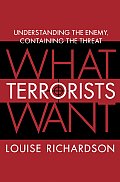 Louise Richardson's book, What Terrorists Want: Understanding the
Enemy, Containing the Threat (2006, Random House, 312 pp.) provides
an uncommon amount of common sense as well as comprehensive research
on terrorism and Bush's misbegotten war. She grew up in an Irish
community disposed to support the IRA, before breaking away into
academia, where she became an expert at comparing and generalizing
from the entire range of terrorist movements. I've collected a lot
of quotes from this book, which follow. In a future post I'll try
to develop my own views. So for now, this is mostly background info.
I've tended to pull out conclusions. The book itself has numerous
examples, of which the current Islamist focus of Bush's War is just
one.
Louise Richardson's book, What Terrorists Want: Understanding the
Enemy, Containing the Threat (2006, Random House, 312 pp.) provides
an uncommon amount of common sense as well as comprehensive research
on terrorism and Bush's misbegotten war. She grew up in an Irish
community disposed to support the IRA, before breaking away into
academia, where she became an expert at comparing and generalizing
from the entire range of terrorist movements. I've collected a lot
of quotes from this book, which follow. In a future post I'll try
to develop my own views. So for now, this is mostly background info.
I've tended to pull out conclusions. The book itself has numerous
examples, of which the current Islamist focus of Bush's War is just
one.
She starts off with a definition (pp. 4-6):
Terrorism simply means deliberately and violently targeting civilians for politican purposes. It has seven crucial characteristics. First, a terrorist act is politically inspired. If not, then it is simply a crime. [ . . . ]
Second, if an act does not involve violence or the threat of violence, it is not terrorism. [ . . . ]
Third, the point of terrorism is not to defeat the enemy but to send a message. Writing of the September 11 attacks, an al-Qaeda spokesman declared, "It rang the bells of restoring Arab and Islamic glory."
Fourth, the act and the victim usually have symbolic significance. Bin Laden referred to the Twin Towers as "icons" of America's "military and economic power." The shock value of the act is enormously enhanced by the symbolism of the target. The whole point is for the psychological impact to be greater than the actual physical act. Terrorism is indeed a weapon of the weak. Terrorist movements are invariably both outmanned and outgunned by their opponents, so they employ such tactics in an effort to gain more attention than any objective assessment of their capabilities would suggest that they warrant.
Fifth -- and this is a controversial point -- terrorism is the act of substate groups, not states. [ . . . ]
A sixth characteristic of terrorism is that the victim of the violence and the audience the terrorists are trying to reach are not the same. Victims are used as a means of altering the behavior of a larger audience, usually a government. Victims are chosen either at random or as representative of some larger group. Individual victims are interchangeable. [ . . . ] This is different from most other forms of political violence, in which security forces or state representatives are targeted in an effort to reduce the strength of an opponent.
The final and most important defining characteristic of terrorism is the deliberate targeting of civilians. This is what sets terrorism apart from other forms of political violence, even the most proximate form, guerrilla warfare. Terrorists have elevated practices that are normally seen as the excesses of warfare to routine practice, striking noncombatants not as an unintended side effect but as deliberate strategy.
Some sort of definition is a necessary starting point, especially if you're trying to develop a comparison set. This one works, although it reflects a subtle bias: it takes the state's view that terrorism is something others do, ignoring the fact that states often do as bad or worse. But it is more limited than most states' charges, which are quick to brand every violent political act against the state as an act of terrorism. Another bias is to exclude non-violent disruptions, such as sabotaging computer networks ("cyberterrorism"). The latter is helpful is that by excluding nonviolent resistance this makes the threshold of interest to be violence itself. The distinction between terrorism and guerrilla warfare matters less, as both are based on violence, on applying force against government power. In point of fact, those distinctions are ultimately so hard to make as to become meaningless. Even the most disciplined military operation results in unplanned, if not unforseeable, violence against noncombatants. Trying to justify such operations takes you over a moral line.
First, a basic rule (p. 40):
The emergence of terrorism requires a lethal cocktail with three ingredients: a disaffected individual, an enabling group, and a legitimizing ideology.
On the frequency of terrorism (pp. 40-41):
There are at least two reasons why it is very difficult to come up with a convincing explanation for terrorism. The first is that there are so many terrorists. The second is that there are so few. Terrorism is a tactic employed by many different groups in many different parts of the world in pursuit of many different objectives. It cocurs in democracies, autocracies, and, most often, transitional states. On the other hand, there are actually very few terrorists. If Islam causes terrorism, with 1.2 billion Muslims in the world and, at most, a few thousand Islamic terrorists, why are there not more? If the social revolutionary movements in Europe in the seventies were caused by the alienation of disaffected youths, why were there not more terrorists? Alienation was widespread among European and American youths, but there were actually very few members of the RAF, Action Directe, the CCC, and the Red Brigades in Germany, France, Belgium, and Italy, respectively.
On the psychology of terrorism (p. 41):
From the vast literature on psychology, three points in particular stand out. Terrorists see the world in Manichean, black-and-white terms; they identify with others; and they desire revenge. They have a highly oversimplified view of the world in which good is pitted against evil and in which their adversaries are to blame for all their woes. They tend to act not out of a desire for personal gratification but on behalf of a group with which they identify (though the two motives can of course coexist). Islamic terrorists, for example, regularly invoke the suffering of Palestinians and other Muslims.
On the question of state sponsors of terrorism (pp. 51-52):
It is often, in fact, a political judgment as to who is or is not a state sponsor of terrorism and who does and does not use terrorism as an instrument of foreign policy. In the 1970s, the USSR and Cuba topped the American public's list of state sponsors of terrorism. In the 1980s, it was Iran and Libya. In the 1990s, Iraq and Syria. Yet if you were to ask people in other countries, even in allied countries, you would find the United States high on most lists, and if you were to ask people in countries hostile to us you would find the United States at the top of their list. The examples invoked in support of the contention that the United States has sponsored terrorism would include the Contras in Nicaragua, the American support for the mujahedin in Afghanistan, and support for local groups trying to overthrow Castro in Cuba and Allende in Chile.
Richardson messes up after this quote with some needless and unuseful equivocations. The key point here is that terror groups are invariably local based, even when they are able to attract material support from foreign states. The states have their own reasons for backing such groups -- usually some form of weakness, including lack of popular domestic support which leads even a strong nation to seek deniability. The reasons why states act in this way are outside the scope of study here, but it is worth noting that one reason terrorist groups exist is that they serve the interests of states acting outside the limits of international law. As such, stronger international law would help curb terrorism.
On the expectations of terrorists (p. 98):
Terrorists often have wildly optimistic expectations of the reactions their action will elicit: American and Israeli withdrawal from the Middle East, British withdrawal from Northern Ireland, the collapse of capitalism. There are several revealing accounts of the first meeting between British politicians and leaders of the IRA in July 1972, including Martin McGuinness and a very young Gerry Adams, who was released from Long Kesh internment camp for the occasion. The British officials were stunned by the expectations of their interlocutors, whom they considered, at best, young hooligans. The IRA representatives insisted upon an immediate declaration from Britain of its intent to withdraw from Northern Ireland and for the withdrawal to be completed by January 1, 1975. [ . . . ] For radical Islamists their faith that Allah is on their side best explains their optimism. In the words of the Taliban leader, Mullah Muhammad Omar, "America is very strong. Even if it were twice as strong or twice that, it could not be strong enough to defeat us. We are confident that no one can harm us if God is with us." This optimism is reinforced by the group members, who create their own reality. The more isolated from their society they become, the more their optimistic fantasies go unchallenged.
Summarizing, Richardson writes, "So long as there is a reaction, therefore, the terrorist purpose is served." She continues (p. 100):
Not reacting is hardly an option for a democratic country with a free press. The actions of the terrorists and the spectacular nature of their attacks are designed to make good television coverage. The media then become tools for terrorists to spread fear. Though it should be said that the media rarely spread sympathy for or understanding of terrorists, they do publicize their actions and thereby serve their purpose. The public are frightened and insist on action to ensure their security. It is part of the power of terrorism that the fear it spreads, due to the random nature of the victims, tends to be out of all proportion to the actual threat posed. In an effort to try to ensure the safety of their citizens and to demonstrate their competence, governments invariably react strongly, and often forcibly. Moreover, if governments do not act, not only do they jeopardize their own political survival, but they run the risk that terrorists will feel compelled to commit ever-larger atrocities in order to elicit a reaction.
Maybe "not reacting is hardly an option," but how you react is the real issue. What feeds the terrorists isn't reaction per se but bad reaction. If political leaders can't resist the demands, often amplified by the media but really rooted in political culture, for revenge, they're letting the terrorists push their buttons. It may be that democracy is particularly susceptible to demagoguery here, but political leaders can be effective arguing both with and against the wind. To take the specific case of Bush on 9/11, he chose a path to war not just because the wind blew that way, but because he saw political opportunities in that direction.
On suicide bombers (pp. 128-129):
In attempting to ascertain what it is that drives an individual to volunteer to be a martyr in the first place, the evidence that, as with terrorism in general, the key motivators are revenge, renown, and reaction is very strong. From Chechens to Tamils to Palestinians to Saudis, from women to men, from young to old, the words of volunteers for suicide are replete with the language of revenge. [ . . . ] Sometimes the desire is to avenge a personal injury, the death or arrest of a relative, and sometimes it is to avenge the ill-treatment of people they do not know but with whom they identify. Often it is to avenge a sense of humiliation. The longer a conflict continues, the more atrocities there are to be avenged.
While the desire for revenge has proven to be a powerful motivator in the human condition generally, in the past it has not sufficed to propel people to commit suicide in large numbers. There are other motivations at play too, and these are the social motivations, the desir eto be loyal to your peers and to be revered in your community. I cannot help getting the sense in seeing some of the final videos, especially the less carefully scripted ones, that the volunteers' desire to be the center of attention is being briefly indulged by the movement's leaders before they are dispatched to war as cannon fodder.
On the fear of WMD attacks by terrorists (p. 165):
In all the discussion of our vulnerabilities to WMDs, there was almost no public discussion of the nature of the threat, no distinctions drawn among chemical, biological, nuclear, and radiological weapons, nor any public discussion of the limitations of these weapons. Rather, government statements have tended to group all forms of weapons of mass destruction together as an apocalyptic means of destroying the country. In fact, as I have pointed out, there are very real differences between the different types of weapons that are linked under the rubric of WMD. Moreover, the lethality of any biological and chemical weapons or dirty bombs likely to be acquired by terrorist groups pales in comparison to that of natural disasters such as Hurricane Katrina. [ . . . ]
The detonation of a nuclear bomb would undoubtedly be devastating and would indeed constitute a turning point in history. But the conflation of this risk with that posed by a hapless Frenchman concocting ricin in his parents' spare bedroom serves only to undermine our ability to formulate coherent and effective counterrterrorist policies.
On America's response to 9/11 (p. 168):
Abroad, the American government conflated the threats it faced and based its policies on the vulnerabilities it felt, rather than the threats it faced. The heinousness of the attack, moreover, blinded the United States to some of the legitimate objections to its policies overseas. One thing that did not change was Americans' confidence in the rectitude of their actions or the unassailability of their moral position.
Domestically, a weak and unpopular president, recently elected with a highly questionable mandate, was transformed into a war leader by a population seeking the security of a strong leader. Believing that the world had changed, we were prepared to accept changes in our longstanding national security doctrine and infrastructure in response. The enormous scale of the atrocity seemed to merit a powerful response, and the United States responded with the most potent weapon in its armory, a declaration of war. But the war was not declared on those who had committed the crime, but rather on the tactic they had used to hurt us. It was a war we could not win.
On the concept of a Global War on Terror (p. 176-177):
The problem with a declaration of war is that warfare conjures up notions of victory and defeat. Yet, as was obvious at the time and as we have begun to realize since, it is very difficult ever to declare victory in a war on terrorism or terror, much less evil. We succeeded in defeating the Taliban in Afghanistan, but that has not brought us victory in the war on terrorism. Indeed, at the time, Americans believed that toppling the Taliban but failing to capture bin Laden and his aides would constitute failure. We have succeeded in severely curtailing the freedom of operation of the al-Qaeda leadership. We have captured many, but by no means all, of its leaders and destroyed its command, communication, and training systems, yet this has not brought us victory in the war on terrorism.
If victory means making the United States invulnerable to terrorist attack, we are never, ever going to be victorious. Here's why casting a conflict in terms of a war one cannot win is a big mistake. By dispatching any operative into any Starbucks, subway station, or shopping mall in the country and blowing it up, a terrorist group could demonstrate that the most powerful country in the history fo the world has not been able to beat it. This is making it much too easy for the terrorists. [ . . . ]
The ultimate goal of any war must be to deny the adversary what it is that he wants. Terrorists want to be considered at war with us, so to concede this to them is to grant them what they want, instead of doing our utmost to deny them what they want.
Terrorists like to be considered soldiers at war both because of the legitimacy they believe it brings their cause and for the status they believe it confers on them. For the United States to declare war on a bunch of radical extremists living under the protection of an impoverished Afghanistan is to elevate their stature in a way that they could not possibly hope to do themselves.
Again (p. 179):
By declaring war yet refusing to be bound by the agreed constraints on warfare and refusing to conduct the war through existing international institutions, the United States alienated its allies and confirmed the worst views of neutrals and adversaries. In 2001, for example, according to a poll conducted by the Pew Research Center, three out of four Indonesians had a positive view of the United States. Two years later, four out of five had a negative view. A BBC poll in summer 2003 revealed that the vast majority of Jordanians and Indonesians considered the United States to be more dangerous than al-Qaeda. A majority in India, Russia, South Korea, and Brazil saw the United States as more dangerous than Iran. The U.S. government believed that the atrocity committed against it was so great that it could not afford to have any constraints on the exercise of its power in response. Ironically, it was precisely the unbridled deployment of that unrivaled power that alienated its allies, turned neutrals against it, swelled the ranks of its adversaries and destroyed its chances of achieving its longterm objective, that is, the containment of the resort to terrorism.
On Bin Laden and Bush (p. 194):
In responding to the attacks of 9/11 with a declaration of war on terror, the United States mirrored the behavior of its adversary. Bin Laden has ignored the rich complexity and nuanced teachings of Islam and superimposed a highly simplified, Manichean view of good and evil: he represents the good servant of Allah; the United States represents the infidel. In response the U.S. government adopted the same black-and-white view of the world, only in its view it represents goodness and he represents evil. Nowhere was this similarity more in evidence than in the unfortunate use of the term "crusade" in describing our war on terror. A few days after the attack, President Bush told reporters that "This crusade, this war on terrorism, is going to take a while." The word might have been dismissed as an unfortunate slip of the tongue had it not been repeated in a set speech tro the troops in Alaska some months later. In that instance, the president said of the Canadians, "They stand with us in this incredibly important crusade to defend freedom."
Again (p. 195):
One of the striking featuers of bin Laden's many statements is the endless litany of grievances against the West. He never takes into account the suffering he has inflicted on others, even of the hundreds of innocent Africans killed and injured in the attacks on the American Embassy in Nairobi in 1998. In our response to bin Laden, it appears that for us, too, only our suffering, only our grievances, matter. In fighting back at al-Qaeda, we inadvertently killed a large number of civilians. By August 2002, the estimated number of Afghan civilian deaths from U.S. bombings was between 3,125 and 3,620; that is, significantly more than the number of civilians killed by al-Qaeda on 9/11. These numbers never became a topic of discussion, much less a cause of concern, in this country. We were so taken with the extent of our own suffering that we didn't consider the suffering we were inflicting on others.
Under "What Is to Be Done?" Richardson offers six rules for counteracting terrorism (pp. 203-233):
- Have a Defensible and Achievable Goal
- Live by Your Principles
- Know Your Enemy
- Separate the Terrorists from Their Communities
- Engage Others in Countering Terrorists with You
- Have Patience and Keep Your Perspective
These are mostly self-explanatory. Somewhere between #2 and #3 there should be a "know thyself" -- which is clearly an American affliction. A couple of quotes from these sections. From Rule 3 (p. 213):
Wars are easier to begin than to end; they tend to last much longer than an objective assessment of the interests of the participants suggest that they should. The same is true of terrorism and counterterrorist campaigns. In some cases one side has overwhelming power and simply wins the conflict, but this is rarely the case. The First World War, for example, ended in 1918 on terms that had essentially been available two years earlier. The Boer War could have ended on the same terms as it eventually did eighteen months earlier. The IRA finally called an end to its campaign seven years after the Good Friday Agreement, and the broad terms of that agreement could have been available many years earlier. There are a variety of reasons for this. The costs of wars are such that participants feel they need to continue fighting to justify the costs already borne. Wars and terrorist campaigns tend to be prolonged by an unlikely alliance of hawks on both sides and generally require an alliance of doves on both sides in order to make peace.
From Rule 4 (p. 216):
Our purpose in alienating the terrorists from their communities is not to win a popularity contest. The reality is that the extent of our wealth and strength will always breed resentment. We do not need to be loved; great powers rarely are. The only threshold we need to reach is that ordinary members of society not be prepared to support those who wish to oppose us by killing our civilians. That is not such a high threshold to achieve. Nevertheless, if by our actions we seem to confirm the view of us held by the terrorists themselves, if our behavior seems more in keeping with their account of our motives than with our own, then we will strengthen our adversaries immeasurably.
Again from Rule 4 (p. 219):
The fact that someone who has committed heinous crimes makes allegations against us does not mean that those allegations are without foundation and should be dismissed out of hand. If our audience is the broader community to which he is appealing, then we need to listen and to respond to the allegations. Nowhere is the gulf between al-Qaeda's argument and ours more in evidence than in the question of the impact of economic sanctions on Iraq. In his statements over the years bin Laden regularly invoked the hundreds of thousands of Iraqi children killed by American sanctions. "A million innocent children are dying as we speak, killed in Iraq without any guilt." Americans simply dismissed these claims as the outrageous rantings of a diabolical fanatic. Economic sanctions, after all, are benign; they are a means of putting pressure on a pariah government without using force. Americans saw our sanctions as evidence of our restraint, and if they caused hardship for Iraqi civilians it was because Saddam Hussein was impeding their implementation in the humanitarian way we had intended.
The fact is that the UN sanctions did cause the deaths of hundreds of thousands of Iraqi children. A UNICEF report issued in 1999 indicated that 500,000 children under the age of five died between 1991 and 1998 in Iraq due largely to the impact of the sanctions. The British medical journal The Lancet reported, "Infant mortality rose from 47 per 1,000 live births during 1984-89 to 108 per 1,000 in 1994-99, and under five mortality rose from 56 to 131 per 1,000 live births." Two successive UN officials in charge of the program resigned to protest the humanitarian catastrophe over which they were presiding.
One reason I quoted this book so extensively is that I was reading a copy from the library, so don't have the book to refer to. There is a section where she argues that a major obstacle to international law regarding terrorism is that too many nations tend to interpret terrorism in the context of their own political agendas. For example, the US likes to make a distinction between "good" terrorists (the anti-Soviet Afghan mujahideen, the anti-Sandinista contras) and "bad" terrorists (e.g., the anti-American Afghan mujahideen). I don't have a quote on that, but she argues that all terrorism, given her definition, is always terrorism. That seems right to me, but it's worth noting that that argument leads to a pacifist position. That's alright with me, too.
But if we take the acts of terrorism as definitive, then we have to provide some accounting for equivalent acts by the state. Such acts are in fact contrary to human rights as commonly defined, so it's not necessary to define them as terrorism in order to condemn them. Moreover, it seems to me that there is a moral equivalence between terrorism and state acts of terror, unless you want to argue that states, by dint of their presumed responsibilities, are even more immoral.
Another point I missed quoting is where she argues that one of the great missed opportunities of the Bush War on Terror was how it failed to consolidate near-universal outrage over the 9/11 attacks into a great strengthening of international law over terrorism. This didn't happen primarily because Bush et al., as rulers of the world's presumed sole hyperpower, intended to settle all scores on its own. That this sounds like something from a Mafia opera isn't coincidental. Bush isn't merely the ruler of a rogue nation; he's the scion of one of the world's great crime families.
Sunday, November 26, 2006
Music: Current count 12602 [12577] rated (+25), 890 [892] unrated (-2). Mostly Recycled Goods this week, with scattered bouts of jazz prospecting just to make sure I don't come up empty. Recycled Goods is currently at 57 records, which is more than enough, but I still want to squeeze the Clash singles in, and I suppose it's now or never for that Johnny Mathis Xmas collection. A couple more days should do it. January's column will be a year-end wrap-up, which as of yet I'm pretty unprepared for.
- African Head Charge: Off the Beaten Track (1986 [2006], Anthology): Based in London, Bongo Iyabinghi Noah's group stripped dub to its echo chamber and mechanistic beats, folding in instruments and chants without adding any complexity; while referring back to the most African music Jamaica has to offer, such roots aren't grounded -- producer Adrian Sherwood done ripped them up. A-
- African Head Charge: In Pursuit of Shashamane Land (1994, On-U Sound/Restless): Similar beats and vamps, but more texture, as if they thought they were expected to develop. B+
- China Shop: 21 Puffs on the Cassette (1979-91 [2006], Anthology): An early postpunk band, frequented CBGB's in the early '80s, released a 4-song EP in 1983, broke up, regrouped, went nowhere much; not negative enough for no wave, not positive enough to leave much of an impression; this collects scraps from eight undated sessions, some prog, some new wave, not bad, but not much. B-
- The Klezmatics: Woody Guthrie's Happy Joyous Hanukkah (2006, JMG): The lyrics, some didactic and some delirious, all date from 1949, when the Okie folksinger made his home in Jewish Brooklyn; the music is new, even happier and more joyous than the lyrics, with a few new instrumentals slipped in, like "(Do the) Latke Flip." B+(*)
- Moondog: Demos (1989 [2006], Anthology): This is ex-Gorilla Biscuits, future Quicksand singer Walter Schreifels, not the eccentric and comparatively famous Louis Hardin, engaged in relatively listenable hardcore thrash; these were unreleased demos, seven songs, not much more than two minutes each, and my advance doesn't match what they're peddling on the website. B-
- My Solid Ground (1971 [2006], Anthology): Early kraut rock -- so early it's not recognizable as such, aside from the fact that the musicians are German, and the instrumental first cut sort of points the way toward Can; with vocals they loosely fit into art rock, metal division. B
- Pärson Sound (1966-68 [2006], Anthology, 2CD): Mostly instrumental, built from thick layers of guitar, cello and sax with hard rock beats punctuating dirgelike repetitive drones -- at its lightest just guitar over bird twitter; mistaken for psychedelia at the time, this owes more to LaMonte Young, parallels the Velvet Underground and Soft Machine, and runs far ahead of hardcore bands like Flipper, but sounds to me most like a jazz fusion road not taken. A-
- Sainte Anthony's Fyre (1971 [2006], Anthology): A rough and fuzzy hard rock power trio from Trenton NJ, packaged at the time as psychedelia because grunge hadn't been conceived. B+(*)
- The Suicide Commandos: The Commandos Commit Suicide Dance Concert ([2006], Anthology): Punk from Minneapolis, which seems to mean polite and well-schooled, down to respectful covers of Chuck Berry and the Animals, as well as crude thrash over unformed hooks. B
- Stoll Vaughan: Love Like a Mule (2006, Shadow Dog): Alt-country singer-songwriter, plays guitar and harmonica like Dylan, and on occasion sings like him. Writes smart songs. I've read nothing about him, so this is well above expectations. B+(***)
- Hank Williams III: Straight to Hell (2006, Bruc, 2CD): "I'm here to put the dick in Dixie/and the cunt back in Country." Can't quote that in F5, so I wrote this instead: He's got his grandpa's pipes and his dad's gonads and he's got more attitude than either. He has big plans for Dixie, and, well, you can guess what part of country he likes -- sure ain't the pop stuff, nor frauds like Kid Rock. Despite all his proud habits and vices, he's managed to live longer than his namesake. Maybe guilt's the worst killer of all? He's safe on that score. Second disc is his rambling redneck revision of Pink Floyd's Atom Heart Mother. A-
Jazz Prospecting (CG #12, Part 2)
Nothing new to report on the still unpublished 11th Jazz Consumer Guide. I still expect the Voice will publish it in early December, but don't have a date, and haven't seen the promised edit. I've mostly been working on December's Recycled Goods column, so not a lot to report below. I'm looking at a few more days of that, then I guess the next thing is to think of year-end lists. At present, my 2006 list has 82 A-records, that is still well short of 2005's 133. No doubt I'm way behind on non-jazz at this point. Some of this I can blame on the Voice's firing of Robert Christgau, whose Consumer Guide has been MIA since July. This will change shortly: Christgau has a deal with MSN Music to publish a bimonthly CG, and the first one will be posted shortly after December 1. I'll have more details later this week, as will Christgau's website once I get an update together.
My January Recycled Goods column will be a year-end review, so sometime in the next four weeks I need to get a much better handle on what I've missed thus far. I'd welcome any lists-in-progress that readers have, and may try to compile them into some kind of metacritic summary. Francis Davis has decided to conduct his own year-end jazz poll which he'll work into his Voice column. That one is due Dec. 13, and will survey 40 NYC-centered critics. I'll post my ballot when I get it together, but looking at my working list, the top ten run from Ornette Coleman to Nik Bärtsch's Ronin or Joe Morris depending on whether Steve Lacy is new or old, with Steven Bernstein and Vandermark 5 just off the cusp.
The other poll I'm likely to contribute to is the Voice's first post-Christgau Pazz & Jop tally. It will be strange this time around.
Pärson Sound (1966-68 [2006], Anthology, 2CD): Well, actually this isn't a CD, let alone two, at all. Anthology Recordings is a label that only sells downloads -- I just happen to have gotten the album on two CDs because the publicist figured (correctly in my case) that some of us would only respond to CDs. I don't like the business model. I've never paid for mere bits, and doubt that I ever will. On the other hand, I mention this here because it is sort-of jazzlike -- mostly instrumental, with saxophones in the lead -- and because it's pretty good. Mostly instrumental, built from thick layers of guitar, cello and sax with hard rock beats punctuating dirgelike repetitive drones -- at its lightest just guitar over bird twitter; mistaken for psychedelia at the time, this owes more to LaMonte Young, parallels the Velvet Underground and Soft Machine, and runs far ahead of hardcore bands like Flipper, but sounds to me most like a jazz fusion road not taken. (Looks like it's still in print in Sweden on Subliminal Sounds. More on Anthology in the next Recycled Goods, due early December.) A-
Bill Anschell: More to the Ear Than Meets the Eye Seattle-based pianist, worked with Nnenna Freelon for several years, has several albums under his own name, dating back to 1994. This one, a mix of five standards and six originals, is built around two trios, with sax or trumpet added on half. Elegant postbop, flowing piano, horns a mixed blessing. B+(*)
Liam Sillery With the David Sills Quartet: On the Fly (2005 [2006], OA2): Sills is a mainstream tenor saxophonist, who did an album earlier this year that I rather liked (Down the Line). His quartet includes organ and guitar, so it takes off from soul jazz mainstream. Sillery plays trumpet and flugelhorn. Sax-trumpet quintets normally spell hard bop, but the bottom is weak here, and the top is rather flighty, the horns harmonizing more than dicing. The result is a sort of elegant postbop I find almost totally uninteresting. B-
Phil Kelly & the SW Santa Ana Winds: My Museum (2006, Origin): Los Angeles-based big band, including a bank of strings and some featured soloists of note -- Wayne Begeron, Pete Christlieb, Bill Cunliffe, Grant Geissman, Jay Thomas are names I recognize. Kelly wrote five of nine pieces and arranged the rest, including "Body & Soul" and "Daydream." Kelly has also worked with a Seattle-based group called the Northwest Prevailing Winds. Nicely done, with some inspired moments, but sometimes I wonder why anyone puts so much effort into projects of such limited potential. B
JC and the Jazz Hoppers: Chillin' at Home (2004 [2006], Jazz-Hop): JC is Jason Campbell, guitarist. The Jazz Hoppers are Colin Nolan and Andrew Dickeson, who play organ and drums, respectively. Don't know anything about Campbell -- his website has Flash but no substance -- but the record was recorded in Australia, which isn't what you'd call an international jazz destination. So, guitar-organ-drums: been done. Chillin'? That too. Sounds like Grant Green? Sort of, but if that's the point, not enough. B-
Mike Marshall/Hamilton de Holanda: New Worlds/Novas Palavras (2005 [2006], Adventure Music, CD+DVD): Mandolins aren't exactly choice dueling instruments, but the point here is more likely to see what can come together than how American and Brazilian mandolinists stack up. The match isn't exactly equal: de Holanda plays 10-string bandolim and Irish bouzouki, both close matches to Marshall's mandolin. Marshall also drops down a bit with mandocello and tenor guitar. This struck me as the label owner's indulgence at first, but it works better than expected. Sounds to my ears somewhat like one of those plucky mediaeval dance things, but more tightly wound -- a plus. DVD has three songs: that's the owner's indulgence, but he wants you to see how happy he is. B+(*)
The Microscopic Septet: Seven Men in Neckties: History of the Micros Volume One (1982-90 [2006], Cuneiform, 2CD): Breakdown here is four saxes, piano, bass (or tuba), drums. Soprano saxophonist Phillip Johnston, most recently heard from in the Captain Beefheart tribute band Fast 'N' Bulbous (also on Cuneiform), is the evident leader, although pianist Joel Forrester writes nearly as much. Dave Sewelson (baritone sax), David Hofstra (bass, tuba), and Richard Dworkin (drums) were constants, with the alto and tenor sax chairs revolving over ten years and four albums. This collects their first two albums: Take the Z Train (1983) and the live Let's Flip (1985), with a few extra tracks thrown in, including a brief take of Forrester's theme for NPR's Fresh Air. Hard to know what to make of this: it's basically swing done by NYC's downtown fringe without any obviously ironic affectations -- sort of the premillennial version of Steven Bernstein's Millennial Territory Orchestra. Live record gets dicier. They can approach the marvelous at times, but don't make a habit of it. [B+(**)]
The Microscopic Septet: Surrealistic Swing: History of the Micros Volume Two (1981-90 [2006], Cuneiform, 2CD): Two more albums -- Off Beat Glory (1986) and Beauty Based on Science (The Visit) (1988) -- and they're done, with a couple of cuts from an early session with John Zorn and John Hagen and more "Fresh Air Theme" stretching the dates. Offhand, I'd say the 1986 album slips a notch, but the 1988 one makes up the lost ground. Thought I heard an attractive tango on the latter, but the title claims it's a waltz. Oh, well. [B+(**)]
Frank Wright: Unity (1974 [2006], ESP-Disk): Wright's a tenor saxophonist from Albert Ayler's generation -- he had a year on Ayler, two on Archie Shepp, five on Pharoah Sanders. He started in r&b bands before leaping to the avant fringe. Didn't record much -- a couple of mid-'60s albums on ESP, a 1970 Free America album, a bit with Cecil Taylor in the '80s. One I like a lot is Last Set, a live set from 1984 under Raphe Malik's name that just appeared a couple of years ago. This seems to be another live discovery: a quartet from the Moers Festival with Bobby Few on piano, Alan Silva on bass, and a drummer I don't recognize named Muhammad Ali. Two pieces -- one 27:28, the other 29:00 -- with the usual solo shots, but Wright is a power house, Few and Silva have strong moments, and they all hit a groove at end end that really rocks the house. [B+(***)]
Cheryl Bentyne: The Book of Love (2006, Telarc): She's enough of a pro that she delivers a perfectly good rendition of perfectly good songs -- a "You Don't Know Me," a "Cry Me a River," anything by Cole Porter. But she's not great enough to get anything out of a song that isn't already there, and the musicians aren't any help at all -- least of all the City of Prague Symphony Orchestra Strings, who might as well serenade Brezhnev. And the title cut gets turned to ethereal fluff by Take 6. Twice. Concepts aren't a strong suit either. C-
And these are final grades/notes on records I put back for further listening the first time around.
Bridge 61: Journal (2005 [2006], Atavistic): You know about Ken Vandermark, Nate McBride, and Tim Daisy by now. The fourth wheel here is Jason Stein on bass clarinet -- Vandermark plays tenor sax, baritone sax, and clarinet. He was born 1976, grew up on Long Island, bounced around through Central America and Montana and Vermont and Michigan and wound up in Chicago. I'm not so sure what he's doing here. This is advertised as an evenly balanced cooperative, but the distribution of compositions is: Vandermark 4, McBride 2, Daisy 2, Stein 0. I don't hear much that sounds like bass clarinet either -- a couple of muffled solos, a fair amount of comping. As for the others, Daisy and McBride continue to develop, and Vandermark closes with a very strong piece for Sonny Sharrock. B+(*)
Sound in Action Trio: Gate (2003 [2006], Atavistic): Two drummers: Robert Barry, from Sun Ra Arkestra, and Tim Daisy, from Triage and numerous Ken Vandermark projects, including the flagship 5. One horn, Vandermark, constantly on the spot. Half originals, all dedicated to drummers; half modern jazz pieces, with Dolphy offering a clarinet feature, and Coltrane setting up some extraordinary tenor sax. A-
Mike Holober: Wish List (2004-05 [2006], Sons of Sound): I don't get the sense that Holober is an exceptional pianist, but I have noticed that he often shows up in good places, and that he is one of the main factors in that success. That may mean he's a better follower than leader. That this record makes such a soft impression may be that his lead players never take charge. Tim Rees adds little more than color with his saxophones; Wolfgang Muthspiel is even more evanescent on guitar. B
Friday, November 24, 2006
F5 Record Report (#17: November 23, 2006)
Probably due to the Thanksgiving holiday, this week's F5 Record Report hasn't been posted yet. The usual link will probably work sooner or later. Meanwhile, you can find my draft here. This one was another rush job, in this case occasioned by an early deadline, so I rumaged through the recyclings. The lineup is:
- Serge Chaloff: Boston Blow-Up! (1955, Capitol Jazz) A- [jazz]
- Buddy Holly: The Definitive Collection (1956-58, Geffen/Chronicles) A [rock]
- Waylon Jennings: Nashville Rebel (1958-95, RCA Nashville/Legacy, 4CD) A- [country]
- Jerry Lee Lewis: The Definitive Collection (1957-81, Hip-O/Chronicles) A- [rock, country]
- Fats Waller: If You Got to Ask, You Ain't Got It (1926-43, Bluebird/Legacy, 3CD) A [jazz]
- Muddy Waters: The Definitive Collection (1948-76, Geffen/Chronicles) A [blues]
Figured we might as well kick off the shopping season with some good records. Two more anomalies are: only six records, which is the bottom end of my 6-8 target range, and only three labels, all majors.
Turned another column in, this one with some new stuff. Should have posted this on Friday at the usual time, since I have no more to report now. But I've been laid low by the holiday weekend as well -- fixed salmon teriyaki and various Japanese-themed dishes Thursday, and more to round out the leftovers on Friday, but that was about all the energy I could muster.
Letter to publicists:
This week's F5 Record Report presumably has a record of interest to
you. F5 is a weekly entertainment tabloid distributed free here in
Wichita KS. I cover 6-8 records per week, sometimes recycling from
other columns. The following URL will get you the latest column,
and the "next article" links will cycle you back in time.

  http://www.f5wichita.com/mba.php?id=55

For more info, see:

  http://tomhull.com/ocston/music.php

The index by label:

  EMI (Blue Note): Serge Chaloff
  Sony/BMG (Legacy): Waylon Jennings, Fats Waller
  Universal: Buddy Holly, Jerry Lee Lewis, Muddy Waters

Thanks for your interest and support.
Thursday, November 23, 2006
An End to Hunger
Saw this in the Wichita Eagle today, from Elizabeth Williamson of the Washington Post:
It's Thanksgiving, a week sine the U.S. Department of Agriculture released its annual hunger -- er, food security -- report, and it's likely that a few folks in the department are ready for a holiday break.
For the first time, the USDA's annual report on Americans' access to food omitted the word "hunger" in describing the condition of 11 million people who at times can't afford to feed themselves. These people, among a group of 35 million who had trouble keeping food on the table at least part of last year, shall heretofore, according to the government, be described as experiencing "very low food security."
This is a relatively trivial example, but reminds us that for the Bush administration, all problems are PR problems, and the only thing it ever takes to fix them is better PR.
On the other hand, I'm not sure that hunger is the right term. Everyone gets hungry, but most of us have little or no trouble finding some kind of food. What we're talking about is persistent hunger, but is the sensation there still hunger? Or is it more like malnutrition? Hunger is a message from your stomach saying fill me up. That's very straightforward, whereas malnutrition doesn't have such an unambiguous signal: your body feels weak, deprived, damaged, but it's harder to tell why or how. That's probably the real problem, but it's a more complicated one: a combination of "low food security," miseducation, possibly a shortfall of motivation, and inadequate health care. Reducing all that down to "hunger" causes a disconnect with most Americans, who are more likely to have a problem with too much food than with too little. And who, if they're at all fortunate, take the rest of the equation for granted.
On the other hand, there's no reason to doubt that the PR solution is politically motivated. That's the Bush solution to everything.
Tuesday, November 21, 2006
Late Movies
The Wichita Eagle has a little feature every Tuesday listing select new DVD releases. Seems a strange sense of priorities that they don't do anything similar for CD releases, but never mind. The thing that struck me today was that two of the movies I've seen but haven't gotten around to noting here are now out on DVD. I don't see a lot of movies, but I haven't written anything in this slot since July 21. So at least I need to stub this, even if I don't have much to say.
Movie: An Inconvenient Truth. In the end, Al Gore reminded me why I like him so little, but also impressed me with an earnestness lacking in other patrician politicians we can name -- more so in reference to the world than in terms of his own ego. The images are particularly striking. The science seems sound, and the facts accumulate. I have a friend who saw this and started making plans to leave the country. Evidently, he's not betting that we'll take Gore's remedies to heart. Or that they'll work. A-
Movie: The Devil Wore Prada. More entertaining than it has any right to be. B+
Movie: Scoop. Back to funny movies, even if Allen's not done with Britain's tiresome upper crust. A-
Movie: Little Miss Sunshine. Spent too much of the movie wanting it to move differently. In retrospect, all those missteps seems to work out anyway. A-
Movie: The Illusionist. Makes me think we could do with more movies about the Austro-Hungarian Empire, and fewer about magicians. B
Movie: The Black Dahlia. Not just overdetermined; downright overresolved. Thought the two female leads were miscast, but the boxer-cops did well enough. B
Movie: The Departed. Another case where the plot was problematic -- especially the extreme body count at the end. But near great, especially Leonardo DiCaprio, who had the toughest role. A-
Movie: Half Nelson. The big problem with drugs is watching other people on them, especially in movies. Couldn't much relate to the dialectics nonsense either, but there is a payoff in the end. B+
Movie: Infamous. The box office loser of the Capote sweepstakes -- gayer and weirder, but slightly off. The New York social trivia is more fun than Capote, perhaps because it plays up the artifice; but that approach is rough on Kansas, especially given the harsh light and rough surfaces given the killers. Sandra Bullock is fine, but Catherine Keener is a natural; Toby Miller matches Capotes physically, but Hoffman gets the anguish right. So acting wins out. B+
Movie: Catch a Fire. After the Americans in Iraq, the biggest surprise is how good South Africa's intelligence was on this case. Not so surprising is that it didn't matter. B+
Movie: Marie Antoinette. The ahistorical music and attitude was expected, but the most striking thing was how the set overwhelmed the story. It's like the rare opportunity to shoot in Versailles demanded such deferential treatment. B
Movie: The Queen. This makes two Elizabeths for Helen Mirren, neither worthy of Prime Suspect. B+
News of Robert Altman's death today. His A Prairie Home Companion is still my top movie this year.
Sunday, November 19, 2006
Music: Current count 12577 [12557] rated (+20), 892 [889] unrated (+1). Still decompressing, but I had a number of box sets awaiting my attention, so I figured this would be a good week. It used to be that when I would write something for Recycled Goods I would just copy it here, but I've been getting sloppy about doing that. Jazz prospecting has resumed. Recycled Goods is in pretty good shape for December, but I need to get to those Anthology download specials for my "in series." Haven't given much thought to year-end yet. Got mostly caught up with my cataloguing, but not quite. Seems like mail has been sparse, but I'm still having trouble keeping up.
- The Byrds: There Is a Season (1964-90 [2006], Columbia/Legacy, 4CD+DVD): After demos as the Jet Set and the Beefeaters, they did a makeover as America's answer to the Beatles, all the way down to the clever misspelling. For songs, producer Terry Melcher tapped Bob Dylan and Pete Seeger, inadvertently inventing folk-rock. The group gradually became self-sufficient, tracking the Beatles through sitars and psychedelia, improbably knocking out a dozen or so indelible hits. When David Crosby left to launch his supergroup, Roger McGuinn hired Gram Parsons and came out way ahead, getting credit for inventing country-rock too. When Parsons left for the Flying Burrito Brothers, McGuinn trudged on, leaving a couple more instances of inspired schlock. They were done by 1973, aside from a brief 1990 reunion to pad out a 4-CD box set -- one track here, once again hauling water for Dylan. This second generation box adds more than it loses, but nothing essential either way. The best you can say is that it works better as a general history, even if most of what you learn is how dull they were live -- a short DVD of their early TV spots show you where shoegazing came from. B+(*)
- Buddy Guy: Can't Quit the Blues (1957-2005 [2006], Silvertone/Legacy, 3CD): He moved up to Chicago from Louisiana in 1957, a young man with a guitar, but a latecomer to the scene. It took him a while to click -- there's nothing all that original in what he does, but blues is an old man's game, and he got stronger as the competition died off. This dispatches 25 years with one disc, limiting frequent partner Junior Wells to five cuts, then fills up two more with recent stuff starting from 1991. That doesn't make this a very well balanced career retrospective, but it never stops for such niceties. Individually, his Silvertone albums seem like more and more of the same old, same old, but packed together they deliver quite a punch. A-
- Roy Orbison: Lonely and Blue (1960 [2006], Monument/Legacy): Unusual for a major label to reissue albums for singles artists from the pre-Beatles era. LPs were strictly hits plus filler. The hits here were: "Only the Lonely," "Blue Angel," and "I'm Hurtin'"; the filler includes two Don Gibson songs, a lot of icky strings and slinky percussion; the bonus tracks include one called "Pretty One" which points clearly to the great one to follow. B
- Chris Smither: Leave the Light On (Signature Sounds): The veteran folksinger's got it all figured out: "Charlie Darwin looked so far into the way things are/He caught a glimpse of God's unfolding plan/God said 'I'll make some DNA, they'll use it any way they want/From paramecium right up to man/They'll have sex, and mix up sections of their code; they'll have mutations/The whole thing works like clockwork over time/I'll just sit back in the shade while everyone gets laid/That's what I call intelligent design." B+(***)
Jazz Prospecting (CG #12, Part 1)
Don't have a schedule yet for when the Village Voice will publish my 11th Jazz Consumer Guide -- understand the editor there is busy through Thanksgiving, but will get back to me with an edit. Early December seems likely. Meanwhile, we'll start prospecting for #12, even though I'm still decompressing. Spent most of last week on a pile of box sets, mostly from Sony/BMG. The Buddy Guy and Waylon Jennings are low A-. I'm not a big fan of either, but they gain through accumulation.
John Bunch: At the Nola Penthouse: Salutes Jimmy Van Heusen (2006, Arbors): The label likes to do these double titles. I'm following the spine, except for adding a colon. Doesn't read right to me, but don't know what else to do. The subject for both clauses is pianist Bunch, who will turn 85 later this year. He's been a dependable name for a long time now. Follows in Teddy Wilson's footsteps, and doesn't wander far from there. Dave Green and Steve Brown complete the trio, neither making much of an impression. Nor does Bunch, really -- this is quiet and respectful, lovely when you focus, but a bit too modest to listen to. B
George Colligan Trio: Blood Pressure (2006, Ultimatum): Trio suggests a group with a fixed lineup, which isn't the case here. Josh Ginsberg is replaced or joined on bass by Boris Kozlov. Jonathan Blake yields the drumset to EJ Strickland and Vanderlai Pereira. Two more cuts have extras: Jamie Baum's flute on one, Meg Okura's violin on the other. Colligan plays synths as well as piano, so there are various electronic blips as well as the usual soft tones. I find it all very confusing, although the straight acoustic piano trio is superb, as usual, and the other stuff is interesting. One thing that is clear is the message to "Mr. Cheney" in the tray photo. B+(*)
Sonny Stitt: Stitt's Bits: The Bebop Recordings, 1949-1952 ([2006], Prestige, 3CD): Stitt always claimed that he developed his style independently of Charlie Parker, sort of like Alfred Russel Wallace's discovery of Charles Darwin's theory of natural selection. But Parker was four years older, got his records out first, and established his case more persuasively. Stitt's early records on Prestige came out when bebop was in full swing -- indeed, Jay Jay Johnson headlined the first set here, and Bud Powell co-led the second. And as he moved from tenor sax to alto, he almost begged comparison to Bird. More than anything else, Stitt was a working musician -- a guy who cranked out hundreds of albums, often on the flimsiest of premises. Most of the sessions here were jousts with Gene Ammons, and the best are when they're both flying high. But including everything drags their faint r&b vocal sides in. B+(**)
Weather Report: Forecast: Tomorrow (1969-85 [2006], Columbia/Legacy, 3CD+DVD): The jazz-rock fusion of the early '70s was less a movement than a family franchise. It started with Miles Davis, then spread with his departing employees: most importantly, John McLaughlin, Herbie Hancock, Chick Corea, and this Wayne Shorter-Joe Zawinul joint venture. Hardly anyone without a connection to Davis mattered, but the preponderance of keyboards set the music adrift -- the rhythms and textures thickening, the atmosphere clouding up. At least that's what I always thought, but this box had me wondering for a while. The first disc gets a running start by including three pre-group cuts, starting with the Davis take of Zawinul's "In a Silent Way." Then it leans heavily on the first album and live cuts where the jazz whiskers come out. But it gets spottier as they go on, especially when Shorter tries to fit in rather than stand out. The DVD offers a 1978 concert at the band's popular peak with Jaco Pastorius and Peter Erskine going shirtless in what must be a Cheap Trick homage. B+(**)
Janice Borla: From Every Angle (2006, Blujazz): Jazz singer from Chicago. Her website lists three albums over the last ten years, but also mentions a first album (Whatever We Imagine) that dates back at least 20, as does her "leading role in vocal jazz education." She's not a cabaret singer -- the songs here come from the bop era with assists from Jon Hendricks and Bobby McFerrin. She can scat. She gets respectful, tasteful backup. In fact, this is expert enough that I feel kind of bad that I don't respond to it more. Professionalism doesn't come easy. Nor does reviewing it. B
Dominique Eade/Jed Wilson: Open (2004-05 [2006], Jazz Project): Jazz singer, teamed here in minimal duets with pianist Wilson. She has a USAF father, Swiss mother, born London, grew up mostly in Germany; attended Vassar, Berklee, New England Conservatory, the latter keeping her on to teach. Five albums, including a tribute to June Christy and Chris Connor. Writes most of the songs here, although Leonard Cohen's "In My Secret Life" is the one that stands out. Way too spartan for my taste, but striking nonetheless. B+(*)
Diane Delin: Offerings for a Peaceable Season (2005 [2006], Blujazz): Violinist with five albums going back to 1997. Don't know anything more, but clearly she's fond of Grappelli. Starts off with "My Favorite Things" and "Baby It's Cold Outside" before toppling into unavoidable Xmas songs, recasting the meaning of those not normally so tainted. By the end of the year this rant is likely to get old, but I have no interest whatsoever in holiday music. Didn't even like it before I read the factoid that it outsells jazz. This one snuck in on the peace train, so I'll let it off with a mild reprimand. The others I'm saving for a real bah humbug day. B-
Muhal Richard Abrams/George Lewis/Roscoe Mitchell: Streaming (2005 [2006], Pi): These guys look serious in the booklet photos -- only Abrams manages to crack a smile, and then only when he isn't working. Lewis plays enough trombone to remind you how much you wish he'd play more, but his main instrument these days is laptop -- presumably the source of the hums and buzzes, not to mention the birdsong effects. Mitchell is probably responsible for most of the percussion, even though his first credits are soprano and alto sax. Still, Abrams is the center here, the reason for this universe's existence. This reminds me of his early work. The toys are different, but the creative impulse is the same. [B+(***)]
Sonic Liberation Front: Change Over Time (2006, High Two): This follows the same lines, and has many of the same wonders, as the their two previous albums, including my fave from 2004, Ashé a Go-Go. But it hasn't quite kicked in yet -- not sure what it is, but I don't get the same rise from the sax, and the vocal pieces don't take on unexpected lives. That leaves the bata drums, which may still be the point. [B+(***)]
And these are final grades/notes on records I put back for further listening the first time around.
Al Di Meola: Consequence of Chaos (2006, Telarc): Fusion guitarist from New Jersey. Made his reputation in Chick Corea's Return to Forever, with Corea returning the favor here. Some of this is pleasantly grooveful. Some is sparely elegant. Some of it is Corea-style fusion. B
Saborit: Que Linda Es Mi Cuba (2006, Tumi Music): I suppose it's pure coincidence that the guitars in this East Cuban group remind me of nothing so much as Guitar Paradise of East Africa. Cuba's Oriente is typically less Afro and more Spanish than the urban jungle of Havana, but for country music this builds on pretty complex riddims. Modestly named for guaracha legend Eduardo Saborit, they've played together for twenty-plus years before piling onto a tractor and heading cross-country for their first studio date. That may make them hicks, but they were right to take the chance. A-
Stanton Moore: III (2006, Telarc): Not sure what you'd call Moore's strain of jazz-funk fusion. It shares some ground with MM&W, looking back to soul jazz organ (Robert Walter is the guy here), guitar (Will Bernard), and sax (Skerik). Garage A Trois's Outre Mer, which Moore had a big hand in, is my favorite example -- it just seems to click together right. This is spottier, especially on the more straightforward funk toons. Two slower pieces toward the end -- Abdullah Ibrahim's "Water From an Ancient Well" and trad.'s "I Shall Not Be Moved" -- are exceptional, curiously sandwiched around a Led Zep blues, "When the Levee Breaks." B+(*)
Towers of Hanoi
Not being a news junkie, and not being able to stomach more than a few nanoseconds of the Bush administration bigwigs at a time, I've only picked up fragmentary reports on the Dauphin's visit to Vietnam. (Sorry, just saw Marie Antoinette and The Queen this weekend, so the stunted progeny of royalty are fresh on my mind.) I've been looking for a coherent summary, but haven't found one yet. (Seems like this one's right up Tom Engelhardt's alley.) Part of the reason has got to be that the whole thing is strange beyond belief -- even before Condoleezza Rice went on record urging the Iraqis to follow Vietnam's example. One thing we know, even if it seems incredible, is that neocon America has memories of Vietnam so bizarre you have to wonder if they've been implanted in some supersecret CIA program. Bush clings to the notion that the only reason the US lost in Vietnam was that we quit the fight -- an analogy he likes to make to Iraq, even though the corrolary is that if we hadn't quit we'd still be fighting in Vietnam. That such distortions persist in the neocon mind is a big part of the reason they marched so blindly into Iraq. But after several years of trying to deny similarities between Iraq and Vietnam, it's especially disturbing that now they find hope in that analogy.
Still, this leaves open the question of why they went to Vietnam in the first place. The only idea I can come up with is that someone figured it might be useful to show Bush that surrendering might not turn out so bad in the long run. But clearly the point is lost on him. One report is that he toured a memorial to victims of the US bombing of Hanoi, and responded that it was one-sided. Well, of course, there are two sides: those who are bombed rarely look at it the same way as those who drop the bombs. On the other hand, it's a bit like complaining that the future 9/11 memorial doesn't have a wing explaining Bin Laden's side of the story.
Friday, November 17, 2006
Self-Hating Jews
War in Context quotes Shmuel Rosner of Haaretz:
United States President George Bush was informed on Tuesday of an initiative to establish a center under his name in Israel, as a sign of gratitude for his support for the country and its security.
Outgoing Israeli Ambassador to the U.S. Daniel Ayalon asked Bush for the go-ahead to establish such a center during a farewell meeting with the president and his deputy, Dick Cheney.
Bush told Ayalon that "freedom" would be a worthy subject for the center to focus on.
We're already seeing signs of the bloodletting to come on the far fringes of the US right as they seek to distance themselves from Bush. Before building a monument to the man, it might be a good idea to see how far he's likely to sink. Israelis are usually much shrewder at reading American public opinion -- especially given that American Jews voted against Bush's party in 2006 by a 6-to-1 margin.
Moreover, it's far from clear that Bush's obeisance to Israel's diehard hawks will be regarded as much of a favor in the long term. Even in the short term, it's not like Bush's support gave them much comfort in Lebanon, or that either is likely to get much satisfaction from their sabre rattling over Iran. More than ever I'm struck by how far some Israelis have turned their backs on decency. They show us who the real self-haters are.
F5 Record Report (#16: November 16, 2006)
This week's F5 Record Report made it to the website. Find it with the usual link. Only cribbed one review from a previous column this time. Thought I needed some jazz, which I'm on some sort of break from, and I thought WSQ could use another plug. The lineup is:
- Archie Bronson Outfit: Derdang Derdang (Domino) B [rock]
- Kimya Dawson: Remember That I Love You (K) B+ [folk]
- The Handsome Family: Last Days of Wonder (Carrot Top) A- [rock]
- Hazmat Modine: Bahamut (Barbès): A- [world]
- Andy Fairweather Low: Sweet Soulful Music (Proper) B+ [rock]
- Spady: The Long Way Around and Other Short Stories (Post Script) B [country]
- World Saxophone Quartet: Political Blues (Justin Time): A [jazz]
Next week's column had to be handed in early for Thanksgiving. I've been playing box sets this week -- unproductive in terms of pumping up my rated count, but I try to deal with what I get, and Legacy's been pretty generous lately. Figured I finally had the time, then got caught short, so next week's F5 column is all oldies, all A- or above. As anyone who's studied statistics knows, it only evens out in the end, more or less.
Letter to publicists:
This week's F5 Record Report presumably has a record of interest to
you. F5 is a weekly entertainment tabloid distributed free here in
Wichita KS. I cover 6-8 records per week, sometimes recycling from
other columns. The following URL will get you the latest column,
and the "next article" links will cycle you back in time.

  http://www.f5wichita.com/mba.php?id=55

For more info, see:

  http://tomhull.com/ocston/music.php

The index by label:

  Barbes: Hazmat Modine
  Carrot Top: The Handsome Family
  Domino: Archie Bronson Outfit
  Justin Time: World Saxophone Quartet
  K: Kimya Dawson
  Post Script: Spady
  Proper: Andy Fairweather Low

Thanks for your interest and support.
Thursday, November 16, 2006
What Terrorists Want
In my post-9/11 reading, I've skipped past virtually every one of the dozens of books on terrorists and counterterrorism -- partial exceptions are Michael Scheuer's Hubris and Ron Suskind's The One Percent Doctrine, both about the CIA operations and views, and Gilles Kepel's books on political Islam, Jihad: The Trail of Political Islam and The War for Muslim Minds: Islam and the West. The books I picked provide the broader context in which the War on Terrorism occurs. The terrorists themselves don't much interest me, and further abstraction of the concept strikes me as wrong-headed.
On the other hand, Louise Richardson's What Terrorists Want: Understanding the Enemy, Containing the Threat strikes me as an exceptionally level-headed comparative survey and analysis of the subject. I've only glanced through it, but Max Rodenbeck has a review at New York Review of Books which summarizes the book rather rigorously. Rodenbeck reduces her book to a dozen points. I'm going to reduce them even further here (bold quotes from Rodenbeck; mostly there were followed with historical examples):
Terrorism is anything but new.
Terrorism is obviously a threat, and the deliberate killing of innocent civilians an outrage, but it is not a very big threat.
The danger from terrorist use of so-called weapons of mass destruction is not as large as scaremongers profess.
Many terrorists are not madmen. The choice to use terror can be quite rational and calculated.
Groups that commit terrorism, in many cases, believe they are acting defensively, using the most effective means at their disposal.
Suicide attacks can also represent a rational policy choice. They are cheap. They can be a means of access to difficult targets. They are effective in frightening people, and in advertising the seriousness and devotion of those who undertake them.
There is no special link between Islam and terrorism. Most major religions have produced some form of terrorism, and many terrorist groups have professed atheism.
Electoral democracy does not prevent terrorism, which has flourished in many democracies, typically being used by groups representing minorities who believe the logic of majority rule excludes them.
Democratic principles are no impediment to prosecuting terrorists.
Military action is sometimes necessary to combat terrorism, but it is often not the best way to do so.
Armies, in fact, often create more problems than they solve.
To address the issues terrorists say they are fighting for cannot automatically be dismissed as appeasement.
Richardson draws on examples as far back as the Jewish Zealots who opposed the Roman Empire and draws from a wide range of examples, including the Irish IRA she grew up with and was attracted to. As far as I know, She doesn't discuss much the causes claimed by the various groups who resort to terror, which leads her to generalize. However, her discussion of counterterrorists focuses sharply on the Bush administration's response to 9/11. Rodenbeck writes:
Because terrorists tend to be aspirational rather than practical, their practices typically amount to what Ms. Richardson calls a search for the three R's of terrorism: revenge, renown, and reaction. As she puts it, "the point of terrorism is not to defeat the enemy but to send a message." This simple insight is important, because it suggests ways of dealing with terrorism: you must blunt the impulse for revenge, try to limit the terrorists' renown, and refrain from reacting in ways that either broaden the terrorists' appeal or encourage further terrorism by showing how effective their tactics are.
Richardson's three R's go a long way toward explaining why American policy has become so disastrously askew. As she notes, an act such as September 11 itself achieves the first of her three R's, revenge. So spectacularly destructive an attack also gains much of the second objective, renown. But the Bush administration's massive and misdirected overreaction has handed al-Qaeda a far greater reward than it ever dreamed of winning.
"The declaration of a global war on terrorism," says Richardson bluntly, "has been a terrible mistake and is doomed to failure." In declaring such a war, she says, the Bush administration chose to mirror its adversary:
Americans opted to accept al-Qaeda's language of cosmic warfare at face value and respond accordingly, rather than respond to al-Qaeda based on an objective assessment of its resources and capabilities.
In essence, America's actions radically upgraded Osama bin Laden's organization from a ragtag network of plotters to a great enemy worthy of a superpower's undivided attention. Even as it successfully shattered the group's core through the invasion of Afghanistan, America empowered al-Qaeda politically by its loud triumphalism, whose very excess encouraged others to try the same terror tactics.
Worse yet, as the National Security Strategy documents clearly show, the Bush administration willfully blended al-Qaeda into a peculiar amalgam including other, far less urgent threats to concoct a perceived global enemy.
The latter was a preconceived program: America's militarists have been searching for a global enemy ever since the Soviet Union's collapse deprived them of their Cold War raison d'être. But they miscalculated severely in deciding to lash out at an abstract noun. The US military wasn't built or oriented for such conflicts, and the political leaders were deaf to how their bombing, invasions, and occupation would play out. Both White House and Pentagon conceived the War on Terrorism in familiar terms, as wars they could fight with the tools they favored. The only thing surprising about their missing the target is how many more targets popped up. But then they missed them too.
Started reading Richardson's book. I'll have more to say on it in due course. One thing that strikes me is that she is rigorous in her definitions, and unwilling to let any non-state terrorism slip by under any other name. She doesn't take a pacifist position, but her stance is compatible with one. As for the states, that should be the subject for another book. She does point out that "state sponsors of terrorism" -- states that back foreign groups that practice terror -- don't create terrorist groups, even though they facilitate them. As for states that directly employ terror in the course of war, it is fair to say that the psychology and motivation is different -- the old adages about "following orders" and "the banality of evil" hold up. It should also be stated that the scale of terror is different too: modern military forces can do things that terrorist groups can only fantasize about. We'll see whether Richardson gets into that at all. She does mention that the trend among terrorists to target random civilians arose alongside world wars where civilians were the primary targets. The obvious conclusion is that if you want to undercut terrorism a first step would be to take away the reference model of interstate warfare.
Wednesday, November 15, 2006
Studying the Course
Now that we're no longer "staying the course" in Iraq, everyone's coming forth to push their favorite new trajectories. On election night, Fox's armchair quarterbacks William Kristol and Juan Williams were calling for more troops and the kind of serious victory campaign that Bush was too wimpy to pursue with an election pending. They did hold out an olive branch to the "victory Democrats" -- the silver lining they saw in an election where so many Americans were cuddling up with terrorists. Senators John McCain and Joe Lieberman have also been pushing for more troops. And then there are the "real men" -- the ones still angling for Tehran.
On the other hand, George McGovern and William Polk have written a book with their "blueprint" for leaving Iraq. I've read the executive summary, and it seems like a reasonable proposal. It's based on two insights: that the US presence in Iraq is the source of a conflict that can only abate after the US exits, and that the US needs to pay reparations and invest in reconstruction in order to stabilize and legitimize an independent Iraqi government. Most of the article is spent itemizing reconstruction budgets, which they calculate in units matching the amount the US spends per day to keep the war running: $246 million. The total bill they come up with is about $17.25 billion -- about ten weeks at the current burn rate.
The weak link in the plan is that the transition from American withdrawal to stabilization is far from certain. They waive this by with a statement that seems basically right but simplistic:
Indeed, after the withdrawal of American troops, as well as British regular troops and mercenary forces, the insurgency, which was aimed at achieving that objective, would almost immediately begin to lose public support. Insurgent gunmen would either put down their weapons or become publicly identified as outlaws.
Of course, it's more complicated than that. When the Americans leave, there will be a power vacuum, and there is no shortage of groups that might aspire to fill it. The extant Iraqi government has limited and tainted legitimacy. They could gain legitimacy by accommodating presently excluded groups, or they could try to keep power by force. In the latter case, the insurgency will continue with a new focus. Nor is the anti-US insurgency the only militia that could challenge the central government, or each other. The reasonable thing to do would be for these forces to concentrate their power locally while sharing in an inclusive central umbrella that would largely exist for divvying up reconstruction funds and oil revenues. But that won't happen if some groups think they have a chance of taking it all. Such hopes could be fostered by support of any foreign government. That indeed is a big part of America's problem in Iraq, but would also be true of Iran, Turkey, Syria, Saudi Arabia, and Israel, and each of those nations has its own preferred reordering of Iraq's fractures.
To some extent, McGovern and Polk brush this aside because they truly respect post-withdrawal Iraq's independence. They recognize that Iraqis will only accept a resolution that they arrive at on their own. That is, after all, what independence means, and what the American presence has made impossible. US withdrawal is the one thing that can be tightly scheduled -- they have it starting by the end of 2006 and complete six months later. Beyond that the plan's recommendations are subject to Iraqi control. For practical purposes, that means they depend on the Iraqis getting their system together. Security and reconstruction aid are resources and incentives. For instance:
To this end, we think that the Iraqi government would be wise to request the temporary services of an international stabilization force to police the country during and immediately after the period of American withdrawal. Such a force should itself have a firm date fixed for its removal. Our estimate is that Iraq would need this force for no more than two years after the American withdrawal is complete. During this period, the force could be slowly but steadily cut back in both personnel and deployment. Its purpose would be limited to activities aimed at enhancing public security.
This attitude of respect for Iraqi independence is what makes the plan practicable. However, it has real political problems. First, it runs against the basic American attitude to foreign aid, which is that if we don't own it, we won't pay for it. That it costs us far more to keep the fighting going is a rational argument. Another is that leaving Iraq as an open sore with a failed government puts the whole region at serious risk. But we didn't pay a dime for wrecking Vietnam, and deep down it's going to be hard for many Americans to swallow having to pay people after they rejected us.
An even bigger political problem is that such a resolution casts doubts on our whole foreign policy in the region -- our unremitting hostility to Iran and Syria, our unquestioning support of the most dangerous factions of Israeli militarism, our holy war against what we've taken to calling Islamofascism. If, say, we do what McGovern and Polk propose, and the result is a stable, rebuilding Iraq that does not export terrorism, that limits its opposition to Israel to diplomacy, and that gets top dollar for its oil, where does that leave the War on Terror? And if the neverending War on Terror dies, where does that leave Bush?
It may be that McGovern and Polk don't much care about those issues, but one thing we can be sure of is that James Baker does think about those things. His Congressionally-mandated bipartisan Iraq Study Group's report is much anticipated, although for now its main utility has been to put off trying to solve the problem. The Iraq Study Group's expertise in Iraq and the Middle East is almost nil, but the one thing they do understand is Washington politics. Just look at the membership: James Baker, Lee Hamilton, Lawrence Eagleburger (replacing Robert Gates), Vernon Jordan, Ed Meese, Sandra Day O'Connor, Leon Panetta, William Perry, Charles Robb, Alan Simpson. There's not a lot of potential conflict here -- the Democrats are the sort who remain loyal opposition even under Bush and Rove. The one curious thing about this group is that I don't see any obvious Israeli lobbyists among them. That doesn't make them any less pro-Israeli than the norm for politicians of their standing. But it does raise a slight glimmer that they may recognize that Israel has become the rotten root of America's problems in the region.
Tony Blair has been in the press lately with his own thinking about regional strategy, and he sees the connection between Iraq and Israel, even if he's not very effective at acting upon it. (The UK abstained from the UNSC resolution against Israel's invasion of Gaza; the US vetoed the resolution.) Meanwhile, Bush has started his own policy review group. As Robin Wright wrote in the Washington Post:
The White House review could give the administration alternatives so that it feels less pressure to fully implement the recommendations of the Iraq Study Group report, foreign policy experts said.
Bush made the decision after his national security team held secret meetings Friday and Saturday to discuss the disparate efforts inside the administration and the implications for Iraq after the Republican defeat in the midterm elections. Further informal meetings were held Monday before yesterday's decision, officials said.
Don't have any names associated with the Bush review. But a lot of Pentagon brass have stepped forward to brag about their recent successes. As I recall, the last time Bush's people studied the question, they came up with research showing that the preferred solution to the problem was "complete victory." I can't imagine how they'll improve on that.
Tuesday, November 14, 2006
The Global Nexus of Terrorism
One thing Bush's "thumpin'" in the elections hasn't done is to settle him down. First we saw a report that Democracy Boy signed an executive order to permit US military training to resume in Latin America. The explanation had something to do with the growing threat of the left down there. Since the left has been winning democratic elections, and the training is meant to help align right-leaning military forces with US interests, the most likely conclusion is that Bush is looking for military coups to do his bidding. That was exactly what happened during the heyday of US training from the '50s well into the '70s, when nearly every nation in the region experienced military rule at one point or another.
Such training had been suspended by Bush in cases where he was trying to badger nations into signing bilateral treaties that would protect US citizens from the International Criminal Court. On the other hand, Bush seems to have no qualms about foreign courts charging his favorite betes noires. From a Reurters report (via warincontext.org):
The White House branded Iran and Hezbollah on Saturday as a "global nexus of terrorism" and applauded an Argentine court for seeking the arrest of former Iranian officials in the 1994 bombing of a Jewish center.
In the Bush administration's latest rhetorical assault on Iran, White House spokesman Tony Snow issued a statement saying the Islamic republic was responsible for the deaths of hundreds of innocent civilians as the world's "leading state sponsor of terrorism." It gave no specifics.
Hundreds? 1994? I don't wish to belittle that, but right now, in the context of Bush in Iraq, that's a rather long and desperate stretch for political points. The histeria over Iran has cranked up again following the elections, with Olmert visiting Washington to make the case, and Netanyahu pushing his favorite analogy (reported by Peter Hirschberg in Haaretz):
Drawing a direct analogy between Iran and Nazi Germany, Likud leader Benjamin Netanyahu asserted Monday that the Iranian nuclear program posed a threat not only to Israel, but to the entire western world. There was "still time," however, to prevent Tehran from acquiring nuclear weapons, he said.
"It's 1938 and Iran is Germany. And Iran is racing to arm itself with atomic bombs," Netanyahu told delegates to the annual United Jewish Communities General Assembly, repeating the line several times, like a chorus, during his address. "Believe him and stop him," the opposition leader said of Iranian President Mahmoud Ahmadinejad. "This is what we must do. Everything else pales before this."
While the Iranian president "denies the Holocaust," Netanyahu said, "he is preparing another Holocaust for the Jewish state."
Someone should advise Netanyahu on Godwin's Law. At least, he's out of the government -- just a cheerleader for genocide --but the even more extremist Avigdor Lieberman has joined Olmert with a portfolio that specifically includes dealing with Iran. It seems that Israel is anxious to egg the US into a military confrontation with Iran, much as Bush was so pleased with Israel taking over the news cycle by attacking Lebanon. By the time that misadventure ended, Olmert was the political equivalent of dead meat, so you can understand his desperation -- even though the last thing most Israelis need is a polarizing war.
This leads us back to the question of whether Bush will attack Iran. Most observers believe not, citing a long list of reasons why doing so would top invading Iraq as the dumbest thing he's ever done. I figured he at least wouldn't do it before the election. At the very least doing so would reinforce the notion that he's a very dangerous loose cannon, and beyond that any number of repercussions could redound against him -- at the very least, the oil markets and gas prices would panic. On the other hand, he celebrated the 2004 elections by launching an offensive against Falluja, and the 2002 elections led to the Iraq war. Nothing in his character makes me think his response would be more measured just because he lost this one. He is, after all, still president, and one way to remind us of that is to start another war.
One problem with tough talk is that it starts to box you in, making it all the more likely that you'll have to act tough to keep face. Bush's whole Middle East policy has turned into a poison pill. But it's still not clear how much damage he'll do before it kills him.
Sunday, November 12, 2006
Music: Current count 12557 [12536] rated (+19), 889 [903] unrated (-14). Still haven't catalogued the Fresh Sound New Talents -- ran out of boxes, and I'm awaiting a new shipment. Didn't feel much like prospecting jazz anyway, and had various other distractions. Also played a lot of things without settling on a grade. Should start to get back in gear this week, but not sure.
- Davendra Banhart: Cripple Crow (2005, XL): Singer-songwriter, enjoys a good critical reputation, but thus far Robert Christgau has yet to weigh in on him. This is his latest -- the first I've heard of four. He spent at least some of his childhood in Venezuela, which shows up here as one of the flavorings in a generally eclectic mix. B+(**)
- Harry Connick Jr.: Harry on Broadway: Act 1 (2006, Columbia, 2CD): Two volumes of Broadway theatre music, one the cast album of The Pajama Game, the other a remake of Thou Shalt Not, both pairing Connick off with Kelli O'Hara. Not bad for that sort of thing, especially when the music takes over from the necessarily dramatic vocals. Slight edge to the moodier Thou Shalt Not, which doesn't make you imagine chorus dancers jerking away in the background. Francis Davis wrote an approving piece on this in the Voice. B
- Hazmat Modine: Bahamut (1999-2005 [2006], Barbès): The group these New Yorkers most remind me of is the Blasters, especially when Wade Schuman sings something hooked into the blues tradition. But whereas the Blasters were content to play American music, this group searches the world for borrowed roots, ranging from Hawaiian steel guitar to Gypsy cimbalom to an alliance with Tuvan throat singers Huun-Huur-Tu. Moreover, their core sound comes from two harmonicas on top of tuba -- a blast of hot air from nowhere in particular. Guess that makes them postmodern folkies. A-
- Journey Into Paradise: The Larry Levan Story (1978-86 [2006], Rhino, 2CD): Disco started in the pop-soul world, dominating the charts in the mid-'70s as the politically charged '60s burned out or went underground, and the Me Generation took over the dancefloor. But disco itself changed in the late '70s, moving into its own underground as dance clubs deviated from pop formula by favoring extended 12-inch mixes. Levan was DJ at New York's Paradise Garage, where he went beyond spinning discs to remixing to producing. His joint closed in 1987 and he died at 38 in 1992, by which point techno had taken over dance music. There are hints of that here, especially as he busts a move from Sister Sledge to Talking Heads, but he never let preconceptions about the music get in the way of the ecstatic moment. A-
- Kid Rock & the Twisted Brock Trucker Band: 'Live' Trucker (2006, Atlantic): I don't mind his shtick -- even though its polymorphuous perversity is received, its grossness can pass for humor. But he sure sells out cheap. The pimp thing is pretty tired. The cowboy thing is getting there. That he's from Detroit may excuse how shamelessly he plays the crowd, but you figure he'd do the same for Charlotte, especially if they whipped the Lakers. And he'd do the same for El Lay if they didn't. B
- Lady Sovereign: Vertically Challenged (2005, Chocolate Industries): Billed as an EP, list $11.98, five songs plus three remixes. Not sure if that's much of a deal, but the repetition doesn't hurt, and the total length is a respectable 36:31. This particular copy comes with a DVD as well, which has no value, at least for me. A-
- The Roots: Game Theory (2006, Def Jam): The rap group famous for playing their instruments instead of regurgitating pop samples has an unusually steady beat, cranked up more than usual here. That alone makes this compelling. I'm slow as usual on the words, but none strike me as false or bogus. Takes a while for it all to sink in, and I'm rushing a bit working on a library copy. Publicist let me down here. A-
- '70s Soul: Gold (1970-79 [2006], Hip-O, 2CD): Enough cross-licensing to provide a general feel, but the skew toward the early '70s is notable -- only 7 of 36 songs hale from the second half of the decade, when disco and funk went their own ways, and still popular MOR sagged, proving forgettable. A-
- Spady: The Long Way Around and Other Short Stories (Post Script): Working in Nashville and on the road since 1974, Spady Brannan played bass behind Reba McEntire and many others. Here he steps out with a first album of well observed craft. B
- Vienna Teng: Dreaming Through the Noise (2006, Zoë/Rounder): California singer-songwriter, born 1978, on her third album. She has a Joni Mitchell voice, similar musicality though her timing isn't quite as sharp. Album turns chamberish toward the end, like maybe she's aiming for Kate Bush. B+(*)
- Yeah Yeah Yeahs: Show Your Bones (2006, Interscope): Rocks hard, with an attractive snap. Song structure is hard to fault. Can't say that any of the songs, attractive as they are, connect, but I'm working off a library copy, and my investment is limited. Could see someone more committed getting into this. B+(***)
No Jazz Prospecting
Once again, I don't have enough jazz prospecting to report. Looking back, I'm not sure what happened to last week. Don't have much to show for it. Maybe I did need a break. Didn't get much in the mail either. The only thing I do have to report is that I did hear back from Rob Harvilla at the Village Voice. He says he'll run Jazz Consumer Guide late November or early December: "after publishing this one i'd like to reassess . . . let's talk more before you start laying the groundwork for the next." Of course, I've already started with the usual transition work. Still, good news so far.
Not sure how this coming week will work out, but it's probable that I will have some prospecting notes to post next week -- starting with catching up on the recycled jazz I skipped toward the end of the last column.
Fringe Moves
Warincontex.org quotes Harry de Quetteville of the Sunday Telegraph writing about Avigdor Lieberman:
When Avigdor Lieberman, a populist Israeli politician frequently compared to Austria's Jorg Haider and France's Jean-Marie le Pen, proposed to bus thousands of Palestinians to the Dead Sea and drown them there, he was just a fringe member of government.
That was three years ago. But last week the controversial nationalist joined the coalition government led by Ehud Olmert in a much more senior role, as vice prime minister with special responsibility for Israel's most pressing issue: the threat from Iran.
In his first interview since taking office -- exclusively with The Sunday Telegraph -- Mr Lieberman said that the best means of achieving peace in the Middle East would be for Jews and Arabs to live apart, including those Arabs who now live inside Israel.
I've been meaning to at least note Lieberman's accession to the inner circle of the Olmert government, but it seems to have passed over with little notice. Indeed, Israel's continuing offensive in Gaza has been little noticed in the press, even though the UN Security Council voted overwhelmingly against it -- without effect, of course, since the US vetoed the resolution.
The main thing I want to point out isn't that Lieberman is monstrous, but that his grant of an official role in Israel's government serves to legitimize him and all he stands for or against. This is analogous to the inclusion of Menachem Begin in the unity government that launched the 1967 War. Before then Begin was considered as far out on the fringe as Lieberman has been considered until now. Within a decade Begin became Prime Minister. During Begin's reign Israel's conflict changed radically: before it was concerned with preserving Israel's existence in a neighborhood of hostile Arab states; Begin made peace with Egypt -- actually, Sadat made peace with Israel -- which allowed him to concentrate the conflict against the Palestinians, both in exile (e.g., Lebanon) and in the Occupied Territories. Under Begin the conflict no longer had anything to do with defending Israel's continued existence.
On the other hand, it wasn't only Begin who drove the conflict in this direction. The Labor-dominated government that launched the 1967 War was the one that occupied the territories, annexed Jerusalem, promulgated the Allon plan, and started the settlements that have proved critical in cementing the continuing tyranny of Jew over Arab in the region. Inviting Begin into the government paved the way to policies that Labor might have flinched from on their own. Inviting Lieberman into the government may very well signal the same course. Olmert may be more circumspect than Lieberman, but his policies tend in the same direction.
Friday, November 10, 2006
Rumsfeld's War
Tony Karon explains the Rumsfeld sacking:
The news that Defense Secretary Donald Rumsfeld is to be the Bush Administration's ritual sacrifice on the altar of its electoral rebuke comes as no surprise: It had been obvious for months now the call for Rumsfeld's head is a kind of consensual fetish among those who supported the Iraq war for not having to deal with their own culpability in the catastrophe it inevitably became. I say "inevitably" because you don't have to have a working knowledge of Iraqi history to have anticipated how Iraqis would respond to their country being occupied by a foreign army -- you simply needed to have watched "Red Dawn" back in the 80s. [ . . . ]
But instead of admitting and reckoning with the fact that the war they advocated was a catastrophically bad idea, everyone from neocon hacks to flip-flopping Democrats, Bob Woodward (arch channeler of White House sources) and the self-styled "liberal hawks" of the chattering classes, like Peter Beinart and George Packer, have signed on to the notion that it was a good war, the right war, executed badly, because Rumsfeld adhered to some bizarre capital-intensive theory of warfare. In other words, if Rumsfeld had simply sent more troops, the outcome would have been different.
Of course, the outcome would have been little different. If you accept the argument that US troops generate their own resistance, more troops might very well have accelerated the revolt. But there were two bigger problems with more troops: one is that Rumsfeld didn't have the troops to spend; the other is that the political price of budgeting the troops might have sunk the whole war plan. If the best way to kill a project is to exaggerate its costs, the corresponding way to sell a project is to minimize its costs. The whole administration did everything they could to lowball the Iraq War. Rumsfeld erred in not correcting those estimates, just as he erred in not sorting out his department's "intelligence" on Iraq. He did those things not because he was incompetent but because he had an overriding political agenda -- the same agenda as Cheney, Bush, Rove, et al., which was to push War to dominate the federal government. Different people may have favored different views of this agenda. For Bush himself, it was the chance to put himself forward as Commander in Chief, the War President. For Rumsfeld, it certainly helped that it grew his department.
The interesting thing here is that Rumsfeld's goals, and for that matter Bush's goals, didn't require, and to some extend didn't need or even want, a clean, speedy resolution of the war. As Bush knew from his father's experience, a short, unsatisfying war can backfire politically. The rally-around-the-leader effect ends when the war ends, so why end the war? Why not stretch it out a bit, at least through the 2004 election? It's unlikely that Rumsfeld and Bush meant to screw it up as badly as they did, but they deliberately did not seek a soft landing. They could have turned civil administration immediately over to the UN and started withdrawing before the revolt geared up, making credible their liberation-not-occupation propaganda claim. That they didn't do this may be chalked up to arrogance, but not incompetence. That they couldn't do what they supposedly tried to do may also be more a matter of arrogance than incompetence -- the former attempts the impossible, while the latter merely fails at the achievable. If Bush's concept of victory, whatever it is, was impossible, it doesn't matter if incompetence did it in before it would have failed anyway.
F5 Record Report (#15: November 9, 2006)
This week's F5 Record Report made it to the website in a timely manner this week. Find it with the usual link. This was another deadline pressure column -- Jazz CG was done, but I was still in the middle of Recycled Goods, so I doubled up there a bit. The lineup is:
- Carneyball Johnson (Akron Cracker) A- [jazz]
- Barry Manilow: One Voice (1979, Arista/Legacy) D- [none]
- Houston Person/Bill Charlap: You Taught My Heart to Sing (High Note) B+ [jazz]
- Les Primitifs du Futur: World Musette (Sunnyside) A- [world]
- Saborit: Que Linda Es Mi Cuba (Tumi Music) A- [world, latin]
- Stephen Stubbs: Teatro Lirico (ECM New Series) B+ [classical]
- Aaron Weinstein: A Handful of Stars (Arbors) B+ [jazz]
As usual, I just finished next week's column. In it, only one of seven records is cribbed off either Jazz CG or Recycled Goods. After having been jammed so often with other deadlines, it was nice to break loose and try to catch up with some of the new non-jazz out there.
Letter to publicists:
This week's F5 Record Report presumably has a record of interest to
you. F5 is a weekly entertainment tabloid distributed free here in
Wichita KS. I cover 6-8 records per week, sometimes recycling from
other columns. The following URL will get you the latest column,
and the "next article" links will cycle you back in time.

  http://www.f5wichita.com/mba.php?id=55

For more info, see:

  http://tomhull.com/ocston/music.php

The index by label:

  Akron Cracker: Carneyball Johnson
  Arbors: Aaron Weinstein
  ECM: Stephen Stubbs
  High Note: Houston Person/Bill Charlap
  Sony/BMG (Legacy): Barry Manilow
  Sunnyside: Les Primitifs du Futur
  Tumi Music: Saborit

Thanks for your interest and support.
Thursday, November 09, 2006
Sorting the Election
A couple of thoughts about the election. It's worth noting again that I've paid very little attention to the gory details. I'm not one of those news junkie types. I take a look at the Wichita Eagle daily and a glance at the New York Times on Sunday. I check out a few blogs, but nothing on the right and nothing closer to the Democratic Party than Salon -- only after the polls closed did I pull up Salon's War Room. Occasionally see some TV news, but not much recently. The net effect of this is that I've managed to keep relatively free of preconceptions about the Democrats this time. But the results strike me thus:
For the first time I remember, the Democrats actually have some sort of coordinated, coherent Congressional political machine. The Republicans have had one since at least 1994 and probably a good deal longer, but as late as 2004 any Democrats who wanted to run for Congress were mostly on their own -- the well-heeled Kerry campaign could hardly acknowledge them.
The levers of power on that machine are securely in the hands of performance-oriented pragmatists -- i.e., people who care more about winning than why, or more importantly are so sick and tired of getting their asses kicked that they'll do damn near anything to halt it. I think that has little to do with ideology, which they take as a given, not a cause. This distinguishes them from the New Democrats, who tried to push their ideology as pragmatism.
They have a healthy fear of getting tagged as leftists, and they shrewdly have no worries about losing the left. They made no effort to save Ned Lamont, which I find very irritating. But they figured Lieberman counted just as well so for their count the seat made no difference, and they feared two things about Lamont: that the Republians would tar him as way to the left, and that he would inspire others to fracture the Party's unity along ideological grounds.
The elections turned out to follow all the conventional rules about money, organization, and positioning -- i.e., they were subject to the skills and resources that the machine could muster. I'm not aware of any surprise upsets. The Democrats who won competitive districts were blessed by the national machine, and those who weren't had no chance.
Two things made races look attractive to the Democratic machine: they challenged seats that were either on friendly ground or were occupied by Republicans who had moved so far to the right that they had left the whole center open. They were very effective within those limits.
But the Democrats didn't have a unifying national campaign, like the Republicans had in 1994 with the Contract on America scam. Nor did they have an ally like Ross Perot -- a pseudo-independent shill who threw his weight behind the anti-incumbent Republicans. Rather, what unified them was Bush, but even that was diffused by local issues. Bush's approval ratings were down about 10 points from 2004, but his effect on the election was more like 5 points. That put the Republicans on the defensive, and that helped the Democrats to sharpen their attack.
The Republicans' usual tactics worked, but less effectively than before. The gaps between what they say and what they do, and between what they try to do and the results they get, have started to erode their credibility -- although there are still many people who follow their lead wherever they go. Because the tactics still work, the Democrats are still wary of them.
On the other hand, look for the Republicans' spin to fail. Arguing that the Democrats won by running conservatives concedes that the Republicans are no longer the conservatives -- they've moved on to become something else. Arguing that the Republicans failed because they weren't true conservatives doesn't help them much either.
The Democrats' pragmatic centrism doesn't bother me all that much. It's built on the idea of unifying popular opposition to the Republicans, and we've rarely if ever had more motivation to form a unified front. By contrast, the New Democrats were out to divide the party by routing the left -- Nader in 2000 was one of many results of that strategy. But the problems the right has ignored, accelerated, or outright created have penetrated the mainstream so thoroughly that that's where the battle lines are drawn. Democratic centrism still has one foot in reality, and the issues are increasingly what will demand our attention.
Still, the Democrats still have a lot to learn. The idea that by controlling Congress they'll be governing is certainly false. The presidency is still an extraordinary power base, even for presidents far less megalomaniacal than Bush. And unity will be harder to maintain as the Republicans push their wedge issues. But for the last six years the Democrats in Washington have been all but totally silenced, and that at least will start to change. The media follows what they regard as legitimate power centers, and control of Congress gives the Democrats one. That sets the stage for 2008, which will depend on two things: how badly Bush continues to fare, and how credible the Democrats become. In many ways, the election this one closely resembles is 1930. The Crash of 1929 turned a shocked nation against the Republicans, but the 1930 election was still razor thin: the Republicans held control of Congress by a margin so thin it evaporated before the 1932 election, which Roosevelt won in a landslide. I don't know who the Democrats have who could do that, but any signs of competency at all are good signs. Bush, on the other hand, is sure to do his part.
The Wichita Eagle today showed surprising love for the Democrats. In article after article, they celebrated how Kansans turned to MODERATION. Nowhere in the paper could you find the dreaded word LIBERAL. Admittedly, moderate is a label that still can cross party lines, as was the case for a couple of Republicans elected to take the state Board of Education back from the creationists. But the banner of moderation was mostly held up by Democrats. The real import of the election appears to be that the Democrats have gained legitimacy as the party of the sane center. That in itself is a remarkable comeback for a party that has been battered and reeling for most of the last 25 years. That should give them new confidence and resolve. And as branding it's a plus: much better to be viewed as a moderate than as a liberal, I'd say.
Bush Referenda
The election results are more mixed than I would have liked -- it's still mostly politics-as-usual, with money and organization critical factors, even if some of the rules have shifted a bit. Still, one thing is clear: Democracy Day's big loser wasn't on any ballot even though he campaigned tirelessly the last weeks. Tim Grieve, at Salon, tallies up Bush's campaign stops:
Oct. 24: Bush campaigned for Republican House candidate Vern Buchanan in Florida. Buchanan lost.
Oct. 26: Bush campaigned for Republican Senate candidate Mike Bouchard in Michigan. He lost. Bush also campaigned for Iowa House candidate Jeff Lamberti. The president kept calling him "Dave," but he lost, too.
Oct. 28: Bush campaigned for Republican Rep. Mike Sodrel in Indiana. He lost.
Oct. 30: Bush campaigned for Max Burns in Georgia and Shelley Sekula-Gibbs in Texas. He's losing; she lost.
Oct. 31: Bush campaigned for Mac Collins in Georgia. He's losing.
Nov. 2: Bush campaigned for Sen. Conrad Burns in Montana. He's losing.
Nov. 3: Bush campaigned for Steve King for Congress and Jim Nussle for governor in Iowa and for Sen. Jim Talent in Missouri. King won, Nussle lost, Talent lost.
Nov. 4: Bush campaigned for Rep. Marilyn Musgrave in Colorado. She won.
Nov. 5: Bush campaigned for Adrian Smith in Nebraska and Jim Ryun in Kansas. Smith won. Ryun is losing.
Nov. 6: Bush campaigned for Rick Perry in Texas and Asa Hutchinson in Arkansas. Perry won, Hutchinson lost. Bush also campaigned for Charlie Crist in Florida, but Crist ditched the president in favor of his own event at the other end of the state. Good call: He won.
Too bad Bush didn't go to Connecticut to campaign for Shays and Lieberman, but they no doubt knew that would have been a bad move. I suppose you could argue that Bush stuck his neck out in some of these races, but you didn't see him dropping in on lost cases like Curt Weldon and John Hostetler. Bush only went to places he carried in 2004, so this just underscores his losing touch.
Another loser of the night was John Kerry. He wasn't on the ballot either, but will be remembered as the guy who lost to Bush -- the guy who should have done what Democrats all over the country did yesterday.
Postscript: As soon as I had this ready to go, another loser stepped up: Donald Rumsfeld. As you'll recall, I argued that should the Democrats win Congress they should start their spring housecleaning by holding impeachment hearings on Rumsfeld. Maybe more folks read my blog than I thought. Too bad. The case against him would have been delicious -- much more entertaining than the Hague is capable of.
Wednesday, November 08, 2006
Recycled Goods #37: November 2006
Better late than never, Recycled Goods #37, November 2006, has been posted at Static Multimedia. I had quite a bit left over from the October column, so didn't worry much as the due date approached. But Jazz CG didn't close until two or three days before the end of October, and that left me a bit short. The big chunk was the the Sonet blues reissues. I've had the first batch done for quite a while, so wanted to get them out, but also wanted to fold the second batch in. The latter didn't arrive until quite late. I also had a second batch of Barry Manilow to deal with. (Thankfully, I flushed all my Journey reissues out in October, so wasn't tempted to deal with their second batch.) And there was a big pile of obvious stuff from UME that I wasn't sure how to deal with -- "in series" or piecemeal? I went for the latter, letting me cherry pick some easy ones and push others -- including several 2-CD Gold titles -- back. That actually didn't take all that long, but other delays dragged the posting out.
One oddity is that the publisher has taken a different tack on the pick hit illustrations. Used to be I'd pick two records and they'd show both album covers on the page. Now I pick two records, and they put the first as a thumbnail on the Music page and the second on the column page. That sort of changes the semantics. Last month I suspected the change was because of the form factor of the box sets, but that's not the case here. What makes it odder is that strictly on grade the pick hits should have been Chuck Berry and Etta James, but I went with Earl King to give you an idea what the Sonet packaging looks like. Berry's first listing got him pushed off the page. Not sure what to do about this. Maybe I need to start submitting my own artwork?
Here's the publicists letter:
Recycled Goods #38, November 2006, is up at Static Multimedia:

  link

51 records, including an "in series" section for Verve's Sonet Blues
Story. Index by label:

  AIM: Herbie Hancock, Charles Mingus, Stanley Turrentine
  Astralwerks: Fatboy Slim
  Cuneiform: Soft Machine
  Ekapa: Sathima Bea Benjamin
  Heartbeat: John Holt, Version Dread, Delroy Wilson
  Inakustik: Soft Machine Legacy
  New West: Merle Haggard, Willie Nelson, Sir Douglas Quintet, Texas Tornados
  Playscape: Thomas Chapin
  Shanachie: Los Jardineros
  Sony/BMG (Legacy): Barry Manilow (7)
  Sunnyside: Charles Mingus, Les Primitifs du Futur, Ben Monder (2)
  TCB: Oscar Peterson/Ella Fitzgerald
  Tumi Music: Saborit
  Universal (UME): Chuck Berry, Tom T. Hall, Etta James, Jerry Lee Lewis,
    Muddy Waters
  Universal (Verve): "The Sonet Blues Story" (15)
  World Music Network: Rough Guide to Israel
  World Village: Albert Kuvezin

Thanks again for your support.
Tuesday, November 07, 2006
How I'm Feeling Now
Billmon has pretty well nailed the Republicans:
Like everybody else, I don't know what's going to happen today, but this election has already illuminated one critical truth: The modern GOP -- or, more specifically, the Axis of '70s Campus Republicans running it -- really is just a criminal enterprise disguised as a political party.
Dirty tricks, large and small, are a sorry fact of life in American politics, but what the Republicans have done over the past few weeks -- the surrealist attack ads, the forged endorsements, the midnight robo calls, the arrest threats, the voter misinformation (did you know your polling station has been moved?) -- is sui generis, at least at the national level.
Even Dick Nixon never tried anything like this on such a grand scale -- although, of course, he also didn't have the technology. The only thing we haven't seen yet is a break in at DNC headquarters. And if the Rovians thought they could get anything out of it that would be useful in this election (nobody else has) we'd probably be reading about that, too.
It's always possible to point to Democratic/liberal offenses, but at this point the comparisons look pretty silly: some downed yard signs here, a few crooked and/or stoned ACORN canvassers there. Not even in the same universe, much less the same ball park.
Couple the GOP's rat-fucking campaign with all the other stuff we already know about -- the collectivized bribery of the K Street Project, the Abramoff casino extortion ring, the Defense and CIA appropriation scams, the Iraq War contracting scams, the Pacific Island sex trade protection racket, the church pulpits doubling as ward halls, the illegal wiretapping, the lies, perjury and obstruction of justice in the Plame case (I really could go on like this all day) -- and it's clear that what we need most isn't a new Congress but a new RICO prosecution, with lots of defendents and unindicted co-conspirators.
At some point it would be good to do a real autopsy of how the Rovians took over the GOP and used it to spearhead their adolescent revolutionary fantasies. I hardly know where to begin -- apologies to Godwin, but the last time a group of relative outsiders conned the rich into letting them lead a right-wing putsch in an advanced industrial nation was the Nazis. As with Germany in the '30s, one keeps wondering not just how long the people will put up with them, but how long the old establishment will tolerate them. But like Germany in the '30s, both potential checks on their power grab are frozen, unable to conceive of the real dangers of such ruthlessness.
Of course, there are differences. The US has a democratic legacy, whereas Germans in the '30s could recall their lives under the Kaiser. The '30s were still stuck in the Age of Imperialism, where military might ruled and conquests promised future profits, whereas the US empire shrouds itself in feel-good liberal platitudes. Racism was another card that Hitler could freely play, whereas the Republicans have to be more circumspect about it. So the Republicans can't be anywhere near as brutal as the Nazis, but they make up for it by being better liars. On the other hand, the Nazis had to actually build something, and they were reasonably competent at pulling the nation out of depression until they bit off more war than they could chew. The Republicans inherited their empire, and were so confident of it that they felt free to strip it for party favors for their sponsors. Competency at actually running anything was a skill they never bothered with. They were selected for nothing more than their ability to fashion talking points. They were safe as long as they never had to do anything but sound good, but were way too successful at it. Given power, they acted on two fronts: on one, they ripped off the government for personal and political gain; on the other, they indulged their delusions about how the world works.
Both have gotten them into a shitload of trouble, but that's just redoubled their efforts to manipulate the public's perception of the truth. In 2002 and 2004 they managed to barely keep one step ahead of the consequences of their acts. They may still get away with that in today's elections, but even if they lose some margin of their control in Congress and elsewhere, they're still certain to come out much better than their record deserves. The buttons they've successfully pushed during their rise to the top don't work as well as they used to, but they still work better than they should. The public's misunderstanding of what they've done is still staggering. You can chalk this up to ignorance or indifference, but a large part of it is that we just have trouble calibrating people who are outside the range of our experience. Take this thought experiment, or better yet do some research: would an average German in 1937 believe that the Nazi government would do what they in fact did do? Looking back, we can see all the signs, but very few could see it at the time -- mostly Jews and/or Communists.
Even if the Republicans survive and recover, they won't turn into Nazis. They have something far more Orwellian in mind, and far more corrupt -- most likely, a synthesis of a Brezhnev-style single-party police state and a Suharto-style kleptocracy, with a Saudi-style mullah-managed welfare sop for the bleeding hearts. Of course, they're not going to be able to propagandize it in those terms, but they'll come up with some clever way to phrase it. We can do what we can to knock down that propaganda, but at this stage it would be more useful to knock down its proponents. The Republicans have been able to get away with six years of their Bushshit because they've been able to take advantage of the trust given the GOP. Their future in crime depends on salvaging that trust. Getting smarter would help us resist them, but locking them up would work even better. Might even let us move on to more generic man-made problems, rather than just having to struggle against Republican-made ones.
Monday, November 06, 2006
Endorsements
I voted for the first time in 1972. I had a mix of Democrats running against bad Republicans, a few Republicans running against even worse Democrats, and a few third party candidates where neither of the major parties had anyone running I'd want on my conscience. Everyone I voted for lost, mostly by huge margins. It was more than 20 years before I voted again. Since the mid-'90s I've voted with some regularity, figuring that it's a gesture of citizenship, even if one that the candidates and parties manage to make as distasteful as possible.
I doubt that I've ever paid as little attention to the details -- who's running against whom, what they think the issues are, how the horse races shape up -- as I have this year. Starting around 1964 I paid a lot of attention to major party politics, even to the point of spending many hours at the library pouring over Congressional Quarterly reports, and building Kevin Phillips-like county voting maps extending as far back as the 1870s. Even when I didn't vote I knew most of the details. On the other hand, this election is not one where the devil's in the details. At this point, the devil is as large and unavoidable as an elephant. I'm not sure why Thomas Nast came up with his partisan caricatures, but for once they fit. The Republican Party is huge, solid, powerful, a well-oiled machine built to pursue political power and the spoils that follow. On the other hand, the Democrats are, at best, cantankerous individualists. Of course, the Democrats are rarely at their best, but their lack of discipline and their inherent weaknesses are far less damaging than Republican cohesiveness. It's gotten to where variation in the Republican Party is nothing more than camouflage, which allows a Mitt Romney or Lincoln Chafee or Olympia Snowe to do limited but valuable Party work in otherwise unfavorable electorates. Indeed, Party discipline is so calculating and so strict they've swung hard behind Joe Lieberman in Connecticut, figuring he's the best they can get, and willing to settle.
Republican cohesion was built up during their years out of power, when they put together their coalition of anti-Democrats -- groups that spanned the rich and the bigotted, and included such natural enemies as libertarians and churchly prohibitionists. Pragmatically they vowed never to attack each other, and that helped them overcome the intrinsic limits of their various positions. It's not like the rich have a natural advantage in an honest democracy, but they've been able to leverage the advantages they have by making politics as cash-intensive as possible. Many of the Republicans' puzzle pieces are minority positions: racists, gun nuts, militarists, the "born again" crowd and their anti-abortion fanatics. But by focusing on their common loathing of the Democrats they've managed to hold their united front together -- so far, anyway.
The Republicans will probably wind up being victims of their success, if their failures don't get them first. Any organization defined by what it's against is likely to have some surprises in store when it takes power. Republican power might have been wielded by pragmatic pro-business types, like those who have done well in the upper Midwest. But as it happens the power fell into the hands of Dick Cheney, Karl Rove, and their favorite stooge, and they took full advantage of leading a party of blind followers -- in fact, led them over the cliff and into the abyss, with hardly any defections. I'm tempted to compare this to the Stalinists, who hijacked a Party that started out opposed to the Tsar and wound up no better. But the more American analogy is to franchise businesses. Petit Republicans are no more likely to break brand identity than McDonalds franchisees are likely to change the menu.
Still, it happens. At least it's happening in Kansas, where the Democratic nominees for Lieutenant Governor and Attorney General are ex-Republicans, and where an ex-Republican running against idiot Rep. Jim Ryun has come close enough to bring Bush himself to the state to rally the faithful. Governor Kathleen Sebelius may have been born Democrat -- her father was former Governor James Gilligan of Ohio -- but her name is Republican, having married the son of long-time US Rep. Keith Sebelius. The Wichita Eagle had an advertisement today listing names of numerous Republicans, including state school board member Carol Rupe and former Attorney General Carla Stovall, endorsing new Democrat Paul Morrison in his Attorney General race against child molestor Phill Kline. One conclusion I draw from this is that it is possible for Republicans to come to their senses and leave the Party. That, in turn, reflects negatively on the morals and scruples of those who don't.
So that's my rationale for casting a straight party line ballot for the Democrats on Tuesday. It's not that I like them, either individually or collectively. It's that Republican Party power has mutated into a uniquely malevolent force in America and the world -- so much so that anything that weakens that power should be a step for the better. After all, Bush's power isn't personal: it's built up from every rung, from every foot soldier in the machine. Take Congress away that some of that power diminishes. It won't stop him, but it will start to make him accountable. Take away the state houses, the county and district and city offices, and you take more power away. The objection that there are some good Republicans and many bad Democrats doesn't matter any more: the last six years have given us the raw taste of one party rule. One of the peculiarities of the US political system is that we only get one day every two years to have any say about who governs. That's Tuesday.
Paul Krugman wrote a similar piece, concluding: "That's why many Americans, myself included, will breathe a lot easier if one-party rule ends tomorrow." Key quote:
At this point, nobody should have any illusions about Mr. Bush's character. To put it bluntly, he's an insecure bully who believes that owning up to a mistake, any mistake, would undermine his manhood -- and who therefore lives in a dream world in which all of his policies are succeeding and all his officials are doing a heckuva job. Just last week he declared himself "pleased with the progress we're making" in Iraq.
In other words, he's the sort of man who should never have been put in a position of authority, let alone been given the kind of unquestioned power, free from normal checks and balances, that he was granted after 9/11. But he was, alas, given that power, as well as a prolonged free ride from much of the news media.
The results have been predictably disastrous. The nightmare in Iraq is only part of the story. In time, the degradation of the federal government by rampant cronyism -- almost every part of the executive branch I know anything about, from the Environmental Protection Agency to the Centers for Disease Control and Prevention, has been FEMAfied -- may come to be seen as an equally serious blow to America's future.
When Krugman describes the Bush disaster as predictable, it's worth noting that he was on the track from the beginning. In early 2001, he published Fuzzy Math: The Essential Guide to the Bush Tax Plan, which has proven to be prescient, even if only the tip of the proverbial ice berg.
Sunday, November 05, 2006
Music: Current count 12536 [12506] rated (+30), 903 [900] unrated (+3). Recycled Goods done. F5 is a weekly grind, but not too bad. Don't have everything catalogued, but this is close enough for now. Seems like I haven't been getting much, but the unrateds keep their numbers up.
- The Gap Band: Greatest Hits (1979-89 [1997], Polygram): Only one shot after 1983, and not that great. Which makes this Special Products toss-off redundant to better selected, and more generous, comps elsewhere. B
- Tom T. Hall: The Definitive Collection (1968-84 [2006], Hip-O): A preacher's kid from Kentucky, Hall parlayed his army tour into a radio career, then headed to Nashville to write songs. After Jeannie C. Riley hit with his "Harper Valley P.T.A." he started recording his own songs. He wrote two kinds: sharply observed stories of ordinary people -- try to find "It Sure Can Get Cold in Des Moines" and "Who's Gonna Feed Them Hogs" -- and soft, sappy homilies -- titles like "I Love," "I Care," "I Like Beer," and "Country Is" are dead giveaways. While the two can converge -- "Old Dogs, Children and Watermelon Wine" and "Faster Horses" are platitudes from geezers -- the claptrap spoils the literature. Since both yielded hits, his compilations are often dreadful -- the exception is the rigorous The Essential Tom T. Hall: The Story Songs (1968-84 [1998], Mercury), still in print and cheaper than this career compromiser, a carbon copy of 2001's The Ultimate Collection. B+(***)
- Buddy Holly: The Definitive Collection (1956-58 [2006], Geffen/Decca/Chronicles): Born in Lubbock TX, so far removed from the centers of American culture that he stitched together his own unquestioning synthesis of everything: country, gospel, doo-wop, rockabilly, and pop from Tin Pan Alley to the Brill Building. The Brits who invaded in 1964 loved him, not least because he paved their way by inventing Merseybeat. Dead at age 22, his three years in the studio were so prolific this 26-cut summary omits "Reminiscing" and "Tell Me How" -- and he was so concise that whatever the reason was it wasn't space. His only limit was subject matter, which ranges from hopeful love songs to deliriously happy love songs. A
- Sebadoh: Sebadoh III (1991 [2006], Domino, 2CD): Lou Barlow specialized in post-grunge confessionals, which come and go in this scattered 23-cut breakthrough of sorts, augmented with a second disc of extras that are hardly any more hit and miss, at least until the long, tedious exercise in sloganeering that wraps it up. B
- Sebadoh: Harmacy (1996, Sub Pop): A big advance in songcraft over III, if not necessarily over the intervening Bakesale. B+
No Jazz Prospecting
No jazz prospecting this week. After finishing the Jazz CG last week, I shifted to Recycled Goods, spending most of the week on November's late column. Done now, but still not posted. Other massive disruptions last week, but mostly I want to clean up my bookkeeping before resuming the Jazz Prospecting posts. This includes the usual purge and resynch.
No word back from Voice music editor Rob Harvilla, so I don't know when, or for that matter if, the Voice will run the column. I have no contingency plans either. For now, still assume this is business as usual. I've taken a week or two out during each column break in the past, so nothing unusual here.
As of this point, the pending file is down to 68 albums, but I haven't logged last week's incoming yet -- most notably, a large pile of Fresh Sound New Talent and a new record and some background oldies from Ellery Eskelin. The done file is at 128. I doubt that the purge will knock it down much. Upcoming week should be relatively unpressured -- unless, of course, Bush's reaction to Tuesday's elections is to bomb Iran on Wednesday. Barring such calamities, I should be ready to resume next week.
Peace Party
Well, that's over. The Wichita Peace Center came up with an idea for fundraising: that volunteers would host dinner parties at their houses, invite guests, and charge them $20+/head donations, figuring it works out to about what a restaurant dinner would cost. That's what's I did, what's over, except for the leftovers and the cleanup. Once again, I got a little carried away, which may be why I'm tired and down now. Actually hosted two dinners in quick succession -- made enough meze for both, then pilaf and two entrees that could be popped into the oven to finish them. Had 18 people. Discounting labor, we probably came out ahead, but labor was a big discount.
Menu:
- Turkish pide bread
- Muhammara -- a dip with roasted red peppers, walnuts, garlic, hot pepper, cumin, olive oil, lemon juice, pomegranate syrup
- Mast va khiar -- a cucumber-yogurt salad with spring onions, mint, walnuts, golden raisins
- Macedonian salad -- grilled eggplant, peppers, tomatoes, garlic
- Black olive, orange and onion salad
- Red beans cooked with sweet spices and topped with feta cheese
- Shepherd's salad
- Bulgur pilaf with peppers and tomatoes
- Baked shrimp with feta cheese
- Lamb-yogurt kebabs -- bread, tomato sauce, yogurt, grilled lamb chunks, butter
- Yogurt cake -- lemon, topped with syrup, served with whipped cream
- Baklava
Some of these recipes are online. They originate from Macedonia, Greece, Turkey, Georgia, and Iran, with Turkey the focus point. Some are things I've cooked in the past, while others were first-time experiments -- the bread and desserts are in the latter category. All turned out well. Only complaint I have is that the muhammara came out too viscous -- looks like I left out a little water -- and I may have throttled the pomegranate and hot pepper back a bit too much. Could have used more tomatoes in the yogurt kebab sauce -- seems to me that the recipe doesn't call for enough, but I didn't remember that until I ran out. Didn't do it all myself: had a few helpers, which made a big difference. One reason for doing stuff like this is that it helps explain how the world works. I had to fend off several queries as to whether I'm Turkish. Nowhere near. Just like the food. But I've found is that you can cook damn near anything if you can find the ingredients, or reasonable facsimiles, and can follow instructions.
Friday, November 03, 2006
The Joke's on Kerry
I finally saw a videotape of John Kerry's famous "botched joke" -- the one the Republicans jumped all over because somewhere in their reptilian memory cells they remembered that he's one guy they can beat. The funny thing is that I had no problem following the logic of the joke, even though it wasn't what I expected given all the brouhaha. The dummy -- err, failed student -- who's stuck in Iraq is clearly George W. Bush. All you need to put that together is a bit of context -- that Bush isn't all that bright, that invading Iraq was a pretty stupid thing to do, and that he's the one who's stuck there with his pants down whacking off to his vision of total victory -- and rudimentary skills with the English language.
So why didn't anyone get it? One reason is that regardless of how stupid Bush is, that's not the main one of his character flaws that led him to Sadr City. For that, start with arrogance, to the point where he has a perverse, almost pornographic eagnerness to shed other people's blood. But also, even if he didn't have all his marbles, he had plenty of smart people around him to convince him that he had that angle covered -- certainly a lot smarter than Kerry, who never seems to have developed a clue about how he was used both to start and to continue the war. In fact, such brains were a necessary ingredient: it took some amazing intellectual gymnastics to come up with the notion that an American occupation of Iraq would be welcomed with flowers, leading to transformation of the entire region into an enclave of enlightened Israel-lovers. I mean, stupid people can't come up with stuff like that -- even if they're dumb enough to believe it.
But the other problem with Kerry's joke was that it scratched a chain of thought which Kerry himself almost certainly does not believe, but almost every one of the rest of us do believe: that only stupid losers wind up serving in the US military in Iraq. Of course, that's not true either, but it has enough truth to it to hurt, and that's what causes people to flinch. Different people have different reasons for signing up, but the most common one is lack of career opportunities. And that connects back to the logic because we tend to associate bad careers with lack or education. And Kerry did start out talking about the bad things that happen when you fail to get a good education.
I also saw a tape of Bush's non sequitur demand that Kerry apologize for his affront to "the brave men and women serving our country in Iraq" (or words to that effect). Logically, it's a lot like one guy accuses another of being a drunk, and the other demands that the first guy apologize to all the drunks he offended. So why didn't anyone respond in kind -- e.g., demand that Bush apologize to the soldiers for sending them into a hellhole for no rhyme or purpose? I can think of several reasons, including the hollow one that the president deserves respect, even though he shows no respect to anyone else. But the main one, I think, is that we disagree on who or what the soldiers are. For Bush and his prowar claque, soldiers are little more than symbols of armed might, fetishes of war -- certainly not people who suffer for the mistakes of politicians and generals. They are the essential props of Bush's photo ops, human shields for his war program. And so he seeks to raise them on a pedestal, to elevate them beyond reproach, or even humanity.
Which leads us to another why? It doesn't require much in the way of observational skills to discover that US soldiers in Iraq have faults and foibles -- that they are confused, misinformed, fearful, prone to destructive acts which undermine their mission. Also that they bleed, and that many who escape that fate come back bruised and battered anyway. But we close our eyes to such things, and let our brains go amok, because we still love the idea that war is the way real men change things. And this is why Kerry makes such a good foil for Bush: Kerry is even more committed to the myth than Bush is. Bush, after all, uses it mostly because it works. Kerry actually signed up and went to war -- the irony in all this is that he was the one dumb enough to get stuck, in his case in Vietnam. Bush, at least, was smart enough to stay clear of that one.
News of the World
Front page news from the Wichita Eagle this morning: "By 2048, fish may not be on the menu":
Clambakes, crab cakes, swordfish steaks and even humble fish sticks could be little more than a fond memory in a few decades.
If current trends of overfishing and pollution continue, the populations of just about all seafood face collapse by 2048, a team of ecologists and economists warns in a report in today's issue of the journal Science.
"Whether we looked at tide pools or studies over the entire world's ocean, we saw the same picture emerging. In losing species we lose the productivity and stability of entire ecosystems," said the lead author Boris Worm, a marine biologist at Canada's Dalhousie University, in Halifax, Nova Scotia.
"I was shocked and disturbed by how consistent these trends are -- beyond anything we suspected," Worm said.
"We really see the end of the line now," he said. "It's within our lifetime. Our children will see a world without seafood if we don't change things."
And more:
Oregon state University marine biologist Jane Lubchenco said the study makes clear that fish stocks are in trouble, even though consumers appear to have a cornucopia of seafood choices.
"I think people don't get it," Lubchenco said. "They think, 'If there is a problem with the oceans, how come the case in my grocery store is so full?' There is a disconnect.
The possible collapse of commercial fisheries could have a serious effect on the global economy, said Gerald Leape, vice president for the advocacy group National Environmental Trust. The industry generates $80 billion a year, Leape said, and more than 200 million people depend directly or indirectly on fishing for their main source of income. Worldwide, a billion people eat seafood as their main source of animal protein.
The article doesn't broach the question of what people will eat instead of fish, or indeed whether they will eat. The problem here is that loss of fisheries isn't the only looming limit on how much food we can produce. Modern industrial agriculture requires ever increasing energy inputs, which largely depend on declining fossil fuel stocks. Soil and water also have limits. Population is still increasing. While most projections imagine a soft levelling off at around nine billion -- 50% more people than now -- I'm haunted by a projection chart in Richard Heinberg's The Party's Over, which shows how population grew as we pumped more oil, and projects a fall as the oil runs out -- not all the way back to pre-oil levels, but to a bit less than the current six billion. That means, to be blunt, that massive numbers of people will starve to death before we are able to find a population level that matches our resources.
I'm not saying that this is fated, any more than the researchers are saying there's no way anyone will eat fish in 2048. But it is a possibility, and its likelihood increases as long as we try to keep living the way we've been living. And it's also possible that the situation could get worse still, because there's more going on than this isolated study can show.
On page 4A, the Eagle reiterates some by-now-old news: "Study: Rich get richer; everyone else stays put":
Over the past quarter-century, and especially in the past 10 years, America's very rich have grown much richer. No one else fared as well.
In 2004, the richest 1 percent of households -- 719,910 of them, with an average annual incomeof $326,720 -- had 19.8 percent of the entire nation's pretax income. That's up from 17.8 percent a year earlier, according to a study by University of California-Berkeley economist Emmanuel Saez.
The study, titled "The Evolution of Top Incomes," also found that the richest one-tenth of 1 percent of Americans -- 129,584 households in 2004 -- reported income equal to 9.5 percent of national pretax income.
However, median, or midpoint, family income rose only 1.6 percent between 2001 and 2004, when adjusted for inflation, according to the Federal Reserve. Median family real net worth -- a family's gross assets minus liabilities -- rose only 1.5 percent during those four years.
Those are very sluggish income growth rates compared with the four years between 1998 and 2001, when median family income grew by 9.5 percent and median family real net worth grew by 10.3 percent.
Experts disagree on the causes, but they're in near agreement that this trend threatens to erode a fundamental American belief about fairness.
"It's not the actual getting ahead in America that's so important -- it's been Americans' deep belief that they have the opportunity to get ahead. And if you lose that, there's damage to our society," said Douglas Holtz-Eakin, who until last year was director of the nonpartisan Congressional Budget Office and before that was chief economist for President George W. Bush.
Interesting how a Bush advisor becomes "nonpartisan" just by changing jobs. But the point about the perception of opportunity being more critical than actual advancement is well taken. The big problem here is that there's a lag between changes in reality and changes in perception. When the latter kick in it's likely to become a shock, especially to those who thought they'd always be able to get away with it.
Methodologically, just checking on the very top and the median doesn't give you a lot of detail. That the median seems to hold steady doesn't mean that "everyone else stays put." Fifty percent of the population are below that median, and every one of those, by definition, are doing less well. The questions of how many are doing how badly, and how their plight might rebound on the rest of us, are subject for further study. One thing we have seen is that violent crime has started to inch up again, after a long period of decline, despite more jails and ever more draconian prosecution.
Thus far, increasing inequality has been tolerated politically, at least within the US. But that's largely been within the context of a growing economy, where lifestyles have been improved as much by technological progress as anything else. Any number of things can change that, leading to a declining economy with a reduction in resources. The effect of this would be to shift from a positive sum game, where everyone can theoretically gain, to a negative sum game, where losers outnumber winners by vast margins. Such a world should satisfy the Hobbesians, who always felt that life -- for others, anyway -- is naturally nasty, brutish, and short.
That both of these "news" items are mere reports on research studies is typical of the media these days, which seems incapable of reporting on anything deeper than what so-called experts are saying. On the other hand, such studies are the only way longer term issues can crack the news mentality.
Thursday, November 02, 2006
F5 Record Report (#14: November 2, 2006)
Last week's F5 Record Report wasn't posted on the website until Tuesday or Wednesday this week. This week's came out on late Thursday, pretty much on time. Find it with the usual link and work your way back. I was stuck deep in Jazz CG when I knocked this one off, and scraped a couple of thing from a future Recycled Goods for variation. The lineup is:
- Lynne Arriale Trio: Live (In+Out/Motema) B+ [jazz]
- Chuck Berry: The Definitive Collection (1955-72, Geffen/Chronicles) A+ [rock]
- Fountains of Wayne: Out-of-State Plates (1996-2005, Virgin, 2CD) A- [rock]
- Frank Hewitt: Fresh From the Cooler (1996, Smalls) A- [jazz]
- Etta James: The Definitive Collection (1954-2004, Geffen/Chronicles) A [blues]
- Keith Jarrett: The Carnegie Hall Concert (ECM, 2CD) B [jazz]
- Ulf Wakenius: Notes From the Heart (ACT) A- [jazz]
Next one, finished tonight, is going to be pretty much in that same vein, although Jazz CG has been handed in to the Voice, and Recycled Goods is waiting a friendly edit before making its way to Static. For the first time in a long time, I don't have any real pressing music deadlines. That means I can finally get around to listening to some non-jazz, non-reissue stuff that's been piling up unheard -- which was a big part of the idea behind doing F5.
Letter to publicists:
This week's F5 Record Report presumably has a record of interest to
you. F5 is a weekly entertainment tabloid distributed free here in
Wichita KS. I cover 6-8 records per week, sometimes recycling from
other columns. The following URL will get you the latest column,
and the "next article" links will cycle you back in time.

  http://www.f5wichita.com/mba.php?id=55

For more info, see:

  http://tomhull.com/ocston/music.php

The index by label:

  ACT: Ulf Wakenius
  ECM: Keith Jarrett
  EMI (Virgin): Fountains of Wayne
  Motema: Lynne Arriale
  Smalls: Frank Hewitt
  Universal: Chuck Berry, Etta James

Thanks for your interest and support.
 |
Oct 2006 | Dec 2006 |  |