Latest
2026
Jul
Jun
May
Apr
Mar
Feb
Jan
2025
Dec
Nov
Oct
Sep
Aug
Jul
Jun
May
Apr
Mar
Feb
Jan
2024
Dec
Nov
Oct
Sep
Aug
Jul
Jun
May
Apr
Mar
Feb
Jan
2023
Dec
Nov
Oct
Sep
Aug
Jul
Jun
May
Apr
Mar
Feb
Jan
2022
Dec
Nov
Oct
Sep
Aug
Jul
Jun
May
Apr
Mar
Feb
Jan
2021
Dec
Nov
Oct
Sep
Aug
Jul
Jun
May
Apr
Mar
Feb
Jan
2020
Dec
Nov
Oct
Sep
Aug
Jul
Jun
May
Apr
Mar
Feb
Jan
2019
Dec
Nov
Oct
Sep
Aug
Jul
Jun
May
Apr
Mar
Feb
Jan
2018
Dec
Nov
Oct
Sep
Aug
Jul
Jun
May
Apr
Mar
Feb
Jan
2017
Dec
Nov
Oct
Sep
Aug
Jul
Jun
May
Apr
Mar
Feb
Jan
2016
Dec
Nov
Oct
Sep
Aug
Jul
Jun
May
Apr
Mar
Feb
Jan
2015
Dec
Nov
Oct
Sep
Aug
Jul
Jun
May
Apr
Mar
Feb
Jan
2014
Dec
Nov
Oct
Sep
Aug
Jul
Jun
May
Apr
Mar
Feb
Jan
2013
Dec
Nov
Oct
Sep
Aug
Jul
Jun
May
Apr
Mar
Feb
Jan
2012
Dec
Nov
Oct
Sep
Aug
Jul
Jun
May
Apr
Mar
Feb
Jan
2011
Dec
Nov
Oct
Sep
Aug
Jul
Jun
May
Apr
Mar
Feb
Jan
2010
Dec
Nov
Oct
Sep
Aug
Jul
Jun
May
Apr
Mar
Feb
Jan
2009
Dec
Nov
Oct
Sep
Aug
Jul
Jun
May
Apr
Mar
Feb
Jan
2008
Dec
Nov
Oct
Sep
Aug
Jul
Jun
May
Apr
Mar
Feb
Jan
2007
Dec
Nov
Oct
Sep
Aug
Jul
Jun
May
Apr
Mar
Feb
Jan
2006
Dec
Nov
Oct
Sep
Aug
Jul
Jun
May
Apr
Mar
Feb
Jan
2005
Dec
Nov
Oct
Sep
Aug
Jul
Jun
May
Apr
Mar
Feb
Jan
2004
Dec
Nov
Oct
Sep
Aug
Jul
Jun
May
Apr
Mar
Feb
Jan
2003
Dec
Nov
Oct
Sep
Aug
Jul
Jun
May
Apr
Mar
Feb
Jan
2002
Dec
Nov
Oct
Sep
Aug
Jul
Jun
May
Apr
Mar
Feb
Jan
2001
Dec
Oct
Sep
Aug
Jul
Jun
May
Apr
Mar
Feb
Wednesday, April 30, 2008
Browse Alert
Tom Engelhardt: Petraeus, Falling Upwards. How to succeed at being a general without actually succeeding at anything you're assigned to do. Now he's moving to Centcom, where he gets to screw with Afghanistan and Somalia as well as Iraq. Once again the Bush Administration manages to suspend the Peter Principle.
Chris Floyd: New Britney Spears Sex Tape Bares All!. OK, it's actually about Somalia. Bad shit happening there. Mostly America's fault. Don't say you didn't know.
Tuesday, April 29, 2008
Fear and Loathing in the Stupid Season
With Obama pinned down unable to talk about anything but the unfortunate Rev. Wright, I now see that Clinton is running ads attacking Obama for his failure to endorse John McCain's "gas tax holiday" idea. We've already talked about why this is a bad idea. Paul Krugman argues that Clinton's version is merely pointless rather than evil, but he misses the real point: that this is publicly identified as McCain's idea, and that once again Clinton is shilling for him, letting him sound like a reasonable person instead of a lunatic. Even if her tactic gains her some ground against Obama, it only digs her a deeper hole against McCain. They're practically a tag team.
Krugman goes on to slam Obama once again on health care -- "so poisoning the well by in effect running against universality." I'm not up on those details, but if Clinton can find some room to run to the left of Obama on health care, I'm all for that. (At least, as far as I know, she hasn't come out and endorsed McCain's idiot do-nothing policies.)
Further down in his blog, Krugman quotes Walter Shapiro on Obama: "By predicating almost his entire campaign on inspiration and process (he can reform the broken system in Washington and Clinton cannot), Obama has deliberately forsaken bread-and-butter issues as a means of persuasion." Krugman adds, if Obama "runs this way in the general election -- if it's about the candidate's awesomeness, not about why progressive policies make peoples' lives better -- it's a formula for defeat." Seems to me that may have been a legitimate poke back when Edwards was in the race, but I don't see that Clinton has any credible space to the left of Obama -- especially not when she's running on her husband's coattails, let alone McCain's. As it is, Obama crushed Edwards, running for Democratic votes where talking up progressive policies should be preaching to the choir. Whether he shifts his emphasis in the fall against McCain, where there's a lot more space between their policies, remains to be seen. But one thing I wonder is whether, given the media, people will notice. For example, this is what Obama had to say about the Clinton-McCain gas tax holiday:
This isn't an idea designed to get you through the summer, it's designed to get them through an election. The easiest thing in the world for a politician to do is to tell you what they think you want to hear. But if we're gonna solve our challenges right now, then we've gotta start telling the American people what they need to hear. Tell 'em the truth.
I don't suppose you heard that on the evening news.
Monday, April 28, 2008
Music: Current count 14414 [14403] rated (+11), 749 [750] unrated (-1). Week cut short with drive to Detroit starting Friday. Working on new laptop computer, which is kind of strange. Keyboard isn't very good.
Jazz Prospecting (CG #17, Part 2)
Late breaking news today is that the Village Voice has postponed my Jazz Consumer Guide another week. It had been scheduled for this week, but I hear that the section got space squeezed at the last minute. So I've been promised the May 6 issue.
Prospecting is short this week. I had to pack and drive to Detroit, where I will be away from my normal working environment for the next week or two. Very awkward place to work, with many distractions, so I don't expect I'll have much to show for it. One added strangeness is that I'm breaking in a new laptop. Some nice things to it, best being Ubuntu Linux pre-loaded with drivers that make everything work. Keyboard is awful. Bought a small USB mouse, which works but I don't like the unsmooth wheel. External USB disk drive plugged right in and worked, too. Haven't tried the wireless yet -- will be a first for me, but I expect it to work too.
Meanwhile, here's the prospecting I got done before I took off. Don't know whether I'll do more next week. I brought 200 CDs with me -- about 65-70% unrated jazz, so in theory I could work on them, but I didn't bring the packages or paperwork, so it may be hard, and I'm likely to have other distractions. Playing a new CD now, but I've already forgotten what it is. Not very good, sorry to say. (Oh, yeah, new Bobby Watson, on Palmetto. Let's try the new Fieldwork, on Pi. There, that's better.)
Mail's being held, so I'll catch up with it when I get back to Cowtown.
Jacob Fred Jazz Odyssey: Lil' Tae Rides Again (2007 [2008], Hyena): Tulsa group, mainstays are keyb player Brian Haas and bassist Reed Mathis, with newcomer Josh Raymer taking over the drums slot. Not sure what producer Tae Meyulks actually did, but there are various electronics undercurrents, and that seems to be his bag. Minor groove pieces, various ambiences, nothing dislikable or compelling. B+(*)
JD Allen Trio: I Am I Am (2008, Sunnyside): Proof that my eyes are shot to shit, although I could try blaming the typography, which at worst is illegible and even at large sizes sows confusion. But it doesn't reflect well on my brain either. Since I got this I had it filed under unknown Jo Allen. Finally it dawned on me that we're talking J.D. Allen. I should have realized that immediately, or no later than when I played the record. Allen's a tenor saxophonist, from Detroit, b. 1972 (AMG sez 1974), broke in with Betty Carter, won some prizes for his 1996 debut, and has stood out everywhere he's played since then. This is basic sax trio, riding on the leader's tone and dynamics, which are classic. Hype sheet starts by comparing him with Joe Henderson. That's a good start, although I wouldn't go on to call him "the Tenor of our Time." But it was stupid on my part to have forgotten about him. B+(***)
Claudio Roditi: Impressions (2006 [2008], Sunnyside): Trumpet player, from Rio de Janeiro, Brazil, b. 1946, moved to US in 1970 to study at Berklee, on to New York in 1976. I tend to think of him as a dependable sideman, but he has about 20 albums under his own name, starting from 1984. Leans toward hard bop -- one of his best regarded albums is a Lee Morgan tribute. Cut this in Rio with a local band I don't recognize: Idriss Boudrioua on alto and soprano sax, Dario Galante on piano, Sergio Barroso on bass, Pascoal Mereilles on drums. The rhythm sways to the local beat, but the program is straight out of jazz mainstream, including four Coltrane tunes. B+(*)
John McNeil/Bill McHenry: Rediscovery (2007 [2008], Sunnyside): McNeil is a veteran trumpet player; McHenry a relatively young tenor saxophonist. Both mainline boppers, McNeil particularly keyed to west coast cool. The rediscoveries are mostly bop era pieces, 1940s-1950s, including George Wallington, Wilbur Harden, Russ Freeman, and Gerry Mulligan. Each contributes an original, McNeil to open, McHenry to close. B+(**) [May 6]
The Harry Allen-Joe Cohn Quartet: Stompin' the Blues (2007 [2008], Arbors): Allen is one of my favorite tenor saxophonists, and his collaboration with guitarist Cohn (Al Cohn's son) continues to be fruitful. The medley of "It Might as Well Be Spring" and "Spring Is Here" is especially delightful. Still, this record doesn't quite deliver on its promise. One problem is that "special guest" Scott Hamilton, who pretty much invented the "young fogey" genre, never seems to mesh well with Allen: the two distinctive tones don't fit together nicely, and when they trade lines Allen may be too deferential. Hamilton only appears on three cuts here, but seems to influence more. Or maybe it's a weakness in Allen's originals (4 of 10, more than usual), including the title cut, which doesn't stomp nearly hard enough. On the other hand, the other "special guest" is a solid contributor throughout: trombonist John Allred. B+(**)
Moss (2008, Sunnyside): Eponymous group album, the group consisting of five vocalists: Theo Bleckmann, Peter Eldridge, Lauren Kinhan, Kate McGarry, and Luciana Souza. Ben Wittman produced, plays drums and some keyboards. Other musicians include Keith Ganz and Ben Monder on guitar, Tim Lefebvre on bass, and Eldridge on piano. Kinhan is best known from New York Voices. The rest have solo catalogs that have never appealed to me, with the exception of Bleckmann, whose sweet, angelic timbre has on occasion been put to interesting ends (cf. Las Vegas Rhapsody: The Night They Invented Champagne). As long as Bleckmann reigns here the layering is oddly intriguing, and at least the Neil Young and Joni Mitchell songs hold up to the treatment (the Mitchell less so). C+
Tom McDermott and Connie Jones: Creole Nocturne (2007 [2008], Arbors): McDermott's an old timey pianist, b. 1957 in St. Louis, moved to New Orleans in 1984 and made himself at home. Scattered discography includes a 1981 New Rags on Stomp Off; 1995 Tom McDermott and His Jazz Hellions on Jazzology; a a flurry of releases c. 2003 on STR Digital including a foray into Brazilian called Choro do Norte and one on Latin New Orleans called Danza, with Evan Christopher. Jones is an older cornet player. Don't know much about him, but there's a photo here of him on stage with Jack Teagarden and Don Ewell in 1964, and he shows up later with McDermott's Jazz Hellions and the Crescent City Jazz Band. Jones sings two songs with a gravelly voice -- a McDermott original called "I Don't Want Nuthin' for Christmas" is charmingly modest. Title cut is Creolized Chopin. Closer is "King Porter Stomp." Sparse, as duets tend to be -- bass and drums would fill out the sound and move things along. B+(*)
Shot x Shot: Let Nature Square (2007 [2008], High Two): Trivia: type "shot x shot" into google and it returns: 1 shot x shot = 1.96783571 × 10⁻⁹ m6. No idea what that means, but typographically the 'x' in the group name is a multiplication sign, so I figure they're somehow related. Philadelphia group: two saxes (Bryan Rogers on tenor, Dan Scofield on alto), bass (Matt Engle), and drums (Dan Capecchi). Almost everyone writes (Rogers missed out this time). Second album. Free jazz, rocks abstractly. The two saxes don't diverge as much as similar sax/trumpet groups, which may be why their stuff blurs a bit. Two good solid albums. Someday a great one? B+(***)
Alex Graham: Brand New (2007 [2008], Origin): Alto saxophonist, based in Michigan (Music Director at the Grand Hotel on Mackinac Island in the summer, Royal Oak in winter). Sixth album since 1995, a sextet with Jim Rotondi (trumpet), Steve Davis (trombone), David Hazeltine (piano), Rodney Whitaker (bass), Carl Allen (drums), all well known names. Songs include standards, originals, pop tunes from the Stylistics and Isleys. The pieces vary in interest quite a bit. The postbop harmony is something of a turnoff. B
Dawn Clement: Break (2007 [2008], Origin): Pianist, from Seattle, sings some, somewhat awkwardly, but can be effective. Has a previous album, Hush, and appears on albums with Julian Priester and Jane Ira Bloom. Trio with Dean Johnson on bass and Matt Wilson on drums. I'm unconvinced one way or another about the piano, which strikes me as serious but studiously mainstream. Johnson and Wilson offer dependable support. B+(*)
And these are final grades/notes on records I put back for further listening the first time around.
Bob Belden: Miles . . . From India (2007 [2008], Times Square/4Q, 2CD): Got the final packaging, which is a nice double fold-out thing with a 16-page booklet tucked away. No artist name on spine, but front cover says "Produced by Bob Belden" below the title and "A Celebration of the Music of Miles Davis" above. Concept is to round up a bunch of Davis veterans, mostly from the 1970s (although Jimmy Cobb and Ron Carter go back further), mix in a bunch of Indian musicians (American alto saxophonist Rudresh Mahanthappa is a plausible ringer; Badal Roy and U. Srinivas are among the better known natives). Of course, they needed a trumpet also, hence Wallace Roney. Although the band is touring, the record itself was pieced together in multiple sessions with various combinations. One notable exception is John McLaughlin, who only appears on one cut, the title track, the only one not from Davis. A mix of good and bad but mostly obvious ideas -- I could have done without the chants which hold it too close to India. Miles always preferred to move on. B+(**)
Unpacking:
- Jon Balke: Book of Velocities (ECM)
- Ketil Bjørnstad/Terje Rypdal: Life in Leipzig (ECM)
- Bill Dixon: 17 Musicians in Search of a Sound: Darfur (AUM Fidelity)
- Fieldwork: Door (Pi)
- Lori Freedman & Scott Thomson: Plumb (Barnyard)
- Amos Garrett: Get Way Back: A Tribute to Percy Mayfield (Stony Plain)
- Jean Martin/Colin Fisher: Little Man on the Boat (Barnyard)
- Jean Martin/Evan Shaw: Piano Music (Barnyard)
- Marilyn Mazur/Jan Garbarek: Elixir (ECM)
- Duke Robillard: A Swingin' Session With Duke Robillard (Stony Plain)
- Walter "Wolfman" Washington: Doin' the Funky Thing (Zoho Roots): June 10
- Eri Yamamoto: Duologue (AUM Fidelity)
- Jacob Young: Sideways (ECM)
Sunday, April 27, 2008
Browse Alert: Obama
The end of the Pennsylvania primary should have been pure relief, but it turned out to be an unrelieved drag for all concerned -- even McCain has to be wondering how the consensus nominee could muster no more than three-fourths of the GOP vote. The Democratic split wound little moved from where it started, the media coverage reduced to nonsense, merely amplified by millions of dollars of advertising. Even more disspiriting, the exit polls suggest that the race has been reduced to little more than identity groups: blacks with Obama, white women with Clinton, the older voters clinging to the Democratic past, the younger hoping for a break. Neither candidate is completely honest here. The game wouldn't permit that luxury, even if one felt inclined to indulge it -- not that either Obama or Clinton, much less McCain, would. As much as anything else, they're being judged mostly on the basis of how well they avoid any of the trip wires that mine the political fields.
This in turn is reflected in the pundits.
Paul Krugman: Self-Inflicted Confusion. Another whine about Obama, ending with the trump card about how the Democrats are increasingly likely to "snatch defeat from the jaws of victory this fall."
Mrs. Clinton has been able to stay in the race, against heavy odds, largely because her no-nonsense style, her obvious interest in the wonkish details of policy, resonate with many voters in a way that Mr. Obama's eloquence does not.
Yes, I know that there are lots of policy proposals on the Obama campaign's Web site. But addressing the real concerns of working Americans isn't the campaign's central theme.
I find this all very surreal. Both candidates are stuck in the awkward position of having to simultaneously appeal to poor voters and wealthy donors. The net effect is a mixed message, but both are inevitably bound to produce mixed results. That may be why who you believe depends so much on who you are. If Clinton is able to make more class-based appeals, it may just be because her hypocrisy is so much more firmly established. Obama, in turn, has to be vaguer and more nuanced -- because of who he is, he cannot afford rhetoric that could be flagged as radical. This opens both doors to Clinton: it's not often that one can engage in demagogic populism and at the same time tag your opponent as part of the radical fringe.
In 1992 Bill Clinton could have started a movement toward the left or to the right. It wasn't clear because he had elements of both. Even in 2000 it might still have worked out: his move to the right might be seen as setting the foundation toward a move back to the left, especially as the economic boom was starting to finally lift up the working class. However, his heir turned out to be Bush rather than Gore, and eight years later Clinton looks much more like the enabler of Bush. Maybe Hillary means to correct that -- more likely with a strong Democratic wind at her back, since about the only thing we can be sure of is that the Clintons will go where the wind blows.
Joan Walsh: Why Jeremiah Wright is so wrong. Walsh basically argues not only that Wright's oft-quoted critiques of "America" are broad and wrong-headed, but that in even talking to media like Bill Moyers he is actively working to undermine the Obama campaign: "Watching Wright and Moyers I also couldn't help thinking: Is Wright trying to ruin Obama?" I'm not in a position to, let alone inclined to, defend Wright chapter and verse, but I will say that Walsh is staking out a fastidious, self-righteous politically correct jingoism that I find very offensive. I for one have said things as rude and pointed about America as Wright has, and almost every political thinker I respect has done the same. Chopping us off deprives moderates like Walsh of support, of ideas, and of the spirit to stand up to the real sources of the problems that afflict us.
Friday, April 25, 2008
Browse Alert
Paul Krugman: Running Out of Planet to Exploit. Starting to lean towards peak oil and other theories that posit some significant problems in the near future due to our limits at expanding and utilizing critical resources. Further note in his blog here, where he goes back to research he did in the 1970s: "But anyway, while the Limits of Growth stuff of the 1970s was a mess, the history of energy technology doesn't support extreme optimism, either."
Andrew Leonard: Malthus is in the air. Cites the Krugman column. Krugman's blog has a previous entry on Malthus, and I don't think that's the only place I've run across the name lately. Leonard has a later post called "Total systematic breakdown, then and now," where he posits analogies between 17th century China and the here and now.
Thursday, April 24, 2008
Bookwatch
A recent trip to the library and bookstore, similar to my posts back on March 15-16 (omitting titles found then).
Chitrita Banerji: Eating India: An Odyssey Into the Food and Culture of the Land of Spices (2007, Bloomsbury): Travel, history, culture, all introduced through food, which is pretty much the way I learned whatever I know about India.
Maude Barlow: Blue Covenant: The Global Water Crisis and the Coming Battle for the Right to Water (2008, New Press): Canadian antiglobalization activist, about dwindling fresh water supplies and the politics surrounding them.
Jared Bernstein: Crunch: Why Do I Feel So Squeezed? (And Other Unsolved Economic Mysteries) (2008, Berrett-Koehler): Short book by an economist who doesn't toe the party line about the gospel of economics. I ordered a copy, and will get to it before long.
Timothy P Carney: The Big Ripoff: How Big Business and Big Government Steal Your Money (2006, Wiley): Described as a "small government conservative," at least he sees business as no better than government. Imagine he has some examples.
Nicholas Carr: The Big Switch: Rewiring the World, From Edison to Google (2008, WW Norton): Another big thinking book about the internet. Not clear whether it's good thinking, although the historical sketch might be useful.
Peter Chapman: Bananas!: How the United Fruit Company Shaped the World (2008, Canongate): The force behind the CIA in Guatemala, and so much more. Does feel like old news, but that's history for you.
Stan Finkelstein/Peter Temin: Reasonable Rx: Solving the Drug Price Crisis (2008, FT Press): Short book on drug pricing and economics. Important subject. Don't know whether they figured it out.
William A Fleckenstein: Greenspan's Bubbles: The Age of Ignorance at the Federal Reserve (2008, McGraw-Hill): Pretty harsh on Greenspan, but probably more accurate than Woodward's book -- what was it called, Maestro? Note that Peter Hartcher has a similar book, Bubble Man.
Bart Jones: ¡Hugo!: The Hugo Chavez Story From Mud Hut to Perpetual Revolution (2007, Steerforth): Newsday reporter's biography, 568 pages, regarded as well written and sympathetic. I have no real interest in or feelings about Chavez, although in general I'd rather see any leftist in power vs. any rightist.
Michael Kinsley: Please Don't Remain Calm: Provocations and Commentaries (2008, WW Norton): Recycled columns, some of possible interest, although I don't see why such recycled goods don't go straight to paperback.
Heidi Squier Kraft: Rule Number Two: Lessons I Learned in a Combat Hospital (2007, Little Brown): A clinical psychologist goes to Iraq. There are hundreds of war memoirs by now, but this is likely to be a little different.
Edward J Larson: A Magnificent Catastrophe: The Tumultuous Election of 1800, America's First Presidential Campaign (2007, Free Press): Not only the first properly partisan campaign, the first serious emergence of treachery in high stakes political activity. Checked this out to answer some questions raised by the HBO John Adams series, poked around, wound up reading most of it.
Quil Lawrence: Invisible Nation: How the Kurds' Quest for Statehood Is Shaping Iraq and the Middle East (2008, Walker & Co): A history of the Kurds, or at least their nationalist political struggle, semi-successful in Iraq as of late.
John Marks: Reasons to Believe: One Man's Journey Among the Evangelicals and the Faith He Left Behind (2008, Ecco): Journalist account, went searching for evangelicals and found some, toyed with joining but ultimately didn't. Sounds sympathetic but skeptical, a reasonable stance.
Stephen Marks: Confessions of a Political Hitman: My Secret Life of Scandal, Corruption, Hypocrisy and Dirty Attacks That Decide Who Gets Elected (and Who Doesn't) (2008, Sourcebooks): Republican operative, worked for the likes of Jesse Helms and Jeb Bush. Sounds like a sleaze bag, which no doubt helps his credibility.
Matt Mason: The Pirate's Dilemma: How Youth Culture Is Reinventing Capitalism (2008, Free Press): Business manifesto, finding opportunities for innovation on the fringes of intellectual property law.
Giles MacDonogh: After the Reich: The Brutal History of the Allied Occupation (2007, Basic Books): 656 pages. A deeper look into the final weeks of WWII and the subsequent occupation of Germany, including the forced transfers of Germans from Eastern Europe. This stuff rarely gets looked at, probably because no one wants to offer sympathy that might be seen as balancing or lightening Germany's own crimes. However, the tendency to sweep such issues from memory allowed Americans to remember their occupation of Germany (and Japan) as more enlightened, setting a precedent for Iraq. Tony Judg covered this ground briefly in Postwar.
Charles R Morris: The Trillion Dollar Meltdown: Easy Money, High Rollers, and the Great Credit Crash (2008, Public Affairs): This looks like the basic background brief on the current and coming economic crisis. I ordered Kevin Phillips' Bad Money instead, but this book is getting a lot of attention.
Ian Patterson: Guernica and Total War (2007, Harvard University Press): The Spanish Civil War, specifically the 1937 German air attack on the Basque town of Guernica, immortalized in Picasso's painting. A case study in the expansion of war to indiscriminate civilian slaughter -- a powerful sign of what was to come.
Allen Raymond: How to Rig an Election: Confessions of a Republican Operative (2008, Simon & Schuster): Like Stephen Marks, another slimeball hawking a memoir as an exposé. Or maybe he's just bragging.
Michael Reid: Forgotten Continent: The Battle for Latin America's Soul (2008, Yale University Press): Survey of Latin American political currents by writer for The Economist, critical both of neoliberalism and leftism.
William Rosen: Justinian's Flea: Plague, Empire, and the Birth of Europe (2007, Viking): Microbial history, on the impact of disease on human events, specifically the plague epidemic that hit Constantinople in 542 CE, helping to usher in the dark ages.
Jeffrey D Sachs: Common Wealth: Economics for a Crowded Planet (2008, Penguin Press): Bought but haven't read Sachs' The End of Poverty, which has taken a beating from critics like William Easterly. (Bought but haven't read one of his books too.) A "sobering but optimistic manifesto."
Frank Schaeffer: Crazy for God: How I Grew Up as One of the Elect, Helped Found the Religious Right, and Lived to Take All (or Almost All) of It Back (2007, Da Capo Press): Memoir. Parents were big-time evangelicals, and he followed in the family business, mixing in politics along the way. Not sure why he fell out, or what it means.
Jeremy Scahill: Blackwater: The Rise of the World's Most Powerful Mercenary Army (2007, Nation Books): Basic review/expose of one of the major mercenary companies today, a principal beneficiary of the Iraq war. Amazon raters are highly polarized politically.
Clay Shirky: Here Comes Everybody: The Power of Organizing Without Organizations (2008, Penguin): How social tools based on the internet change the ways we interact and collaborate. Shirky has writen a number of seminal papers on these subjects, notably one on how the price of data always converges to zero. I checked this out, read it, and will report further.
Neil Shubin: Your Inner Fish: A Journey Into the 3.5-Billion-Year History of the Human Body (2008, Pantheon): Fish paleontologist, explores evolutionary links preserved in human ontogeny.
Ronald H Spector: In the Ruins of Empire: The Japanese Surrender and the Battle for Postwar Asia (2007, Random House): Covers the political aftermath of WWII, especially in China, Korea, Vietnam, Malaya and Indonesia, with US involvement in most of those areas.
Clive Stafford Smith: Eight O'Clock Ferry to the Windward Side: Seeking Justice in Guantánamo Bay (2007, Nation Books): Lawyer involved in defending many Guantánamo cases. No doubt has much to say. Not a subject I'm able to get agitated about, although I don't doubt that there are plenty of horrors to expose.
Michael Stephenson: Patriot Battles: How the War of Independence Was fought (2007, Harper Collins): Fairly detailed military history, factoring in viewpoints gained from other anticolonial wars of national liberation.
Joseph E Stiglitz, Aaron S Edlin, J Bradford DeLong, eds.: The Economists' Voice: Top Economists Take on Today's Problems (2007, Columbia University Press): A bunch of essays, many look quite interesting.
Richard H Thaler/Cass R Sunstein: Nudge: Improviding Decisions About Health, Wealth, and Happiness (2008, Yale University Press): Economist and lawyer, respectively, they expound a viewpoint they call "libertarian paternalism," which provides options for free choices but biases them in ways deemed to be socially constructive. I gather that Thaler is an influential Obama adviser.
William E Unrau: The Rise and Fall of Indian Country, 1825-1855 (2007, University Press of Kansas): Covers the period from the designation of territory from the Louisiana Purchase for "Indian country" to the partial dismemberment of that territory as Kansas was carved off from what eventually became Oklahoma.
Muhammad Yunus: Creating a World Without Poverty: Social Business and the Future of Capitalism (2008, Public Affairs): Won Noble Prize for his work in microcredit, already detailed in his book Banker to the Poor.
Jonathan Zittrain: The Future of the Internet: And How to Stop It (2008, Yale University Press): Favorable plugs by Lawrence Lessig, Laurence Tribe, Cass Sunstein. Presumably on how important it is to keep the internet free, to escape lockdowns by big brother and/or moneyed interests.
Wednesday, April 23, 2008
Here Comes Everybody
 Clay Shirky: Here Comes Everybody: The Power of Organizing
Without Organizations (2008, Penguin Press)
Clay Shirky: Here Comes Everybody: The Power of Organizing
Without Organizations (2008, Penguin Press)
Clay Shirky teaches at NYU's Interactive Telecommunications Program. He's written a number of essays on how the internet has changed things, several of which are downright profound (e.g., "Help, the Price of Information Has Fallen and It Can't Get Up"). His book continues in that direction. The book is based around a number of stories, which act as case examples, some famous like Wikipedia and Linux, others obscure. The quotes below focus on the generalizations from the stories.
Books starts off with a story of how someone lost an expensive cell phone (a "Sidekick") but was able to recover it after a friend organized a search over the web, eventually putting enough pressure in the NYPD to arrest the person who found the phone and refused to return it -- chapter title is "It Takes a Village to Find a Phone" (pp. 18-20):
There are many small reasons for this, both technological and social, but they all add up to one big change: forming groups has gotten a lot easier. To put it in economic terms, the costs incurred by creating a new group or joining an existing one have fallen in recent years, and not just by a little bit. They have collapsed. ("Cost" here is used in the economist's sense of anything expended -- money, but also time, effort, or attention.) One of the few uncontentious tenets of economics is that people respond to incentives. If you give them more of a reason to do something, they will do more of it, and if you make it easier to do more of something they are already inclined to do, they will also do more of it.
Why do the economics matter, though? In theory, since humans have a gift for mutually beneficial cooperation, we should be able to assemble as needed to take on tasks too big for one person. If this were true, anything that required shared effort -- whether policing, road construction, or garbage collection -- would simply arise out of the motivations of the individual members. In practice, the difficulties of coordination prevent that from happening. [ . . . ]
In a way, every institution lives in a kind of contradiction: it exists to take advantage of group effort, but some of tis resources are drained away by directing that effort. Call this the institutional dilemma -- because an institution expends resources to manage resources, there is a gap between what those institutions are capable of in theory and in practice, and the larger the institution, the greater those costs.
(pp. 30-31):
This ability of the traditional management structure to simplify coordination helps answer one of the most famous questions in all of economics: If markets are such a good idea, why do we have organizations at all? Why can't all exchanges of value happen in the market? This question originally was posed by Ronald Coase in 1937 in his famous paper "The Nature of the Firm," wherein he also offered the first coherent explanation of the value of hierarchical organization. Coase realized that workers could simply contract with one another, selling their labor, and buying the labor of others in turn, in a market, without needing any managerial oversight. However, a completely open market for labor, reasoned Coase, would underperform labor in firms because of the transaction costs, and in particular the costs of discovering the options and making and enforcing agreements among the participating parties. The more people are involved in a given task, the more potential agreements need to be negotiated to do anything, and the greater the transaction costs, as in the movie example above.
A firm is successful when the costs of directing employee effort are lower than the potential gain from directing. It's tempting to assume that central control is better than markets for arranging all sorts of group effort. (Indeed, during the twentieth century much of the world lived under governments that made that assumption.) But there is a strong limiting factor to this directed management, and that is the cost of management itself. [ . . . ]
Activities whose costs are higher than the potential value for both firms and markets simply don't happen. Here is the institutional dilemma again: because the minimum costs of being an organization in the first place are relatively high, certain activities may have some value but not enough to make them worth pursuing in any organized way. New social tools are altering this equation by lowering the costs of coordinating group action. The easiest place to see this change is in activities that are too difficult to be pursued with traditional management but that have become possible with new forms of coordination.
Shirky then introduces an example from Flickr, which lets people share their photographs and associate them by shared tags. He cites a Mermaid Parade, which was comprehensively documented despite no one making any managerial effort to do so. He then looks beyond simple sharing (pp. 49-51):
Cooperation is the next rung on the ladder. Cooperating is harder than simply sharing, because it involves changing your behavior to synchronize with people who are changing their behavior to synchronize with you. Unlike sharing, where the group is mainly an aggregate of participants, cooperating creates group identity -- you know who you are cooperating with. One simple form of cooperation, almost universal with social tools, is conversation; when people are in one another's company, even virtually, they like to talk. Sometimes the conversation is with words, as with e-mail, IM, or text messaging, and sometimes it is with other media: YouTube, the video sharing site, allows users to post new videos in response to videos they've seen on the site. Conversation creates more of a sense of community than sharing does, but it also introduces new problems. It is famously difficult to keep online conversations from devolving into either name-calling or blather, much less to keep them on topic. Some groups are perfectly happy with those effects (indeed, there are communities on the internet that revel in puerile or fatuous conversation), but for any group determined to maintain a set of communal standards some mechanism of enforcement must exist.
Collaborative production is a more involved form of cooperation, as it increases the tension between individual and group goals. The litmus test for collaborative production is simple: no one person can take credit for what gets created, and the project could not come into being without the participation of many. Structurally, the biggest difference between information sharing and collaborative production is that in collaborative production at least some collective decisions have to be made. The back-and-forth talking and editing that makes Wikipedia work results in a single page on a particular subject (albeit one that changes over time). Collaboration is not an absolute good -- many tools work by reducing the amount of required coordination, as Flickr does in aggregating photos. Collaborative production can also be valuable, but it is harder to get right than sharing, because anything that has to be negotiated about, like a Wikipedia article, takes more energy than things that can just be accreted, like a group of Flickr photos.
Collective action, the third rung, is the hardest kind of group effort, as it requires a group of people to commit themselves to undertaking a particular effort together, and to do so in a way that makes the decision of the group binding on the individual members. All group structures create dilemmas, but these dilemmas are hardest when it comes to collective action, because the cohesion of the group becomes critical to its success. Information sharing produces shared awareness among the participants, and collaborative production relies on shared creation, but collective action creates shared responsibility, by tying the user's identity to the identity of the group. In historical terms, a potluck dinner or a barn raising is collaborative production (the members work together to create something), while a union or a government engages in collective action, action that is undertaken in the name of the members meant to change something out in the world, often in opposition to other groups committed to different outcomes.
He follows this up with a discussion of the "Tragedy of the Commons" ("the commonest collective action problem"). Next chapter is "Everyone Is a Media Outlet" (pp. 59-60):
In any profession, particularly one that has existed long enough that no one can remember a time when it didn't exist, members have a tendency to equate provisional solutions to particular problems with deep truths about the world. This is true of newspapers today and of the media generally. The media industries have suffered first and most from the recent collapse in communications costs. It used to be hard to move words, images, and sounds from creator to consumer, and most media businesses involve expensive and complex management of that pipeline problem, whether running a printing press or a record label. In return for helping overcome these problems, media businesses got to exert considerable control over the media and extract considerable revenues from the public. The commercial viability of most media businesses involves providing those solutions, so preservation of the original problems became an economic imperative. Now, though, the problems of production, reproduction, and distribution are much less serious. As a consequence, control over the media is less completely in the hands of the professionals.
As new capabilities go, unlimited perfect copyability is a lulu, and that capability now exists in the hands of everyone who owns a computer. Digital means of distributing words and images have robbed newspapers of the coherence they formerly had, revealing the physical object of the newspaper as a merely provisional solution; now every article is its own section. The permanently important question is how society will be informed of the news of the day. The newspaper used to be a pretty good answer to that question, but like all such answers, it was dependent on what other solutions were available. Television and radio obviously changed the landscape in which the newspaper operated, but even then printed news had a monopoly on the written word -- until the Web came along. The Web didn't introduce a new competitor into the old ecosystem, as USA Today had done. The Web created a new ecosystem.
Next he introduces blogs, starting with the story of Trent Lott's toast to Strom Thurmond's segregationist presidential campaign, which no news media outlet considered newsworthy, but gained wide exposure through blogs. (p. 79):
In a world where publishing is effortless, the decision to publish something isn't terribly momentous. Just as movable type raised the value of being able to read and write even as it destroyed the scribal tradition, globally free publishing is making public speech and action more valuable, even as its absolute abundance diminishes the specialness of professional publishing. For a generation that is growing up without the scarcity that made publishing such a serious-minded pursuit, the written word has no special value in and of itself. Adam Smith, in The Wealth of Nations, pointed out that although water is far more important than diamonds to human life, diamonds are far more expensive, because they are rare. The entire basis on which the scribes earned their keep vanished not when reading and writing vanished but when reading and writing became ubiquitous. If everyone can do something, it is no longer rare enough to pay for, even if it is vital.
(p. 91):
The Web makes interactivity technologically possible, but what technology giveth, social factors taketh away. In the case of the famous, any potential interactivity is squashed, because fame isn't an attitude, and it isn't technological artifact. Fame is simply an imbalance between inbound and outbound attention, more arrows pointing in than out. Two things have to happen for someone to be famous, neither of them related to technology. The first is scale: he or she has to have some minimum amount of attention, an audience in the thousands or more. (This is why the internet version of the Warhol quote -- "In the future everyone will be famous to fifteen people" -- is appealing but wrong.) Second, he or she has to be unable to reciprocate. We know this pattern from television; audiences for the most popular shows are huge, and reciprocal attention is technologically impossible. We believed (often because we wanted to believe) that technical limits caused this imbalance in attention. When weblogs and other forms of interactive media began to spread, they enabled direct, unfiltered conversation among all parties and removed the structural imbalances of fame. This removal of the technological limits has exposed a second set of social ones.
(pp. 120-122):
Wikis avoid the institutional dilemma. Because contributors aren't employees, a wiki can take a staggering amount of input with a minimum of overhead. This is key to its success: it does not need to make sure its contributors are competent, or producing steadily, or even showing up. Mandated specialization of talent and consistency of effort, seemingly the hallmarks of large-scale work, actually have little to do with division of labor itself. A business needs employee A and employee B to put in the same effort if they are doing the same job, because it needs interchangeability and because it needs to reduce friction between energetic and lazy workers. By this measure, most contributors to Wikipedia are lazy. The majority of contributors edit only one article, once, while the majority of the effort comes from a much smaller and more active group. (The two asphalt articles, with a quarter of the work coming from six contributors, are a microcosm of this general phenomenon.) Since no one is being paid, the energetic and occasional contributors happily coexist in the same ecosystem.
The freedom of contributors to jump from article to article and from task to task makes the work on any given article unpredictable, but since there are no shareholders or managers or even customers, predictability of that sort doesn't matter. Furthermore, since anyone can act, the ability of the people in charge to kill initiatives through inaction is destroyed. This is what befell Nupedia: because everyone working on that project understood that only experts were to write articles, no one would even begin an article they knew little about, and as long as the experts did nothing (which, on Nupedia, is mostly what they did), nothing happened. In an expert-driven system, an article on asphalt that read "Asphalt is a material used for road coverings" would never appear, even as a stub. So short! So uninformative! Why, anyone could have written that! Which, of course, is one of the principal advantages of Wikipedia.
In a system where anyone is free to get something started, however badly, a short, uninformative article can be the anchor for the good article that will eventually appear. Its very inadequacy motivates people to improve it; many more people are willing to make a bad article better than are willing to start a good article from scratch. In 1991 Richard Gabriel, a software engineer at Sun Microsystems, wrote an essay that included a section called "Worse Is Better," describing this effect. He contrasted two programming languages, one elegant but complex versus another that was awkward but simple. The belief at the time was that the elegant solution would eventually triumph; Gabriel instead predicted, correctly, that the language that was simpler would spread faster, and as a result, more people would come to care about improving the simple language than improving the complex one. The early successes of a simple model created exactly the incentives (attention, the desire to see your work spread) needed to create serious improvements. These kinds of incentives help ensure that, despite the day-to-day chaos, a predictable pattern emerges over time: readers continue to read, some of them become contributors, Wikipedia continues to grow, and articles continue to improve. The process is more like creating a coral reef, the sum of millions of individual actions, than creating a car. And the key to creating those individual actions is to hand as much freedom as possible to the average user.
(p. 134):
In one well-known experiment, called the Ultimatum Game, two people divide ten dollars between them. The first person is given the money and can then divide it between the two of them in any way he likes; the only freedom the second person has is to take or leave the deal for both of them. Pure economic rationality would suggest that the second person would accept any split of the money, down to a $9.99-to-$.01 division, because taking even a penny would make him better off then before. In practice, though, the recipient would refuse to accept a division that was seen as too unequal (less than a $7-to-$3 split, in practice) even though this meant that neither person received any cash at all. Contrary to classical economic theory, in other words, we have a willingness to punish those who are treating us unfairly, even at personal cost, or, to put it another way, a preference for fairness that is more emotional than rational. This in turn suggests that relying on nonfinancial motivations may actually make systems more tolerant of variable participation.
(pp. 192-193):
When Robert Putnam, a Harvard sociologist, published Bowling Alone in 2000, it was an immediate sensation. His account of the weakening of community in the United States, based on a huge number of indicators from the decline of picnicking to the abandonment of league bowling, offered two provocative observations. First, much of the success of the United States as a nation has had to do with its ability to generate social capital, that mysterious but critical set of characteristics of functioning communities. When your neighbor walks your dog while you are ill, or the guy behind the counter trusts you to pay him next time, social capital is at work. It is the shadow of the future on a societal scale. Individuals in groups with more social capital (which is to say, more habits of cooperation) are better off on a large number of metrics, from health and happiness to earning potential, than those in groups with less social capital. Societies characterized by a high store of social capital overall do better than societies with low social capital on a similarly wide range of measurements, from crime rate to the costs of doing business to economic growth.
This is the shadow of the future at work: direct reciprocity assumes that if you do someone a favor today, that person will do you a favor tomorrow. Indirect reciprocity is even more remarkable -- it assumes that if you do something in your community a favor today, someone in your community will be around to do you a favor tomorrow, even if it isn't the same person. The set of norms and behaviors that instantiates the shadow of the future is social capital, a set of norms that facilitate cooperation within or among groups.
It was Putnam's second observation, however, that generated the real reaction. Across a remarkably broad range of measures, participation in group activities, the vehicle for creating and sustaining social capital, was on the decline in the United States. Putting the two observations together, he concluded that one of the greatest assets in the growth and stability of the United States was ebbing away. One cause of the decline in social capital was a simple increase in the difficulty of people getting together -- an increase in transaction costs, to use Coase's term. When an activity becomes more expensive, either in direct costs or increased hassle, people do less of it, and several effects of the last fifty years -- including smaller households, delayed marriage, two-worker families, the spread of television, and suburbanization -- have increased the transaction costs for coordinating group activities outside work.
(pp. 236-237):
Failure is free, high-quality research, offering direct evidence of what works and what doesn't. Groups that people want to join are sorted from groups that people don't want to join, every day. By dispensing with the right to direct what its users try to create, Meetup sheds the costs and distorting effects of managing each individual effort. Trial and error, in a system like Meetup, has both a lower cost and a higher value than in traditional institutions, where failure often comes with someone's name attached. From a conventional business perspective, Meetup has no quality control, but from another perspective Meetup is all quality control. All that's required to take advantage of this sort of market are passionate users and an appetite for repeated public failure.
(pp. 239-242):
The number of people who are willing to start something is smaller, much smaller, than the number of people who are willing to contribute once someone else starts something. This pattern is the same as in the creation of Wikipedia articles, where a simple seven-word entry on asphalt can, through repeated improvement, become a pair of detailed and informative articles. Similarly, enough people have volunteered to help improve Linux that it has gone from a hobby project to an essential piece of digital infrastructure and also has helped propel the idea of collaboratively created (or "open source") software in the world.
Open source software has been one of the great successes of the digital age. The phrase refers to source code, the set of computer instructions written by programmers that then gets turned into software. Because software exists as source code first, anyone distributing software has to decide whether to distribute the source code as well, in order to allow users to read and modify it. The alternate choice, of course, is to distribute only the software itself, without the source code, thus keeping the ability to read and modify the code with the original creators.
Prior to the 1980s, software was something that generally came free with a computer, and much of it was distributed with the source code. As software sales become a business on its own, however, the economic logic shifted, and companies began distributing only the software. One of the first people to recognize this shift was Richard Stallman. In 1980 Stallman was working in an MIT lab that had access to Xerox's first-ever laser printer, the 9700. The lab wanted to modify the printer to send a message to users when their document had finished printing. Xerox, however, had not sent the source code for the 9700, so no one at MIT could make the improvement. Recognizing a broader trend in the industry, Stallman started advocating for free software ("free as in speech," as he puts it). He founded the Free Software Foundation (FSF) in 1983, with a twofold mission. First, he wanted to produce high-quality free software that was compatible with an operating system called Unix. (This was playfully named GNU, for "GNU's Not Unix.") The second part of the FSF mission was to create a legal framework for ensuring that software stayed free. (This effort led to the GNU Public License, or GPL, which Torvalds was to adopt almost a decade later.)
The year 1983 was a bad time to be arguing for this kind of freedom, as the big computing news was the advent of the personal computer, which was distributed under the "no source code included" model. In the first decade of its existence, FSF seemed to be fighting a losing battle. GPL-licensed software made up an insignificant fraction of the total software in the world, and all of it was used in small and technically adept user communities rather than in the rapidly growing population of home and business users. By the late 1980s it looked like the free software movement was going to be limited to a tiny niche.
That didn't happen, to put it mildly, because the GPL proved useful for holding together much looser groups of collaborators than had ever worked together before, groups like the global tribe now working on Linux. Almost a decade passed between the founding of the FSF and Torvalds's original message. Why did Stallman's vision not spread earlier? And why, after a decade of marginal adoption, did it become a global phenomenon in the 1990s? In that time not much about either software or arguments in favor of freedom had changed. What did change was that programmers had been given a global medium to communicate in. Linux is Exhibit A. When Torvalds announced the effort to build a tiny operating system, he received immediate responses from Austria, Iceland, the United States, Finland, and the U.K., a global collection of potential contributors assembled in twenty-four hours. Within months a simple version of the operating system was up and running, and by then conversations about Linux (as it came to be called) included people in Brazil, Canada, Australia, Germany, and the Netherlands. This had simply been less possible in the 1980s; while there were people online from all those places, they weren't numerous. More is different, and the increased density of people using the internet made the early 1990s a much more fertile time for free software than any previous era.
(p. 246):
The open source movement makes neither kind of mistake, because it doesn't have employees, it doesn't make investments, it doesn't even make decisions. It is not an organization, it is an ecosystem, and one that is remarkably tolerant of failure. Open source doesn't reduce the likelihood of failure, it reduces the cost of failure; it essentially gets failure for free. This reversal, where the cost of deciding what to try is higher than the cost of actually trying them, is true of open systems generally. As with the mass amateurization of media, open source relies on the "publish-then-filter" pattern. In traditional organizations, trying anything is expensive, even if just in staff time to discuss the idea, so someone must make some attempt to filter the successes from the failures in advance. In open systems, the cost of trying something is so low that handicapping the likelihood of success is often an unnecessary distraction. Even in a firm committed to experimentation, considerable work goes into reducing the likelihood of failure. This doesn't mean that open source communities don't discuss -- on the contrary, they have more discussions than in managed production, because no one is in a position to compel work on a particular project. Open systems, by reducing the cost of failure, enable their participants to fail like crazy, building on the successes as they go.
(p. 252):
The open source movement introduced this way of working, but the pattern of aggregating individual contributions into something more valuable has become general. One example of the expansion into other domains is Groklaw, a site for discussing legal issues related to the digital realm. When the Santa Cruz Organization (SCO), a software publisher, threatened a patent lawsuit against IBM, claiming that IBM's offering Linux to its customers violated SCO's patents, SCO clearly expected that IBM wouldn't want to face either the cost of fighting the suit or the chance of losing and would either pay to license the patents or simply buy SCO outright. Instead, IBM took SCO to court and set about the complex process of uncovering and aggregating what was known about SCO's patents and legal arguments. What SCO hadn't counted on was that Groklaw, a site run by a paralegal named Pamela Jones, would become a kind of third party in the fight. When IBM called SCO's bluff and the threatened suit went forward, Groklaw would post and then explain all the various legal documents being filed. This in turn made Groklaw required reading for everyone interested in the case. The knowledgeable audience that Jones assembled began to post comments related to the case, including, most damningly, comments from former SCO engineers that explicitly contradicted the version of events that SCO was alleging in the trial. Groklaw functioned as a kind of distributed and free friend-of-the-court brief, uncovering material that would have been too difficult and too expensive for IBM to get any other way. The normal course for such a lawsuit would have been that SOC and IBM fought the case in court, while the open source community looked on. What Groklaw did was assemble that community in a way that actually changed the landscape of the case.
(pp. 260-263):
Every story in this book relies on a successful fusion of a plausible promise, an effective tool, and an acceptable bargain with the users. The promise is the basic "why" for anyone to join or contribute to a group. The tool helps with the "how" -- how will the difficulties of coordination be overcome, or at least be held to manageable levels? And the bargain sets the rules of the road: if you are interested in the promise and adopt the tools, what can you expect, and what will be expected of you? [ . . . ]
The order of promise, tool, and bargain is also the order in which they matter to the success of any given group. Creating a promise that enough people believe in is the basic requirement. The promise creates the basic desire to participate. Then come the tools. After getting the promise right (or right enough), th next hurdle is figuring out which tools will best help people approach the promise together. Wikis make arriving at shared judgment easier than hosting a discussion, while e-mail has the opposite set of characteristics, so getting the tools right matters to the kind of interactions the group will rely on. Then comes the bargain. Tools don't completely determine behavior; different mailing lists have different cultures, for example, and these cultures are a result of an often implicit bargain among the users. One possible bargain for a mailing list is: "We expect politeness of one another,a nd we rebuke the impolite." Another, very different bargain is: "Anything goes." You can see how these bargains would lead to very different cultures, even among groups using the same tools, yet both patterns exist in abundance. A successful bargain among users must be a good fit for both the promise and the tools used. Taken together, these three characteristics are useful for understanding both successes and failures of groups relying on social tools.
The promise is the essential piece, the thing that convinces a potential user to become an actual user. Everyone already has enough to do, every day, and no matter what you think of those choices ("I would never watch that much TV," "Why are they at work at ten p.m.?"), those choices are theirs to make. Any new claim on someone's time must obviously offer some value, but more important, it must offer some value higher than something else she already does, and she won't free up the time. The promise has to hit a sweet spot among several extremes. The original promise of Voice of the Faithful was neither too mundane ("Let's blow off some steam about abusive priests") nor too disrespectful ("Let's demolish the Church"). Instead, its message balanced loyalty with anger -- "Keep the faith, change the church." Just right, at least for purposes of recruiting. Similarly, the original message inviting people to work on the Linux operating system was neither too provisional ("Let's try to see if we can come up with something together") nor too sweeping ("Let's create a world-changing operating system"). Instead, Linus's proposal was modest but interesting -- a new but small operating system, undertaken principally as a way to learn together. Just right. [ . . . ]
The problem of getting the promise right is unlike traditional marketing, because most marketing involves selling something that will be made for the listeners rather than by them. "Buy Cheesy Poofs" is a different message from "Join us, and we will invent Cheesy Poofs together." This second kind of message is more complicated, because of something called the paradox of groups. The paradox is simple -- there can be no group without members (obviously), but there can also be no members without a group, because what would they be members of? Single-user tools, from word-processing software to Tetris, have a simple message for the potential user: if you use this, you will find it satisfying or effective or both. With social tools, the group is the user, so you need to convince individuals not just that they will find the group satisfying and effective but that others will find it so as well; no matter how appealing the promise, there's no point in being the only user of a social tool. As a result, users of social tools are making two related judgments: Will I like using this tool or participating in this group? Will enough other people feel as I do to make it take off?
(p. 303):
One reason many of the stories in this book seem to be populated with young people is that those of us born before 1980 remember a time before any tools supported group communication well. For us, no matter how deeply we immerse ourselves in new technology, it will always have a certain provisional quality. Those of us with considerable real-world experience are often at an advantage relative to young people, who are comparative novices in the way the world works. The mistakes that novices make come from lack of experience. They overestimate mere fads, seeing revolution everywhere, and they make this kind of mistake a thousand times before they learn better. But in times of revolution, the experienced among us make the opposite mistake. When a real once-in-a-lifetime change comes along, we are at risk of regarding it as a fad. [ . . . ]
I'm old enough to know a lot of things just from life experience. I know that newspapers are where you get your political news and how you look for a job. I know that music comes from stores. I know that if you want to have a conversation with someone, you call them on the phone. I know that complicated things like software and encyclopedias have to be created by professionals. In the last fifteen years I've had to unlearn every one of those things and a million others, because they have stopped being true. I've become like the grown-ups arguing in my local paper about calculators; just as it took them a long time to realize that calculators were never going away, those of us old enough to remember a time before social tools became widely available are constantly playing catch-up. Meanwhile my students, many of whom are fifteen years younger than I am, don't have to unlearn those things, because they never had to learn them in the first place.
The advantage of youth, however, is relative, not absolute. Just as everyone eventually came to treat the calculator as a ubiquitous and invisible tool, we are all coming to take our social tools for granted as well. Our social tools are dramatically improving our ability to share, cooperate, and act together. As everyone from working biologists to angry air passengers adopts those tools, it is leading to an epochal change.
Tuesday, April 22, 2008
Beyond the Green Zone
 Dahr Jamail: Beyond the Green Zone: Dispatches From an Unembedded
Journalist in Occupied Iraq (2007, Haymarket Books)
Dahr Jamail: Beyond the Green Zone: Dispatches From an Unembedded
Journalist in Occupied Iraq (2007, Haymarket Books)
Along with Nir Rosen and Patrick Cockburn, Jamail has been one of the few reporters who have covered the invasion and occupation of Iraq from outside the confines of the US "safety net" -- not just the Green Zone but the US propaganda mission that seeks to control how we view what has happened in Iraq. I picked this up from the library, and unfortunately didn't get very far into it -- too many other distractions, too little time. The following are a few quotes. With more time I'm sure I could have found more. Some day I will.
(pp. 37-38):
Some of the men we spoke with in the fuel line were aware of the fact that Halliburton subsidiary KBR had just been caught by the Pentagon for grossly overcharging them by importing gasoline into Iraq from Kuwait at $2.65 per gallon. Iraqi concerns were able to do the job for just under one dollar per gallon. Halliburton, which had Dick Cheney as its chairman and CEO from 1995 to 2000 before he relinquished his position in order to become vice president of the United States, was unabashedly looting the Pentagon. By this time, Cheney's old company, which he still had financial ties with, had obtained billions of dollars of contracts in Iraq. (No one knows exactly how much money has been contracted in total, but as of the time of this writing, Halliburton's overall contracts for LOGCAP and oil infrastructure rebuilding have totaled approximately $20 billion in Iraq. Total expenditures on U.S. corporations operations in Iraq on reconstruction and other services is about $50 billion. LOGCAP is a Logistics Civil Augmentation Program with the U.S. Army Corps of Engineers, which is Halliburton's largest government contract. Under this contract, Halliburton is responsible for providing supplies and services to the military on a global basis. Services include construction of military housing for troops, transporting food and supplies to bases, and serving food.
It's worth noting that it was Dick Cheney, as defense secretary in 1992, who spearheaded the movement to privatize most of the military's civil logistics activities. Under Cheney's direction, $9 million was paid by the Pentagon to KBR to conduct a study to determine whether private companies like KBR should handle all the military's civil logistics. KBR's classified study conveniently concluded that greater privatization of logistics was in the government's best interest. Shortly thereafter, on August 3, 1992, Secretary Cheney awarded the first comprehensive LOGCAP contract to KBR. The Washington Post reported, "The Pentagon chose [KBR] to carry out the study and subsequently selected the company to implement its own plan." Three years later Cheney became CEO of Halliburton.
(pp. 44-45):
I had met [translator] Harb [al-Mukhtar] a few days before this second trip to Ramadi. At that time, he had been finishing up his work with a depleted uranium (DU) study team from Japan. He'd taken them all over southern Iraq with their Geiger counters to measure what he said were extremely high levels of radiation in particular locations. DU munitions are used during combat because they are extremely effective. Made of radioactive heavy metals that can effortlessly cut through armor, they leave a radioactive dust upon impact that filters through the air, water, and ground, contaminating everything it touches.
Uranium is a heavy metal and a radioactive poison whose toxicity is not debatable, even according to the director of the U.S. Army Environmental Policy Institute, who stated in a report mandated by Congress, "No available technology can significantly change the inherent chemical and radiological toxicity of DU. These are intrinsic properties of uranium." In fact, even the primary U.S. Army training manual stated, "NOTE: (Depleted Uranium) Contamination will make food and water unsafe for consumptions." Nevertheless, hundreds of tons of DU munitions were used in the prior Gulf War, and the Pentagon admitted to using much more during this war. The effects on the Iraqi people had already been shown to be devastating.
(p. 60):
Things were already going poorly for the occupiers. According to the Department of Defense, by December 2003, U.S. soldiers reported to be sick, injured, or dead from the invasion/occupation numbered over ten thousand, a figure that kept rising, alarmingly, by the day. Resistance attacks on Americans were averaging over thirty per day, which amounted to an average over over 1.3 soldiers killed per day.
But, it was far worse for Iraqis. One of the doctors I interviewed at the Baghdad medical center informed me that the number of Iraqi children dying from malnutrition and disease had doubled sine the invasion, and natal mortality among women had tripled. Fear of kidnappings led to most children being kept at home. Women faced a constant threat of rape and abduction from criminal gangs on the rampage. Gunfire at all hours of the night and day had become familiar and commonplace in most areas of Baghdad.
It was gut-wrenching to witness the heavy toll that a dictatorial regime, multiple wars, sanctions, and now the occupation had taken on this ancient land. Environmentally, Iraq was a disaster area. Most people I knew, including myself, had the "Baghdad cough" from the impossibly high levels of pollution in the capital city. Many areas in southern Iraq were uninhabitable due to the presence of contaminated soil and water from the use of depleted uranium munitions by the U.S. military during the 1991 Gulf War. The scars of war were visible everywhere: on the buildings, the landscape, and the people.
Monday, April 21, 2008
Music: Current count 14403 [14377] rated (+26), 750 [754] unrated (-0). Rough week. Looks like the start of many more to come.
- Marvin Gaye: Here My Dear (1978, Motown): Thought I'd listen to the new "Deluxe Edition" but Rhapsody didn't have the full package -- didn't even come close. On the other hand, they did have the original album, which I missed at the time, and is a good place to start. Consistently applies Gaye's soft shuffle groove. Lyrics pick and pinch a bit -- a fallen love story wrapped up as a divorce present. A- [Rhapsody]
Jazz Prospecting (CG #17, Part 1)
No news on Jazz CG #16. Presumably the Voice's JIT staff will snap to attention sometime this week and get it out on the 30th as planned. I'll believe it when I see it. Meanwhile, Jazz Prospecting for the next round starts out with a bunch of oldies. These used to invariably reappear in Recycled Goods, but that's on hiatus, so read about 'em here.
I expect the next 3-4 weeks to be especially chaotic. I'll be out of town for much of that period, trying to deal with a family health crisis that looks grim. Simply being away cuts into what I can do, and that's the least of it. At least I'm driving, so I can pack relatively heavy. Should be able to take most of the 100+ unplayed CDs on my shelf, but don't know how easy it will be to get to them, write about them, and post the writing. On the plus side, I should be able to get some reading done, and finally work a bit on the book, which has proven difficult interleaved with music criticism.
Louis Armstrong All Stars: Live in Zurich, Switzerland 18.10.1949 (1949 [2007], TCB): Previously unreleased, presumably a live concert recording, pretty much the usual set, jumpin' those good ol' good 'uns. All Stars indeed: Jack Teagarden (trombone, vocals), Barney Bigard (clarinet), Earl Hines (piano), Arvell Shaw (bass), Cozy Cole (drums), Velma Middleton (vocals). Two vocals each by Teagarden and Middleton. Hines get a long intro to "Honeysuckle Rose" and holds court for "Fine and Dandy." Bigard gets a feature on "High Society." Pops MC's, sings a few, and plays his usual spectacular trumpet. Nothing new if you've heard The Complete Town Hall Concert (1947) or the All Stars' half of The California Concerts -- 4 CDs from 1951-55 that are never less than magnificent. B+(***)
Duke Ellington and His Orchestra: Live in Zurich, Switzerland 2.5.1950 (1950 [2007], TCB): Another newly released live shot, picking up Ellington's Orchestra at what is generally considered to be a relatively low point. Relatively is the key word there. The trumpet section strikes me as nearly no-name (at one point Ellington introduces "one of the world's great trumpet players": Ernie Royal; Ray Nance -- misspelled Roy -- isn't the only one I've heard of, but is the only one I'd think of for an all-time Ellington list), and Lawrence Brown is the only standard on trombone (where's Juan Tizol?). On the other hand, kudos for filling the vacant tenor sax chair with Don Byas, whose feature here is a high point. And Johnny Hodges, whose split from Ellington during this period is often seen as critical, made the trip, along with Jimmy Hamilton, Russell Procope, and dependable Harry Carney. Mixed bag of songs, with more covers than expected -- "How High the Moon" (featuring Byas), "St. Louis Blues" (sung by Nance), "S'wonderful," and a retooling of "Frankie & Johnnie" (credited to Ellington). Kay Davis takes the wordless vocal to "Creole Love Call." Set closes with "The Jeep Is Jumpin'," with Hodges resplendent. Sound is so-so; kind of hard to get it right with this group. Not a lot of live Ellington from this period, so it has some historical interest, and sometimes transcends even that. B+(***)
The Cannonball Adderley Sextet: In New York (Keepnews Collection) (1962 [2008], Riverside): Starts with the leader explaining that they've made a bunch of live records in San Francisco, but hadn't done one in New York before because they didn't think the audience was hip enough. However, now it turns out that the matinee audience passed muster, so they figure they'll give it a try. The sextet swings effortlessly, but their slickness leaves a greasy aftertaste, and tenor sax man Yusef Lateef's forays into exotica, including bits on oboe and flute, seem out of place. B
Bill Evans: Portrait in Jazz (Keepnews Collection) (1959 [2008], Riverside): The first flash of one of the most famous piano trios in jazz, matching Evans with bassist Scott LaFaro and drummer Paul Motian. I always find Evans difficult -- well, except for Sunday at the Village Vanguard -- so I may be going with the consensus too readily, but LaFaro's bass lines sing, and Motian putters inventively. A-
Milt Jackson/Wes Montgomery: Bags Meets Wes! (Keenpews Collection) (1961 [2008], Riverside): With Wynton Kelly, Sam Jones, and Philly Joe Jones. Jackson swings as always, but Montgomery and Kelly rarely break out of the background, subtle moves that set up the vibes but never upstage them. B+(**)
Blue Mitchell: Blue Soul (Keepnews Collection) (1959 [2008], Riverside): Trumpet player, made ends meet in R&B groups from Earl Bostic to Ray Charles, played hard bop with a soulful polish, both on his own records and with Horace Silver; a classy sextet with Curtis Fuller on trombone, Jimmy Heath on tenor sax, and Wynton Kelly on piano, they can cook, but shine even more on the slow ones. A-
Thelonious Monk: Brilliant Corners (Keepnews Collection) (1956 [2008], Riverside): The title cut was so unconventional none of 25 studio takes nailed it, so the record was famously pieced together after the fact; you can still sense the fear and awe the band, including young Sonny Rollins, felt in facing Monk's tunes -- a solo piano cover of "I Surrender Dear" comes as blessed relief, but turns out every bit as brilliant. A
Paul Bley: Closer (1965 [2008], ESP-Disk): Not sure exactly where this fits in the marital chronology, but this is built on first wife Carla Bley's compositions (7 of 10), and ends with second wife Annette Peacock's "Cartoon," with one of the pianist's ("Figfoot") and one by Ornette Coleman ("Crossroads"). Adding to the incestuousness is bassist Steve Swallow, who if memory serves wound up as Carla Bley's third husband. As far as I know, percussionist Barry Altschul has no further involvement. One of the high points in Bley's distinguished discography: deft, light, almost jaunty, largely attributable to the songs but all three players pull it off. He returned to Carla Bley's songs several times in the future, and recorded whole Annette Peacock albums as well, but none match this first menage à trois. A-
Bob James Trio: Explosions (1965 [2008], ESP-Disk): Some years ago when I was just starting to get systematic about jazz history, one of the most useful guides I found was The Gramophone Jazz Good CD Guide (I'm referring back to the 1995 edition). Most of its choices are unimpeachable. A few of the surprises, like Willis Jackson's Bar Wars, are wonderful. One of the few idiosyncratic choices I never bothered tracking down was this record. James moved into pop jazz shortly after this early effort, making scads of records under his own name and as part of Four Play. I've heard very few of them -- at best them give the impression of a more or less talented guy slumming. This sounds more like the work of the session's bassist, Barre Phillips, who acquits himself particularly well with some austere arco bass, among other things. The drummer is Robert Pozar, and two tracks have mixed tape sounds which Gordon Mumma and Robert Ashley (copy says "Bob Ashley") contributed to. Not all that explosive, but curiously abstract, oddly interesting. Not a masterpiece; just one of those odd cult items good for a conversation piece. B+(***)
Steve Lacy: The Forest and the Zoo (1966 [2008], ESP-Disk): Two 20-minute pieces, "Forest" and "Zoo," cut live in Buenos Aires with South Africans Johnny Dyani and Louis Moholo on bass and drums; the soprano sax great is in classic squeaky form, but the real jolt to the memory here is trumpeter Enrico Rava -- genteel and laconic of late, he snatches these pieces like a pit bull and never lets go. A-
New York Art Quartet (1964 [2008], ESP-Disk): One-shot avant-garde group, at least until they reunited for a 35th Reunion record, but an important item in trombonist Roswell Rudd's discography -- he dominates the rough interplay with alto saxist John Tchicai, while percussionist Milford Graves is at least as sparkling; the sole artiness is the cut that frames a poem, but it too is a signpost of the times, "Black Dada Nihilismus," by Amiri Baraka. A-
Wynton Marsalis: Standards & Ballads (1983-98 [2008], Columbia/Legacy): Not just standards, given one original from Citi Movement. Not all ballads either, though mostly sluggish; only 8 of 14 tracks come from his generally excellent Standard Time series, so not really a sampler thereof -- in fact, nothing from Vol. 6: Mr. Jelly Lord. One vocal track is incongruous here, but organic to the Tune In Tomorrow soundtrack, the rest of which is better than anything here, possibly excepting the lovely "Flamingo." B
Paul West/Mark Brown: Words & Music (2007 [2008], OA2): Two guys with common names and short, uncertain paper trails. Both play piano, write and sing songs. Based in Seattle. Both sport gray hair, although West looks to be a score older -- something in here about his 70th birthday. Wikipedia has an entry on a poet Paul West (b. 1930) who has 16 fiction titles, 4 poetry collections, and a pile of nonfiction, mostly lit stuff from Byron to Robert Penn Warren. Probably not the same guy. AMG lists 18 Mark Browns. The one in bold is an English choral music producer, most certainly not the same guy. West has a couple of previous albums on Origin/OA2. Haven't figured out which voice is which, but they are distinct, albeit loosely associated in the Mose Allison/Bob Dorough vein. A couple of lyrics to jazz classics like "Groovin' High." Originals lead off with "Laugh to Keep From Cryin' Blues," which is typical, although they can get soft and sentimental as well. B+(**)
Doug Munro: Big Boss Bossa Nova 2.0 (2007 [2008], Chase Music Group): Guitarist, based in New York, claims 10 albums since 1987 (AMG knows about 7 of them). I looked at this and filed it under pop jazz, which is unfair. At least I didn't misfile it under Brazilian -- he'll never be confused with Charlie Byrd, let alone Luis Bonfa or Baden Powell or Ricardo Silveira. Trios with bass and drums, very straightforward. Four originals, six covers -- mostly bop-era (Monk, Rollins, Shorter, Hubbard, Corea). Has some Spanish licks; fairly dense, clean sound, good beat. B+(*)
Jason Stein's Locksmith Isidore: A Calculus of Loss (2006 [2008], Clean Feed): Stein is 31, plays bass clarinet, studied at Michigan-Ann Arbor, is based in Chicago, has appeared on Keefe Jackson's Project Project and Bridge 61 (a Ken Vandermark group). Trio here, with Kevin Davis on cello, Mike Pride on percussion. Free jazz. The instruments tend to soften the edges, so you're left with more form than fury. Band named for Stein's grandfather, a New York locksmith known as Izzy. B+(*)
Scott Fields Freetet: Bitter Love Songs (2007 [2008], Clean Feed): Guitarist, sort of Chicago's answer to Derek Bailey, although I wouldn't swear on that, since for me one of the main things they have in common is that I've never made much sense out of either. This is a trio, recorded in Germany, with Sebastian Gramss on double bass and João Lobo on drums. Title isn't obviously reflected in the music, but it sure is in the song titles: "Yea, sure, we can still be friends, whatever"; "Go ahead, take the furniture, at least you helped pick it out"; "My love is love, your love is hate"; "Your parents must be just ecstatic now"; "I was good enough for you until your friends butted in"; "You used to say I love you but so what now." Liner notes hit even harder. Not sure where the music comes from -- sublimated anger? -- but it seems uncommonly focused, for once. [A-]
Dick Hyman/Chris Hopkins: Teddy Wilson in 4 Hands (2006 [2007], Victoria): Hyman's been around forever, but while most jazz musicians try to establish their own sound, he's a scholar and a chameleon, the guy you'd go to if you wanted to sound just like any stride pianist you can name. The notes here say that he's soon coming out with "an encyclopedic CD-ROM" called Dick Hyman's 100 Years of Jazz Piano. He's the obvious choice to do it all. Also mentions that he has three duo-piano albums with Ray Kennedy, Bernd Lhotzky, and Chris Hopkins. The only one I've heard is the one Hopkins sent me. Hopkins was born in 1972 in Princeton, NJ, but grew up and lives in Germany (Bochum, near Düsseldorf; American father, German mother). Another swing kid, he cites a stellar list of influences from James P. Johnson to Johnny Guarnieri (Waller, Smith, Basie, Stacy, Hines, Wilson, "many others"; Ellington must be among the latter, but I don't hear much that reminds me of Tatum). Five cuts are solos, twelve duets. Normally I react to solo piano as too sparse, and to duo piano as too much of too sparse, but these pieces are utterly charming. The secret, of course, is Wilson. I wonder how many younger jazz fans even recognize the name compared to other names on the influences list. Part of the problem is that a big chunk of Wilson's discography is now routinely reissued under his singer's name, Billie Holiday, but his trios and solos have lapsed into obscurity as well. This record brings Wilson's abundant charms back into focus. A-
The Spencer Katzman Threeo: 5 Is the New 3 (2006 [2008], 6V6): Guitarist, based in New York, first album, a trio with Keith Witty on bass and Dave Sharma on drums and tabla. Studied with Bill Frisell, Dave Fiuczynski, others. Covers include Brendan Benson and Neutral Milk Hotel. Nice sound, well thought out, enjoyable; not sure how far to go beyond that. B+(**)
And these are final grades/notes on records I put back for further listening the first time around.
Lee Konitz-Ohad Talmor Big Band: Portology (2006 [2007], Omnitone): Cover shows three dozen or so doors of various sizes, shapes, and designs -- portals, each of which presumably leads to a distinct space. Don't know what, if anything, that has to do with the music. Aside from the featured alto saxophonist, the group is Portugal's Orquestra Jazz de Matosinhos. The compositions are credited to Konitz and Talmor; the arrangements to Talmor. Intriguing music, but there are spots that sound a bit off. B+(**) [advance]
Unpacking:
- Jorge Albuquerque/Marcos Amorim/Rafael Barata: Revolving Landscapes (Adventure Music)
- Jamie Baum Septet: Solace (Sunnyside)
- Bob Belden: Miles From India (Times Square/4Q, 2CD)
- Marilyn Crispell: Vignettes (ECM)
- Taylor Eigsti: Let It Come to You (Concord)
- Forgetting Sarah Marshall (Original Motion Picture Soundtrack) (Verve Forecast)
- Laszlo Gardony: Dig Deep (Sunnyside)
- Fernando Huergo: Provinciano (Sunnyside)
- Industrial Jazz Group: Leef (Evander Music)
- Andy Pratt: Masters of War (It's About Music)
- The Stein Brothers Quintet: Quixotic (Jazzed Media)
- Welcome to artistShare: Q2 2008 Sampler (ArtistShare): project previews, promo only
- Shea Breaux Wells: A Blind Date (Ultimate)
- Yellowjackets: Lifesycle (Heads Up): May 20
Sunday, April 20, 2008
A Magnificent Catastrophe
 Edward J Larson: A Magnificent Catastrophe: The Tumultuous
Election of 1800, America's First Presidential Campaign (2007,
Free Press)
Edward J Larson: A Magnificent Catastrophe: The Tumultuous
Election of 1800, America's First Presidential Campaign (2007,
Free Press)
I picked Larson's book out of the library on a whim, mostly to check up on details unclear or missing from HBO's John Adams series, which I have been watching. I didn't read it through so much as pick through the index for topics I was curious about: more background on Aaron Burr, the bizarre presidential electoral system, the scheming of Alexander Hamilton and his followers. Later I thumbed through the book looking for quotes, and read quite a bit more. While it's a truism that history reflects the present as much as the past, there is quite a bit here that is recognizable today: even in its origins, the machinations of the political parties and their distorting effects on discourse and statesmanship are more than evident; the Federalists' focus on a strong executive and their eagerness to police their power through their Alien and Sedition Acts anticipates Bush by a long ways, as does their willingness to risk war for political gain, and their fancy for an extended empire. On the other hand, I have to wonder whether Jefferson's ability to translate radical political ideas into middle American platitudes, partly through his eloquence and partly through his pragmatism, isn't key to Obama's promise.
(pp. 18-19):
The differences dividing Adams and Jefferson reflected a deepening ideological rift that divided mainstream Americans into factions. As the nascent government took shape under the Constitution, the people and their chosen representatives vigorously debated various issues regarding the authority of the national government and the balance of power among its branches and between it and the states. Whether the national government could charter a bank and thus create a national banking system became especially heated, for example. Many doubted if the new national government would long survive. Adams and those calling themselves Federalists saw a strong central government led by a powerful president as vital for a prosperous, secure nation. Extremists in this camp, like Alexander Hamilton, who favored transferring virtually all power to the national government and consolidating it in a strong executive and aristocratic Senate, became known as the ultra or High Federalists. At the Constitutional Convention, Hamilton had unabashedly depicted the monarchical British government as "the best in the world" and famously proposed life tenure for the United States President and senators.
Jefferson and his emerging Republican faction viewed such thinking as inimical to freedom. A devotee of enlightenment science, which emphasized reason and natural law over revelation and authoritarian regimes, Jefferson trusted popular rule and distrusted elite institutions. Indeed, like the French philosopher Jean Jacques Rousseau, Jefferson instinctively revered man in nature. "Those who labor in the earth," such as farmers and frontiersmen, possess "substantial and genuine virtue," he wrote in his 1787 book, Notes on the State of Virginia. "The will of the majority, the natural law of every society, is the only sure guardian of the rights of men," Jefferson affirmed three years later. He instinctively favored the people over any institution.
(p. 19):
Although more moderate in his Federalism than Hamilton, but still unlike the Republican Jefferson, Adams thought that every nation needed a single, strong leader who could rise above and control self-interested factions of all classes and types. Neither an aristocratic Senate nor a democratic House of Representatives would safeguard individual rights, he believed. Indeed, Adams once complained to Jefferson about "the avarice, the unbounded ambition, [and] the unfeeling cruelty of a majority of those (in all nations) who are allowed an aristocratic influence; and . . . the stupidity with which the more numerous multitude not only become their dupes but even love to be taken in by their tricks." Only a disinterested chief executive -- the fabled philosopher-king of old -- would protect liberty and justice for all. Adams thus combined a Calvinist view of humanity's innate sinfulness with an Old Testament faith that a Moses-like leader could guide even such a fallen people through the wilderness into the promised land of freedom.
(pp. 20-21):
The differences between Adams and Jefferson became clear in their responses to Shays's Rebellion, a widely publicized antigovernment protest in Adams's home state of Massachusetts. In 1786, hundreds of western Massachusetts farmers led by Revolutionary War officer Daniel Shays briefly took arms against high taxes and strict foreclosure laws during the economic recession that followed the American Revolution. Massive deflation threatened these protesters with the loss of their property and jobs, while the state government only made matters worse for them by raising taxes to repay bondholders for Revolutionary Era debts.
When news of the uprising reached him in Paris, Jefferson used a metaphor from science to convey his reaction in a letter to Abigail Adams, who was then in London with her husband. "I like a little revolution now and then. It is like a storm in the atmosphere," Jefferson wrote. She was horrified. Speaking for herself and probably her husband, she told Jefferson her views on Shays's Rebellion in no uncertain terms: "Ignorant, restless desperados, without conscience or principles, have led a deluded multitude to follow their standard under pretense of grievances which have no existence but in their indignations."
Jefferson came to see the episode as significant. From his post in London, John Adams did not sufficiently appreciate the protesters' dire plight, Jefferson later wrote. He feared that Adams took the uprising to mean that even "the absence of want and oppression was not a sufficient guarantee of order" against popular revolts stirred by a demagogue. This disagreement over Shays's Rebellion, however mild it seemed at the time, begin to fray the relationship between Jefferson and the Adamses; it was a foretaste of the bitter divisions to come.
On the original electoral college scheme for electing the president (pp. 41-42):
The Framers' vision of how the process would work now seems quaint: independent electors meeting in collegiate settings and using their own judgment in casting their ballots for two individuals whom they deemed best qualified to lead the nation. But the process actually operated much as the Framers intended in 1789 and 1792, when Washington was the clear favorite among all the electors. Aside from Franklin, who died in 1790, Washington was America's only truly national hero: the one indispensable person in forming the new government. No party nominated him for President and he never campaigned for the office. Every elector cast one vote for him on both occasions, and he tried to assemble a nonpartisan administration. In both of those elections, John Adams obtained the second-highest number of electoral votes -- despite Hamilton's efforts to suppress votes for him in 1789 -- giving him the vice presidency.
In 1796, Adams and Jefferson continued the tradition of non campaigning for President, but much else changed. The nation's two ideological factions had been evolving steadily into more organized political parties, and their leaders were working ever more assiduously to induce electors aligned with their party to vote for what amounted to a partisan "ticket" of two candidates designated by the party's caucus in Congress. Presumably, electors would cast their "first" vote for the party's preferred presidential candidate and their "second" vote for its suggested vice presidential pick, even though they could not designate their votes as such. In 1796, the Federalists had agreed on Adams for President and South Carolinian Thomas Pinckney for Vice President. In their caucus, the Republicans in Congress, while uniformly for Jefferson as President, apparently discussed four candidates for Vice President without settling on one of them for the post.
The Federalist electors wound up, contrary to Hamilton's scheme, splitting their votes, with enough voting for either Oliver Ellsworth or John Jay to drop Pinckney to third place, giving Jefferson second place and the vice presidency. This system broke down in 1800, when Jefferson and his Republican vice presidential candidate Aaron Burr got the same number of votes, throwing the election to the House of Representatives, which the Federalists deadlocked by voting for Burr. After thirty-some ballots a couple of Federalists abstained, enough to tilt the election to Jefferson. The constitution was amended after that so that electors could specify votes for president and vice president.
Following the French Revolution, war broke out between England and France, which threatened to drag the US in. The High Federalists around Hamilton favored England, while the Jefferson's Republicans favored France. Washington and Adams tried to steer a neutral course, but in response to a treaty negotiated by John Jay with the English, France interfered with US shipping, threatening war. An Adams peace mission to France was rebuffed in what was called the XYZ Affair. Federalists wanted to prepare for war with France, toward which (over Adams' objections) they passed legislation establishing what was called the Additional Army (p. 53):
Privately, Washington agreed with Adams's assessment of the military situation but nevertheless accepted the commission as the Army's leader. He insisted on appointing his own officers corps and, over Adams's strenuous objections, named Hamilton as his Inspector General, the second in command. Two other Federalist politicians with wartime experience, Charles Cotesworth Pinckney and Henry Lee, became major generals, but Hamilton largely organized and led the troops while Washington remained at home.
Republicans had vehemently criticized the domestic military buildup -- fearing with some justification that Hamilton might turn the new Army against them. Jefferson in particular worried about a military coup to maintain Federalist hegemony. Even Adams became concerned about Hamilton's intentions when shown private letters from the Inspector General suggesting that he might use the Army to suppress antigovernment "resistance" in Virginia and "take possession" of Florida and Louisiana from France's ally, Spain. "This man is stark mad or I am," Adams later claimed to have said about Hamilton upon reading these and other confidential letters outlining his plans.
After Washington died, the Additional Army under Hamilton, was increasingly attacked by the Republicans, until in May 1800 Adams ordered it disbanded, much to Hamilton's chagrin. During the war crisis with France the Federalists also passed (and Adams signed) the Alien and Sedition Acts (pp. 74-75):
Each of these three [Republican] papers had become the subject of multiple prosecutions under the Sedition Act or related laws. In all, federal attorneys brought at least seventeen indictments against Republican newspapers between 1798 and 1800, with most of these cases intended to shut down presses during the run-up to critical elections. Some succeeded in that objective, but new Republican papers quickly replaced shuttered ones. "The most vigorous and undisguised efforts are making to crush the republican presses, and stifle enquiry as it may respect the ensuing election," one Republican senator privately advised Madison in April 1800.
With Adams's full knowledge, Secretary of State Timothy Pickering coordinated the legal assault. According to Pickering, the Sedition Act could not possibly violate the Constitution because it punished only "pests of society and disturbers of order." Partisan attacks on the Additional Army particularly incensed Pickering, Hamilton loyalist.
Simply referring to the federal troops as a "standing army" could serve as grounds for an indictment. To the Revolutionary War generation in the United States, including both Federalists and Republicans, the term carried a sinister meaning. Under popular rule, Americans then commonly believed that citizen soldiers would turn out in sufficient numbers to defend their country in times of foreign invasion or domestic insurrection, and then return home after the danger passed. State militias acted in this manner and provided the bulk of American forces at the time. The citizen-soldier ideal was personified by George Washington. In contrast, Americans saw foreign tyrants using professional "standing armies" to usurp or maintain power against the popular will. In this respect, among the despotic "abuses and usurpations" of power listed to justify the American Revolution, the Declaration of Independence specifically charged George III with having "kept among us in times of peace standing armies." Even if not used to subdue popular rule, Americans at the time tended to view soldiers in a peacetime standing army as armed and potentially dangerous idle young men living well at taxpayer expense.
The Republicans picked Aaron Burr as Jefferson's running mate in hopes of carrying Burr's home state of New York (p. 98):
Burr laid the foundation for victory in 1799 when, as a state legislator, he had secured the charter for the Manhattan Company, which broke the Federalist banking monopoly in New York City. By the spring of 1800, artisans and owners of small businesses could openly support Republican candidates without fear of losing access to credit. Indeed, bank records suggest that the Manhattan Company significantly stepped up operations to coincide with the election. "The [Federalist] bank influence is now totally destroyed," Burr protégé Matthew Davis boasted in a preelection letter to Republican congressional leader Albert Gallatin, "the Manhattan Company will, in all probability, operate much in our favor." Other partisans made similar comments at the time, and some later historians have seen the bank's role in the city election as decisive.
Burr was able to beat Hamilton's slate in New York, a major turn in the slowly unfolding 1800 election. Hamilton, meanwhile was still scheming against Adams, as he had in past elections. The idea was to saddle Adams with a running mate loyal to Hamilton, then short Adams' votes in the electoral college, throwing the presidency to the vice presidential candidate (pp. 121-122):
The scheme might succeed in 1800 where it had failed in 1796, Hamilton reasoned, because Adams had lost so much High Federalist support by then due to the resumption of peace negotiations with France. Although moderates within the party welcomed the peace mission, High Federalists hated it. Enough electors from New England might now knowingly go along with his scheme for it to work, in contrast to those who had scuttled it last time. "It is therefore essential that the Federalists should not separate without coming to a distinct and solemn concert to pursue this course bona fide," he wrote to Sedgwick.
The strategy behind the caucus agreement was clear to all astute political observers. Jefferson immediately dubbed it a "hocus-pocus maneuver," presumably referring to the substitution of the popular candidate, Adams, by the High Federalists' choice, Pinckney. Adams guessed Hamilton's game as soon as he heard what the caucus had done, and he was livid.
Adams responded by purging two Hamilton loyalists, James McHenry and Timothy Pickering, from his cabinet. (Adams retained a third, Oliver Walcott, whom he regarded as more competent.) Adams went on to discharge Hamilton's Additional Army (p. 152):
Making the most of the short time remaining in his tenure as Inspector General of the Additional Army, Hamilton set out in June to bolster Pinckney and undermine Adams among potential Federalist electors in New England during a four-state tour ostensibly designed to bid farewell to the disbanding troops. Traveling in full military regalia, Hamilton planned to meet with Federalist leaders throughout the region. Surely they still deferred to him, he believed, even if Adams did not.
Any military purposes for Hamilton's trip took a backseat to political ones. "The General did not come to disband the troops," Abigail Adams explained in a letter to her son, Thomas. "His visit was merely an electioneering business, to feel the pulse of the New England states, and to impress those upon whom he could have any influence to vote for Pinckney and bring him on as president." Her husband had heard as much from several of those subjected to Hamilton's pleas.
During the campaign Jefferson was repeatedly attacked for his insufficient religion (pp. 172-173):
In their public attacks, Christian critics drew on evidence from Jefferson's private and public life to complete their picture of him as an infidel. Jefferson rarely attended church services, they noted. He desecrated the Sabbath by working and entertaining on Sunday. He did not invoke biblical authority or acknowledge Christ in the Declaration of Independence. When a foreign visitor to Virginia commented on the shabby condition of local churches, Jefferson reportedly replied, "It is good enough for him that was born in a manger!" Federalists eagerly repeated the visitor's conclusion: "Such a contemptuous fling at the blessed Jesus could issue from the lips of no other than a deadly foe to his name and his glory."
A campaign tract addressed to Delaware voters by a self-proclaimed "Christian Federalist" put the issue in blunt terms. "If Jefferson is elected and the Jacobins get into authority," it declared, "those morals which protect our lives from the knife of the assassin, which guard the chastity of our wives and daughters from seduction and violence, defend our property from plunder and devaluation, and shield our religion from contempt and profanation, will be trampled upon and exploded." With Republicans in power, this Christian warned, America would follow France into the moral and political abyss where the people turned "more ferocious than savages, more bloody than tigers, more impious than demons."
(p. 199):
Despite their partisan wrangling over the causes and handling of the Virginia slave conspiracy, during the campaign of 1800, neither Federalists nor Republicans spoke substantively to the underlying issue of slavery. Even though most northern states had abolished slavery by 1800, it remained deeply entrenched in the South. Neither party could hope to win the presidency if it took a strong stand on slavery, so they both equivocated on what was already emerging as the most divisive topic in American politics.
Both parties were deeply split by the issue. Slavery disgusted Adams -- he once called it "an evil of colossal magnitude" -- yet, he included three slave owners in his five-member cabinet, and his hope for reelection rode on winning electoral votes from three slave states: Maryland, Delaware, and South Carolina. Many Northern High Federalists opposed slavery on moral or religious grounds, yet their faction's favored candidate for President, Charles Cotesworth Pinckney, possessed vast slave plantations and, as a delegate to the Constitutional Convention, led the successful effort to ensure that the Constitution protected the right of states to maintain slavery. If the Constitution "should fail to insure some security to the southern states against an emancipation of slaves," Pinckney told his fellow delegates, he "would be bound by this duty to his state to vote against [it]."
The Republican Party encompassed a similar diversity of views on slavery, from the ardent support for it expressed by many party leaders in the Deep South through Jefferson's tortured acquiescence of the practice to the fevered abolitionism of such prominent Northern Republicans as Albert Gallatin. "Slavery is inconsistent with every principle of humanity, justice, and right," Gallatin had written in a 1793 legislative report, yet he served as Jefferson's point man in Congress during the 1800 election.
Hamilton wrote a vicious broadside attacking Adams, presumably meant to be closely held in confidence by the Federalists it was addressed to, but a copy was quickly leaked (pp. 219-221):
As news of Hamilton's letter and its contents spread across the country, it became a factor in the presidential campaign. The public now knew that the once unified Federalists were rent into factions with its best-known leaders locked in mortal combat. People seemed less interested in debating the merits of the letter's charges than in speculating about who came off worse in the episode, Hamilton or Adams. While the contents of the letter gave new currency to old doubts about Adams's leadership, its style, substance, and timing raised even graver misgivings about Hamilton's judgment. [ . . . ]
Adams's supporters rallied to his defense in pamphlets and published letters. Federalist lexicographer Noah Webster took the lead in a widely reprinted open letter to Hamilton. "Admitting all your charges against Mr. Adams, they amount to too small a sum to balance the immense hazard of the game you are playing," Webster wrote of Hamilton's scheme to elect Pinckney. "It avails little that you accuse the President of vanity for as to this . . . were it an issue between Mr. Adams and yourself, which has the most, you could not rely on an unanimous verdict in your favor," he charged. "That the President is unmanageable is, in a degree true: that is, you and your supporters can not manage him; but this will not pass in this country as a crime. That he is unstable is alleged -- pray sir . . . did he waver during the Revolutionary War?"
Occasional ill humor and hasty declarations do not equal lunacy, Webster argued. Adams was neither mad nor mentally unfit for office. Webster admonished Hamilton that, by asserting otherwise about the party's candidate for President on the even of a critical election, "Your conduct on this occasion will be deemed little short of insanity." Given the risk that the letter would either divide the Federalist Party or destroy it. Webster asked, "Will not Federal men, as well as anti-Federal, believe that your ambition, pride, and overbearing temper have destined you to be the evil genius of this country?"
The election was won by the Republican ticket, but with votes for president and vice president undistinguished, the result was a tie between Jefferson and Burr. (The Federalists, had they won, would have avoided this problem as one elector voted for John Jay instead of Pinckney, giving Adams a one vote margin over his vice presidential running mate -- the opposite of Hamilton's scheme.) The tie threw the election to the House of Representatives, where Federalists could influence the outcome by picking between the two Republicans (pp. 248-249):
Virtually all Federalists in Congress viewed Burr as grasping, selfish, and unprincipled. "A profligate without character and without property -- a bankrupt in both," Sedgwick called him at the time. These very traits made him all the more likely, though, to cooperate with them in maintaining a strong national government, Federalists believed. "By persons friendly to Mr. Burr, it is distinctly stated that he is willing to consider the Federalists as his friends and to accept the office of President as their gift," Delaware Representative James A. Bayard asserted on the basis of some contacts apparently not authorized by Burr. "He must lean on those who bring him to the chair, or he must fall to never rise again," Virginia Congressman Henry Lee added. In short, by electing him President, Federalists hoped to turn Burr into their creature. "I believe," Maryland Representative William Hindman noted, "that he would support the Federal[ist] cause as the Jeffersonians would become his bitter implacable enemies."
On the positive side, Federalists also viewed Burr as more vigorous and pragmatic than Jefferson, whom they scorned as a cowardly, misguided visionary. Hindman wrote to Burr, "He is a soldier and a man of energy and decision." "To courage he joins generosity," New York Senator Gouverneur Morris added. "If Mr. Burr succeeds, we may flatter ourselves that he will not suffer the executive power to be frittered into insignificance," James McHenry stated. "Either will be bad," Connecticut Senator Uriah Tracy conceded, but "I am . . . in favor of Burr principally because I think a paralytic complaint is most to be shunned by a popular government." Federalists also anticipated that Burr, as a New York commercial lawyer, would support Federalist business interests more than Jefferson, a Virginia agrarian. "His very selfishness," Sedgwick wryly noted about Burr and the business interests, "will afford some security that he will not only patronize their support but their invigoration." [ . . . ]
By some manner of twisted reasoning, by the beginning of 1801, Burr had become the Federalists' white knight. No solid evidence exists that he ever promised anything in exchange for their support. Faced with the prospect of losing power for the first time, they simply gave it to him on faith.
The House remained deadlocked through 35 ballots before a couple of Federalists backed off and abstained, ceding the election to Jefferson. Many Federalists blamed Adams for cooling the war fever against France (p. 250):
Many Federalists blamed Adams for the party's losses. By "sending the last mission to France," McHenry observed in words that gave voice to the party line, "Mr. Adams had taken . . . a course which has lost to him the presidency and led to his utter debasement." Pickering soon added, "The President, I am told, is in a state of deep dejection. His feelings are not to be envied. To his UNADVISED (to use a mild term) measures are traced the evils with which the whole of our country is now perplexed and depressed." The truth is, though, that although he lost the election, Adams did better than his party as a whole. Outside New York, he received more electoral votes in 1800 than in 1796, when he won. The Republicans' narrow victory in the New York City elections had indeed turned the tide. [ . . . ] Meanwhile, Federalists lost control of Congress for the first time in the nation's history, dropping more than ten seats in the Senate and more than twice that number in the House.
Inauguration day, which found Adams slipping away from the White House on the 4AM stage for Baltimore (pp. 271-273):
Thomas Jefferson surely rose before the sun that day too; he always did. He still roomed in a small suite at Conrad and McMunn's boardinghouse near the Capitol, and would stay there for two more weeks as work progressed on the Executive Mansion. After other boarders got up and dressed, Jefferson ate breakfast with them at the common table and reportedly declined their invitation to sit at its head. Escorted by soldiers of the Virginia militia and flanked by various members of Congress and other dignitaries, Jefferson then walked to the Senate chamber for his inauguration. His predecessors had ridden in a coach with liveried attendants on such occasions. Jefferson wore a plain suit and, unlike Washington and Adams at their inaugurals, he neither powdered his hair nor carried a sword. He wanted to set a democratic tone for his administration, and continued doing so by curtailing official levees, accepting a handshake rather than a bow, and otherwise introducing an informal style to state functions. A better writer than speaker, Jefferson sent his messages to Congress rather than deliver them to assembled lawmakers. Before taking the oath of office, however, in a shy, small voice all but lost in the ornate, crowded Senate chamber, Jefferson gave the greatest speech of his political career. He beautifully crafted it to claim the middle ground after the bitter, divisive campaign. Newspapers carried it to the nation.
"During the contest of opinion through which we have passed, the animation of discussion and of exertions has sometimes worn an aspect which might impose on strangers unused to think freely," Jefferson began. "But this being now decided by the voice of the people . . . let us restore to social intercourse that harmony and affection without which liberty, and even life itself, are but dreary things." Among the causes of these differences, he stressed the divided opinion "as to measures of safety" against the widening European war. "Every difference of opinion is not a difference of principle," Jefferson cautioned in a statement calculated to reach out to moderates. "We are all Republicans: We are all Federalists. If there be any among us who would wish to dissolve this Union, or to challenge its republican form, let them stand undisturbed as monuments of the safety with which error of opinion may be tolerated where reason is left free." He then restated his political principles in centrist terms: neutrality abroad, the freedom of religion and the press at home, full payment of the national debt, and equal justice with impartial juries. No Federalist could have expected more from a Republican; many expected much less from Jefferson. In an apparent answer to those who questioned his belief in God, he closed with a prayer: "May that Infinite Power which rules the destines of the universe lead our councils to what is best, and give them a favorable issue for your peace and prosperity."
Saturday, April 19, 2008
Browse Alert: Politicking
Steve Benen: McCain releases tax returns -- at least, some of them. Another way McCain is the new Kerry: his wife holds almost all of the money. Maybe not as much as Teresa Heinz Kerry, but something on the order of $100 million. Kerry initially tried to get by with only releasing his own tax returns, and got slammed by the Republicans for the slight. Not sure of all the ins and outs, but McCain's wife is his second, after he dumped his first for a younger, richer model.
Steve Benen: Debating the debate, complaining about complaining. More fallout from the last Pennsylvania debate. Key quote:
Yesterday afternoon, Bill Clinton suggested Obama was "whining," adding, "If you don't want to play, keep your uniform off."
The first level of inanity here is to treat running for president as a game. The higher level is to treat the media's framework of gotcha trivia as the proper set of rules for the game. Maybe the Clintons are so satisfied with the mere idea of being president that they're willing to forego any serious issues and cater to the media's whims, but let's say you had a hypothetical candidate who felt like running because he or she thought that real issues matter. What should such a candidate do? The campaign path is already like a potato sack race, where all the candidates are made to make fools of themselves in order to get taken seriously. Is it any wonder that campaigns like this result in winners like we have had?
Friday, April 18, 2008
Forgetting War
Tony Judt: What Have We Learned, If Anything? A non-review essay in the May 1, 2008 New York Review of Books. I suspect it's actually a piece in Judt's new essay collection, Reappraisals: Reflections on the Forgotten Twentieth Century (2008, Penguin Books). The whole essay is worth reading, but several paragraphs stand out.
After talking about the tendency to remember the century either as triumph or tragedy (p. 16):
The expansion of communication offers a case in point. Until the last decades of the twentieth century most people in the world had limited access to information; but -- thanks to national education, state-controlled radio and television, and a common print culture -- within any one state or nation or community people were all likely to know many of the same things. Today, the opposite applies. Most people in the world outside of sub-Saharan Africa have access to a near infinity of data. But in the absence of any common culture beyond a small elite, and not always even there, the fragmented information and ideas that people select or encounter are determined by a multiplicity of tastes, affinities, and interests. As the years pass, each one of us has less in common with the fast-multiplying worlds of our contemporaries, not to speak of the world of our forebears.
All of this is surely true -- and it has disturbing implications for the future of democratic governance. Nevertheless, disruptive change, even global transformation, is not in itself unprecedented. The economic "globalization" of the late nineteenth century was no less turbulent, except that its implications were initially felt and understood by far fewer people. What is significant about the present age of transformations is the unique insouciance with which we have abandoned not merely the practices of the past but their very memory. A world just recently lost is already half forgotten.
For me, the most glaring example of what has been hastily forgotten is class struggle and the inherent limits of capitalism, which have quickly been swept under the rug with the failure of the Soviet Union.
But Judt is thinking more of war (p. 18):
War was not just a catastrophe in its own right; it brought other horrors in its wake. World War I led to an unprecedented militarization of society, the worship of violence, and a cult of death that long outlasted the war itself and prepared the ground for the political disasters that followed. States and societies seized during and after World War II by Hitler or Stalin (or by both, in sequence) experienced not just occupation and exploitation but degradation and corrosion of the laws and norms of civil society. The very structures of civilized life -- regulations, laws, teachers, policemen, judges -- disappeared or else took on sinister significance: far from guaranteeing security, the state itself became the leading source of insecurity. Reciprocity and trust, whether in neighbors, colleagues, community, or leaders, collapsed. Behavior that would be aberrant in conventional circumstances -- theft, dishonesty, dissemblance, indifference to the misfortune of others, and the opportunistic exploitation of their suffering -- became not just normal but sometimes the only way to save your family and yourself. Dissent or opposition was stifled by universal fear.
War, in short, prompted behavior that would have been unthinkable as well as dysfunctional in peacetime. It is war, not racism or ethnic antagonism or religious fervor, that leads to atrocity. War -- total war -- has been the crucial antecedent condition for mass criminality in the modern era. The first primitive concentration camps were set up by the British during the Boer War of 1899-1902. Without World War I there would have been no Armenian genocide and it is highly unlikely that either communism or fascism would have seized hold of modern states. Without World War II there would have been no Holocaust. Absent the forcible involvement of Cambodia in the Vietnam War, we would never have heard of Pol Pot. As for the brutalizing effect of war on ordinary soldiers themselves, this of course has been copiously documented.
Next paragraph opens a new section (p. 18)
The United States avoided almost all of that. Americans, perhaps alone in the world, experienced the twentieth century in a far more positive light. The US was not invaded. It did not lose vast numbers of citizens, or huge swathes of territory, as a result of occupation or dismemberment. Although humiliated in distant neocolonial wars (in Vietnam and now in Iraq), the US has never suffered the full consequences of defeat. Despit etheir ambivalence toward its recent undertakings, most Americans still feel that the wars their country has fought were mostly "good wars." The US was greatly enriched by its role in the two world wars and by their outcome, in which respect it has nothing in common with Britain, the only other major country to emerge unambiguously victorious from those strugles but at the cost of near bankruptcy and the loss of empire. And compared with other major twentieth-century combatants, the US lost relatively few soldiers in battle and suffered hardly any civilian casualties.
This contrast merits statistical emphasis. In World War I the US suffered slightly fewer than 120,000 combat deaths. For the UK, France, and Germany the figures are respectively 885,000, 1.4 million, and over 2 million. In World War II, when the US lost about 420,000 armed forces in combat, Japan lost 2.1 million, China 3.8 million, Germany 5.5 million, and the Soviet Union an estimated 10.7 million. The Vietnam Veterans Memorial in Washington, D.C., records the deaths of 58,195 Americans over the course of a war lasting fifteen years: but the French army lost double that number in six weeks of fighting in May-June 1940. In the US Army's costliest engagement of the century -- the Ardennes offensive of December 1944-January 1945 (the "Battle of the Bulge") -- 19,300 American soldiers were killed. In the first twenty-four hours of the Battle of the Somme (July 1, 1916), the British army lost more than 20,000 dead. At the Battle of Stalingrad, the Red Army lost 750,000 men and the Wehrmacht almost as many.
With the exception of the generation of men who fought in World War II, the United States thus has no modern memory of combat or loss remotely comparable to that of the armed forces of other countries. But it is civilian casualties that leave the most enduring mark on national memory and here the contrast is piquant indeed. In World War II alone the British suffered 67,000 civilian dead. In continental Europe, France lost 270,000 civilians. Yugoslavia recorded over half a million, Poland 5.5 million, and the Soviet Union an estimated 11.4 million. These aggregate figures include some 5.8 million Jewish dead. Further afield, in China, the death count exceeded 16 illion. American civilian losses (excluding the merchant navy) in both world wars amounted to less than 2,000 dead.
Judt doesn't mention this, but that number is significantly less (but on the same order of magnitude) as 9/11. That may help explain the shock of the 9/11 attacks, although I suspect that the blow that actually mattered was to the ego of the world's sole so-called superpower. Judt continues (p. 18)
As a consequence, the United States today is the only advanced democracy where public figures glorify and exalt the military, a sentiment familiar in Europe before 1945 but quite unknown today. Politicians in the US surround themselves with the symbols and trappings of armed prowess; even in 2008 American commentators excoriate allies that hesitate to engage in armed conflict. I believe it is this contrasting recollection of war and its impact, rather than any structural difference between the US and otherwise comparable countries, which accounts for their dissimilar responses to international challenges today. Indeed, the complacent neoconservative claim that war and conflict are things Americans understand -- in contrast to naive Europeans with their pacifistic fantasies -- seems to me exactly wrong: it is Europeans (along with Asians and Africans) who understand war all too well. Most Americans have been fortunate enough to live in blissful ignorance of its true significance.
In conclusion (p. 20)
Far from escaping the twentieth century, we need, I think, to go back and look a bit more carefully. We need to learn again -- or perhaps for the first time -- how war brutalizes and degrades winners and losers alike and what happens to us when, having heedlessly waged war for no good reason, we are encouraged to inflate and demonize our enemies in order to justify that war's indefinite continuance. And perhaps, in this protracted electoral season, we could put a question to our aspirant leaders: Daddy (or, as it might be, Mommy), what did you do to prevent the war?
There's an old saying about those who forget history are condemned to repeat it. The corrolary is that they'll be blindsided and dumbstruck by it. I remember Vietnam way too well. While I feel bad about those 58,195 names on the wall (some of whom I knew) and about the millions of Vietnamese, Cambodians, and Laotions who were killed and maimed, the most sinister and pervasive effect of the war was the wedge that it drove between people revulsed by it, like me, and those who even today continue to justify and rationalize it. With so many bad things that have happened to America traceable back to Vietnam, you'd think we'd start to learn from the experience. Rather, all I see is effort not just to forget but to backtrack into misrepresentation and ignorance.
Thursday, April 17, 2008
Music Year 2008 in Progress
After finishing the Jazz Consumer Guide, I wanted a bit of a change of pace. Don't get much non-jazz anymore, but I have an account at Rhapsody, so I thought I'd check out some new 2008 records. These are snap judgments, based on usually one, rarely two plays. Every now and then I find Rhapsody doesn't have a track, so that's one more caveat. I still consider packaging important too, and that's missing. So these aren't much more than educated guesses. I imagine that some of the records would get better with more exposure, but that most won't, and there may even be some cases where I've erred on the favorable side.
I'll probably do this again every 2-3 months, especially given that I've already started putting together a Year End List Mentions file, as well as my standard Year End List.
Hot Chip: Made in the Dark (2008, Astralwerks): English group, electronic beats, not so fast or fancy as to move them into the techno category, especially given that they set cogent pop songs to them. Multiple voices, none prepossessing. Several previous albums, including remixes. One line I recall: "I'm only going to heaven if it feels like hell/I'm only going to heaven if it tastes like caramel." B+(***)
Drive-By Truckers: Brighter Than Creation's Dark (2007 [2008], New West): Nineteen songs here, what would have been a double-LP in the old days, and like such hard to get your head around it all. Especially given that the tunes are merely as good as they have to be to support the words, and that I've never been much good at focusing on the words. But most I notice, with "Bob" and "Lisa's Birthday" and "Crystal Meth" and several others sinking in. I hear Jason Isbell is gone, and girl singer Shonna Tucker pops up on a couple of occasions, a curve I didn't expect and didn't swing at. On the other hand, Christgau praised this, taking the occasion to pan A Blessing and a Curse once more -- a record I liked just fine. This is as good, maybe better. A-
The Magnetic Fields: Distortion (2008, Nonesuch): Never much of a fan of 69 Love Songs, I find Stephin Merritt's wit insufficiently funny, his songcraft too arch, his voice -- well, it's too arch, too. His new move here is lo-fi distortion, which has its moments -- the "California Girls" he hates so much is one. But it also muddies even the lyrics, where "Zombie Boy" sounds so much like "Tommie" I take it personally. Too much drinking. Not enough dreaming. B+(**)
Vampire Weekend: Vampire Weekend (2008, XL): New rock group, got some notices for their EP last year, setting up their eponymous debut. Tries to get by on brains and culture, including cops from reggae and afropop (one song called "Cape Cod Kwassa Kwassa" shows their erudition but lacks a convincing beat). Singer commands little presence, and the keyboards mush up the sound a bit, so the brains and culture are saving graces. B+(***)
Los Campesinos!: Hold on Now, Youngster . . . (2008, Arts & Crafts): Welsh group, hyperactive punk-pop with shades of circus music, both male and female lead singers, exceedingly clever. Not something I normally like, more like something I'd rather admire infrequently from a distance, but then it's not close to normal in any regard. I hate to say it, but what I am likely to return for is to decipher a few more lyrics. Some intriguing wit there. But I do think they're way too young to use a word like "youngster." B+(***)
Be Your Own Pet: Get Awkward (2008, Ecstatic Peace): I liked their eponymous intro album -- not sure if it was their first, but it was definitely their coming out party. This one is much more awkward, their crunch moving toward metal, their themes moving toward horror movies. B
Stephen Malkmus & the Jicks: Real Emotional Trash (2007 [2008], Matador): Malkmus seemed such an inept singer, and his melodies seemed so strangely constructed, with big loops and curlicues where anyone else would aim for a straight line, that he made it seem miraculous whenever anything worked at all. I've gone up and down on Pavement albums, with one topping a year-end list, and others I never managed to be able to deal with. Solo, he seems to have settled into a more consistent state -- his singing has steadied, anyway, but here the melodies are as loopy as ever. First couple caused me a lot of agita, but the more moderate "Cold Son" started to zone in, and the title track works out as a generous 10:08 band exercise. Another record that needs more time than I can (or really want to) give it. Those who do are likely to like it a lot. B+(***)
Shelby Lynne: Just a Little Lovin' (2008, Lost Highway): Probably shouldn't bother, given that Rhapsody is only providing 6 of 10 songs. Still, the concept is straightforward: songs picked out of Dusty Springfield's songbook, which Lynne sets as firmly in Memphis as ever. Probably pretty easy to guess the rest. B+(*)
Van Morrison: Keep It Simple (2008, Lost Highway): Reasonable sentiments, admirably executed. Not an exceptional album, at least by his standards; by anyone else's would be another story. Already I regret not picking up a copy when I saw it on sale. On the other hand, I doubt that I would pick it from the shelf over, say, Days Like This, let alone Down the Road. Still wouldn't mind hearing this any time, and expect a song or two to show up on another late, great best-of. B+(***)
Akrobatik: Absolute Value (2008, Fat Beats): Underground rapper, from Boston, had a good debut album in 2003 called Balance, then popped up with an even better one in a group called the Perceptionists. But this one seems like a scattered mess, starting off with old style guest autohype, waking up midstream to overly obvious politics (Katrina strikes again), eventually stumbling onto some minimalist beats that hold up the underground aesthetic. B+(*)
Moby: Last Night (2008, Mute): Working famililar territory here, although he seems reluctant to pick a sample that stamps an indelible hook, or to push his grooves beyond the well established of his trademark sound. That's OK, but not by much. B+(**)
DeVotchKa: A Mad and Faithful Telling (2008, Anti-): Denver rock group, draws on Eastern Europe for its sound, but not charged hard enough for gypsy punk. With violin or accordion, a bass player who doubles on sousaphone, a guitarist-singer who plays some trumpet. B+(***)
Kathleen Edwards: Asking for Flowers (2008, Zoë): Singer-songwriter, from Canada, sings OK, can write a little, with a countryish eye for realistic detail, and ordinary melodies that can be pumped up or aired out. B+(*)
Willie Nelson: Moment of Forever (2008, Lost Highway): Scattered songs, a couple by Nelson himself, but most picked up from hither and yon, most unfamiliar to me -- "Gotta Serve Somebody" and "Louisiana" the exceptions -- done haphazardly which doesn't preclude a marvelous performance but doesn't guarantee one either. Picks up a duet partner on "Worry B Gone" (producer Kenny Chesney?). B+(*)
Erykah Badu: New Amerykah, Pt. 1: 4th World War (2008, Universal Motown): Complex, fractured funk. Took a while for it to start to kick in -- "Soldier" was one I noticed, most likely because it's relatively simple and straightforward. The sort of album that takes more time than I can allocate, but some rough spots make me wonder. Missing one cut. B+(***)
Raheem DeVaughn: Love Behind the Melody (2008, 128/Jive/Zomba): Neo-soul singer, second album, sounds slick and sexy, capable of waxing porn, but songs are pretty weak, forced metaphors propped up with some overly obvious samples. Son of jazz cellist Abdul Wadud, who used to play with Julius Hemphill. B
Toumast: Ishumar (2007 [2008], Real World): Saharan group, Tuareg to be more specific, not sure where leader Mousa Ag Keyna and his cousin Aminatou Goumar come from -- Algeria is my best guess -- but the group formed in Paris, and Christgau reports that Dan Levy is the secret ingredient. Like many Sarahan groups, they seem to fit a straighter rock mold than either the Africans to the south or the Arabs and Berbers to the north, so this is short on flashy, fancy beats, but stable and winning at its chosen speed. One some ("Innulamane") in English, way out of line from everything else except in tone, but it's a good one. A-
Del Tha Funkee Homosapien: Eleventh Hour (2008, Definitive Jux): Fifth album since 1991, first since 2008. Del was underground before the genre sorted itself out: loose, funky, clever, constructive. Beats here are suitably unhinged, with a broad grin of a rap voice. They got me foot tapping, but not many words are registering. B+(**)
Foals: Antidotes (2008, Sub Pop): English rock group, from Oxford I think. Rhapsody listed them as "alt dance" -- probably because they have a beat. AMG classifies them as "new wave/post-punk revival" and something I've never heard of called "math rock." Maybe that means they program their beats. Singer sounds arch, educated, alienated. Does remind me of some new wave groups, ranging from Fashion to the Auteurs, but neither the beat nor the whine are world class. Two "bonus tracks" at the end -- UK singles "Hummer" and "Matheletics" -- are better; mostly because they're denser, you feel that something is at stake, like their careers. B+(*)
Carlene Carter: Stronger (2008, Yep Roc): No matter what, she has a name and legacy to fall back on, to pick her up when she crashes. Her early rock records didn't offer much more than cutesy rebellion, as her reprise of "I'm So Cool" (from Musical Shapes) shows. But she had a good run of records from 1990-95, starting with I Fell in Love. This is her first since then. Did it the hard way, writing all the songs. Mostly somber stuff, which is to say more conventionally country. She's entitled to the title cliché, but that doesn't mean we have to honor it. Her voice is converging on her mother's, but she's still short a sense of humor. B
The Raconteurs: Consolers of the Lonely (2008, Warner Bros.): Touted as a supergroup, but Brendan Benson is just a name I've vaguely heard of, and the Greenhomes is a band I'm pretty sure I hadn't heard of, leaving White Stripe Jack White, who contributes enough to make this feel like more than a throwaway side project. Seems like a lot of talent, but not put to any use I find interesting. Only thing I glommed onto was "Rich Kid Blues," which seems à propos, and not a plus. Cover looks rustic, like they'd like to be 2008's The Band. B
Hayes Carll: Trouble in Mind (2008, Lost Highway): Singer-songwriter from Texas. Hadn't heard of him when his second album, Little Rock, showed up in the mail, one of the most refreshing pieces of country songwriting I've heard in years. This one goes for cheaper jokes, but "Drunken Poet's Dream" is Bukowski for hicks, and "She Left Me for Jesus" is quotable from beginning to end: "She's given up whiskey and taken up wine/While she prays for his trouble she's forgot about mine/I'm gonna get even I can't handle the shame/Why last time we made love she even called out his name/She left me for Jesus and that just ain't fair/She says that he's perfect how could I compare/She says I should find him and I'll know peace at last/If I ever find Jesus I'm kickin' his ass." Not as consistent as Todd Snider, but pulling away from Guy Clark. A-
Ashton Shepherd: Sounds So Good (2008, MCA Nashville): Born 1986, sounds much older -- guess we should give her credit for not trying to pass as jailbait. Voice isn't weathered so much as darkly operatic, with an occasional yodel trying to get out. Drinks a lot; sings about it, anyway. Wish I thought she enjoyed it more. Age 21 is pretty young to congratulate yourself that you're not dead yet. C+
The Mountain Goats: Heretic Pride (2008, 4AD): Unable to really focus on the words, I note that this is finely structured and uncommonly balanced, even with the instrumentation varying significantly from song to song. The lyrics are likely to add something. One I fretted over a bit was a line about Israel in "Sept. 15, 1983" -- turns out the memorable date was the death of Michael James Williams, better known as Prince Far I. A-
Kevin Ayers: The Unfairground (2007, Gigantic): A personal, rather idiosyncratic interest of mine, one I backtracked from his June 1, 1974 live album with Eno and Nico to his central role on the first Soft Machine album, finding a number of pieces of brilliant pataphysical kitsch along the way. The last really good album he did was 1976's Yes We Have No Mañanas (a fitting successor to 1973's Bananamour). I notice that my database skips several later albums that I no longer own and barely remember, and even I stopped buying them at some point -- 1983's Diamond Jack and the Queen of Pain is the last title I recall, excepting a See for Miles compilation from 1990. This new record is what you'd call a return to form. Ayers' songwriting toolkit is rather limited, with many timeworn melodies recycled once again. His voice is droll and he ambles through the lyrics. Not as funny nor as absurd as in his heyday, but much the same feel. B+(*)
Les Amazones de Guinée: Wamato (2008, Sterns Africa): Formed in 1961 as the official band of the Guinean police force, as the name suggests, all female. I ran across the name before in reference to former members Sona Diabaté and M'Mah Sylla, who aimed for a dry, folkish Sahel sound. Not so here, where the group rocks out, in Mande riddims that split the distance between Nigeria and Senegal minus the idiosyncrasies of either. A-
Dolly Parton: Backwoods Barbie (2008, Dolly): She wrote 9 of 12 songs this time, including one good enough it wouldn't disgrace her best-of. It's called "I Will Forever Hate Roses," and I wouldn't be surprised if George Jones finds out about it. It's also the only stone cold country tune here. A couple more might pass, but not the unfeminist title cut, nor the one called "Shinola" that only reminds you of the missing word. Two of three covers wreck any assertions that she's returning to country from pop: "Drives Me Crazy" (from Fine Young Cannibals, words a bit mangled) and "The Tracks of My Tears" (Smokey Robinson). The third cover is called "Jesus & Gravity" -- you know, lifts me up, pulls me down, follows up on "Backwoods Barbie"'s push-up bra. Done with a gospel chorus. Sure shot for her worst-of tape. AMG reports that there are also exclusive editions for Wal-Mart, Target, and Best Buy, so your mileage may vary. C
Sheryl Crow: Detours (2008, A&M): The acoustic opener, "God Bless This Mess," could refer to the album as well as the state of the world. Unlike her, I never found any comfort in Bush's post-9/11 words -- I knew then that the immediate horror would only be amplified in the months and years to come. Then she moves from folkie to arena rocker with "Shine Over Babylon" -- God's answer record? It's pretty tedious, but she starts shuffling in Latin rhythms and odd twists. While she's never been mistaken for a deep thinker, she's on to something in her post-peak oil "Gasoline" where she recognizes, "we'll be the last to recognize where there's shit there's always flies." (Previous line: "cause the money's in the pipeline and the pipeline's running dry.") That's not the only point of interest, either music or theme. Would take some time to sort out the mess, even the one contained within the album. B+(**)
The Teenagers: Reality Check (2008, XL): French synthpop group, sing in English, an achievement that makes them sound a good deal more mature than the American standard for their namesakes -- compare the much rougher and more hormone-disturbed Be Your Own Pet. More like old new wave, with the guy playing with his newfound toy "fuck" and the girl shying away from it. The beats translate better than the ballads. B+(*)
Morcheeba: Dive Deep (2008, Ultra): Appeared in the mid-1990s as a dance group with a sharp beat. A half dozen albums later they're evoking comparisons to Portishead. I don't find them quite that dead ass, but they've lost much of their edge -- "stop chasing shadows just enjoy the ride" is a refrain with enough of a beat to get you somewhere, but not what you'd call a thrill. B
The Raveonettes: Lust Lust Lust (2008, Vice): Danish duo. I think the name comes from Buddy Holly's "Rave On." Sometimes they give off a whiff of 1950s rock 'n' roll, but at this point the band they most resemble is Jesus and Mary Chain, with the fuzzed guitar pushed a bit further toward industrial. It's an effective sound when they push it hard enough. B+(**)
The Service Industry: Limited Coverage (2008, Sauspop): Austin TX group. Heard the singer is from KS, but haven't managed to find much info on them. Most of the songs are about work, less because of any intrinsic interest than because it takes up so much time there's not much else to think or talk about. B+(**)
The Five Blind Boys of Alabama: Down in New Orleans (2008, Time Life): Presumably this is new, although the group with various personnel changes goes back to 1939, and only a couple of the songs were written more recently -- Earl King's "Make a Better World" and Curtis Mayfield's "A Prayer" go back quite a ways. Allen Toussaint produced, giving it a New Orleans undertow, helped out by the Preservation Hall Jazz Band -- great to hear that tuba. Songs are classic ("Free at Last," "You Got to Move," "Uncloudy Day," "Down by the Riverside"). None are spectacular, but that in itself is refreshing, given the current state of gospel hysteria. B+(**)
Clinic: Do It! (2008, Domino): English rock group, fifth album since 2000, would be alt-indie here, but come off a bit more metallic, bending guitar notes instead of letting them fall. Have a reputation, including Christgau HM on first two, A- on next two. Not something I normally care for, but tantalizing enough to get a second play, which got a bit better. Some day they might be worth investigating. B+(**)
Lyrics Born: Everywhere at Once (2008, Anti-): Great album in 2003 (Later That Day), recycled for a good one in 2005. This one has good stuff on it, but doesn't seem comfortable with itself -- several songs feel like they're angled for airplay but split off in different directions. No doubt about his talent, just about what it's good for. B+(**)
Dengue Fever: Venus on Earth (2008, M80): LA alt-rock band, fronted by Cambodian pop singer Chhom Nimol, sometimes singing in Khmer. As one who often has trouble with rock vocals, this doesn't seem much out of the ordinary to me. The music is new wavish, swooping rather than punchy, with occasional east Asian tics, some quite enchanting. B+(**)
Wednesday, April 16, 2008
Browse Alert: Peak Oil
Paul Krugman: Oil wells that don't end well. This was occasioned by a report that Russian oil production has peaked and may never return to current levels. Quote:One of the defining features of the last 8 years or so has been the way ideas go from crazy stuff that only DFHs [Dirty Fucking Hippies] believe to stuff everyone knows, without ever going through a stage in which the holders of conventional wisdom acknowledge that they were wrong. Oh, and the people who were right are still considered DFHs; you see, they were right too soon.
In a subsequent post Krugman notes that gross world product has accelerated from 2.9 percent in the 90s to almost 5 percent in recent years, mostly from China but all from emerging economies. Meanwhile world oil production has stalled: having grown around 1.6% per year in the 1990s, it's been "basically flat for the last three years." The result is the run up in prices:
This is what peak oil is supposed to look like -- not Oh My God We've Just Run Out Of Oil, but steady pressure on the economy and the way we live from rising energy prices and their consequences. And it doesn't matter much whether we're literally at the peak, or whether production can rise by a few million more barrels a day; unless there are big sources of oil out there, we'll be feeling peakish for the foreseeable future.
Michael Klare: Oil Rules!. Author of Resource Wars and Blood and Oil, Klare has a new book out on energy politics: Rising Powers, Shrinking Planet: The New Geopolitics of Oil. He offers five theses:
- "Intense competition between older and newer economic powers for available supplies of energy": i.e., China's gonna eat our lunch.
- "The insufficiency of primary energy supplies": peak oil within a decade; peak everything else within a few decades.
- "The painfully slow development of energy alternatives": wind, solar, etc. Switching to coal causes more problems. Oil companies are still chasing more oil with meager results.
- "A steady migration of power and wealth from energy-deficit to energy-surplus nations": the net flow was already $970 billion in 2006, and rising fast.
- "A growing risk of conflict": as the US, China, and whoever else try to protect their dwindling energy supplies.
I don't quite buy this, especially the last point. Even if you buy the notion that the US invaded Iraq to secure its oil supplies, what we've learned (at least those of us who have learned anything) is that such oil supplies are very vulnerable to sabotage. It's clear now that the US will never be able to recover its costs in Iraq. So instead of producing more cost-ineffective conflicts, we will be better off just trying to live with the losses, at least in the short term as long as the losses are manageable. In the long run, some nations may become so desperate they figure they have nothing more to lose -- in which case they're likely to attack not the producers but the competitive consumers. I'm already worried that China's being scapegoated as the cause of rising gas prices in the US, even though China's per capita usage is still a small fraction of what we use.
As for the "rising powers," their fate will depend not just on having an energy surplus but on how they use it. Thus far oil wealth has not proven much of a boon to economic development, without which none of these powers will rise. If anything, oil appears to stunt the brain. You can find evidence for that all over, starting in the White House.
Klare has never been all that sharp on peak oil, and still refuses to recognize that it may already have occurred. But he does seem to have turned the corner -- further evidence that the theory is becoming a commonplace.
Andrew Leonard: The Decline and Fall of the American Empire of Debt. Book review of Kevin Phillips' Bad Money: Reckless Finance, Failed Politics, and the Global Crisis of American Capitalism. Short story is that it reiterates pretty much everything in Phillips' previous book, American Theocracy: The Peril and Politics of Radical Religion, Oil and Borrowed Money in the 21st Century, somewhat condensed, except for an extra helping of I-told-you-so's.
Leonard quotes Phillips:
My summation is that American financial capitalism, at a pivotal period in the nation's history, cavalierly ventured a multiple gamble: first, financializing a hitherto more diversified U.S. economy; second, using massive quantities of debt and leverage to do so; third, following up a stock market bubble with an even larger housing and mortgage credit bubble; fourth, roughly quadrupling U.S credit-market debt between 1987 and 2007, a scale of excess that historically unwinds; and fifth, consummating these events with a mixed fireworks of dishonesty, incompetence, and quantitative negligence.
While Phillips concentrates on finance, he traces US imperial rise and decline to oil, which peaked domestically in 1969. Ever since then the US has run trade surpluses to keep oil flowing, a necessity given that the only alternative would be to change our way of life and conserve. Leonard writes:
As for oil, while at first it might seem a bit off-putting to find a chapter on "peak oil" in the middle of a book mostly devoted to financial shenanigans, the current price tags of a barrel of crude and a gallon of gasoline obviously pile even more stress on top of an economy already teetering after years of gross mismanagement. Phillips has long castigated the Bush administration for its energy misadventures -- believing, as do many Bush critics, that the invasion of Iraq was motivated in large part by geopolitical petroleum concerns. But how could two oilmen in the White House have screwed up so spectacularly? Dark times are ahead, he foresees, as the major powers of the world struggle for control of the world's dwindling supplies of fossil fuels. But as this time of peril hastens toward us, the once mighty U.S. is no longer master of its own manifest destiny.
I have a copy on order, so will be writing more later.
Andrew Leonard: McCain-onomics: Cheap Gas in Every Tank. McCain picked April 15 to unveil his so-called economic plan, since it's pretty much limited to the Republican orthodoxy of cutting taxes, and what better time to push that button than on tax day? His first plank is to temporarily suspend federal excise tax on gasoline, 18.4 cents per gallon. While people are hurting from gas prices, making it a wee bit cheaper in the short run does nothing good in the long run. One funny thing about the proposal is that for most other things, like health care, McCain thinks it's good to raise prices so people will have to consume less. On gas, which in the long term we will have to learn to consume less of because there will be shortages, he wants to lower prices so we can consume more. Or maybe not; it's temporary after all. Maybe he just wants to sweep it under the rug, especially since his beloved Iraq war is the main proximate cause.
Jared Bernstein: More Reasons to Worry About McCain-onomics. More dope on McCain's tax cut plan, like how it's skewed to help the rich, how the personal exemption boost is just a loss leader, how there's no way McCain can recover the losses by cutting spending, especially while he's keeping all his wars firing.
Steve Benen: The "Distractions" Debate. Meanwhile, the Democratic candidates are debating in Pennsylvania. What are the big issues?
About half an hour into tonight's debate in Philadelphia, Barack Obama warned that the political world had become "obsessed" with "distractions" and "gaffes."
Watching the debate, I think he wasn't just talking to the political world in general. In a 90-minute forum, the first 45 minutes included the following topics, in this order:
- The "bitter" controversy
- The Jeremiah Wright controversy
- The Bosnia "sniper fire" story
- The flag-pin question
- The William Ayers story
When the candidates would try to suggest that these issues are unrelated to the challenges facing the country, they were ignored.
Josh Marshall added: "Looking around other sites, I guess I'm not the only one that thought this debate was unmitigated travesty. Maybe the embargo on debate rebroadcast was a pro-human rights stand."
Steve Benen: The Master of His Flip-Flopping Domain. A laundry list of McCain flip-flops.
Tuesday, April 15, 2008
Bitter Enders
Like most he-said/she-said political fiascos, I missed the original provocation on the Obama small town bitter quote and I'm still confused about what all the blather is about. Presumably it's the source of Richard Crowson's Wichita Eagle editorial cartoon today:
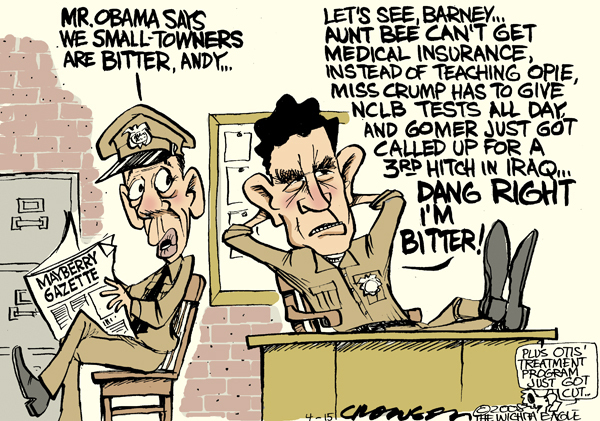
Admittedly, I'm generalizing a bit from Kansas, but the main reason small towns exist is because of agriculture. Small towns exist in the middle of an area of farms. (In Kansas they were literally, repeatedly laid out with one small town in the middle of each 6 x 6-mile block, with the county seats eventually rising to relative prominence.) For every so many people living on farms, there's a corresponding number of people in small towns doing business with them. So what's happened is that as the farm population shrank, small towns shrank with them. And those forces have been further exacerbated by small towns aren't big enough to support the schools, hospitals, cultural centers, and the more complex companies you find in larger cities.
One result of this is that small towns have effectively been forgotten about by most people in big cities, especially on the coasts, and that includes the private sector as well as government. For all of Clinton's economic growth in the 1990s, damn little of it occurred in small towns. (In KS the small towns that grew were the ones willing to tolerate the environmental distress of feedlots and a mass influx of Mexican laborers.) Are people in small towns bitter? I don't know, but one thing that is pretty clear is that they've been shunted off from most of the economic progress there has been recently. It also looks like they've tried to make up for this by embracing America's standard pieties. In particular, small towns provide a very disproportionate number of military recruits. There's no single explanation for that, but one large factor is the lack of other job opportunities.
I suppose one reason the "bitter" remark is seen as controversial is that embracing religion and/or patriotism is fundamentally a hopeful response to stress -- if anything, it's a form of denial, where one thing they're denying is bitterness. On the other hand, scapegoating others, be they illegal immigrants or Democratic elitists, does show one's bitterness, and there's more than a little of that, even if you don't want to admit it. The two reactions are intertwined enough that it's hard to sort them out. After all, today's hopeful enlistee is liable to turn into tomorrow's mangled, shocked vet.
The Democrats lost a lot of ground in small towns and poor rural areas -- West Virginia is the worst case -- during the 1990s when Clinton was wooing Silicon Valley and making hay for New York bankers. Robert Reich figured there'd be no problem sending low-paying jobs overseas because he'd raise scads of money to retrain everyone to become high-paid symbol manipulators. It will be hard to make that up because nobody has any real solutions to rural poverty, but it should at least be possible to show that what the Republicans have to offer is even worse. Small towns are hurting not just because they're small towns. They're hurting because almost everyone in America is hurting, because the Republicans have been siphoning wealth off to the already rich, squandering even more wealth, and sticking the rest of us with all the risks -- what they call "responsibility."
Wichita Blogs
The Wichita Eagle has taken to quoting bits from their website blogs on the editorial page. Oftentimes the writing and thinking is much sharper than their editorial writers can muster. For example, on April 13 they had an item about how please Sen. Pat Roberts is with Gen. Petraeus, followed by an item titled ". . . But Iraqis unimpressed by Petraeus testimony":
While Congress lavished attention last week on the testimony of Gen. David Petraeus, most Iraqis weren't listening, according to the Washington Post.
"The Americans have hundreds of meetings and testimonies like this, and what has it done for the Iraqi people? Nothing," said a carpenter in Baghdad. "So why do we care? We just want all the foreigners to leave and stop causing disasters for our country."
Sami al-Askari, an adviser to Prime Minister Nouri al-Maliki, said Iraqi politicians weren't following the hearings. "To be honest, no one expects anything different in the report or believes that it will have that big an impact on Iraq."
Not exactly a vote of confidence from those we're supposed to be helping.
Another item: "Glickman laments rising cost of campaigns":
Dan Glickman, former 4th District congressman and current chairman and CEO of the Motion Picture Association of America, was back in Wichita last week. He helped campaign for state Sen. Donald Betts, who is running for Glickman's old congressional seat, now held by Rep. Todd Tiahrt, R-Goddard.
Glickman told The Eagle editorial board that he spent only $100,000 when he first ran for Congress in 1976 (less than $400,000 in today's dollars). Now, he said, members of Congress continually have to raise money and often are paralyzed from doing anything that might upset their donors. "It's an insidious system," he said.
They didn't explain further, but my understanding is that Tiahrt entered the campaign season with a warchest over $2 million. He is for all intents and purposes Boeing's bag man on Capitol Hill, so thoroughly wed to the tanker scam that Bush nicknamed him Tanker Todd. The only way I can imagine anyone challenging him is if they run against the money, making Tiahrt's sponsors the great issue of the campaign, driving that message home everywhere using a cheaper medium, paper.
The Eagle also carried a letter by Rev. Michael Poage, titled "Selective Morality," which started:
Sometimes a boycott is helpful and important. However, the idea of President Bush considering a boycott of the opening ceremonies of the Summer Olympics in China strikes me as ludicrous and hypocritical. This is someone whose arrogant and oligarchic reign has had lies, violation of human rights, torture and an illegal war as the foundation of his presidency. His administration lied to get us into a war in which we have practiced the disregard for human rights through various torture techniques.
Personally, I can't see why Bush, or any other US president, would want to attend the opening of any Olympics outside of the US, or why any other nation would want Bush, or any other US president, to show up. Quite simply, the security hassles on top of every other fool thing should be prohibitory. The Olympics has gotten to be such a gargantuan national ego thing that one hardly needs any other reason to want to stay clear. For China this amounts to a national coming out party, a symbol that they're one of the big dogs now, which of course merely validates what's already the case. I imagine that India, Brazil, Indonesia, Turkey, and further down the line Iran, will want to follow in the same line.
As for the anti-Chinese protests, my immediate reaction is: I think it is lazy and cowardly for any American to protest a foreign government more strenuously than they do opposing their own when it is engaged in comparably bad behavior, as the US government most certainly is. (Maybe you can make an exception for individuals who have immediate ties to affected people, but that is very rarely the case here.) Part of this is that it's just too easy to get people to turn against some other government, especially when it doesn't challenge one's own -- China, Russia, Sudan, Iran, Burma, Zimbabwe are all easy marks, but you don't see much agitation over Egypt, Colombia, Ethiopia, or other so-called allies with equally dubious records. When such protests occur, one suspects some sort of hidden agenda, the work of some secret sponsor. I don't know whether this is the case here, but the CIA (for instance) has a long track record of orchestrating protests. We know that China is viewed warily by the neocon right -- one reason they so missed 9/11 was that the US was so busy war gaming against China.
Which leads to another problem with Americans protesting China, or virtually any other country except the US: all protests default to demands on one's own country, and the US has a long history of acting badly even when a protest goal is virtuous. Part of this is because the US tends to act unilaterally (with or without token followers), and such actions primarily serve to undergird US power throughout the world, which ultimately does more harm than good.
My reasoning here is a little more subtle than Rev. Poage's, but his instincts are right, including his proposal for a war crimes tribunal to try Bush, Cheney, Rumsfeld, and Wolfowitz. After all, anyone who wants the right to criticize others first has to clean up their own act.
Monday, April 14, 2008
Music: Current count 14377 [14346] rated (+31), 754 [732] unrated (+22). Jazz CG done. Took a break and spent much of the week downloading stuff from Rhapsody. The quickie approach netted a large rated account without cutting into the unrated pile. Did at least catch up with my incoming mail bookkeeping.
- Rolling Stones/Martin Scorsese: Shine a Light (2006 [2008], Polydor, 2CD): Never seen the Rolling Stones live, although I have seen several televised concerts. They came to Wichita during this tour, playing outside in the track stadium at WSU. I thought the prices were obscene, and from that point had little interest -- but they did manage to sell out. Laura wants to see the movie this is soundtrack to, and given the lack of anything else of interest, we may wind up doing that. The movie/soundtrack catches two shows at the Beacon Theatre in New York. (Don't recall ever going there, but I suppose it may have been named something else when I lived in NYC.) The official band of four has been beefed up with nine more, plus three one-shot guests. Blondie Chaplin is a name I recall fondly, although he's only credited with vocals. Haven't done a tally of songs, but they seem to center on Some Girls, which came out while I was living in NYC (1978). It was a solid comeback album after several years of grappling with the dread of getting old, and even now seems to be the best answer they can come up with. Sound is so so -- probably no worse than Get Your Ya-Ya's Out!, but the music doesn't hold up as well. Buddy Guy's guest shot is on a blues called "Champaigne and Reefer," borrowed from Muddy Waters and amusing in context. Guy at least makes sense, even elevating the proceedings. The other guests (Jack White and Christine Aguilera) are so inappròs I wonder how much they paid to get the exposure. I certainly don't expect Mick to turn down a generous figure. The record is also available in a single disc package. I doubt that tighter selection helps much. B
No Jazz Prospecting
Took a break last week, after spending 3-4 weeks playing nothing but new jazz that I needed to write something about. I took the time to catch up on non-jazz, and will post something on that later in the week. Jazz Prospecting should be back next week, starting the hunt for the 17th Jazz Consumer Guide column.
The 16th such column is in the Village Voice's capable hands now. I held more than half a column's material back for next time, and I expect a couple of more items will be scratched by the time they get it laid out. The Jazz Prospecting for this past cycle totalled 240 albums -- down a bit from 259 last cycle, mostly because the time period was significantly shorter. With the current backlog, another short cycle should be possible.
My break before make on Recycled Goods is still broken. My flow of recycled records has pretty much dried up. Due to bad health and other hassles, I haven't gotten to enjoy the time that theoretically opened up when I dropped Recycled Goods. Still catching up, but making some progress.
Unpacking:
- The Harry Allen-Joe Cohn Quartet: Stompin' the Blues (Arbors)
- Sylvia Bennett: Songs From the Heart (Out of Sight Music): May 1
- Bridge Quartet: Day (Origin)
- Bobby Broom: The Way I Play (Origin)
- The Amazing World of Arthur Brown: The Voice of Love (Zoho Roots): June 10
- Armen Donelian Trio: Oasis (Sunnyside): May 6
- Fieldwork: Door (Pi): advance, April 22
- Gabi Lunca: Sounds From a Bygone Age, Vol. 5 (1956-78, Asphalt Tango)
- The Malchicks: To Kill a Mockingbird (Zoho Roots): June 10
- Tom McDermott and Connie Jones: Creole Nocturne (Arbors)
- John McNeil/Bill McHenry: Rediscovery (Sunnyside): May 6
- Jason Miles/DJ Logic: Global Noize (Shanachie)
- Doug Miller: Regeneration (Origin)
- Stanton Moore Trio: Emphasis on Parenthesis (Telarc)
- Ocote Soul Sounds and Adrian Quesada: The Alchemist Manifesto (ESL Music): June 10
- Enrico Pieranunzi: As Never Before (CAM Jazz)
- Marc Ribot's Ceramic Dog: Party Intellectuals (Pi): advance, May 13
- Thom Rotella 4tet: Out of the Blues (Four Bar Music)
- Marcus Shelby Jazz Orchestra: Harriet Tubman (Noir, 2CD)
- Esperalda Spalding: Esperanza (Heads Up): May 20
- Rave Tesar Trio: You Decide (Tesar Music): June 1
- Sumi Tonooka Trio: Long Ago Today (ARC)
- Torben Waldorff: Afterburn (ArtistShare)
- Robert Walter: Cure All (Palmetto): advance, June 10
- Jessica Williams: Songs for a New Century (Origin)
- Cassandra Wilson: Loverly (Blue Note): avance, June 10
- Alon Yavnai: Travel Notes (ObliqSound): advance, May 13
Purchases:
- Kate Nash: Made of Bricks (Geffen)
- REM: Accelerate (Warner Bros.)
- Rolling Stones/Martin Scorsese: Shine a Light (Polydor, 2CD)
Sunday, April 13, 2008
Browse Alert: Iraq
Fred Kaplan: Stonewall Petraeus. Last week's big no-new-news event was the testifying of Petraeus and Crocker before Congress. Yes, we've made progress, but no, not really. No, we can't withdraw any troops, because even if we've made progress it won't hold without the troops. Oh, and Iran is causing us a lot of trouble, although no way near as much as they might if they tried.
Fred Kaplan: Bush's Double Talk on Iraq. As usual, Bush heard what he wanted to hear from Petraeus, then made up some more for good measure.
Tony Karon: Iraq: Ain't a Damn Thing Changed. Karon was so impressed by the Petraeus-Crocker testimony that he decided to re-run a column he wrote on April 26, 2007, unchanged.
Helena Cobban: Iraq: A Sinkhole, Not a Quagmire. The semantic differences betwen sinkhole and quagmire are overstated -- even if quagmire suggests that there's a end point to slog to, it doesn't offer much confidence in one's ability to get there. Otherwise, a good summary of the present situation.
Frank Rich: The Petraeus-Crocker Show Gets the Hook. Once and future drama critic: "The best General Petraeus could muster was a bit of bloodless Beltway-speak . . . He couldn't even argue that we're on a humanitarian mission on behalf of the Iraqi people. That would require him to acknowledge that roughly five million of those people, 60 percent of them children, are now refugees receiving scant help from either our government of Nuri al-Maliki's." Last paragraph is worth quoting, referring back to the new Errol Morris documentary, Standard Operating Procedure:
This war has lasted so long that Americans, even the bad apples of Abu Ghraib interviewed by Mr. Morris, have had the time to pass through all five of the Kübler-Ross stages of grief over its implosion. Though dead-enders like Mr. McCain may have only gone from denial to anger to bargaining, most others have moved on to depression and acceptance. Unable to even look at the fiasco anymore, the nation is now just waiting for someone to administer the last rites.
Browse Alert: Dark Ages
Paul Krugman: Who is John Galt?. Quotes a Bloomberg News piece about businesses paying universities to teach Ayn Rand:
The charitable arm of BB&T Corp., a banking company, pledged $1 million to the University of North Carolina Charlotte in 2005 and obtained an agreement that Rand's novel Atlas Shrugged would become required reading for students. Marshall University in Huntington, West Virginia, and Johnson C. Smith University in Charlotte, North Carolina, say they also took grants and agreed to teach Rand.
I've never been a fan of requiring schools to teach Animal Farm, which is preferable to Rand's book only on the grounds of its relative brevity. The notion that education is used to brainwash students to support the established order is not new to me. Still, I find this to be shocking evidence of how far the US educational system has shrunk back from any notion of academic integrity. Money changes everything, indeed.
Saturday, April 12, 2008
Browse Alert: Food and Revolution
Tony Karon: A 'Revolutionary' Moment in Egypt? We've seen a relatively sudden rash of food riots. (See map here.) Global food prices have risen 80% over the last three years, costs that have more than a little to do with the run up in the price of oil. These costs are causing some people to feel the pinch worse than others. Karon sees Mubarak's regime in Egypt, which has heavily subsidized the cost of bread for many years now, as especially vulnerable. This wouldn't be the first time for bread to be central to a revolution: Karon cites the French Revolution and the Soviet Revolution as two examples.
Moreover, when the source of that hunger is not the absence of food per se, but the invisible barrier of social inequalities that stand between poor people and the food supplies their poverty denies them, things can turn pretty nasty, pretty quickly. And that's precisely what we're seeing right now: As Josette Sheeran of the UN World Food Program put it last month, "We are seeing food on the shelves but people being unable to afford it."
That's a situation in which people start to question the very property relations that stand between them and those sacks of rice and bags of beans piled up behind that storefront grill and the riot policemen in front of it. Absent those property relations, all that stands between angry, hungry people and a square meal for the night are a couple of locks or windows to smash, and gendarmes that can be politely, or impolitely, persuaded to give way.
Food prices are significantly up in the US as well. I haven't seen much inclination to directly blame the Bush administration for this, although one can identify various piles of smoldering leaves that could break out at any time. The Iraq war has disabled a major short term supplier of oil. The various sanctions against Iran has shorted another. Bush's pissing contest with Russia over anti-missile defense doesn't help, and the whole Caspian region is bothered by Bush's belligerence. The one group that's not hurt by high oil prices is the oil industry, and Bush is especially close to them -- both directly to the oil companies and to the financial networks stoked by oil profits. It doesn't take advanced mathemtatics to add these interests up.
There's also the ongoing trade deficits, especially with China -- which is getting a shitload of bad publicity lately; wonder why? -- which in turn bolsters China's competition for what oil is available. Plus the whole thing is being paid for with US dollars, which have lost about half their value in 7+ Bush years. He doesn't get a lot of blame for that, either, but with the whole world financial system lurching toward collapse you wonder how long that will last.
Of course, it's not just Bush. There are two levels of limits, two levels of scarcity, at work here. One is systemic, the other political. We always hit the political ones first, so the tendency is to dismiss them as just bad politics. The late 1970s oil crisis is a classic case: politically-driven scarcity that opened up into a glut. But this time is different: oil is at or real close to peak production, and that underlies the price spikes, although it isn't the main factor at the moment. Food is less clear, but long term it is certainly clear that food production will diminish if energy inputs (which currently means oil) decline. We may just be seeing political effects right now, but they provide a preview of a future where more people will try to survive on less oil. It doesn't look pretty.
Friday, April 11, 2008
McCain's Senior Pass
Steve Benen: The Dreaded Septuagenerian Issue. Looks like the Democrats, officially anyhow, will be pulling their punches with McCain:
Democratic National Committee Chairman Howard Dean hosted a press briefing yesterday to go over some new polling data from 17 swing states, and mentioned that the party would probably not go after John McCain's age as a campaign issue.
Noting that it's the kind of tactic Republicans would be far more comfortable with, Dean said, "I doubt we will bring it up in the election." He added, "There is somewhat of a higher ethical bar on what we do. We don't have any Lee Atwaters or Karl Roves on our side."
The focus groups not only "health concern" with McCain's age (71), but also "this guy is out of step with what modern views are." Of course, there are plenty of other things to hang McCain on. His health care hand waving and his "refined" subprime mortgage plan have been in the press lately. And he's still trying to squirm out of his 100-years-in-Iraq campaign line (evidently the GOP's focus groups decided that one doesn't fly). But there's hundreds, maybe thousands of more issues, especially comparing what he's campaigning on now vs. what he's said in the past. If you want to talk about flip-flops, the GOP has found their John Kerry. That both of them are Vietnam vets touted as war heroes is another point in common. I don't care much one way or another, but I wouldn't be surprised if someone could come up with a comparably credible "swift boat" case against McCain. You may respect or at least sympathize with McCain's ordeal, but I don't how his sitting out a losing war in a Hanoi POW camp was in any way heroic. (Kerry at least found the courage to protest the war, although it's not clear how clear he still is on that.)
There have been plenty of cases in US history where wars have proven to be springboards for successful political careers, but it helps to have won those wars. I can't think of any successful politician who came out of the Korean War, and the best Vietnam has offered is Kerry and McCain -- low-level officers with no real pull and minimal accomplishments. Even the winners haven't been able to parlay much: Colin Powell might have gotten some mileage out of Iraq I, but he blew that betting on Iraq II. Wesley Clark ran on Kosovo, but didn't get past Oklahoma. At some point even the politicians will have to recognize that war isn't much of a career move.
Thursday, April 10, 2008
Asymmetric Parties
There's a significant asymmetry in US electoral politics. Political parties compete to assemble a majority coalition of votes, but they also compete for money, which not only influences votes but to some extent is necessary even to establish a candidacy. While votes are, in principle at least, equally distributed, money is not. This means that both parties have to curry favor with the rich, regardless of the interests of their prospective voter coalition. This presents fundamentally different problems for the Republican and Democratic parties.
The Republicans blatantly favor the interests of the rich, which has long given them a substantial advantage in raising money. Their problem is that the rich are a tiny minority in America, one that they have to opportunistically broaden to win elections. The money certainly helps. The Republicans have put together a very efficient propaganda machine, especially adept at exploiting non-economic issues that do not significantly detract from the party's sponsors. Their success is a remarkable story, especially in how they've used thin vote margins to promote their extreme ideological agenda.
The Democrats, on the other hand, are torn between the two pillars of American politics. Their voting base is working class, but they have to balance their voter appeal off against their funder appeals. For numerous reasons, the latter predominate. The result is that it is impossible for them to promote a consistent populist platform. One casualty of this inconsistency has been voter turnout: because the Democrats deliver so little to the poor many poor voters don't see much point in politics. Needing to bridge between their funders and voters, Democrats emphasize moderation, reconciliation, a mixed society. One effect is wishy-washy messages. Another is overeagerness to compromise, even when the other side is clearly wrong.
In theory, you could eliminate fundraising from politics, thereby getting rid of the distorting effects of money (not to mention the flat out corruption), and restoring democracy -- the ideal that each vote is equal to any other vote. One reason this is hard to do is that the current system selects for politicians who are adept at raising money. Another reason is that the current system favors the rich by giving them about two parties vs. maybe one-half for the poor. The net effect is that nothing political can happen that runs against their interests.
That the Democrats are raising more money this year than the Republicans are reflects the fact that no matter how much they claim to support the rich, their extremist ideology and their corrupt implementation has actually done immeasurable harm. However, that only makes possible a very limited set of reforms -- much more limited than what is actually needed to move back toward the ideal of America as a land of democracy, equality, and opportunity.
Wednesday, April 09, 2008
The Ticket
Over the last couple of weeks I've been getting increasingly nervous that the continuing degeneration of the Democratic presidential campaign will tear the party far enough apart to let the otherwise unthinkable happen: four more years of GOP terror. One thing that stimulated this fear was reading Donald Critchlow's The Conservative Ascendancy, which has capsule recaps of all the presidential elections, at least from 1964 on. In three cases incumbent presidents were defeated, each following primary challenges that Critchlow puts a lot of weight on: Gerald Ford, Jimmy Carter, and the former George Bush. One could also add Johnson/Humphrey in 1968 to that list. Admittedly, the Democratic nominee isn't the incumbent this year, but a unified Democratic party would have been presumed to be a strong favorite. That expectation is palpably weakening as the nicks and scratches of a campaign has gone through a stretch that has been barren of real election results.
The degeneration is mostly coming out of the Clinton camp as they try to find some traction with the nomination slowly slipping from their grasp. At present, Clinton is trailing slightly in delegates and in votes, slightly ahead in early superdelegate endorsements but losing her edge lately, and way behind in money. I figure the last of these will prove fatal: the Republican Party can usually finance promising candidates, but the Democrats especially like someone who can raise his or her own money. Meanwhile, Clinton's favorite tactic is to hypothesize tests that supposedly put Obama at a disadvantage, but which she's hardly rock solid on either. Most obvious is the "Commander in Chief Test" -- her experience at rubber stamping DOD expenses and her propensity for hot-headed posturing don't make for much of a case. Most insidious is the whole debate over electability, which all too readily slips into race baiting, even though polls show prejudice against voting for a woman is if anything stronger than prejudice against voting for a black man (unless, that is, the polls are tainted by the woman in question). Then there's the whining over Michigan and Florida. The problem with all of these things is not just that they induce division among Democrats but that many of them are readymade for McCain to exploit in the fall.
But the biggest problem with Clinton's campaign is and always has been the sense of inevitability. She was the front runner because she started with an incumbent-level brand name campaign organization, backed by the sense that Bill Clinton was the only Democrat in recent times to have solved the problem of how to beat the Republicans. The effect was that were Obama tries to sell change, Clinton promises restoration. I don't see that as an idea that's been at all well tested. The Bush restoration, which a Clinton return unfortunately recalls, at least moved a generation forward with mostly different people and priorities. Clinton promises something unprecedentedly close to a third term -- of the regime if not strictly the figurehead -- and no one really knows how that will play with the voters.
That's hardly the only baggage Clinton carries. For whatever combination of reasons, she's fallen behind Obama. She's managed to avoid being eliminated by winning some big Democratic-leaning states, benefitting from labor, city and state machines, white ethnics (who seem, along with Republican-leaning southerners, to be the last redoubts of racial backlash). She'll probably do that again in Pennsylvania, then lose North Carolina and Indiana to wind up about where she is, not quite numerically eliminated but still behind, having accomplished nothing but to drag the decision out.
But there would be a simple way for Clinton to undo much of the damage her campaign is causing. That would be to withdraw and go a couple of steps further: endorse Obama and offer her services as a vice-presidential candidate, which would remind her supporters every day of their stake in the Obama campaign, and dispell any notion that Democrats are divided in such a critical election. Right now I'm unfavorable enough on Clinton I'm not sure this would be a good thing. But it's probably an option if she wants it. For one thing, it would go some ways toward mitigating some big problems I see with her in the top slot: it seriously cuts down on her patronage, which means her ability to reconstruct the previous Clinton administration; it keeps Bill Clinton out of the White House, with its inevitable who's-in-charge confusion; it keeps her away from the commander in chief conceit, limiting her greatest liability, which is a tendency to get belligerent in foreign affairs. Conversely, it sets Obama up to set the public tone, to work his vision mojo. There's at least one precedent for this: JFK/LBJ. That didn't work out perfectly in every respect, but at least it held the party together to win a close election reversing an 8-year Republican hold on the White House.
Postscript: It occurs to me that Clinton could even take the Cheney vow, promising she won't run for president to succeed Obama. Of course, she wouldn't be as effective, not to mention destructive, as Cheney, whose unique power is partly a reflection on Bush. She also wouldn't be as good assassination insurance, especially given that most bullets come from the right.
Monday, April 07, 2008
Music: Current count 14346 [14316] rated (+30), 732 [740] unrated (-8). Jazz CG finished. Much bookkeeping left to do, including this week's receipts. As I was mopping up, I figured it might be interesting to sample some unheard jazz via Rhapsody. The experiment generated some jazz prospecting, but not much more. Leftovers set next Jazz CG up as better than half-done. Lot of unheard stuff on the shelves.
Jazz Prospecting (CG #16, Part 10)
My draft for the 16th Jazz Consumer Guide is done. It's currently configured with 38 records (17 A-list, 16 HM, 5 Duds), 1775 words. A little more than 200 words will have to be hacked out of that by the time it is laid out. That leaves 22 albums, 932 words carried forward in the draft file for Jazz CG 17. I upgraded the two pick hits from A- to A. I've been trying to keep my current grading consistent with what I've done in the past, but when I put the ratings database together in the first place I was very stingy with A grades, reserving them for records that had clearly stood the test of time. That's hard to do on the fly, but I wound up playing these two quite a bit and I'm pretty solid with them.
The other change is that the featured "Dud of the Month" is gone, replaced by a "Duds" list with one-liners and grades. The grade breakdown includes two B, two B-, one C+. More about those later.
This is the last week of jazz prospecting for this round. Next week, unless I take a break, starts the next round. I finished off some records from the replay shelves, but for some reason I didn't feel like opening up anything new from the unplayed shelves. So I did something different this week as an experiment. I used Rhapsody to stream a bunch of jazz albums I never received. I think my first idea was that I might find a usable dud, but I soon got distracted by more interesting fare. I also have to report that I had a lot of trouble finding things. Mainstream European labels that I have been wanting to hear more from, like Criss Cross and Steeplechase, are not available. Avant-garde stuff is very spotty. Last year's "wish list" came up virtually empty, and checking stuff off the Voice's jazz poll didn't offer much more. And in the end I didn't bother with the few pop jazz things I thought of (Chris Botti, Kenny G) -- figured I'd just as well spend my time with, well, see below.
Like my year-end round-up plunge into Rhapsody, these are snap judgments, based on one or (rarely) two plays. Credits and discographical info are spotty. My policy on these is evolving. At present, I'm not using any of these records in Jazz CG, unless I find a particularly egregious dud. I am keeping track of B+(***) and up, and may seek out real copies. In any case, if/when I do get copies, I'll reconsider, write a second-pass jazz prospecting note, and possibly write something for Jazz CG. I don't know how often I'll do this in the future. It certainly helps in the case of some labels that produce interesting music but don't make promos available -- e.g., Tzadik.
Jazz Prospecting closes for this round with 240 records covered (including the scragglers from Rhapsody). Jazz CG is scheduled to be published in the Village Voice April 30.
Brad Mehldau Trio: Live (2006 [2008], Nonesuch, 2CD): I thought I might use the last week of the cycle to stream some records I never got -- the paranoid idea being that I might pounce on one or two for my Duds list. But to stream them, I have first to think of them, and this was the first that popped into my mind. I haven't gotten any of Mehldau's releases since Jazz CG started, although the publicist has been more/less supportive in general. (Bill Frisell's records have also been hard to come by, but they send me the Black Keys, so what can I say?) In some ways it's just as well. With few exceptions, Mehldau works trio or solo, and I often have trouble there. Mehldau is probably the biggest star to come out of the Fresh Sound New Talent series, and he made a tremendous splash when Introducing Brad Mehldau came out on Warner Bros. I concurred, but the following five Art of the Trio volumes left me increasingly speechless -- I think Vol. 5 is still unplayed (at least unrated) somewhere on a shelf here, and that's the last I have. I don't doubt that he is one of the major jazz pianists of the age, but he's so unidiosyncratic he's hard to characterize, and so consistent he's hard to sort. Larry Grenadier has been his bassist since 1995. Jeff Ballard plays drums, replacing Jorge Rossy sometime between 2002 and 2005. They take 12 songs deep here, the shortest the opener at 8:44, longest "Black Hole Sun" at 23:30, most in the 10-15 minute range. I got the most mileage out of "The Very Thought of You," no doubt because it was the most familiar song. Too long to digest, so pleasant and thoughtful and moderate it folds readily into the background. No doubt the sound is better on disc. Grades on streamed records are necessarily swags, but will hold for now. At some point I have some catching up to do with Mehldau. B+(***) [Rhapsody]
John Zorn: The Dreamers (2007 [2008], Tzadik): Not much evidence of Zorn's alto sax here. In some ways this more closely resembles his Film Works, although having heard only one or two of what are now 19 volumes hardly makes me any kind of expert. A dozen groove pieces, most led by Marc Ribot's guitar, with keyboards (Jamie Saft), vibes (Kenny Wollesen), bass (Trevor Dunn), drums (Joey Baron), and percussion (Cyro Baptista). Several build into substantial pieces of music, while most ingratiate and beguile. An earlier album, The Gift, is reputed to be similar. B+(***) [Rhapsody]
John Zorn: Filmworks XIX: The Rain Horse (2008, Tzadik): Might as well check out some of the latest film music while I'm at it. Zorn is prodigious, especially since he started his own label. The label doesn't provide any promos to reviewers, a big disappointment when I started Jazz CG. I've picked up his records when I had the chance, but have only heard a dozen or so out of more than 100 -- some wonderful, at least one awful. This one was written for a film by Russian animator Dmitri Geller. The pieces are played by Rob Burger on piano, Erik Friedlander on cello, and Greg Cohen on bass. Minor charms, the kind of thing that slips into a film without you noticing too much, but stands up to playing on its own. Leans a bit toward Russian, by which I mean Jewish, chamber music. B+(**) [Rhapsody]
Cyro Baptista: Banquet of the Spirits (2008, Tzadik): Brazilian percussionist, in US since 1980, with several previous albums on Tzadik and a lot of side credits. Starts out in disjointed Brazilian psychedelic mode, with Baptista singing over his disjointed beats, a style I've rarely if ever managed to follow. Later on several pieces pick up a Middle Eastern vibe, thanks to Shanir Ezra Blumenkranz, playing oud, bass, and gimbri, and they're easier to handle. Probably some good ideas here, but too much weirdness for me to handle on short order. B- [Rhapsody]
Karrin Allyson: Imagina: Songs of Brasil (2007 [2008], Concord Jazz): Singer, from Great Bend, pretty close to the dead center of Kansas, although we think of it as out west. Ten or so albums since 1992, starting with cabaret material and moving around a bit, including a couple of previous forays into Brazil. Plays some piano too, but Gil Goldstein is also credited here (also on accordion), and I don't have the breakdown. Most songs start off in Portuguese, then slip into English. I don't find either all that convincing, although it settles into a bit of a groove. B- [Rhapsody]
Marcus Miller: Marcus (2008, Concord Jazz): Two cuts in (called "Blast" and "Funk Joint") I wondered whether his minimalist bass fuzz would sustain interest at album length. Three cuts I got a negative answer, in the form of vocalist Corrine Bailey. I could have gone longer, but he didn't. Fourth cut fuzzed up Stevie Wonder's "Higher Ground." Fifth cut guest slots Keb' Mo': 'nuff said. More fuzz, especially on pieces he was inspired to call "Pluck" and "Strum." More guests. "When I Fall in Love" is semi-amusing; "What Is Hip?" isn't. Closes with a second take of "Lost Without U" with Lalah Hathaway singing, an improbable and mostly fuzzless choice cut. B [Rhapsody]
Jacques Schwarz-Bart: Soné Ka-La (2007, Emarcy): Tenor saxophonist, from Guadeloupe, b. 1962; father French-Jewish; grew up partly in Switzerland as well as Guadeloupe. I've run across him several times before, and he's often impressed me with strong tenor sax lines, but he's fairly mild here, even playing a bit of soprano, flute, and guitar. The album mostly rides along on the gwoka drums, and various vocalists drop in for a world pop fusion thing. B+(**) [Rhapsody]
Roberta Gambarini & Hank Jones: You Are There (2005 [2008], Emarcy): Italian singer, from Torino. Don't know how old she is, but she seems to have recorded in Italy since 1986 or so. First US release was Easy to Love in 2006, which got a lot of notice, although I missed it. This looks to be import only, at least for now -- it seems like a lot of jazz artists on major labels in Europe and Japan never get picked up here. But it's probably just a matter of time in this case, not only because she's crossed her first hurdle but because her duet partner is something of a name in these parts. Just voice and piano. She sings in remarkable English, marvelous voice, clear and precise, a good ear for detail. The songs are all standards -- "Stardust" and "Lush Life" the most common, the latter as nicely turned out as any I can recall. Also a luscious version of "Just Squeeze Me." Other songs haven't connected yet, partly lack of familiarity. Of course, it's tempting to pick this up just for the pianist, and anyone so inclined won't be disappointed. B+(***) [Rhapsody]
Irving Fields Trio: My Yiddishe Mama's Favorites (2007, Tzadik): A pianist, b. 1915, still playing at 92. In his heyday he was what we'd now call a "lounge pianist," best known for his 1959 novelty record, Bagels and Bongos, which was a remarkably successful recasting of Jewish songs like "Hava Nagila" with Cuban percussion. He returned to the bongos thing many times, recording not only More Bagels and Bongos but also Pizzas and Bongos, Bikinis and Bongos, and Champagne and Bongos. It seems inevitable that he would be rediscovered by Cuban percussionist Roberto Rodriguez, who elevated Jewish-Cuban fusion to a whole new level, and that they would record as part of John Zorn's Radical Jewish Culture series. This is a much tamer, more respectful album: the songs are older, the piano dominates, the percussion is subdued and sometimes incidental. But they do reprise "Hava Nagila," and that picks up the pace. Greg Cohen plays bass. B+(**) [Rhapsody]
Irving Fields Meets Roberto Rodriguez: Oy Vey!!! . . . Olé!!! (2006, Tzadik): An earlier meeting, this time Fields' piano fits nicely into Rodriguez's rhythmic framework, with the instrumentation filled out by Gilad Harel on clarinet, Uri Sharlin on accordion and organ, and Meg Okura on violin -- also some vocal early on, but thankfully that didn't stick. The principals alternate songs, including Fields oldies like "Miami Beach Rhumba," "Managua Nicaragua," and "Song of Manila." Not sure how good it all is, but the shtick is pretty irresistible. B+(***)
Jeremy Pelt & Wired: Shock Value: Live at Smoke (2007, MaxJazz): Trumpet player, got some notice a few years back as the hot new kid on the block. Doesn't seem so hot here: don't know whether he's using a mute, riding the flugelhorn, or stuck in his effects -- probably a bit of all three. Opens with a long blues jam called "Blues," led by guitarist Al Street. Frank LoCrasto plays Fender Rhodes and B3, a smorgasbord of soul jazz clichés. Bass is probably electric too, hence the group name. Becca Stevens sings one song, which started off unpromising anyway. Only the closer, "Scorpio," starts to show off his trumpet to advantage. Too little, too late. B- [Rhapsody]
Third World Love: New Blues (2007 [2008], Anzic): Fourth album by this group, consisting of three Israelis based in New York, plus native drummer Daniel Freedman. I've been filing the records under trumpeter Avishai Cohen (Anat's brother, not the same-named bassist). The others are pianist Yonatan Avishai and bassist Omer Avital. All four players write, and the closer is by someone named Ellington -- Avital, who has a substantial body of work on his own, has the most, but Avishai's one piece is particularly nice. Slight Middle East flavor -- nothing too specific, nor generically world. Subtle enough it gained on the second play, and might benefit from more exposure. B+(***) [Rhapsody]
Tyshawn Sorey: What/Not (2007, Firehouse 12, 2CD): As far as I've been able to tell, one of the best young drummers to appear recently. Plays a little piano too, but so does Corey Smythe -- not sure what the breakdown is, but probably favors the specialist. In any case, this is a composer's record: the drums play minor, but sometimes startling, roles, with either piano or Ben Gerstein's trombone taking the leads. The long (42:50) "Permutations for Solo Piano" dominates the first disc. I figure it for sub-minimalism, mostly slow two-note patterns with a lot of resonance. Once you get acclimated, it doesn't much matter how long it goes on -- could be hours, but 42:50 is long enough to make the point. I can go either way on the piece. The trombone leads are more immediately appealing, especially the latter third of the 22:52 "Sacred and Profane." Most of the pieces are abstracts, sound dabbling with a limited palette. Many of them make sense only if you're playing close attention -- which among other things means noticing bassist Thomas Morgan. The record got a lot of positive notice when it came out, including a number two spot on Francis Davis's year-end list. When I asked for a copy, I was pointedly turned down, and I'm still rather pissed about that. Admittedly, it's the sort of record that I rarely find much more than interesting. After two plays I could go up or down on it, making credible arguments either way. But the second play revealed more, and there's so many diversely interesting stretches that it could conceivably cohere into a tour de force. A- [Rhapsody]
Ken Vandermark: Ideas (2005 [2007], Not Two): One of a number of albums -- a couple dozen is a wild guess -- that are little more than impromptu improvs Vandermark cut on the road with whoever managed to hook up the recording equipment and a small label interested in the product. Here the road is in Poland, and the band are the Oles brothers, Marcin Oles on bass, Bartlomiej Brat Oles on drums. Typical, I would say. Mostly tenor sax, some clarinet, some baritone -- the latter strikes me once again as exceptional. B+(**) [Rhapsody]
Ken Vandermark & Paal Nilssen-Love: Seven (2005 [2006], Smalltown Supersound): Rhapsody lists this as a single, but at 43:55 it comes to more than LP length: one long pieces (26:36), one medium (14:03), one short (3:19). Duets, the third set between Vandermark and his favorite Norwegian drummer. The long one starts ugly and takes a while to sort itself out, before turning into the usual cornucopia of sonic assaults. That, in itself, is not something I'm inclined to complain about. But a better place to start, not least because it was thought out from the start, is Dual Pleasure. B+(*) [Rhapsody]
The Thing With Ken Vandermark: Immediate Sound (2007, Smalltown Superjazz): The Thing is a Norwegian group, led by (mostly baritone) saxophonist Mats Gustafsson, with Ingebrigt Håker Flaten on bass and Paal Nilssen-Love on drums -- all names that will be familiar to anyone following Vandermark around. Vandermark started playing with Gustafsson back when the latter was in the Aaly Quartet, and they've collided a dozen or more times since then. Gustafsson is an inveterately noisy player. for the most part, I find him a difficult taste, but I've liked it when the Thing takes on pieces of grunge rock, where there is some structure to wrap the noise around. This isn't that. It's a four-part improv thing, which comes together neatly with rotating baritone lines near the end, but makes a bloody mess along the way. B+(*) [Rhapsody]
Taylor Ho Bynum Sextet: The Middle Picture (2005-06 [2007], Firehouse 12): Plays cornet. Student of Anthony Braxton; seems to have a continuing relationship. First and last cuts are trio with guitar (Mary Halvorson) and drums (Tomas Fujiwara). The rest add a second guitar (Evan O'Reilly), Jessica Pavone (viola, electric bass), and Matt Bauder (tenor sax, clarinet, bass clarinet). Very fractured, discontinuous music. The two covers ("In a Silent Way" and "Bluebird of Delhi") are useful for gauging the deconstruction -- the latter, from Ellington's The Far East Suite, is especially striking. The originals are difficult abstractions, intriguing but hard to get a handle on. The sort of thing I'd save for some extra plays if that were practical. B+(**) [Rhapsody]
Mary Halvorson & Jessica Pavone: On and Off (2007, Skirl): Halvorson plays guitar: grew up in Boston, studied at Wesleyan with Anthony Braxton, works out of Brooklyn. Plays in Braxton's Quintet, Taylor Ho Bynum's Trio and Sextet, her own trio. Pavone plays viola. Also has a relationship with Braxton and Bynum, and has appeared on a couple of Assif Tsahar's records. Also that Vampire Weekend record that's been getting a lot of hype lately. She has a couple of string thing records on her own label. Name reminds me of the great bassist Mario Pavone, but I haven't seen any references. AMG classifies both as Avant-Garde Music, not as Jazz. Fairly abstract chamber music -- not as broken up as on the Bynum album, but no swing or bop. Not an instrumentation I find appealing, plus I usually demur (or worse) from vocals, which both indulge in, but in the end I found this oddly charming. B+(*) [Rhapsody]
Free Fall: The Point in a Line (2006 [2007], Smalltown Superjazz): Third album by Ken Vandermark's trio, featuring the same clarinet-piano-bass lineup as appeared on Jimmy Giuffre's namesake album. Håvard Wiik plays Paul Bley, Ingebrigt Håker Flaten plays Steve Swallow, and Vandermark handles the clarinets. Beyond the lineup, I've never seen much affinity to Giuffre's trio, but I've also never turned into a big fan of the Free Fall album. Still, this is an interesting album on whatever terms apply: Wiik is more pro-active on piano, and Vandermark's aggressiveness is muted by the clarinet's limited volume. B+(**) [Rhapsody]
Derek Bailey: Standards (2002 [2007], Tzadik): Don't have a recording date, but reports are that this set was recorded two months before the widely acclaimed 2002 album Ballads. Bailey was an avant-garde guitarist -- perhaps I should say the avant-garde guitarist, at least on the British scene. The has a vast catalog, of which I've heard next to nothing (4 albums), and have no particular insight to. Not sure whether he's mannered or just obscure, or whether I'm just confused. This is acoustic guitar, solo. The seven songs are credited to Bailey. They may or may not code references to real standards -- "Please Send Me Sweet Chariot" seems like a promising title. No idea what it means. But there is something semi-hypnotic about his approximately random attack. It must means something that I wouldn't mind hearing it some more. B+(*) [Rhapsody]
And these are final grades/notes on records I put back for further listening the first time around.
Slow Poke: At Home (1998 [2007], Palmetto): Recorded by Lounge Lizards/Sex Mob bassist Tony Scherr at home in Brooklyn, laid back blues for sophisticates with no reason to be blue. Slide guitarist Dave Tronzo stretches out melodies by Duke Ellington and Neil Young, and saxophonist Michael Blake sails effortlessly along. A- [advance]
Pat Metheny: Day Trip (2005 [2008], Nonesuch): The bad news is that Metheny's got not just his own face but his whole trio on the April 2008 cover of Downbeat. Early on in Jazz CG history I noticed that there was a strong correlation between my duds list and Downbeat's cover. Incidentally, it's usually been the case that I had nailed the records before the Downbeat covers appeared, although with Jazz CG's notorious lag time it may have looked otherwise. I've never been a Metheny fan -- never been much of a guitar fan, although I can point to exceptions -- and he certainly qualifies as big enough to fail. On the other hand, when I put this on this morning I figured it for an Honorable Mention, not a Dud. Four plays later it's Neither. I like the simple framework Christian McBride and Antonio Sanchez provide, and the small figure guitar lines, but I can't get excited about either. B+(**)
Paul Bollenback: Invocation (2007, Elefant Dreams): Clear, ringing tone on guitar, nicely defined, graceful, usually makes sense. Turning it into an album is an open proposition. A guest like Randy Brecker helps. On the other hand, I find Chris McNulty's scat distracting, not to mention annoying. B
Raya Yarbrough (2006 [2008], Telarc): The leadoff blues "Lord Knows I Would" is a choice cut, and her "Mood Indigo" shows she could be a standards threat. But her singer-songwriter fare is overorchestrated, pretentiously so -- I'm reminded of such long-forgotten pop-rock icons as Andy Pratt. As rockers figured out, such affectations do little to make us care about the songs, which at bottom is what songwriting is about. As such, it's hard to find reason to care about these. She's talented, but it's not clear what for. B-
Dave Mullen and Butta: Mahoney's Way (2006 [2007], Roberts Music Group): I'm not sure that Mullen won't wind up smothered in smooth jazz jam -- his credits include keys and sequencing, drum programming, vocals, flute and trumpet, as well as his lead tenor sax and kiss-of-death soprano, which position him well for the slick side. Still, he opens with a slice of R&B honk called "Flip It," then introduces his title cut with a rap. When he reaches for a soul cover, he picks Stevie Wonder's "As," then turns it over to Nile Rodgers for a hardcore funk beat, and roasts the True Worship Ministries Singers with his tenor sax, lest they get too Godly on him. His originals have overreaching messages (e.g., his "Prayer for Our Times") and one called "Lost Souls" breaks into a chorus chant of "a love supreme." His other cover is a nice sax ballad of "Bewitched" -- a soft landing at the end. The synthesis strikes me as over his head, but for now at least his head's in the game. B+(**)
Matana Roberts Quartet: The Chicago Project (2007 [2008], Central Control): Alto saxophonist, Chicago native, AACM member (young, I think), lives in New York. Got a strong pick up band when she returned to Chicago for this session, including Fred Anderson on tenor sax and Jeff Parker on guitar, and got production help from Vijay Iyer. Doesn't come together much, although there are interesting patches, especially the guitar. B [advance]
Giacomo Gates: Luminosity (2007 [2008], Doubledave Music): Finally, a male jazz singer in "the Eddie Jefferson/Jon Hendricks tradition" I actually enjoy. He talks his way offhandedly into introductions, then slips effortlessly into song. Pulls a couple of gems out like "Hungry Man," and wrote one himself ("Full of Myself" -- of course, he couldn't be). Would even be better if he didn't keep working his way into those vocalese jams, but at least he keeps his cool. Can't say that for any of his obvious competition. B+(***)
Zaid Nasser: Escape From New York (2007, Smalls): An alto saxophonist who not risks sounding like Charlie Parker and winds up showing how it should be done. He taps Ellington for two tunes, wails through "Chinatown My Chinatown," plucks a barnburner from oldtime bebop pianist George Wallington, strings them together with a couple of originals, including one from pianist Sacha Perry. Not a tribute. More like 55th Street is back in business. A- [advance]
The Joe Locke Quartet: Sticks and Strings (2007, Jazz Eyes): Even handed: Locke's vibes and Joe La Barbera's drums count as sticks; Jay Anderson's bass and Jonathan Kreisberg's guitar provide the strings. Kreisberg is very appealing here, both on acoustic and electric, and the contrast to the vibes works nicely. B+(***)
Exploding Star Orchestra: We Are All From Somewhere Else (2006 [2007], Thrill Jockey): Rob Mazurek's Chicago-based big band for all intents and purposes is the new Sun Ra Arkestra. They make for an unworldly space jazz, but where Ra could tap into his roots and swing, the group here relates more to prog rock and whatever experimental rock came on down the road -- e.g., the label's main act is Tortoise. Magnificent in parts, scattered elsewhere. B+(*)
Bill Dixon With Exploding Star Orchestra (2007 [2008], Thrill Jockey): Dixon is a logical fit for Rob Mazurek's supernova big band -- an esteemed avant-gardist, a rarely heard trumpet, normally the sharpest instrument in the band (although Mazurek's cornet provides some competition). He composed two long pieces; Mazurek dedicates the third to him. Still, Dixon tends to get lost in the mix. Similar to last year's mixed bag, but a bit more climactic. B+(**)
Buddy DeFranco: Charlie Cat 2 (2006 [2007], Arbors): This reminds me of what Louis Armstrong used to call "the good ole good uns," even though DeFranco remains for all intents and purposes a bebopper -- "Anthropology" closes this out in a rush. But his chosen instrument is clarinet, which tends to refer back to the swing era, especially when he's lined up with the usual Arbors crew, including Howard Alden and/or Joe Cohn on guitar, Derek Smith on piano, Rufus Reid on bass, and Ed Metz Jr. on drums. B+(**)
Unpacking: Not yet.
Friday, April 04, 2008
Martin Luther King [To]Day
Last night I caught a couple of snippets of a Martin Luther King speech, trotted out on the 40th anniversary of his murder. Today the Wichita Eagle had an op-ed on King, written by right-wing nut case Cal Thomas, which was respectful and almost coherent. Checked TPM -- the Clinton-Obama primary squabble is making me crazy (more on that later) -- and there are various reports on McCain speaking (and getting heckled) in Memphis honoring King. McCain even admitted his error in voting against the MLK holiday. Looks like King, like Harry Truman and Woodrow Wilson, is gaining posthumous entry to the halls of conservative saints.
Coincidentally, I'm reading Geoffrey Nunberg's Talking Right, and I picked up today in a chapter called "New Bottles, Old Whines" where I read this (pp. 156-157):
Conservatives like to invoke Martin Luther King's famous call for a color-blind America: "I have a dream that my four little children will one day live in a nation where they will not be judged by the color of their skin but by the content of their character." But the quotation, like conservatives' memory, is selective [ . . . ] As many conservatives tell the story, that's no longer a big problem; if the government would only stop taking race into account, nobody would notice it anymore.
Nunberg introduces this by explaining (p. 156):
The right's embrace of the language of color-blindness, "reverse discrimination," and the like provides ideological cover for white resentments about racial preferences that might otherwise leave people vulnerable to charges of racism and sexism.
Nunberg goes on (pp. 157-158):
Conservatives' appropriation of the language of the early civil rights movement allows them to rpesent themsleves as the true inheritors of tradition represented by John and Bobby Kennedy and especially Martin Luther King, whom the right has recast as a conservative icon. As William Bennett puts it, "If you said in 1968 that you should judge people by the content of their character, not the color of their skin, that you should be color-blind, you were a liberal. If you say it now, you are a conservative." But conservatives also credit King with othe rur-conservative virtues. According [to] the Heritage Foundation's Carolyn Garris, King's "core beliefs, such as the power and necessity of faith-based association and self-government based on absolute truth and moral law, are profoundly conservative," adding that "King's primary aim was not to change laws, but to change people." On King's birthday in 2006, the Wall Street Journal celebrated King's "commitment to non-violent social change," in the course of deploring the liberals who "do violence to the English language and King legacy by engaging in inflammatory rhetoric." Whatever the historical realities, many on the right have turned King into a mythic embodiment of the "good" liberalism of the early civil rights movement, before it "degenerated into a collection of political extremists, homosexual militants, Muslim activists, and anti-American Marxists," as the right-wing media watchdog group Accuracy in Media puts it.
Thomas Frank, in What's the Matter With Kansas?, has many more examples of the right adopting the rhetoric of the civil rights movement for its own ends. This might be something of a paradox, given that the right opposed the civil rights movement at each and every stage, yet now they argue that it was a good and necessary thing, a triumph of good old fashioned Americanism. Cal Thomas writes:
It is easy to bask in his glow four decades after his death. It took incredible bravery at the time to walk with him in support of his cause. And it wasn't only his cause. It was an American cause. He challenged this country to live up to its ideals and what he knew was its better nature, if it could escape from behind the barricade of prejudice and ignorance.
Thomas goes on to say: "King deserves more than a national holiday. In what he said about race and brotherhood, he deserves to be followed." On the other hand, the way Thomas follows King is to attack Obama's pastor, Rev. Jeremiah Wright as a bigot. The big difference between Wright and King is that King died 40 years ago, so his speeches refer to an America that is now safely interred in the past, where self-serving conservatives can clean it up and present it as a triumph of Americanism, as opposed to a still unfinished struggle against America's deep habits and most disreputable impulses.
Michael Eric Dyson: The Prophetic Anger of MLK. Read this for a view of King 40 years ago that still has some immediate relevance today -- the word "prophetic" is not too strong:
After the grand victories of the Civil Rights Act of 1964 and the 1965 Voting Rights Act, King turned his attention to poverty, economic injustice and class inequality. King argued that those "legislative and judicial victories did very little to improve" Northern ghettos or to "penetrate the lower depths of Negro deprivation." In a frank assessment of the civil rights movement, King said the changes that came about from 1955 to 1965 "were at best surface changes" that were "limited mainly to the Negro middle class." In seeking to end black poverty, King told his staff in 1966 that blacks "care now making demands that will cost the nation something. . . . You're really tampering and getting on dangerous ground because you are messing with folk then."
King's conclusion? "There must be a better distribution of wealth, and maybe America must move toward a democratic socialism." He didn't say this in the mainstream but to his black colleagues.
Similarly, although King spoke famously against the Vietnam War before a largely white audience at Riverside Church in New York in 1967, exactly a year before he died, he reserved some of his strongest antiwar language for his sermons before black congregations. In his own pulpit at Ebenezer Baptist Church in Atlanta, two months before his death, King raged against America's "bitter, colossal contest for supremacy." He argued that God "didn't call America to do what she's doing in the world today," preaching that "we are criminals in that war" and that we "have committed more war crimes almost than any nation in the world."
Amen.
Thursday, April 03, 2008
Browse Alert: Iraq
Missed posting yesterday, after posting at least something every day in March.
Anne Flaherty: Military Feels Fuel-Cost Gouge in Iraq. AP article, noticed it in Wichita Eagle this morning. Reports that the US military is paying an average of $3.23/gallon for fuel in Iraq (about what we're paying here in Kansas), which given the Pentagon's penchant for gas guzzlers works out to $88 per soldier per day.
Some lawmakers say oil-rich allies in the Middle East should be doing more to subsidize fuel costs because of the stake they have in a secure Iraq.
Maybe they realize that the US isn't doing squat to stabilize and reconstruct a secure Iraq. Maybe they just appreciate the up side of free markets, which allows scarce commodities to rise in price until pain pinches demand. Bush in Iraq actually works both sides of this equation: adding to the demand while taking much of Iraq's oil off the market. Exxon Mobil doesn't flinch from taking advantage of the market. Why should Saudi Aramco? This is about the only positive payback the Saudis have received from billions of dollars they've paid out to subsidize US war aims, especially in Afghanistan from 1980 to when we pulled the rug out from under their buddies in the Taliban.
Tony Karon: A Teachable Moment in Basra. Summary quote, followed by a long list of examples (Somalia, Israel/Palestine, Lebanon, Iraq, Afghanistan, Iraq, Iraq):
The pattern is all too common: The U.S. or an ally or proxy launches a military offensive against a politically popular "enemy" group; Bush and his minions welcome the violence as "clarifying" matters, demonstrating "resolve," or, in the most grotesque rhetorical flourish of all, the "birth pangs" of a brave new world. Each time, the "enemy" proves far more resilient than expected, largely because Bush and his allies have failed to recognize that each adversary's power should be measured in political support rather than firepower; and the net effect of the offensive invariably leaves the enemy strengthened and the U.S. and its allies even weaker than before they launched the offensive.
That the US (especially Bush) can screw up so consistently and not incur the wrath of American voters just goes to show that the consequences of success or failure in the Middle East are relatively trivial for most Americans -- contrary to all those admonitions on how we can't afford to lose.
While the analysts -- at least the ones I bother reading -- are pretty much unanimous that the Basra offensive hurt Maliki (and the US) and helped Sadr (and Iran, diplomatically more so than because they have much of a stake in Sadr), it has led to a major purge of the Iraqi Army, with those who refused to fight the Sadrists out and much or all of ISCI's Badr Militia (the ones actually trained in Iran) joining in. This augurs for similar offensives in the future, which Bush will no doubt support as enthusiastically as he did this one.
Tuesday, April 01, 2008
Browse Alert: Iraq
Juan Cole: Why Al-Maliki Attacked Basra. The analysis is starting to come out now, not to mention the spin. Why did Maliki launch this "predictable fiasco, another in a long line of strategic failures for the sickly and divided Iraqi government, which survives largely because it is propped up by the United States"?
Three main motivations present themselves: control of petroleum smuggling, staying in power (including keeping U.S. troops around to ensure it), and the achievement of a Shiite super-province in the south. A southern super-province would spell a soft partition of the country, benefiting Shiites in the long term while cutting Sunnis out of substantial oil revenues, both licit and illicit. But all of the motivations have to do with something President Bush established as a benchmark in January 2007: upcoming provincial elections.
Still, this only adds up if you think Maliki thought he could decisively defeat the Sadrists. What I find striking is not only that he couldn't, but that he threw in the towel so quickly. He doesn't really want the provincial elections --they've always been part of the US reconciliation plan, but would only serve to weaken Maliki's central government (such as it is). So it's at least possible that he went along with the hair brained scheme to show Bush that elections will just hurt the US. Whether the message has gotten through isn't clear, but it's pretty clearly been sent.
Charles Crain: How Moqtada al-Sadr Won in Basra. Argues that one thing that Maliki's act of force clarified is that Moqtada al-Sadr is in effective charge of the Mehdi Army. More specifically, he's in a position where he can restrain the militia for political reasons, but doesn't necessarily direct it when it springs into action. He is a man to be dealth with, cautiously.
Helena Cobban: US Position in Iraq Eroding Fast. Whether the US started the attack on Basra, ushered it along, or just went along for a joy ride, it's clear now that the only force in the region that wanted stability and was able to do something about it was Iran. I'm sure that matters little to a Bush Administration that still fancies Iran as the Great Satan, the sole unrepentant member of the once notorious Axis of Evil. On the other hand, if some future administration finds it wants to get something accomplished to start disengaging from the abyss, it looks like Iran is the answer. Bush has done little but play into Iran's hands the last six years anyway, taking out Iran's enemies and installing Iran's friends in their place.
 |
Mar 2008 | May 2008 |  |